FuelModelLookup
Anderson (1982) 13 fuel-model parameter lookup: maps integer fuel model code (1–13) to the six Rothermel fire spread fuel properties (σ, w₀, δ, Mₓ, h, Tᶠ). Aggregates the six registered fuel_* functions (fuel_savr, fuel_load, fuel_depth, fuel_mce, fuel_heat, fuel_weight) into a single observed-variable component. Out-of-range codes (including LANDFIRE non-burnable codes 91–99) return fuel-model-1 defaults for σ, w₀, δ, Mₓ, and Tᶠ, and 0 J/kg for h. Migrated from WildlandFire.jl@126976f2 src/coupling.jl:155 (`FuelModelLookup` @mtkmodel). Resolves the gt-p3ep blocking gap via ifelse + interp.linear for the five variable-valued properties and a simple ifelse for the constant heat content.
Description
Anderson (1982) 13 fuel-model parameter lookup: maps integer fuel model code (1–13) to the six Rothermel fire spread fuel properties (σ, w₀, δ, Mₓ, h, Tᶠ). Aggregates the six registered fuel_* functions (fuel_savr, fuel_load, fuel_depth, fuel_mce, fuel_heat, fuel_weight) into a single observed-variable component. Out-of-range codes (including LANDFIRE non-burnable codes 91–99) return fuel-model-1 defaults for σ, w₀, δ, Mₓ, and Tᶠ, and 0 J/kg for h. Migrated from WildlandFire.jl@126976f2 src/coupling.jl:155 (FuelModelLookup @mtkmodel). Resolves the gt-p3ep blocking gap via ifelse + interp.linear for the five variable-valued properties and a simple ifelse for the constant heat content.
Reference
Anderson, H.E. (1982). Aids to determining fuel models for estimating fire behavior. USDA Forest Service Gen. Tech. Rep. INT-122.
_source_ref: WildlandFire.jl@126976f2508ceacca6c486b21ae6da5b168c6f46:src/coupling.jl:155
Upstream FuelModelLookup is an MTK @mtkmodel whose single input is code (@parameters code=1) and whose six outputs are @variables sigma(t), w_0(t), delta(t), M_x(t), h(t), T_f(t) defined by @observed equations that call the six @register_symbolic fuel functions:
sigma ~ fuel_savr(code) w_0 ~ fuel_load(code) delta ~ fuel_depth(code) M_x ~ fuel_mce(code) h ~ fuel_heat(code) T_f ~ fuel_weight(code)
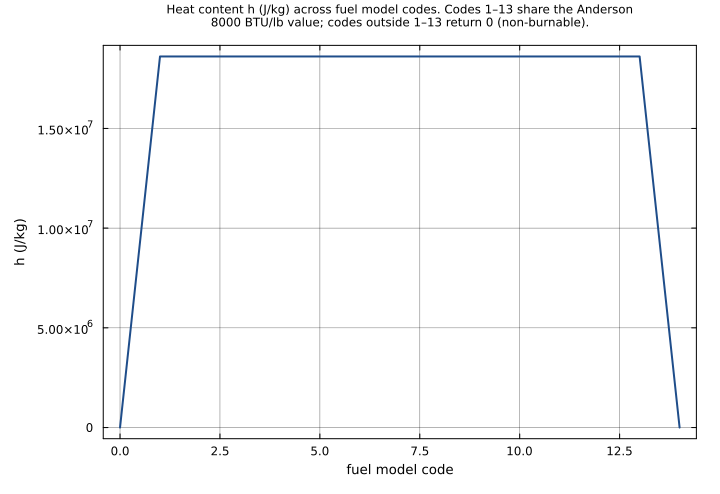
Each fuel_* registered function maps the integer Anderson code to a physical property in SI units, falling back to the fuel-model-1 default for out-of-range codes. The sole exception is fuel_heat, which maps codes 1–13 to the shared value 18,608,000 J/kg and all other codes (including LANDFIRE non-burnable 91–99) to 0 J/kg.
SI unit conversions (applied in the registered function ESMs, preserved here): sigma (σ): 1/ft → 1/m via ÷ 0.3048 w_0 (w₀): upstream mixed units → kg/m² via × (0.45359237 / 0.09290304) delta (δ): ft → m via × 0.3048 M_x: already dimensionless fraction in source h: BTU/lb → J/kg via × 2326 (8000 BTU/lb for all Anderson models) T_f: s (weight / 0.8514 where weight is the source time constant)
gt-p3ep resolution: each property except h is expressed as ifelse(AND(code>=1, code<=13), interp.linear(values, [1..13], code), default) where interp.linear on integer-valued code returns the exact table value. h uses the degenerate form ifelse(AND(code>=1, code<=13), 18608000.0, 0.0) because all 13 Anderson models share the same heat content.
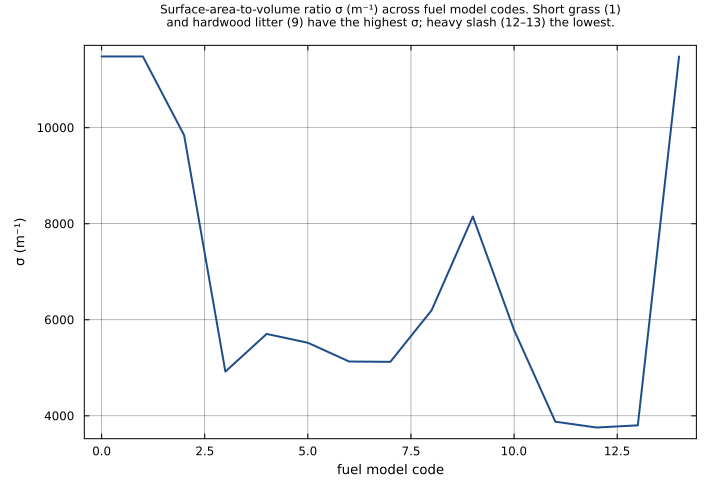
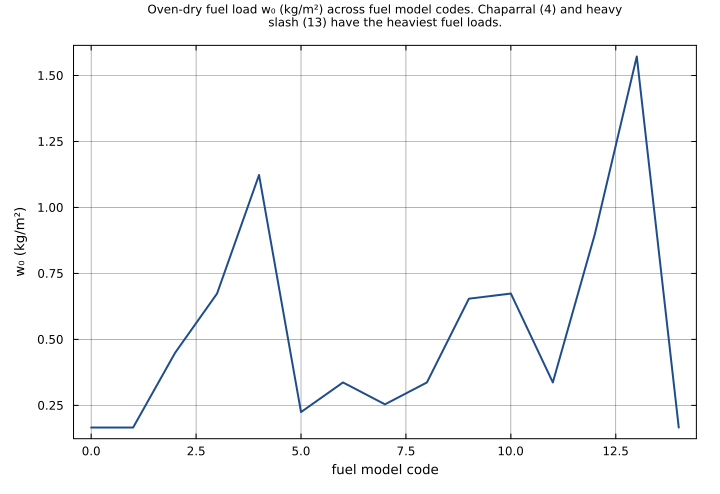
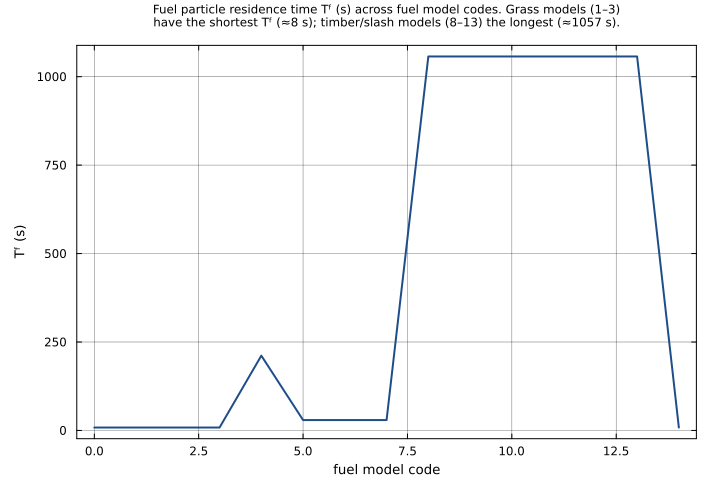
Anderson fuel model parameter table (SI units): code | sigma (m⁻¹) | w_0 (kg/m²) | delta (m) | M_x | h (J/kg) | T_f (s) 1 | 11482.939633 | 0.166002540 | 0.3048 | 0.12 | 18608000 | 8.221752 2 | 9842.519685 | 0.449183343 | 0.3048 | 0.15 | 18608000 | 8.221752 3 | 4921.259843 | 0.673775014 | 0.762 | 0.25 | 18608000 | 8.221752 4 | 5705.380577 | 1.122958356 | 1.8288 | 0.20 | 18608000 | 211.41649 5 | 5521.653543 | 0.224591671 | 0.6096 | 0.20 | 18608000 | 29.36340 6 | 5131.233596 | 0.336887507 | 0.762 | 0.25 | 18608000 | 29.36340 7 | 5124.671916 | 0.253886237 | 0.762 | 0.40 | 18608000 | 29.36340 8 | 6197.506562 | 0.336887507 | 0.06096 | 0.30 | 18608000 | 1057.08245 9 | 8149.606299 | 0.654245303 | 0.06096 | 0.25 | 18608000 | 1057.08245 10 | 5787.401575 | 0.673775014 | 0.3048 | 0.25 | 18608000 | 1057.08245 11 | 3877.952756 | 0.336887507 | 0.3048 | 0.15 | 18608000 | 1057.08245 12 | 3756.561680 | 0.898366685 | 0.70104 | 0.20 | 18608000 | 1057.08245 13 | 3802.493438 | 1.572141699 | 0.9144 | 0.25 | 18608000 | 1057.08245 other| 11482.939633 | 0.166002540 | 0.3048 | 0.12 | 0 | 8.221752
Tolerance rationale (model-level rel=1e-12): all six outputs are computed via ifelse + interp.linear at integer-valued code inputs, which returns exact table values at grid knots. 1e-12 covers the one-ULP float64 rounding without admitting any physical imprecision._
Parameters
| Name | Units | Default | Description |
|---|---|---|---|
code | 1 | 1.0 | Anderson 13 fuel model code (integer 1–13). Values outside this range (including LANDFIRE non-burnable codes 91–99) return fuel-model-1 defaults for all properties except h, which returns 0 J/kg for out-of-range codes. |
Observed
| Name | Units | Default | Description |
|---|---|---|---|
sigma | 1/m | Surface-area-to-volume ratio σ of the fuel particle (m⁻¹). Anderson model 1 (short grass): 11482.94 m⁻¹ through model 13 (heavy slash): 3802.49 m⁻¹. Out-of-range codes return 11482.94 m⁻¹ (fuel model 1 default). Sourced from fuel_savr registered function. | |
w_0 | kg/m^2 | Oven-dry fuel load per unit area w₀ (kg/m²). Anderson model 1: 0.1660 kg/m² (light short-grass fuel); model 13 (heavy slash): 1.5721 kg/m². Out-of-range codes return 0.1660 kg/m² (fuel model 1 default). Sourced from fuel_load registered function. | |
delta | m | Fuel bed depth δ (m). Anderson model 1: 0.3048 m (1 ft, short grass); model 4 (chaparral): 1.8288 m (6 ft). Models 8 and 9 (closed/open timber litter): 0.06096 m (0.2 ft). Out-of-range codes return 0.3048 m (fuel model 1 default). Sourced from fuel_depth registered function. | |
M_x | 1 | Dead fuel moisture content of extinction Mₓ (dimensionless dry-weight-basis fraction). Ranges from 0.12 (model 1, short grass) to 0.40 (model 7, southern rough). Out-of-range codes return 0.12 (fuel model 1 default). Sourced from fuel_mce registered function. | |
h | J/kg | Low heat content of combustion h (J/kg). All 13 Anderson fuel models share h = 8000 BTU/lb = 18,608,000 J/kg (using 1 BTU/lb = 2326 J/kg). LANDFIRE non-burnable codes (91–99) and other out-of-range codes return 0 J/kg (no combustion). Sourced from fuel_heat registered function. | |
T_f | s | Fuel particle residence time Tᶠ (s), computed as the WRF-SFIRE weight constant divided by 0.8514. Codes 1–3 (grass): ≈ 8.22 s; code 4 (chaparral): ≈ 211.4 s; codes 5–7 (shrub): ≈ 29.4 s; codes 8–13 (timber/slash): ≈ 1057 s. Out-of-range codes return ≈ 8.22 s (fuel model 1 default). Sourced from fuel_weight registered function. | |
wind_reduction | 1 | Midflame wind adjustment factor (unsheltered fuel; Baughman & Albini 1980, Andrews 2012 RMRS-GTR-266): WAF = 1.83 / ln((6.096 + 0.36·δ)/(0.13·δ)), with δ the fuel-bed depth in METRES and 6.096 m = 20 ft (the reference wind height). This is the feet-form 1.83/ln((20+0.36·δ_ft)/(0.13·δ_ft)) rewritten in SI (multiply num & den by 0.3048) so it is dimensionally consistent. It is the ratio of the midflame wind to the 10 m (≈20 ft) wind: grass (δ=1 ft=0.305 m)→≈0.36, brush/chaparral (δ=6 ft=1.83 m)→≈0.55. Coupled to MidflameWind.wind_reduction to replace the former fixed 0.4, making the reduction fuel-dependent. δ floored at 0.01 m so the log stays finite for non-burnable codes (which carry h=0 → R0=0 anyway). |
Observed expressions
$$ sigma = \mathrm{ifelse}\left(\mathrm{and}\left(\mathrm{>=}\left(code, 1.0\right), \mathrm{<=}\left(code, 13.0\right)\right), \mathrm{fn}\left(\mathrm{const}\left(\right), \mathrm{const}\left(\right), code\right), 11482.939632545931\right) $$Surface-area-to-volume ratio σ of the fuel particle (m⁻¹). Anderson model 1 (short grass): 11482.94 m⁻¹ through model 13 (heavy slash): 3802.49 m⁻¹. Out-of-range codes return 11482.94 m⁻¹ (fuel model 1 default). Sourced from fuel_savr registered function.
$$ w_{0} = \mathrm{ifelse}\left(\mathrm{and}\left(\mathrm{>=}\left(code, 1.0\right), \mathrm{<=}\left(code, 13.0\right)\right), \mathrm{fn}\left(\mathrm{const}\left(\right), \mathrm{const}\left(\right), code\right), 0.16600253963702372\right) $$Oven-dry fuel load per unit area w₀ (kg/m²). Anderson model 1: 0.1660 kg/m² (light short-grass fuel); model 13 (heavy slash): 1.5721 kg/m². Out-of-range codes return 0.1660 kg/m² (fuel model 1 default). Sourced from fuel_load registered function.
$$ delta = \mathrm{ifelse}\left(\mathrm{and}\left(\mathrm{>=}\left(code, 1.0\right), \mathrm{<=}\left(code, 13.0\right)\right), \mathrm{fn}\left(\mathrm{const}\left(\right), \mathrm{const}\left(\right), code\right), 0.3048\right) $$Fuel bed depth δ (m). Anderson model 1: 0.3048 m (1 ft, short grass); model 4 (chaparral): 1.8288 m (6 ft). Models 8 and 9 (closed/open timber litter): 0.06096 m (0.2 ft). Out-of-range codes return 0.3048 m (fuel model 1 default). Sourced from fuel_depth registered function.
$$ M_{x} = \mathrm{ifelse}\left(\mathrm{and}\left(\mathrm{>=}\left(code, 1.0\right), \mathrm{<=}\left(code, 13.0\right)\right), \mathrm{fn}\left(\mathrm{const}\left(\right), \mathrm{const}\left(\right), code\right), 0.12\right) $$Dead fuel moisture content of extinction Mₓ (dimensionless dry-weight-basis fraction). Ranges from 0.12 (model 1, short grass) to 0.40 (model 7, southern rough). Out-of-range codes return 0.12 (fuel model 1 default). Sourced from fuel_mce registered function.
$$ h = \mathrm{ifelse}\left(\mathrm{and}\left(\mathrm{>=}\left(code, 1.0\right), \mathrm{<=}\left(code, 13.0\right)\right), 18608000.0, 0.0\right) $$Low heat content of combustion h (J/kg). All 13 Anderson fuel models share h = 8000 BTU/lb = 18,608,000 J/kg (using 1 BTU/lb = 2326 J/kg). LANDFIRE non-burnable codes (91–99) and other out-of-range codes return 0 J/kg (no combustion). Sourced from fuel_heat registered function.
$$ T_{f} = \mathrm{ifelse}\left(\mathrm{and}\left(\mathrm{>=}\left(code, 1.0\right), \mathrm{<=}\left(code, 13.0\right)\right), \mathrm{fn}\left(\mathrm{const}\left(\right), \mathrm{const}\left(\right), code\right), 8.221752407798919\right) $$Fuel particle residence time Tᶠ (s), computed as the WRF-SFIRE weight constant divided by 0.8514. Codes 1–3 (grass): ≈ 8.22 s; code 4 (chaparral): ≈ 211.4 s; codes 5–7 (shrub): ≈ 29.4 s; codes 8–13 (timber/slash): ≈ 1057 s. Out-of-range codes return ≈ 8.22 s (fuel model 1 default). Sourced from fuel_weight registered function.
$$ wind_{reduction} = \frac{1.83}{\ln\left(\frac{6.096 + 0.36 \cdot \mathrm{max}\left(delta, 0.01\right)}{0.13 \cdot \mathrm{max}\left(delta, 0.01\right)}\right)} $$Midflame wind adjustment factor (unsheltered fuel; Baughman & Albini 1980, Andrews 2012 RMRS-GTR-266): WAF = 1.83 / ln((6.096 + 0.36·δ)/(0.13·δ)), with δ the fuel-bed depth in METRES and 6.096 m = 20 ft (the reference wind height). This is the feet-form 1.83/ln((20+0.36·δ_ft)/(0.13·δ_ft)) rewritten in SI (multiply num & den by 0.3048) so it is dimensionally consistent. It is the ratio of the midflame wind to the 10 m (≈20 ft) wind: grass (δ=1 ft=0.305 m)→≈0.36, brush/chaparral (δ=6 ft=1.83 m)→≈0.55. Coupled to MidflameWind.wind_reduction to replace the former fixed 0.4, making the reduction fuel-dependent. δ floored at 0.01 m so the log stays finite for non-burnable codes (which carry h=0 → R0=0 anyway).
Analyses
fuel_properties_vs_code
Sweep fuel model codes 0–14 to visualise all six Rothermel fuel properties across the 13 Anderson models. Code 0 and 14 return the out-of-range defaults (fuel-model-1 for σ, w₀, δ, Mₓ, Tᶠ; 0 for h). The plots show the piecewise-constant lookup structure and the discontinuity in h at the boundary between burnable (codes 1–13) and non-burnable codes.
Time span: 0.0 → 1.0
Swept over: code
Raw .esm
Raw .esm JSON (this component)
{
"reference": {
"citation": "Anderson, H.E. (1982). Aids to determining fuel models for estimating fire behavior. USDA Forest Service Gen. Tech. Rep. INT-122.",
"notes": "source_ref: WildlandFire.jl@126976f2508ceacca6c486b21ae6da5b168c6f46:src/coupling.jl:155\n\nUpstream `FuelModelLookup` is an MTK `@mtkmodel` whose single input is `code` (`@parameters code=1`) and whose six outputs are `@variables sigma(t), w_0(t), delta(t), M_x(t), h(t), T_f(t)` defined by `@observed` equations that call the six `@register_symbolic` fuel functions:\n\n sigma ~ fuel_savr(code)\n w_0 ~ fuel_load(code)\n delta ~ fuel_depth(code)\n M_x ~ fuel_mce(code)\n h ~ fuel_heat(code)\n T_f ~ fuel_weight(code)\n\nEach fuel_* registered function maps the integer Anderson code to a physical property in SI units, falling back to the fuel-model-1 default for out-of-range codes. The sole exception is fuel_heat, which maps codes 1–13 to the shared value 18,608,000 J/kg and all other codes (including LANDFIRE non-burnable 91–99) to 0 J/kg.\n\nSI unit conversions (applied in the registered function ESMs, preserved here):\n sigma (σ): 1/ft → 1/m via ÷ 0.3048\n w_0 (w₀): upstream mixed units → kg/m² via × (0.45359237 / 0.09290304)\n delta (δ): ft → m via × 0.3048\n M_x: already dimensionless fraction in source\n h: BTU/lb → J/kg via × 2326 (8000 BTU/lb for all Anderson models)\n T_f: s (weight / 0.8514 where weight is the source time constant)\n\ngt-p3ep resolution: each property except h is expressed as\n ifelse(AND(code>=1, code<=13), interp.linear(values, [1..13], code), default)\nwhere interp.linear on integer-valued code returns the exact table value.\nh uses the degenerate form ifelse(AND(code>=1, code<=13), 18608000.0, 0.0)\nbecause all 13 Anderson models share the same heat content.\n\nAnderson fuel model parameter table (SI units):\n code | sigma (m⁻¹) | w_0 (kg/m²) | delta (m) | M_x | h (J/kg) | T_f (s)\n 1 | 11482.939633 | 0.166002540 | 0.3048 | 0.12 | 18608000 | 8.221752\n 2 | 9842.519685 | 0.449183343 | 0.3048 | 0.15 | 18608000 | 8.221752\n 3 | 4921.259843 | 0.673775014 | 0.762 | 0.25 | 18608000 | 8.221752\n 4 | 5705.380577 | 1.122958356 | 1.8288 | 0.20 | 18608000 | 211.41649\n 5 | 5521.653543 | 0.224591671 | 0.6096 | 0.20 | 18608000 | 29.36340\n 6 | 5131.233596 | 0.336887507 | 0.762 | 0.25 | 18608000 | 29.36340\n 7 | 5124.671916 | 0.253886237 | 0.762 | 0.40 | 18608000 | 29.36340\n 8 | 6197.506562 | 0.336887507 | 0.06096 | 0.30 | 18608000 | 1057.08245\n 9 | 8149.606299 | 0.654245303 | 0.06096 | 0.25 | 18608000 | 1057.08245\n 10 | 5787.401575 | 0.673775014 | 0.3048 | 0.25 | 18608000 | 1057.08245\n 11 | 3877.952756 | 0.336887507 | 0.3048 | 0.15 | 18608000 | 1057.08245\n 12 | 3756.561680 | 0.898366685 | 0.70104 | 0.20 | 18608000 | 1057.08245\n 13 | 3802.493438 | 1.572141699 | 0.9144 | 0.25 | 18608000 | 1057.08245\n other| 11482.939633 | 0.166002540 | 0.3048 | 0.12 | 0 | 8.221752\n\nTolerance rationale (model-level rel=1e-12): all six outputs are computed\nvia ifelse + interp.linear at integer-valued code inputs, which returns\nexact table values at grid knots. 1e-12 covers the one-ULP float64\nrounding without admitting any physical imprecision."
},
"tolerance": {
"rel": 1e-12
},
"variables": {
"code": {
"type": "parameter",
"units": "1",
"default": 1.0,
"description": "Anderson 13 fuel model code (integer 1–13). Values outside this range (including LANDFIRE non-burnable codes 91–99) return fuel-model-1 defaults for all properties except h, which returns 0 J/kg for out-of-range codes."
},
"sigma": {
"type": "unknown",
"units": "1/m",
"description": "Surface-area-to-volume ratio σ of the fuel particle (m⁻¹). Anderson model 1 (short grass): 11482.94 m⁻¹ through model 13 (heavy slash): 3802.49 m⁻¹. Out-of-range codes return 11482.94 m⁻¹ (fuel model 1 default). Sourced from fuel_savr registered function."
},
"w_0": {
"type": "unknown",
"units": "kg/m^2",
"description": "Oven-dry fuel load per unit area w₀ (kg/m²). Anderson model 1: 0.1660 kg/m² (light short-grass fuel); model 13 (heavy slash): 1.5721 kg/m². Out-of-range codes return 0.1660 kg/m² (fuel model 1 default). Sourced from fuel_load registered function."
},
"delta": {
"type": "unknown",
"units": "m",
"description": "Fuel bed depth δ (m). Anderson model 1: 0.3048 m (1 ft, short grass); model 4 (chaparral): 1.8288 m (6 ft). Models 8 and 9 (closed/open timber litter): 0.06096 m (0.2 ft). Out-of-range codes return 0.3048 m (fuel model 1 default). Sourced from fuel_depth registered function."
},
"M_x": {
"type": "unknown",
"units": "1",
"description": "Dead fuel moisture content of extinction Mₓ (dimensionless dry-weight-basis fraction). Ranges from 0.12 (model 1, short grass) to 0.40 (model 7, southern rough). Out-of-range codes return 0.12 (fuel model 1 default). Sourced from fuel_mce registered function."
},
"h": {
"type": "unknown",
"units": "J/kg",
"description": "Low heat content of combustion h (J/kg). All 13 Anderson fuel models share h = 8000 BTU/lb = 18,608,000 J/kg (using 1 BTU/lb = 2326 J/kg). LANDFIRE non-burnable codes (91–99) and other out-of-range codes return 0 J/kg (no combustion). Sourced from fuel_heat registered function."
},
"T_f": {
"type": "unknown",
"units": "s",
"description": "Fuel particle residence time Tᶠ (s), computed as the WRF-SFIRE weight constant divided by 0.8514. Codes 1–3 (grass): ≈ 8.22 s; code 4 (chaparral): ≈ 211.4 s; codes 5–7 (shrub): ≈ 29.4 s; codes 8–13 (timber/slash): ≈ 1057 s. Out-of-range codes return ≈ 8.22 s (fuel model 1 default). Sourced from fuel_weight registered function."
},
"wind_reduction": {
"type": "unknown",
"units": "1",
"description": "Midflame wind adjustment factor (unsheltered fuel; Baughman & Albini 1980, Andrews 2012 RMRS-GTR-266): WAF = 1.83 / ln((6.096 + 0.36·δ)/(0.13·δ)), with δ the fuel-bed depth in METRES and 6.096 m = 20 ft (the reference wind height). This is the feet-form 1.83/ln((20+0.36·δ_ft)/(0.13·δ_ft)) rewritten in SI (multiply num & den by 0.3048) so it is dimensionally consistent. It is the ratio of the midflame wind to the 10 m (≈20 ft) wind: grass (δ=1 ft=0.305 m)→≈0.36, brush/chaparral (δ=6 ft=1.83 m)→≈0.55. Coupled to MidflameWind.wind_reduction to replace the former fixed 0.4, making the reduction fuel-dependent. δ floored at 0.01 m so the log stays finite for non-burnable codes (which carry h=0 → R0=0 anyway)."
}
},
"equations": [
{
"lhs": "sigma",
"rhs": {
"op": "ifelse",
"args": [
{
"op": "and",
"args": [
{
"op": ">=",
"args": [
"code",
1.0
]
},
{
"op": "<=",
"args": [
"code",
13.0
]
}
]
},
{
"op": "fn",
"name": "interp.linear",
"args": [
{
"op": "const",
"value": [
11482.939632545931,
9842.51968503937,
4921.259842519685,
5705.380577427822,
5521.653543307087,
5131.233595800525,
5124.6719160104985,
6197.50656167979,
8149.606299212598,
5787.40157480315,
3877.952755905512,
3756.561679790026,
3802.49343832021
],
"args": []
},
{
"op": "const",
"value": [
1.0,
2.0,
3.0,
4.0,
5.0,
6.0,
7.0,
8.0,
9.0,
10.0,
11.0,
12.0,
13.0
],
"args": []
},
"code"
]
},
11482.939632545931
]
}
},
{
"lhs": "w_0",
"rhs": {
"op": "ifelse",
"args": [
{
"op": "and",
"args": [
{
"op": ">=",
"args": [
"code",
1.0
]
},
{
"op": "<=",
"args": [
"code",
13.0
]
}
]
},
{
"op": "fn",
"name": "interp.linear",
"args": [
{
"op": "const",
"value": [
0.16600253963702372,
0.4491833425472406,
0.673775013820861,
1.1229583563681016,
0.2245916712736203,
0.3368875069104305,
0.2538862370919186,
0.3368875069104305,
0.6542453032753287,
0.673775013820861,
0.3368875069104305,
0.8983666850944813,
1.5721416989153423
],
"args": []
},
{
"op": "const",
"value": [
1.0,
2.0,
3.0,
4.0,
5.0,
6.0,
7.0,
8.0,
9.0,
10.0,
11.0,
12.0,
13.0
],
"args": []
},
"code"
]
},
0.16600253963702372
]
}
},
{
"lhs": "delta",
"rhs": {
"op": "ifelse",
"args": [
{
"op": "and",
"args": [
{
"op": ">=",
"args": [
"code",
1.0
]
},
{
"op": "<=",
"args": [
"code",
13.0
]
}
]
},
{
"op": "fn",
"name": "interp.linear",
"args": [
{
"op": "const",
"value": [
0.3048,
0.3048,
0.762,
1.8288,
0.6096,
0.762,
0.762,
0.06096,
0.06096,
0.3048,
0.3048,
0.70104,
0.9144
],
"args": []
},
{
"op": "const",
"value": [
1.0,
2.0,
3.0,
4.0,
5.0,
6.0,
7.0,
8.0,
9.0,
10.0,
11.0,
12.0,
13.0
],
"args": []
},
"code"
]
},
0.3048
]
}
},
{
"lhs": "M_x",
"rhs": {
"op": "ifelse",
"args": [
{
"op": "and",
"args": [
{
"op": ">=",
"args": [
"code",
1.0
]
},
{
"op": "<=",
"args": [
"code",
13.0
]
}
]
},
{
"op": "fn",
"name": "interp.linear",
"args": [
{
"op": "const",
"value": [
0.12,
0.15,
0.25,
0.2,
0.2,
0.25,
0.4,
0.3,
0.25,
0.25,
0.15,
0.2,
0.25
],
"args": []
},
{
"op": "const",
"value": [
1.0,
2.0,
3.0,
4.0,
5.0,
6.0,
7.0,
8.0,
9.0,
10.0,
11.0,
12.0,
13.0
],
"args": []
},
"code"
]
},
0.12
]
}
},
{
"lhs": "h",
"rhs": {
"op": "ifelse",
"args": [
{
"op": "and",
"args": [
{
"op": ">=",
"args": [
"code",
1.0
]
},
{
"op": "<=",
"args": [
"code",
13.0
]
}
]
},
18608000.0,
0.0
]
}
},
{
"lhs": "T_f",
"rhs": {
"op": "ifelse",
"args": [
{
"op": "and",
"args": [
{
"op": ">=",
"args": [
"code",
1.0
]
},
{
"op": "<=",
"args": [
"code",
13.0
]
}
]
},
{
"op": "fn",
"name": "interp.linear",
"args": [
{
"op": "const",
"value": [
8.221752407798919,
8.221752407798919,
8.221752407798919,
211.4164904862579,
29.36340145642471,
29.36340145642471,
29.36340145642471,
1057.0824524312895,
1057.0824524312895,
1057.0824524312895,
1057.0824524312895,
1057.0824524312895,
1057.0824524312895
],
"args": []
},
{
"op": "const",
"value": [
1.0,
2.0,
3.0,
4.0,
5.0,
6.0,
7.0,
8.0,
9.0,
10.0,
11.0,
12.0,
13.0
],
"args": []
},
"code"
]
},
8.221752407798919
]
}
},
{
"lhs": "wind_reduction",
"rhs": {
"op": "/",
"args": [
1.83,
{
"op": "log",
"args": [
{
"op": "/",
"args": [
{
"op": "+",
"args": [
6.096,
{
"op": "*",
"args": [
0.36,
{
"op": "max",
"args": [
"delta",
0.01
]
}
]
}
]
},
{
"op": "*",
"args": [
0.13,
{
"op": "max",
"args": [
"delta",
0.01
]
}
]
}
]
}
]
}
]
}
}
],
"tests": [
{
"id": "code_1_short_grass_all_properties",
"description": "Anderson fuel model 1 (short grass): code=1 → verify all six Rothermel fuel properties. This is the lowest-numbered Anderson model and the default for out-of-range codes (except h).",
"parameter_overrides": {
"code": 1.0
},
"time_span": {
"start": 0.0,
"end": 1.0
},
"assertions": [
{
"variable": "sigma",
"time": 0.0,
"expected": 11482.939632545931,
"tolerance": {
"abs": 0.0,
"rel": 0.0
}
},
{
"variable": "w_0",
"time": 0.0,
"expected": 0.16600253963702372,
"tolerance": {
"abs": 0.0,
"rel": 0.0
}
},
{
"variable": "delta",
"time": 0.0,
"expected": 0.3048,
"tolerance": {
"abs": 0.0,
"rel": 0.0
}
},
{
"variable": "M_x",
"time": 0.0,
"expected": 0.12,
"tolerance": {
"abs": 0.0,
"rel": 0.0
}
},
{
"variable": "h",
"time": 0.0,
"expected": 18608000.0,
"tolerance": {
"abs": 0.0,
"rel": 0.0
}
},
{
"variable": "T_f",
"time": 0.0,
"expected": 8.221752407798919,
"tolerance": {
"abs": 0.0,
"rel": 0.0
}
}
]
},
{
"id": "code_2_timber_grass",
"description": "Anderson fuel model 2 (timber/grass/shrub understory): code=2 → verify σ and T_f (same T_f as model 1 but different σ and w₀).",
"parameter_overrides": {
"code": 2.0
},
"time_span": {
"start": 0.0,
"end": 1.0
},
"assertions": [
{
"variable": "sigma",
"time": 0.0,
"expected": 9842.51968503937,
"tolerance": {
"abs": 0.0,
"rel": 0.0
}
},
{
"variable": "w_0",
"time": 0.0,
"expected": 0.4491833425472406,
"tolerance": {
"abs": 0.0,
"rel": 0.0
}
},
{
"variable": "M_x",
"time": 0.0,
"expected": 0.15,
"tolerance": {
"abs": 0.0,
"rel": 0.0
}
},
{
"variable": "T_f",
"time": 0.0,
"expected": 8.221752407798919,
"tolerance": {
"abs": 0.0,
"rel": 0.0
}
}
]
},
{
"id": "code_4_chaparral_all_properties",
"description": "Anderson fuel model 4 (chaparral): code=4 → verify all six properties. Model 4 has the deepest fuel bed (1.8288 m) and the longest residence time (≈211.4 s) of the shrub/brush group.",
"parameter_overrides": {
"code": 4.0
},
"time_span": {
"start": 0.0,
"end": 1.0
},
"assertions": [
{
"variable": "sigma",
"time": 0.0,
"expected": 5705.380577427822,
"tolerance": {
"abs": 0.0,
"rel": 0.0
}
},
{
"variable": "w_0",
"time": 0.0,
"expected": 1.1229583563681016,
"tolerance": {
"abs": 0.0,
"rel": 0.0
}
},
{
"variable": "delta",
"time": 0.0,
"expected": 1.8288,
"tolerance": {
"abs": 0.0,
"rel": 0.0
}
},
{
"variable": "M_x",
"time": 0.0,
"expected": 0.2,
"tolerance": {
"abs": 0.0,
"rel": 0.0
}
},
{
"variable": "h",
"time": 0.0,
"expected": 18608000.0,
"tolerance": {
"abs": 0.0,
"rel": 0.0
}
},
{
"variable": "T_f",
"time": 0.0,
"expected": 211.4164904862579,
"tolerance": {
"abs": 0.0,
"rel": 0.0
}
}
]
},
{
"id": "code_7_southern_rough",
"description": "Anderson fuel model 7 (southern rough): code=7 → highest Mₓ (0.40) in the Anderson table; T_f in the shrub group (≈29.4 s).",
"parameter_overrides": {
"code": 7.0
},
"time_span": {
"start": 0.0,
"end": 1.0
},
"assertions": [
{
"variable": "sigma",
"time": 0.0,
"expected": 5124.6719160104985,
"tolerance": {
"abs": 0.0,
"rel": 0.0
}
},
{
"variable": "w_0",
"time": 0.0,
"expected": 0.2538862370919186,
"tolerance": {
"abs": 0.0,
"rel": 0.0
}
},
{
"variable": "delta",
"time": 0.0,
"expected": 0.762,
"tolerance": {
"abs": 0.0,
"rel": 0.0
}
},
{
"variable": "M_x",
"time": 0.0,
"expected": 0.4,
"tolerance": {
"abs": 0.0,
"rel": 0.0
}
},
{
"variable": "h",
"time": 0.0,
"expected": 18608000.0,
"tolerance": {
"abs": 0.0,
"rel": 0.0
}
},
{
"variable": "T_f",
"time": 0.0,
"expected": 29.36340145642471,
"tolerance": {
"abs": 0.0,
"rel": 0.0
}
}
]
},
{
"id": "code_8_closed_timber_litter",
"description": "Anderson fuel model 8 (closed timber litter): code=8 → transitions to the timber/slash group with T_f≈1057 s and very shallow fuel bed (0.06096 m = 0.2 ft).",
"parameter_overrides": {
"code": 8.0
},
"time_span": {
"start": 0.0,
"end": 1.0
},
"assertions": [
{
"variable": "sigma",
"time": 0.0,
"expected": 6197.50656167979,
"tolerance": {
"abs": 0.0,
"rel": 0.0
}
},
{
"variable": "delta",
"time": 0.0,
"expected": 0.06096,
"tolerance": {
"abs": 0.0,
"rel": 0.0
}
},
{
"variable": "M_x",
"time": 0.0,
"expected": 0.3,
"tolerance": {
"abs": 0.0,
"rel": 0.0
}
},
{
"variable": "T_f",
"time": 0.0,
"expected": 1057.0824524312895,
"tolerance": {
"abs": 0.0,
"rel": 0.0
}
}
]
},
{
"id": "code_13_heavy_slash_all_properties",
"description": "Anderson fuel model 13 (heavy logging slash): code=13 → highest-numbered valid model; highest w₀ (1.5721 kg/m²) and long residence time (≈1057 s).",
"parameter_overrides": {
"code": 13.0
},
"time_span": {
"start": 0.0,
"end": 1.0
},
"assertions": [
{
"variable": "sigma",
"time": 0.0,
"expected": 3802.49343832021,
"tolerance": {
"abs": 0.0,
"rel": 0.0
}
},
{
"variable": "w_0",
"time": 0.0,
"expected": 1.5721416989153423,
"tolerance": {
"abs": 0.0,
"rel": 0.0
}
},
{
"variable": "delta",
"time": 0.0,
"expected": 0.9144,
"tolerance": {
"abs": 0.0,
"rel": 0.0
}
},
{
"variable": "M_x",
"time": 0.0,
"expected": 0.25,
"tolerance": {
"abs": 0.0,
"rel": 0.0
}
},
{
"variable": "h",
"time": 0.0,
"expected": 18608000.0,
"tolerance": {
"abs": 0.0,
"rel": 0.0
}
},
{
"variable": "T_f",
"time": 0.0,
"expected": 1057.0824524312895,
"tolerance": {
"abs": 0.0,
"rel": 0.0
}
}
]
},
{
"id": "code_0_below_range",
"description": "Code 0 (below valid range 1–13): all five non-h properties return fuel-model-1 defaults; h returns 0.0 J/kg (no combustion for non-burnable codes).",
"parameter_overrides": {
"code": 0.0
},
"time_span": {
"start": 0.0,
"end": 1.0
},
"assertions": [
{
"variable": "sigma",
"time": 0.0,
"expected": 11482.939632545931,
"tolerance": {
"rel": 1e-12
}
},
{
"variable": "w_0",
"time": 0.0,
"expected": 0.16600253963702372,
"tolerance": {
"rel": 1e-12
}
},
{
"variable": "delta",
"time": 0.0,
"expected": 0.3048,
"tolerance": {
"rel": 1e-12
}
},
{
"variable": "M_x",
"time": 0.0,
"expected": 0.12,
"tolerance": {
"rel": 1e-12
}
},
{
"variable": "h",
"time": 0.0,
"expected": 0.0,
"tolerance": {
"abs": 1e-12
}
},
{
"variable": "T_f",
"time": 0.0,
"expected": 8.221752407798919,
"tolerance": {
"rel": 1e-12
}
}
]
},
{
"id": "code_14_above_range",
"description": "Code 14 (above valid range 1–13): same default behavior as code 0. Confirms upper boundary of the guard.",
"parameter_overrides": {
"code": 14.0
},
"time_span": {
"start": 0.0,
"end": 1.0
},
"assertions": [
{
"variable": "sigma",
"time": 0.0,
"expected": 11482.939632545931,
"tolerance": {
"rel": 1e-12
}
},
{
"variable": "h",
"time": 0.0,
"expected": 0.0,
"tolerance": {
"abs": 1e-12
}
},
{
"variable": "T_f",
"time": 0.0,
"expected": 8.221752407798919,
"tolerance": {
"rel": 1e-12
}
}
]
},
{
"id": "code_91_nonburnable_urban",
"description": "LANDFIRE non-burnable code 91 (urban): h returns 0 J/kg (fire spread suppressed via zero heat content); other five properties return fuel-model-1 defaults.",
"parameter_overrides": {
"code": 91.0
},
"time_span": {
"start": 0.0,
"end": 1.0
},
"assertions": [
{
"variable": "sigma",
"time": 0.0,
"expected": 11482.939632545931,
"tolerance": {
"rel": 1e-12
}
},
{
"variable": "w_0",
"time": 0.0,
"expected": 0.16600253963702372,
"tolerance": {
"rel": 1e-12
}
},
{
"variable": "delta",
"time": 0.0,
"expected": 0.3048,
"tolerance": {
"rel": 1e-12
}
},
{
"variable": "M_x",
"time": 0.0,
"expected": 0.12,
"tolerance": {
"rel": 1e-12
}
},
{
"variable": "h",
"time": 0.0,
"expected": 0.0,
"tolerance": {
"abs": 1e-12
}
},
{
"variable": "T_f",
"time": 0.0,
"expected": 8.221752407798919,
"tolerance": {
"rel": 1e-12
}
}
]
},
{
"id": "code_11_light_logging_slash",
"description": "Anderson fuel model 11 (light logging slash): code=11 → lowest σ of the three slash models (3877.95 m⁻¹); M_x drops back to 0.15 (same as model 2).",
"parameter_overrides": {
"code": 11.0
},
"time_span": {
"start": 0.0,
"end": 1.0
},
"assertions": [
{
"variable": "sigma",
"time": 0.0,
"expected": 3877.952755905512,
"tolerance": {
"abs": 0.0,
"rel": 0.0
}
},
{
"variable": "w_0",
"time": 0.0,
"expected": 0.3368875069104305,
"tolerance": {
"abs": 0.0,
"rel": 0.0
}
},
{
"variable": "delta",
"time": 0.0,
"expected": 0.3048,
"tolerance": {
"abs": 0.0,
"rel": 0.0
}
},
{
"variable": "M_x",
"time": 0.0,
"expected": 0.15,
"tolerance": {
"abs": 0.0,
"rel": 0.0
}
},
{
"variable": "T_f",
"time": 0.0,
"expected": 1057.0824524312895,
"tolerance": {
"abs": 0.0,
"rel": 0.0
}
}
]
}
],
"analyses": [
{
"id": "fuel_properties_vs_code",
"description": "Sweep fuel model codes 0–14 to visualise all six Rothermel fuel properties across the 13 Anderson models. Code 0 and 14 return the out-of-range defaults (fuel-model-1 for σ, w₀, δ, Mₓ, Tᶠ; 0 for h). The plots show the piecewise-constant lookup structure and the discontinuity in h at the boundary between burnable (codes 1–13) and non-burnable codes.",
"initial_state": {},
"parameters": {
"code": 1.0
},
"time_span": {
"start": 0.0,
"end": 1.0
},
"parameter_sweep": {
"type": "cartesian",
"dimensions": [
{
"parameter": "code",
"range": {
"start": 0.0,
"stop": 14.0,
"count": 15,
"scale": "linear"
}
}
]
},
"plots": [
{
"id": "sigma_vs_code",
"type": "line",
"description": "Surface-area-to-volume ratio σ (m⁻¹) across fuel model codes. Short grass (1) and hardwood litter (9) have the highest σ; heavy slash (12–13) the lowest.",
"x": {
"variable": "code",
"label": "fuel model code"
},
"y": {
"variable": "sigma",
"label": "σ (m⁻¹)"
}
},
{
"id": "w0_vs_code",
"type": "line",
"description": "Oven-dry fuel load w₀ (kg/m²) across fuel model codes. Chaparral (4) and heavy slash (13) have the heaviest fuel loads.",
"x": {
"variable": "code",
"label": "fuel model code"
},
"y": {
"variable": "w_0",
"label": "w₀ (kg/m²)"
}
},
{
"id": "h_vs_code",
"type": "line",
"description": "Heat content h (J/kg) across fuel model codes. Codes 1–13 share the Anderson 8000 BTU/lb value; codes outside 1–13 return 0 (non-burnable).",
"x": {
"variable": "code",
"label": "fuel model code"
},
"y": {
"variable": "h",
"label": "h (J/kg)"
}
},
{
"id": "Tf_vs_code",
"type": "line",
"description": "Fuel particle residence time Tᶠ (s) across fuel model codes. Grass models (1–3) have the shortest Tᶠ (≈8 s); timber/slash models (8–13) the longest (≈1057 s).",
"x": {
"variable": "code",
"label": "fuel model code"
},
"y": {
"variable": "T_f",
"label": "Tᶠ (s)"
}
}
]
}
]
}