Clark1996WindProfile
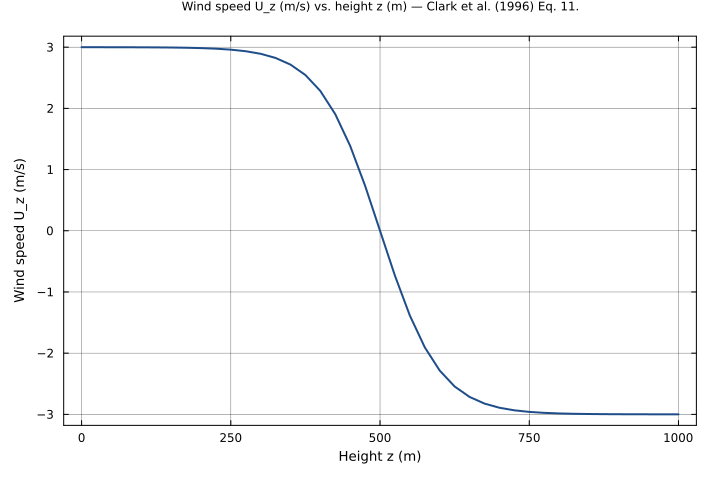
Hyperbolic-tangent vertical wind profile used in the FR7CS1 experiment of Clark et al. (1996), Eq. 11. U(z) = 3 - 3*(1 + tanh((z - 500)/100)) m/s — gives U ≈ +3 m/s near the surface, reverses sign at z = 500 m, and is asymptotic to -3 m/s aloft. Migrated from WildlandFire.jl@126976f2 src/clark1996.jl:299 (`Clark1996WindProfile` @component). Observed-only: z is the input (parameter); U_z is an algebraic output.
Description
Hyperbolic-tangent vertical wind profile used in the FR7CS1 experiment of Clark et al. (1996), Eq. 11. U(z) = 3 - 3*(1 + tanh((z - 500)/100)) m/s — gives U ≈ +3 m/s near the surface, reverses sign at z = 500 m, and is asymptotic to -3 m/s aloft. Migrated from WildlandFire.jl@126976f2 src/clark1996.jl:299 (Clark1996WindProfile @component). Observed-only: z is the input (parameter); U_z is an algebraic output.
Reference
_source_ref: WildlandFire.jl@126976f2508ceacca6c486b21ae6da5b168c6f46:src/clark1996.jl:299
Upstream Clark1996WindProfile is an MTK @component whose single input z is a @parameter and whose single output U_z is a time-indexed @variable with one algebraic equation. The upstream @constants U_base, z_reversal, z_scale, and one_dimless are MTK literals; here they are declared as parameters with their upstream default values, mirroring the terrain_slope.esm pattern (components/wildland_fire/terrain_slope.esm) where upstream @constants are preserved as zero-/literal-valued parameters to maintain 1:1 fidelity with the upstream component.
ESS operator note: the equation uses the native tanh op, part of the ESS static operator set since origin/main commit 8b8d3056 (bead ess-v9a.1). It was previously hand-rolled via the float64-equivalent identity tanh(x) = (exp(2x) - 1) / (exp(2x) + 1) because the v0.4.0 expression vocabulary lacked tanh; bead esm-ji2 substituted the native op. The substitution is exact at every inline-test point — U_z is byte-identical (0 ULP) for z ∈ {0, 100, 250, 400, 450, 500, 550, 600, 750, 900, 1000}, inheriting the prior identity’s already-verified 0-ULP agreement with math.tanh.
The one_dimless constant (= 1.0) is preserved in the equation as an additive term inside the (1 + tanh) factor — upstream uses it for MTK’s unit checker so the (1 + tanh(…)) expression has consistent units; we keep it for 1:1 structural fidelity with the upstream component.
Tolerance rationale (model-level rel=1e-12): observed-only single-equation algebraic system (no ODE integration); the equation is a native tanh plus a small number of arithmetic ops on hardware-supported intrinsics — float64 roundoff is at the ULP level (~1e-15). 1e-12 is comfortably above ULP and far below any plausible physical-discrimination scale on m/s wind speeds._
Parameters
| Name | Units | Default | Description |
|---|---|---|---|
z | m | 0.0 | Height above ground level |
U_base | m/s | 3.0 | Base wind speed (upstream @constant; FR7CS1 default = 3 m/s) |
z_reversal | m | 500.0 | Height at which the wind speed reverses sign (upstream @constant; FR7CS1 default = 500 m) |
z_scale | m | 100.0 | Vertical scale of the wind transition (upstream @constant; FR7CS1 default = 100 m) |
one_dimless | 1 | 1.0 | Dimensionless one (MTK unit-balancing literal preserved from upstream; the 1 inside (1 + tanh(…))) |
Observed
| Name | Units | Default | Description |
|---|---|---|---|
U_z | m/s | Wind speed at height z |
Observed expressions
$$ U_{z} = U_{base} - U_{base} \cdot \left(one_{dimless} + \mathrm{tanh}\left(\frac{z - z_{reversal}}{z_{scale}}\right)\right) $$Wind speed at height z
Analyses
wind_profile_curve
Wind speed as a function of height — reproduces the canonical S-shaped Clark et al. (1996) Eq. 11 profile from the surface (U ≈ +3 m/s) through the reversal at 500 m to the upper asymptote (U ≈ -3 m/s) at 1000 m. This is the FR7CS1 vertical wind structure that drives the fire-induced convective flow back into the boundary layer.
Time span: 0.0 → 1.0
Swept over: z
scale_sensitivity
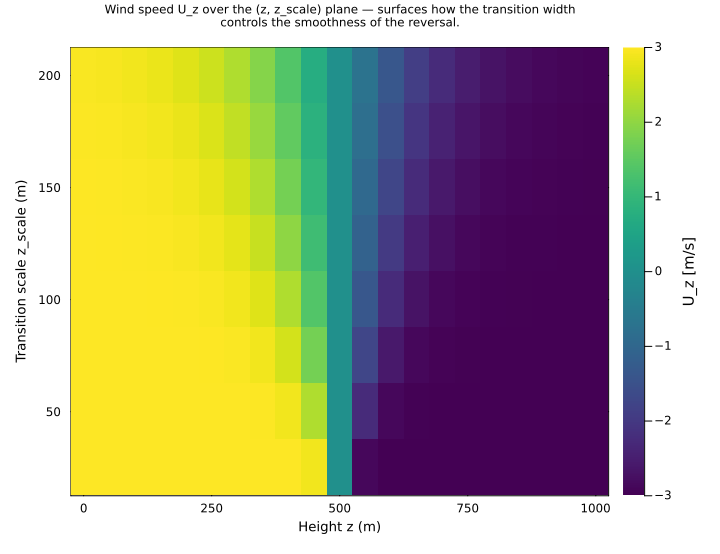
Sensitivity of the wind profile to z_scale — sharper transitions (small z_scale) approach a step function, while wider z_scale produces a more gradual blend across the reversal height.
Time span: 0.0 → 1.0
Swept over: z, z_scale
Raw .esm
Raw .esm JSON (this component)
{
  "reference": {
    "notes": "source_ref: WildlandFire.jl@126976f2508ceacca6c486b21ae6da5b168c6f46:src/clark1996.jl:299\nUpstream `Clark1996WindProfile` is an MTK `@component` whose single input z is a `@parameter` and whose single output U_z is a time-indexed `@variable` with one algebraic equation. The upstream `@constants` U_base, z_reversal, z_scale, and one_dimless are MTK literals; here they are declared as parameters with their upstream default values, mirroring the terrain_slope.esm pattern (components/wildland_fire/terrain_slope.esm) where upstream `@constants` are preserved as zero-/literal-valued parameters to maintain 1:1 fidelity with the upstream component.\n\nESS operator note: the equation uses the native `tanh` op, part of the ESS static operator set since origin/main commit 8b8d3056 (bead ess-v9a.1). It was previously hand-rolled via the float64-equivalent identity tanh(x) = (exp(2x) - 1) / (exp(2x) + 1) because the v0.4.0 expression vocabulary lacked `tanh`; bead esm-ji2 substituted the native op. The substitution is exact at every inline-test point — U_z is byte-identical (0 ULP) for z ∈ {0, 100, 250, 400, 450, 500, 550, 600, 750, 900, 1000}, inheriting the prior identity's already-verified 0-ULP agreement with math.tanh.\n\nThe `one_dimless` constant (= 1.0) is preserved in the equation as an additive term inside the (1 + tanh) factor — upstream uses it for MTK's unit checker so the (1 + tanh(...)) expression has consistent units; we keep it for 1:1 structural fidelity with the upstream component.\n\nTolerance rationale (model-level rel=1e-12): observed-only single-equation algebraic system (no ODE integration); the equation is a native tanh plus a small number of arithmetic ops on hardware-supported intrinsics — float64 roundoff is at the ULP level (~1e-15). 1e-12 is comfortably above ULP and far below any plausible physical-discrimination scale on m/s wind speeds."
  },
  "tolerance": {
    "rel": 1e-12
  },
  "variables": {
    "z": {
      "type": "parameter",
      "units": "m",
      "default": 0.0,
      "description": "Height above ground level"
    },
    "U_base": {
      "type": "parameter",
      "units": "m/s",
      "default": 3.0,
      "description": "Base wind speed (upstream @constant; FR7CS1 default = 3 m/s)"
    },
    "z_reversal": {
      "type": "parameter",
      "units": "m",
      "default": 500.0,
      "description": "Height at which the wind speed reverses sign (upstream @constant; FR7CS1 default = 500 m)"
    },
    "z_scale": {
      "type": "parameter",
      "units": "m",
      "default": 100.0,
      "description": "Vertical scale of the wind transition (upstream @constant; FR7CS1 default = 100 m)"
    },
    "one_dimless": {
      "type": "parameter",
      "units": "1",
      "default": 1.0,
      "description": "Dimensionless one (MTK unit-balancing literal preserved from upstream; the 1 inside (1 + tanh(...)))"
    },
    "U_z": {
      "type": "unknown",
      "units": "m/s",
      "description": "Wind speed at height z"
    }
  },
  "equations": [
    {
      "lhs": "U_z",
      "rhs": {
        "op": "-",
        "args": [
          "U_base",
          {
            "op": "*",
            "args": [
              "U_base",
              {
                "op": "+",
                "args": [
                  "one_dimless",
                  {
                    "op": "tanh",
                    "args": [
                      {
                        "op": "/",
                        "args": [
                          {
                            "op": "-",
                            "args": [
                              "z",
                              "z_reversal"
                            ]
                          },
                          "z_scale"
                        ]
                      }
                    ]
                  }
                ]
              }
            ]
          }
        ]
      }
    }
  ],
  "tests": [
    {
      "id": "surface",
      "description": "Ground level (z = 0). tanh(-5) ≈ -0.99991 → U_z ≈ +3 m/s — verifies the near-surface positive-wind regime that ventilates the fire upstream.",
      "parameter_overrides": {
        "z": 0.0
      },
      "time_span": {
        "start": 0.0,
        "end": 1.0
      },
      "assertions": [
        {
          "variable": "U_z",
          "time": 0.0,
          "expected": 2.9997276127877854
        }
      ]
    },
    {
      "id": "near_surface_100m",
      "description": "Low altitude (z = 100 m). tanh(-4) → U_z ≈ +2.998 m/s — still in the asymptotic regime below the transition.",
      "parameter_overrides": {
        "z": 100.0
      },
      "time_span": {
        "start": 0.0,
        "end": 1.0
      },
      "assertions": [
        {
          "variable": "U_z",
          "time": 0.0,
          "expected": 2.9979878992172013
        }
      ]
    },
    {
      "id": "below_reversal_250m",
      "description": "Approaching the transition zone from below (z = 250 m). tanh(-2.5) ≈ -0.9866 → U_z ≈ +2.96 m/s.",
      "parameter_overrides": {
        "z": 250.0
      },
      "time_span": {
        "start": 0.0,
        "end": 1.0
      },
      "assertions": [
        {
          "variable": "U_z",
          "time": 0.0,
          "expected": 2.959842894454291
        }
      ]
    },
    {
      "id": "below_reversal_400m",
      "description": "Inside the transition zone, one z_scale below reversal (z = 400 m). tanh(-1) → U_z ≈ +2.285 m/s — exercises the steepest part of the gradient.",
      "parameter_overrides": {
        "z": 400.0
      },
      "time_span": {
        "start": 0.0,
        "end": 1.0
      },
      "assertions": [
        {
          "variable": "U_z",
          "time": 0.0,
          "expected": 2.2847824678672946
        }
      ]
    },
    {
      "id": "near_reversal_450m",
      "description": "Half a z_scale below reversal (z = 450 m). tanh(-0.5) → U_z ≈ +1.386 m/s.",
      "parameter_overrides": {
        "z": 450.0
      },
      "time_span": {
        "start": 0.0,
        "end": 1.0
      },
      "assertions": [
        {
          "variable": "U_z",
          "time": 0.0,
          "expected": 1.3863514717800294
        }
      ]
    },
    {
      "id": "reversal_height",
      "description": "Exactly at the wind-reversal height (z = z_reversal = 500 m). tanh(0) = 0 → U_z = U_base - U_base * 1 = 0 m/s — the defining point of the profile.",
      "parameter_overrides": {
        "z": 500.0
      },
      "time_span": {
        "start": 0.0,
        "end": 1.0
      },
      "assertions": [
        {
          "variable": "U_z",
          "time": 0.0,
          "expected": 0.0,
          "tolerance": {
            "abs": 1e-15
          }
        }
      ]
    },
    {
      "id": "near_reversal_550m",
      "description": "Half a z_scale above reversal (z = 550 m). tanh(0.5) → U_z ≈ -1.386 m/s — verifies the antisymmetry of the profile about z_reversal.",
      "parameter_overrides": {
        "z": 550.0
      },
      "time_span": {
        "start": 0.0,
        "end": 1.0
      },
      "assertions": [
        {
          "variable": "U_z",
          "time": 0.0,
          "expected": -1.3863514717800296
        }
      ]
    },
    {
      "id": "above_reversal_600m",
      "description": "One z_scale above reversal (z = 600 m). tanh(1) → U_z ≈ -2.285 m/s — exercises the antisymmetric steep-gradient point.",
      "parameter_overrides": {
        "z": 600.0
      },
      "time_span": {
        "start": 0.0,
        "end": 1.0
      },
      "assertions": [
        {
          "variable": "U_z",
          "time": 0.0,
          "expected": -2.284782467867295
        }
      ]
    },
    {
      "id": "above_reversal_750m",
      "description": "Approaching the upper asymptote (z = 750 m). tanh(2.5) → U_z ≈ -2.96 m/s.",
      "parameter_overrides": {
        "z": 750.0
      },
      "time_span": {
        "start": 0.0,
        "end": 1.0
      },
      "assertions": [
        {
          "variable": "U_z",
          "time": 0.0,
          "expected": -2.959842894454291
        }
      ]
    },
    {
      "id": "high_altitude_900m",
      "description": "High altitude (z = 900 m). tanh(4) → U_z ≈ -2.998 m/s.",
      "parameter_overrides": {
        "z": 900.0
      },
      "time_span": {
        "start": 0.0,
        "end": 1.0
      },
      "assertions": [
        {
          "variable": "U_z",
          "time": 0.0,
          "expected": -2.9979878992172013
        }
      ]
    },
    {
      "id": "aloft",
      "description": "Far aloft (z = 1000 m). tanh(5) ≈ +0.99991 → U_z ≈ -3 m/s — verifies the upper asymptote where ambient flow opposes the surface flow.",
      "parameter_overrides": {
        "z": 1000.0
      },
      "time_span": {
        "start": 0.0,
        "end": 1.0
      },
      "assertions": [
        {
          "variable": "U_z",
          "time": 0.0,
          "expected": -2.999727612787785
        }
      ]
    },
    {
      "id": "scaled_profile",
      "description": "Override the @constants U_base, z_reversal, z_scale to verify the parameterization (U_base=5 m/s, z_reversal=300 m, z_scale=50 m) is wired correctly. Below reversal at z=200 m: 2*z_scale below the new reversal → tanh(-2) ≈ -0.9640 → U_z ≈ +4.82 m/s.",
      "parameter_overrides": {
        "z": 200.0,
        "U_base": 5.0,
        "z_reversal": 300.0,
        "z_scale": 50.0
      },
      "time_span": {
        "start": 0.0,
        "end": 1.0
      },
      "assertions": [
        {
          "variable": "U_z",
          "time": 0.0,
          "expected": 4.820137900379084
        }
      ]
    }
  ],
  "analyses": [
    {
      "id": "wind_profile_curve",
      "description": "Wind speed as a function of height — reproduces the canonical S-shaped Clark et al. (1996) Eq. 11 profile from the surface (U ≈ +3 m/s) through the reversal at 500 m to the upper asymptote (U ≈ -3 m/s) at 1000 m. This is the FR7CS1 vertical wind structure that drives the fire-induced convective flow back into the boundary layer.",
      "initial_state": {},
      "parameters": {},
      "time_span": {
        "start": 0.0,
        "end": 1.0
      },
      "parameter_sweep": {
        "type": "cartesian",
        "dimensions": [
          {
            "parameter": "z",
            "range": {
              "start": 0.0,
              "stop": 1000.0,
              "count": 41,
              "scale": "linear"
            }
          }
        ]
      },
      "plots": [
        {
          "id": "U_z_vs_z",
          "type": "line",
          "description": "Wind speed U_z (m/s) vs. height z (m) — Clark et al. (1996) Eq. 11.",
          "x": {
            "variable": "z",
            "label": "Height z (m)"
          },
          "y": {
            "variable": "U_z",
            "label": "Wind speed U_z (m/s)"
          }
        }
      ]
    },
    {
      "id": "scale_sensitivity",
      "description": "Sensitivity of the wind profile to z_scale — sharper transitions (small z_scale) approach a step function, while wider z_scale produces a more gradual blend across the reversal height.",
      "initial_state": {},
      "parameters": {},
      "time_span": {
        "start": 0.0,
        "end": 1.0
      },
      "parameter_sweep": {
        "type": "cartesian",
        "dimensions": [
          {
            "parameter": "z",
            "range": {
              "start": 0.0,
              "stop": 1000.0,
              "count": 21,
              "scale": "linear"
            }
          },
          {
            "parameter": "z_scale",
            "range": {
              "start": 25.0,
              "stop": 200.0,
              "count": 8,
              "scale": "linear"
            }
          }
        ]
      },
      "plots": [
        {
          "id": "U_z_heatmap",
          "type": "heatmap",
          "description": "Wind speed U_z over the (z, z_scale) plane — surfaces how the transition width controls the smoothness of the reversal.",
          "x": {
            "variable": "z",
            "label": "Height z (m)"
          },
          "y": {
            "variable": "z_scale",
            "label": "Transition scale z_scale (m)"
          },
          "value": {
            "variable": "U_z",
            "reduce": "final"
          }
        }
      ]
    }
  ]
}