HeatingCoolingFlux
Heating/cooling fluxes through the building floor for the urban canopy thermal column. Migrated from UrbanCanopy.jl@9200edd4 src/roof_wall_road_snow_temperatures.jl:638 (`HeatingCoolingFlux` @component). Implements Oleson et al. (2010, CLM Tech Note Ch. 4) Eqs. 4.51 and 4.52: the building uses HVAC to clamp the internal building temperature T_iB to the prescribed comfort window [T_iB_min, T_iB_max]. The combined floor flux F_combined is the Crank-Nicholson average of F_bottom_n (time n) and F_bottom_np1 (time n+1) per Eq. 4.53/4.54; if T_iB falls below T_iB_min the absolute value of F_combined is reported as the heating flux F_heat (Eq. 4.51); if T_iB rises above T_iB_max the absolute value is reported as the cooling flux F_cool (Eq. 4.52); inside the comfort window both F_heat and F_cool are zero (no HVAC demand). Parameterized as observed-only with three algebraic equations: F_combined, F_heat, F_cool are state variables; T_iB, T_iB_min, T_iB_max, F_bottom_n, F_bottom_np1 are inputs (parameters in standalone form).
Description
Heating/cooling fluxes through the building floor for the urban canopy thermal column. Migrated from UrbanCanopy.jl@9200edd4 src/roof_wall_road_snow_temperatures.jl:638 (HeatingCoolingFlux @component). Implements Oleson et al. (2010, CLM Tech Note Ch. 4) Eqs. 4.51 and 4.52: the building uses HVAC to clamp the internal building temperature T_iB to the prescribed comfort window [T_iB_min, T_iB_max]. The combined floor flux F_combined is the Crank-Nicholson average of F_bottom_n (time n) and F_bottom_np1 (time n+1) per Eq. 4.53/4.54; if T_iB falls below T_iB_min the absolute value of F_combined is reported as the heating flux F_heat (Eq. 4.51); if T_iB rises above T_iB_max the absolute value is reported as the cooling flux F_cool (Eq. 4.52); inside the comfort window both F_heat and F_cool are zero (no HVAC demand). Parameterized as observed-only with three algebraic equations: F_combined, F_heat, F_cool are state variables; T_iB, T_iB_min, T_iB_max, F_bottom_n, F_bottom_np1 are inputs (parameters in standalone form).
Reference
_source_ref: UrbanCanopy.jl@9200edd4f15609f20339d3a7d104de8064544310:src/roof_wall_road_snow_temperatures.jl:638
Upstream HeatingCoolingFlux is an MTK @component with five @parameters (T_iB, T_iB_min, T_iB_max, F_bottom_n, F_bottom_np1), three time-indexed @variables (F_combined, F_heat, F_cool), and three algebraic equations (no derivatives). Identical equation structure preserved here. Upstream structural test (test/roof_wall_road_snow_temperatures_test.jl:590) asserts length(equations(sys)) == 3 and length(unknowns(sys)) == 3 — matched here.
The upstream component declares two @constants, both encoded here as parameters with the upstream default values: α_CN = 0.5 (Crank-Nicholson weight, dimensionless) and zero_flux = 0.0 W/m^2 (zero-flux reference used as the inactive-HVAC branch). Greek α_CN is renamed alpha_CN for ASCII parameter names per the rig convention (matches snow_density.esm rho_* convention).
The HVAC threshold conditions use strict < and > per the upstream ifelse semantics: at T_iB = T_iB_min, the heating condition T_iB < T_iB_min is FALSE (strict less-than), so F_heat = 0; at T_iB = T_iB_max, the cooling condition T_iB > T_iB_max is FALSE (strict greater-than), so F_cool = 0. Equality at either threshold goes to the no-HVAC branch.
Inactive-branch encoding: the upstream component uses zero_flux (a @constants with unit W/m^2) rather than the bare numeric literal 0.0 in the inactive ifelse branch. This is unit-balancing in MTK’s symbolic algebra — the active branch abs(F_combined) carries unit W/m^2, so the inactive branch must too, otherwise MTK rejects the equation as unit-inconsistent. Preserving zero_flux as a parameter with default 0.0 W/m^2 here keeps that contract explicit at the .esm level for any future unit-checking ESS reader.
Observability classification: this component is functionally observed-only — the three output variables are each given by a single algebraic equation in terms of the parameters (the (t) time index has no role since there are no derivatives). Test scenarios use time_span: [0, 1] and sample at t=0 to mirror the convention used by sibling observed-only ESM files in this rig (snow_density.esm, snow_capping_runoff.esm, total_phase_change_energy.esm).
Tolerance rationale (model-level rel=1e-9): observed-only algebraic system (no ODE integration); the equations involve only multiplication, addition, ifelse, and abs — all at IEEE-754 ULP precision (~1e-16). 1e-9 leaves comfortable headroom above ULP roundoff and matches the convention used by sibling observed-only files (total_phase_change_energy.esm uses 1e-9 for the analogous additive-identity equations). Tighter abs: 1e-12 is asserted on outputs that are exactly zero by construction (the inactive HVAC branches) so the assertion does not silently accept a stuck-at-1e-3 regression._
Parameters
| Name | Units | Default | Description |
|---|---|---|---|
alpha_CN | 1 | 0.5 | Crank-Nicholson weight (dimensionless) — upstream @constants α_CN; alpha=0.5 gives the symmetric Crank-Nicholson average of F_bottom_n and F_bottom_np1 |
zero_flux | W/m^2 | 0.0 | Zero flux reference (W/m^2) — upstream @constants zero_flux; used as the inactive-branch value of F_heat and F_cool to keep unit algebra consistent with the active abs(F_combined) branch |
T_iB | K | 295.0 | Internal building temperature (Oleson Eq. 4.37) — input from a building-energy-balance subsystem; HVAC engages when T_iB exits the comfort window [T_iB_min, T_iB_max] |
T_iB_min | K | 290.0 | Minimum prescribed building temperature (lower edge of HVAC comfort window) — heating engages when T_iB < T_iB_min |
T_iB_max | K | 300.0 | Maximum prescribed building temperature (upper edge of HVAC comfort window) — cooling engages when T_iB > T_iB_max |
F_bottom_n | W/m^2 | 0.0 | Bottom heat flux at time n (Oleson Eq. 4.53) — heat flux from the building floor into the building interior at the start of the time step |
F_bottom_np1 | W/m^2 | 0.0 | Bottom heat flux at time n+1 (Oleson Eq. 4.54) — heat flux from the building floor at the end of the time step |
Observed
| Name | Units | Default | Description |
|---|---|---|---|
F_combined | W/m^2 | Combined bottom flux (Crank-Nicholson average): alpha_CN*F_bottom_n + (1-alpha_CN)*F_bottom_np1 | |
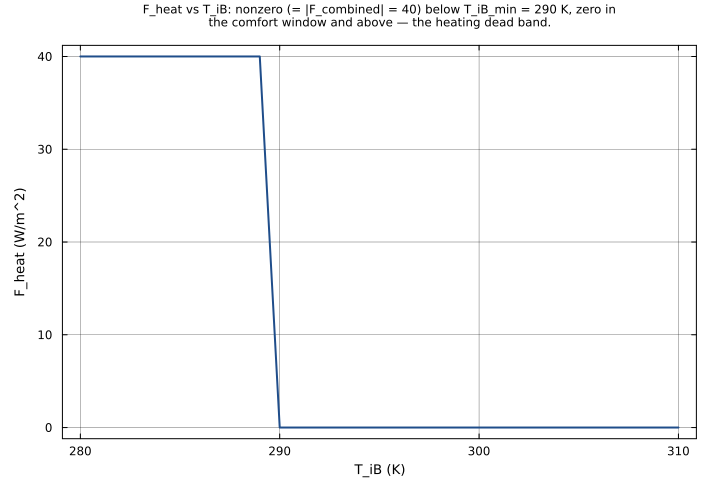
F_heat | W/m^2 | Heating flux (Oleson Eq. 4.51): |F_combined| if T_iB < T_iB_min, else 0 — the HVAC heating demand needed to clamp T_iB at the lower comfort threshold | |
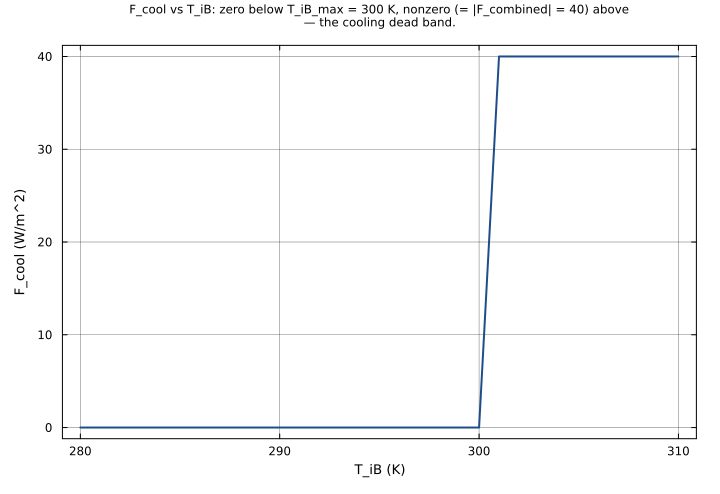
F_cool | W/m^2 | Cooling flux (Oleson Eq. 4.52): |F_combined| if T_iB > T_iB_max, else 0 — the HVAC cooling demand needed to clamp T_iB at the upper comfort threshold |
Observed expressions
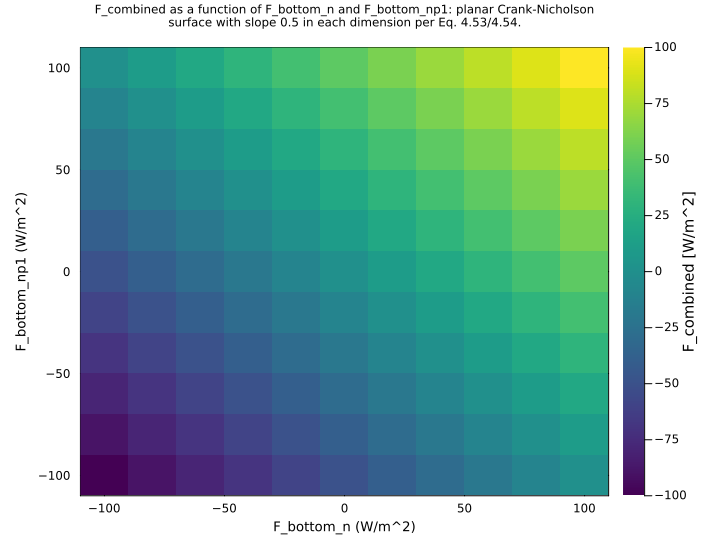
$$ F_{combined} = alpha_{CN} \cdot F_{bottom\,n} + \left(1.0 - alpha_{CN}\right) \cdot F_{bottom\,np1} $$Combined bottom flux (Crank-Nicholson average): alpha_CN*F_bottom_n + (1-alpha_CN)*F_bottom_np1
$$ F_{heat} = \mathrm{ifelse}\left(\mathrm{<}\left(T_{iB}, T_{iB\,min}\right), \left|F_{combined}\right|, zero_{flux}\right) $$Heating flux (Oleson Eq. 4.51): |F_combined| if T_iB < T_iB_min, else 0 — the HVAC heating demand needed to clamp T_iB at the lower comfort threshold
$$ F_{cool} = \mathrm{ifelse}\left(\mathrm{>}\left(T_{iB}, T_{iB\,max}\right), \left|F_{combined}\right|, zero_{flux}\right) $$Cooling flux (Oleson Eq. 4.52): |F_combined| if T_iB > T_iB_max, else 0 — the HVAC cooling demand needed to clamp T_iB at the upper comfort threshold
Analyses
hvac_demand_vs_internal_temperature
Sweep T_iB across a range spanning both the heating and cooling comfort thresholds with fixed floor fluxes (F_bottom_n = F_bottom_np1 = -40 W/m^2 so F_combined = -40). F_heat = 40 for T_iB below 290 K, drops to 0 in the comfort window, and stays 0 above 300 K; F_cool = 0 for T_iB below 300 K, jumps to 40 above. Surfaces the dual-threshold HVAC dead band of Eqs. 4.51-4.52 directly.
Time span: 0.0 → 1.0
Swept over: T_iB
crank_nicholson_combined_flux_surface
Joint sweep over F_bottom_n and F_bottom_np1 to surface the Crank-Nicholson combiner F_combined = 0.5*(F_bottom_n + F_bottom_np1). T_iB held in the comfort window so the HVAC branches are inactive — isolates the combiner. Iso-flux contours are 45-degree lines, slope -1 (constant F_combined for trade-offs between time-n and time-(n+1) flux).
Time span: 0.0 → 1.0
Swept over: F_bottom_n, F_bottom_np1
Raw .esm
Raw .esm JSON (this component)
{
  "reference": {
    "notes": "source_ref: UrbanCanopy.jl@9200edd4f15609f20339d3a7d104de8064544310:src/roof_wall_road_snow_temperatures.jl:638\nUpstream `HeatingCoolingFlux` is an MTK `@component` with five `@parameters` (T_iB, T_iB_min, T_iB_max, F_bottom_n, F_bottom_np1), three time-indexed `@variables` (F_combined, F_heat, F_cool), and three algebraic equations (no derivatives). Identical equation structure preserved here. Upstream structural test (test/roof_wall_road_snow_temperatures_test.jl:590) asserts `length(equations(sys)) == 3` and `length(unknowns(sys)) == 3` — matched here.\n\nThe upstream component declares two `@constants`, both encoded here as parameters with the upstream default values: α_CN = 0.5 (Crank-Nicholson weight, dimensionless) and zero_flux = 0.0 W/m^2 (zero-flux reference used as the inactive-HVAC branch). Greek `α_CN` is renamed `alpha_CN` for ASCII parameter names per the rig convention (matches snow_density.esm rho_* convention).\n\nThe HVAC threshold conditions use strict `<` and `>` per the upstream `ifelse` semantics: at T_iB = T_iB_min, the heating condition `T_iB < T_iB_min` is FALSE (strict less-than), so F_heat = 0; at T_iB = T_iB_max, the cooling condition `T_iB > T_iB_max` is FALSE (strict greater-than), so F_cool = 0. Equality at either threshold goes to the no-HVAC branch.\n\nInactive-branch encoding: the upstream component uses `zero_flux` (a `@constants` with unit W/m^2) rather than the bare numeric literal `0.0` in the inactive `ifelse` branch. This is unit-balancing in MTK's symbolic algebra — the active branch `abs(F_combined)` carries unit W/m^2, so the inactive branch must too, otherwise MTK rejects the equation as unit-inconsistent. Preserving `zero_flux` as a parameter with default 0.0 W/m^2 here keeps that contract explicit at the .esm level for any future unit-checking ESS reader.\n\nObservability classification: this component is functionally observed-only — the three output variables are each given by a single algebraic equation in terms of the parameters (the `(t)` time index has no role since there are no derivatives). Test scenarios use `time_span: [0, 1]` and sample at t=0 to mirror the convention used by sibling observed-only ESM files in this rig (snow_density.esm, snow_capping_runoff.esm, total_phase_change_energy.esm).\n\nTolerance rationale (model-level rel=1e-9): observed-only algebraic system (no ODE integration); the equations involve only multiplication, addition, `ifelse`, and `abs` — all at IEEE-754 ULP precision (~1e-16). 1e-9 leaves comfortable headroom above ULP roundoff and matches the convention used by sibling observed-only files (total_phase_change_energy.esm uses 1e-9 for the analogous additive-identity equations). Tighter `abs: 1e-12` is asserted on outputs that are exactly zero by construction (the inactive HVAC branches) so the assertion does not silently accept a stuck-at-1e-3 regression."
  },
  "tolerance": {
    "rel": 1e-09
  },
  "variables": {
    "alpha_CN": {
      "type": "parameter",
      "units": "1",
      "default": 0.5,
      "description": "Crank-Nicholson weight (dimensionless) — upstream `@constants` α_CN; alpha=0.5 gives the symmetric Crank-Nicholson average of F_bottom_n and F_bottom_np1"
    },
    "zero_flux": {
      "type": "parameter",
      "units": "W/m^2",
      "default": 0.0,
      "description": "Zero flux reference (W/m^2) — upstream `@constants` zero_flux; used as the inactive-branch value of F_heat and F_cool to keep unit algebra consistent with the active `abs(F_combined)` branch"
    },
    "T_iB": {
      "type": "parameter",
      "units": "K",
      "default": 295.0,
      "description": "Internal building temperature (Oleson Eq. 4.37) — input from a building-energy-balance subsystem; HVAC engages when T_iB exits the comfort window [T_iB_min, T_iB_max]"
    },
    "T_iB_min": {
      "type": "parameter",
      "units": "K",
      "default": 290.0,
      "description": "Minimum prescribed building temperature (lower edge of HVAC comfort window) — heating engages when T_iB < T_iB_min"
    },
    "T_iB_max": {
      "type": "parameter",
      "units": "K",
      "default": 300.0,
      "description": "Maximum prescribed building temperature (upper edge of HVAC comfort window) — cooling engages when T_iB > T_iB_max"
    },
    "F_bottom_n": {
      "type": "parameter",
      "units": "W/m^2",
      "default": 0.0,
      "description": "Bottom heat flux at time n (Oleson Eq. 4.53) — heat flux from the building floor into the building interior at the start of the time step"
    },
    "F_bottom_np1": {
      "type": "parameter",
      "units": "W/m^2",
      "default": 0.0,
      "description": "Bottom heat flux at time n+1 (Oleson Eq. 4.54) — heat flux from the building floor at the end of the time step"
    },
    "F_combined": {
      "type": "unknown",
      "units": "W/m^2",
      "description": "Combined bottom flux (Crank-Nicholson average): alpha_CN*F_bottom_n + (1-alpha_CN)*F_bottom_np1"
    },
    "F_heat": {
      "type": "unknown",
      "units": "W/m^2",
      "description": "Heating flux (Oleson Eq. 4.51): |F_combined| if T_iB < T_iB_min, else 0 — the HVAC heating demand needed to clamp T_iB at the lower comfort threshold"
    },
    "F_cool": {
      "type": "unknown",
      "units": "W/m^2",
      "description": "Cooling flux (Oleson Eq. 4.52): |F_combined| if T_iB > T_iB_max, else 0 — the HVAC cooling demand needed to clamp T_iB at the upper comfort threshold"
    }
  },
  "equations": [
    {
      "lhs": "F_combined",
      "rhs": {
        "op": "+",
        "args": [
          {
            "op": "*",
            "args": [
              "alpha_CN",
              "F_bottom_n"
            ]
          },
          {
            "op": "*",
            "args": [
              {
                "op": "-",
                "args": [
                  1.0,
                  "alpha_CN"
                ]
              },
              "F_bottom_np1"
            ]
          }
        ]
      }
    },
    {
      "lhs": "F_heat",
      "rhs": {
        "op": "ifelse",
        "args": [
          {
            "op": "<",
            "args": [
              "T_iB",
              "T_iB_min"
            ]
          },
          {
            "op": "abs",
            "args": [
              "F_combined"
            ]
          },
          "zero_flux"
        ]
      }
    },
    {
      "lhs": "F_cool",
      "rhs": {
        "op": "ifelse",
        "args": [
          {
            "op": ">",
            "args": [
              "T_iB",
              "T_iB_max"
            ]
          },
          {
            "op": "abs",
            "args": [
              "F_combined"
            ]
          },
          "zero_flux"
        ]
      }
    }
  ],
  "tests": [
    {
      "id": "heating_active",
      "description": "Reproduces upstream `HeatingCoolingFlux - Heating Active` test (UrbanCanopy.jl test/roof_wall_road_snow_temperatures_test.jl:600). T_iB = 285 K is below T_iB_min = 290 K, so the heating branch engages. Floor fluxes F_bottom_n = -20, F_bottom_np1 = -25 W/m^2 (negative = outflow from building) give F_combined = 0.5*(-20) + 0.5*(-25) = -22.5 W/m^2, so F_heat = |-22.5| = 22.5 W/m^2 and F_cool = 0. Anchors fidelity to the upstream Julia component at this canonical fixture point.",
      "parameter_overrides": {
        "T_iB": 285.0,
        "T_iB_min": 290.0,
        "T_iB_max": 300.0,
        "F_bottom_n": -20.0,
        "F_bottom_np1": -25.0
      },
      "time_span": {
        "start": 0.0,
        "end": 1.0
      },
      "assertions": [
        {
          "variable": "F_combined",
          "time": 0.0,
          "expected": -22.5
        },
        {
          "variable": "F_heat",
          "time": 0.0,
          "expected": 22.5
        },
        {
          "variable": "F_cool",
          "time": 0.0,
          "expected": 0.0,
          "tolerance": {
            "abs": 1e-12
          }
        }
      ]
    },
    {
      "id": "cooling_active",
      "description": "Reproduces upstream `HeatingCoolingFlux - Cooling Active` test (test/roof_wall_road_snow_temperatures_test.jl:627). T_iB = 305 K is above T_iB_max = 300 K, so the cooling branch engages. Floor fluxes F_bottom_n = 30, F_bottom_np1 = 35 W/m^2 (positive = inflow into building) give F_combined = 0.5*30 + 0.5*35 = 32.5 W/m^2, so F_cool = |32.5| = 32.5 W/m^2 and F_heat = 0.",
      "parameter_overrides": {
        "T_iB": 305.0,
        "T_iB_min": 290.0,
        "T_iB_max": 300.0,
        "F_bottom_n": 30.0,
        "F_bottom_np1": 35.0
      },
      "time_span": {
        "start": 0.0,
        "end": 1.0
      },
      "assertions": [
        {
          "variable": "F_combined",
          "time": 0.0,
          "expected": 32.5
        },
        {
          "variable": "F_cool",
          "time": 0.0,
          "expected": 32.5
        },
        {
          "variable": "F_heat",
          "time": 0.0,
          "expected": 0.0,
          "tolerance": {
            "abs": 1e-12
          }
        }
      ]
    },
    {
      "id": "no_hvac_needed",
      "description": "Reproduces upstream `HeatingCoolingFlux - No HVAC Needed` test (test/roof_wall_road_snow_temperatures_test.jl:648). T_iB = 295 K sits inside the comfort window [290, 300] K, so neither HVAC branch engages. F_combined = 0.5*10 + 0.5*12 = 11.0 W/m^2 (still computed, because it is not gated by the temperature window), but F_heat and F_cool are both zero by construction.",
      "parameter_overrides": {
        "T_iB": 295.0,
        "T_iB_min": 290.0,
        "T_iB_max": 300.0,
        "F_bottom_n": 10.0,
        "F_bottom_np1": 12.0
      },
      "time_span": {
        "start": 0.0,
        "end": 1.0
      },
      "assertions": [
        {
          "variable": "F_combined",
          "time": 0.0,
          "expected": 11.0
        },
        {
          "variable": "F_heat",
          "time": 0.0,
          "expected": 0.0,
          "tolerance": {
            "abs": 1e-12
          }
        },
        {
          "variable": "F_cool",
          "time": 0.0,
          "expected": 0.0,
          "tolerance": {
            "abs": 1e-12
          }
        }
      ]
    },
    {
      "id": "heating_at_lower_threshold_strict",
      "description": "Boundary case: T_iB = T_iB_min = 290 K exactly. Upstream `ifelse` uses strict `<`, so the heating condition `T_iB < T_iB_min` is FALSE at equality and F_heat = 0. Verifies that equality at the lower threshold goes to the no-heating branch, not the heating branch — the comfort window is closed on the lower boundary.",
      "parameter_overrides": {
        "T_iB": 290.0,
        "T_iB_min": 290.0,
        "T_iB_max": 300.0,
        "F_bottom_n": -20.0,
        "F_bottom_np1": -25.0
      },
      "time_span": {
        "start": 0.0,
        "end": 1.0
      },
      "assertions": [
        {
          "variable": "F_combined",
          "time": 0.0,
          "expected": -22.5
        },
        {
          "variable": "F_heat",
          "time": 0.0,
          "expected": 0.0,
          "tolerance": {
            "abs": 1e-12
          }
        },
        {
          "variable": "F_cool",
          "time": 0.0,
          "expected": 0.0,
          "tolerance": {
            "abs": 1e-12
          }
        }
      ]
    },
    {
      "id": "cooling_at_upper_threshold_strict",
      "description": "Boundary case: T_iB = T_iB_max = 300 K exactly. Upstream `ifelse` uses strict `>`, so the cooling condition `T_iB > T_iB_max` is FALSE at equality and F_cool = 0. Verifies that equality at the upper threshold goes to the no-cooling branch — the comfort window is closed on the upper boundary as well.",
      "parameter_overrides": {
        "T_iB": 300.0,
        "T_iB_min": 290.0,
        "T_iB_max": 300.0,
        "F_bottom_n": 30.0,
        "F_bottom_np1": 35.0
      },
      "time_span": {
        "start": 0.0,
        "end": 1.0
      },
      "assertions": [
        {
          "variable": "F_combined",
          "time": 0.0,
          "expected": 32.5
        },
        {
          "variable": "F_heat",
          "time": 0.0,
          "expected": 0.0,
          "tolerance": {
            "abs": 1e-12
          }
        },
        {
          "variable": "F_cool",
          "time": 0.0,
          "expected": 0.0,
          "tolerance": {
            "abs": 1e-12
          }
        }
      ]
    },
    {
      "id": "heating_with_positive_flux",
      "description": "Heating branch with positive floor fluxes: T_iB = 285 K below comfort window, but F_bottom_n = 15, F_bottom_np1 = 25 W/m^2 are both positive (heat flowing into the building). F_combined = 20.0, and F_heat = |20.0| = 20.0 (the absolute value is taken regardless of sign — the building still demands heating because T_iB is below the comfort threshold). Verifies the abs() does not depend on the sign of F_combined and that the heating demand is reported as a positive magnitude.",
      "parameter_overrides": {
        "T_iB": 285.0,
        "T_iB_min": 290.0,
        "T_iB_max": 300.0,
        "F_bottom_n": 15.0,
        "F_bottom_np1": 25.0
      },
      "time_span": {
        "start": 0.0,
        "end": 1.0
      },
      "assertions": [
        {
          "variable": "F_combined",
          "time": 0.0,
          "expected": 20.0
        },
        {
          "variable": "F_heat",
          "time": 0.0,
          "expected": 20.0
        },
        {
          "variable": "F_cool",
          "time": 0.0,
          "expected": 0.0,
          "tolerance": {
            "abs": 1e-12
          }
        }
      ]
    },
    {
      "id": "zero_floor_flux_outside_window",
      "description": "Edge case: building temperature is below T_iB_min but the floor flux happens to be exactly zero (F_bottom_n = F_bottom_np1 = 0). F_combined = 0, F_heat = |0| = 0, F_cool = 0. The HVAC condition fires (T_iB < T_iB_min is TRUE) but the magnitude is zero — exercises the active-branch arithmetic with a zero argument and confirms abs(0) = 0.",
      "parameter_overrides": {
        "T_iB": 285.0,
        "T_iB_min": 290.0,
        "T_iB_max": 300.0,
        "F_bottom_n": 0.0,
        "F_bottom_np1": 0.0
      },
      "time_span": {
        "start": 0.0,
        "end": 1.0
      },
      "assertions": [
        {
          "variable": "F_combined",
          "time": 0.0,
          "expected": 0.0,
          "tolerance": {
            "abs": 1e-12
          }
        },
        {
          "variable": "F_heat",
          "time": 0.0,
          "expected": 0.0,
          "tolerance": {
            "abs": 1e-12
          }
        },
        {
          "variable": "F_cool",
          "time": 0.0,
          "expected": 0.0,
          "tolerance": {
            "abs": 1e-12
          }
        }
      ]
    },
    {
      "id": "asymmetric_crank_nicholson_average",
      "description": "Stress-tests the Crank-Nicholson averaging arithmetic with very different magnitudes at time n vs n+1: F_bottom_n = 100, F_bottom_np1 = -50 (sign flip during the step, e.g. solar heating dropping at sunset). F_combined = 0.5*100 + 0.5*(-50) = 25.0. T_iB = 295 K is inside the comfort window so F_heat = F_cool = 0 — verifies that the Crank-Nicholson combiner is computed independently of the HVAC branches.",
      "parameter_overrides": {
        "T_iB": 295.0,
        "T_iB_min": 290.0,
        "T_iB_max": 300.0,
        "F_bottom_n": 100.0,
        "F_bottom_np1": -50.0
      },
      "time_span": {
        "start": 0.0,
        "end": 1.0
      },
      "assertions": [
        {
          "variable": "F_combined",
          "time": 0.0,
          "expected": 25.0
        },
        {
          "variable": "F_heat",
          "time": 0.0,
          "expected": 0.0,
          "tolerance": {
            "abs": 1e-12
          }
        },
        {
          "variable": "F_cool",
          "time": 0.0,
          "expected": 0.0,
          "tolerance": {
            "abs": 1e-12
          }
        }
      ]
    }
  ],
  "analyses": [
    {
      "id": "hvac_demand_vs_internal_temperature",
      "description": "Sweep T_iB across a range spanning both the heating and cooling comfort thresholds with fixed floor fluxes (F_bottom_n = F_bottom_np1 = -40 W/m^2 so F_combined = -40). F_heat = 40 for T_iB below 290 K, drops to 0 in the comfort window, and stays 0 above 300 K; F_cool = 0 for T_iB below 300 K, jumps to 40 above. Surfaces the dual-threshold HVAC dead band of Eqs. 4.51-4.52 directly.",
      "initial_state": {},
      "parameters": {
        "T_iB_min": 290.0,
        "T_iB_max": 300.0,
        "F_bottom_n": -40.0,
        "F_bottom_np1": -40.0
      },
      "time_span": {
        "start": 0.0,
        "end": 1.0
      },
      "parameter_sweep": {
        "type": "cartesian",
        "dimensions": [
          {
            "parameter": "T_iB",
            "range": {
              "start": 280.0,
              "stop": 310.0,
              "count": 31,
              "scale": "linear"
            }
          }
        ]
      },
      "plots": [
        {
          "id": "F_heat_curve",
          "type": "line",
          "description": "F_heat vs T_iB: nonzero (= |F_combined| = 40) below T_iB_min = 290 K, zero in the comfort window and above — the heating dead band.",
          "x": {
            "variable": "T_iB",
            "label": "T_iB (K)"
          },
          "y": {
            "variable": "F_heat",
            "label": "F_heat (W/m^2)"
          }
        },
        {
          "id": "F_cool_curve",
          "type": "line",
          "description": "F_cool vs T_iB: zero below T_iB_max = 300 K, nonzero (= |F_combined| = 40) above — the cooling dead band.",
          "x": {
            "variable": "T_iB",
            "label": "T_iB (K)"
          },
          "y": {
            "variable": "F_cool",
            "label": "F_cool (W/m^2)"
          }
        }
      ]
    },
    {
      "id": "crank_nicholson_combined_flux_surface",
      "description": "Joint sweep over F_bottom_n and F_bottom_np1 to surface the Crank-Nicholson combiner F_combined = 0.5*(F_bottom_n + F_bottom_np1). T_iB held in the comfort window so the HVAC branches are inactive — isolates the combiner. Iso-flux contours are 45-degree lines, slope -1 (constant F_combined for trade-offs between time-n and time-(n+1) flux).",
      "initial_state": {},
      "parameters": {
        "T_iB": 295.0,
        "T_iB_min": 290.0,
        "T_iB_max": 300.0
      },
      "time_span": {
        "start": 0.0,
        "end": 1.0
      },
      "parameter_sweep": {
        "type": "cartesian",
        "dimensions": [
          {
            "parameter": "F_bottom_n",
            "range": {
              "start": -100.0,
              "stop": 100.0,
              "count": 11,
              "scale": "linear"
            }
          },
          {
            "parameter": "F_bottom_np1",
            "range": {
              "start": -100.0,
              "stop": 100.0,
              "count": 11,
              "scale": "linear"
            }
          }
        ]
      },
      "plots": [
        {
          "id": "F_combined_heatmap",
          "type": "heatmap",
          "description": "F_combined as a function of F_bottom_n and F_bottom_np1: planar Crank-Nicholson surface with slope 0.5 in each dimension per Eq. 4.53/4.54.",
          "x": {
            "variable": "F_bottom_n",
            "label": "F_bottom_n (W/m^2)"
          },
          "y": {
            "variable": "F_bottom_np1",
            "label": "F_bottom_np1 (W/m^2)"
          },
          "value": {
            "variable": "F_combined",
            "reduce": "final"
          }
        }
      ]
    }
  ]
}