ImperviousWaterBalance
Surface water balance for roof and impervious-road urban surfaces, following Oleson et al. (2010, CLM Tech Note Ch. 5) Eqs. 5.2-5.5. Migrated from UrbanCanopy.jl@9200edd4 src/hydrology.jl:937 (`ImperviousWaterBalance` @component). Parameterized as observed-only: precipitation (q_rain, q_sno) and loss fluxes (E_surface, q_over, q_rgwl, q_snwcp_ice) are inputs; q_grnd_liq, q_grnd_ice, and water_input are algebraic outputs.
Description
Surface water balance for roof and impervious-road urban surfaces, following Oleson et al. (2010, CLM Tech Note Ch. 5) Eqs. 5.2-5.5. Migrated from UrbanCanopy.jl@9200edd4 src/hydrology.jl:937 (ImperviousWaterBalance @component). Parameterized as observed-only: precipitation (q_rain, q_sno) and loss fluxes (E_surface, q_over, q_rgwl, q_snwcp_ice) are inputs; q_grnd_liq, q_grnd_ice, and water_input are algebraic outputs.
Reference
_source_ref: UrbanCanopy.jl@9200edd4:src/hydrology.jl:937
Upstream ImperviousWaterBalance is an MTK @component whose six inputs (q_rain, q_sno, E_surface, q_over, q_rgwl, q_snwcp_ice) are @parameters (driven by a parent surface/atmosphere coupler) and whose three outputs (water_input, q_grnd_liq, q_grnd_ice) are time-indexed @variables with three algebraic equations and no derivatives. Identical structure preserved here.
Upstream-source detail intentionally not migrated: the Julia component declares two @constants (w_pond_max = 1.0 kg/m^2 ponding limit; zero_kgpm2s = 0.0 kg/(m^2*s) zero-flux sentinel) that are not referenced by any of the three eqs in this component. They appear to be vestigial copies of the constants used by sibling components ImperviousRunoff (hydrology.jl:991) and PerviousRoadRunoff. Omitting them here preserves the mathematical model exactly while keeping the .esm minimal; if the canonical pipeline ever needs them for cross-component coupling, they should be added at that time alongside the equations that reference them.
Observability classification: this component is functionally observed-only — all three outputs are given by single algebraic equations in terms of the parameters (the (t) time index has no role since there are no derivatives). Test scenarios use time_span: [0, 1] and sample at t=0 to mirror the convention used by the other observed-only ESM files in this directory (soil_water_content_calc.esm, snow_compaction.esm).
Tolerance rationale (model-level rel=1e-9): observed-only algebraic system (no ODE integration); the equations are at most one summation of six float64 terms — fewer than ten IEEE-754 operations — so roundoff is ~1e-15. 1e-9 leaves comfortable headroom above ULP roundoff and is well below any physical-discrimination scale on surface mass-flux densities (which range from ~1e-6 to ~1e-2 kg/(m^2*s) for any plausible CLMU urban surface state)._
Parameters
| Name | Units | Default | Description |
|---|---|---|---|
q_rain | kg/(m^2*s) | 0.0 | Liquid precipitation rate (Eq. 5.4) |
q_sno | kg/(m^2*s) | 0.0 | Solid precipitation rate (Eq. 5.5) |
E_surface | kg/(m^2*s) | 0.0 | Total evaporation from surface |
q_over | kg/(m^2*s) | 0.0 | Surface runoff |
q_rgwl | kg/(m^2*s) | 0.0 | Liquid runoff from groundwater |
q_snwcp_ice | kg/(m^2*s) | 0.0 | Solid runoff from snow capping |
Observed
| Name | Units | Default | Description |
|---|---|---|---|
q_grnd_liq | kg/(m^2*s) | Liquid precipitation reaching surface (Oleson Eq. 5.4): q_grnd_liq = q_rain | |
q_grnd_ice | kg/(m^2*s) | Solid precipitation reaching surface (Oleson Eq. 5.5): q_grnd_ice = q_sno | |
water_input | kg/(m^2*s) | Net water input rate to impervious surface (Oleson Eqs. 5.2-5.3): water_input = q_rain + q_sno - E_surface - q_over - q_rgwl - q_snwcp_ice |
Observed expressions
$$ q_{grnd\,liq} = q_{rain} $$Liquid precipitation reaching surface (Oleson Eq. 5.4): q_grnd_liq = q_rain
$$ q_{grnd\,ice} = q_{sno} $$Solid precipitation reaching surface (Oleson Eq. 5.5): q_grnd_ice = q_sno
$$ water_{input} = q_{rain} + q_{sno} - \left(E_{surface} + q_{over} + q_{rgwl} + q_{snwcp\,ice}\right) $$Net water input rate to impervious surface (Oleson Eqs. 5.2-5.3): water_input = q_rain + q_sno - E_surface - q_over - q_rgwl - q_snwcp_ice
Analyses
water_input_vs_rain_rate
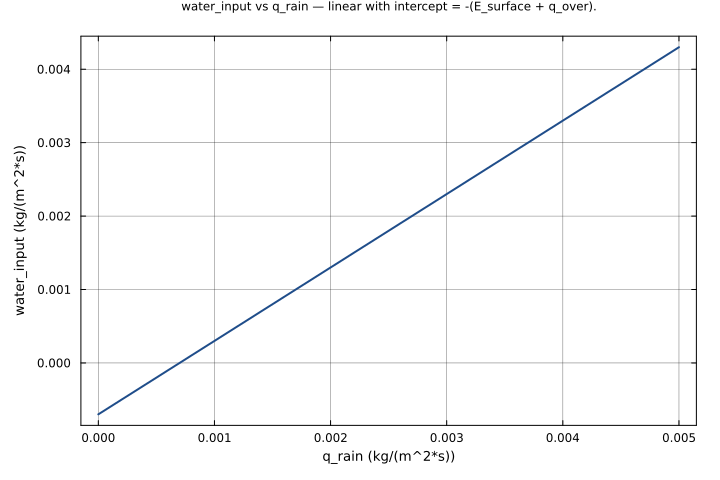
Net water input as a function of incident rainfall rate (with fixed evaporation E_surface = 5e-4 and fixed overland runoff q_over = 2e-4). The linear unit-slope dependence in Eqs. 5.2-5.3 is visible: each kg/(m^2s) of additional rain raises water_input by exactly 1 kg/(m^2s). Sweeps q_rain over the typical urban-storm range (0 to 5e-3 kg/(m^2*s) ≈ 0 to 18 mm/hr).
Time span: 0.0 → 1.0
Swept over: q_rain
water_input_rain_evap_grid
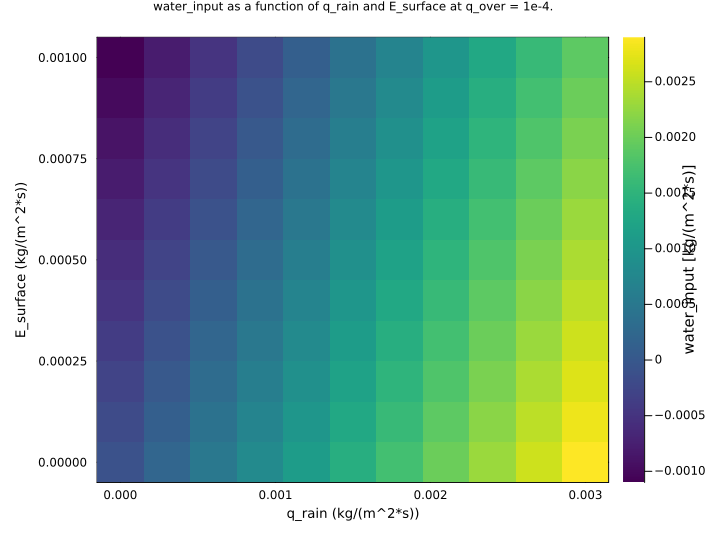
Joint sweep over q_rain and E_surface at fixed q_over = 1e-4 — surfaces the iso-water_input contours of Eq. 5.2 across the (precipitation, evaporation) plane. Useful for visualizing the net-zero locus where rainfall just balances evaporation plus runoff.
Time span: 0.0 → 1.0
Swept over: q_rain, E_surface
Raw .esm
Raw .esm JSON (this component)
{
  "reference": {
    "notes": "source_ref: UrbanCanopy.jl@9200edd4:src/hydrology.jl:937\nUpstream `ImperviousWaterBalance` is an MTK `@component` whose six inputs (q_rain, q_sno, E_surface, q_over, q_rgwl, q_snwcp_ice) are `@parameters` (driven by a parent surface/atmosphere coupler) and whose three outputs (water_input, q_grnd_liq, q_grnd_ice) are time-indexed `@variables` with three algebraic equations and no derivatives. Identical structure preserved here.\n\nUpstream-source detail intentionally not migrated: the Julia component declares two `@constants` (w_pond_max = 1.0 kg/m^2 ponding limit; zero_kgpm2s = 0.0 kg/(m^2*s) zero-flux sentinel) that are not referenced by any of the three eqs in this component. They appear to be vestigial copies of the constants used by sibling components ImperviousRunoff (hydrology.jl:991) and PerviousRoadRunoff. Omitting them here preserves the mathematical model exactly while keeping the .esm minimal; if the canonical pipeline ever needs them for cross-component coupling, they should be added at that time alongside the equations that reference them.\n\nObservability classification: this component is functionally observed-only — all three outputs are given by single algebraic equations in terms of the parameters (the `(t)` time index has no role since there are no derivatives). Test scenarios use `time_span: [0, 1]` and sample at t=0 to mirror the convention used by the other observed-only ESM files in this directory (soil_water_content_calc.esm, snow_compaction.esm).\n\nTolerance rationale (model-level rel=1e-9): observed-only algebraic system (no ODE integration); the equations are at most one summation of six float64 terms — fewer than ten IEEE-754 operations — so roundoff is ~1e-15. 1e-9 leaves comfortable headroom above ULP roundoff and is well below any physical-discrimination scale on surface mass-flux densities (which range from ~1e-6 to ~1e-2 kg/(m^2*s) for any plausible CLMU urban surface state)."
  },
  "tolerance": {
    "rel": 1e-09
  },
  "variables": {
    "q_rain": {
      "type": "parameter",
      "units": "kg/(m^2*s)",
      "default": 0.0,
      "description": "Liquid precipitation rate (Eq. 5.4)"
    },
    "q_sno": {
      "type": "parameter",
      "units": "kg/(m^2*s)",
      "default": 0.0,
      "description": "Solid precipitation rate (Eq. 5.5)"
    },
    "E_surface": {
      "type": "parameter",
      "units": "kg/(m^2*s)",
      "default": 0.0,
      "description": "Total evaporation from surface"
    },
    "q_over": {
      "type": "parameter",
      "units": "kg/(m^2*s)",
      "default": 0.0,
      "description": "Surface runoff"
    },
    "q_rgwl": {
      "type": "parameter",
      "units": "kg/(m^2*s)",
      "default": 0.0,
      "description": "Liquid runoff from groundwater"
    },
    "q_snwcp_ice": {
      "type": "parameter",
      "units": "kg/(m^2*s)",
      "default": 0.0,
      "description": "Solid runoff from snow capping"
    },
    "q_grnd_liq": {
      "type": "unknown",
      "units": "kg/(m^2*s)",
      "description": "Liquid precipitation reaching surface (Oleson Eq. 5.4): q_grnd_liq = q_rain"
    },
    "q_grnd_ice": {
      "type": "unknown",
      "units": "kg/(m^2*s)",
      "description": "Solid precipitation reaching surface (Oleson Eq. 5.5): q_grnd_ice = q_sno"
    },
    "water_input": {
      "type": "unknown",
      "units": "kg/(m^2*s)",
      "description": "Net water input rate to impervious surface (Oleson Eqs. 5.2-5.3): water_input = q_rain + q_sno - E_surface - q_over - q_rgwl - q_snwcp_ice"
    }
  },
  "equations": [
    {
      "lhs": "q_grnd_liq",
      "rhs": "q_rain"
    },
    {
      "lhs": "q_grnd_ice",
      "rhs": "q_sno"
    },
    {
      "lhs": "water_input",
      "rhs": {
        "op": "-",
        "args": [
          {
            "op": "+",
            "args": [
              "q_rain",
              "q_sno"
            ]
          },
          {
            "op": "+",
            "args": [
              "E_surface",
              {
                "op": "+",
                "args": [
                  "q_over",
                  {
                    "op": "+",
                    "args": [
                      "q_rgwl",
                      "q_snwcp_ice"
                    ]
                  }
                ]
              }
            ]
          }
        ]
      }
    }
  ],
  "tests": [
    {
      "id": "all_zero",
      "description": "All inputs zero — quiescent dry surface with no precipitation, no evaporation, no runoff. All three outputs must be exactly zero. Exercises the additive-zero limit of Eqs. 5.2-5.5.",
      "parameter_overrides": {
        "q_rain": 0.0,
        "q_sno": 0.0,
        "E_surface": 0.0,
        "q_over": 0.0,
        "q_rgwl": 0.0,
        "q_snwcp_ice": 0.0
      },
      "time_span": {
        "start": 0.0,
        "end": 1.0
      },
      "assertions": [
        {
          "variable": "q_grnd_liq",
          "time": 0.0,
          "expected": 0.0,
          "tolerance": {
            "abs": 1e-15
          }
        },
        {
          "variable": "q_grnd_ice",
          "time": 0.0,
          "expected": 0.0,
          "tolerance": {
            "abs": 1e-15
          }
        },
        {
          "variable": "water_input",
          "time": 0.0,
          "expected": 0.0,
          "tolerance": {
            "abs": 1e-15
          }
        }
      ]
    },
    {
      "id": "pure_rain",
      "description": "Pure liquid precipitation event (q_rain = 1e-3 kg/(m^2*s) ≈ 3.6 mm/hr) with no other fluxes. q_grnd_liq must equal q_rain (Eq. 5.4), q_grnd_ice = 0 (Eq. 5.5), and water_input = q_rain (Eqs. 5.2-5.3 with all loss terms zero).",
      "parameter_overrides": {
        "q_rain": 0.001,
        "q_sno": 0.0,
        "E_surface": 0.0,
        "q_over": 0.0,
        "q_rgwl": 0.0,
        "q_snwcp_ice": 0.0
      },
      "time_span": {
        "start": 0.0,
        "end": 1.0
      },
      "assertions": [
        {
          "variable": "q_grnd_liq",
          "time": 0.0,
          "expected": 0.001
        },
        {
          "variable": "q_grnd_ice",
          "time": 0.0,
          "expected": 0.0,
          "tolerance": {
            "abs": 1e-15
          }
        },
        {
          "variable": "water_input",
          "time": 0.0,
          "expected": 0.001
        }
      ]
    },
    {
      "id": "pure_snow",
      "description": "Pure solid precipitation event (q_sno = 5e-4 kg/(m^2*s)) with no other fluxes. q_grnd_ice must equal q_sno (Eq. 5.5), q_grnd_liq = 0 (Eq. 5.4), and water_input = q_sno.",
      "parameter_overrides": {
        "q_rain": 0.0,
        "q_sno": 0.0005,
        "E_surface": 0.0,
        "q_over": 0.0,
        "q_rgwl": 0.0,
        "q_snwcp_ice": 0.0
      },
      "time_span": {
        "start": 0.0,
        "end": 1.0
      },
      "assertions": [
        {
          "variable": "q_grnd_liq",
          "time": 0.0,
          "expected": 0.0,
          "tolerance": {
            "abs": 1e-15
          }
        },
        {
          "variable": "q_grnd_ice",
          "time": 0.0,
          "expected": 0.0005
        },
        {
          "variable": "water_input",
          "time": 0.0,
          "expected": 0.0005
        }
      ]
    },
    {
      "id": "evaporation_only",
      "description": "Dry-surface evaporation event (E_surface = 2e-4 kg/(m^2*s)) with no precipitation or runoff. q_grnd_liq and q_grnd_ice are zero; water_input = -E_surface = -2e-4 (a net loss). Exercises the negative-balance regime where the surface is losing mass.",
      "parameter_overrides": {
        "q_rain": 0.0,
        "q_sno": 0.0,
        "E_surface": 0.0002,
        "q_over": 0.0,
        "q_rgwl": 0.0,
        "q_snwcp_ice": 0.0
      },
      "time_span": {
        "start": 0.0,
        "end": 1.0
      },
      "assertions": [
        {
          "variable": "q_grnd_liq",
          "time": 0.0,
          "expected": 0.0,
          "tolerance": {
            "abs": 1e-15
          }
        },
        {
          "variable": "q_grnd_ice",
          "time": 0.0,
          "expected": 0.0,
          "tolerance": {
            "abs": 1e-15
          }
        },
        {
          "variable": "water_input",
          "time": 0.0,
          "expected": -0.0002
        }
      ]
    },
    {
      "id": "all_loss_terms",
      "description": "All three loss-only paths active simultaneously (q_over = 1e-4, q_rgwl = 2e-4, q_snwcp_ice = 3e-4) with no precipitation or evaporation. water_input = -(q_over + q_rgwl + q_snwcp_ice) = -6e-4. Verifies that the three runoff terms enter the balance with the correct (negative) sign and that the balance equation distinguishes them from the precipitation terms.",
      "parameter_overrides": {
        "q_rain": 0.0,
        "q_sno": 0.0,
        "E_surface": 0.0,
        "q_over": 0.0001,
        "q_rgwl": 0.0002,
        "q_snwcp_ice": 0.0003
      },
      "time_span": {
        "start": 0.0,
        "end": 1.0
      },
      "assertions": [
        {
          "variable": "q_grnd_liq",
          "time": 0.0,
          "expected": 0.0,
          "tolerance": {
            "abs": 1e-15
          }
        },
        {
          "variable": "q_grnd_ice",
          "time": 0.0,
          "expected": 0.0,
          "tolerance": {
            "abs": 1e-15
          }
        },
        {
          "variable": "water_input",
          "time": 0.0,
          "expected": -0.0006
        }
      ]
    },
    {
      "id": "mixed_storm_with_losses",
      "description": "Mixed-phase storm with all loss paths active — the canonical Eqs. 5.2-5.5 use case. q_rain = 2e-3, q_sno = 1e-3, E_surface = 3e-4, q_over = 2e-4, q_rgwl = 1e-4, q_snwcp_ice = 4e-4. water_input = (2e-3 + 1e-3) - (3e-4 + 2e-4 + 1e-4 + 4e-4) = 3e-3 - 1e-3 = 2e-3 kg/(m^2*s). Exercises the full balance with all six inputs nonzero.",
      "parameter_overrides": {
        "q_rain": 0.002,
        "q_sno": 0.001,
        "E_surface": 0.0003,
        "q_over": 0.0002,
        "q_rgwl": 0.0001,
        "q_snwcp_ice": 0.0004
      },
      "time_span": {
        "start": 0.0,
        "end": 1.0
      },
      "assertions": [
        {
          "variable": "q_grnd_liq",
          "time": 0.0,
          "expected": 0.002
        },
        {
          "variable": "q_grnd_ice",
          "time": 0.0,
          "expected": 0.001
        },
        {
          "variable": "water_input",
          "time": 0.0,
          "expected": 0.002
        }
      ]
    },
    {
      "id": "heavy_rain_with_overland_runoff",
      "description": "Intense rainstorm (q_rain = 5e-3 kg/(m^2*s) ≈ 18 mm/hr) on an impervious surface generating substantial overland runoff (q_over = 2e-3). q_grnd_liq = 5e-3, q_grnd_ice = 0, water_input = 5e-3 - 2e-3 = 3e-3. Represents a typical urban storm-runoff partition where roughly 40% of incident rain is shed as runoff.",
      "parameter_overrides": {
        "q_rain": 0.005,
        "q_sno": 0.0,
        "E_surface": 0.0,
        "q_over": 0.002,
        "q_rgwl": 0.0,
        "q_snwcp_ice": 0.0
      },
      "time_span": {
        "start": 0.0,
        "end": 1.0
      },
      "assertions": [
        {
          "variable": "q_grnd_liq",
          "time": 0.0,
          "expected": 0.005
        },
        {
          "variable": "q_grnd_ice",
          "time": 0.0,
          "expected": 0.0,
          "tolerance": {
            "abs": 1e-15
          }
        },
        {
          "variable": "water_input",
          "time": 0.0,
          "expected": 0.003
        }
      ]
    },
    {
      "id": "winter_snow_capping",
      "description": "Cold-season snowfall on an impervious surface where the saturated snow layer caps further accumulation, diverting solid precipitation to runoff (q_snwcp_ice). q_sno = 8e-4 kg/(m^2*s), q_snwcp_ice = 3e-4. q_grnd_ice = q_sno = 8e-4 (all incident snow reaches the surface in Eq. 5.5), but water_input = 8e-4 - 3e-4 = 5e-4 since some is shed as solid runoff. Exercises the q_snwcp_ice loss path that is unique to impervious surfaces.",
      "parameter_overrides": {
        "q_rain": 0.0,
        "q_sno": 0.0008,
        "E_surface": 0.0,
        "q_over": 0.0,
        "q_rgwl": 0.0,
        "q_snwcp_ice": 0.0003
      },
      "time_span": {
        "start": 0.0,
        "end": 1.0
      },
      "assertions": [
        {
          "variable": "q_grnd_liq",
          "time": 0.0,
          "expected": 0.0,
          "tolerance": {
            "abs": 1e-15
          }
        },
        {
          "variable": "q_grnd_ice",
          "time": 0.0,
          "expected": 0.0008
        },
        {
          "variable": "water_input",
          "time": 0.0,
          "expected": 0.0005
        }
      ]
    },
    {
      "id": "summer_warm_dry_with_evap_runoff",
      "description": "Warm-season rainfall on a heated impervious surface — concurrent rain (q_rain = 1.5e-3), evaporation (E_surface = 5e-4), and overland runoff (q_over = 4e-4). water_input = 1.5e-3 - 5e-4 - 4e-4 = 6e-4. Verifies that evaporation and runoff both enter as negative terms and that the balance handles a positive but reduced net input.",
      "parameter_overrides": {
        "q_rain": 0.0015,
        "q_sno": 0.0,
        "E_surface": 0.0005,
        "q_over": 0.0004,
        "q_rgwl": 0.0,
        "q_snwcp_ice": 0.0
      },
      "time_span": {
        "start": 0.0,
        "end": 1.0
      },
      "assertions": [
        {
          "variable": "q_grnd_liq",
          "time": 0.0,
          "expected": 0.0015
        },
        {
          "variable": "q_grnd_ice",
          "time": 0.0,
          "expected": 0.0,
          "tolerance": {
            "abs": 1e-15
          }
        },
        {
          "variable": "water_input",
          "time": 0.0,
          "expected": 0.0006
        }
      ]
    },
    {
      "id": "groundwater_lateral_loss",
      "description": "Light rain (q_rain = 5e-4) with a lateral groundwater loss term active (q_rgwl = 7e-4) — net negative balance because the q_rgwl outflow exceeds the incoming rain. water_input = 5e-4 - 7e-4 = -2e-4. Exercises the q_rgwl loss path in isolation and verifies that water_input correctly goes negative when losses outweigh inputs.",
      "parameter_overrides": {
        "q_rain": 0.0005,
        "q_sno": 0.0,
        "E_surface": 0.0,
        "q_over": 0.0,
        "q_rgwl": 0.0007,
        "q_snwcp_ice": 0.0
      },
      "time_span": {
        "start": 0.0,
        "end": 1.0
      },
      "assertions": [
        {
          "variable": "q_grnd_liq",
          "time": 0.0,
          "expected": 0.0005
        },
        {
          "variable": "q_grnd_ice",
          "time": 0.0,
          "expected": 0.0,
          "tolerance": {
            "abs": 1e-15
          }
        },
        {
          "variable": "water_input",
          "time": 0.0,
          "expected": -0.0002
        }
      ]
    }
  ],
  "analyses": [
    {
      "id": "water_input_vs_rain_rate",
      "description": "Net water input as a function of incident rainfall rate (with fixed evaporation E_surface = 5e-4 and fixed overland runoff q_over = 2e-4). The linear unit-slope dependence in Eqs. 5.2-5.3 is visible: each kg/(m^2*s) of additional rain raises water_input by exactly 1 kg/(m^2*s). Sweeps q_rain over the typical urban-storm range (0 to 5e-3 kg/(m^2*s) ≈ 0 to 18 mm/hr).",
      "initial_state": {},
      "parameters": {
        "E_surface": 0.0005,
        "q_over": 0.0002
      },
      "time_span": {
        "start": 0.0,
        "end": 1.0
      },
      "parameter_sweep": {
        "type": "cartesian",
        "dimensions": [
          {
            "parameter": "q_rain",
            "range": {
              "start": 0.0,
              "stop": 0.005,
              "count": 26,
              "scale": "linear"
            }
          }
        ]
      },
      "plots": [
        {
          "id": "water_input_vs_q_rain",
          "type": "line",
          "description": "water_input vs q_rain — linear with intercept = -(E_surface + q_over).",
          "x": {
            "variable": "q_rain",
            "label": "q_rain (kg/(m^2*s))"
          },
          "y": {
            "variable": "water_input",
            "label": "water_input (kg/(m^2*s))"
          }
        }
      ]
    },
    {
      "id": "water_input_rain_evap_grid",
      "description": "Joint sweep over q_rain and E_surface at fixed q_over = 1e-4 — surfaces the iso-water_input contours of Eq. 5.2 across the (precipitation, evaporation) plane. Useful for visualizing the net-zero locus where rainfall just balances evaporation plus runoff.",
      "initial_state": {},
      "parameters": {
        "q_over": 0.0001
      },
      "time_span": {
        "start": 0.0,
        "end": 1.0
      },
      "parameter_sweep": {
        "type": "cartesian",
        "dimensions": [
          {
            "parameter": "q_rain",
            "range": {
              "start": 0.0,
              "stop": 0.003,
              "count": 11,
              "scale": "linear"
            }
          },
          {
            "parameter": "E_surface",
            "range": {
              "start": 0.0,
              "stop": 0.001,
              "count": 11,
              "scale": "linear"
            }
          }
        ]
      },
      "plots": [
        {
          "id": "water_input_heatmap",
          "type": "heatmap",
          "description": "water_input as a function of q_rain and E_surface at q_over = 1e-4.",
          "x": {
            "variable": "q_rain",
            "label": "q_rain (kg/(m^2*s))"
          },
          "y": {
            "variable": "E_surface",
            "label": "E_surface (kg/(m^2*s))"
          },
          "value": {
            "variable": "water_input",
            "reduce": "final"
          }
        }
      ]
    }
  ]
}