ClOxCycle
Stratospheric ClOx catalytic ozone destruction cycle (Seinfeld & Pandis 2006, Ch. 5 §5.5.1). Migrated from GasChem.jl@8c12c048 src/StratosphericChemistry.jl:272 (`ClOxCycle` @component). Implements 4 ODEs (Cl, ClO, HCl, ClONO2) coupled to 2 algebraic family sums (ClOx = Cl + ClO, Cly = Cl + ClO + HCl + ClONO2). Rate coefficients are Arrhenius (k = A·exp(C/T)) for the five binary reactions and a (T_ref/T)^3.4 form for the termolecular ClO + NO2 + M → ClONO2 channel. All upstream `@constants` are encoded as parameters with their literal SI defaults; physical-condition `@parameters` (T, M, photolysis rates, fixed-bath species O, O3, NO, NO2, OH, CH4) are also parameters so the cycle can be exercised at different atmospheric conditions.
Description
Stratospheric ClOx catalytic ozone destruction cycle (Seinfeld & Pandis 2006, Ch. 5 §5.5.1). Migrated from GasChem.jl@8c12c048 src/StratosphericChemistry.jl:272 (ClOxCycle @component). Implements 4 ODEs (Cl, ClO, HCl, ClONO2) coupled to 2 algebraic family sums (ClOx = Cl + ClO, Cly = Cl + ClO + HCl + ClONO2). Rate coefficients are Arrhenius (k = A·exp(C/T)) for the five binary reactions and a (T_ref/T)^3.4 form for the termolecular ClO + NO2 + M → ClONO2 channel. All upstream @constants are encoded as parameters with their literal SI defaults; physical-condition @parameters (T, M, photolysis rates, fixed-bath species O, O3, NO, NO2, OH, CH4) are also parameters so the cycle can be exercised at different atmospheric conditions.
Reference
_source_ref: GasChem.jl@8c12c048482b515fb8eb2110bf8ab4b4f4e71309:src/StratosphericChemistry.jl:272
Upstream ClOxCycle is an MTK @component with 12 @constants (Arrhenius pre-factors and activation temperatures for five binary channels plus the termolecular ClO + NO2 + M reference), 9 @parameters (T, M, j_ClONO2, and the six fixed-bath concentrations CH4, O, O3, NO, NO2, OH), and 6 @variables (4 time-indexed states Cl, ClO, HCl, ClONO2 + 2 algebraic family sums ClOx, Cly). All 6 equations preserved verbatim: 4 ODEs (D(Cl), D(ClO), D(HCl), D(ClONO2)) + 2 algebraic (ClOx ~ Cl + ClO, Cly ~ Cl + ClO + HCl + ClONO2). The upstream structural test (test/StratosphericChemistry_test.jl:71-81) asserts length(equations(sys)) == 6 and that Cl, ClO, ClONO2, ClOx appear as states — both preserved here.
Upstream @constants are encoded as parameters with their upstream SI default values, matching the convention used by sibling migrations in this rig (snow_thermal.esm encodes physical constants as parameters with default; diameter_growth.esm encodes R_gas, D_diff similarly). Rate coefficients are written inline in the equations as A * exp(C / T) (binary) and A * (T_ref / T)^3.4 (termolecular ClO + NO2 + M) per Seinfeld & Pandis Table B.1/B.2 (pp. 162-167). CGS→SI conversion factors (cm³/molec/s × 1e-6; cm⁶/molec²/s × 1e-12) are folded into the _A defaults: e.g. upstream Cl + O3 pre-factor 2.3e-11 cm³/molec/s → 2.3e-17 m³/s.
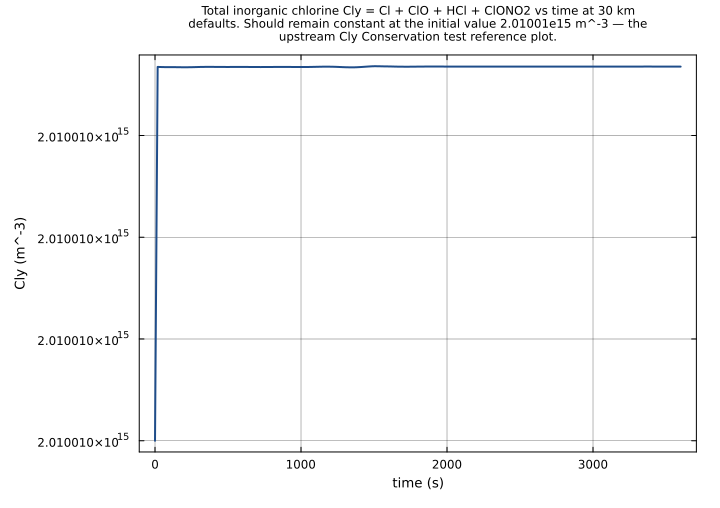
Cly conservation: the upstream Cly Conservation (ClOx Cycle) test (test/StratosphericChemistry_test.jl:266-290) asserts that Cly = Cl + ClO + HCl + ClONO2 is conserved to rtol = 1e-6 over a 1 s integration. This is structurally exact for this component — summing the four ODEs:
D(Cl)     = -k_Cl_O3·Cl·O3 + k_ClO_O·ClO·O + k_ClO_NO·ClO·NO - k_Cl_CH4·Cl·CH4 + k_OH_HCl·OH·HCl + j_ClONO2·ClONO2
D(ClO)    = +k_Cl_O3·Cl·O3 - k_ClO_O·ClO·O - k_ClO_NO·ClO·NO - k_ClO_NO2_M·ClO·NO2·M
D(HCl)    = +k_Cl_CH4·Cl·CH4 - k_OH_HCl·OH·HCl
D(ClONO2) = +k_ClO_NO2_M·ClO·NO2·M - j_ClONO2·ClONO2
Σ         = 0
so D(Cly) ≡ 0 analytically and any observed drift in Cly is integrator roundoff — this is why the upstream test uses rtol = 1e-6 over 1 s while internal solver tolerances run at abstol = 1e-12, reltol = 1e-12. The migration preserves this exact conservation structure.
ClOx (= Cl + ClO) is NOT conserved: D(ClOx) = -k_Cl_CH4·Cl·CH4 + k_OH_HCl·OH·HCl + j_ClONO2·ClONO2 - k_ClO_NO2_M·ClO·NO2·M, the four-channel exchange between the active ClOx pair and the reservoir species HCl and ClONO2. The Cl + CH4 / OH + HCl pair shuttles between ClOx and HCl; the ClO + NO2 + M / ClONO2 + hν pair shuttles between ClOx and ClONO2.
Tolerance rationale (model-level rel=1e-6): reference trajectories from upstream Julia MTK Tsit5 integration at abstol=1e-10, reltol=1e-10. 1e-6 covers Tsit5↔SciPy LSODA truncation over 3600 s plus float64 roundoff. Cly conservation runs at the same 1e-6 — it matches the upstream test tolerance (test/StratosphericChemistry_test.jl:289). Several anchors test small-fractional deltas near the initial reservoir mass (HCl, ClONO2 changing by 0.1-1% over short windows) — these use looser per-assertion abs floors derived from the variable magnitude (~1e15 m^-3 × 1e-6 = 1e9 abs floor).
Domain validity: this is a stratospheric component. Defaults match the upstream component (T = 227 K and M = 3.1e23 m^-3 are ~30 km conditions; CH4 = 1e19 m^-3, O3 = 3e18 m^-3 are typical stratospheric values). All bath species (O, O3, NO, NO2, OH, CH4) are parameters here because the upstream component treats them as such — this cycle is a sub-model that runs against externally-prescribed environmental conditions, not a self-contained chemistry box. Coupling with the larger StratosphericOzoneSystem (test/StratosphericChemistry_test.jl:94+) is what promotes these to dynamical species; that integration is out of scope for this single-component migration._
Variables
| Name | Units | Default | Description |
|---|---|---|---|
Cl | m^-3 | 10000000000.0 | Cl atom number density (upstream default initial value 1e4 molec/cm^3 × 1e6 → 1e10 m^-3). |
ClO | m^-3 | 10000000000000.0 | ClO number density (upstream default initial value 1e7 molec/cm^3 × 1e6 → 1e13 m^-3). |
HCl | m^-3 | 1000000000000000.0 | HCl reservoir number density (upstream default initial value 1e9 molec/cm^3 × 1e6 → 1e15 m^-3). |
ClONO2 | m^-3 | 1000000000000000.0 | ClONO2 reservoir number density (upstream default initial value 1e9 molec/cm^3 × 1e6 → 1e15 m^-3). |
Parameters
| Name | Units | Default | Description |
|---|---|---|---|
T | K | 227.0 | Temperature. Default 227 K matches the upstream component and is the canonical 30 km stratospheric value (Seinfeld & Pandis Table 5.1). |
j_ClONO2 | s^-1 | 0.0001 | ClONO2 photolysis rate (ClONO2 + hν → Cl + NO3). |
CH4 | m^-3 | 1e+19 | Methane number density (1e13 molec/cm^3 × 1e6 → 1e19 m^-3). Drives the Cl + CH4 → HCl reservoir-formation channel. |
M | m^-3 | 3.1e+23 | Air number density at 30 km (3.1e17 molec/cm^3 × 1e6 → 3.1e23 m^-3). Third body for the ClO + NO2 + M → ClONO2 termolecular channel. |
O | m^-3 | 10000000000000.0 | Atomic oxygen number density (1e7 molec/cm^3 × 1e6 → 1e13 m^-3). Drives the ClO + O → Cl + O2 catalytic-cycle closing step. |
O3 | m^-3 | 3e+18 | Ozone number density (3e12 molec/cm^3 × 1e6 → 3e18 m^-3). Drives the Cl + O3 → ClO + O2 catalytic-cycle initiating step. |
NO | m^-3 | 1000000000000000.0 | NO number density (1e9 molec/cm^3 × 1e6 → 1e15 m^-3). Drives the ClO + NO → Cl + NO2 alternative recycling channel. |
NO2 | m^-3 | 1000000000000000.0 | NO2 number density (1e9 molec/cm^3 × 1e6 → 1e15 m^-3). Reactant in the ClO + NO2 + M → ClONO2 reservoir-formation channel. |
OH | m^-3 | 1000000000000.0 | OH number density (1e6 molec/cm^3 × 1e6 → 1e12 m^-3). Drives the OH + HCl → Cl + H2O reservoir-release channel. |
k_Cl_O3_A | m^3/s | 2.3e-17 | Arrhenius pre-factor for Cl + O3 → ClO + O2 (upstream constant: 2.3e-11 cm^3/molec/s × 1e-6 → 2.3e-17 m^3/s, Seinfeld & Pandis Table B.1, p. 162). |
C_Cl_O3 | K | -200.0 | Activation temperature (C = -E_a/R) for Cl + O3 (upstream constant: -200 K, Seinfeld & Pandis p. 162). |
k_ClO_O_A | m^3/s | 3e-17 | Arrhenius pre-factor for ClO + O → Cl + O2 (upstream constant: 3.0e-11 cm^3/molec/s × 1e-6 → 3.0e-17 m^3/s, Seinfeld & Pandis Table B.1, p. 162). |
C_ClO_O | K | 70.0 | Activation temperature for ClO + O (upstream constant: 70 K, Seinfeld & Pandis p. 162). Positive C means the reaction speeds up at low T (catalytic cycle is more efficient in the cold stratosphere). |
k_ClO_NO_A | m^3/s | 6.4e-18 | Arrhenius pre-factor for ClO + NO → Cl + NO2 (upstream constant: 6.4e-12 cm^3/molec/s × 1e-6 → 6.4e-18 m^3/s, Seinfeld & Pandis Table B.1, p. 163). |
C_ClO_NO | K | 290.0 | Activation temperature for ClO + NO (upstream constant: 290 K). |
k_Cl_CH4_A | m^3/s | 9.6e-18 | Arrhenius pre-factor for Cl + CH4 → HCl + CH3 (upstream constant: 9.6e-12 cm^3/molec/s × 1e-6 → 9.6e-18 m^3/s, Seinfeld & Pandis Table B.1, p. 168). |
C_Cl_CH4 | K | -1360.0 | Activation temperature for Cl + CH4 (upstream constant: -1360 K — strongly endothermic, slow in the cold stratosphere). |
k_OH_HCl_A | m^3/s | 2.6e-18 | Arrhenius pre-factor for OH + HCl → Cl + H2O (upstream constant: 2.6e-12 cm^3/molec/s × 1e-6 → 2.6e-18 m^3/s, Seinfeld & Pandis p. 168). |
C_OH_HCl | K | -350.0 | Activation temperature for OH + HCl (upstream constant: -350 K). |
k_ClO_NO2_M_A | m^6/s | 1.8e-43 | Pre-factor for the termolecular ClO + NO2 + M → ClONO2 reaction at T_ref = 300 K (upstream constant: 1.8e-31 cm^6/molec^2/s × 1e-12 → 1.8e-43 m^6/s, Seinfeld & Pandis p. 165). Rate is k = A · (T_ref/T)^3.4, not Arrhenius. |
T_ref_ClO | K | 300.0 | Reference temperature for the ClO + NO2 + M rate law k = k_A · (T_ref/T)^3.4. |
Observed
| Name | Units | Default | Description |
|---|---|---|---|
ClOx | m^-3 | Active chlorine family ClOx = Cl + ClO (algebraic). Catalytically destroys O3 via the Cl + O3 / ClO + O cycle. | |
Cly | m^-3 | Total inorganic chlorine Cly = Cl + ClO + HCl + ClONO2 (algebraic). Conserved by the four ODEs (D(Cly) ≡ 0). |
Observed expressions
$$ ClOx = Cl + ClO $$Active chlorine family ClOx = Cl + ClO (algebraic). Catalytically destroys O3 via the Cl + O3 / ClO + O cycle.
$$ Cly = Cl + ClO + HCl + ClONO2 $$Total inorganic chlorine Cly = Cl + ClO + HCl + ClONO2 (algebraic). Conserved by the four ODEs (D(Cly) ≡ 0).
Equations
$$ \mathrm{D}\left(Cl\right) = \left(-1\right) \cdot k_{Cl\,O3\,A} \cdot e^{\frac{C_{Cl\,O3}}{T}} \cdot Cl \cdot O3 - k_{Cl\,CH4\,A} \cdot e^{\frac{C_{Cl\,CH4}}{T}} \cdot Cl \cdot CH4 + k_{ClO\,O\,A} \cdot e^{\frac{C_{ClO\,O}}{T}} \cdot ClO \cdot O + k_{ClO\,NO\,A} \cdot e^{\frac{C_{ClO\,NO}}{T}} \cdot ClO \cdot NO + k_{OH\,HCl\,A} \cdot e^{\frac{C_{OH\,HCl}}{T}} \cdot OH \cdot HCl + j_{ClONO2} \cdot ClONO2 $$ $$ \mathrm{D}\left(ClO\right) = k_{Cl\,O3\,A} \cdot e^{\frac{C_{Cl\,O3}}{T}} \cdot Cl \cdot O3 - \left(k_{ClO\,O\,A} \cdot e^{\frac{C_{ClO\,O}}{T}} \cdot ClO \cdot O + k_{ClO\,NO\,A} \cdot e^{\frac{C_{ClO\,NO}}{T}} \cdot ClO \cdot NO + k_{ClO\,NO2\,M\,A} \cdot \frac{T_{ref\,ClO}}{T}^{3.4} \cdot ClO \cdot NO2 \cdot M\right) $$ $$ \mathrm{D}\left(HCl\right) = k_{Cl\,CH4\,A} \cdot e^{\frac{C_{Cl\,CH4}}{T}} \cdot Cl \cdot CH4 - k_{OH\,HCl\,A} \cdot e^{\frac{C_{OH\,HCl}}{T}} \cdot OH \cdot HCl $$ $$ \mathrm{D}\left(ClONO2\right) = k_{ClO\,NO2\,M\,A} \cdot \frac{T_{ref\,ClO}}{T}^{3.4} \cdot ClO \cdot NO2 \cdot M - j_{ClONO2} \cdot ClONO2 $$Analyses
clox_cycle_default_one_hour
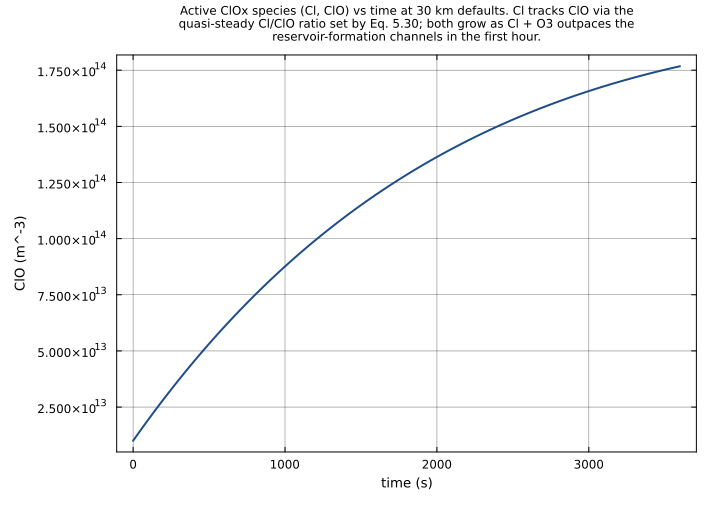
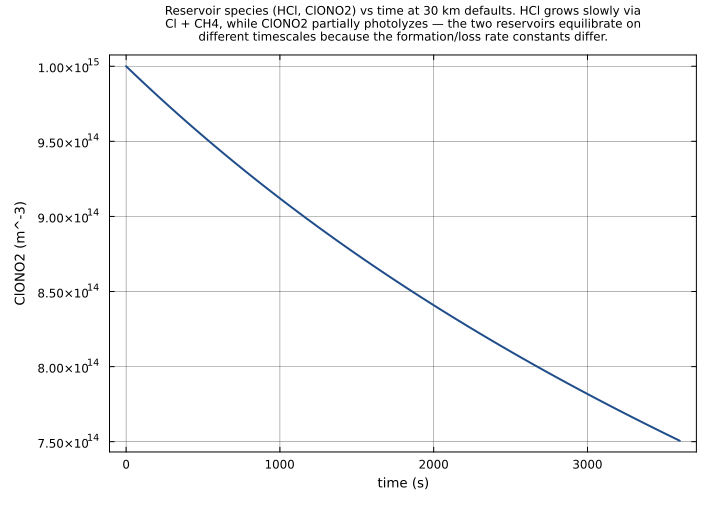
Default 30 km stratospheric run (T = 227 K, M = 3.1e23 m^-3, upstream initial conditions) over 1 hour. Surfaces the canonical ClOx-cycle behavior: ClO grows by ~18x as Cl + O3 drives the catalytic cycle, while HCl slowly accumulates and ClONO2 partially photolyzes. Reproduces the upstream ClOx Cycle Integration reference run (test/StratosphericChemistry_test.jl:182).
Time span: 0.0 → 3600.0
clox_cycle_temperature_sweep
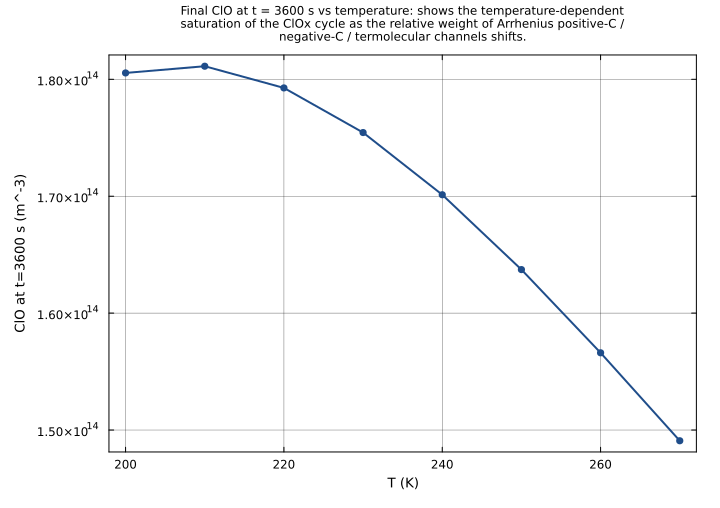
Sweep T over the stratospheric range [200, 270] K at otherwise-default conditions. Surfaces the temperature dependence of the ClOx cycle: ClO at t = 3600 s rises with T (the positive-C Arrhenius channels — ClO + O, ClO + NO, OH + HCl — speed up faster than the negative-C channels — Cl + O3, Cl + CH4 — slow down). The termolecular ClO + NO2 + M → ClONO2 also slows at higher T (k ∝ (T_ref/T)^3.4), shifting the partition away from the ClONO2 reservoir.
Time span: 0.0 → 3600.0
Swept over: T
Raw .esm
Raw .esm JSON (this component)
{
"reference": {
"notes": "source_ref: GasChem.jl@8c12c048482b515fb8eb2110bf8ab4b4f4e71309:src/StratosphericChemistry.jl:272\n\nUpstream `ClOxCycle` is an MTK `@component` with 12 `@constants` (Arrhenius pre-factors and activation temperatures for five binary channels plus the termolecular ClO + NO2 + M reference), 9 `@parameters` (T, M, j_ClONO2, and the six fixed-bath concentrations CH4, O, O3, NO, NO2, OH), and 6 `@variables` (4 time-indexed states Cl, ClO, HCl, ClONO2 + 2 algebraic family sums ClOx, Cly). All 6 equations preserved verbatim: 4 ODEs (D(Cl), D(ClO), D(HCl), D(ClONO2)) + 2 algebraic (ClOx ~ Cl + ClO, Cly ~ Cl + ClO + HCl + ClONO2). The upstream structural test (test/StratosphericChemistry_test.jl:71-81) asserts `length(equations(sys)) == 6` and that Cl, ClO, ClONO2, ClOx appear as states — both preserved here.\n\nUpstream `@constants` are encoded as parameters with their upstream SI default values, matching the convention used by sibling migrations in this rig (snow_thermal.esm encodes physical constants as parameters with default; diameter_growth.esm encodes R_gas, D_diff similarly). Rate coefficients are written inline in the equations as `A * exp(C / T)` (binary) and `A * (T_ref / T)^3.4` (termolecular ClO + NO2 + M) per Seinfeld & Pandis Table B.1/B.2 (pp. 162-167). CGS→SI conversion factors (cm³/molec/s × 1e-6; cm⁶/molec²/s × 1e-12) are folded into the `_A` defaults: e.g. upstream Cl + O3 pre-factor 2.3e-11 cm³/molec/s → 2.3e-17 m³/s.\n\nCly conservation: the upstream `Cly Conservation (ClOx Cycle)` test (test/StratosphericChemistry_test.jl:266-290) asserts that Cly = Cl + ClO + HCl + ClONO2 is conserved to rtol = 1e-6 over a 1 s integration. This is structurally exact for this component — summing the four ODEs:\n\n D(Cl) = -k_Cl_O3·Cl·O3 + k_ClO_O·ClO·O + k_ClO_NO·ClO·NO - k_Cl_CH4·Cl·CH4 + k_OH_HCl·OH·HCl + j_ClONO2·ClONO2\n D(ClO) = +k_Cl_O3·Cl·O3 - k_ClO_O·ClO·O - k_ClO_NO·ClO·NO - k_ClO_NO2_M·ClO·NO2·M\n D(HCl) = +k_Cl_CH4·Cl·CH4 - k_OH_HCl·OH·HCl\n D(ClONO2) = +k_ClO_NO2_M·ClO·NO2·M - j_ClONO2·ClONO2\n Σ = 0\n\nso D(Cly) ≡ 0 analytically and any observed drift in Cly is integrator roundoff — this is why the upstream test uses rtol = 1e-6 over 1 s while internal solver tolerances run at abstol = 1e-12, reltol = 1e-12. The migration preserves this exact conservation structure.\n\nClOx (= Cl + ClO) is NOT conserved: D(ClOx) = -k_Cl_CH4·Cl·CH4 + k_OH_HCl·OH·HCl + j_ClONO2·ClONO2 - k_ClO_NO2_M·ClO·NO2·M, the four-channel exchange between the active ClOx pair and the reservoir species HCl and ClONO2. The Cl + CH4 / OH + HCl pair shuttles between ClOx and HCl; the ClO + NO2 + M / ClONO2 + hν pair shuttles between ClOx and ClONO2.\n\nTolerance rationale (model-level rel=1e-6): reference trajectories from upstream Julia MTK Tsit5 integration at abstol=1e-10, reltol=1e-10. 1e-6 covers Tsit5↔SciPy LSODA truncation over 3600 s plus float64 roundoff. Cly conservation runs at the same 1e-6 — it matches the upstream test tolerance (test/StratosphericChemistry_test.jl:289). Several anchors test small-fractional deltas near the initial reservoir mass (HCl, ClONO2 changing by 0.1-1% over short windows) — these use looser per-assertion abs floors derived from the variable magnitude (~1e15 m^-3 × 1e-6 = 1e9 abs floor).\n\nDomain validity: this is a stratospheric component. Defaults match the upstream component (T = 227 K and M = 3.1e23 m^-3 are ~30 km conditions; CH4 = 1e19 m^-3, O3 = 3e18 m^-3 are typical stratospheric values). All bath species (O, O3, NO, NO2, OH, CH4) are parameters here because the upstream component treats them as such — this cycle is a sub-model that runs against externally-prescribed environmental conditions, not a self-contained chemistry box. Coupling with the larger StratosphericOzoneSystem (test/StratosphericChemistry_test.jl:94+) is what promotes these to dynamical species; that integration is out of scope for this single-component migration."
},
"tolerance": {
"rel": 1e-06
},
"variables": {
"T": {
"type": "parameter",
"units": "K",
"default": 227.0,
"description": "Temperature. Default 227 K matches the upstream component and is the canonical 30 km stratospheric value (Seinfeld & Pandis Table 5.1)."
},
"j_ClONO2": {
"type": "parameter",
"units": "s^-1",
"default": 0.0001,
"description": "ClONO2 photolysis rate (ClONO2 + hν → Cl + NO3)."
},
"CH4": {
"type": "parameter",
"units": "m^-3",
"default": 1e+19,
"description": "Methane number density (1e13 molec/cm^3 × 1e6 → 1e19 m^-3). Drives the Cl + CH4 → HCl reservoir-formation channel."
},
"M": {
"type": "parameter",
"units": "m^-3",
"default": 3.1e+23,
"description": "Air number density at 30 km (3.1e17 molec/cm^3 × 1e6 → 3.1e23 m^-3). Third body for the ClO + NO2 + M → ClONO2 termolecular channel."
},
"O": {
"type": "parameter",
"units": "m^-3",
"default": 10000000000000.0,
"description": "Atomic oxygen number density (1e7 molec/cm^3 × 1e6 → 1e13 m^-3). Drives the ClO + O → Cl + O2 catalytic-cycle closing step."
},
"O3": {
"type": "parameter",
"units": "m^-3",
"default": 3e+18,
"description": "Ozone number density (3e12 molec/cm^3 × 1e6 → 3e18 m^-3). Drives the Cl + O3 → ClO + O2 catalytic-cycle initiating step."
},
"NO": {
"type": "parameter",
"units": "m^-3",
"default": 1000000000000000.0,
"description": "NO number density (1e9 molec/cm^3 × 1e6 → 1e15 m^-3). Drives the ClO + NO → Cl + NO2 alternative recycling channel."
},
"NO2": {
"type": "parameter",
"units": "m^-3",
"default": 1000000000000000.0,
"description": "NO2 number density (1e9 molec/cm^3 × 1e6 → 1e15 m^-3). Reactant in the ClO + NO2 + M → ClONO2 reservoir-formation channel."
},
"OH": {
"type": "parameter",
"units": "m^-3",
"default": 1000000000000.0,
"description": "OH number density (1e6 molec/cm^3 × 1e6 → 1e12 m^-3). Drives the OH + HCl → Cl + H2O reservoir-release channel."
},
"k_Cl_O3_A": {
"type": "parameter",
"units": "m^3/s",
"default": 2.3e-17,
"description": "Arrhenius pre-factor for Cl + O3 → ClO + O2 (upstream constant: 2.3e-11 cm^3/molec/s × 1e-6 → 2.3e-17 m^3/s, Seinfeld & Pandis Table B.1, p. 162)."
},
"C_Cl_O3": {
"type": "parameter",
"units": "K",
"default": -200.0,
"description": "Activation temperature (C = -E_a/R) for Cl + O3 (upstream constant: -200 K, Seinfeld & Pandis p. 162)."
},
"k_ClO_O_A": {
"type": "parameter",
"units": "m^3/s",
"default": 3e-17,
"description": "Arrhenius pre-factor for ClO + O → Cl + O2 (upstream constant: 3.0e-11 cm^3/molec/s × 1e-6 → 3.0e-17 m^3/s, Seinfeld & Pandis Table B.1, p. 162)."
},
"C_ClO_O": {
"type": "parameter",
"units": "K",
"default": 70.0,
"description": "Activation temperature for ClO + O (upstream constant: 70 K, Seinfeld & Pandis p. 162). Positive C means the reaction speeds up at low T (catalytic cycle is more efficient in the cold stratosphere)."
},
"k_ClO_NO_A": {
"type": "parameter",
"units": "m^3/s",
"default": 6.4e-18,
"description": "Arrhenius pre-factor for ClO + NO → Cl + NO2 (upstream constant: 6.4e-12 cm^3/molec/s × 1e-6 → 6.4e-18 m^3/s, Seinfeld & Pandis Table B.1, p. 163)."
},
"C_ClO_NO": {
"type": "parameter",
"units": "K",
"default": 290.0,
"description": "Activation temperature for ClO + NO (upstream constant: 290 K)."
},
"k_Cl_CH4_A": {
"type": "parameter",
"units": "m^3/s",
"default": 9.6e-18,
"description": "Arrhenius pre-factor for Cl + CH4 → HCl + CH3 (upstream constant: 9.6e-12 cm^3/molec/s × 1e-6 → 9.6e-18 m^3/s, Seinfeld & Pandis Table B.1, p. 168)."
},
"C_Cl_CH4": {
"type": "parameter",
"units": "K",
"default": -1360.0,
"description": "Activation temperature for Cl + CH4 (upstream constant: -1360 K — strongly endothermic, slow in the cold stratosphere)."
},
"k_OH_HCl_A": {
"type": "parameter",
"units": "m^3/s",
"default": 2.6e-18,
"description": "Arrhenius pre-factor for OH + HCl → Cl + H2O (upstream constant: 2.6e-12 cm^3/molec/s × 1e-6 → 2.6e-18 m^3/s, Seinfeld & Pandis p. 168)."
},
"C_OH_HCl": {
"type": "parameter",
"units": "K",
"default": -350.0,
"description": "Activation temperature for OH + HCl (upstream constant: -350 K)."
},
"k_ClO_NO2_M_A": {
"type": "parameter",
"units": "m^6/s",
"default": 1.8e-43,
"description": "Pre-factor for the termolecular ClO + NO2 + M → ClONO2 reaction at T_ref = 300 K (upstream constant: 1.8e-31 cm^6/molec^2/s × 1e-12 → 1.8e-43 m^6/s, Seinfeld & Pandis p. 165). Rate is k = A · (T_ref/T)^3.4, not Arrhenius."
},
"T_ref_ClO": {
"type": "parameter",
"units": "K",
"default": 300.0,
"description": "Reference temperature for the ClO + NO2 + M rate law k = k_A · (T_ref/T)^3.4."
},
"Cl": {
"type": "unknown",
"units": "m^-3",
"default": 10000000000.0,
"description": "Cl atom number density (upstream default initial value 1e4 molec/cm^3 × 1e6 → 1e10 m^-3)."
},
"ClO": {
"type": "unknown",
"units": "m^-3",
"default": 10000000000000.0,
"description": "ClO number density (upstream default initial value 1e7 molec/cm^3 × 1e6 → 1e13 m^-3)."
},
"HCl": {
"type": "unknown",
"units": "m^-3",
"default": 1000000000000000.0,
"description": "HCl reservoir number density (upstream default initial value 1e9 molec/cm^3 × 1e6 → 1e15 m^-3)."
},
"ClONO2": {
"type": "unknown",
"units": "m^-3",
"default": 1000000000000000.0,
"description": "ClONO2 reservoir number density (upstream default initial value 1e9 molec/cm^3 × 1e6 → 1e15 m^-3)."
},
"ClOx": {
"type": "unknown",
"units": "m^-3",
"description": "Active chlorine family ClOx = Cl + ClO (algebraic). Catalytically destroys O3 via the Cl + O3 / ClO + O cycle."
},
"Cly": {
"type": "unknown",
"units": "m^-3",
"description": "Total inorganic chlorine Cly = Cl + ClO + HCl + ClONO2 (algebraic). Conserved by the four ODEs (D(Cly) ≡ 0)."
}
},
"equations": [
{
"lhs": {
"op": "D",
"wrt": "t",
"args": [
"Cl"
]
},
"rhs": {
"op": "+",
"args": [
{
"op": "-",
"args": [
{
"op": "*",
"args": [
-1,
{
"op": "*",
"args": [
"k_Cl_O3_A",
{
"op": "exp",
"args": [
{
"op": "/",
"args": [
"C_Cl_O3",
"T"
]
}
]
}
]
},
"Cl",
"O3"
]
},
{
"op": "*",
"args": [
{
"op": "*",
"args": [
"k_Cl_CH4_A",
{
"op": "exp",
"args": [
{
"op": "/",
"args": [
"C_Cl_CH4",
"T"
]
}
]
}
]
},
"Cl",
"CH4"
]
}
]
},
{
"op": "*",
"args": [
{
"op": "*",
"args": [
"k_ClO_O_A",
{
"op": "exp",
"args": [
{
"op": "/",
"args": [
"C_ClO_O",
"T"
]
}
]
}
]
},
"ClO",
"O"
]
},
{
"op": "*",
"args": [
{
"op": "*",
"args": [
"k_ClO_NO_A",
{
"op": "exp",
"args": [
{
"op": "/",
"args": [
"C_ClO_NO",
"T"
]
}
]
}
]
},
"ClO",
"NO"
]
},
{
"op": "*",
"args": [
{
"op": "*",
"args": [
"k_OH_HCl_A",
{
"op": "exp",
"args": [
{
"op": "/",
"args": [
"C_OH_HCl",
"T"
]
}
]
}
]
},
"OH",
"HCl"
]
},
{
"op": "*",
"args": [
"j_ClONO2",
"ClONO2"
]
}
]
}
},
{
"lhs": {
"op": "D",
"wrt": "t",
"args": [
"ClO"
]
},
"rhs": {
"op": "-",
"args": [
{
"op": "*",
"args": [
{
"op": "*",
"args": [
"k_Cl_O3_A",
{
"op": "exp",
"args": [
{
"op": "/",
"args": [
"C_Cl_O3",
"T"
]
}
]
}
]
},
"Cl",
"O3"
]
},
{
"op": "+",
"args": [
{
"op": "*",
"args": [
{
"op": "*",
"args": [
"k_ClO_O_A",
{
"op": "exp",
"args": [
{
"op": "/",
"args": [
"C_ClO_O",
"T"
]
}
]
}
]
},
"ClO",
"O"
]
},
{
"op": "*",
"args": [
{
"op": "*",
"args": [
"k_ClO_NO_A",
{
"op": "exp",
"args": [
{
"op": "/",
"args": [
"C_ClO_NO",
"T"
]
}
]
}
]
},
"ClO",
"NO"
]
},
{
"op": "*",
"args": [
{
"op": "*",
"args": [
"k_ClO_NO2_M_A",
{
"op": "^",
"args": [
{
"op": "/",
"args": [
"T_ref_ClO",
"T"
]
},
3.4
]
}
]
},
"ClO",
"NO2",
"M"
]
}
]
}
]
}
},
{
"lhs": {
"op": "D",
"wrt": "t",
"args": [
"HCl"
]
},
"rhs": {
"op": "-",
"args": [
{
"op": "*",
"args": [
{
"op": "*",
"args": [
"k_Cl_CH4_A",
{
"op": "exp",
"args": [
{
"op": "/",
"args": [
"C_Cl_CH4",
"T"
]
}
]
}
]
},
"Cl",
"CH4"
]
},
{
"op": "*",
"args": [
{
"op": "*",
"args": [
"k_OH_HCl_A",
{
"op": "exp",
"args": [
{
"op": "/",
"args": [
"C_OH_HCl",
"T"
]
}
]
}
]
},
"OH",
"HCl"
]
}
]
}
},
{
"lhs": {
"op": "D",
"wrt": "t",
"args": [
"ClONO2"
]
},
"rhs": {
"op": "-",
"args": [
{
"op": "*",
"args": [
{
"op": "*",
"args": [
"k_ClO_NO2_M_A",
{
"op": "^",
"args": [
{
"op": "/",
"args": [
"T_ref_ClO",
"T"
]
},
3.4
]
}
]
},
"ClO",
"NO2",
"M"
]
},
{
"op": "*",
"args": [
"j_ClONO2",
"ClONO2"
]
}
]
}
},
{
"lhs": "ClOx",
"rhs": {
"op": "+",
"args": [
"Cl",
"ClO"
]
}
},
{
"lhs": "Cly",
"rhs": {
"op": "+",
"args": [
"Cl",
"ClO",
"HCl",
"ClONO2"
]
}
}
],
"tests": [
{
"id": "default_30km_short_window",
"description": "Reference trajectory at upstream default conditions (T = 227 K, M = 3.1e23 m^-3 — 30 km, defaults for all bath species, initial Cl = 1e10, ClO = 1e13, HCl = 1e15, ClONO2 = 1e15). Samples Cl, ClO, HCl, ClONO2, and the algebraic family sums ClOx and Cly at t = 0, 1, 60, 600 s. Pinned from upstream Julia MTK Tsit5 integration at abstol=1e-10, reltol=1e-10. Exercises all four ODE channels (Cl + O3, ClO + O, ClO + NO, Cl + CH4, OH + HCl, ClO + NO2 + M, j_ClONO2) and both algebraic family sums simultaneously.",
"time_span": {
"start": 0.0,
"end": 600.0
},
"assertions": [
{
"variable": "Cl",
"time": 0.0,
"expected": 10000000000.0
},
{
"variable": "ClO",
"time": 0.0,
"expected": 10000000000000.0
},
{
"variable": "HCl",
"time": 0.0,
"expected": 1000000000000000.0
},
{
"variable": "ClONO2",
"time": 0.0,
"expected": 1000000000000000.0
},
{
"variable": "ClOx",
"time": 0.0,
"expected": 10010000000000.0
},
{
"variable": "Cly",
"time": 0.0,
"expected": 2010010000000000.0
},
{
"variable": "Cl",
"time": 1.0,
"expected": 11667854808.897636
},
{
"variable": "ClO",
"time": 1.0,
"expected": 10094658379034.93
},
{
"variable": "HCl",
"time": 1.0,
"expected": 1000002222141430.2,
"tolerance": {
"abs": 1000000000.0
}
},
{
"variable": "ClONO2",
"time": 1.0,
"expected": 999901451624726.2,
"tolerance": {
"abs": 1000000000.0
}
},
{
"variable": "ClOx",
"time": 1.0,
"expected": 10106326233843.828
},
{
"variable": "Cl",
"time": 60.0,
"expected": 16190275896.757105
},
{
"variable": "ClO",
"time": 60.0,
"expected": 15698213820352.043
},
{
"variable": "ClOx",
"time": 60.0,
"expected": 15714404096248.8
},
{
"variable": "Cl",
"time": 600.0,
"expected": 52499282405.076584
},
{
"variable": "ClO",
"time": 600.0,
"expected": 60699774240375.87
},
{
"variable": "HCl",
"time": 600.0,
"expected": 1004412905738617.2
},
{
"variable": "ClONO2",
"time": 600.0,
"expected": 944844820738602.4
},
{
"variable": "ClOx",
"time": 600.0,
"expected": 60752273522780.945
}
]
},
{
"id": "default_30km_long_window_one_hour",
"description": "Same upstream-default conditions extended to t = 3600 s (1 hour) — the exact window of the upstream `ClOx Cycle Integration` test (test/StratosphericChemistry_test.jl:182-202). At this point HCl has grown ~8% (~1.08e15) and ClONO2 has dropped ~25% (~7.5e14), as ClO + NO2 + M / ClONO2 + hν has not yet reached steady state and the Cl + CH4 / OH + HCl channel slowly transfers Cl into HCl. Exercises long-window numerical agreement and verifies positivity-preservation (all species ≥ 0) as the upstream test asserts.",
"time_span": {
"start": 0.0,
"end": 3600.0
},
"assertions": [
{
"variable": "Cl",
"time": 3600.0,
"expected": 145917563476.57654
},
{
"variable": "ClO",
"time": 3600.0,
"expected": 176769411036707.2
},
{
"variable": "HCl",
"time": 3600.0,
"expected": 1082448634324647.6
},
{
"variable": "ClONO2",
"time": 3600.0,
"expected": 750646037075181.4
},
{
"variable": "ClOx",
"time": 3600.0,
"expected": 176915328600183.75
}
]
},
{
"id": "cly_conservation_short_window",
"description": "Reproduces the upstream `Cly Conservation (ClOx Cycle)` test (test/StratosphericChemistry_test.jl:266-290): integrating 1 s under defaults, total inorganic chlorine Cly = Cl + ClO + HCl + ClONO2 must remain at its initial value 2.01001e15 m^-3 to rtol = 1e-6. Analytically D(Cly) = D(Cl) + D(ClO) + D(HCl) + D(ClONO2) ≡ 0, so any deviation is integrator roundoff. Samples Cly at three points spanning the integration window.",
"time_span": {
"start": 0.0,
"end": 1.0
},
"assertions": [
{
"variable": "Cly",
"time": 0.0,
"expected": 2010010000000000.0
},
{
"variable": "Cly",
"time": 0.1,
"expected": 2010010000000000.5
},
{
"variable": "Cly",
"time": 0.5,
"expected": 2010010000000000.5
},
{
"variable": "Cly",
"time": 1.0,
"expected": 2010010000000000.5
}
]
},
{
"id": "warm_temperature_40km",
"description": "Reference trajectory at T = 251 K (40 km conditions, Seinfeld & Pandis Table 5.1) with all other parameters at defaults. Warmer T accelerates the Arrhenius positive-C channels (ClO + O, ClO + NO, OH + HCl) and slows the negative-C channels (Cl + O3, Cl + CH4) — net effect is faster ClOx cycling (ClO at 1 hour ≈ 1.63e14, vs ~1.77e14 at 30 km). Exercises the temperature-dependent rate-law branch at a textbook-relevant altitude. Reference values pinned from upstream Tsit5 integration.",
"time_span": {
"start": 0.0,
"end": 3600.0
},
"parameter_overrides": {
"T": 251.0
},
"assertions": [
{
"variable": "Cl",
"time": 600.0,
"expected": 42172605375.89072
},
{
"variable": "ClO",
"time": 600.0,
"expected": 59592773138181.42
},
{
"variable": "HCl",
"time": 600.0,
"expected": 1006449594334760.8
},
{
"variable": "ClONO2",
"time": 600.0,
"expected": 943925459921681.9
},
{
"variable": "Cl",
"time": 3600.0,
"expected": 109484925766.25302
},
{
"variable": "ClO",
"time": 3600.0,
"expected": 163039344052707.62
},
{
"variable": "HCl",
"time": 3600.0,
"expected": 1113523856447711.2
},
{
"variable": "ClONO2",
"time": 3600.0,
"expected": 733337314573806.8
}
]
},
{
"id": "no_methane_channel",
"description": "Methane-free scenario (CH4 = 0). Eliminates the Cl + CH4 → HCl reservoir-formation channel, so HCl can only decrease (OH + HCl → Cl is the only HCl term). After 1 hour HCl has dropped ~0.2% (vs growing ~8% at default CH4) because the only HCl source is the externally-prescribed OH + HCl reaction. Exercises the parameter-sweep behavior of the CH4 channel; reference values pinned from upstream Tsit5 integration.",
"time_span": {
"start": 0.0,
"end": 3600.0
},
"parameter_overrides": {
"CH4": 0.0
},
"assertions": [
{
"variable": "Cl",
"time": 60.0,
"expected": 16488836255.480213
},
{
"variable": "ClO",
"time": 60.0,
"expected": 15897307817018.953
},
{
"variable": "HCl",
"time": 600.0,
"expected": 999666239397679.0,
"tolerance": {
"abs": 10000000000.0
}
},
{
"variable": "HCl",
"time": 3600.0,
"expected": 997999106584768.9,
"tolerance": {
"abs": 10000000000.0
}
},
{
"variable": "ClO",
"time": 3600.0,
"expected": 247575679957642.84
}
]
},
{
"id": "no_no2_channel",
"description": "NO2-free scenario (NO2 = 0). Eliminates the ClO + NO2 + M → ClONO2 reservoir-formation channel, so ClONO2 can only decrease (ClONO2 + hν → Cl is the only ClONO2 term). After 1 hour ClONO2 has dropped ~30% (vs ~25% at default NO2) because the photolysis loss is no longer balanced by formation. Exercises the parameter-sweep behavior of the termolecular ClO + NO2 + M channel; reference values pinned from upstream Tsit5 integration.",
"time_span": {
"start": 0.0,
"end": 3600.0
},
"parameter_overrides": {
"NO2": 0.0
},
"assertions": [
{
"variable": "Cl",
"time": 60.0,
"expected": 16279100182.742704
},
{
"variable": "ClO",
"time": 60.0,
"expected": 15808340135467.223
},
{
"variable": "ClONO2",
"time": 600.0,
"expected": 941764533584252.1
},
{
"variable": "ClONO2",
"time": 3600.0,
"expected": 697676326071035.1
},
{
"variable": "ClO",
"time": 3600.0,
"expected": 217428446195968.0
}
]
}
],
"analyses": [
{
"id": "clox_cycle_default_one_hour",
"description": "Default 30 km stratospheric run (T = 227 K, M = 3.1e23 m^-3, upstream initial conditions) over 1 hour. Surfaces the canonical ClOx-cycle behavior: ClO grows by ~18x as Cl + O3 drives the catalytic cycle, while HCl slowly accumulates and ClONO2 partially photolyzes. Reproduces the upstream `ClOx Cycle Integration` reference run (test/StratosphericChemistry_test.jl:182).",
"initial_state": {
"Cl": 10000000000.0,
"ClO": 10000000000000.0,
"HCl": 1000000000000000.0,
"ClONO2": 1000000000000000.0
},
"time_span": {
"start": 0.0,
"end": 3600.0
},
"plots": [
{
"id": "active_clox_vs_time",
"type": "line",
"description": "Active ClOx species (Cl, ClO) vs time at 30 km defaults. Cl tracks ClO via the quasi-steady Cl/ClO ratio set by Eq. 5.30; both grow as Cl + O3 outpaces the reservoir-formation channels in the first hour.",
"x": {
"variable": "t",
"label": "time (s)"
},
"y": {
"variable": "ClO",
"label": "ClO (m^-3)"
}
},
{
"id": "reservoir_species_vs_time",
"type": "line",
"description": "Reservoir species (HCl, ClONO2) vs time at 30 km defaults. HCl grows slowly via Cl + CH4, while ClONO2 partially photolyzes — the two reservoirs equilibrate on different timescales because the formation/loss rate constants differ.",
"x": {
"variable": "t",
"label": "time (s)"
},
"y": {
"variable": "ClONO2",
"label": "ClONO2 (m^-3)"
}
},
{
"id": "cly_conservation_vs_time",
"type": "line",
"description": "Total inorganic chlorine Cly = Cl + ClO + HCl + ClONO2 vs time at 30 km defaults. Should remain constant at the initial value 2.01001e15 m^-3 — the upstream Cly Conservation test reference plot.",
"x": {
"variable": "t",
"label": "time (s)"
},
"y": {
"variable": "Cly",
"label": "Cly (m^-3)"
}
}
]
},
{
"id": "clox_cycle_temperature_sweep",
"description": "Sweep T over the stratospheric range [200, 270] K at otherwise-default conditions. Surfaces the temperature dependence of the ClOx cycle: ClO at t = 3600 s rises with T (the positive-C Arrhenius channels — ClO + O, ClO + NO, OH + HCl — speed up faster than the negative-C channels — Cl + O3, Cl + CH4 — slow down). The termolecular ClO + NO2 + M → ClONO2 also slows at higher T (k ∝ (T_ref/T)^3.4), shifting the partition away from the ClONO2 reservoir.",
"initial_state": {
"Cl": 10000000000.0,
"ClO": 10000000000000.0,
"HCl": 1000000000000000.0,
"ClONO2": 1000000000000000.0
},
"time_span": {
"start": 0.0,
"end": 3600.0
},
"parameter_sweep": {
"type": "cartesian",
"dimensions": [
{
"parameter": "T",
"range": {
"start": 200.0,
"stop": 270.0,
"count": 8,
"scale": "linear"
}
}
]
},
"plots": [
{
"id": "ClO_final_vs_T",
"type": "line",
"description": "Final ClO at t = 3600 s vs temperature: shows the temperature-dependent saturation of the ClOx cycle as the relative weight of Arrhenius positive-C / negative-C / termolecular channels shifts.",
"x": {
"variable": "T",
"label": "T (K)"
},
"y": {
"variable": "ClO",
"label": "ClO at t=3600 s (m^-3)"
}
}
]
}
]
}