StefanBoltzmann
Stefan-Boltzmann law for blackbody radiation — Seinfeld & Pandis (2006) Ch. 4 Eq. 4.4. Total emissive power F_B of a blackbody at temperature T integrated over all wavelengths: F_B = σ·T^4, where σ = 5.671×10⁻⁸ W·m⁻²·K⁻⁴. Migrated from GasChem.jl@8c12c048 src/radiation_fundamentals.jl:164 (`StefanBoltzmann` @component). One observed binding (F_B) over two parameters (T input + σ as a fixed-default parameter encoding the upstream `@constants` block per the rig convention of translating `@constants` to fixed-default parameters so units flow through MTK's unit checker — matches sibling clmu_atmosphere.esm/surface_energy_flux.esm). Closed-form algebraic: after mtkcompile the system has zero ODE states and the inline-test runner exercises F_B at its observed algebraic value.
Description
Stefan-Boltzmann law for blackbody radiation — Seinfeld & Pandis (2006) Ch. 4 Eq. 4.4. Total emissive power F_B of a blackbody at temperature T integrated over all wavelengths: F_B = σ·T^4, where σ = 5.671×10⁻⁸ W·m⁻²·K⁻⁴. Migrated from GasChem.jl@8c12c048 src/radiation_fundamentals.jl:164 (StefanBoltzmann @component). One observed binding (F_B) over two parameters (T input + σ as a fixed-default parameter encoding the upstream @constants block per the rig convention of translating @constants to fixed-default parameters so units flow through MTK’s unit checker — matches sibling clmu_atmosphere.esm/surface_energy_flux.esm). Closed-form algebraic: after mtkcompile the system has zero ODE states and the inline-test runner exercises F_B at its observed algebraic value.
Reference
_source_ref: GasChem.jl@8c12c048482b515fb8eb2110bf8ab4b4f4e71309:src/radiation_fundamentals.jl:164
Upstream StefanBoltzmann is an MTK @component with one algebraic equation F_B ~ σ * T^4, one @constants (σ = 5.671e-8 W·m⁻²·K⁻⁴, Seinfeld & Pandis Page 101), one @parameters (T = 255 K Earth-equilibrium default), and one @variables (F_B in W/m²). After mtkcompile the system collapses to zero ODE states and one observed binding for F_B.
Observability classification: F_B is an algebraic function of T and σ — bound as a type: observed variable with its expression carrying the Eq. 4.4 right-hand side σ·T^4.
Constant→parameter translation: the upstream @constants σ = 5.671e-8 is encoded as a fixed-default parameter σ carrying the upstream Float64 value bit-for-bit. This mirrors the sibling convention in clmu_atmosphere.esm/surface_energy_flux.esm of translating @constants to fixed-default parameters (a) so MTK’s unit checker sees σ as a named quantity rather than a magic literal in the equation RHS, and (b) so any sensitivity study can override σ if it ever needs to (the default value is the canonical Seinfeld & Pandis Eq. 4.4 value and is not expected to change in routine use).
Tolerance rationale (model-level rel=1e-10 / abs=1e-12): F_B = σ·T^4 is a two-step IEEE-754 evaluation (one ^ + one ×) over fixed Float64 inputs, so rel=1e-10 captures float64 ULP roundoff with ~6 orders of magnitude margin to the ~1e-16 IEEE-754 ULP floor. abs=1e-12 floors the T=0 sentinel (F_B → 0) and any near-zero-K cold-limit testing. Matches the closed-form-algebraic tolerance convention in sibling cloud_albedo.esm (rel=1e-8) and critical_ssa.esm (rel=1e-8); the tighter 1e-10 here reflects the simpler two-op expression._
Parameters
| Name | Units | Default | Description |
|---|---|---|---|
T | K | 255.0 | Temperature (input parameter; default 255 K is Earth’s equilibrium temperature per S&P Page 101) |
σ | W/(m^2*K^4) | 5.671e-08 | Stefan-Boltzmann constant (upstream @constants value 5.671×10⁻⁸ W·m⁻²·K⁻⁴ from S&P Page 101; encoded as a fixed-default parameter per rig convention) |
Observed
| Name | Units | Default | Description |
|---|---|---|---|
F_B | W/m^2 | Total blackbody emissive power (Eq. 4.4): F_B = σ·T^4 integrated over all wavelengths. |
Observed expressions
$$ F_{B} = σ \cdot T^{4} $$Total blackbody emissive power (Eq. 4.4): F_B = σ·T^4 integrated over all wavelengths.
Analyses
F_B_vs_T_canonical_curve
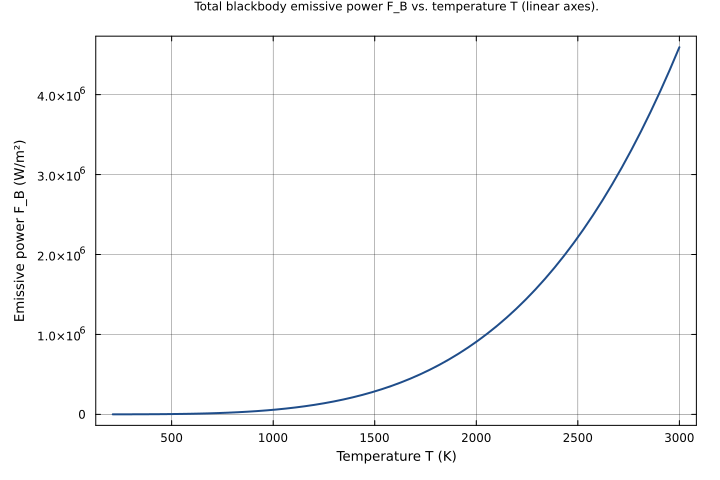
Stefan-Boltzmann F_B = σ·T^4 over the planetary-temperature range covering Mars (~210 K), Earth (~255 K equilibrium / ~288 K surface), Venus (~735 K surface) up through cool-star photospheres (~3000 K). Confirms the T^4 monotonic increase: F_B rises by ~262× over the 210-3000 K range (T-ratio 14.29, T^4 ratio ≈ 41680). The Earth-equilibrium point (255 K, 239.78 W/m²) is the canonical S&P Page 101 anchor; the visible-light onset at ~3000 K marks where blackbody emission shifts from longwave to optical regime.
Time span: 0.0 → 1.0
Swept over: T
F_B_vs_T_log_sweep_solar
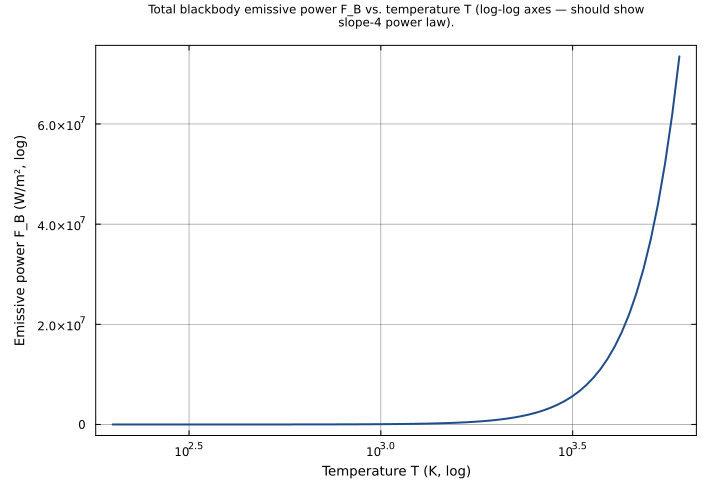
Stefan-Boltzmann log-T sweep spanning planetary equilibrium temperatures (~200 K cold outer-planet) through solar photosphere (~6000 K). On a log-log plot F_B = σ·T^4 is a straight line with slope 4; confirms the T^4 scaling visually across ~5 orders of magnitude in F_B (from ~10² W/m² at 200 K to ~10⁸ W/m² at 6000 K). The reference points Earth (255 K, ~240 W/m²) and Sun (5800 K, ~6.42e7 W/m²) bracket the canonical S&P examples.
Time span: 0.0 → 1.0
Swept over: T
Raw .esm
Raw .esm JSON (this component)
{
  "reference": {
    "notes": "source_ref: GasChem.jl@8c12c048482b515fb8eb2110bf8ab4b4f4e71309:src/radiation_fundamentals.jl:164\nUpstream `StefanBoltzmann` is an MTK `@component` with one algebraic equation `F_B ~ σ * T^4`, one `@constants` (σ = 5.671e-8 W·m⁻²·K⁻⁴, Seinfeld & Pandis Page 101), one `@parameters` (T = 255 K Earth-equilibrium default), and one `@variables` (F_B in W/m²). After mtkcompile the system collapses to zero ODE states and one observed binding for F_B.\n\nObservability classification: F_B is an algebraic function of T and σ — bound as a `type: observed` variable with its `expression` carrying the Eq. 4.4 right-hand side σ·T^4.\n\nConstant→parameter translation: the upstream `@constants σ = 5.671e-8` is encoded as a fixed-default parameter `σ` carrying the upstream Float64 value bit-for-bit. This mirrors the sibling convention in clmu_atmosphere.esm/surface_energy_flux.esm of translating `@constants` to fixed-default parameters (a) so MTK's unit checker sees σ as a named quantity rather than a magic literal in the equation RHS, and (b) so any sensitivity study can override σ if it ever needs to (the default value is the canonical Seinfeld & Pandis Eq. 4.4 value and is not expected to change in routine use).\n\nTolerance rationale (model-level rel=1e-10 / abs=1e-12): F_B = σ·T^4 is a two-step IEEE-754 evaluation (one ^ + one ×) over fixed Float64 inputs, so rel=1e-10 captures float64 ULP roundoff with ~6 orders of magnitude margin to the ~1e-16 IEEE-754 ULP floor. abs=1e-12 floors the T=0 sentinel (F_B → 0) and any near-zero-K cold-limit testing. Matches the closed-form-algebraic tolerance convention in sibling cloud_albedo.esm (rel=1e-8) and critical_ssa.esm (rel=1e-8); the tighter 1e-10 here reflects the simpler two-op expression."
  },
  "variables": {
    "T": {
      "type": "parameter",
      "units": "K",
      "default": 255.0,
      "description": "Temperature (input parameter; default 255 K is Earth's equilibrium temperature per S&P Page 101)"
    },
    "σ": {
      "type": "parameter",
      "units": "W/(m^2*K^4)",
      "default": 5.671e-08,
      "description": "Stefan-Boltzmann constant (upstream `@constants` value 5.671×10⁻⁸ W·m⁻²·K⁻⁴ from S&P Page 101; encoded as a fixed-default parameter per rig convention)"
    },
    "F_B": {
      "type": "unknown",
      "units": "W/m^2",
      "description": "Total blackbody emissive power (Eq. 4.4): F_B = σ·T^4 integrated over all wavelengths."
    }
  },
  "equations": [
    {
      "lhs": "F_B",
      "rhs": {
        "op": "*",
        "args": [
          "σ",
          {
            "op": "^",
            "args": [
              "T",
              4
            ]
          }
        ]
      }
    }
  ],
  "tolerance": {
    "rel": 1e-10,
    "abs": 1e-12
  },
  "tests": [
    {
      "id": "upstream_earth_equilibrium_T255",
      "description": "Reproduces the upstream `Equation: StefanBoltzmann (Eq. 4.4)` testitem default case from GasChem.jl test/radiation_fundamentals_test.jl. At T = 255 K (Earth's equilibrium temperature, Seinfeld & Pandis Page 101), F_B = 5.671e-8 × 255^4 = 239.78409294375 W/m². Upstream asserts rtol = 1e-2 against 239.7; we pin the exact analytic value at full Float64 precision.",
      "parameter_overrides": {
        "T": 255.0
      },
      "time_span": {
        "start": 0.0,
        "end": 1.0
      },
      "assertions": [
        {
          "variable": "F_B",
          "time": 0.0,
          "expected": 239.78409294375
        },
        {
          "variable": "F_B",
          "time": 1.0,
          "expected": 239.78409294375
        }
      ]
    },
    {
      "id": "upstream_solar_surface_T5800",
      "description": "Reproduces the upstream `Equation: StefanBoltzmann (Eq. 4.4)` second case at T = 5800 K (Sun's effective surface temperature). F_B = 5.671e-8 × 5800^4 = 5.671e-8 × 1.1316496e15 = 64175848.816 W/m². Upstream asserts rtol = 1e-2 against 6.42e7; we pin the exact analytic value at full Float64 precision.",
      "parameter_overrides": {
        "T": 5800.0
      },
      "time_span": {
        "start": 0.0,
        "end": 1.0
      },
      "assertions": [
        {
          "variable": "F_B",
          "time": 0.0,
          "expected": 64175848.816
        },
        {
          "variable": "F_B",
          "time": 1.0,
          "expected": 64175848.816
        }
      ]
    },
    {
      "id": "cold_limit_T100",
      "description": "Cold-limit cross-check well below Earth's equilibrium temperature. At T = 100 K, F_B = 5.671e-8 × 100^4 = 5.671 W/m². Anchors the T^4 scaling: 100 K is ~2.55× below 255 K, so F_B drops by (2.55)^4 ≈ 42× relative to the Earth-equilibrium case.",
      "parameter_overrides": {
        "T": 100.0
      },
      "time_span": {
        "start": 0.0,
        "end": 1.0
      },
      "assertions": [
        {
          "variable": "F_B",
          "time": 0.0,
          "expected": 5.671
        }
      ]
    },
    {
      "id": "hot_limit_T1000",
      "description": "Hot-limit cross-check intermediate between Earth equilibrium (255 K) and Sun surface (5800 K). At T = 1000 K, F_B = 5.671e-8 × 1000^4 = 56710 W/m². Anchors the T^4 scaling at a round value: a 3.92× temperature increase over 255 K gives a (3.92)^4 ≈ 236× increase in F_B.",
      "parameter_overrides": {
        "T": 1000.0
      },
      "time_span": {
        "start": 0.0,
        "end": 1.0
      },
      "assertions": [
        {
          "variable": "F_B",
          "time": 0.0,
          "expected": 56710.0
        }
      ]
    },
    {
      "id": "zero_temperature_limit",
      "description": "Boundary case T = 0 K → F_B = 0 W/m² (T^4 collapses the σ·T^4 product). Uses abs tolerance to gate the stuck-at-non-zero failure mode. Physically T = 0 is the absolute-zero limit; the model's algebraic equation evaluates exactly at IEEE-754 zero.",
      "parameter_overrides": {
        "T": 0.0
      },
      "time_span": {
        "start": 0.0,
        "end": 1.0
      },
      "assertions": [
        {
          "variable": "F_B",
          "time": 0.0,
          "expected": 0.0,
          "tolerance": {
            "abs": 1e-12
          }
        }
      ]
    },
    {
      "id": "doubling_T_amplifies_16x",
      "description": "Verifies the canonical T^4 quartic scaling by doubling T = 255 K to T = 510 K. Expected ratio F_B(510)/F_B(255) = 2^4 = 16 exactly. At T = 510 K, F_B = 5.671e-8 × 510^4 = 3836.5454871 W/m² = 16 × 239.78409294375 W/m².",
      "parameter_overrides": {
        "T": 510.0
      },
      "time_span": {
        "start": 0.0,
        "end": 1.0
      },
      "assertions": [
        {
          "variable": "F_B",
          "time": 0.0,
          "expected": 3836.5454871
        }
      ]
    },
    {
      "id": "sigma_override_sensitivity",
      "description": "Verifies the parameter-passthrough of σ at T = 255 K. Overriding σ to 1.0 W/(m²·K⁴) (a non-physical sentinel) makes F_B = 1.0 × 255^4 = 4.228250625e9 W/m² — confirms σ acts as a linear multiplier in the observed binding and is not accidentally hard-coded into the expression. Pinned at the analytic Float64 value.",
      "parameter_overrides": {
        "T": 255.0,
        "σ": 1.0
      },
      "time_span": {
        "start": 0.0,
        "end": 1.0
      },
      "assertions": [
        {
          "variable": "F_B",
          "time": 0.0,
          "expected": 4228250625.0
        }
      ]
    }
  ],
  "analyses": [
    {
      "id": "F_B_vs_T_canonical_curve",
      "description": "Stefan-Boltzmann F_B = σ·T^4 over the planetary-temperature range covering Mars (~210 K), Earth (~255 K equilibrium / ~288 K surface), Venus (~735 K surface) up through cool-star photospheres (~3000 K). Confirms the T^4 monotonic increase: F_B rises by ~262× over the 210-3000 K range (T-ratio 14.29, T^4 ratio ≈ 41680). The Earth-equilibrium point (255 K, 239.78 W/m²) is the canonical S&P Page 101 anchor; the visible-light onset at ~3000 K marks where blackbody emission shifts from longwave to optical regime.",
      "time_span": {
        "start": 0.0,
        "end": 1.0
      },
      "parameter_sweep": {
        "type": "cartesian",
        "dimensions": [
          {
            "parameter": "T",
            "range": {
              "start": 210.0,
              "stop": 3000.0,
              "count": 60,
              "scale": "linear"
            }
          }
        ]
      },
      "plots": [
        {
          "id": "F_B_vs_T_linear",
          "type": "line",
          "description": "Total blackbody emissive power F_B vs. temperature T (linear axes).",
          "x": {
            "variable": "T",
            "label": "Temperature T (K)"
          },
          "y": {
            "variable": "F_B",
            "label": "Emissive power F_B (W/m²)"
          }
        }
      ]
    },
    {
      "id": "F_B_vs_T_log_sweep_solar",
      "description": "Stefan-Boltzmann log-T sweep spanning planetary equilibrium temperatures (~200 K cold outer-planet) through solar photosphere (~6000 K). On a log-log plot F_B = σ·T^4 is a straight line with slope 4; confirms the T^4 scaling visually across ~5 orders of magnitude in F_B (from ~10² W/m² at 200 K to ~10⁸ W/m² at 6000 K). The reference points Earth (255 K, ~240 W/m²) and Sun (5800 K, ~6.42e7 W/m²) bracket the canonical S&P examples.",
      "time_span": {
        "start": 0.0,
        "end": 1.0
      },
      "parameter_sweep": {
        "type": "cartesian",
        "dimensions": [
          {
            "parameter": "T",
            "range": {
              "start": 200.0,
              "stop": 6000.0,
              "count": 80,
              "scale": "log"
            }
          }
        ]
      },
      "plots": [
        {
          "id": "F_B_vs_T_log",
          "type": "line",
          "description": "Total blackbody emissive power F_B vs. temperature T (log-log axes — should show slope-4 power law).",
          "x": {
            "variable": "T",
            "label": "Temperature T (K, log)"
          },
          "y": {
            "variable": "F_B",
            "label": "Emissive power F_B (W/m², log)"
          }
        }
      ]
    }
  ]
}