arrh
The five SuperFast rate-law helper functions migrated from GasChem.jl@8c12c048482b515fb8eb2110bf8ab4b4f4e71309 src/SuperFast.jl — the reusable builder functions the SuperFast() chemical mechanism uses to construct the rate coefficient of every gas-phase reaction. Each is migrated as its own observed-only algebraic `models` entry: rate_toppb (SuperFast.jl:6) the constant-rate / `constant_k` converter, arrh (:33) the modified-Arrhenius workhorse, arr_3rd (:64) the third-body / Troe-falloff law, rate_2HO2 (:102) the HO2+HO2 law with water-vapour enhancement, and rate_OH_CO (:142) the JPL 15-10 OH+CO law. Upstream each function returns a one-variable ReactionSystem (`@variables k(t)`); the composed builders (arr_3rd, rate_2HO2, rate_OH_CO) compose `arrh` sub-systems. This file reproduces each function's compiled rate as a topologically-ordered cascade of `type: state` algebraic equations whose named intermediates mirror the upstream Julia locals and sub-system k's verbatim, with the Arrhenius coefficients exposed as `type: parameter` (defaults taken from the representative SuperFast reaction each builder serves). All five models are purely algebraic — no time derivatives — so each rate coefficient is constant in time. Units follow the upstream's mixed CGS / ppb system (rate coefficients in 1/(s*ppb), Arrhenius pre-exponentials in cm^3/molec/s).
Description
The five SuperFast rate-law helper functions migrated from GasChem.jl@8c12c048482b515fb8eb2110bf8ab4b4f4e71309 src/SuperFast.jl — the reusable builder functions the SuperFast() chemical mechanism uses to construct the rate coefficient of every gas-phase reaction. Each is migrated as its own observed-only algebraic models entry: rate_toppb (SuperFast.jl:6) the constant-rate / constant_k converter, arrh (:33) the modified-Arrhenius workhorse, arr_3rd (:64) the third-body / Troe-falloff law, rate_2HO2 (:102) the HO2+HO2 law with water-vapour enhancement, and rate_OH_CO (:142) the JPL 15-10 OH+CO law. Upstream each function returns a one-variable ReactionSystem (@variables k(t)); the composed builders (arr_3rd, rate_2HO2, rate_OH_CO) compose arrh sub-systems. This file reproduces each function’s compiled rate as a topologically-ordered cascade of type: state algebraic equations whose named intermediates mirror the upstream Julia locals and sub-system k’s verbatim, with the Arrhenius coefficients exposed as type: parameter (defaults taken from the representative SuperFast reaction each builder serves). All five models are purely algebraic — no time derivatives — so each rate coefficient is constant in time. Units follow the upstream’s mixed CGS / ppb system (rate coefficients in 1/(s*ppb), Arrhenius pre-exponentials in cm^3/molec/s).
Reference
_source_ref: GasChem.jl@8c12c048482b515fb8eb2110bf8ab4b4f4e71309:src/SuperFast.jl:33
arrh(t, T, P, a0, b0, c0) is the SuperFast modified-Arrhenius rate builder. It is the workhorse rate law of the SuperFast mechanism: most of the ~20 gas-phase reactions in SuperFast() are built with it (through the local arr closure), and the three other builders in this file (arr_3rd, rate_2HO2, rate_OH_CO) all compose arrh sub-systems internally.
The compiled equation is k ~ a0 * exp(c0/T) * (K_300/T)^b0 * c, with air_volume = R*T/P and c = A/air_volume*ppb_unit as Julia locals. NOTE the exponent base: the source CODE uses (K_300/T)^b0 = (300/T)^b0, whereas the function’s docstring writes (T/300)^b0 — the code is authoritative and is what every SuperFast reaction actually uses, so this migration transcribes (K_300/T)^b0. air_volume and c are type: state cascade variables; k is the type: state output. a0/b0/c0 and A/R/ppb_unit/K_300 are type: parameter; the unused upstream @constants num_density_unit_inv is omitted.
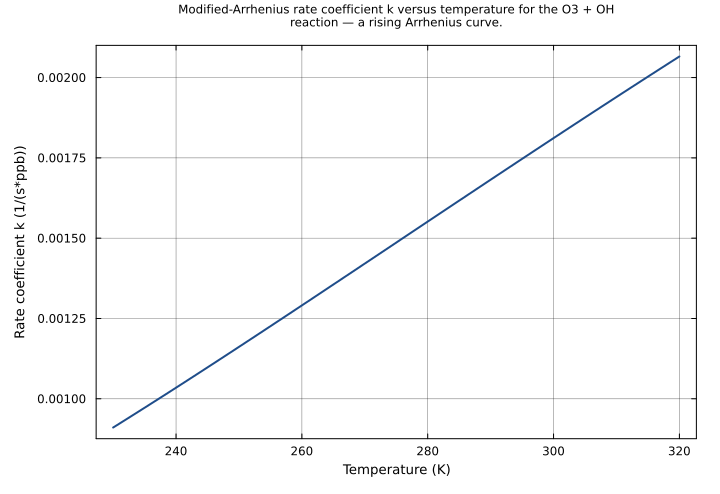
Defaults a0 = 1.7e-12 cm^3/molec/s, b0 = 0 (dimensionless), c0 = -940 K are the coefficients of the first SuperFast reaction, arr(T, P, 1.7e-12, 0.0, -940.0), O3 + OH --> HO2 + O2 (SuperFast.jl:275). With b0 = 0 the (K_300/T)^b0 factor is exactly 1.0; the b0_nonzero test exercises a non-trivial power-law factor and the o3_no_reaction_coefficients test swaps in a second real SuperFast coefficient set. At the defaults k = 0.0015516914092470017 (s*ppb)^-1.
Algebraic, no time derivative. Tolerance rel=1e-10, purely relative: the equation adds one exp and one pow to the rate_toppb expression tree; both are correctly-rounded library calls and 1e-10 absorbs any libm/numpy ULP-level difference while still pinning a0, b0, c0 and the (K_300/T) base to full working precision._
Parameters
| Name | Units | Default | Description |
|---|---|---|---|
T | K | 280.0 | Air temperature. Upstream the rate-law builders receive T as a ParentScope parameter; the default 280.0 K is the SuperFast() @parameters T default (SuperFast.jl:250). |
P | Pa | 101325.0 | Air pressure. Upstream a ParentScope parameter; the default 101325 Pa (1 atm) is the SuperFast() @parameters P default (SuperFast.jl:251). |
A | molec/mol | 6.02e+23 | Avogadro’s number. Upstream @constants A = 6.02e23 (SuperFast.jl). Appears in the ppb conversion factor c = A/air_volume*ppb_unit. |
R | (Pa*cm^3)/(K*mol) | 8314000.0 | Universal gas constant in the upstream’s mixed Pa-cm^3 unit system. Upstream @constants R = 8.314e6. Sets the molar air volume air_volume = R*T/P. |
ppb_unit | 1/ppb | 1e-09 | mol/mol_air per ppb: 1 ppb is 1e-9 mol/mol, so the factor is 1e-9 with units 1/ppb, and c = A/air_volumeppb_unit carries molec/(cm^3ppb). Upstream @constants ppb_unit = 1.0e-9 declares the unit as ppb, the exponent the wrong way round (the value is unchanged). |
K_300 | K | 300.0 | Arrhenius reference temperature (300 K). Upstream @constants K_300 = 300. |
a0 | cm^3/molec/s | 1.7e-12 | Arrhenius pre-exponential factor in CGS cm^3/molec/s. Default 1.7e-12 from O3 + OH --> HO2 + O2 (SuperFast.jl:275). |
b0 | 1 | 0.0 | Arrhenius power-law (temperature) exponent for the (K_300/T)^b0 factor. Default 0.0 (no power-law dependence) from O3 + OH --> HO2 + O2. |
c0 | K | -940.0 | Arrhenius activation-temperature parameter (-Ea/R) in K for the exp(c0/T) factor. Default -940.0 from O3 + OH --> HO2 + O2. |
Observed
| Name | Units | Default | Description |
|---|---|---|---|
air_volume | cm^3/mol | Molar volume of air, R*T/P. | |
c | molec/(cm^3*ppb) | ppb conversion factor A/air_volume*ppb_unit. | |
k | 1/(s*ppb) | Modified-Arrhenius rate coefficient in (sppb)^-1: k = a0exp(c0/T)(K_300/T)^b0c. |
Observed expressions
$$ air_{volume} = \frac{R \cdot T}{P} $$Molar volume of air, R*T/P.
$$ c = \frac{A}{air_{volume}} \cdot ppb_{unit} $$ppb conversion factor A/air_volume*ppb_unit.
$$ k = a0 \cdot e^{\frac{c0}{T}} \cdot \frac{K_{300}}{T}^{b0} \cdot c $$Modified-Arrhenius rate coefficient in (sppb)^-1: k = a0exp(c0/T)(K_300/T)^b0c.
Analyses
arrhenius_rate_vs_temperature
Sweeps temperature T from 230 K to 320 K with the default O3+OH coefficients (a0=1.7e-12, b0=0, c0=-940). With c0 negative the exp(c0/T) Arrhenius factor rises steeply with temperature, the classic Arrhenius rate-vs-temperature curve.
Time span: 0.0 → 1.0
Swept over: T
Raw .esm
Raw .esm JSON (this component)
{
  "reference": {
    "notes": "source_ref: GasChem.jl@8c12c048482b515fb8eb2110bf8ab4b4f4e71309:src/SuperFast.jl:33\n\n`arrh(t, T, P, a0, b0, c0)` is the SuperFast modified-Arrhenius rate builder. It is the workhorse rate law of the SuperFast mechanism: most of the ~20 gas-phase reactions in SuperFast() are built with it (through the local `arr` closure), and the three other builders in this file (arr_3rd, rate_2HO2, rate_OH_CO) all compose arrh sub-systems internally.\n\nThe compiled equation is `k ~ a0 * exp(c0/T) * (K_300/T)^b0 * c`, with `air_volume = R*T/P` and `c = A/air_volume*ppb_unit` as Julia locals. NOTE the exponent base: the source CODE uses (K_300/T)^b0 = (300/T)^b0, whereas the function's docstring writes (T/300)^b0 — the code is authoritative and is what every SuperFast reaction actually uses, so this migration transcribes (K_300/T)^b0. air_volume and c are `type: state` cascade variables; k is the `type: state` output. a0/b0/c0 and A/R/ppb_unit/K_300 are `type: parameter`; the unused upstream `@constants num_density_unit_inv` is omitted.\n\nDefaults a0 = 1.7e-12 cm^3/molec/s, b0 = 0 (dimensionless), c0 = -940 K are the coefficients of the first SuperFast reaction, `arr(T, P, 1.7e-12, 0.0, -940.0), O3 + OH --> HO2 + O2` (SuperFast.jl:275). With b0 = 0 the (K_300/T)^b0 factor is exactly 1.0; the b0_nonzero test exercises a non-trivial power-law factor and the o3_no_reaction_coefficients test swaps in a second real SuperFast coefficient set. At the defaults k = 0.0015516914092470017 (s*ppb)^-1.\n\nAlgebraic, no time derivative. Tolerance rel=1e-10, purely relative: the equation adds one exp and one pow to the rate_toppb expression tree; both are correctly-rounded library calls and 1e-10 absorbs any libm/numpy ULP-level difference while still pinning a0, b0, c0 and the (K_300/T) base to full working precision."
  },
  "tolerance": {
    "rel": 1e-10
  },
  "variables": {
    "T": {
      "type": "parameter",
      "units": "K",
      "default": 280.0,
      "description": "Air temperature. Upstream the rate-law builders receive T as a `ParentScope` parameter; the default 280.0 K is the SuperFast() `@parameters T` default (SuperFast.jl:250)."
    },
    "P": {
      "type": "parameter",
      "units": "Pa",
      "default": 101325.0,
      "description": "Air pressure. Upstream a `ParentScope` parameter; the default 101325 Pa (1 atm) is the SuperFast() `@parameters P` default (SuperFast.jl:251)."
    },
    "A": {
      "type": "parameter",
      "units": "molec/mol",
      "default": 6.02e+23,
      "description": "Avogadro's number. Upstream `@constants A = 6.02e23` (SuperFast.jl). Appears in the ppb conversion factor c = A/air_volume*ppb_unit."
    },
    "R": {
      "type": "parameter",
      "units": "(Pa*cm^3)/(K*mol)",
      "default": 8314000.0,
      "description": "Universal gas constant in the upstream's mixed Pa-cm^3 unit system. Upstream `@constants R = 8.314e6`. Sets the molar air volume air_volume = R*T/P."
    },
    "ppb_unit": {
      "type": "parameter",
      "units": "1/ppb",
      "default": 1e-09,
      "description": "mol/mol_air per ppb: 1 ppb is 1e-9 mol/mol, so the factor is 1e-9 with units 1/ppb, and c = A/air_volume*ppb_unit carries molec/(cm^3*ppb). Upstream `@constants ppb_unit = 1.0e-9` declares the unit as `ppb`, the exponent the wrong way round (the value is unchanged)."
    },
    "K_300": {
      "type": "parameter",
      "units": "K",
      "default": 300.0,
      "description": "Arrhenius reference temperature (300 K). Upstream `@constants K_300 = 300`."
    },
    "a0": {
      "type": "parameter",
      "units": "cm^3/molec/s",
      "default": 1.7e-12,
      "description": "Arrhenius pre-exponential factor in CGS cm^3/molec/s. Default 1.7e-12 from `O3 + OH --> HO2 + O2` (SuperFast.jl:275)."
    },
    "b0": {
      "type": "parameter",
      "units": "1",
      "default": 0.0,
      "description": "Arrhenius power-law (temperature) exponent for the (K_300/T)^b0 factor. Default 0.0 (no power-law dependence) from `O3 + OH --> HO2 + O2`."
    },
    "c0": {
      "type": "parameter",
      "units": "K",
      "default": -940.0,
      "description": "Arrhenius activation-temperature parameter (-Ea/R) in K for the exp(c0/T) factor. Default -940.0 from `O3 + OH --> HO2 + O2`."
    },
    "air_volume": {
      "type": "unknown",
      "units": "cm^3/mol",
      "description": "Molar volume of air, R*T/P."
    },
    "c": {
      "type": "unknown",
      "units": "molec/(cm^3*ppb)",
      "description": "ppb conversion factor A/air_volume*ppb_unit."
    },
    "k": {
      "type": "unknown",
      "units": "1/(s*ppb)",
      "description": "Modified-Arrhenius rate coefficient in (s*ppb)^-1: k = a0*exp(c0/T)*(K_300/T)^b0*c."
    }
  },
  "equations": [
    {
      "lhs": "air_volume",
      "rhs": {
        "op": "/",
        "args": [
          {
            "op": "*",
            "args": [
              "R",
              "T"
            ]
          },
          "P"
        ]
      }
    },
    {
      "lhs": "c",
      "rhs": {
        "op": "*",
        "args": [
          {
            "op": "/",
            "args": [
              "A",
              "air_volume"
            ]
          },
          "ppb_unit"
        ]
      }
    },
    {
      "lhs": "k",
      "rhs": {
        "op": "*",
        "args": [
          "a0",
          {
            "op": "exp",
            "args": [
              {
                "op": "/",
                "args": [
                  "c0",
                  "T"
                ]
              }
            ]
          },
          {
            "op": "^",
            "args": [
              {
                "op": "/",
                "args": [
                  "K_300",
                  "T"
                ]
              },
              "b0"
            ]
          },
          "c"
        ]
      }
    }
  ],
  "tests": [
    {
      "id": "default_o3_oh_reaction",
      "description": "All parameters at their defaults: T=280 K, P=101325 Pa, a0=1.7e-12, b0=0.0, c0=-940.0 (the O3 + OH --> HO2 + O2 coefficient set). With b0=0 the (K_300/T)^b0 power-law factor is exactly 1.0. Pins every cascade variable; k asserted at t=0 and t=1 for time-invariance.",
      "parameter_overrides": {},
      "time_span": {
        "start": 0.0,
        "end": 1.0
      },
      "assertions": [
        {
          "variable": "air_volume",
          "time": 0.0,
          "expected": 22974.784110535405
        },
        {
          "variable": "c",
          "time": 0.0,
          "expected": 26202640125.09021
        },
        {
          "variable": "k",
          "time": 0.0,
          "expected": 0.0015516914092470017
        },
        {
          "variable": "k",
          "time": 1.0,
          "expected": 0.0015516914092470017
        }
      ]
    },
    {
      "id": "warm_temperature",
      "description": "T raised to 300 K. Both the exp(c0/T) Arrhenius factor and the conversion factor c shift with temperature; the test pins the combined result.",
      "parameter_overrides": {
        "arrh.T": 300.0
      },
      "time_span": {
        "start": 0.0,
        "end": 1.0
      },
      "assertions": [
        {
          "variable": "air_volume",
          "time": 0.0,
          "expected": 24615.84011843079
        },
        {
          "variable": "c",
          "time": 0.0,
          "expected": 24455797450.084198
        },
        {
          "variable": "k",
          "time": 0.0,
          "expected": 0.0018115126600967313
        }
      ]
    },
    {
      "id": "nonzero_power_law_exponent",
      "description": "b0 set to 2.0 with all else at defaults, activating the (K_300/T)^b0 power-law factor. At T=280 K, K_300/T = 300/280 > 1, so (K_300/T)^2 > 1 and k is larger than the b0=0 default.",
      "parameter_overrides": {
        "arrh.b0": 2.0
      },
      "time_span": {
        "start": 0.0,
        "end": 1.0
      },
      "assertions": [
        {
          "variable": "k",
          "time": 0.0,
          "expected": 0.0017812784034723233
        }
      ]
    },
    {
      "id": "zero_activation_temperature",
      "description": "c0 set to 0.0, so the exp(c0/T) factor collapses to exp(0)=1.0 and k reduces to a0*(K_300/T)^b0*c. With the default b0=0 this is just a0*c = the rate_toppb form — k jumps by exactly the factor 1/exp(-940/280) relative to the default.",
      "parameter_overrides": {
        "arrh.c0": 0.0
      },
      "time_span": {
        "start": 0.0,
        "end": 1.0
      },
      "assertions": [
        {
          "variable": "k",
          "time": 0.0,
          "expected": 0.04454448821265336
        }
      ]
    },
    {
      "id": "o3_no_reaction_coefficients",
      "description": "A second real SuperFast coefficient set: a0=3.0e-12, b0=0.0, c0=-1500.0, the O3 + NO --> NO2 + O2 reaction (SuperFast.jl:280). Exercises arrh with a different pre-exponential and a stronger (more negative) activation temperature.",
      "parameter_overrides": {
        "arrh.a0": 3e-12,
        "arrh.b0": 0.0,
        "arrh.c0": -1500.0
      },
      "time_span": {
        "start": 0.0,
        "end": 1.0
      },
      "assertions": [
        {
          "variable": "k",
          "time": 0.0,
          "expected": 0.00037058575829340316
        }
      ]
    }
  ],
  "analyses": [
    {
      "id": "arrhenius_rate_vs_temperature",
      "description": "Sweeps temperature T from 230 K to 320 K with the default O3+OH coefficients (a0=1.7e-12, b0=0, c0=-940). With c0 negative the exp(c0/T) Arrhenius factor rises steeply with temperature, the classic Arrhenius rate-vs-temperature curve.",
      "time_span": {
        "start": 0.0,
        "end": 1.0
      },
      "parameter_sweep": {
        "type": "cartesian",
        "dimensions": [
          {
            "parameter": "T",
            "range": {
              "start": 230.0,
              "stop": 320.0,
              "count": 60,
              "scale": "linear"
            }
          }
        ]
      },
      "plots": [
        {
          "id": "arrhenius_k_vs_t",
          "type": "line",
          "description": "Modified-Arrhenius rate coefficient k versus temperature for the O3 + OH reaction — a rising Arrhenius curve.",
          "x": {
            "variable": "T",
            "label": "Temperature (K)"
          },
          "y": {
            "variable": "k",
            "label": "Rate coefficient k (1/(s*ppb))"
          }
        }
      ]
    }
  ]
}