PartialPressureMixingRatio
Relates the volume mixing ratio of an atmospheric species to its partial pressure: xi = p_i / p (Seinfeld & Pandis, Atmospheric Chemistry and Physics, Ch. 1, Eq. 1.8). The mixing ratio equals the ratio of the species' partial pressure to the total atmospheric pressure. Migrated from AtmosphericDynamics.jl@816cc391 src/seinfeld_pandis_ch1.jl:308 (`PartialPressureMixingRatio` @component). Parameterized as observed-only: the partial pressure p_i and total pressure p are inputs (parameters in standalone form), xi is the algebraic output. Upstream the Julia @component declares p_i, p, and xi as @variables for composition into a parent system; for standalone serialization (3 unknowns vs 1 equation otherwise), p_i and p are declared as parameters here, mirroring the IdealGasLaw / ScaleHeight serialization pattern in the same module.
Description
Relates the volume mixing ratio of an atmospheric species to its partial pressure: xi = p_i / p (Seinfeld & Pandis, Atmospheric Chemistry and Physics, Ch. 1, Eq. 1.8). The mixing ratio equals the ratio of the species’ partial pressure to the total atmospheric pressure. Migrated from AtmosphericDynamics.jl@816cc391 src/seinfeld_pandis_ch1.jl:308 (PartialPressureMixingRatio @component). Parameterized as observed-only: the partial pressure p_i and total pressure p are inputs (parameters in standalone form), xi is the algebraic output. Upstream the Julia @component declares p_i, p, and xi as @variables for composition into a parent system; for standalone serialization (3 unknowns vs 1 equation otherwise), p_i and p are declared as parameters here, mirroring the IdealGasLaw / ScaleHeight serialization pattern in the same module.
Reference
_source_ref: AtmosphericDynamics.jl@816cc391:src/seinfeld_pandis_ch1.jl:308
Upstream PartialPressureMixingRatio is an MTK @component where p_i, p, and xi are @variables driven by a parent system. For standalone serialization — and to make the component well-posed in isolation (3 unknowns would be under-determined by the single equation otherwise) — the input partial pressure p_i and total pressure p are declared as parameters here; xi remains the algebraic state. This matches the (S, observed-only) classification in docs/migration-tracker.md and the IdealGasLaw / ScaleHeight pattern in the same module. The single algebraic equation xi = p_i / p (Seinfeld & Pandis Eq. 1.8) is unchanged from upstream.
Tolerance rationale (model-level rel=1e-6): observed-only single-equation algebraic system (no ODE integration); 1e-6 covers float64 roundoff in the single p_i / p division across the atmospheric mixing-ratio range (~4e-4 for CO2 up to 1.0 for a pure single-component gas)._
Parameters
| Name | Units | Default | Description |
|---|---|---|---|
p_i | Pa | 21227.5875 | Partial pressure of species i (default: oxygen partial pressure at standard sea-level pressure, dry-air mole fraction 0.2095) |
p | Pa | 101325.0 | Total atmospheric pressure (default: standard sea-level pressure) |
Observed
| Name | Units | Default | Description |
|---|---|---|---|
xi | 1 | Volume mixing ratio of species i (dimensionless ratio of partial pressure to total pressure) |
Observed expressions
$$ xi = \frac{p_{i}}{p} $$Volume mixing ratio of species i (dimensionless ratio of partial pressure to total pressure)
Analyses
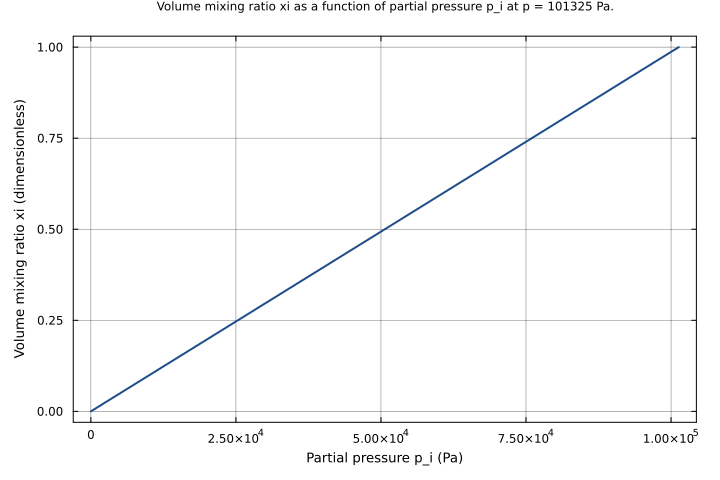
xi_vs_partial_pressure
Volume mixing ratio as a function of partial pressure at fixed total pressure (p = 101325 Pa, standard sea level). xi rises linearly from 0 to 1 as the species’ partial pressure increases from 0 to the total pressure (Seinfeld & Pandis Eq. 1.8).
Time span: 0.0 → 1.0
Swept over: p_i
xi_vs_total_pressure
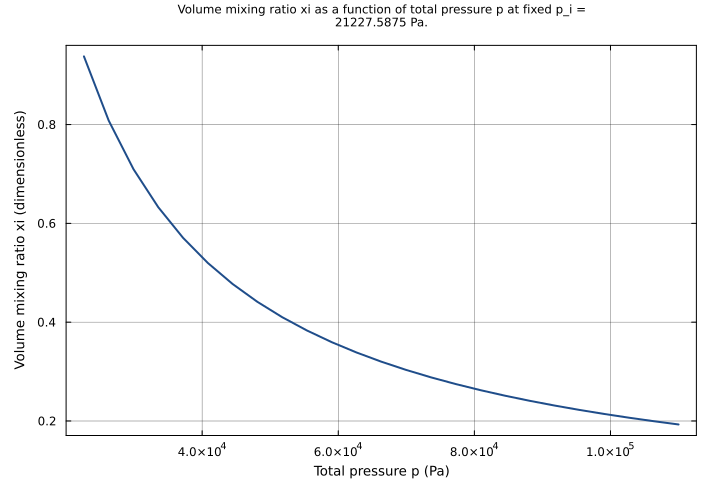
Volume mixing ratio as a function of total atmospheric pressure at fixed partial pressure (p_i = 21227.5875 Pa, the oxygen partial pressure at sea level). Holding p_i fixed, xi follows the inverse relation xi proportional to 1/p across the tropospheric pressure range (22.6-110 kPa) — an illustrative mathematical sweep rather than a physical altitude profile, since a species’ partial pressure normally falls together with the total pressure.
Time span: 0.0 → 1.0
Swept over: p
mixing_ratio_heatmap
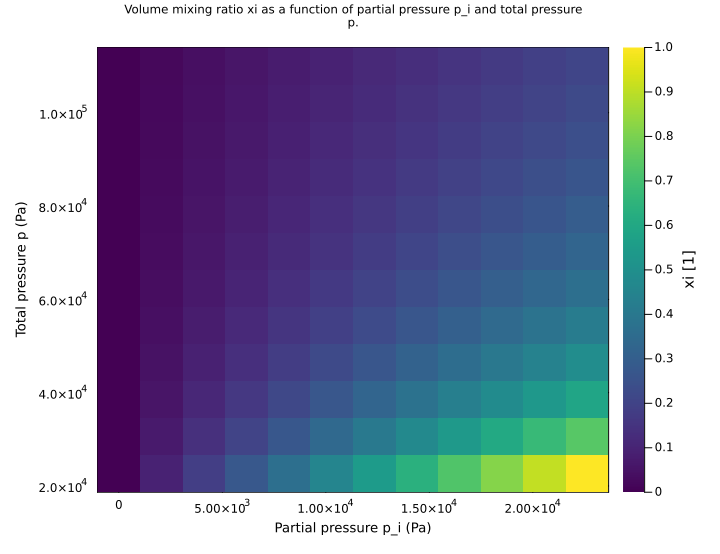
Two-dimensional sweep of the volume mixing ratio over partial pressure p_i and total pressure p. Surfaces the full xi = p_i / p relation across the physical regime p_i <= p (so xi <= 1); xi approaches 1 only where the partial pressure approaches the smallest total pressure in the sweep.
Time span: 0.0 → 1.0
Swept over: p_i, p
Raw .esm
Raw .esm JSON (this component)
{
  "reference": {
    "notes": "source_ref: AtmosphericDynamics.jl@816cc391:src/seinfeld_pandis_ch1.jl:308\nUpstream `PartialPressureMixingRatio` is an MTK `@component` where p_i, p, and xi are `@variables` driven by a parent system. For standalone serialization — and to make the component well-posed in isolation (3 unknowns would be under-determined by the single equation otherwise) — the input partial pressure p_i and total pressure p are declared as parameters here; xi remains the algebraic state. This matches the (S, observed-only) classification in docs/migration-tracker.md and the IdealGasLaw / ScaleHeight pattern in the same module. The single algebraic equation xi = p_i / p (Seinfeld & Pandis Eq. 1.8) is unchanged from upstream.\n\nTolerance rationale (model-level rel=1e-6): observed-only single-equation algebraic system (no ODE integration); 1e-6 covers float64 roundoff in the single p_i / p division across the atmospheric mixing-ratio range (~4e-4 for CO2 up to 1.0 for a pure single-component gas)."
  },
  "tolerance": {
    "rel": 1e-06
  },
  "variables": {
    "p_i": {
      "type": "parameter",
      "units": "Pa",
      "default": 21227.5875,
      "description": "Partial pressure of species i (default: oxygen partial pressure at standard sea-level pressure, dry-air mole fraction 0.2095)"
    },
    "p": {
      "type": "parameter",
      "units": "Pa",
      "default": 101325.0,
      "description": "Total atmospheric pressure (default: standard sea-level pressure)"
    },
    "xi": {
      "type": "unknown",
      "units": "1",
      "description": "Volume mixing ratio of species i (dimensionless ratio of partial pressure to total pressure)"
    }
  },
  "equations": [
    {
      "lhs": "xi",
      "rhs": {
        "op": "/",
        "args": [
          "p_i",
          "p"
        ]
      }
    }
  ],
  "tests": [
    {
      "id": "nitrogen_sea_level",
      "description": "Molecular nitrogen, the dominant constituent of dry air (mole fraction 0.7808). At standard sea-level pressure (p = 101325 Pa) its partial pressure is p_i = 79114.56 Pa, recovering the mixing ratio xi ~ 0.7808 (Seinfeld & Pandis Ch 1, dry-air composition).",
      "parameter_overrides": {
        "p_i": 79114.56,
        "p": 101325.0
      },
      "time_span": {
        "start": 0.0,
        "end": 1.0
      },
      "assertions": [
        {
          "variable": "xi",
          "time": 0.0,
          "expected": 0.7807999999999999
        }
      ]
    },
    {
      "id": "oxygen_sea_level",
      "description": "Molecular oxygen at standard sea-level pressure (mole fraction 0.2095). Partial pressure p_i = 21227.5875 Pa with p = 101325 Pa gives xi ~ 0.2095 — the second-most-abundant component of dry air.",
      "parameter_overrides": {
        "p_i": 21227.5875,
        "p": 101325.0
      },
      "time_span": {
        "start": 0.0,
        "end": 1.0
      },
      "assertions": [
        {
          "variable": "xi",
          "time": 0.0,
          "expected": 0.20950000000000002
        }
      ]
    },
    {
      "id": "water_vapor_humid_surface",
      "description": "Water vapor at saturation over liquid water near 20 degC: saturation vapor pressure p_i ~ 2339 Pa at total pressure p = 101325 Pa yields a mixing ratio xi ~ 0.0231 — humid surface air is roughly 2.3% water vapor by volume.",
      "parameter_overrides": {
        "p_i": 2339.0,
        "p": 101325.0
      },
      "time_span": {
        "start": 0.0,
        "end": 1.0
      },
      "assertions": [
        {
          "variable": "xi",
          "time": 0.0,
          "expected": 0.02308413520848754
        }
      ]
    },
    {
      "id": "argon_sea_level",
      "description": "Argon, the most abundant trace gas in dry air (mole fraction 0.0093). Partial pressure p_i = 942.3225 Pa at p = 101325 Pa gives xi = 0.0093 — exercises the sub-1% mixing-ratio regime.",
      "parameter_overrides": {
        "p_i": 942.3225,
        "p": 101325.0
      },
      "time_span": {
        "start": 0.0,
        "end": 1.0
      },
      "assertions": [
        {
          "variable": "xi",
          "time": 0.0,
          "expected": 0.0093
        }
      ]
    },
    {
      "id": "co2_present_day",
      "description": "Carbon dioxide at a representative recent global mean abundance (~421 ppm). Partial pressure p_i = 42.657825 Pa at p = 101325 Pa yields xi ~ 4.21e-4 — exercises the trace-gas (parts-per-million) mixing-ratio regime.",
      "parameter_overrides": {
        "p_i": 42.657825,
        "p": 101325.0
      },
      "time_span": {
        "start": 0.0,
        "end": 1.0
      },
      "assertions": [
        {
          "variable": "xi",
          "time": 0.0,
          "expected": 0.00042100000000000004
        }
      ]
    },
    {
      "id": "unit_ratio_pure_component",
      "description": "Boundary case: a single-component gas whose partial pressure equals the total pressure (p_i = p = 101325 Pa). The mixing ratio saturates at xi = 1.0 — the species accounts for the entire gas mixture.",
      "parameter_overrides": {
        "p_i": 101325.0,
        "p": 101325.0
      },
      "time_span": {
        "start": 0.0,
        "end": 1.0
      },
      "assertions": [
        {
          "variable": "xi",
          "time": 0.0,
          "expected": 1.0
        }
      ]
    },
    {
      "id": "oxygen_tropopause",
      "description": "Oxygen at the U.S. Standard Atmosphere tropopause (~11 km, p = 22632 Pa). With O2 retaining its dry-air mole fraction 0.2095, the partial pressure scales to p_i = 4741.404 Pa and xi ~ 0.2095 — identical to the sea-level case, confirming that the mixing ratio is a pure pressure ratio independent of the absolute pressure level.",
      "parameter_overrides": {
        "p_i": 4741.404,
        "p": 22632.0
      },
      "time_span": {
        "start": 0.0,
        "end": 1.0
      },
      "assertions": [
        {
          "variable": "xi",
          "time": 0.0,
          "expected": 0.20950000000000002
        }
      ]
    }
  ],
  "analyses": [
    {
      "id": "xi_vs_partial_pressure",
      "description": "Volume mixing ratio as a function of partial pressure at fixed total pressure (p = 101325 Pa, standard sea level). xi rises linearly from 0 to 1 as the species' partial pressure increases from 0 to the total pressure (Seinfeld & Pandis Eq. 1.8).",
      "initial_state": {},
      "parameters": {
        "p": 101325.0
      },
      "time_span": {
        "start": 0.0,
        "end": 1.0
      },
      "parameter_sweep": {
        "type": "cartesian",
        "dimensions": [
          {
            "parameter": "p_i",
            "range": {
              "start": 0.0,
              "stop": 101325.0,
              "count": 25,
              "scale": "linear"
            }
          }
        ]
      },
      "plots": [
        {
          "id": "xi_vs_pi",
          "type": "line",
          "description": "Volume mixing ratio xi as a function of partial pressure p_i at p = 101325 Pa.",
          "x": {
            "variable": "p_i",
            "label": "Partial pressure p_i (Pa)"
          },
          "y": {
            "variable": "xi",
            "label": "Volume mixing ratio xi (dimensionless)"
          }
        }
      ]
    },
    {
      "id": "xi_vs_total_pressure",
      "description": "Volume mixing ratio as a function of total atmospheric pressure at fixed partial pressure (p_i = 21227.5875 Pa, the oxygen partial pressure at sea level). Holding p_i fixed, xi follows the inverse relation xi proportional to 1/p across the tropospheric pressure range (22.6-110 kPa) — an illustrative mathematical sweep rather than a physical altitude profile, since a species' partial pressure normally falls together with the total pressure.",
      "initial_state": {},
      "parameters": {
        "p_i": 21227.5875
      },
      "time_span": {
        "start": 0.0,
        "end": 1.0
      },
      "parameter_sweep": {
        "type": "cartesian",
        "dimensions": [
          {
            "parameter": "p",
            "range": {
              "start": 22632.0,
              "stop": 110000.0,
              "count": 25,
              "scale": "linear"
            }
          }
        ]
      },
      "plots": [
        {
          "id": "xi_vs_p",
          "type": "line",
          "description": "Volume mixing ratio xi as a function of total pressure p at fixed p_i = 21227.5875 Pa.",
          "x": {
            "variable": "p",
            "label": "Total pressure p (Pa)"
          },
          "y": {
            "variable": "xi",
            "label": "Volume mixing ratio xi (dimensionless)"
          }
        }
      ]
    },
    {
      "id": "mixing_ratio_heatmap",
      "description": "Two-dimensional sweep of the volume mixing ratio over partial pressure p_i and total pressure p. Surfaces the full xi = p_i / p relation across the physical regime p_i <= p (so xi <= 1); xi approaches 1 only where the partial pressure approaches the smallest total pressure in the sweep.",
      "initial_state": {},
      "parameters": {},
      "time_span": {
        "start": 0.0,
        "end": 1.0
      },
      "parameter_sweep": {
        "type": "cartesian",
        "dimensions": [
          {
            "parameter": "p_i",
            "range": {
              "start": 0.0,
              "stop": 22632.0,
              "count": 12,
              "scale": "linear"
            }
          },
          {
            "parameter": "p",
            "range": {
              "start": 22632.0,
              "stop": 110000.0,
              "count": 12,
              "scale": "linear"
            }
          }
        ]
      },
      "plots": [
        {
          "id": "xi_heatmap",
          "type": "heatmap",
          "description": "Volume mixing ratio xi as a function of partial pressure p_i and total pressure p.",
          "x": {
            "variable": "p_i",
            "label": "Partial pressure p_i (Pa)"
          },
          "y": {
            "variable": "p",
            "label": "Total pressure p (Pa)"
          },
          "value": {
            "variable": "xi",
            "reduce": "final"
          }
        }
      ]
    }
  ]
}