GeneralCirculation
General circulation of the atmosphere — Coriolis parameter, tangential speed, geostrophic wind, and thermal-wind relations from Seinfeld & Pandis (2006) Chapter 21. Migrated from AtmosphericDynamics.jl@816cc391 src/general_circulation.jl:60 (`GeneralCirculation` @component).
Description
General circulation of the atmosphere — Coriolis parameter, tangential speed, geostrophic wind, and thermal-wind relations from Seinfeld & Pandis (2006) Chapter 21. Migrated from AtmosphericDynamics.jl@816cc391 src/general_circulation.jl:60 (GeneralCirculation @component).
Reference
_source_ref: AtmosphericDynamics.jl@816cc391:src/general_circulation.jl:60
GeneralCirculation is an MTK @component implementing the diagnostic (algebraic) equations for large-scale atmospheric circulation from Seinfeld & Pandis (2006), Atmospheric Chemistry and Physics, 2nd ed., Chapter 21: the Coriolis parameter (Eq. 21.2), the tangential speed of Earth’s surface (Eq. 21.1), the geostrophic wind components (Eq. 21.14), and the thermal-wind relations (Eq. 21.22). All six equations are algebraic — there is no ODE integration.
Constants: the upstream @constants Omega (Earth’s angular velocity), R_earth (Earth’s mean radius), and g (gravitational acceleration) are serialized as parameter-type variables with fixed defaults — the .esm schema has no dedicated constant variable type, and physical constants are carried as parameters, mirroring the IdealGasLaw migration’s treatment of R and M_air.
lat default: the upstream @parameters lat declares no default. A default of 0.7853981633974483 rad (45 deg N = pi/4) is supplied here for standalone well-posedness; 45 deg N is the canonical mid-latitude used in the upstream docstring example and the documentation figures.
Omitted parameter: the upstream component declares an air-pressure parameter p = 101325 Pa that appears in no equation. MTK prunes unused parameters and mtk2esm follows suit, so p is not carried here.
Equatorial singularity: the Coriolis parameter f -> 0 at the equator, so the geostrophic-wind and thermal-wind equations (which divide by f) are non-finite (0/0) at exactly lat=0. A 0-D inline test cannot be simulated there because the runner’s initial state would contain non-finite components; the small-f regime is therefore covered by the coriolis_near_equator test at lat = 1 deg rather than the exact equator. The latitude-sweep examples likewise use an even sample count so lat=0 is never sampled.
Tolerance rationale (rel=1e-6, abs=1e-9): an algebraic diagnostic system with no ODE integration. rel=1e-6 covers float64 roundoff in the closed-form trig and division expressions; abs=1e-9 covers the intended exact zeros (geostrophic / thermal-wind components when their driving gradient is zero) and the v_tan -> 0 limit at the pole, where cos(pi/2) leaves a floating-point residual of ~2.8e-14._
Parameters
| Name | Units | Default | Description |
|---|---|---|---|
Omega | rad/s | 7.2921e-05 | Earth’s angular velocity |
R_earth | m | 6371000.0 | Earth’s mean radius |
g | m/s^2 | 9.807 | Gravitational acceleration |
lat | rad | 0.7853981633974483 | Latitude (default 45 deg N = pi/4; upstream declares no default) |
rho | kg/m^3 | 1.225 | Air density |
dp_dx | Pa/m | 0.0 | Pressure gradient in x (eastward) direction |
dp_dy | Pa/m | 0.0 | Pressure gradient in y (northward) direction |
dT_dx | K/m | 0.0 | Temperature gradient in x direction at constant pressure |
dT_dy | K/m | 0.0 | Temperature gradient in y direction at constant pressure |
T | K | 288.15 | Air temperature |
Observed
| Name | Units | Default | Description |
|---|---|---|---|
f | s^-1 | Coriolis parameter | |
v_tan | m/s | Tangential speed at latitude due to Earth rotation | |
u_g | m/s | Zonal (eastward) geostrophic wind component | |
v_g | m/s | Meridional (northward) geostrophic wind component | |
du_g_dz | s^-1 | Thermal wind: vertical gradient of zonal geostrophic wind | |
dv_g_dz | s^-1 | Thermal wind: vertical gradient of meridional geostrophic wind |
Observed expressions
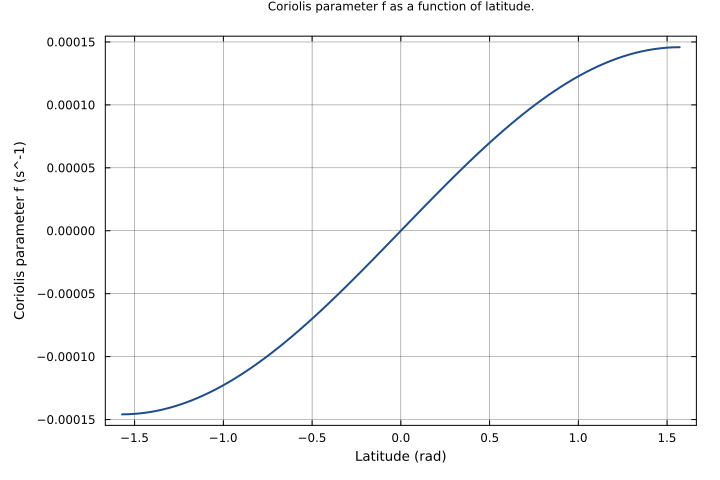
$$ f = 2 \cdot Omega \cdot \sin\left(lat\right) $$Coriolis parameter
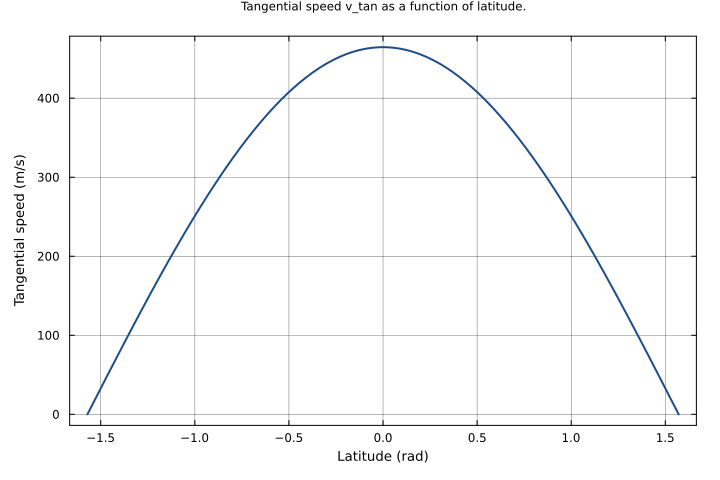
$$ v_{tan} = Omega \cdot \cos\left(lat\right) \cdot R_{earth} $$Tangential speed at latitude due to Earth rotation
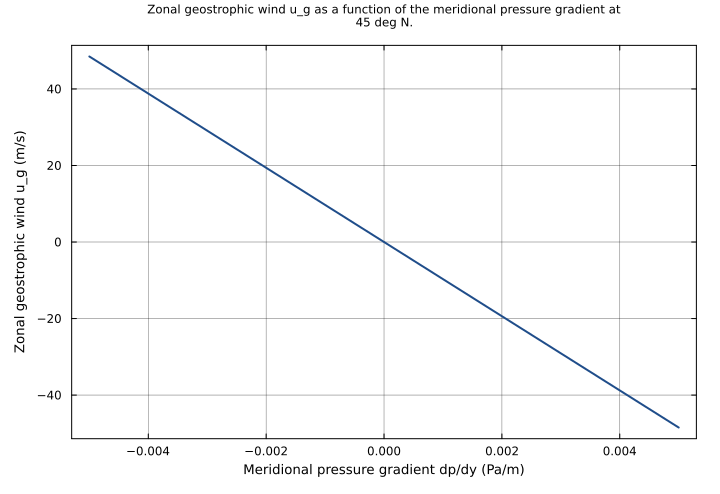
$$ u_{g} = \frac{\left(-1\right) \cdot dp_{dy}}{f \cdot rho} $$Zonal (eastward) geostrophic wind component
$$ v_{g} = \frac{dp_{dx}}{f \cdot rho} $$Meridional (northward) geostrophic wind component
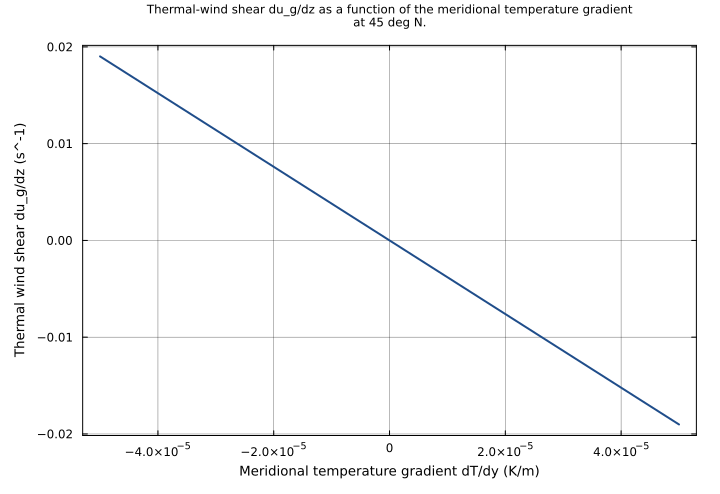
$$ du_{g\,dz} = \frac{\left(-1\right) \cdot dT_{dy} \cdot g}{f \cdot T} $$Thermal wind: vertical gradient of zonal geostrophic wind
$$ dv_{g\,dz} = \frac{dT_{dx} \cdot g}{f \cdot T} $$Thermal wind: vertical gradient of meridional geostrophic wind
Analyses
coriolis_parameter_vs_latitude
Coriolis parameter f as a function of latitude over the full -90 to +90 deg range. Reproduces the ‘Coriolis Parameter vs. Latitude (Eq. 21.2)’ figure from the AtmosphericDynamics.jl documentation: f = 2 Omega sin(phi) is antisymmetric about the equator — zero there, +/- 2 Omega at the poles. The sweep uses an even point count so the equatorial singularity at lat=0 is not sampled.
Time span: 0.0 → 1.0
Swept over: lat
tangential_speed_vs_latitude
Tangential (rotational) speed of Earth’s surface as a function of latitude. Reproduces the ‘Earth Surface Speed vs. Latitude (Eq. 21.1)’ documentation figure: v_tan = Omega R_earth cos(phi) is maximal (~465 m/s) at the equator and zero at the poles.
Time span: 0.0 → 1.0
Swept over: lat
geostrophic_wind_vs_pressure_gradient
Zonal geostrophic wind at 45 deg N as a function of the meridional pressure gradient. Reproduces the ‘Geostrophic Wind at 45 deg N (Eq. 21.14)’ documentation figure: u_g = -(1 / (rho f)) (dp/dy) — a northward pressure decrease drives a westerly wind (Buys Ballot’s law).
Time span: 0.0 → 1.0
Swept over: dp_dy
thermal_wind_vs_temperature_gradient
Thermal-wind shear of the zonal geostrophic wind at 45 deg N as a function of the meridional temperature gradient, at a mid-troposphere temperature T = 250 K. Reproduces the ‘Thermal Wind Relation at 45 deg N (Eq. 21.22)’ documentation figure: du_g/dz = -(g / (f T)) (dT/dy) — a poleward temperature decrease strengthens westerlies with height.
Time span: 0.0 → 1.0
Swept over: dT_dy
Raw .esm
Raw .esm JSON (this component)
{
"reference": {
"notes": "source_ref: AtmosphericDynamics.jl@816cc391:src/general_circulation.jl:60\n\nGeneralCirculation is an MTK `@component` implementing the diagnostic (algebraic) equations for large-scale atmospheric circulation from Seinfeld & Pandis (2006), Atmospheric Chemistry and Physics, 2nd ed., Chapter 21: the Coriolis parameter (Eq. 21.2), the tangential speed of Earth's surface (Eq. 21.1), the geostrophic wind components (Eq. 21.14), and the thermal-wind relations (Eq. 21.22). All six equations are algebraic — there is no ODE integration.\n\nConstants: the upstream `@constants` Omega (Earth's angular velocity), R_earth (Earth's mean radius), and g (gravitational acceleration) are serialized as parameter-type variables with fixed defaults — the .esm schema has no dedicated constant variable type, and physical constants are carried as parameters, mirroring the IdealGasLaw migration's treatment of R and M_air.\n\nlat default: the upstream `@parameters lat` declares no default. A default of 0.7853981633974483 rad (45 deg N = pi/4) is supplied here for standalone well-posedness; 45 deg N is the canonical mid-latitude used in the upstream docstring example and the documentation figures.\n\nOmitted parameter: the upstream component declares an air-pressure parameter `p = 101325 Pa` that appears in no equation. MTK prunes unused parameters and mtk2esm follows suit, so p is not carried here.\n\nEquatorial singularity: the Coriolis parameter f -> 0 at the equator, so the geostrophic-wind and thermal-wind equations (which divide by f) are non-finite (0/0) at exactly lat=0. A 0-D inline test cannot be simulated there because the runner's initial state would contain non-finite components; the small-f regime is therefore covered by the coriolis_near_equator test at lat = 1 deg rather than the exact equator. The latitude-sweep examples likewise use an even sample count so lat=0 is never sampled.\n\nTolerance rationale (rel=1e-6, abs=1e-9): an algebraic diagnostic system with no ODE integration. rel=1e-6 covers float64 roundoff in the closed-form trig and division expressions; abs=1e-9 covers the intended exact zeros (geostrophic / thermal-wind components when their driving gradient is zero) and the v_tan -> 0 limit at the pole, where cos(pi/2) leaves a floating-point residual of ~2.8e-14."
},
"tolerance": {
"rel": 1e-06,
"abs": 1e-09
},
"variables": {
"Omega": {
"type": "parameter",
"units": "rad/s",
"default": 7.2921e-05,
"description": "Earth's angular velocity"
},
"R_earth": {
"type": "parameter",
"units": "m",
"default": 6371000.0,
"description": "Earth's mean radius"
},
"g": {
"type": "parameter",
"units": "m/s^2",
"default": 9.807,
"description": "Gravitational acceleration"
},
"lat": {
"type": "parameter",
"units": "rad",
"default": 0.7853981633974483,
"description": "Latitude (default 45 deg N = pi/4; upstream declares no default)"
},
"rho": {
"type": "parameter",
"units": "kg/m^3",
"default": 1.225,
"description": "Air density"
},
"dp_dx": {
"type": "parameter",
"units": "Pa/m",
"default": 0.0,
"description": "Pressure gradient in x (eastward) direction"
},
"dp_dy": {
"type": "parameter",
"units": "Pa/m",
"default": 0.0,
"description": "Pressure gradient in y (northward) direction"
},
"dT_dx": {
"type": "parameter",
"units": "K/m",
"default": 0.0,
"description": "Temperature gradient in x direction at constant pressure"
},
"dT_dy": {
"type": "parameter",
"units": "K/m",
"default": 0.0,
"description": "Temperature gradient in y direction at constant pressure"
},
"T": {
"type": "parameter",
"units": "K",
"default": 288.15,
"description": "Air temperature"
},
"f": {
"type": "unknown",
"units": "s^-1",
"description": "Coriolis parameter"
},
"v_tan": {
"type": "unknown",
"units": "m/s",
"description": "Tangential speed at latitude due to Earth rotation"
},
"u_g": {
"type": "unknown",
"units": "m/s",
"description": "Zonal (eastward) geostrophic wind component"
},
"v_g": {
"type": "unknown",
"units": "m/s",
"description": "Meridional (northward) geostrophic wind component"
},
"du_g_dz": {
"type": "unknown",
"units": "s^-1",
"description": "Thermal wind: vertical gradient of zonal geostrophic wind"
},
"dv_g_dz": {
"type": "unknown",
"units": "s^-1",
"description": "Thermal wind: vertical gradient of meridional geostrophic wind"
}
},
"equations": [
{
"lhs": "f",
"rhs": {
"op": "*",
"args": [
2,
"Omega",
{
"op": "sin",
"args": [
"lat"
]
}
]
}
},
{
"lhs": "v_tan",
"rhs": {
"op": "*",
"args": [
"Omega",
{
"op": "cos",
"args": [
"lat"
]
},
"R_earth"
]
}
},
{
"lhs": "u_g",
"rhs": {
"op": "/",
"args": [
{
"op": "*",
"args": [
-1,
"dp_dy"
]
},
{
"op": "*",
"args": [
"f",
"rho"
]
}
]
}
},
{
"lhs": "v_g",
"rhs": {
"op": "/",
"args": [
"dp_dx",
{
"op": "*",
"args": [
"f",
"rho"
]
}
]
}
},
{
"lhs": "du_g_dz",
"rhs": {
"op": "/",
"args": [
{
"op": "*",
"args": [
-1,
"dT_dy",
"g"
]
},
{
"op": "*",
"args": [
"f",
"T"
]
}
]
}
},
{
"lhs": "dv_g_dz",
"rhs": {
"op": "/",
"args": [
{
"op": "*",
"args": [
"dT_dx",
"g"
]
},
{
"op": "*",
"args": [
"f",
"T"
]
}
]
}
}
],
"tests": [
{
"id": "coriolis_near_equator",
"description": "Coriolis parameter and tangential speed near the equator (lat = 1 deg N). f = 2 Omega sin(1 deg) is small (~2.5e-6 s^-1) and v_tan = Omega R_earth cos(1 deg) is near its equatorial maximum (~464.5 m/s). The exact equator (lat=0) is a singularity of this model: the geostrophic and thermal-wind components divide by f, so they are non-finite (0/0) when f=0 and the model cannot be simulated there as a 0-D inline test. lat = 1 deg exercises the small-f regime instead.",
"parameter_overrides": {
"lat": 0.017453292519943295
},
"time_span": {
"start": 0.0,
"end": 1.0
},
"assertions": [
{
"variable": "f",
"time": 0.0,
"expected": 2.545293859626302e-06
},
{
"variable": "v_tan",
"time": 0.0,
"expected": 464.50893326281846
}
]
},
{
"id": "coriolis_30N",
"description": "Coriolis parameter at 30 deg N (lat=pi/6). f = 2 Omega sin(pi/6) = Omega (Seinfeld & Pandis Eq. 21.2).",
"parameter_overrides": {
"lat": 0.5235987755982988
},
"time_span": {
"start": 0.0,
"end": 1.0
},
"assertions": [
{
"variable": "f",
"time": 0.0,
"expected": 7.292099999999999e-05
},
{
"variable": "v_tan",
"time": 0.0,
"expected": 402.3378144883248
}
]
},
{
"id": "coriolis_45N",
"description": "Coriolis parameter at 45 deg N (lat=pi/4). f = 2 Omega sin(pi/4) ~ sqrt(2) Omega (Eq. 21.2).",
"parameter_overrides": {
"lat": 0.7853981633974483
},
"time_span": {
"start": 0.0,
"end": 1.0
},
"assertions": [
{
"variable": "f",
"time": 0.0,
"expected": 0.00010312586718180846
},
{
"variable": "v_tan",
"time": 0.0,
"expected": 328.5074499076509
}
]
},
{
"id": "coriolis_pole",
"description": "Coriolis parameter and tangential speed at the North Pole (lat=pi/2). f = 2 Omega is maximal; v_tan = Omega R_earth cos(pi/2) = 0.",
"parameter_overrides": {
"lat": 1.5707963267948966
},
"time_span": {
"start": 0.0,
"end": 1.0
},
"assertions": [
{
"variable": "f",
"time": 0.0,
"expected": 0.000145842
},
{
"variable": "v_tan",
"time": 0.0,
"expected": 0.0
}
]
},
{
"id": "coriolis_45S",
"description": "Coriolis parameter at 45 deg S (lat=-pi/4). f is negative in the Southern Hemisphere with the same magnitude as 45 deg N; v_tan is unchanged because cos is even (physical-consistency check, upstream test).",
"parameter_overrides": {
"lat": -0.7853981633974483
},
"time_span": {
"start": 0.0,
"end": 1.0
},
"assertions": [
{
"variable": "f",
"time": 0.0,
"expected": -0.00010312586718180846
},
{
"variable": "v_tan",
"time": 0.0,
"expected": 328.5074499076509
}
]
},
{
"id": "geostrophic_wind_40N",
"description": "Geostrophic wind at 40 deg N for a meridional pressure gradient dp/dy = -0.002 Pa/m with rho = 1.0 kg/m^3 (Seinfeld & Pandis Problem 21.1A, p. 1000). A northward pressure decrease drives a positive (westerly) zonal wind u_g; v_g = 0 because dp/dx = 0.",
"parameter_overrides": {
"lat": 0.6981317007977318,
"dp_dy": -0.002,
"dp_dx": 0.0,
"rho": 1.0
},
"time_span": {
"start": 0.0,
"end": 1.0
},
"assertions": [
{
"variable": "f",
"time": 0.0,
"expected": 9.374543057190427e-05
},
{
"variable": "u_g",
"time": 0.0,
"expected": 21.33437318276508
},
{
"variable": "v_g",
"time": 0.0,
"expected": 0.0
}
]
},
{
"id": "geostrophic_wind_45S",
"description": "Geostrophic wind at 45 deg S for a meridional pressure gradient dp/dy = -0.001 Pa/m with rho = 1.0 kg/m^3. With f < 0 in the Southern Hemisphere the same northward pressure decrease drives a negative (easterly) zonal wind, the hemispheric mirror of geostrophic_wind_40N.",
"parameter_overrides": {
"lat": -0.7853981633974483,
"dp_dy": -0.001,
"dp_dx": 0.0,
"rho": 1.0
},
"time_span": {
"start": 0.0,
"end": 1.0
},
"assertions": [
{
"variable": "f",
"time": 0.0,
"expected": -0.00010312586718180846
},
{
"variable": "u_g",
"time": 0.0,
"expected": -9.696888155490841
},
{
"variable": "v_g",
"time": 0.0,
"expected": 0.0
}
]
},
{
"id": "thermal_wind",
"description": "Thermal-wind relation (Eq. 21.22) for a zonal temperature gradient dT/dx = -4e-5 K/m at the latitude where f = 1e-4 s^-1, with T = 248 K (Seinfeld & Pandis example, pp. 995-996). dv_g/dz = (g / (f T)) dT/dx; du_g/dz = 0 because dT/dy = 0.",
"parameter_overrides": {
"lat": 0.7555285998340915,
"dT_dx": -4e-05,
"dT_dy": 0.0,
"T": 248.0
},
"time_span": {
"start": 0.0,
"end": 1.0
},
"assertions": [
{
"variable": "f",
"time": 0.0,
"expected": 0.0001
},
{
"variable": "dv_g_dz",
"time": 0.0,
"expected": -0.01581774193548387
},
{
"variable": "du_g_dz",
"time": 0.0,
"expected": 0.0
}
]
},
{
"id": "buys_ballot_meridional",
"description": "Buys Ballot's law at 45 deg N: a northward pressure decrease (dp/dy < 0) drives a westerly wind (u_g > 0), placing low pressure to the left of the wind in the Northern Hemisphere. v_g = 0 because dp/dx = 0.",
"parameter_overrides": {
"lat": 0.7853981633974483,
"dp_dy": -0.001,
"dp_dx": 0.0,
"rho": 1.0
},
"time_span": {
"start": 0.0,
"end": 1.0
},
"assertions": [
{
"variable": "u_g",
"time": 0.0,
"expected": 9.696888155490841
},
{
"variable": "v_g",
"time": 0.0,
"expected": 0.0
}
]
},
{
"id": "buys_ballot_zonal",
"description": "Buys Ballot's law at 45 deg N: an eastward pressure decrease (dp/dx < 0) drives a southward wind (v_g < 0). u_g = 0 because dp/dy = 0.",
"parameter_overrides": {
"lat": 0.7853981633974483,
"dp_dy": 0.0,
"dp_dx": -0.001,
"rho": 1.0
},
"time_span": {
"start": 0.0,
"end": 1.0
},
"assertions": [
{
"variable": "u_g",
"time": 0.0,
"expected": 0.0
},
{
"variable": "v_g",
"time": 0.0,
"expected": -9.696888155490841
}
]
},
{
"id": "full_circulation",
"description": "Comprehensive check exercising all six outputs at 45 deg N with every driving gradient nonzero: dp/dx = -0.0015, dp/dy = -0.002 Pa/m, dT/dx = -3e-5, dT/dy = 2e-5 K/m, rho = 1.1 kg/m^3, T = 270 K.",
"parameter_overrides": {
"lat": 0.7853981633974483,
"dp_dx": -0.0015,
"dp_dy": -0.002,
"dT_dx": -3e-05,
"dT_dy": 2e-05,
"rho": 1.1,
"T": 270.0
},
"time_span": {
"start": 0.0,
"end": 1.0
},
"assertions": [
{
"variable": "f",
"time": 0.0,
"expected": 0.00010312586718180846
},
{
"variable": "v_tan",
"time": 0.0,
"expected": 328.5074499076509
},
{
"variable": "u_g",
"time": 0.0,
"expected": 17.630705737256072
},
{
"variable": "v_g",
"time": 0.0,
"expected": -13.223029302942054
},
{
"variable": "du_g_dz",
"time": 0.0,
"expected": -0.007044250528955458
},
{
"variable": "dv_g_dz",
"time": 0.0,
"expected": -0.010566375793433187
}
]
},
{
"id": "default_parameters",
"description": "All parameters at their declared defaults (lat = pi/4 = 45 deg N, all pressure and temperature gradients zero). Verifies the declared defaults are wired correctly: f and v_tan take their 45 deg N values, and every wind component is zero because its driving gradient is zero.",
"time_span": {
"start": 0.0,
"end": 1.0
},
"assertions": [
{
"variable": "f",
"time": 0.0,
"expected": 0.00010312586718180846
},
{
"variable": "v_tan",
"time": 0.0,
"expected": 328.5074499076509
},
{
"variable": "u_g",
"time": 0.0,
"expected": 0.0
},
{
"variable": "v_g",
"time": 0.0,
"expected": 0.0
},
{
"variable": "du_g_dz",
"time": 0.0,
"expected": 0.0
},
{
"variable": "dv_g_dz",
"time": 0.0,
"expected": 0.0
}
]
}
],
"analyses": [
{
"id": "coriolis_parameter_vs_latitude",
"description": "Coriolis parameter f as a function of latitude over the full -90 to +90 deg range. Reproduces the 'Coriolis Parameter vs. Latitude (Eq. 21.2)' figure from the AtmosphericDynamics.jl documentation: f = 2 Omega sin(phi) is antisymmetric about the equator — zero there, +/- 2 Omega at the poles. The sweep uses an even point count so the equatorial singularity at lat=0 is not sampled.",
"initial_state": {},
"parameters": {},
"time_span": {
"start": 0.0,
"end": 1.0
},
"parameter_sweep": {
"type": "cartesian",
"dimensions": [
{
"parameter": "lat",
"range": {
"start": -1.5707963267948966,
"stop": 1.5707963267948966,
"count": 90,
"scale": "linear"
}
}
]
},
"plots": [
{
"id": "f_vs_lat",
"type": "line",
"description": "Coriolis parameter f as a function of latitude.",
"x": {
"variable": "lat",
"label": "Latitude (rad)"
},
"y": {
"variable": "f",
"label": "Coriolis parameter f (s^-1)"
}
}
]
},
{
"id": "tangential_speed_vs_latitude",
"description": "Tangential (rotational) speed of Earth's surface as a function of latitude. Reproduces the 'Earth Surface Speed vs. Latitude (Eq. 21.1)' documentation figure: v_tan = Omega R_earth cos(phi) is maximal (~465 m/s) at the equator and zero at the poles.",
"initial_state": {},
"parameters": {},
"time_span": {
"start": 0.0,
"end": 1.0
},
"parameter_sweep": {
"type": "cartesian",
"dimensions": [
{
"parameter": "lat",
"range": {
"start": -1.5707963267948966,
"stop": 1.5707963267948966,
"count": 90,
"scale": "linear"
}
}
]
},
"plots": [
{
"id": "v_tan_vs_lat",
"type": "line",
"description": "Tangential speed v_tan as a function of latitude.",
"x": {
"variable": "lat",
"label": "Latitude (rad)"
},
"y": {
"variable": "v_tan",
"label": "Tangential speed (m/s)"
}
}
]
},
{
"id": "geostrophic_wind_vs_pressure_gradient",
"description": "Zonal geostrophic wind at 45 deg N as a function of the meridional pressure gradient. Reproduces the 'Geostrophic Wind at 45 deg N (Eq. 21.14)' documentation figure: u_g = -(1 / (rho f)) (dp/dy) — a northward pressure decrease drives a westerly wind (Buys Ballot's law).",
"initial_state": {},
"parameters": {
"lat": 0.7853981633974483,
"rho": 1.0
},
"time_span": {
"start": 0.0,
"end": 1.0
},
"parameter_sweep": {
"type": "cartesian",
"dimensions": [
{
"parameter": "dp_dy",
"range": {
"start": -0.005,
"stop": 0.005,
"count": 90,
"scale": "linear"
}
}
]
},
"plots": [
{
"id": "u_g_vs_dp_dy",
"type": "line",
"description": "Zonal geostrophic wind u_g as a function of the meridional pressure gradient at 45 deg N.",
"x": {
"variable": "dp_dy",
"label": "Meridional pressure gradient dp/dy (Pa/m)"
},
"y": {
"variable": "u_g",
"label": "Zonal geostrophic wind u_g (m/s)"
}
}
]
},
{
"id": "thermal_wind_vs_temperature_gradient",
"description": "Thermal-wind shear of the zonal geostrophic wind at 45 deg N as a function of the meridional temperature gradient, at a mid-troposphere temperature T = 250 K. Reproduces the 'Thermal Wind Relation at 45 deg N (Eq. 21.22)' documentation figure: du_g/dz = -(g / (f T)) (dT/dy) — a poleward temperature decrease strengthens westerlies with height.",
"initial_state": {},
"parameters": {
"lat": 0.7853981633974483,
"T": 250.0
},
"time_span": {
"start": 0.0,
"end": 1.0
},
"parameter_sweep": {
"type": "cartesian",
"dimensions": [
{
"parameter": "dT_dy",
"range": {
"start": -5e-05,
"stop": 5e-05,
"count": 90,
"scale": "linear"
}
}
]
},
"plots": [
{
"id": "du_g_dz_vs_dT_dy",
"type": "line",
"description": "Thermal-wind shear du_g/dz as a function of the meridional temperature gradient at 45 deg N.",
"x": {
"variable": "dT_dy",
"label": "Meridional temperature gradient dT/dy (K/m)"
},
"y": {
"variable": "du_g_dz",
"label": "Thermal wind shear du_g/dz (s^-1)"
}
}
]
}
]
}