ParticleSettling
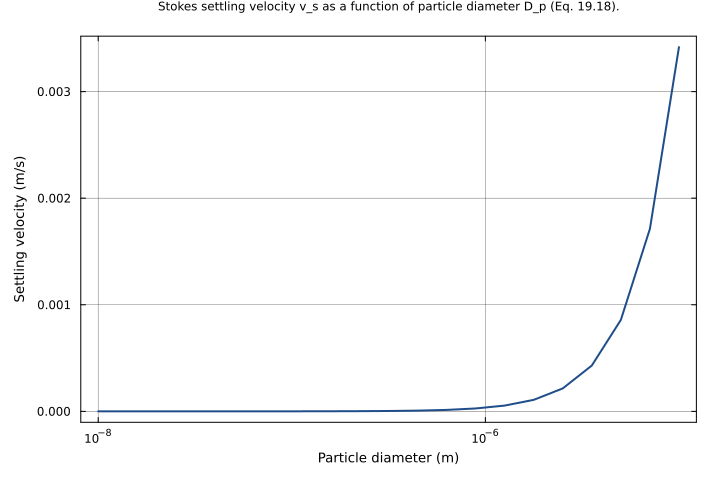
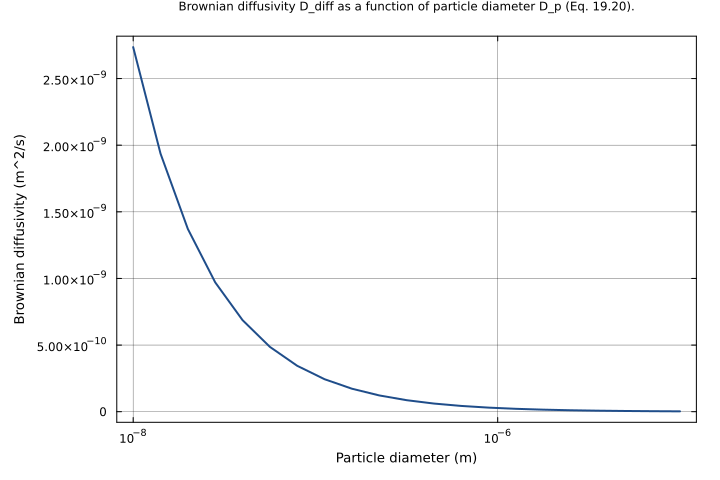
Gravitational settling velocity and Brownian diffusivity of an aerosol particle, from Seinfeld & Pandis (2006), Atmospheric Chemistry and Physics, 2nd ed., Chapter 19 (Dry Deposition). Two algebraic outputs are computed from the particle and air properties. The settling (terminal) velocity v_s = rho_p*D_p^2*g*C_c/(18*mu) (Eq. 19.18) is the steady gravitational drift speed of a particle in the Stokes (low-Reynolds-number) regime, where aerodynamic drag balances gravity; the Cunningham slip correction factor C_c (>= 1) accounts for the non-continuum reduction in drag when the particle diameter approaches the mean free path of air. The Brownian diffusivity D_diff = k_B*T*C_c/(3*pi*mu*D_p) (Eq. 19.20) is the Stokes-Einstein diffusion coefficient describing the particle's thermal random walk. The two quantities have opposite size dependence -- v_s grows as D_p^2 while D_diff falls as 1/D_p -- which is the physical origin of the dry-deposition-velocity minimum for accumulation-mode (~0.1-1 um) aerosol: such particles settle too slowly to deposit gravitationally yet are too large to diffuse efficiently to the surface. Both quantities feed the Zhang et al. (2001) quasi-laminar resistance and the overall particle dry deposition velocity computed by the sibling sp_ch19 components. Migrated from AtmosphericDeposition.jl@e4468c79 src/seinfeld_pandis_ch19.jl:182 (`ParticleSettling` @component). Observed-only algebraic model: rho_p, D_p, mu, T, C_c are input parameters, g/k_B/pi_val are physical-constant parameters, and v_s and D_diff are the two algebraic outputs, each fixed by one equation with no time derivative.
Description
Gravitational settling velocity and Brownian diffusivity of an aerosol particle, from Seinfeld & Pandis (2006), Atmospheric Chemistry and Physics, 2nd ed., Chapter 19 (Dry Deposition). Two algebraic outputs are computed from the particle and air properties. The settling (terminal) velocity v_s = rho_pD_p^2gC_c/(18mu) (Eq. 19.18) is the steady gravitational drift speed of a particle in the Stokes (low-Reynolds-number) regime, where aerodynamic drag balances gravity; the Cunningham slip correction factor C_c (>= 1) accounts for the non-continuum reduction in drag when the particle diameter approaches the mean free path of air. The Brownian diffusivity D_diff = k_BTC_c/(3pimu*D_p) (Eq. 19.20) is the Stokes-Einstein diffusion coefficient describing the particle’s thermal random walk. The two quantities have opposite size dependence – v_s grows as D_p^2 while D_diff falls as 1/D_p – which is the physical origin of the dry-deposition-velocity minimum for accumulation-mode (~0.1-1 um) aerosol: such particles settle too slowly to deposit gravitationally yet are too large to diffuse efficiently to the surface. Both quantities feed the Zhang et al. (2001) quasi-laminar resistance and the overall particle dry deposition velocity computed by the sibling sp_ch19 components. Migrated from AtmosphericDeposition.jl@e4468c79 src/seinfeld_pandis_ch19.jl:182 (ParticleSettling @component). Observed-only algebraic model: rho_p, D_p, mu, T, C_c are input parameters, g/k_B/pi_val are physical-constant parameters, and v_s and D_diff are the two algebraic outputs, each fixed by one equation with no time derivative.
Reference
Seinfeld, J. H., & Pandis, S. N. (2006). Atmospheric Chemistry and Physics: From Air Pollution to Climate Change (2nd ed.), Ch. 19, Eqs. 19.18 and 19.20. John Wiley & Sons, Inc.
_source_ref: AtmosphericDeposition.jl@e4468c79c8dd4aae88646cd16d6bcf290874742c:src/seinfeld_pandis_ch19.jl:182
Upstream ParticleSettling is an MTK @component in the DryDeposition module of seinfeld_pandis_ch19.jl. It declares 3 @constants (g, k_B, pi_val), 5 @parameters (rho_p, D_p, mu, T, C_c) and 2 @variables(t) (v_s, D_diff), related by 2 equations. Neither equation carries a time derivative, so the system is purely algebraic (observed-only): system_kind is left unset because ode is the schema default and there is no differential state, matching the sibling observed-only AtmosphericDeposition.jl migrations gas_scavenging_coeff.esm (esm-8sez) and reversible_gas_scavenging.esm (esm-0jvy). v_s and D_diff are each serialized as type: state with one explicit algebraic equation in the equations array.
@constants -> parameters. The ESM schema has no constant variable type, so the 3 upstream @constants migrate as type: parameter carrying their evaluated numeric defaults – the convention applied by the sibling diagnostic_pressure.esm @constant g. g = G_ACCEL = 9.81 m/s^2; k_B = K_BOLTZ = 1.38e-23 J/K; pi_val = Float64(pi) = 3.141592653589793 (dimensionless). Each constant remains a named symbol in the equations rather than being inlined, keeping the .esm equations symbol-for-symbol identical to the upstream System(eqs, t). k_B keeps its upstream name: it is the Boltzmann constant and its declared units J/K satisfy the ESS schema’s reserved-physical-constant dimensional check for the name k_B.
@parameters carry no defaults. The 5 upstream @parameters (rho_p, D_p, mu, T, C_c) are declared in seinfeld_pandis_ch19.jl with no default values – they are required inputs, set when the component is composed into DryDepositionParticle. They are therefore migrated WITHOUT a default field; every inline test supplies all 5 via parameter_overrides, and the examples supply them via the example parameters block plus the swept dimension.
Equations. Eq. 19.18 (Stokes settling velocity with Cunningham slip correction): v_s = rho_pD_p^2gC_c/(18mu). Eq. 19.20 (Brownian / Stokes-Einstein diffusivity with Cunningham slip correction): D = k_BTC_c/(3pimuD_p). The integer literals 18 and 3 are kept as integers, mirroring the upstream Ints; D_p^2 is encoded as a ^ node with integer exponent 2. Both equations are dimensionally consistent (v_s: [kg/m^3][m^2][m/s^2][1]/([1][Pas]) = m/s; D_diff: [J/K][K][1]/([1][1][Pas][m]) = m^2/s), so there is no upstream checks=false to mirror.
The module-level structs LandUseParameters and GasProperties and their Table 19.2 / 19.4 instances are not referenced by ParticleSettling and are not migrated.
Tolerance rationale (model-level rel=1e-6): an observed-only algebraic system with no ODE integration; each equation is a closed-form rational expression evaluated once at each test point. rel=1e-6 comfortably covers float64 round-off in the handful of multiplies and one divide of each equation, well above the bit-level agreement expected between bindings, and matches the sibling gas_scavenging_coeff.esm choice. No abs tolerance is needed: every asserted value is nonzero (smallest ~1.37e-11).
Test provenance: the canonical_one_micron_particle test reproduces the upstream seinfeld_pandis_ch19_test.jl testitem ‘2.3 Eq. 19.18: Particle Settling Velocity (Stokes)’ (rho_p=1000 kg/m^3, D_p=1 um, mu=1.85e-5 Pa*s, C_c=1.16), which checks v_s ~ 3.41e-5 m/s at rtol 0.1; the migrated test pins the exact value v_s = 3.417297297297298e-5 m/s and additionally pins D_diff = 2.7359646632305877e-11 m^2/s at T=298 K. The other 5 tests each vary one parameter from that canonical case to exercise every dependency in the two equations._
Parameters
| Name | Units | Default | Description |
|---|---|---|---|
rho_p | kg/m^3 | Particle density | |
D_p | m | Particle diameter | |
mu | Pa*s | Dynamic viscosity of air | |
T | K | Temperature | |
C_c | 1 | Cunningham slip correction factor (dimensionless) | |
g | m/s^2 | 9.81 | Gravitational acceleration |
k_B | J/K | 1.38e-23 | Boltzmann constant |
pi_val | 1 | 3.141592653589793 | Mathematical constant pi (dimensionless) |
Observed
| Name | Units | Default | Description |
|---|---|---|---|
v_s | m/s | Particle settling velocity (Eq. 19.18) | |
D_diff | m^2/s | Brownian diffusivity of particle (Eq. 19.20) |
Observed expressions
$$ v_{s} = \frac{rho_{p} \cdot D_{p}^{2} \cdot g \cdot C_{c}}{18 \cdot mu} $$Particle settling velocity (Eq. 19.18)
$$ D_{diff} = \frac{k_{B} \cdot T \cdot C_{c}}{3 \cdot pi_{val} \cdot mu \cdot D_{p}} $$Brownian diffusivity of particle (Eq. 19.20)
Analyses
settling_and_diffusion_vs_particle_diameter
Stokes settling velocity v_s and Brownian diffusivity D_diff as functions of particle diameter D_p, swept log-spaced from 0.01 um to 10 um at unit particle density (rho_p = 1000 kg/m^3), air viscosity mu = 1.85e-5 Pa*s, temperature T = 298 K, and Cunningham slip correction C_c = 1.16. The two outputs have opposite size dependence: v_s proportional to D_p^2 (Eq. 19.18) rises steeply with size, while D_diff proportional to 1/D_p (Eq. 19.20) falls – accumulation-mode particles (~0.1-1 um) lie in the dry-deposition trough where neither settling nor diffusion is efficient. Note: this standalone-component sweep holds C_c fixed; physically the Cunningham correction rises as D_p falls, so the true small-particle settling velocity is somewhat larger than this fixed-C_c curve.
Time span: 0.0 → 1.0
Swept over: D_p
settling_velocity_over_diameter_and_density
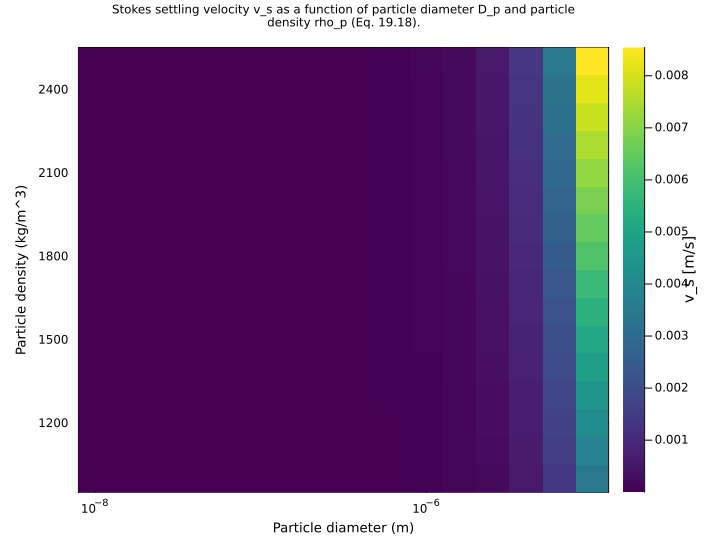
Two-dimensional sweep of the Stokes settling velocity v_s over particle diameter D_p (0.01-10 um, log-spaced) and particle density rho_p (1000-2500 kg/m^3, spanning water-like through mineral-dust aerosol), at air viscosity mu = 1.85e-5 Pas, temperature T = 298 K, and Cunningham slip correction C_c = 1.16. Surfaces the joint Eq. 19.18 dependence v_s = rho_pD_p^2gC_c/(18*mu): linear in rho_p, quadratic in D_p – the settling velocity is largest for big, dense particles.
Time span: 0.0 → 1.0
Swept over: D_p, rho_p
Raw .esm
Raw .esm JSON (this component)
{
  "reference": {
    "citation": "Seinfeld, J. H., & Pandis, S. N. (2006). Atmospheric Chemistry and Physics: From Air Pollution to Climate Change (2nd ed.), Ch. 19, Eqs. 19.18 and 19.20. John Wiley & Sons, Inc.",
    "notes": "source_ref: AtmosphericDeposition.jl@e4468c79c8dd4aae88646cd16d6bcf290874742c:src/seinfeld_pandis_ch19.jl:182\nUpstream `ParticleSettling` is an MTK `@component` in the DryDeposition module of seinfeld_pandis_ch19.jl. It declares 3 `@constants` (g, k_B, pi_val), 5 `@parameters` (rho_p, D_p, mu, T, C_c) and 2 `@variables(t)` (v_s, D_diff), related by 2 equations. Neither equation carries a time derivative, so the system is purely algebraic (observed-only): `system_kind` is left unset because `ode` is the schema default and there is no differential state, matching the sibling observed-only AtmosphericDeposition.jl migrations gas_scavenging_coeff.esm (esm-8sez) and reversible_gas_scavenging.esm (esm-0jvy). v_s and D_diff are each serialized as `type: state` with one explicit algebraic equation in the `equations` array.\n\n@constants -> parameters. The ESM schema has no constant variable type, so the 3 upstream `@constants` migrate as `type: parameter` carrying their evaluated numeric defaults -- the convention applied by the sibling diagnostic_pressure.esm `@constant g`. g = G_ACCEL = 9.81 m/s^2; k_B = K_BOLTZ = 1.38e-23 J/K; pi_val = Float64(pi) = 3.141592653589793 (dimensionless). Each constant remains a named symbol in the equations rather than being inlined, keeping the .esm equations symbol-for-symbol identical to the upstream `System(eqs, t)`. k_B keeps its upstream name: it is the Boltzmann constant and its declared units J/K satisfy the ESS schema's reserved-physical-constant dimensional check for the name `k_B`.\n\n@parameters carry no defaults. The 5 upstream `@parameters` (rho_p, D_p, mu, T, C_c) are declared in seinfeld_pandis_ch19.jl with no default values -- they are required inputs, set when the component is composed into DryDepositionParticle. They are therefore migrated WITHOUT a `default` field; every inline test supplies all 5 via `parameter_overrides`, and the examples supply them via the example `parameters` block plus the swept dimension.\n\nEquations. Eq. 19.18 (Stokes settling velocity with Cunningham slip correction): v_s = rho_p*D_p^2*g*C_c/(18*mu). Eq. 19.20 (Brownian / Stokes-Einstein diffusivity with Cunningham slip correction): D = k_B*T*C_c/(3*pi*mu*D_p). The integer literals 18 and 3 are kept as integers, mirroring the upstream Ints; D_p^2 is encoded as a `^` node with integer exponent 2. Both equations are dimensionally consistent (v_s: [kg/m^3]*[m^2]*[m/s^2]*[1]/([1]*[Pa*s]) = m/s; D_diff: [J/K]*[K]*[1]/([1]*[1]*[Pa*s]*[m]) = m^2/s), so there is no upstream `checks=false` to mirror.\n\nThe module-level `struct`s LandUseParameters and GasProperties and their Table 19.2 / 19.4 instances are not referenced by `ParticleSettling` and are not migrated.\n\nTolerance rationale (model-level rel=1e-6): an observed-only algebraic system with no ODE integration; each equation is a closed-form rational expression evaluated once at each test point. rel=1e-6 comfortably covers float64 round-off in the handful of multiplies and one divide of each equation, well above the bit-level agreement expected between bindings, and matches the sibling gas_scavenging_coeff.esm choice. No `abs` tolerance is needed: every asserted value is nonzero (smallest ~1.37e-11).\n\nTest provenance: the `canonical_one_micron_particle` test reproduces the upstream seinfeld_pandis_ch19_test.jl testitem '2.3 Eq. 19.18: Particle Settling Velocity (Stokes)' (rho_p=1000 kg/m^3, D_p=1 um, mu=1.85e-5 Pa*s, C_c=1.16), which checks v_s ~ 3.41e-5 m/s at rtol 0.1; the migrated test pins the exact value v_s = 3.417297297297298e-5 m/s and additionally pins D_diff = 2.7359646632305877e-11 m^2/s at T=298 K. The other 5 tests each vary one parameter from that canonical case to exercise every dependency in the two equations."
  },
  "tolerance": {
    "rel": 1e-06
  },
  "variables": {
    "rho_p": {
      "type": "parameter",
      "units": "kg/m^3",
      "description": "Particle density"
    },
    "D_p": {
      "type": "parameter",
      "units": "m",
      "description": "Particle diameter"
    },
    "mu": {
      "type": "parameter",
      "units": "Pa*s",
      "description": "Dynamic viscosity of air"
    },
    "T": {
      "type": "parameter",
      "units": "K",
      "description": "Temperature"
    },
    "C_c": {
      "type": "parameter",
      "units": "1",
      "description": "Cunningham slip correction factor (dimensionless)"
    },
    "g": {
      "type": "parameter",
      "units": "m/s^2",
      "default": 9.81,
      "description": "Gravitational acceleration"
    },
    "k_B": {
      "type": "parameter",
      "units": "J/K",
      "default": 1.38e-23,
      "description": "Boltzmann constant"
    },
    "pi_val": {
      "type": "parameter",
      "units": "1",
      "default": 3.141592653589793,
      "description": "Mathematical constant pi (dimensionless)"
    },
    "v_s": {
      "type": "unknown",
      "units": "m/s",
      "description": "Particle settling velocity (Eq. 19.18)"
    },
    "D_diff": {
      "type": "unknown",
      "units": "m^2/s",
      "description": "Brownian diffusivity of particle (Eq. 19.20)"
    }
  },
  "equations": [
    {
      "_comment": "Eq. 19.18 - Stokes settling (terminal) velocity with Cunningham slip correction: v_s = rho_p*D_p^2*g*C_c/(18*mu). v_s depends only on parameters, so it is constant in time.",
      "lhs": "v_s",
      "rhs": {
        "op": "/",
        "args": [
          {
            "op": "*",
            "args": [
              "rho_p",
              {
                "op": "^",
                "args": [
                  "D_p",
                  2
                ]
              },
              "g",
              "C_c"
            ]
          },
          {
            "op": "*",
            "args": [
              18,
              "mu"
            ]
          }
        ]
      }
    },
    {
      "_comment": "Eq. 19.20 - Brownian (Stokes-Einstein) diffusivity with Cunningham slip correction: D = k_B*T*C_c/(3*pi*mu*D_p). D_diff depends only on parameters, so it is constant in time.",
      "lhs": "D_diff",
      "rhs": {
        "op": "/",
        "args": [
          {
            "op": "*",
            "args": [
              "k_B",
              "T",
              "C_c"
            ]
          },
          {
            "op": "*",
            "args": [
              3,
              "pi_val",
              "mu",
              "D_p"
            ]
          }
        ]
      }
    }
  ],
  "tests": [
    {
      "id": "canonical_one_micron_particle",
      "description": "Canonical case -- a unit-density (rho_p = 1000 kg/m^3) 1 um particle in air at 298 K (mu = 1.85e-5 Pa*s, Cunningham slip correction C_c = 1.16). Reproduces the upstream seinfeld_pandis_ch19_test.jl testitem '2.3 Eq. 19.18: Particle Settling Velocity (Stokes)', which checks v_s ~ 3.41e-5 m/s (rtol 0.1). The Stokes settling velocity v_s = 3.4173e-5 m/s (~0.034 mm/s) is the slow gravitational drift of an accumulation-mode aerosol particle; the Brownian diffusivity D_diff = 2.736e-11 m^2/s is its thermal random-walk diffusion coefficient (Eq. 19.20).",
      "parameter_overrides": {
        "rho_p": 1000.0,
        "D_p": 1e-06,
        "mu": 1.85e-05,
        "T": 298.0,
        "C_c": 1.16
      },
      "time_span": {
        "start": 0.0,
        "end": 1.0
      },
      "assertions": [
        {
          "variable": "v_s",
          "time": 0.0,
          "expected": 3.417297297297298e-05
        },
        {
          "variable": "D_diff",
          "time": 0.0,
          "expected": 2.7359646632305877e-11
        }
      ]
    },
    {
      "id": "dense_particle",
      "description": "Doubling the particle density rho_p from 1000 to 2000 kg/m^3 (representative of a mineral-dust or sea-salt aerosol) doubles the settling velocity to 6.835e-5 m/s (v_s proportional to rho_p, Eq. 19.18) while leaving the Brownian diffusivity unchanged at 2.736e-11 m^2/s -- Eq. 19.20 has no density dependence.",
      "parameter_overrides": {
        "rho_p": 2000.0,
        "D_p": 1e-06,
        "mu": 1.85e-05,
        "T": 298.0,
        "C_c": 1.16
      },
      "time_span": {
        "start": 0.0,
        "end": 1.0
      },
      "assertions": [
        {
          "variable": "v_s",
          "time": 0.0,
          "expected": 6.834594594594596e-05
        },
        {
          "variable": "D_diff",
          "time": 0.0,
          "expected": 2.7359646632305877e-11
        }
      ]
    },
    {
      "id": "larger_particle",
      "description": "Doubling the particle diameter D_p from 1 to 2 um quadruples the settling velocity to 1.367e-4 m/s (v_s proportional to D_p^2, Eq. 19.18) and halves the Brownian diffusivity to 1.368e-11 m^2/s (D_diff proportional to 1/D_p, Eq. 19.20) -- the opposing size dependence that produces the dry-deposition-velocity minimum for accumulation-mode particles.",
      "parameter_overrides": {
        "rho_p": 1000.0,
        "D_p": 2e-06,
        "mu": 1.85e-05,
        "T": 298.0,
        "C_c": 1.16
      },
      "time_span": {
        "start": 0.0,
        "end": 1.0
      },
      "assertions": [
        {
          "variable": "v_s",
          "time": 0.0,
          "expected": 0.00013669189189189192
        },
        {
          "variable": "D_diff",
          "time": 0.0,
          "expected": 1.3679823316152939e-11
        }
      ]
    },
    {
      "id": "warm_air",
      "description": "Raising the temperature T from 298 to 320 K leaves the settling velocity unchanged at 3.417e-5 m/s (Eq. 19.18 carries no explicit temperature term) but raises the Brownian diffusivity to 2.938e-11 m^2/s (D_diff proportional to T via the Stokes-Einstein relation, Eq. 19.20).",
      "parameter_overrides": {
        "rho_p": 1000.0,
        "D_p": 1e-06,
        "mu": 1.85e-05,
        "T": 320.0,
        "C_c": 1.16
      },
      "time_span": {
        "start": 0.0,
        "end": 1.0
      },
      "assertions": [
        {
          "variable": "v_s",
          "time": 0.0,
          "expected": 3.417297297297298e-05
        },
        {
          "variable": "D_diff",
          "time": 0.0,
          "expected": 2.937948631657007e-11
        }
      ]
    },
    {
      "id": "higher_viscosity",
      "description": "Raising the dynamic viscosity of air mu from 1.85e-5 to 2.0e-5 Pa*s lowers both outputs: the settling velocity falls to 3.161e-5 m/s and the Brownian diffusivity to 2.531e-11 m^2/s (both proportional to 1/mu -- the Stokes drag in Eqs. 19.18 and 19.20).",
      "parameter_overrides": {
        "rho_p": 1000.0,
        "D_p": 1e-06,
        "mu": 2e-05,
        "T": 298.0,
        "C_c": 1.16
      },
      "time_span": {
        "start": 0.0,
        "end": 1.0
      },
      "assertions": [
        {
          "variable": "v_s",
          "time": 0.0,
          "expected": 3.1610000000000004e-05
        },
        {
          "variable": "D_diff",
          "time": 0.0,
          "expected": 2.5307673134882935e-11
        }
      ]
    },
    {
      "id": "slip_correction_unity",
      "description": "Setting the Cunningham slip correction factor C_c to 1.0 (the continuum limit, valid when the particle is much larger than the mean free path of air) lowers both outputs by the factor 1/1.16 relative to the canonical case: v_s = 2.946e-5 m/s and D_diff = 2.359e-11 m^2/s. C_c multiplies both equations identically, so it scales the two outputs together.",
      "parameter_overrides": {
        "rho_p": 1000.0,
        "D_p": 1e-06,
        "mu": 1.85e-05,
        "T": 298.0,
        "C_c": 1.0
      },
      "time_span": {
        "start": 0.0,
        "end": 1.0
      },
      "assertions": [
        {
          "variable": "v_s",
          "time": 0.0,
          "expected": 2.9459459459459466e-05
        },
        {
          "variable": "D_diff",
          "time": 0.0,
          "expected": 2.3585902269229204e-11
        }
      ]
    }
  ],
  "analyses": [
    {
      "id": "settling_and_diffusion_vs_particle_diameter",
      "description": "Stokes settling velocity v_s and Brownian diffusivity D_diff as functions of particle diameter D_p, swept log-spaced from 0.01 um to 10 um at unit particle density (rho_p = 1000 kg/m^3), air viscosity mu = 1.85e-5 Pa*s, temperature T = 298 K, and Cunningham slip correction C_c = 1.16. The two outputs have opposite size dependence: v_s proportional to D_p^2 (Eq. 19.18) rises steeply with size, while D_diff proportional to 1/D_p (Eq. 19.20) falls -- accumulation-mode particles (~0.1-1 um) lie in the dry-deposition trough where neither settling nor diffusion is efficient. Note: this standalone-component sweep holds C_c fixed; physically the Cunningham correction rises as D_p falls, so the true small-particle settling velocity is somewhat larger than this fixed-C_c curve.",
      "initial_state": {},
      "parameters": {
        "rho_p": 1000.0,
        "mu": 1.85e-05,
        "T": 298.0,
        "C_c": 1.16
      },
      "time_span": {
        "start": 0.0,
        "end": 1.0
      },
      "parameter_sweep": {
        "type": "cartesian",
        "dimensions": [
          {
            "parameter": "D_p",
            "range": {
              "start": 1e-08,
              "stop": 1e-05,
              "count": 21,
              "scale": "log"
            }
          }
        ]
      },
      "plots": [
        {
          "id": "v_s_vs_d_p",
          "type": "line",
          "description": "Stokes settling velocity v_s as a function of particle diameter D_p (Eq. 19.18).",
          "x": {
            "variable": "D_p",
            "label": "Particle diameter (m)"
          },
          "y": {
            "variable": "v_s",
            "label": "Settling velocity (m/s)"
          }
        },
        {
          "id": "d_diff_vs_d_p",
          "type": "line",
          "description": "Brownian diffusivity D_diff as a function of particle diameter D_p (Eq. 19.20).",
          "x": {
            "variable": "D_p",
            "label": "Particle diameter (m)"
          },
          "y": {
            "variable": "D_diff",
            "label": "Brownian diffusivity (m^2/s)"
          }
        }
      ]
    },
    {
      "id": "settling_velocity_over_diameter_and_density",
      "description": "Two-dimensional sweep of the Stokes settling velocity v_s over particle diameter D_p (0.01-10 um, log-spaced) and particle density rho_p (1000-2500 kg/m^3, spanning water-like through mineral-dust aerosol), at air viscosity mu = 1.85e-5 Pa*s, temperature T = 298 K, and Cunningham slip correction C_c = 1.16. Surfaces the joint Eq. 19.18 dependence v_s = rho_p*D_p^2*g*C_c/(18*mu): linear in rho_p, quadratic in D_p -- the settling velocity is largest for big, dense particles.",
      "initial_state": {},
      "parameters": {
        "mu": 1.85e-05,
        "T": 298.0,
        "C_c": 1.16
      },
      "time_span": {
        "start": 0.0,
        "end": 1.0
      },
      "parameter_sweep": {
        "type": "cartesian",
        "dimensions": [
          {
            "parameter": "D_p",
            "range": {
              "start": 1e-08,
              "stop": 1e-05,
              "count": 16,
              "scale": "log"
            }
          },
          {
            "parameter": "rho_p",
            "range": {
              "start": 1000.0,
              "stop": 2500.0,
              "count": 16,
              "scale": "linear"
            }
          }
        ]
      },
      "plots": [
        {
          "id": "v_s_heatmap",
          "type": "heatmap",
          "description": "Stokes settling velocity v_s as a function of particle diameter D_p and particle density rho_p (Eq. 19.18).",
          "x": {
            "variable": "D_p",
            "label": "Particle diameter (m)"
          },
          "y": {
            "variable": "rho_p",
            "label": "Particle density (kg/m^3)"
          },
          "value": {
            "variable": "v_s",
            "reduce": "final"
          }
        }
      ]
    }
  ]
}