ReversibleGasScavenging
Below-cloud scavenging of a reversibly-absorbed (Henry's-law) trace gas by falling raindrops, from Chapter 20 (Wet Deposition) of Seinfeld & Pandis (2006). Unlike the irreversible-uptake parameterizations used for highly soluble species such as HNO3, this component retains the equilibrium (Henry's law) ceiling: a raindrop falling through polluted air relaxes toward -- but cannot exceed -- the aqueous concentration in equilibrium with the local gas phase, and a drop entering the layer already overloaded (C_aq0 above equilibrium) instead desorbs gas back to the air. Two algebraic outputs: C_aq_ground (Eq. 20.33, which is Eq. 20.28 evaluated at the cloud-base fall distance h) is the aqueous-phase concentration in a drop arriving at the ground; F_bc (Eq. 20.35) is the total below-cloud scavenging flux. Both are governed by the single dimensionless exponent alpha = 6*K_c*h/(D_p*U_t*HRT): the drop relaxes from its initial aqueous concentration C_aq0 toward the Henry's-law equilibrium C_eq = C_g*HRT, and (1 - exp(-alpha)) is the fraction of that equilibrium uptake realised over the fall. Migrated from AtmosphericDeposition.jl@e4468c79 src/seinfeld_pandis_2006_ch20.jl:194 (`ReversibleGasScavenging` @component). The upstream component is a flat MTK System whose two equations call the module helper functions reversible_drop_conc (Eq. 20.28) and reversible_scavenging_flux (Eq. 20.35); both helpers are inlined into the equation ASTs here. The eight upstream @parameters (C_g, HRT, K_c, D_p, U_t, h, C_aq0, p0) map directly to type:parameter and the two upstream @variables(t) (C_aq_ground, F_bc) to type:state, each fixed by one explicit algebraic equation. HRT is the dimensionless product H* x R x T x 1000 (effective Henry's law coefficient x gas constant x temperature x unit conversion); for HNO3 at 298 K, HRT = 2.1e5 x 8.206e-5 x 298 x 1000 is approximately 5.14e6 (the declared default). Observed-only algebraic system: both equations are algebraic (no D operator), so the two outputs are the algebraic solution while the gas-phase, drop, and precipitation inputs are parameters; system_kind is left unset.
Description
Below-cloud scavenging of a reversibly-absorbed (Henry’s-law) trace gas by falling raindrops, from Chapter 20 (Wet Deposition) of Seinfeld & Pandis (2006). Unlike the irreversible-uptake parameterizations used for highly soluble species such as HNO3, this component retains the equilibrium (Henry’s law) ceiling: a raindrop falling through polluted air relaxes toward – but cannot exceed – the aqueous concentration in equilibrium with the local gas phase, and a drop entering the layer already overloaded (C_aq0 above equilibrium) instead desorbs gas back to the air. Two algebraic outputs: C_aq_ground (Eq. 20.33, which is Eq. 20.28 evaluated at the cloud-base fall distance h) is the aqueous-phase concentration in a drop arriving at the ground; F_bc (Eq. 20.35) is the total below-cloud scavenging flux. Both are governed by the single dimensionless exponent alpha = 6K_ch/(D_pU_tHRT): the drop relaxes from its initial aqueous concentration C_aq0 toward the Henry’s-law equilibrium C_eq = C_gHRT, and (1 - exp(-alpha)) is the fraction of that equilibrium uptake realised over the fall. Migrated from AtmosphericDeposition.jl@e4468c79 src/seinfeld_pandis_2006_ch20.jl:194 (ReversibleGasScavenging @component). The upstream component is a flat MTK System whose two equations call the module helper functions reversible_drop_conc (Eq. 20.28) and reversible_scavenging_flux (Eq. 20.35); both helpers are inlined into the equation ASTs here. The eight upstream @parameters (C_g, HRT, K_c, D_p, U_t, h, C_aq0, p0) map directly to type:parameter and the two upstream @variables(t) (C_aq_ground, F_bc) to type:state, each fixed by one explicit algebraic equation. HRT is the dimensionless product H x R x T x 1000 (effective Henry’s law coefficient x gas constant x temperature x unit conversion); for HNO3 at 298 K, HRT = 2.1e5 x 8.206e-5 x 298 x 1000 is approximately 5.14e6 (the declared default). Observed-only algebraic system: both equations are algebraic (no D operator), so the two outputs are the algebraic solution while the gas-phase, drop, and precipitation inputs are parameters; system_kind is left unset.
Reference
Seinfeld & Pandis (2006), Atmospheric Chemistry and Physics, 2nd ed., Chapter 20, Eqs. 20.28, 20.33, 20.35.
_source_ref: AtmosphericDeposition.jl@e4468c79:src/seinfeld_pandis_2006_ch20.jl:194
Upstream ReversibleGasScavenging is an MTK @component that declares C_g, HRT, K_c, D_p, U_t, h, C_aq0, p0 as @parameters and C_aq_ground, F_bc as @variables, so the parameter/state split maps directly with no re-typing (matching the sibling observed-only migrations air_refreshing.esm / cloud_ice_uptake.esm). The two upstream helper functions are inlined into the equation ASTs: reversible_drop_conc (Eq. 20.28: C_eq - (C_eq - C_aq0)exp(-alpha) with C_eq = C_gHRT) is the body of the C_aq_ground equation, and reversible_scavenging_flux (Eq. 20.35) the body of the F_bc equation. Both share the dimensionless exponent alpha = 6K_ch/(D_pU_tHRT); it is written out independently in each equation because the AST has no shared-subexpression binding. The leading factor 6 is kept as an integer literal, mirroring the upstream Int. This component references none of the seinfeld_pandis_2006_ch20.jl module @constants (mu_air_sp, rho_air_sp, g_sp, etc. are used only by the particle-scavenging components). system_kind is left unset (zero differential states – no D operator), consistent with the observed-only siblings air_refreshing.esm / cloud_ice_uptake.esm.
The parameter p0 keeps the upstream Unicode subscript-zero identifier verbatim (matches air_refreshing.esm preserving the Greek/subscript identifiers Ki, tau_A, Delta_x).
Tolerance rationale (model-level rel=1e-9, abs=1e-20): observed-only algebraic system (no ODE integration). Each equation is a closed-form expression – a handful of multiplications, one subtraction, one division, and one exp – evaluated once by topological substitution; rel=1e-9 sits comfortably above float64 ULP roundoff (~1e-16) and absorbs any libm exp difference between the reference calculation and the ESS runner. abs=1e-20 gates the two physically-zero F_bc cases: F_bc at the cloud base (h=0, fall distance zero -> 1-exp(0)=0) and F_bc at Henry’s-law equilibrium (C_aq0 = C_g*HRT -> the concentration difference vanishes), where the relative check is undefined._
Parameters
| Name | Units | Default | Description |
|---|---|---|---|
C_g | mol/m^3 | 1e-06 | Gas-phase concentration |
HRT | 1 | 5140000.0 | H* x R x T x 1000 (dimensionless effective Henry’s law coefficient) |
K_c | m/s | 0.13 | Mass transfer coefficient |
D_p | m | 0.001 | Raindrop diameter |
U_t | m/s | 4.0 | Terminal velocity of raindrop |
h | m | 1000.0 | Cloud base height / fall distance |
C_aq0 | mol/m^3 | 0.0 | Initial aqueous-phase concentration |
p₀ | m/s | 2.778e-07 | Precipitation rate |
Observed
| Name | Units | Default | Description |
|---|---|---|---|
C_aq_ground | mol/m^3 | Ground-level drop concentration (Eq. 20.33) | |
F_bc | mol/m^2/s | Below-cloud scavenging flux (Eq. 20.35) |
Observed expressions
$$ C_{aq\,ground} = C_{g} \cdot HRT - \left(C_{g} \cdot HRT - C_{aq0}\right) \cdot e^{-\frac{6 \cdot K_{c} \cdot h}{D_{p} \cdot U_{t} \cdot HRT}} $$Ground-level drop concentration (Eq. 20.33)
$$ F_{bc} = p₀ \cdot \left(C_{g} \cdot HRT - C_{aq0}\right) \cdot \left(1 - e^{-\frac{6 \cdot K_{c} \cdot h}{D_{p} \cdot U_{t} \cdot HRT}}\right) $$Below-cloud scavenging flux (Eq. 20.35)
Analyses
c_aq_vs_henry
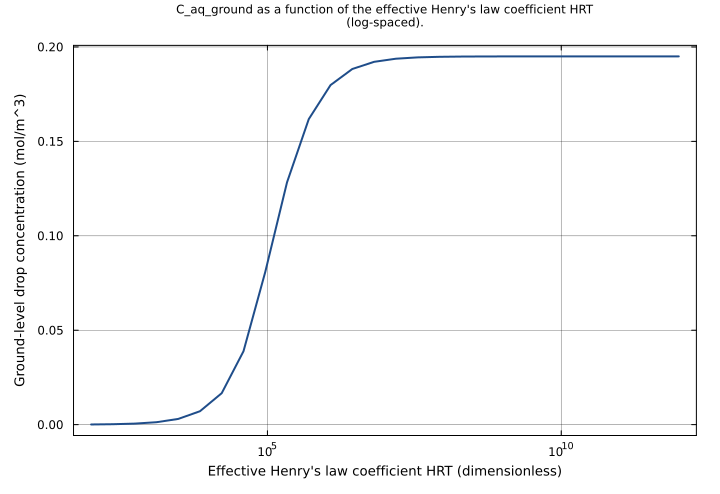
Ground-level drop concentration C_aq_ground (Eq. 20.33) as a function of the dimensionless effective Henry’s law coefficient HRT, swept log-spaced over ten decades at the component defaults. The curve traces the transition between two regimes: at low HRT the drop fully equilibrates and C_aq_ground = C_gHRT rises linearly with solubility; at high HRT the exponent alpha = 6K_ch/(D_pU_tHRT) becomes small and C_aq_ground saturates at the mass-transfer-limited ceiling C_g6K_ch/(D_p*U_t) = 0.195 mol/m^3, independent of HRT.
Time span: 0.0 → 1.0
Swept over: HRT
c_aq_vs_fall_distance
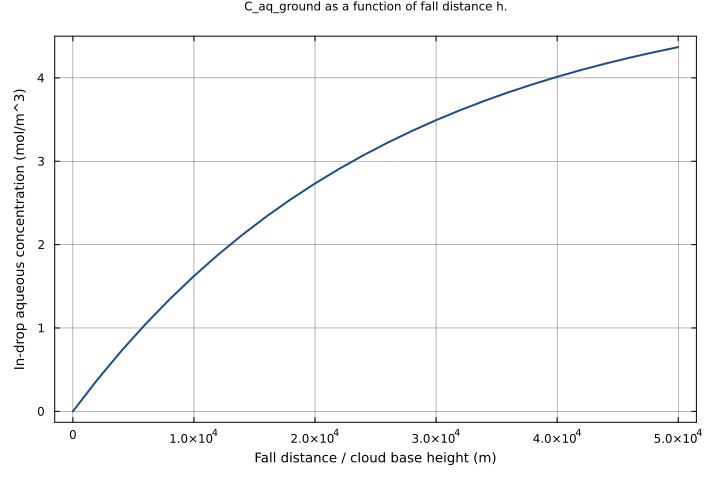
Build-up of the in-drop aqueous concentration along the fall, from cloud base to the ground (Eq. 20.33). Sweeping the fall distance h from 0 to 50 km at the component defaults (HRT = 5.14e6, the HNO3 case): at h = 0 the drop carries only its initial load C_aq0 = 0, and as it falls C_aq_ground climbs monotonically toward the Henry’s-law equilibrium C_eq = C_g*HRT = 5.14 mol/m^3.
Time span: 0.0 → 1.0
Swept over: h
flux_vs_henry
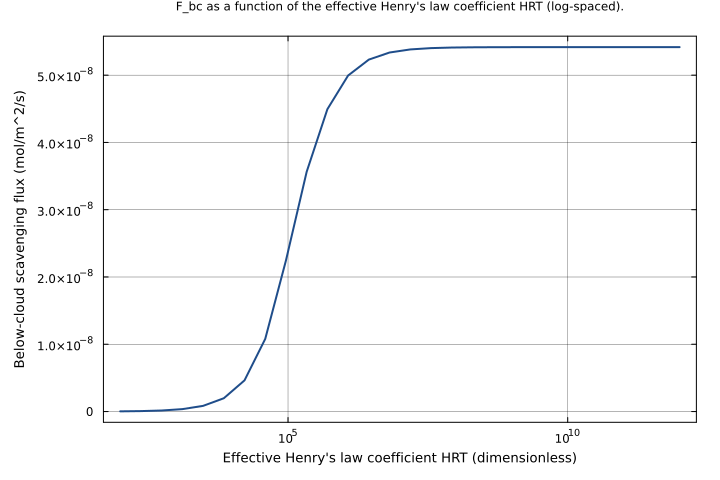
Below-cloud scavenging flux F_bc (Eq. 20.35) as a function of the effective Henry’s law coefficient HRT, swept log-spaced over ten decades at the component defaults. F_bc rises with solubility and saturates at the mass-transfer-limited flux p0C_g6K_ch/(D_p*U_t) = 5.42e-8 mol/m^2/s – once the drop is mass-transfer limited, adding solubility no longer increases the removal rate.
Time span: 0.0 → 1.0
Swept over: HRT
flux_heatmap_transfer_falldistance
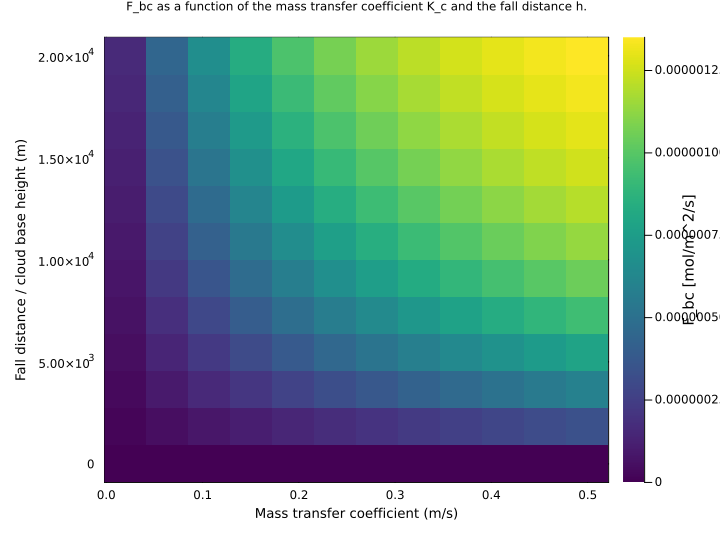
Two-dimensional sweep of the below-cloud scavenging flux F_bc over the raindrop mass transfer coefficient K_c and the fall distance h, at the component defaults (HRT = 5.14e6, the HNO3 case). Both parameters enter only through the e-folding exponent alpha = 6K_ch/(D_pU_tHRT), so F_bc rises smoothly with each – from zero along the h = 0 cloud-base edge (no fall, no exchange) toward the precipitation-limited ceiling p0C_gHRT = 1.43e-6 mol/m^2/s in the fast-transfer, long-fall corner. The iso-flux contours follow lines of constant K_c*h.
Time span: 0.0 → 1.0
Swept over: K_c, h
Raw .esm
Raw .esm JSON (this component)
{
"reference": {
"citation": "Seinfeld & Pandis (2006), Atmospheric Chemistry and Physics, 2nd ed., Chapter 20, Eqs. 20.28, 20.33, 20.35.",
"notes": "source_ref: AtmosphericDeposition.jl@e4468c79:src/seinfeld_pandis_2006_ch20.jl:194\nUpstream `ReversibleGasScavenging` is an MTK `@component` that declares C_g, HRT, K_c, D_p, U_t, h, C_aq0, p0 as `@parameters` and C_aq_ground, F_bc as `@variables`, so the parameter/state split maps directly with no re-typing (matching the sibling observed-only migrations air_refreshing.esm / cloud_ice_uptake.esm). The two upstream helper functions are inlined into the equation ASTs: `reversible_drop_conc` (Eq. 20.28: C_eq - (C_eq - C_aq0)*exp(-alpha) with C_eq = C_g*HRT) is the body of the C_aq_ground equation, and `reversible_scavenging_flux` (Eq. 20.35) the body of the F_bc equation. Both share the dimensionless exponent alpha = 6*K_c*h/(D_p*U_t*HRT); it is written out independently in each equation because the AST has no shared-subexpression binding. The leading factor 6 is kept as an integer literal, mirroring the upstream Int. This component references none of the seinfeld_pandis_2006_ch20.jl module `@constants` (mu_air_sp, rho_air_sp, g_sp, etc. are used only by the particle-scavenging components). `system_kind` is left unset (zero differential states -- no D operator), consistent with the observed-only siblings air_refreshing.esm / cloud_ice_uptake.esm.\n\nThe parameter p0 keeps the upstream Unicode subscript-zero identifier verbatim (matches air_refreshing.esm preserving the Greek/subscript identifiers Ki, tau_A, Delta_x).\n\nTolerance rationale (model-level rel=1e-9, abs=1e-20): observed-only algebraic system (no ODE integration). Each equation is a closed-form expression -- a handful of multiplications, one subtraction, one division, and one `exp` -- evaluated once by topological substitution; rel=1e-9 sits comfortably above float64 ULP roundoff (~1e-16) and absorbs any libm `exp` difference between the reference calculation and the ESS runner. abs=1e-20 gates the two physically-zero F_bc cases: F_bc at the cloud base (h=0, fall distance zero -> 1-exp(0)=0) and F_bc at Henry's-law equilibrium (C_aq0 = C_g*HRT -> the concentration difference vanishes), where the relative check is undefined."
},
"tolerance": {
"rel": 1e-09,
"abs": 1e-20
},
"variables": {
"C_g": {
"type": "parameter",
"units": "mol/m^3",
"default": 1e-06,
"description": "Gas-phase concentration"
},
"HRT": {
"type": "parameter",
"units": "1",
"default": 5140000.0,
"description": "H* x R x T x 1000 (dimensionless effective Henry's law coefficient)"
},
"K_c": {
"type": "parameter",
"units": "m/s",
"default": 0.13,
"description": "Mass transfer coefficient"
},
"D_p": {
"type": "parameter",
"units": "m",
"default": 0.001,
"description": "Raindrop diameter"
},
"U_t": {
"type": "parameter",
"units": "m/s",
"default": 4.0,
"description": "Terminal velocity of raindrop"
},
"h": {
"type": "parameter",
"units": "m",
"default": 1000.0,
"description": "Cloud base height / fall distance"
},
"C_aq0": {
"type": "parameter",
"units": "mol/m^3",
"default": 0.0,
"description": "Initial aqueous-phase concentration"
},
"p₀": {
"type": "parameter",
"units": "m/s",
"default": 2.778e-07,
"description": "Precipitation rate"
},
"C_aq_ground": {
"type": "unknown",
"units": "mol/m^3",
"description": "Ground-level drop concentration (Eq. 20.33)"
},
"F_bc": {
"type": "unknown",
"units": "mol/m^2/s",
"description": "Below-cloud scavenging flux (Eq. 20.35)"
}
},
"equations": [
{
"_comment": "Eq. 20.33 (Eq. 20.28 evaluated at fall distance h) -- ground-level aqueous concentration in a reversibly-absorbing raindrop: C_aq_ground = C_g*HRT - (C_g*HRT - C_aq0)*exp(-alpha), alpha = 6*K_c*h/(D_p*U_t*HRT). C_g*HRT is the Henry's-law equilibrium aqueous concentration C_eq; the drop relaxes from C_aq0 toward C_eq with dimensionless e-folding exponent alpha over the fall distance h. Inlines the upstream helper reversible_drop_conc.",
"lhs": "C_aq_ground",
"rhs": {
"op": "-",
"args": [
{
"op": "*",
"args": [
"C_g",
"HRT"
]
},
{
"op": "*",
"args": [
{
"op": "-",
"args": [
{
"op": "*",
"args": [
"C_g",
"HRT"
]
},
"C_aq0"
]
},
{
"op": "exp",
"args": [
{
"op": "-",
"args": [
{
"op": "/",
"args": [
{
"op": "*",
"args": [
6,
"K_c",
"h"
]
},
{
"op": "*",
"args": [
"D_p",
"U_t",
"HRT"
]
}
]
}
]
}
]
}
]
}
]
}
},
{
"_comment": "Eq. 20.35 -- total below-cloud scavenging flux for a reversibly-absorbed gas: F_bc = p0*(C_g*HRT - C_aq0)*(1 - exp(-alpha)), same alpha as Eq. 20.33. The factor (1 - exp(-alpha)) is the fraction of the equilibrium uptake realised over the fall; p0 converts per-drop uptake to a mol/m^2/s areal flux. F_bc > 0 is net scavenging (gas -> drop); F_bc < 0 is net desorption when C_aq0 exceeds the equilibrium C_g*HRT. Inlines the upstream helper reversible_scavenging_flux.",
"lhs": "F_bc",
"rhs": {
"op": "*",
"args": [
"p₀",
{
"op": "-",
"args": [
{
"op": "*",
"args": [
"C_g",
"HRT"
]
},
"C_aq0"
]
},
{
"op": "-",
"args": [
1,
{
"op": "exp",
"args": [
{
"op": "-",
"args": [
{
"op": "/",
"args": [
{
"op": "*",
"args": [
6,
"K_c",
"h"
]
},
{
"op": "*",
"args": [
"D_p",
"U_t",
"HRT"
]
}
]
}
]
}
]
}
]
}
]
}
}
],
"tests": [
{
"id": "component_defaults",
"description": "All eight parameters at their declared defaults -- the HNO3-at-298-K case (HRT = 5.14e6). alpha = 6*0.13*1000/(1e-3*4*5.14e6) = 0.0379, so the drop realises only ~3.7% of its (large) equilibrium uptake over a 1 km fall: C_aq_ground = 0.1913 mol/m^3, F_bc = 5.316e-8 mol/m^2/s. Implicitly verifies every serialized default value.",
"parameter_overrides": {
"C_g": 1e-06,
"HRT": 5140000.0,
"K_c": 0.13,
"D_p": 0.001,
"U_t": 4.0,
"h": 1000.0,
"C_aq0": 0.0,
"p₀": 2.778e-07
},
"time_span": {
"start": 0.0,
"end": 1.0
},
"assertions": [
{
"variable": "C_aq_ground",
"time": 0.0,
"expected": 0.1913474060882807
},
{
"variable": "F_bc",
"time": 0.0,
"expected": 5.31563094113243e-08
}
]
},
{
"id": "drop_conc_huge_henry",
"description": "Mass-transfer-limited regime (upstream Eq. 20.28 test `C_aq_huge_H`): an enormous effective Henry's law coefficient HRT = 1e12 makes alpha = 1.95e-7 tiny, so the drop barely fills despite an enormous equilibrium C_eq = 1e6. C_aq_ground approaches the mass-transfer ceiling C_g*6*K_c*h/(D_p*U_t) = 0.195 mol/m^3 (the upstream test asserts C_aq_ground is approx 0 to within atol 1.0).",
"parameter_overrides": {
"C_g": 1e-06,
"HRT": 1000000000000.0,
"K_c": 0.13,
"D_p": 0.001,
"U_t": 4.0,
"h": 1000.0,
"C_aq0": 0.0,
"p₀": 2.778e-07
},
"time_span": {
"start": 0.0,
"end": 1.0
},
"assertions": [
{
"variable": "C_aq_ground",
"time": 0.0,
"expected": 0.1949999809730798
},
{
"variable": "F_bc",
"time": 0.0,
"expected": 5.417099470521602e-08
}
]
},
{
"id": "drop_conc_full_equilibration",
"description": "Full-equilibration regime (upstream Eq. 20.28 test `C_aq_equil`): a large mass transfer coefficient K_c = 10, small drop D_p = 1e-4, slow fall U_t = 0.1, and long fall distance h = 1e4 drive alpha to ~6e10, so exp(-alpha) underflows to 0 and the drop reaches the Henry's-law equilibrium exactly: C_aq_ground = C_g*HRT = 1e-6 mol/m^3.",
"parameter_overrides": {
"C_g": 1e-06,
"HRT": 1.0,
"K_c": 10.0,
"D_p": 0.0001,
"U_t": 0.1,
"h": 10000.0,
"C_aq0": 0.0,
"p₀": 2.778e-07
},
"time_span": {
"start": 0.0,
"end": 1.0
},
"assertions": [
{
"variable": "C_aq_ground",
"time": 0.0,
"expected": 1e-06
},
{
"variable": "F_bc",
"time": 0.0,
"expected": 2.778e-13
}
]
},
{
"id": "drop_conc_at_cloud_base",
"description": "Cloud-base boundary (upstream Eq. 20.28 test `C_aq_z0`): with fall distance h = 0 the exponent alpha = 0 and exp(-alpha) = 1, so the drop has had no chance to exchange and C_aq_ground equals the initial aqueous concentration C_aq0 = 5e-4 exactly. The scavenging flux F_bc is identically zero because the realised-uptake fraction (1 - exp(0)) = 0.",
"parameter_overrides": {
"C_g": 1e-06,
"HRT": 100.0,
"K_c": 0.13,
"D_p": 0.001,
"U_t": 4.0,
"h": 0.0,
"C_aq0": 0.0005,
"p₀": 2.778e-07
},
"time_span": {
"start": 0.0,
"end": 1.0
},
"assertions": [
{
"variable": "C_aq_ground",
"time": 0.0,
"expected": 0.0005
},
{
"variable": "F_bc",
"time": 0.0,
"expected": 0.0
}
]
},
{
"id": "flux_positive",
"description": "Net scavenging (upstream Eq. 20.35 test `F_pos`): clean initial drops (C_aq0 = 0) below a gas reservoir, alpha = 1950 so the realised-uptake fraction is essentially 1. F_bc = p0*C_g*HRT = 2.778e-11 mol/m^2/s is strictly positive -- gas is removed from the air into the rain.",
"parameter_overrides": {
"C_g": 1e-06,
"HRT": 100.0,
"K_c": 0.13,
"D_p": 0.001,
"U_t": 4.0,
"h": 1000.0,
"C_aq0": 0.0,
"p₀": 2.778e-07
},
"time_span": {
"start": 0.0,
"end": 1.0
},
"assertions": [
{
"variable": "C_aq_ground",
"time": 0.0,
"expected": 9.999999999999999e-05
},
{
"variable": "F_bc",
"time": 0.0,
"expected": 2.778e-11
}
]
},
{
"id": "flux_equilibrium_zero",
"description": "Henry's-law equilibrium (upstream Eq. 20.35 test `F_equil`): the incoming drops are already in equilibrium with the gas (C_aq0 = C_g*HRT = 1e-4), so the concentration difference C_g*HRT - C_aq0 vanishes and there is no net flux -- F_bc = 0 (the upstream test asserts |F_bc| < 1e-20). C_aq_ground stays pinned at the equilibrium 1e-4 mol/m^3.",
"parameter_overrides": {
"C_g": 1e-06,
"HRT": 100.0,
"K_c": 0.13,
"D_p": 0.001,
"U_t": 4.0,
"h": 1000.0,
"C_aq0": 0.0001,
"p₀": 2.778e-07
},
"time_span": {
"start": 0.0,
"end": 1.0
},
"assertions": [
{
"variable": "C_aq_ground",
"time": 0.0,
"expected": 9.999999999999999e-05
},
{
"variable": "F_bc",
"time": 0.0,
"expected": 0.0
}
]
},
{
"id": "flux_desorption_negative",
"description": "Net desorption -- the reversible regime the irreversible parameterizations cannot capture. Incoming drops are overloaded (C_aq0 = 5e-4 above the equilibrium C_g*HRT = 1e-4), so the concentration difference is negative and F_bc = -1.111e-10 mol/m^2/s: gas is released from the rain back into the air. With alpha = 1950 the drop fully relaxes to equilibrium, so C_aq_ground returns to C_g*HRT = 1e-4.",
"parameter_overrides": {
"C_g": 1e-06,
"HRT": 100.0,
"K_c": 0.13,
"D_p": 0.001,
"U_t": 4.0,
"h": 1000.0,
"C_aq0": 0.0005,
"p₀": 2.778e-07
},
"time_span": {
"start": 0.0,
"end": 1.0
},
"assertions": [
{
"variable": "C_aq_ground",
"time": 0.0,
"expected": 9.999999999999999e-05
},
{
"variable": "F_bc",
"time": 0.0,
"expected": -1.1112000000000001e-10
}
]
},
{
"id": "drop_conc_nonzero_initial",
"description": "Partial fill from a non-zero initial aqueous load: defaults except C_aq0 = 0.05 mol/m^3 (between 0 and the equilibrium C_eq = 5.14). Exercises the full relaxation form C_eq - (C_eq - C_aq0)*exp(-alpha) with both a non-zero C_aq0 and a non-trivial alpha = 0.0379. C_aq_ground = 0.2395 (above the C_aq0=0 default result of 0.1913 because the drop started already loaded); F_bc = 5.264e-8 is slightly below the default because the smaller concentration difference scavenges marginally less.",
"parameter_overrides": {
"C_g": 1e-06,
"HRT": 5140000.0,
"K_c": 0.13,
"D_p": 0.001,
"U_t": 4.0,
"h": 1000.0,
"C_aq0": 0.05,
"p₀": 2.778e-07
},
"time_span": {
"start": 0.0,
"end": 1.0
},
"assertions": [
{
"variable": "C_aq_ground",
"time": 0.0,
"expected": 0.239486049997927
},
{
"variable": "F_bc",
"time": 0.0,
"expected": 5.263922468942426e-08
}
]
},
{
"id": "flux_scales_with_precipitation",
"description": "Precipitation-rate wiring sentinel: defaults except p0 doubled to 5.556e-7 m/s. F_bc enters linearly through p0, so the flux doubles to 1.0631e-7 mol/m^2/s (exactly 2x the component_defaults F_bc). C_aq_ground does not depend on p0 and is unchanged at 0.1913 -- catching any equation that wrongly couples the precipitation rate into the in-drop concentration.",
"parameter_overrides": {
"C_g": 1e-06,
"HRT": 5140000.0,
"K_c": 0.13,
"D_p": 0.001,
"U_t": 4.0,
"h": 1000.0,
"C_aq0": 0.0,
"p₀": 5.556e-07
},
"time_span": {
"start": 0.0,
"end": 1.0
},
"assertions": [
{
"variable": "C_aq_ground",
"time": 0.0,
"expected": 0.1913474060882807
},
{
"variable": "F_bc",
"time": 0.0,
"expected": 1.063126188226486e-07
}
]
}
],
"analyses": [
{
"id": "c_aq_vs_henry",
"description": "Ground-level drop concentration C_aq_ground (Eq. 20.33) as a function of the dimensionless effective Henry's law coefficient HRT, swept log-spaced over ten decades at the component defaults. The curve traces the transition between two regimes: at low HRT the drop fully equilibrates and C_aq_ground = C_g*HRT rises linearly with solubility; at high HRT the exponent alpha = 6*K_c*h/(D_p*U_t*HRT) becomes small and C_aq_ground saturates at the mass-transfer-limited ceiling C_g*6*K_c*h/(D_p*U_t) = 0.195 mol/m^3, independent of HRT.",
"initial_state": {},
"parameters": {
"C_g": 1e-06,
"K_c": 0.13,
"D_p": 0.001,
"U_t": 4.0,
"h": 1000.0,
"C_aq0": 0.0,
"p₀": 2.778e-07
},
"time_span": {
"start": 0.0,
"end": 1.0
},
"parameter_sweep": {
"type": "cartesian",
"dimensions": [
{
"parameter": "HRT",
"range": {
"start": 100.0,
"stop": 1000000000000.0,
"count": 28,
"scale": "log"
}
}
]
},
"plots": [
{
"id": "c_aq_vs_hrt",
"type": "line",
"description": "C_aq_ground as a function of the effective Henry's law coefficient HRT (log-spaced).",
"x": {
"variable": "HRT",
"label": "Effective Henry's law coefficient HRT (dimensionless)"
},
"y": {
"variable": "C_aq_ground",
"label": "Ground-level drop concentration (mol/m^3)"
}
}
]
},
{
"id": "c_aq_vs_fall_distance",
"description": "Build-up of the in-drop aqueous concentration along the fall, from cloud base to the ground (Eq. 20.33). Sweeping the fall distance h from 0 to 50 km at the component defaults (HRT = 5.14e6, the HNO3 case): at h = 0 the drop carries only its initial load C_aq0 = 0, and as it falls C_aq_ground climbs monotonically toward the Henry's-law equilibrium C_eq = C_g*HRT = 5.14 mol/m^3.",
"initial_state": {},
"parameters": {
"C_g": 1e-06,
"HRT": 5140000.0,
"K_c": 0.13,
"D_p": 0.001,
"U_t": 4.0,
"C_aq0": 0.0,
"p₀": 2.778e-07
},
"time_span": {
"start": 0.0,
"end": 1.0
},
"parameter_sweep": {
"type": "cartesian",
"dimensions": [
{
"parameter": "h",
"range": {
"start": 0.0,
"stop": 50000.0,
"count": 26,
"scale": "linear"
}
}
]
},
"plots": [
{
"id": "c_aq_vs_h",
"type": "line",
"description": "C_aq_ground as a function of fall distance h.",
"x": {
"variable": "h",
"label": "Fall distance / cloud base height (m)"
},
"y": {
"variable": "C_aq_ground",
"label": "In-drop aqueous concentration (mol/m^3)"
}
}
]
},
{
"id": "flux_vs_henry",
"description": "Below-cloud scavenging flux F_bc (Eq. 20.35) as a function of the effective Henry's law coefficient HRT, swept log-spaced over ten decades at the component defaults. F_bc rises with solubility and saturates at the mass-transfer-limited flux p0*C_g*6*K_c*h/(D_p*U_t) = 5.42e-8 mol/m^2/s -- once the drop is mass-transfer limited, adding solubility no longer increases the removal rate.",
"initial_state": {},
"parameters": {
"C_g": 1e-06,
"K_c": 0.13,
"D_p": 0.001,
"U_t": 4.0,
"h": 1000.0,
"C_aq0": 0.0,
"p₀": 2.778e-07
},
"time_span": {
"start": 0.0,
"end": 1.0
},
"parameter_sweep": {
"type": "cartesian",
"dimensions": [
{
"parameter": "HRT",
"range": {
"start": 100.0,
"stop": 1000000000000.0,
"count": 28,
"scale": "log"
}
}
]
},
"plots": [
{
"id": "f_bc_vs_hrt",
"type": "line",
"description": "F_bc as a function of the effective Henry's law coefficient HRT (log-spaced).",
"x": {
"variable": "HRT",
"label": "Effective Henry's law coefficient HRT (dimensionless)"
},
"y": {
"variable": "F_bc",
"label": "Below-cloud scavenging flux (mol/m^2/s)"
}
}
]
},
{
"id": "flux_heatmap_transfer_falldistance",
"description": "Two-dimensional sweep of the below-cloud scavenging flux F_bc over the raindrop mass transfer coefficient K_c and the fall distance h, at the component defaults (HRT = 5.14e6, the HNO3 case). Both parameters enter only through the e-folding exponent alpha = 6*K_c*h/(D_p*U_t*HRT), so F_bc rises smoothly with each -- from zero along the h = 0 cloud-base edge (no fall, no exchange) toward the precipitation-limited ceiling p0*C_g*HRT = 1.43e-6 mol/m^2/s in the fast-transfer, long-fall corner. The iso-flux contours follow lines of constant K_c*h.",
"initial_state": {},
"parameters": {
"C_g": 1e-06,
"HRT": 5140000.0,
"D_p": 0.001,
"U_t": 4.0,
"C_aq0": 0.0,
"p₀": 2.778e-07
},
"time_span": {
"start": 0.0,
"end": 1.0
},
"parameter_sweep": {
"type": "cartesian",
"dimensions": [
{
"parameter": "K_c",
"range": {
"start": 0.02,
"stop": 0.5,
"count": 12,
"scale": "linear"
}
},
{
"parameter": "h",
"range": {
"start": 0.0,
"stop": 20000.0,
"count": 12,
"scale": "linear"
}
}
]
},
"plots": [
{
"id": "f_bc_heatmap",
"type": "heatmap",
"description": "F_bc as a function of the mass transfer coefficient K_c and the fall distance h.",
"x": {
"variable": "K_c",
"label": "Mass transfer coefficient (m/s)"
},
"y": {
"variable": "h",
"label": "Fall distance / cloud base height (m)"
},
"value": {
"variable": "F_bc",
"reduce": "final"
}
}
]
}
]
}