GasScavengingCoeff
Below-cloud gas scavenging coefficient for irreversible uptake of a gas-phase species by falling monodisperse raindrops, from Seinfeld & Pandis (2006), Atmospheric Chemistry and Physics, 2nd ed., Chapter 20 (Wet Deposition), Eq. 20.25. The scavenging coefficient Λ_gas = 6·p₀·K_c/(D_p·U_t) sets the first-order loss rate (s⁻¹) of a soluble gas to rain: it rises linearly with the precipitation rate p₀ and the gas-phase mass transfer coefficient K_c, and falls inversely with the raindrop diameter D_p and terminal velocity U_t. 'Irreversible' uptake assumes the gas is captured and not re-released — the limiting case opposite to the Henry's-law-equilibrium treatment of the sibling ReversibleGasScavenging component. Migrated from AtmosphericDeposition.jl@e4468c79 src/seinfeld_pandis_2006_ch20.jl:116 (`GasScavengingCoeff` @component). Observed-only algebraic model: K_c, U_t, D_p, p₀ are input parameters and Λ_gas is the single algebraic output, fixed by one equation with no time derivative.
Description
Below-cloud gas scavenging coefficient for irreversible uptake of a gas-phase species by falling monodisperse raindrops, from Seinfeld & Pandis (2006), Atmospheric Chemistry and Physics, 2nd ed., Chapter 20 (Wet Deposition), Eq. 20.25. The scavenging coefficient Λ_gas = 6·p₀·K_c/(D_p·U_t) sets the first-order loss rate (s⁻¹) of a soluble gas to rain: it rises linearly with the precipitation rate p₀ and the gas-phase mass transfer coefficient K_c, and falls inversely with the raindrop diameter D_p and terminal velocity U_t. ‘Irreversible’ uptake assumes the gas is captured and not re-released — the limiting case opposite to the Henry’s-law-equilibrium treatment of the sibling ReversibleGasScavenging component. Migrated from AtmosphericDeposition.jl@e4468c79 src/seinfeld_pandis_2006_ch20.jl:116 (GasScavengingCoeff @component). Observed-only algebraic model: K_c, U_t, D_p, p₀ are input parameters and Λ_gas is the single algebraic output, fixed by one equation with no time derivative.
Reference
Seinfeld, J. H., & Pandis, S. N. (2006). Atmospheric Chemistry and Physics: From Air Pollution to Climate Change (2nd ed.), Ch. 20, Eq. 20.25. John Wiley & Sons, Inc.
_source_ref: AtmosphericDeposition.jl@e4468c79c8dd4aae88646cd16d6bcf290874742c:src/seinfeld_pandis_2006_ch20.jl:116
Upstream GasScavengingCoeff is an MTK @component with 4 input @parameters (K_c, U_t, D_p, p₀) and 1 @variable (Λ_gas) related by 1 equation. The single equation Λ_gas ~ gas_scavenging_coeff(K_c, U_t, D_p, p₀) carries no time derivative, so the system is purely algebraic (observed-only): system_kind is left unset because ode is the schema default and there is no differential state, matching the sibling observed-only sp_ch1 migrations (barometric.esm, scale_height.esm). Λ_gas is serialized as type: state with one explicit algebraic equation in the equations array.
The single upstream helper function gas_scavenging_coeff(K_c, U_t, D_p, p₀_SI) is inlined into the Λ_gas equation AST: its body is Λ = 6 * p₀_SI * K_c / (D_p * U_t) (Eq. 20.25), encoded as the numerator 6*p₀*K_c over the denominator D_p*U_t, matching Julia’s left-associative 6*p₀*K_c/(D_p*U_t). This is the same inlined expression as the Λ_gas equation of the sibling below_cloud_gas_scavenging.esm migration (esm-mzdf), which also wraps Eq. 20.25. The factor 6 is the dimensionless monodisperse-drop prefactor derived upstream from the drop number density N_D = 6·p₀/(π·D_p³·U_t) (Eq. 20.56); it carries no units.
The module-level @constants of seinfeld_pandis_2006_ch20.jl (μ_air_sp, ρ_air_sp, μ_w_sp, ρ_w_sp, g_sp, kB_sp) are NOT referenced by GasScavengingCoeff or by gas_scavenging_coeff — both use only the component’s own parameters — so no constants are migrated. The equation is dimensionally consistent (Λ_gas: [1]·[m/s]·[m/s]/([m]·[m/s]) = s⁻¹), so there is no upstream checks=false to mirror.
The 4 parameters carry the upstream component defaults (K_c=0.13 m/s, U_t=3.0 m/s, D_p=1.0e-3 m, p₀=2.778e-7 m/s ≈ 1 mm/h). Λ_gas has no upstream default; it is fixed entirely by the algebraic equation. At the component defaults Λ_gas = 7.2228e-5 s⁻¹ ≈ 0.26 h⁻¹ — the D_p = 0.1 cm row of Seinfeld & Pandis Table 20.1 (p. 941).
Tolerance rationale (model-level rel=1e-6): an observed-only algebraic system with no ODE integration; the single equation is a closed-form rational expression evaluated once at each test point. rel=1e-6 comfortably covers float64 round-off in the three multiplies and one divide of 6·p₀·K_c/(D_p·U_t), well above the bit-level agreement expected between bindings._
Parameters
| Name | Units | Default | Description |
|---|---|---|---|
K_c | m/s | 0.13 | Gas-phase mass transfer coefficient to the raindrop |
U_t | m/s | 3.0 | Terminal velocity of the raindrop |
D_p | m | 0.001 | Raindrop diameter |
p₀ | m/s | 2.778e-07 | Precipitation rate (2.778e-7 m/s = 1 mm/h) |
Observed
| Name | Units | Default | Description |
|---|---|---|---|
Λ_gas | s^-1 | Gas scavenging coefficient (Eq. 20.25) |
Observed expressions
$$ Λ_{gas} = \frac{6 \cdot p₀ \cdot K_{c}}{D_{p} \cdot U_{t}} $$Gas scavenging coefficient (Eq. 20.25)
Analyses
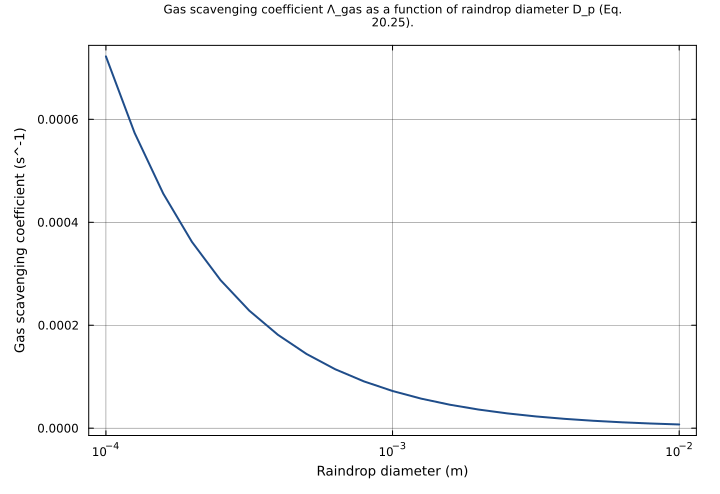
scavenging_coefficient_vs_raindrop_diameter
Gas scavenging coefficient Λ_gas as a function of raindrop diameter D_p, swept log-spaced from 0.1 mm to 10 mm at the default mass transfer coefficient, terminal velocity, and precipitation rate (p₀ ≈ 1 mm/h). Λ_gas ∝ 1/D_p (Eq. 20.25), so smaller drops scavenge far more efficiently — the central message of Seinfeld & Pandis Table 20.1 (p. 941) and the Gas Scavenging Coefficient vs. Raindrop Diameter figure of the AtmosphericDeposition.jl seinfeld_pandis_2006_ch20 documentation. Note: this standalone-component sweep varies only D_p; Table 20.1 additionally co-varies U_t and K_c with drop size, so its overall slope is steeper than this single-parameter curve.
Time span: 0.0 → 1.0
Swept over: D_p
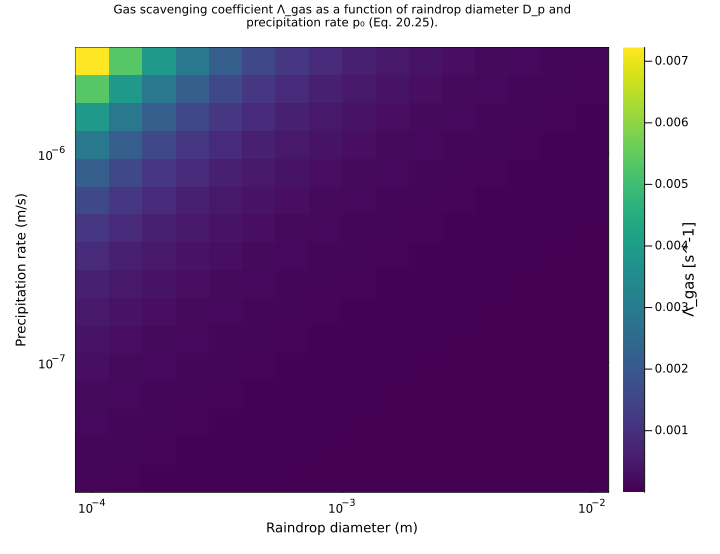
scavenging_coefficient_over_diameter_and_precipitation
Two-dimensional sweep of the gas scavenging coefficient Λ_gas over raindrop diameter D_p (0.1-10 mm) and precipitation rate p₀ (≈ 0.1-10 mm/h), at the default mass transfer coefficient and terminal velocity. Surfaces the joint Eq. 20.25 dependence Λ_gas = 6·p₀·K_c/(D_p·U_t): linear in p₀, inverse in D_p — the scavenging coefficient is largest for small drops in heavy rain.
Time span: 0.0 → 1.0
Swept over: D_p, p₀
Raw .esm
Raw .esm JSON (this component)
{
  "reference": {
    "citation": "Seinfeld, J. H., & Pandis, S. N. (2006). Atmospheric Chemistry and Physics: From Air Pollution to Climate Change (2nd ed.), Ch. 20, Eq. 20.25. John Wiley & Sons, Inc.",
    "notes": "source_ref: AtmosphericDeposition.jl@e4468c79c8dd4aae88646cd16d6bcf290874742c:src/seinfeld_pandis_2006_ch20.jl:116\nUpstream `GasScavengingCoeff` is an MTK `@component` with 4 input `@parameters` (K_c, U_t, D_p, p₀) and 1 `@variable` (Λ_gas) related by 1 equation. The single equation `Λ_gas ~ gas_scavenging_coeff(K_c, U_t, D_p, p₀)` carries no time derivative, so the system is purely algebraic (observed-only): `system_kind` is left unset because `ode` is the schema default and there is no differential state, matching the sibling observed-only sp_ch1 migrations (barometric.esm, scale_height.esm). Λ_gas is serialized as `type: state` with one explicit algebraic equation in the `equations` array.\n\nThe single upstream helper function `gas_scavenging_coeff(K_c, U_t, D_p, p₀_SI)` is inlined into the Λ_gas equation AST: its body is `Λ = 6 * p₀_SI * K_c / (D_p * U_t)` (Eq. 20.25), encoded as the numerator `6*p₀*K_c` over the denominator `D_p*U_t`, matching Julia's left-associative `6*p₀*K_c/(D_p*U_t)`. This is the same inlined expression as the Λ_gas equation of the sibling below_cloud_gas_scavenging.esm migration (esm-mzdf), which also wraps Eq. 20.25. The factor 6 is the dimensionless monodisperse-drop prefactor derived upstream from the drop number density N_D = 6·p₀/(π·D_p³·U_t) (Eq. 20.56); it carries no units.\n\nThe module-level `@constants` of seinfeld_pandis_2006_ch20.jl (μ_air_sp, ρ_air_sp, μ_w_sp, ρ_w_sp, g_sp, kB_sp) are NOT referenced by `GasScavengingCoeff` or by `gas_scavenging_coeff` — both use only the component's own parameters — so no constants are migrated. The equation is dimensionally consistent (Λ_gas: [1]·[m/s]·[m/s]/([m]·[m/s]) = s⁻¹), so there is no upstream `checks=false` to mirror.\n\nThe 4 parameters carry the upstream component defaults (K_c=0.13 m/s, U_t=3.0 m/s, D_p=1.0e-3 m, p₀=2.778e-7 m/s ≈ 1 mm/h). Λ_gas has no upstream default; it is fixed entirely by the algebraic equation. At the component defaults Λ_gas = 7.2228e-5 s⁻¹ ≈ 0.26 h⁻¹ — the D_p = 0.1 cm row of Seinfeld & Pandis Table 20.1 (p. 941).\n\nTolerance rationale (model-level rel=1e-6): an observed-only algebraic system with no ODE integration; the single equation is a closed-form rational expression evaluated once at each test point. rel=1e-6 comfortably covers float64 round-off in the three multiplies and one divide of 6·p₀·K_c/(D_p·U_t), well above the bit-level agreement expected between bindings."
  },
  "tolerance": {
    "rel": 1e-06
  },
  "variables": {
    "K_c": {
      "type": "parameter",
      "units": "m/s",
      "default": 0.13,
      "description": "Gas-phase mass transfer coefficient to the raindrop"
    },
    "U_t": {
      "type": "parameter",
      "units": "m/s",
      "default": 3.0,
      "description": "Terminal velocity of the raindrop"
    },
    "D_p": {
      "type": "parameter",
      "units": "m",
      "default": 0.001,
      "description": "Raindrop diameter"
    },
    "p₀": {
      "type": "parameter",
      "units": "m/s",
      "default": 2.778e-07,
      "description": "Precipitation rate (2.778e-7 m/s = 1 mm/h)"
    },
    "Λ_gas": {
      "type": "unknown",
      "units": "s^-1",
      "description": "Gas scavenging coefficient (Eq. 20.25)"
    }
  },
  "equations": [
    {
      "_comment": "Eq. 20.25 - gas scavenging coefficient for irreversible uptake by monodisperse raindrops: Λ_gas = 6·p₀·K_c/(D_p·U_t). Inlines the upstream helper gas_scavenging_coeff(K_c, U_t, D_p, p₀). Λ_gas depends only on parameters, so it is constant in time.",
      "lhs": "Λ_gas",
      "rhs": {
        "op": "/",
        "args": [
          {
            "op": "*",
            "args": [
              6,
              "p₀",
              "K_c"
            ]
          },
          {
            "op": "*",
            "args": [
              "D_p",
              "U_t"
            ]
          }
        ]
      }
    }
  ],
  "tests": [
    {
      "id": "canonical_defaults",
      "description": "Component defaults — K_c=0.13 m/s, U_t=3.0 m/s, D_p=1.0e-3 m, p₀=2.778e-7 m/s (≈ 1 mm/h). This is the first case of the upstream AtmosphericDeposition.jl seinfeld_pandis_2006_ch20_test.jl `Gas Scavenging Coefficient (Eq. 20.25)` testitem, which checks Λ ≈ 7.22e-5 s⁻¹ (rtol 0.02). The scavenging coefficient Λ_gas = 6·p₀·K_c/(D_p·U_t) = 7.2228e-5 s⁻¹ ≈ 0.26 h⁻¹ reproduces the D_p = 0.1 cm row of Seinfeld & Pandis Table 20.1 (p. 941).",
      "time_span": {
        "start": 0.0,
        "end": 1.0
      },
      "assertions": [
        {
          "variable": "Λ_gas",
          "time": 0.0,
          "expected": 7.2228e-05
        }
      ]
    },
    {
      "id": "small_drops_fast_uptake",
      "description": "Second case of the upstream `Gas Scavenging Coefficient (Eq. 20.25)` testitem (K_c=0.32 m/s, U_t=0.26 m/s, D_p=1.0e-4 m, p₀ at the default), which checks Λ ≈ 0.0205 s⁻¹ (rtol 0.02). Small, slow-falling drops with a high mass transfer coefficient scavenge ~280× faster than the canonical 1-mm-drop case — Λ_gas = 0.020514461538461537 s⁻¹ — illustrating the dominance of drop size in Seinfeld & Pandis Table 20.1.",
      "parameter_overrides": {
        "K_c": 0.32,
        "U_t": 0.26,
        "D_p": 0.0001
      },
      "time_span": {
        "start": 0.0,
        "end": 1.0
      },
      "assertions": [
        {
          "variable": "Λ_gas",
          "time": 0.0,
          "expected": 0.020514461538461537
        }
      ]
    },
    {
      "id": "heavy_precipitation",
      "description": "Heavy rainfall: p₀ = 2.778e-6 m/s (≈ 10 mm/h) raises the scavenging coefficient tenfold to 7.2228e-4 s⁻¹ (Λ_gas ∝ p₀, Eq. 20.25). Verifies the linear precipitation-rate dependence.",
      "parameter_overrides": {
        "p₀": 2.778e-06
      },
      "time_span": {
        "start": 0.0,
        "end": 1.0
      },
      "assertions": [
        {
          "variable": "Λ_gas",
          "time": 0.0,
          "expected": 0.00072228
        }
      ]
    },
    {
      "id": "light_drizzle",
      "description": "Light drizzle: p₀ = 2.778e-8 m/s (≈ 0.1 mm/h) lowers the scavenging coefficient tenfold to 7.2228e-6 s⁻¹ (Λ_gas ∝ p₀, Eq. 20.25) — the weak-scavenging regime where washout is a minor sink.",
      "parameter_overrides": {
        "p₀": 2.778e-08
      },
      "time_span": {
        "start": 0.0,
        "end": 1.0
      },
      "assertions": [
        {
          "variable": "Λ_gas",
          "time": 0.0,
          "expected": 7.2228000000000005e-06
        }
      ]
    },
    {
      "id": "large_raindrops",
      "description": "Larger raindrops: doubling the drop diameter D_p to 2 mm halves the scavenging coefficient to 3.6114e-5 s⁻¹ (Λ_gas ∝ 1/D_p, Eq. 20.25) — larger drops present less collecting surface per unit rainfall volume, so washout is slower.",
      "parameter_overrides": {
        "D_p": 0.002
      },
      "time_span": {
        "start": 0.0,
        "end": 1.0
      },
      "assertions": [
        {
          "variable": "Λ_gas",
          "time": 0.0,
          "expected": 3.6114e-05
        }
      ]
    },
    {
      "id": "fast_falling_drops",
      "description": "Faster-falling drops: raising the terminal velocity U_t from 3 to 4.5 m/s lowers Λ_gas to 4.8151999999999996e-5 s⁻¹ (Λ_gas ∝ 1/U_t, Eq. 20.25) — a drop spends less time per unit fall distance collecting gas.",
      "parameter_overrides": {
        "U_t": 4.5
      },
      "time_span": {
        "start": 0.0,
        "end": 1.0
      },
      "assertions": [
        {
          "variable": "Λ_gas",
          "time": 0.0,
          "expected": 4.8151999999999996e-05
        }
      ]
    },
    {
      "id": "enhanced_mass_transfer",
      "description": "Enhanced gas-phase mass transfer: doubling the mass transfer coefficient K_c to 0.26 m/s doubles the scavenging coefficient to 1.44456e-4 s⁻¹ (Λ_gas ∝ K_c, Eq. 20.25) — more efficient gas uptake at the drop surface accelerates washout.",
      "parameter_overrides": {
        "K_c": 0.26
      },
      "time_span": {
        "start": 0.0,
        "end": 1.0
      },
      "assertions": [
        {
          "variable": "Λ_gas",
          "time": 0.0,
          "expected": 0.000144456
        }
      ]
    }
  ],
  "analyses": [
    {
      "id": "scavenging_coefficient_vs_raindrop_diameter",
      "description": "Gas scavenging coefficient Λ_gas as a function of raindrop diameter D_p, swept log-spaced from 0.1 mm to 10 mm at the default mass transfer coefficient, terminal velocity, and precipitation rate (p₀ ≈ 1 mm/h). Λ_gas ∝ 1/D_p (Eq. 20.25), so smaller drops scavenge far more efficiently — the central message of Seinfeld & Pandis Table 20.1 (p. 941) and the `Gas Scavenging Coefficient vs. Raindrop Diameter` figure of the AtmosphericDeposition.jl seinfeld_pandis_2006_ch20 documentation. Note: this standalone-component sweep varies only D_p; Table 20.1 additionally co-varies U_t and K_c with drop size, so its overall slope is steeper than this single-parameter curve.",
      "initial_state": {},
      "parameters": {},
      "time_span": {
        "start": 0.0,
        "end": 1.0
      },
      "parameter_sweep": {
        "type": "cartesian",
        "dimensions": [
          {
            "parameter": "D_p",
            "range": {
              "start": 0.0001,
              "stop": 0.01,
              "count": 21,
              "scale": "log"
            }
          }
        ]
      },
      "plots": [
        {
          "id": "lambda_gas_vs_d_p",
          "type": "line",
          "description": "Gas scavenging coefficient Λ_gas as a function of raindrop diameter D_p (Eq. 20.25).",
          "x": {
            "variable": "D_p",
            "label": "Raindrop diameter (m)"
          },
          "y": {
            "variable": "Λ_gas",
            "label": "Gas scavenging coefficient (s^-1)"
          }
        }
      ]
    },
    {
      "id": "scavenging_coefficient_over_diameter_and_precipitation",
      "description": "Two-dimensional sweep of the gas scavenging coefficient Λ_gas over raindrop diameter D_p (0.1-10 mm) and precipitation rate p₀ (≈ 0.1-10 mm/h), at the default mass transfer coefficient and terminal velocity. Surfaces the joint Eq. 20.25 dependence Λ_gas = 6·p₀·K_c/(D_p·U_t): linear in p₀, inverse in D_p — the scavenging coefficient is largest for small drops in heavy rain.",
      "initial_state": {},
      "parameters": {},
      "time_span": {
        "start": 0.0,
        "end": 1.0
      },
      "parameter_sweep": {
        "type": "cartesian",
        "dimensions": [
          {
            "parameter": "D_p",
            "range": {
              "start": 0.0001,
              "stop": 0.01,
              "count": 16,
              "scale": "log"
            }
          },
          {
            "parameter": "p₀",
            "range": {
              "start": 2.778e-08,
              "stop": 2.778e-06,
              "count": 16,
              "scale": "log"
            }
          }
        ]
      },
      "plots": [
        {
          "id": "lambda_gas_heatmap",
          "type": "heatmap",
          "description": "Gas scavenging coefficient Λ_gas as a function of raindrop diameter D_p and precipitation rate p₀ (Eq. 20.25).",
          "x": {
            "variable": "D_p",
            "label": "Raindrop diameter (m)"
          },
          "y": {
            "variable": "p₀",
            "label": "Precipitation rate (m/s)"
          },
          "value": {
            "variable": "Λ_gas",
            "reduce": "final"
          }
        }
      ]
    }
  ]
}