GasDiffusionTimescale
Characteristic timescale for gas-phase diffusion of a species to an aerosol particle — Seinfeld & Pandis (2006), Atmospheric Chemistry and Physics, 2nd ed., Chapter 12, Eq. 12.49. The gas-phase diffusion timescale τ_dg = R_p²/(4·D_g) is the characteristic time for a gas-phase concentration perturbation to diffuse to the surface of a particle of radius R_p, given the gas-phase molecular diffusivity D_g of the species. It is one of the family of mass-transfer timescales in Ch. 12 — gas-phase diffusion, interfacial transport, aqueous-phase diffusion, aqueous-phase reaction — that are compared against one another to identify the rate-limiting step in gas-to-particle conversion: a short τ_dg means gas-phase diffusion is fast and not the bottleneck. The timescale grows quadratically with the particle radius and inversely with the diffusivity. Migrated from Aerosol.jl GasDiffusionTimescale.
Description
Characteristic timescale for gas-phase diffusion of a species to an aerosol particle — Seinfeld & Pandis (2006), Atmospheric Chemistry and Physics, 2nd ed., Chapter 12, Eq. 12.49. The gas-phase diffusion timescale τ_dg = R_p²/(4·D_g) is the characteristic time for a gas-phase concentration perturbation to diffuse to the surface of a particle of radius R_p, given the gas-phase molecular diffusivity D_g of the species. It is one of the family of mass-transfer timescales in Ch. 12 — gas-phase diffusion, interfacial transport, aqueous-phase diffusion, aqueous-phase reaction — that are compared against one another to identify the rate-limiting step in gas-to-particle conversion: a short τ_dg means gas-phase diffusion is fast and not the bottleneck. The timescale grows quadratically with the particle radius and inversely with the diffusivity. Migrated from Aerosol.jl GasDiffusionTimescale.
Reference
Seinfeld, J. H., and Pandis, S. N. (2006). Atmospheric Chemistry and Physics: From Air Pollution to Climate Change, 2nd Edition, John Wiley & Sons, Chapter 12. Gas-phase diffusion timescale: Eq. 12.49.
_source_ref: Aerosol.jl@c8c640bb636b22f2425460e9ed5cba50793bfee1:src/timescales.jl:14
Upstream GasDiffusionTimescale is an MTK @component (no parameterization). It declares two scalar @parameters — R_p (particle radius, m, default 1.0e-5) and D_g (gas-phase diffusivity, m^2/s, default 2.0e-5) — and one scalar @variable τ_dg (gas-phase diffusion timescale, s). The single equation is τ_dg ~ R_p^2 / (4 * D_g) — Eq. 12.49 of Seinfeld & Pandis (2006) Ch. 12: the characteristic time for a gas-phase concentration perturbation to diffuse to the particle surface.
Observed classification: GasDiffusionTimescale has no D() time-derivative anywhere — it is a purely-algebraic component. τ_dg is an algebraic output (τ_dg ~ R_p^2/(4·D_g)). After MTK mtkcompile / structural_simplify the compiled system has zero ODE states and τ_dg becomes an observed quantity. It is therefore serialized as type: observed with an expression (not type: state with an equation), and the equations array is empty, matching the sibling pure-algebraic timescale migration aqueous_eq.esm (src/timescales.jl:183) and the other pure-algebraic Aerosol.jl migrations zsr.esm and critical_ssa.esm.
Unicode identifier τ_dg is kept verbatim from the upstream @variables declaration; the ESM identifier pattern permits unicode and the sibling Aerosol.jl migrations (aqueous_eq.esm: τ_s, τ_a; zsr.esm: α_w; kelvin.esm: σ, ρ_l) keep Greek symbols, so no ASCII rename is applied. The ASCII parameter names R_p and D_g are likewise carried verbatim from the upstream @parameters; R_p does not collide with the reserved bare constant name R (universal gas constant).
Tests authored from physics: the upstream timescales.jl carries no test file (has_tests: N in the migration tracker). The inline tests block is authored from the closed-form Eq. 12.49 — pinning the exact analytic value of τ_dg = R_p²/(4·D_g) at the upstream default parameterization, bracketing the quadratic dependence on the particle radius R_p on both sides of the default (radius doubled → timescale ×4; radius halved → timescale ÷4), exercising the inverse dependence on the gas-phase diffusivity D_g (diffusivity doubled → timescale ÷2), the fast-diffusion limit of a fine accumulation-mode particle, and the R_p = 0 limit where the timescale vanishes.
Not migrated: timescales.jl defines six independent @components — GasDiffusionTimescale, AqueousDiffusionTimescale, InterfacialTimescale, ReactionTimescale, SolidEquilibrationTimescale, and AqueousEquilibrationTimescale. Only GasDiffusionTimescale (src/timescales.jl:14) is in scope for this component migration; the other five are separate migration-tracker rows with their own target .esm files under components/aerosol/timescales/.
Tolerance rationale (model-level rel=1e-8): the model is a single closed-form algebraic expression — one squaring, one multiplication, and one division — so float64 evaluation roundoff is at the 1-ULP (~1e-16 relative) level; rel=1e-8 leaves ample headroom. The zero_radius_zero_timescale test adds a tight per-assertion abs=1e-20 so a stuck-nonzero regression in the τ_dg quotient cannot pass on the relative branch._
Parameters
| Name | Units | Default | Description |
|---|---|---|---|
R_p | m | 1e-05 | Particle radius — the characteristic radius of the aerosol particle to which the gas-phase species diffuses (Eq. 12.49 term R_p). Sets the diffusion length scale; because the perturbation must spread across a distance comparable to R_p, the timescale grows as R_p². |
D_g | m^2/s | 2e-05 | Gas-phase (molecular) diffusivity of the species in air (Eq. 12.49 term D_g) — sets the rate at which a gas-phase concentration perturbation spreads. A larger diffusivity propagates the perturbation to the particle surface faster and shortens the diffusion timescale. |
Observed
| Name | Units | Default | Description |
|---|---|---|---|
τ_dg | s | Gas-phase diffusion timescale (Eq. 12.49): τ_dg = R_p²/(4·D_g). The characteristic time for a gas-phase concentration perturbation to diffuse to the particle surface. Grows quadratically with the particle radius R_p and inversely with the gas-phase diffusivity D_g; when short relative to the interfacial, aqueous-diffusion and reaction timescales, gas-phase diffusion is not the rate-limiting step in gas-to-particle conversion. |
Observed expressions
$$ τ_{dg} = \frac{R_{p}^{2}}{4 \cdot D_{g}} $$Gas-phase diffusion timescale (Eq. 12.49): τ_dg = R_p²/(4·D_g). The characteristic time for a gas-phase concentration perturbation to diffuse to the particle surface. Grows quadratically with the particle radius R_p and inversely with the gas-phase diffusivity D_g; when short relative to the interfacial, aqueous-diffusion and reaction timescales, gas-phase diffusion is not the rate-limiting step in gas-to-particle conversion.
Analyses
timescale_vs_radius
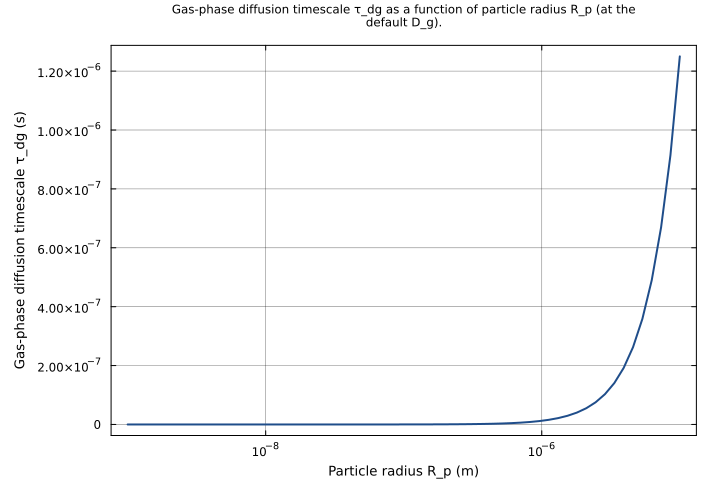
The gas-phase diffusion timescale rises quadratically with the particle radius (Eq. 12.49). Sweeping R_p over the 1e-9–1e-5 m range — from a nucleation-mode cluster up to a coarse particle — at the default D_g = 2e-5 m²/s traces the parabola τ_dg = R_p²/(4·D_g): τ_dg climbs four orders of magnitude for every two decades of radius.
Time span: 0.0 → 1.0
Swept over: R_p
timescale_vs_diffusivity
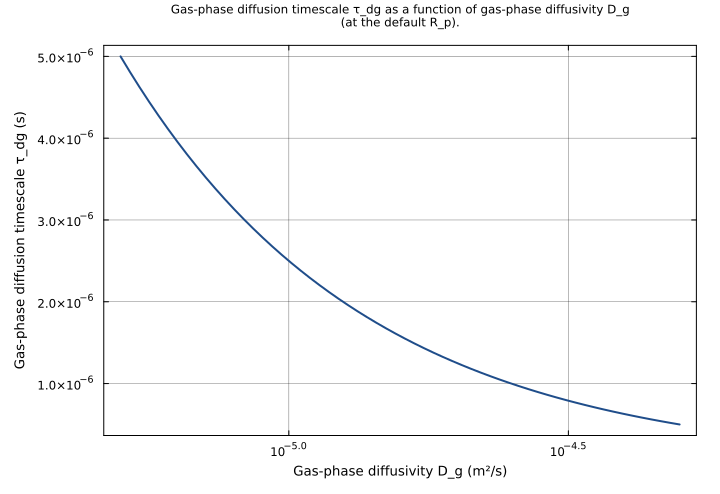
The gas-phase diffusion timescale varies inversely with the gas-phase diffusivity (Eq. 12.49). With R_p at the default 1e-5 m, sweeping D_g over the 5e-6–5e-5 m²/s range — the span of molecular diffusivities of trace gases in air — traces the τ_dg = R_p²/(4·D_g) hyperbola: a faster-diffusing species reaches the particle surface sooner.
Time span: 0.0 → 1.0
Swept over: D_g
timescale_radius_diffusivity_heatmap
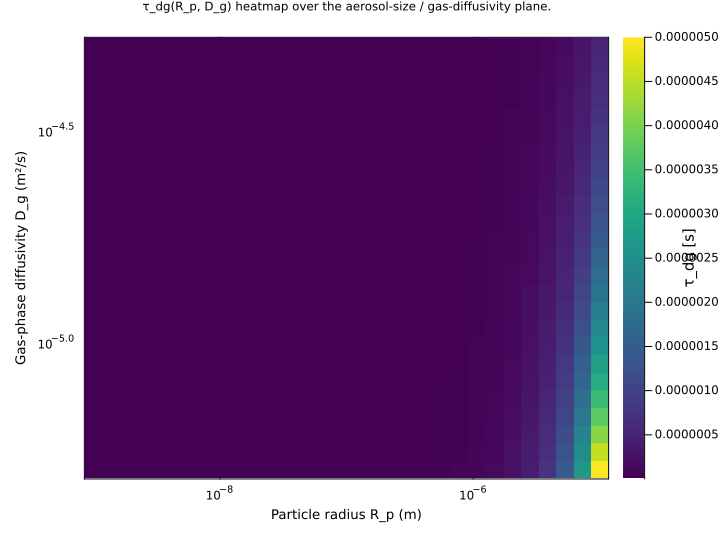
Joint dependence of the gas-phase diffusion timescale on the particle radius and the gas-phase diffusivity (Eq. 12.49). The heatmap of τ_dg(R_p, D_g) shows the timescale rising steeply (quadratically) with R_p and falling with D_g — the τ_dg = R_p²/(4·D_g) surface over the aerosol-size / gas-diffusivity plane.
Time span: 0.0 → 1.0
Swept over: R_p, D_g
Raw .esm
Raw .esm JSON (this component)
{
  "reference": {
    "citation": "Seinfeld, J. H., and Pandis, S. N. (2006). Atmospheric Chemistry and Physics: From Air Pollution to Climate Change, 2nd Edition, John Wiley & Sons, Chapter 12. Gas-phase diffusion timescale: Eq. 12.49.",
    "notes": "source_ref: Aerosol.jl@c8c640bb636b22f2425460e9ed5cba50793bfee1:src/timescales.jl:14\n\nUpstream `GasDiffusionTimescale` is an MTK `@component` (no parameterization). It declares two scalar `@parameters` — `R_p` (particle radius, m, default 1.0e-5) and `D_g` (gas-phase diffusivity, m^2/s, default 2.0e-5) — and one scalar `@variable` `τ_dg` (gas-phase diffusion timescale, s). The single equation is `τ_dg ~ R_p^2 / (4 * D_g)` — Eq. 12.49 of Seinfeld & Pandis (2006) Ch. 12: the characteristic time for a gas-phase concentration perturbation to diffuse to the particle surface.\n\nObserved classification: GasDiffusionTimescale has no `D()` time-derivative anywhere — it is a purely-algebraic component. `τ_dg` is an algebraic output (`τ_dg ~ R_p^2/(4·D_g)`). After MTK `mtkcompile` / `structural_simplify` the compiled system has zero ODE states and `τ_dg` becomes an observed quantity. It is therefore serialized as `type: observed` with an `expression` (not `type: state` with an equation), and the `equations` array is empty, matching the sibling pure-algebraic timescale migration `aqueous_eq.esm` (src/timescales.jl:183) and the other pure-algebraic Aerosol.jl migrations `zsr.esm` and `critical_ssa.esm`.\n\nUnicode identifier `τ_dg` is kept verbatim from the upstream `@variables` declaration; the ESM identifier pattern permits unicode and the sibling Aerosol.jl migrations (`aqueous_eq.esm`: `τ_s`, `τ_a`; `zsr.esm`: `α_w`; `kelvin.esm`: `σ`, `ρ_l`) keep Greek symbols, so no ASCII rename is applied. The ASCII parameter names `R_p` and `D_g` are likewise carried verbatim from the upstream `@parameters`; `R_p` does not collide with the reserved bare constant name `R` (universal gas constant).\n\nTests authored from physics: the upstream `timescales.jl` carries no test file (`has_tests: N` in the migration tracker). The inline `tests` block is authored from the closed-form Eq. 12.49 — pinning the exact analytic value of `τ_dg = R_p²/(4·D_g)` at the upstream default parameterization, bracketing the quadratic dependence on the particle radius R_p on both sides of the default (radius doubled → timescale ×4; radius halved → timescale ÷4), exercising the inverse dependence on the gas-phase diffusivity D_g (diffusivity doubled → timescale ÷2), the fast-diffusion limit of a fine accumulation-mode particle, and the R_p = 0 limit where the timescale vanishes.\n\nNot migrated: `timescales.jl` defines six independent `@component`s — `GasDiffusionTimescale`, `AqueousDiffusionTimescale`, `InterfacialTimescale`, `ReactionTimescale`, `SolidEquilibrationTimescale`, and `AqueousEquilibrationTimescale`. Only `GasDiffusionTimescale` (src/timescales.jl:14) is in scope for this component migration; the other five are separate migration-tracker rows with their own target `.esm` files under `components/aerosol/timescales/`.\n\nTolerance rationale (model-level rel=1e-8): the model is a single closed-form algebraic expression — one squaring, one multiplication, and one division — so float64 evaluation roundoff is at the 1-ULP (~1e-16 relative) level; rel=1e-8 leaves ample headroom. The `zero_radius_zero_timescale` test adds a tight per-assertion abs=1e-20 so a stuck-nonzero regression in the `τ_dg` quotient cannot pass on the relative branch."
  },
  "variables": {
    "R_p": {
      "type": "parameter",
      "units": "m",
      "default": 1e-05,
      "description": "Particle radius — the characteristic radius of the aerosol particle to which the gas-phase species diffuses (Eq. 12.49 term R_p). Sets the diffusion length scale; because the perturbation must spread across a distance comparable to R_p, the timescale grows as R_p²."
    },
    "D_g": {
      "type": "parameter",
      "units": "m^2/s",
      "default": 2e-05,
      "description": "Gas-phase (molecular) diffusivity of the species in air (Eq. 12.49 term D_g) — sets the rate at which a gas-phase concentration perturbation spreads. A larger diffusivity propagates the perturbation to the particle surface faster and shortens the diffusion timescale."
    },
    "τ_dg": {
      "type": "unknown",
      "units": "s",
      "description": "Gas-phase diffusion timescale (Eq. 12.49): τ_dg = R_p²/(4·D_g). The characteristic time for a gas-phase concentration perturbation to diffuse to the particle surface. Grows quadratically with the particle radius R_p and inversely with the gas-phase diffusivity D_g; when short relative to the interfacial, aqueous-diffusion and reaction timescales, gas-phase diffusion is not the rate-limiting step in gas-to-particle conversion."
    }
  },
  "equations": [
    {
      "lhs": "τ_dg",
      "rhs": {
        "op": "/",
        "args": [
          {
            "op": "^",
            "args": [
              "R_p",
              2
            ]
          },
          {
            "op": "*",
            "args": [
              4,
              "D_g"
            ]
          }
        ]
      }
    }
  ],
  "tolerance": {
    "rel": 1e-08
  },
  "tests": [
    {
      "id": "default_parameters",
      "description": "Eq. 12.49 at the upstream default parameterization (R_p = 1e-5 m, D_g = 2e-5 m²/s). The gas-phase diffusion timescale is τ_dg = R_p²/(4·D_g) = (1e-5)²/(4·2e-5) = 1.25e-6 s — a microsecond-scale time for a gas-phase concentration perturbation to diffuse to the particle surface. The output is algebraic and time-invariant, so the same value is asserted at t = 0 and t = 1.",
      "parameter_overrides": {},
      "time_span": {
        "start": 0.0,
        "end": 1.0
      },
      "assertions": [
        {
          "variable": "τ_dg",
          "time": 0.0,
          "expected": 1.25e-06
        },
        {
          "variable": "τ_dg",
          "time": 1.0,
          "expected": 1.25e-06
        }
      ]
    },
    {
      "id": "quadratic_in_radius",
      "description": "Eq. 12.49 is quadratic in the particle radius R_p — the diffusion length scale enters squared. Doubling R_p from the 1e-5 m default to 2e-5 m quadruples the gas-phase diffusion timescale from 1.25e-6 to τ_dg = (2e-5)²/(4·2e-5) = 5e-6 s: a larger particle presents a longer distance for the gas-phase perturbation to diffuse across.",
      "parameter_overrides": {
        "R_p": 2e-05
      },
      "time_span": {
        "start": 0.0,
        "end": 1.0
      },
      "assertions": [
        {
          "variable": "τ_dg",
          "time": 0.0,
          "expected": 5e-06
        }
      ]
    },
    {
      "id": "radius_halved_quarters_timescale",
      "description": "The quadratic dependence of Eq. 12.49 acts downward as well: halving the particle radius R_p from the 1e-5 m default to 5e-6 m quarters the gas-phase diffusion timescale from 1.25e-6 to τ_dg = (5e-6)²/(4·2e-5) = 3.125e-7 s. Together with quadratic_in_radius this brackets the R_p² scaling on both sides of the default.",
      "parameter_overrides": {
        "R_p": 5e-06
      },
      "time_span": {
        "start": 0.0,
        "end": 1.0
      },
      "assertions": [
        {
          "variable": "τ_dg",
          "time": 0.0,
          "expected": 3.125e-07
        }
      ]
    },
    {
      "id": "inverse_in_diffusivity",
      "description": "Eq. 12.49 varies inversely with the gas-phase diffusivity D_g. Doubling D_g from the 2e-5 m²/s default to 4e-5 m²/s halves the gas-phase diffusion timescale from 1.25e-6 to τ_dg = (1e-5)²/(4·4e-5) = 6.25e-7 s — a faster-diffusing species spreads a concentration perturbation to the particle surface more quickly.",
      "parameter_overrides": {
        "D_g": 4e-05
      },
      "time_span": {
        "start": 0.0,
        "end": 1.0
      },
      "assertions": [
        {
          "variable": "τ_dg",
          "time": 0.0,
          "expected": 6.25e-07
        }
      ]
    },
    {
      "id": "fine_particle_fast_diffusion",
      "description": "For a fine accumulation-mode particle the quadratic R_p² scaling makes gas-phase diffusion extremely fast. With R_p = 1e-7 m (a 0.1 µm radius, two decades below the coarse-particle default) and the default D_g = 2e-5 m²/s, τ_dg = (1e-7)²/(4·2e-5) = 1.25e-10 s — sub-nanosecond, confirming gas-phase diffusion is never the rate-limiting step for fine particles.",
      "parameter_overrides": {
        "R_p": 1e-07
      },
      "time_span": {
        "start": 0.0,
        "end": 1.0
      },
      "assertions": [
        {
          "variable": "τ_dg",
          "time": 0.0,
          "expected": 1.25e-10
        }
      ]
    },
    {
      "id": "zero_radius_zero_timescale",
      "description": "Limiting case: with a vanishing particle radius (R_p = 0) there is no diffusion length scale and τ_dg = 0 exactly — the numerator R_p² vanishes while the denominator 4·D_g stays finite at the default D_g. A tight per-assertion absolute tolerance guards against a stuck-nonzero regression in the τ_dg quotient.",
      "parameter_overrides": {
        "R_p": 0.0
      },
      "time_span": {
        "start": 0.0,
        "end": 1.0
      },
      "assertions": [
        {
          "variable": "τ_dg",
          "time": 0.0,
          "expected": 0.0,
          "tolerance": {
            "abs": 1e-20
          }
        }
      ]
    }
  ],
  "analyses": [
    {
      "id": "timescale_vs_radius",
      "description": "The gas-phase diffusion timescale rises quadratically with the particle radius (Eq. 12.49). Sweeping R_p over the 1e-9–1e-5 m range — from a nucleation-mode cluster up to a coarse particle — at the default D_g = 2e-5 m²/s traces the parabola τ_dg = R_p²/(4·D_g): τ_dg climbs four orders of magnitude for every two decades of radius.",
      "parameters": {},
      "time_span": {
        "start": 0.0,
        "end": 1.0
      },
      "parameter_sweep": {
        "type": "cartesian",
        "dimensions": [
          {
            "parameter": "R_p",
            "range": {
              "start": 1e-09,
              "stop": 1e-05,
              "count": 60,
              "scale": "log"
            }
          }
        ]
      },
      "plots": [
        {
          "id": "tau_dg_vs_R_p",
          "type": "line",
          "description": "Gas-phase diffusion timescale τ_dg as a function of particle radius R_p (at the default D_g).",
          "x": {
            "variable": "R_p",
            "label": "Particle radius R_p (m)"
          },
          "y": {
            "variable": "τ_dg",
            "label": "Gas-phase diffusion timescale τ_dg (s)"
          }
        }
      ]
    },
    {
      "id": "timescale_vs_diffusivity",
      "description": "The gas-phase diffusion timescale varies inversely with the gas-phase diffusivity (Eq. 12.49). With R_p at the default 1e-5 m, sweeping D_g over the 5e-6–5e-5 m²/s range — the span of molecular diffusivities of trace gases in air — traces the τ_dg = R_p²/(4·D_g) hyperbola: a faster-diffusing species reaches the particle surface sooner.",
      "parameters": {},
      "time_span": {
        "start": 0.0,
        "end": 1.0
      },
      "parameter_sweep": {
        "type": "cartesian",
        "dimensions": [
          {
            "parameter": "D_g",
            "range": {
              "start": 5e-06,
              "stop": 5e-05,
              "count": 60,
              "scale": "log"
            }
          }
        ]
      },
      "plots": [
        {
          "id": "tau_dg_vs_D_g",
          "type": "line",
          "description": "Gas-phase diffusion timescale τ_dg as a function of gas-phase diffusivity D_g (at the default R_p).",
          "x": {
            "variable": "D_g",
            "label": "Gas-phase diffusivity D_g (m²/s)"
          },
          "y": {
            "variable": "τ_dg",
            "label": "Gas-phase diffusion timescale τ_dg (s)"
          }
        }
      ]
    },
    {
      "id": "timescale_radius_diffusivity_heatmap",
      "description": "Joint dependence of the gas-phase diffusion timescale on the particle radius and the gas-phase diffusivity (Eq. 12.49). The heatmap of τ_dg(R_p, D_g) shows the timescale rising steeply (quadratically) with R_p and falling with D_g — the τ_dg = R_p²/(4·D_g) surface over the aerosol-size / gas-diffusivity plane.",
      "parameters": {},
      "time_span": {
        "start": 0.0,
        "end": 1.0
      },
      "parameter_sweep": {
        "type": "cartesian",
        "dimensions": [
          {
            "parameter": "R_p",
            "range": {
              "start": 1e-09,
              "stop": 1e-05,
              "count": 30,
              "scale": "log"
            }
          },
          {
            "parameter": "D_g",
            "range": {
              "start": 5e-06,
              "stop": 5e-05,
              "count": 25,
              "scale": "log"
            }
          }
        ]
      },
      "plots": [
        {
          "id": "tau_dg_R_p_D_g_heatmap",
          "type": "heatmap",
          "description": "τ_dg(R_p, D_g) heatmap over the aerosol-size / gas-diffusivity plane.",
          "x": {
            "variable": "R_p",
            "label": "Particle radius R_p (m)"
          },
          "y": {
            "variable": "D_g",
            "label": "Gas-phase diffusivity D_g (m²/s)"
          },
          "value": {
            "variable": "τ_dg",
            "reduce": "final"
          }
        }
      ]
    }
  ]
}