CloudOpticalDepth
Cloud optical depth from liquid water content and droplet number concentration — Seinfeld & Pandis (2006) Ch. 24 §24.8.1, Eq. 24.36.
Description
Cloud optical depth from liquid water content and droplet number concentration — Seinfeld & Pandis (2006) Ch. 24 §24.8.1, Eq. 24.36.
Reference
Seinfeld, J. H., and Pandis, S. N. (2006). Atmospheric Chemistry and Physics: From Air Pollution to Climate Change, 2nd Edition, Chapter 24, Section 24.8.1, Equation 24.36.
_source_ref: Aerosol.jl@c8c640bb:src/aerosol_radiative_forcing.jl:154
Cloud optical depth in terms of cloud thickness h, liquid water content L, and cloud droplet number concentration N. Closed-form algebraic relation τ_c = h · (9π·L²·N / (2·ρ_w²))^(1/3). The upstream Julia component declares ρ_w as an MTK @constants value; here it is exposed as a parameter (default 1000.0 kg/m³) so it remains overridable from the canonical Python runner — it is not a tunable physical knob, it is the density of liquid water. After MTK structural_simplify the system has zero ODE states and τ_c is an observed binding, so the inline-test runner samples τ_c at its algebraic value at any requested time.
Tolerance rationale (model-level rel=1e-8 / abs=1e-12): closed-form algebraic τ_c = h·(9π·L²·N / (2·ρ_w²))^(1/3) reduces to zero ODE states after MTK structural_simplify, so 1e-8 captures only float64 roundoff in the cube-root + multiply chain. abs=1e-12 floors near-zero limits (very thin / dilute clouds). Matches the tolerance choice on the sister CloudAlbedo component._
Parameters
| Name | Units | Default | Description |
|---|---|---|---|
h | m | 500.0 | Cloud thickness |
L | kg/m^3 | 0.0003 | Liquid water content (in-cloud, kg of liquid water per m³ of cloud air) |
N | m^-3 | 100000000.0 | Cloud droplet number concentration |
ρ_w | kg/m^3 | 1000.0 | Density of liquid water (upstream @constants; exposed as a parameter for ESM serialization but not a tunable physical knob) |
Observed
| Name | Units | Default | Description |
|---|---|---|---|
τ_c | 1 | Cloud optical depth from Seinfeld & Pandis (2006) Eq. 24.36, τ_c = h·(9π·L²·N / (2·ρ_w²))^(1/3). |
Observed expressions
$$ τ_{c} = h \cdot \frac{9 \cdot 3.141592653589793 \cdot L^{2} \cdot N}{2 \cdot ρ_{w}^{2}}^{\frac{1}{3}} $$Cloud optical depth from Seinfeld & Pandis (2006) Eq. 24.36, τ_c = h·(9π·L²·N / (2·ρ_w²))^(1/3).
Analyses
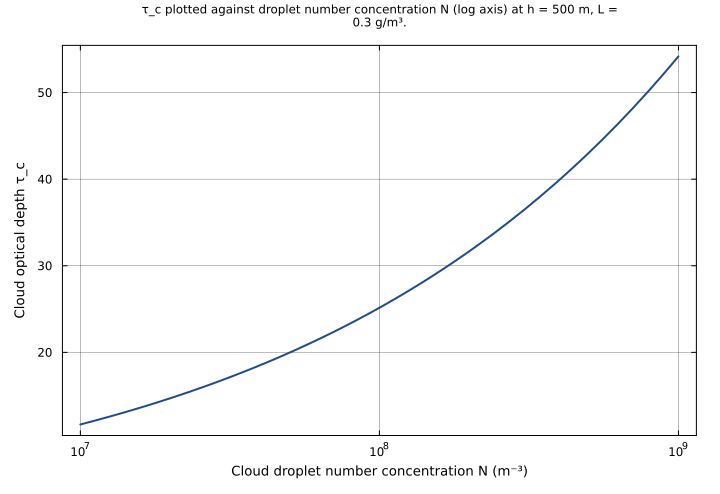
figure_24_17_tau_c_vs_N
Reproduces Figure 24.17 from Seinfeld & Pandis (2006), p. 1082 — cloud optical depth τ_c as a function of droplet number concentration N at the canonical h = 500 m, L = 0.3 g/m³. The cube-root scaling τ_c ∝ N^(1/3) is the underlying mechanism for the first indirect (Twomey) aerosol effect.
Time span: 0.0 → 1.0
Swept over: N
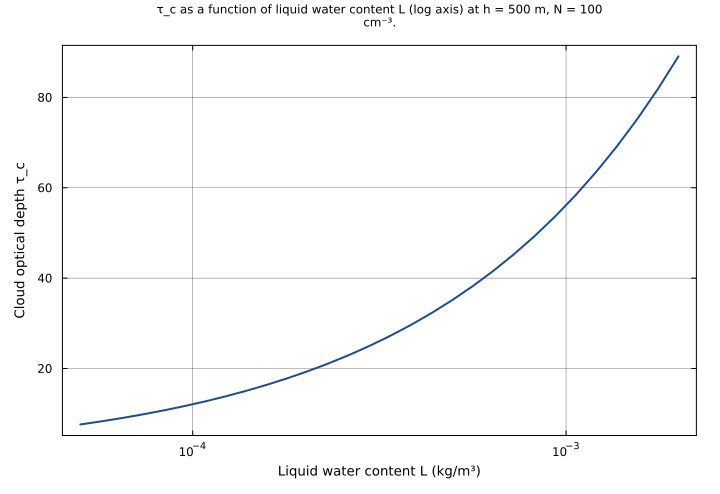
tau_c_vs_L
Liquid-water-content sweep at fixed h = 500 m, N = 100 cm⁻³. τ_c ∝ L^(2/3); spans the stratocumulus-to-cumulus range (≈0.05 g/m³ to ≈2 g/m³).
Time span: 0.0 → 1.0
Swept over: L
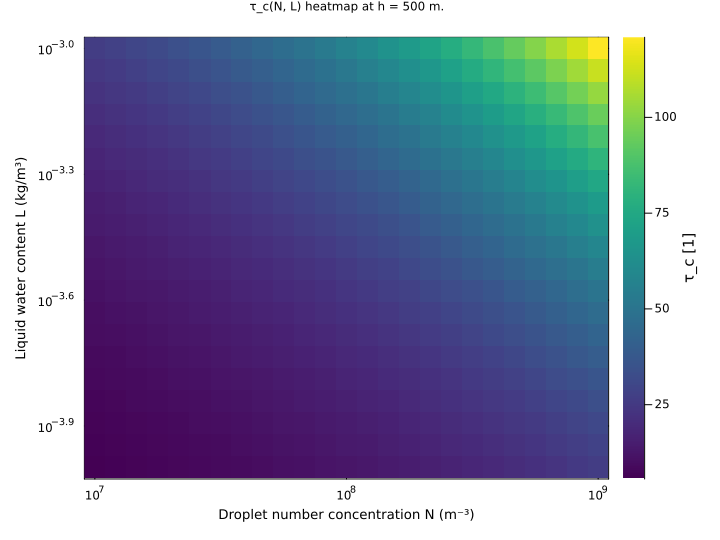
tau_c_N_L_joint_sweep
Joint sensitivity of τ_c to droplet number concentration and liquid water content at fixed h = 500 m. Visualizes the cube-root × two-thirds-power surface τ_c(N, L). Confirms monotonic increase in both directions and quantifies the Twomey-effect leverage of N on τ_c at varying L.
Time span: 0.0 → 1.0
Swept over: N, L
Raw .esm
Raw .esm JSON (this component)
{
  "reference": {
    "citation": "Seinfeld, J. H., and Pandis, S. N. (2006). Atmospheric Chemistry and Physics: From Air Pollution to Climate Change, 2nd Edition, Chapter 24, Section 24.8.1, Equation 24.36.",
    "notes": "source_ref: Aerosol.jl@c8c640bb:src/aerosol_radiative_forcing.jl:154\nCloud optical depth in terms of cloud thickness h, liquid water content L, and cloud droplet number concentration N. Closed-form algebraic relation τ_c = h · (9π·L²·N / (2·ρ_w²))^(1/3). The upstream Julia component declares ρ_w as an MTK `@constants` value; here it is exposed as a parameter (default 1000.0 kg/m³) so it remains overridable from the canonical Python runner — it is not a tunable physical knob, it is the density of liquid water. After MTK structural_simplify the system has zero ODE states and τ_c is an observed binding, so the inline-test runner samples τ_c at its algebraic value at any requested time.\n\nTolerance rationale (model-level rel=1e-8 / abs=1e-12): closed-form algebraic τ_c = h·(9π·L²·N / (2·ρ_w²))^(1/3) reduces to zero ODE states after MTK structural_simplify, so 1e-8 captures only float64 roundoff in the cube-root + multiply chain. abs=1e-12 floors near-zero limits (very thin / dilute clouds). Matches the tolerance choice on the sister CloudAlbedo component."
  },
  "variables": {
    "h": {
      "type": "parameter",
      "units": "m",
      "default": 500.0,
      "description": "Cloud thickness"
    },
    "L": {
      "type": "parameter",
      "units": "kg/m^3",
      "default": 0.0003,
      "description": "Liquid water content (in-cloud, kg of liquid water per m³ of cloud air)"
    },
    "N": {
      "type": "parameter",
      "units": "m^-3",
      "default": 100000000.0,
      "description": "Cloud droplet number concentration"
    },
    "ρ_w": {
      "type": "parameter",
      "units": "kg/m^3",
      "default": 1000.0,
      "description": "Density of liquid water (upstream `@constants`; exposed as a parameter for ESM serialization but not a tunable physical knob)"
    },
    "τ_c": {
      "type": "unknown",
      "units": "1",
      "description": "Cloud optical depth from Seinfeld & Pandis (2006) Eq. 24.36, τ_c = h·(9π·L²·N / (2·ρ_w²))^(1/3)."
    }
  },
  "equations": [
    {
      "lhs": "τ_c",
      "rhs": {
        "op": "*",
        "args": [
          "h",
          {
            "op": "^",
            "args": [
              {
                "op": "/",
                "args": [
                  {
                    "op": "*",
                    "args": [
                      9,
                      3.141592653589793,
                      {
                        "op": "^",
                        "args": [
                          "L",
                          2
                        ]
                      },
                      "N"
                    ]
                  },
                  {
                    "op": "*",
                    "args": [
                      2,
                      {
                        "op": "^",
                        "args": [
                          "ρ_w",
                          2
                        ]
                      }
                    ]
                  }
                ]
              },
              {
                "op": "/",
                "args": [
                  1,
                  3
                ]
              }
            ]
          }
        ]
      }
    }
  ],
  "tolerance": {
    "rel": 1e-08,
    "abs": 1e-12
  },
  "tests": [
    {
      "id": "figure_24_17_default_params",
      "description": "Reproduces the default-parameter τ_c computation from the upstream Aerosol.jl `Cloud Optical Depth - Eq. 24.36` testitem. With h=500 m, L=0.3 g/m³, N=100 cm⁻³ (typical Figure 24.17 caption values), τ_c ≈ 25.15. Upstream asserts τ_c > 0 and τ_c < 100; we pin the analytic value.",
      "parameter_overrides": {
        "h": 500.0,
        "L": 0.0003,
        "N": 100000000.0
      },
      "time_span": {
        "start": 0.0,
        "end": 1.0
      },
      "assertions": [
        {
          "variable": "τ_c",
          "time": 0.0,
          "expected": 25.148087898296158
        },
        {
          "variable": "τ_c",
          "time": 1.0,
          "expected": 25.148087898296158
        }
      ]
    },
    {
      "id": "figure_24_17_high_N",
      "description": "Twomey-leg sensitivity: doubling cloud droplet number concentration raises τ_c by 2^(1/3) ≈ 1.26. Upstream `Cloud Optical Depth - Eq. 24.36` asserts τ_c(N=200e6) > τ_c(N=100e6); we pin the analytic value.",
      "parameter_overrides": {
        "h": 500.0,
        "L": 0.0003,
        "N": 200000000.0
      },
      "time_span": {
        "start": 0.0,
        "end": 1.0
      },
      "assertions": [
        {
          "variable": "τ_c",
          "time": 0.0,
          "expected": 31.68460530766985
        }
      ]
    },
    {
      "id": "figure_24_17_high_L",
      "description": "Liquid-water-content sensitivity at fixed h, N. Going from L=0.3 g/m³ to L=0.5 g/m³ raises τ_c by (5/3)^(2/3) ≈ 1.41. Upstream asserts τ_c(L=0.5e-3) > τ_c(L=0.3e-3); we pin the analytic value.",
      "parameter_overrides": {
        "h": 500.0,
        "L": 0.0005,
        "N": 100000000.0
      },
      "time_span": {
        "start": 0.0,
        "end": 1.0
      },
      "assertions": [
        {
          "variable": "τ_c",
          "time": 0.0,
          "expected": 35.35119800550433
        }
      ]
    },
    {
      "id": "figure_24_17_double_h",
      "description": "Linear scaling in cloud thickness: doubling h doubles τ_c exactly. Upstream `Cloud Optical Depth - Eq. 24.36` asserts τ_c(h=1000) ≈ 2·τ_c(h=500) at rtol=0.01; we pin the exact analytic value.",
      "parameter_overrides": {
        "h": 1000.0,
        "L": 0.0003,
        "N": 100000000.0
      },
      "time_span": {
        "start": 0.0,
        "end": 1.0
      },
      "assertions": [
        {
          "variable": "τ_c",
          "time": 0.0,
          "expected": 50.296175796592316
        }
      ]
    },
    {
      "id": "low_N_branch",
      "description": "Low droplet count (N=50 cm⁻³, marine background) at default h, L lowers τ_c by 0.5^(1/3) ≈ 0.794 versus the default. Confirms monotonicity in N below the default.",
      "parameter_overrides": {
        "h": 500.0,
        "L": 0.0003,
        "N": 50000000.0
      },
      "time_span": {
        "start": 0.0,
        "end": 1.0
      },
      "assertions": [
        {
          "variable": "τ_c",
          "time": 0.0,
          "expected": 19.960050592372035
        }
      ]
    },
    {
      "id": "low_L_branch",
      "description": "Optically thin cloud (L=0.1 g/m³) at default h, N. τ_c shrinks by (1/3)^(2/3) ≈ 0.481 versus the default. Confirms monotonicity in L below the default.",
      "parameter_overrides": {
        "h": 500.0,
        "L": 0.0001,
        "N": 100000000.0
      },
      "time_span": {
        "start": 0.0,
        "end": 1.0
      },
      "assertions": [
        {
          "variable": "τ_c",
          "time": 0.0,
          "expected": 12.089939655123525
        }
      ]
    },
    {
      "id": "thin_cloud_h200",
      "description": "Thin-cloud sweep point (h=200 m). With default L, N this gives τ_c ≈ 10.06, near the canonical CloudAlbedo default τ_c=10. Anchors the h-leg of the Figure 24.17 cube-root×linear scaling.",
      "parameter_overrides": {
        "h": 200.0,
        "L": 0.0003,
        "N": 100000000.0
      },
      "time_span": {
        "start": 0.0,
        "end": 1.0
      },
      "assertions": [
        {
          "variable": "τ_c",
          "time": 0.0,
          "expected": 10.059235159318463
        }
      ]
    }
  ],
  "analyses": [
    {
      "id": "figure_24_17_tau_c_vs_N",
      "description": "Reproduces Figure 24.17 from Seinfeld & Pandis (2006), p. 1082 — cloud optical depth τ_c as a function of droplet number concentration N at the canonical h = 500 m, L = 0.3 g/m³. The cube-root scaling τ_c ∝ N^(1/3) is the underlying mechanism for the first indirect (Twomey) aerosol effect.",
      "parameters": {
        "h": 500.0,
        "L": 0.0003
      },
      "time_span": {
        "start": 0.0,
        "end": 1.0
      },
      "parameter_sweep": {
        "type": "cartesian",
        "dimensions": [
          {
            "parameter": "N",
            "range": {
              "start": 10000000.0,
              "stop": 1000000000.0,
              "count": 40,
              "scale": "log"
            }
          }
        ]
      },
      "plots": [
        {
          "id": "tau_c_vs_N",
          "type": "line",
          "description": "τ_c plotted against droplet number concentration N (log axis) at h = 500 m, L = 0.3 g/m³.",
          "x": {
            "variable": "N",
            "label": "Cloud droplet number concentration N (m⁻³)"
          },
          "y": {
            "variable": "τ_c",
            "label": "Cloud optical depth τ_c"
          }
        }
      ]
    },
    {
      "id": "tau_c_vs_L",
      "description": "Liquid-water-content sweep at fixed h = 500 m, N = 100 cm⁻³. τ_c ∝ L^(2/3); spans the stratocumulus-to-cumulus range (≈0.05 g/m³ to ≈2 g/m³).",
      "parameters": {
        "h": 500.0,
        "N": 100000000.0
      },
      "time_span": {
        "start": 0.0,
        "end": 1.0
      },
      "parameter_sweep": {
        "type": "cartesian",
        "dimensions": [
          {
            "parameter": "L",
            "range": {
              "start": 5e-05,
              "stop": 0.002,
              "count": 30,
              "scale": "log"
            }
          }
        ]
      },
      "plots": [
        {
          "id": "tau_c_vs_L",
          "type": "line",
          "description": "τ_c as a function of liquid water content L (log axis) at h = 500 m, N = 100 cm⁻³.",
          "x": {
            "variable": "L",
            "label": "Liquid water content L (kg/m³)"
          },
          "y": {
            "variable": "τ_c",
            "label": "Cloud optical depth τ_c"
          }
        }
      ]
    },
    {
      "id": "tau_c_N_L_joint_sweep",
      "description": "Joint sensitivity of τ_c to droplet number concentration and liquid water content at fixed h = 500 m. Visualizes the cube-root × two-thirds-power surface τ_c(N, L). Confirms monotonic increase in both directions and quantifies the Twomey-effect leverage of N on τ_c at varying L.",
      "parameters": {
        "h": 500.0
      },
      "time_span": {
        "start": 0.0,
        "end": 1.0
      },
      "parameter_sweep": {
        "type": "cartesian",
        "dimensions": [
          {
            "parameter": "N",
            "range": {
              "start": 10000000.0,
              "stop": 1000000000.0,
              "count": 25,
              "scale": "log"
            }
          },
          {
            "parameter": "L",
            "range": {
              "start": 0.0001,
              "stop": 0.001,
              "count": 20,
              "scale": "log"
            }
          }
        ]
      },
      "plots": [
        {
          "id": "tau_c_heatmap",
          "type": "heatmap",
          "description": "τ_c(N, L) heatmap at h = 500 m.",
          "x": {
            "variable": "N",
            "label": "Droplet number concentration N (m⁻³)"
          },
          "y": {
            "variable": "L",
            "label": "Liquid water content L (kg/m³)"
          },
          "value": {
            "variable": "τ_c",
            "reduce": "final"
          }
        }
      ]
    }
  ]
}