BrownianDiffusion
Brownian (Stokes-Einstein) diffusion coefficient for aerosol single-particle dynamics. Migrated from Aerosol.jl@c8c640bb src/single_particle_dynamics.jl:172 (`BrownianDiffusion` @component). Computes the Brownian diffusivity D of a particle via the Stokes-Einstein relation with Cunningham slip correction (Seinfeld & Pandis 2006, Chapter 9, Eq. 9.73).
Description
Brownian (Stokes-Einstein) diffusion coefficient for aerosol single-particle dynamics. Migrated from Aerosol.jl@c8c640bb src/single_particle_dynamics.jl:172 (BrownianDiffusion @component). Computes the Brownian diffusivity D of a particle via the Stokes-Einstein relation with Cunningham slip correction (Seinfeld & Pandis 2006, Chapter 9, Eq. 9.73).
Reference
_source_ref: Aerosol.jl@c8c640bb636b22f2425460e9ed5cba50793bfee1:src/single_particle_dynamics.jl:172
Upstream BrownianDiffusion is an MTK @component with two constants (k_B, π_val), four @parameters (T, D_p, μ, C_c) and one variable (D). The single equation is:
• D ~ k_B * T * C_c / (3 * π_val * μ * D_p) (Eq. 9.73 — Brownian / Stokes-Einstein diffusivity)
The equation is algebraic (no derivatives), making this an observed-only component.
Observability classification: observed-only — the single output D is given by one algebraic equation in which D appears only on the LHS. D migrates as type: state with an explicit equations entry, matching the sibling single_particle_dynamics.jl migrations mean_free_path.esm, slip.esm, mobility.esm, electrical_mobility.esm, stokes.esm and aerodynamic_diameter.esm. Test scenarios use time_span: [0, 1] and sample at t=0.
Constants k_B (Boltzmann constant, 1.38e-23 J/K) and π_val (3.141592653589793) migrate as type: parameter carrying their numeric defaults. k_B keeps its upstream name; it is one of the ESS schema’s reserved physical-constant names and its units J/K satisfy the dimensional check. π_val is not in the reserved list and is preserved verbatim from the source, consistent with mean_free_path.esm, mobility.esm and electrical_mobility.esm.
All four @parameters and both constants appear in the equation, so parameters(sys) collects the full set — no unused-parameter pruning is needed.
Tolerance rationale (model-level rel=1e-9): observed-only algebraic system (no ODE integration); the D equation is a single product/division of parameters. Expected values are computed in float64 with the same arithmetic; floating-point round-off is ~1e-15. 1e-9 leaves comfortable headroom._
Parameters
| Name | Units | Default | Description |
|---|---|---|---|
k_B | J/K | 1.38e-23 | Boltzmann constant |
π_val | 1 | 3.141592653589793 | Pi (dimensionless) |
T | K | 298.15 | Temperature |
D_p | m | 1e-06 | Particle diameter |
μ | kg/(m*s) | 1.8e-05 | Dynamic viscosity of air |
C_c | 1 | 1.0 | Slip correction factor (dimensionless) |
Observed
| Name | Units | Default | Description |
|---|---|---|---|
D | m^2/s | Brownian diffusion coefficient |
Observed expressions
$$ D = \frac{k_{B} \cdot T \cdot C_{c}}{3 \cdot π_{val} \cdot μ \cdot D_{p}} $$Brownian diffusion coefficient
Analyses
size_dependence
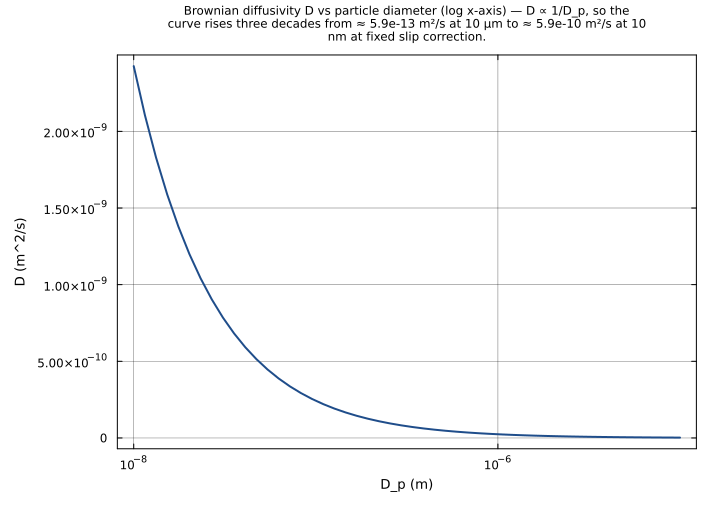
Sweep particle diameter D_p from 10 nm to 10 μm (log scale) at default temperature (T = 298.15 K), viscosity (μ = 1.8e-5 kg/(m·s)) and slip correction held at unity (C_c = 1.0) to isolate the geometric dependence. The Brownian diffusivity D = k_BTC_c/(3π μ D_p) ∝ 1/D_p falls by three decades across the range — smaller particles diffuse far more rapidly, which is why ultrafine aerosol particles have negligible settling but significant diffusional loss to surfaces.
Time span: 0.0 → 1.0
Swept over: D_p
Raw .esm
Raw .esm JSON (this component)
{
  "reference": {
    "notes": "source_ref: Aerosol.jl@c8c640bb636b22f2425460e9ed5cba50793bfee1:src/single_particle_dynamics.jl:172\nUpstream `BrownianDiffusion` is an MTK `@component` with two constants (k_B, π_val), four `@parameters` (T, D_p, μ, C_c) and one variable (D). The single equation is:\n  • D ~ k_B * T * C_c / (3 * π_val * μ * D_p)  (Eq. 9.73 — Brownian / Stokes-Einstein diffusivity)\nThe equation is algebraic (no derivatives), making this an observed-only component.\n\nObservability classification: observed-only — the single output D is given by one algebraic equation in which D appears only on the LHS. D migrates as `type: state` with an explicit `equations` entry, matching the sibling single_particle_dynamics.jl migrations mean_free_path.esm, slip.esm, mobility.esm, electrical_mobility.esm, stokes.esm and aerodynamic_diameter.esm. Test scenarios use `time_span: [0, 1]` and sample at t=0.\n\nConstants k_B (Boltzmann constant, 1.38e-23 J/K) and π_val (3.141592653589793) migrate as `type: parameter` carrying their numeric defaults. k_B keeps its upstream name; it is one of the ESS schema's reserved physical-constant names and its units J/K satisfy the dimensional check. π_val is not in the reserved list and is preserved verbatim from the source, consistent with mean_free_path.esm, mobility.esm and electrical_mobility.esm.\n\nAll four `@parameters` and both constants appear in the equation, so `parameters(sys)` collects the full set — no unused-parameter pruning is needed.\n\nTolerance rationale (model-level rel=1e-9): observed-only algebraic system (no ODE integration); the D equation is a single product/division of parameters. Expected values are computed in float64 with the same arithmetic; floating-point round-off is ~1e-15. 1e-9 leaves comfortable headroom."
  },
  "tolerance": {
    "rel": 1e-09
  },
  "variables": {
    "k_B": {
      "type": "parameter",
      "units": "J/K",
      "default": 1.38e-23,
      "description": "Boltzmann constant"
    },
    "π_val": {
      "type": "parameter",
      "units": "1",
      "default": 3.141592653589793,
      "description": "Pi (dimensionless)"
    },
    "T": {
      "type": "parameter",
      "units": "K",
      "default": 298.15,
      "description": "Temperature"
    },
    "D_p": {
      "type": "parameter",
      "units": "m",
      "default": 1e-06,
      "description": "Particle diameter"
    },
    "μ": {
      "type": "parameter",
      "units": "kg/(m*s)",
      "default": 1.8e-05,
      "description": "Dynamic viscosity of air"
    },
    "C_c": {
      "type": "parameter",
      "units": "1",
      "default": 1.0,
      "description": "Slip correction factor (dimensionless)"
    },
    "D": {
      "type": "unknown",
      "units": "m^2/s",
      "description": "Brownian diffusion coefficient"
    }
  },
  "equations": [
    {
      "lhs": "D",
      "rhs": {
        "op": "/",
        "args": [
          {
            "op": "*",
            "args": [
              "k_B",
              "T",
              "C_c"
            ]
          },
          {
            "op": "*",
            "args": [
              3,
              "π_val",
              "μ",
              "D_p"
            ]
          }
        ]
      }
    }
  ],
  "tests": [
    {
      "id": "default_conditions",
      "description": "Default conditions: T = 298.15 K, D_p = 1.0e-6 m (1 μm particle), μ = 1.8e-5 kg/(m·s), C_c = 1.0. The Brownian diffusivity D = k_B*T*C_c/(3π μ D_p) ≈ 2.4253e-11 m²/s — the Stokes-Einstein diffusivity of a 1 μm particle in air at 298 K.",
      "time_span": {
        "start": 0.0,
        "end": 1.0
      },
      "assertions": [
        {
          "variable": "D",
          "time": 0.0,
          "expected": 2.425326810012262e-11
        }
      ]
    },
    {
      "id": "slip_corrected_micron",
      "description": "1 μm particle with the physically appropriate slip correction C_c = 1.164 (the Cunningham value for D_p = 1 μm at λ ≈ 6.5e-8 m) at default temperature and viscosity. D ∝ C_c, so D ≈ 2.8231e-11 m²/s — 16.4% larger than the uncorrected default.",
      "parameter_overrides": {
        "C_c": 1.164
      },
      "time_span": {
        "start": 0.0,
        "end": 1.0
      },
      "assertions": [
        {
          "variable": "D",
          "time": 0.0,
          "expected": 2.823080406854272e-11
        }
      ]
    },
    {
      "id": "small_particle",
      "description": "Small particle (D_p = 1.0e-7 m = 100 nm), with the larger slip correction C_c = 2.85 appropriate to that size. D ∝ C_c/D_p, so both a 10× smaller diameter and a larger slip correction raise the diffusivity strongly to ≈ 6.9122e-10 m²/s — about 28× the default value, confirming that smaller particles diffuse much more rapidly.",
      "parameter_overrides": {
        "D_p": 1e-07,
        "C_c": 2.85
      },
      "time_span": {
        "start": 0.0,
        "end": 1.0
      },
      "assertions": [
        {
          "variable": "D",
          "time": 0.0,
          "expected": 6.912181408534947e-10
        }
      ]
    },
    {
      "id": "large_particle",
      "description": "Large particle (D_p = 1.0e-5 m = 10 μm), with the lower slip correction C_c = 1.016 appropriate to that size. D ∝ 1/D_p, so a 10× larger diameter lowers the diffusivity roughly tenfold to ≈ 2.4641e-12 m²/s — large particles sediment rather than diffuse.",
      "parameter_overrides": {
        "D_p": 1e-05,
        "C_c": 1.016
      },
      "time_span": {
        "start": 0.0,
        "end": 1.0
      },
      "assertions": [
        {
          "variable": "D",
          "time": 0.0,
          "expected": 2.464132038972458e-12
        }
      ]
    },
    {
      "id": "elevated_temperature",
      "description": "Elevated temperature (T = 350 K) at default particle size and viscosity. D ∝ T, so a 17.4% increase in temperature raises the diffusivity by the same factor to ≈ 2.8471e-11 m²/s.",
      "parameter_overrides": {
        "T": 350.0
      },
      "time_span": {
        "start": 0.0,
        "end": 1.0
      },
      "assertions": [
        {
          "variable": "D",
          "time": 0.0,
          "expected": 2.84710509308835e-11
        }
      ]
    },
    {
      "id": "high_viscosity",
      "description": "Doubled dynamic viscosity (μ = 3.6e-5 kg/(m·s)) at default particle size and temperature. D ∝ 1/μ, so doubling the viscosity halves the diffusivity to ≈ 1.2127e-11 m²/s — exactly half the default-conditions value.",
      "parameter_overrides": {
        "μ": 3.6e-05
      },
      "time_span": {
        "start": 0.0,
        "end": 1.0
      },
      "assertions": [
        {
          "variable": "D",
          "time": 0.0,
          "expected": 1.212663405006131e-11
        }
      ]
    }
  ],
  "analyses": [
    {
      "id": "size_dependence",
      "description": "Sweep particle diameter D_p from 10 nm to 10 μm (log scale) at default temperature (T = 298.15 K), viscosity (μ = 1.8e-5 kg/(m·s)) and slip correction held at unity (C_c = 1.0) to isolate the geometric dependence. The Brownian diffusivity D = k_B*T*C_c/(3π μ D_p) ∝ 1/D_p falls by three decades across the range — smaller particles diffuse far more rapidly, which is why ultrafine aerosol particles have negligible settling but significant diffusional loss to surfaces.",
      "initial_state": {},
      "time_span": {
        "start": 0.0,
        "end": 1.0
      },
      "parameter_sweep": {
        "type": "cartesian",
        "dimensions": [
          {
            "parameter": "D_p",
            "range": {
              "start": 1e-08,
              "stop": 1e-05,
              "count": 50,
              "scale": "log"
            }
          }
        ]
      },
      "plots": [
        {
          "id": "diffusivity_vs_diameter",
          "type": "line",
          "description": "Brownian diffusivity D vs particle diameter (log x-axis) — D ∝ 1/D_p, so the curve rises three decades from ≈ 5.9e-13 m²/s at 10 μm to ≈ 5.9e-10 m²/s at 10 nm at fixed slip correction.",
          "x": {
            "variable": "D_p",
            "label": "D_p (m)"
          },
          "y": {
            "variable": "D",
            "label": "D (m^2/s)"
          }
        }
      ]
    }
  ]
}