AerodynamicDiameter
Equivalent particle diameters for aerosol single-particle dynamics. Migrated from Aerosol.jl@c8c640bb src/single_particle_dynamics.jl:390 (`AerodynamicDiameter` @component). Computes the classical aerodynamic diameter D_ca (the diameter of a unit-density sphere with the same settling velocity) and its continuum-limit approximation (Seinfeld & Pandis 2006, Chapter 9, Eqs. 9.110 and 9.112).
Description
Equivalent particle diameters for aerosol single-particle dynamics. Migrated from Aerosol.jl@c8c640bb src/single_particle_dynamics.jl:390 (AerodynamicDiameter @component). Computes the classical aerodynamic diameter D_ca (the diameter of a unit-density sphere with the same settling velocity) and its continuum-limit approximation (Seinfeld & Pandis 2006, Chapter 9, Eqs. 9.110 and 9.112).
Reference
_source_ref: Aerosol.jl@c8c640bb636b22f2425460e9ed5cba50793bfee1:src/single_particle_dynamics.jl:390
Upstream AerodynamicDiameter is an MTK @component with one constant (ρ_p0), five @parameters (D_p, ρ_p, C_c_Dp, C_c_Da, χ), and two variables (D_ca, D_ca_continuum). The equations are:
• D_ca ~ D_p * sqrt(ρ_p / ρ_p0) * sqrt(C_c_Dp / C_c_Da) (Eq. 9.110 — classical aerodynamic diameter)
• D_ca_continuum ~ D_p * sqrt(ρ_p / ρ_p0) (Eq. 9.112 — continuum-limit approximation, C_c ≈ 1)
Both equations are algebraic (no derivatives), making this an observed-only component.
Unused-parameter pruning: the @parameter χ (dynamic shape factor) is declared upstream but appears in no equation in the component’s eqs array — the docstring’s electrical-mobility-diameter relation that would use it is not implemented. System(eqs, t) collects parameters from the equations only, so parameters(sys) excludes χ; χ is therefore omitted from this migration. The migrated parameter set (ρ_p0, D_p, ρ_p, C_c_Dp, C_c_Da) matches parameters(sys).
Constant ρ_p0 (reference density, 1000 kg/m³ — a unit-density sphere) migrates as a type: parameter carrying its numeric default, consistent with the sibling single_particle_dynamics.jl migrations (mean_free_path.esm, slip.esm).
Observability classification: observed-only — every output is given by a single algebraic equation in which the output appears only on the LHS. Outputs migrate as type: state with explicit equations, matching the sibling components mean_free_path.esm and slip.esm. Test scenarios use time_span: [0, 1] and sample at t=0.
Tolerance rationale (model-level rel=1e-9): observed-only algebraic system (no ODE integration); each equation is a product of a sqrt and a division of parameters. Floating-point round-off is ~1e-15. 1e-9 leaves comfortable headroom._
Parameters
| Name | Units | Default | Description |
|---|---|---|---|
ρ_p0 | kg/m^3 | 1000.0 | Reference density (1 g/cm³) |
D_p | m | 1e-06 | Particle diameter |
ρ_p | kg/m^3 | 1500.0 | Particle density |
C_c_Dp | 1 | 1.0 | Slip correction at D_p (dimensionless) |
C_c_Da | 1 | 1.0 | Slip correction at D_ca (dimensionless) |
Observed
| Name | Units | Default | Description |
|---|---|---|---|
D_ca | m | Classical aerodynamic diameter | |
D_ca_continuum | m | Aerodynamic diameter (continuum limit) |
Observed expressions
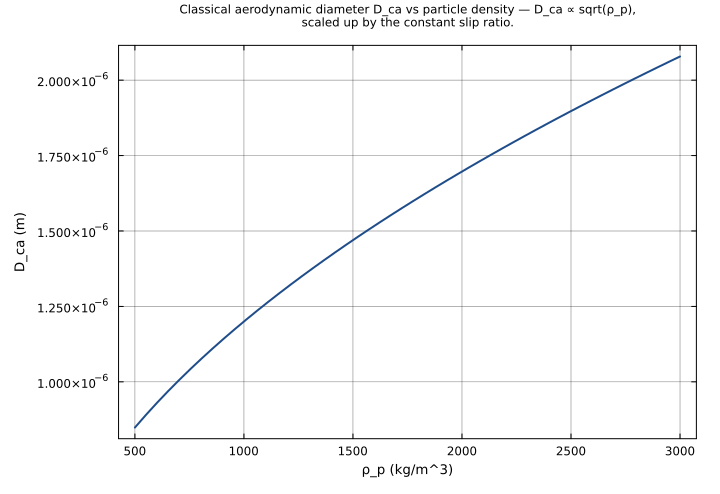
$$ D_{ca} = D_{p} \cdot \sqrt{\frac{ρ_{p}}{ρ_{p0}}} \cdot \sqrt{\frac{C_{c\,Dp}}{C_{c\,Da}}} $$Classical aerodynamic diameter
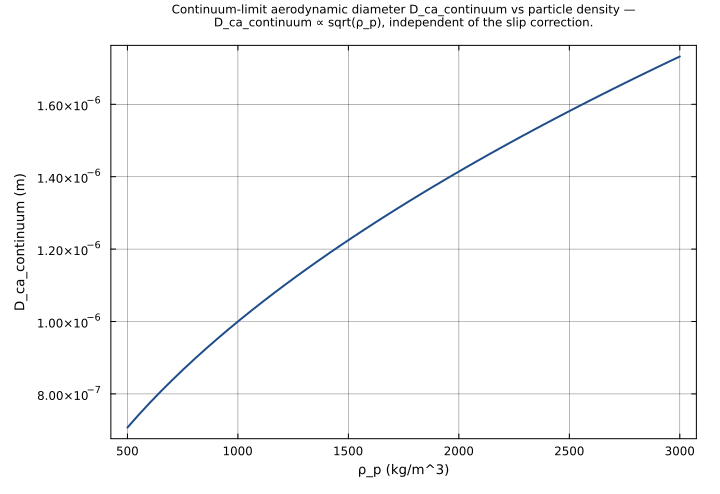
$$ D_{ca\,continuum} = D_{p} \cdot \sqrt{\frac{ρ_{p}}{ρ_{p0}}} $$Aerodynamic diameter (continuum limit)
Analyses
density_dependence
Sweep particle density ρ_p from 500 to 3000 kg/m³ at a fixed geometric diameter D_p = 1.0e-6 m. With C_c_Dp = 1.44 and C_c_Da = 1.0 the slip ratio sqrt(C_c_Dp/C_c_Da) = 1.2, so the classical aerodynamic diameter D_ca exceeds the continuum-limit diameter D_ca_continuum by a constant factor of 1.2 while both scale as sqrt(ρ_p).
Time span: 0.0 → 1.0
Swept over: ρ_p
Raw .esm
Raw .esm JSON (this component)
{
  "reference": {
    "notes": "source_ref: Aerosol.jl@c8c640bb636b22f2425460e9ed5cba50793bfee1:src/single_particle_dynamics.jl:390\nUpstream `AerodynamicDiameter` is an MTK `@component` with one constant (ρ_p0), five `@parameters` (D_p, ρ_p, C_c_Dp, C_c_Da, χ), and two variables (D_ca, D_ca_continuum). The equations are:\n  • D_ca           ~ D_p * sqrt(ρ_p / ρ_p0) * sqrt(C_c_Dp / C_c_Da)  (Eq. 9.110 — classical aerodynamic diameter)\n  • D_ca_continuum ~ D_p * sqrt(ρ_p / ρ_p0)                          (Eq. 9.112 — continuum-limit approximation, C_c ≈ 1)\nBoth equations are algebraic (no derivatives), making this an observed-only component.\n\nUnused-parameter pruning: the `@parameter` χ (dynamic shape factor) is declared upstream but appears in no equation in the component's `eqs` array — the docstring's electrical-mobility-diameter relation that would use it is not implemented. `System(eqs, t)` collects parameters from the equations only, so `parameters(sys)` excludes χ; χ is therefore omitted from this migration. The migrated parameter set (ρ_p0, D_p, ρ_p, C_c_Dp, C_c_Da) matches `parameters(sys)`.\n\nConstant ρ_p0 (reference density, 1000 kg/m³ — a unit-density sphere) migrates as a `type: parameter` carrying its numeric default, consistent with the sibling single_particle_dynamics.jl migrations (mean_free_path.esm, slip.esm).\n\nObservability classification: observed-only — every output is given by a single algebraic equation in which the output appears only on the LHS. Outputs migrate as `type: state` with explicit `equations`, matching the sibling components mean_free_path.esm and slip.esm. Test scenarios use `time_span: [0, 1]` and sample at t=0.\n\nTolerance rationale (model-level rel=1e-9): observed-only algebraic system (no ODE integration); each equation is a product of a sqrt and a division of parameters. Floating-point round-off is ~1e-15. 1e-9 leaves comfortable headroom."
  },
  "tolerance": {
    "rel": 1e-09
  },
  "variables": {
    "ρ_p0": {
      "type": "parameter",
      "units": "kg/m^3",
      "default": 1000.0,
      "description": "Reference density (1 g/cm³)"
    },
    "D_p": {
      "type": "parameter",
      "units": "m",
      "default": 1e-06,
      "description": "Particle diameter"
    },
    "ρ_p": {
      "type": "parameter",
      "units": "kg/m^3",
      "default": 1500.0,
      "description": "Particle density"
    },
    "C_c_Dp": {
      "type": "parameter",
      "units": "1",
      "default": 1.0,
      "description": "Slip correction at D_p (dimensionless)"
    },
    "C_c_Da": {
      "type": "parameter",
      "units": "1",
      "default": 1.0,
      "description": "Slip correction at D_ca (dimensionless)"
    },
    "D_ca": {
      "type": "unknown",
      "units": "m",
      "description": "Classical aerodynamic diameter"
    },
    "D_ca_continuum": {
      "type": "unknown",
      "units": "m",
      "description": "Aerodynamic diameter (continuum limit)"
    }
  },
  "equations": [
    {
      "lhs": "D_ca",
      "rhs": {
        "op": "*",
        "args": [
          {
            "op": "*",
            "args": [
              "D_p",
              {
                "op": "sqrt",
                "args": [
                  {
                    "op": "/",
                    "args": [
                      "ρ_p",
                      "ρ_p0"
                    ]
                  }
                ]
              }
            ]
          },
          {
            "op": "sqrt",
            "args": [
              {
                "op": "/",
                "args": [
                  "C_c_Dp",
                  "C_c_Da"
                ]
              }
            ]
          }
        ]
      }
    },
    {
      "lhs": "D_ca_continuum",
      "rhs": {
        "op": "*",
        "args": [
          "D_p",
          {
            "op": "sqrt",
            "args": [
              {
                "op": "/",
                "args": [
                  "ρ_p",
                  "ρ_p0"
                ]
              }
            ]
          }
        ]
      }
    }
  ],
  "tests": [
    {
      "id": "default_conditions",
      "description": "Default conditions: D_p = 1.0e-6 m, ρ_p = 1500 kg/m³, C_c_Dp = C_c_Da = 1.0. With equal slip corrections the slip ratio is 1, so D_ca = D_ca_continuum = D_p*sqrt(ρ_p/ρ_p0) = 1e-6*sqrt(1.5) ≈ 1.2247e-6 m.",
      "time_span": {
        "start": 0.0,
        "end": 1.0
      },
      "assertions": [
        {
          "variable": "D_ca",
          "time": 0.0,
          "expected": 1.224744871391589e-06
        },
        {
          "variable": "D_ca_continuum",
          "time": 0.0,
          "expected": 1.224744871391589e-06
        }
      ]
    },
    {
      "id": "unit_density",
      "description": "Particle density equal to the reference density (ρ_p = ρ_p0 = 1000 kg/m³): sqrt(ρ_p/ρ_p0) = 1, so both diameters equal the geometric diameter D_p = 1.0e-6 m.",
      "parameter_overrides": {
        "ρ_p": 1000.0
      },
      "time_span": {
        "start": 0.0,
        "end": 1.0
      },
      "assertions": [
        {
          "variable": "D_ca",
          "time": 0.0,
          "expected": 1e-06
        },
        {
          "variable": "D_ca_continuum",
          "time": 0.0,
          "expected": 1e-06
        }
      ]
    },
    {
      "id": "dense_particle",
      "description": "Dense particle (ρ_p = 4000 kg/m³): sqrt(ρ_p/ρ_p0) = sqrt(4) = 2, so D_ca = D_ca_continuum = 2*D_p = 2.0e-6 m.",
      "parameter_overrides": {
        "ρ_p": 4000.0
      },
      "time_span": {
        "start": 0.0,
        "end": 1.0
      },
      "assertions": [
        {
          "variable": "D_ca",
          "time": 0.0,
          "expected": 2e-06
        },
        {
          "variable": "D_ca_continuum",
          "time": 0.0,
          "expected": 2e-06
        }
      ]
    },
    {
      "id": "slip_correction_ratio",
      "description": "Unequal slip corrections (C_c_Dp = 1.44, C_c_Da = 1.0): the slip ratio sqrt(C_c_Dp/C_c_Da) = 1.2 enlarges D_ca relative to the continuum diameter. D_ca = 1e-6*sqrt(1.5)*1.2 ≈ 1.4697e-6 m; D_ca_continuum is unaffected by slip at 1e-6*sqrt(1.5) ≈ 1.2247e-6 m.",
      "parameter_overrides": {
        "C_c_Dp": 1.44,
        "C_c_Da": 1.0
      },
      "time_span": {
        "start": 0.0,
        "end": 1.0
      },
      "assertions": [
        {
          "variable": "D_ca",
          "time": 0.0,
          "expected": 1.4696938456699068e-06
        },
        {
          "variable": "D_ca_continuum",
          "time": 0.0,
          "expected": 1.224744871391589e-06
        }
      ]
    },
    {
      "id": "large_particle",
      "description": "Large particle (D_p = 1.0e-5 m = 10 μm): both diameters scale linearly with D_p. D_ca = D_ca_continuum = 1e-5*sqrt(1.5) ≈ 1.2247e-5 m.",
      "parameter_overrides": {
        "D_p": 1e-05
      },
      "time_span": {
        "start": 0.0,
        "end": 1.0
      },
      "assertions": [
        {
          "variable": "D_ca",
          "time": 0.0,
          "expected": 1.224744871391589e-05
        },
        {
          "variable": "D_ca_continuum",
          "time": 0.0,
          "expected": 1.224744871391589e-05
        }
      ]
    },
    {
      "id": "light_particle_high_slip",
      "description": "Light particle below reference density (ρ_p = 500 kg/m³) with a larger slip correction at D_ca than at D_p (C_c_Da = 2.0, C_c_Dp = 1.0 default): D_ca = 1e-6*sqrt(0.5)*sqrt(0.5) = 5.0e-7 m, smaller than the continuum diameter D_ca_continuum = 1e-6*sqrt(0.5) ≈ 7.071e-7 m.",
      "parameter_overrides": {
        "ρ_p": 500.0,
        "C_c_Da": 2.0
      },
      "time_span": {
        "start": 0.0,
        "end": 1.0
      },
      "assertions": [
        {
          "variable": "D_ca",
          "time": 0.0,
          "expected": 5e-07
        },
        {
          "variable": "D_ca_continuum",
          "time": 0.0,
          "expected": 7.071067811865476e-07
        }
      ]
    }
  ],
  "analyses": [
    {
      "id": "density_dependence",
      "description": "Sweep particle density ρ_p from 500 to 3000 kg/m³ at a fixed geometric diameter D_p = 1.0e-6 m. With C_c_Dp = 1.44 and C_c_Da = 1.0 the slip ratio sqrt(C_c_Dp/C_c_Da) = 1.2, so the classical aerodynamic diameter D_ca exceeds the continuum-limit diameter D_ca_continuum by a constant factor of 1.2 while both scale as sqrt(ρ_p).",
      "initial_state": {},
      "parameters": {
        "D_p": 1e-06,
        "C_c_Dp": 1.44,
        "C_c_Da": 1.0
      },
      "time_span": {
        "start": 0.0,
        "end": 1.0
      },
      "parameter_sweep": {
        "type": "cartesian",
        "dimensions": [
          {
            "parameter": "ρ_p",
            "range": {
              "start": 500.0,
              "stop": 3000.0,
              "count": 50
            }
          }
        ]
      },
      "plots": [
        {
          "id": "aerodynamic_diameter_vs_density",
          "type": "line",
          "description": "Classical aerodynamic diameter D_ca vs particle density — D_ca ∝ sqrt(ρ_p), scaled up by the constant slip ratio.",
          "x": {
            "variable": "ρ_p",
            "label": "ρ_p (kg/m^3)"
          },
          "y": {
            "variable": "D_ca",
            "label": "D_ca (m)"
          }
        },
        {
          "id": "continuum_diameter_vs_density",
          "type": "line",
          "description": "Continuum-limit aerodynamic diameter D_ca_continuum vs particle density — D_ca_continuum ∝ sqrt(ρ_p), independent of the slip correction.",
          "x": {
            "variable": "ρ_p",
            "label": "ρ_p (kg/m^3)"
          },
          "y": {
            "variable": "D_ca_continuum",
            "label": "D_ca_continuum (m)"
          }
        }
      ]
    }
  ]
}