ECTracerMethod
Elemental carbon (EC) tracer method for estimating secondary organic carbon (OC) from measurements of total OC and EC. Primary OC is estimated as combustion-related OC (proportional to EC via the OC-to-EC ratio) plus noncombustion OC; secondary OC is the non-negative remainder. From Seinfeld and Pandis (2006), Chapter 14, Section 14.3.2, Equations 14.3–14.4.
Description
Elemental carbon (EC) tracer method for estimating secondary organic carbon (OC) from measurements of total OC and EC. Primary OC is estimated as combustion-related OC (proportional to EC via the OC-to-EC ratio) plus noncombustion OC; secondary OC is the non-negative remainder. From Seinfeld and Pandis (2006), Chapter 14, Section 14.3.2, Equations 14.3–14.4.
Reference
Seinfeld, J. H. and Pandis, S. N. (2006) Atmospheric Chemistry and Physics, 2nd Edition, Chapter 14, Section 14.3.2, Eqs. 14.3–14.4 — EC tracer method. Migrated from Aerosol.jl src/organic_aerosol.jl ECTracerMethod (esm-sgh).
_source_ref: Aerosol.jl@main:src/organic_aerosol.jl:18
Upstream ECTracerMethod is an MTK @component with two parameters (OC_EC_ratio, OC_NC), one constant (zero_conc = 0.0 kg/m^3 for unit consistency in the max call), and four variables (OC, EC, OC_primary, OC_secondary). The two algebraic equations are:
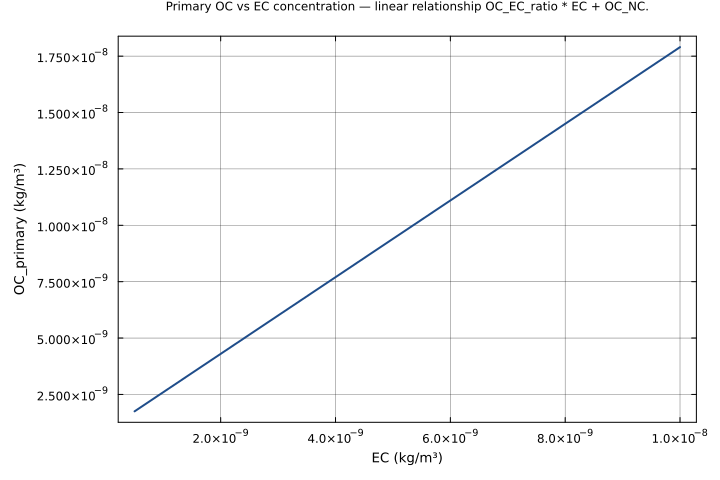
• OC_primary ~ OC_EC_ratio * EC + OC_NC (Eq. 14.4)
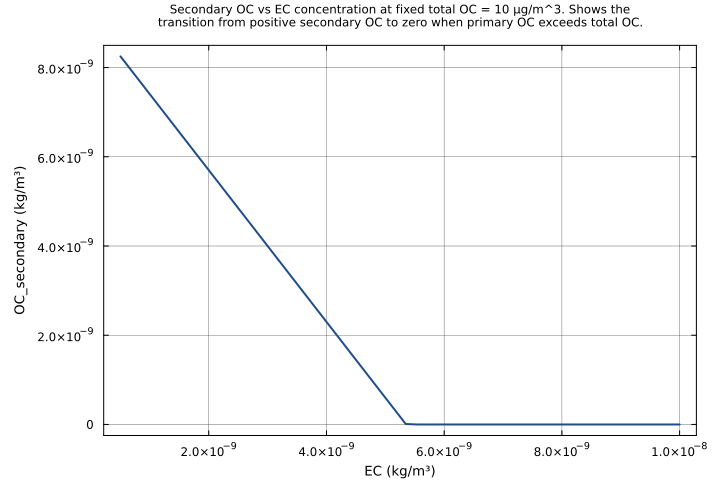
• OC_secondary ~ max(zero_conc, OC - OC_primary) (Eq. 14.3)
OC and EC are externally supplied @variables in the upstream component; in this ESM they are represented as parameters (observed-only pattern — see also bet.esm, two_product_soa.esm). The system has two algebraic states (OC_primary, OC_secondary) and two equations — well-posed, no ODE integration.
Equation ordering for the ESS topological substitution loop: OC_primary depends only on parameters, so it resolves first; OC_secondary then depends on OC_primary (now known) and OC (a parameter), so it resolves second. The dependency graph is acyclic — no SimulationError.
The max(0, ...) floor enforces non-negativity: when total OC is less than estimated primary OC (measurement noise / model mismatch), secondary OC is clamped to zero rather than going negative. The upstream constant zero_conc = 0.0 serves no purpose beyond unit-consistency annotation in MTK; in the ESM the literal 0 is used directly.
Tolerance rationale (model-level rel=1e-9): observed-only algebraic system (no ODE integration). Eq. 14.4 is a linear combination of parameters; Eq. 14.3 adds a max. Floating-point round-off is ~1e-15. 1e-9 leaves comfortable headroom. The zero-secondary test uses absolute tolerance since the expected value is exactly 0._
Parameters
| Name | Units | Default | Description |
|---|---|---|---|
OC_EC_ratio | 1 | 1.7 | OC-to-EC ratio for combustion sources (dimensionless). Typical value for urban environments. |
OC_NC | kg/m^3 | 9e-10 | Noncombustion primary OC concentration (background biogenic and other non-combustion sources). |
OC | kg/m^3 | 3e-09 | Total organic carbon concentration. Input parameter — measured total OC driving the EC tracer calculation. |
EC | kg/m^3 | 1e-09 | Elemental carbon concentration. Input parameter — measured EC used to estimate primary OC. |
Observed
| Name | Units | Default | Description |
|---|---|---|---|
OC_primary | kg/m^3 | Primary organic carbon concentration. Estimated as OC_EC_ratio * EC + OC_NC (Eq. 14.4). | |
OC_secondary | kg/m^3 | Secondary organic carbon concentration. Non-negative remainder after subtracting primary OC from total OC (Eq. 14.3). |
Observed expressions
$$ OC_{primary} = OC_{EC\,ratio} \cdot EC + OC_{NC} $$Primary organic carbon concentration. Estimated as OC_EC_ratio * EC + OC_NC (Eq. 14.4).
$$ OC_{secondary} = \mathrm{max}\left(0, OC + \left(-1\right) \cdot OC_{primary}\right) $$Secondary organic carbon concentration. Non-negative remainder after subtracting primary OC from total OC (Eq. 14.3).
Analyses
ec_oc_sweep
Sweep EC concentration from 0.5 to 10 μg/m^3 with fixed total OC = 10 μg/m^3, showing how increasing EC (and thus primary OC) reduces secondary OC. When EC > ~5.4 μg/m^3, OC_primary exceeds total OC and OC_secondary is clamped to zero.
Time span: 0.0 → 1.0
Swept over: EC
Raw .esm
Raw .esm JSON (this component)
{
  "reference": {
    "citation": "Seinfeld, J. H. and Pandis, S. N. (2006) Atmospheric Chemistry and Physics, 2nd Edition, Chapter 14, Section 14.3.2, Eqs. 14.3–14.4 — EC tracer method. Migrated from Aerosol.jl src/organic_aerosol.jl `ECTracerMethod` (esm-sgh).",
    "notes": "source_ref: Aerosol.jl@main:src/organic_aerosol.jl:18\n\nUpstream `ECTracerMethod` is an MTK `@component` with two parameters (OC_EC_ratio, OC_NC), one constant (zero_conc = 0.0 kg/m^3 for unit consistency in the max call), and four variables (OC, EC, OC_primary, OC_secondary). The two algebraic equations are:\n  • OC_primary  ~ OC_EC_ratio * EC + OC_NC           (Eq. 14.4)\n  • OC_secondary ~ max(zero_conc, OC - OC_primary)   (Eq. 14.3)\n\nOC and EC are externally supplied `@variables` in the upstream component; in this ESM they are represented as parameters (observed-only pattern — see also bet.esm, two_product_soa.esm). The system has two algebraic states (OC_primary, OC_secondary) and two equations — well-posed, no ODE integration.\n\nEquation ordering for the ESS topological substitution loop: OC_primary depends only on parameters, so it resolves first; OC_secondary then depends on OC_primary (now known) and OC (a parameter), so it resolves second. The dependency graph is acyclic — no SimulationError.\n\nThe `max(0, ...)` floor enforces non-negativity: when total OC is less than estimated primary OC (measurement noise / model mismatch), secondary OC is clamped to zero rather than going negative. The upstream constant zero_conc = 0.0 serves no purpose beyond unit-consistency annotation in MTK; in the ESM the literal 0 is used directly.\n\nTolerance rationale (model-level rel=1e-9): observed-only algebraic system (no ODE integration). Eq. 14.4 is a linear combination of parameters; Eq. 14.3 adds a max. Floating-point round-off is ~1e-15. 1e-9 leaves comfortable headroom. The zero-secondary test uses absolute tolerance since the expected value is exactly 0."
  },
  "tolerance": {
    "rel": 1e-09
  },
  "variables": {
    "OC_EC_ratio": {
      "type": "parameter",
      "units": "1",
      "default": 1.7,
      "description": "OC-to-EC ratio for combustion sources (dimensionless). Typical value for urban environments."
    },
    "OC_NC": {
      "type": "parameter",
      "units": "kg/m^3",
      "default": 9e-10,
      "description": "Noncombustion primary OC concentration (background biogenic and other non-combustion sources)."
    },
    "OC": {
      "type": "parameter",
      "units": "kg/m^3",
      "default": 3e-09,
      "description": "Total organic carbon concentration. Input parameter — measured total OC driving the EC tracer calculation."
    },
    "EC": {
      "type": "parameter",
      "units": "kg/m^3",
      "default": 1e-09,
      "description": "Elemental carbon concentration. Input parameter — measured EC used to estimate primary OC."
    },
    "OC_primary": {
      "type": "unknown",
      "units": "kg/m^3",
      "description": "Primary organic carbon concentration. Estimated as OC_EC_ratio * EC + OC_NC (Eq. 14.4)."
    },
    "OC_secondary": {
      "type": "unknown",
      "units": "kg/m^3",
      "description": "Secondary organic carbon concentration. Non-negative remainder after subtracting primary OC from total OC (Eq. 14.3)."
    }
  },
  "equations": [
    {
      "lhs": "OC_primary",
      "rhs": {
        "op": "+",
        "args": [
          {
            "op": "*",
            "args": [
              "OC_EC_ratio",
              "EC"
            ]
          },
          "OC_NC"
        ]
      }
    },
    {
      "lhs": "OC_secondary",
      "rhs": {
        "op": "max",
        "args": [
          0,
          {
            "op": "+",
            "args": [
              "OC",
              {
                "op": "*",
                "args": [
                  -1,
                  "OC_primary"
                ]
              }
            ]
          }
        ]
      }
    }
  ],
  "tests": [
    {
      "id": "typical_urban",
      "description": "Typical urban conditions: EC = 1 μg/m^3, OC = 3 μg/m^3 (OC_EC_ratio = 1.7, OC_NC = 0.9e-9). OC_primary = 1.7*1e-9 + 0.9e-9 = 2.6e-9 kg/m^3; OC_secondary = max(0, 3e-9 - 2.6e-9) = 4.0e-10 kg/m^3.",
      "time_span": {
        "start": 0.0,
        "end": 1.0
      },
      "parameter_overrides": {
        "EC": 1e-09,
        "OC": 3e-09
      },
      "assertions": [
        {
          "variable": "OC_primary",
          "time": 0.0,
          "expected": 2.6e-09,
          "tolerance": {
            "rel": 1e-09
          }
        },
        {
          "variable": "OC_secondary",
          "time": 0.0,
          "expected": 4e-10,
          "tolerance": {
            "rel": 1e-06
          }
        }
      ]
    },
    {
      "id": "zero_secondary",
      "description": "OC below estimated primary OC: EC = 1 μg/m^3, OC = 2 μg/m^3. OC_primary = 2.6e-9 > OC, so OC_secondary = max(0, 2e-9 - 2.6e-9) = 0.0 kg/m^3 (max floor).",
      "time_span": {
        "start": 0.0,
        "end": 1.0
      },
      "parameter_overrides": {
        "EC": 1e-09,
        "OC": 2e-09
      },
      "assertions": [
        {
          "variable": "OC_primary",
          "time": 0.0,
          "expected": 2.6e-09,
          "tolerance": {
            "rel": 1e-09
          }
        },
        {
          "variable": "OC_secondary",
          "time": 0.0,
          "expected": 0.0,
          "tolerance": {
            "abs": 1e-20
          }
        }
      ]
    },
    {
      "id": "high_ec",
      "description": "High EC environment: EC = 5 μg/m^3, OC = 15 μg/m^3. OC_primary = 1.7*5e-9 + 0.9e-9 = 9.4e-9 kg/m^3; OC_secondary = max(0, 15e-9 - 9.4e-9) = 5.6e-9 kg/m^3.",
      "time_span": {
        "start": 0.0,
        "end": 1.0
      },
      "parameter_overrides": {
        "EC": 5e-09,
        "OC": 1.5e-08
      },
      "assertions": [
        {
          "variable": "OC_primary",
          "time": 0.0,
          "expected": 9.4e-09,
          "tolerance": {
            "rel": 1e-09
          }
        },
        {
          "variable": "OC_secondary",
          "time": 0.0,
          "expected": 5.6e-09,
          "tolerance": {
            "rel": 1e-06
          }
        }
      ]
    }
  ],
  "analyses": [
    {
      "id": "ec_oc_sweep",
      "description": "Sweep EC concentration from 0.5 to 10 μg/m^3 with fixed total OC = 10 μg/m^3, showing how increasing EC (and thus primary OC) reduces secondary OC. When EC > ~5.4 μg/m^3, OC_primary exceeds total OC and OC_secondary is clamped to zero.",
      "initial_state": {},
      "parameters": {
        "OC_EC_ratio": 1.7,
        "OC_NC": 9e-10,
        "OC": 1e-08
      },
      "time_span": {
        "start": 0.0,
        "end": 1.0
      },
      "parameter_sweep": {
        "type": "cartesian",
        "dimensions": [
          {
            "parameter": "EC",
            "range": {
              "start": 5e-10,
              "stop": 1e-08,
              "count": 50
            }
          }
        ]
      },
      "plots": [
        {
          "id": "secondary_oc_vs_ec",
          "type": "line",
          "description": "Secondary OC vs EC concentration at fixed total OC = 10 μg/m^3. Shows the transition from positive secondary OC to zero when primary OC exceeds total OC.",
          "x": {
            "variable": "EC",
            "label": "EC (kg/m³)"
          },
          "y": {
            "variable": "OC_secondary",
            "label": "OC_secondary (kg/m³)"
          }
        },
        {
          "id": "primary_oc_vs_ec",
          "type": "line",
          "description": "Primary OC vs EC concentration — linear relationship OC_EC_ratio * EC + OC_NC.",
          "x": {
            "variable": "EC",
            "label": "EC (kg/m³)"
          },
          "y": {
            "variable": "OC_primary",
            "label": "OC_primary (kg/m³)"
          }
        }
      ]
    }
  ]
}