AbsorptivePartitioning
Absorptive partitioning model for equilibrium gas–particle partitioning of semivolatile organic compounds. A compound distributes between the gas phase and an absorbing organic aerosol phase according to a mass-based partition coefficient K_om and the total absorbing organic aerosol mass C_oa. From Seinfeld and Pandis (2006), Chapter 9, Section 9.4, Equation 9.23.
Description
Absorptive partitioning model for equilibrium gas–particle partitioning of semivolatile organic compounds. A compound distributes between the gas phase and an absorbing organic aerosol phase according to a mass-based partition coefficient K_om and the total absorbing organic aerosol mass C_oa. From Seinfeld and Pandis (2006), Chapter 9, Section 9.4, Equation 9.23.
Reference
Seinfeld, J. H. and Pandis, S. N. (2006) Atmospheric Chemistry and Physics, 2nd Edition, Chapter 9, Section 9.4, Eq. 9.23 — absorptive partitioning of a semivolatile organic between gas and particle phases. Migrated from Aerosol.jl src/organic_aerosol.jl AbsorptivePartitioning (esm-aez).
_source_ref: Aerosol.jl@main:src/organic_aerosol.jl:125
Upstream AbsorptivePartitioning is an MTK @component with two parameters (K_om, C_oa), one input variable (C_tot), and one output variable (F_p). The equation is:
• F_p ~ K_om * C_oa * C_tot / (1 + K_om * C_oa) (derived from Eq. 9.23)
The equation is algebraic (no derivatives), making this an observed-only component.
Derivation: the partition equilibrium F_p / A_g = K_om * C_oa (Eq. 9.23) combined with mass balance C_tot = F_p + A_g gives F_p = K_om * C_oa * C_tot / (1 + K_om * C_oa), where A_g is gas-phase concentration and F_p is particle-phase concentration.
Observability classification: observed-only — the single output F_p is given by an algebraic equation in terms of inputs K_om, C_oa, C_tot. Test scenarios use time_span: [0, 1] and sample at t=0.
ESM representation note: in the upstream MTK component C_tot is an @variable supplied externally as the input; in this .esm it is represented as a parameter (not a state) so the system is well-posed under the schema’s equation-count rule (one equation per state) and to match the observed-only pattern used elsewhere in this rig (see components/aerosol/organic/bet.esm). Tests vary C_tot via parameter_overrides, and the partitioning_sweep example sweeps K_om as a parameter dimension.
Tolerance rationale (model-level rel=1e-9): observed-only algebraic system (no ODE integration); the equation involves only multiplication and division. Floating-point round-off is ~1e-15. 1e-9 leaves comfortable headroom._
Parameters
| Name | Units | Default | Description |
|---|---|---|---|
K_om | m^3 ug^-1 | 1.0 | Mass-based partition coefficient for absorptive partitioning into organic aerosol |
C_oa | ug m^-3 | 10.0 | Total absorbing organic aerosol mass concentration |
C_tot | ug m^-3 | 1.0 | Total concentration of the compound (gas + particle phases). Input parameter — the observed-only model has one algebraic equation for F_p given C_tot. |
Observed
| Name | Units | Default | Description |
|---|---|---|---|
F_p | ug m^-3 | Particle-phase (aerosol) concentration of the compound |
Observed expressions
$$ F_{p} = \frac{K_{om} \cdot C_{oa} \cdot C_{tot}}{1 + K_{om} \cdot C_{oa}} $$Particle-phase (aerosol) concentration of the compound
Analyses
partitioning_sweep
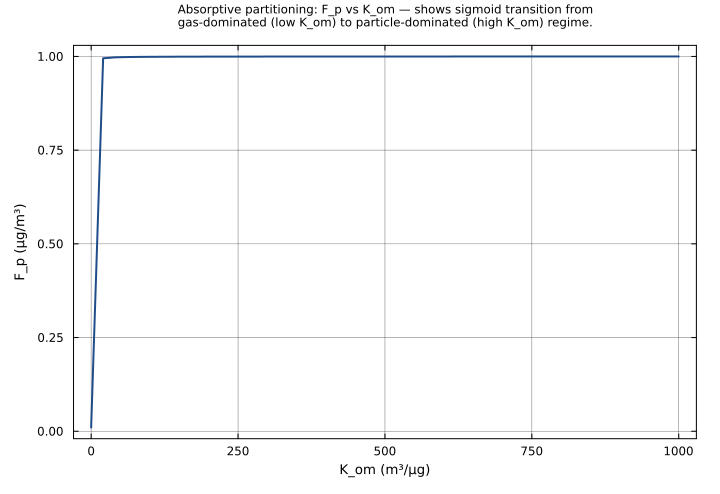
Sweep partition coefficient K_om from 0.001 to 1000 m³/µg (log scale) to show transition from gas-dominated (K_omC_oa « 1) to particle-dominated (K_omC_oa » 1) regimes.
Time span: 0.0 → 1.0
Swept over: K_om
Raw .esm
Raw .esm JSON (this component)
{
  "reference": {
    "citation": "Seinfeld, J. H. and Pandis, S. N. (2006) Atmospheric Chemistry and Physics, 2nd Edition, Chapter 9, Section 9.4, Eq. 9.23 — absorptive partitioning of a semivolatile organic between gas and particle phases. Migrated from Aerosol.jl src/organic_aerosol.jl `AbsorptivePartitioning` (esm-aez).",
    "notes": "source_ref: Aerosol.jl@main:src/organic_aerosol.jl:125\nUpstream `AbsorptivePartitioning` is an MTK `@component` with two parameters (K_om, C_oa), one input variable (C_tot), and one output variable (F_p). The equation is:\n  • F_p ~ K_om * C_oa * C_tot / (1 + K_om * C_oa)  (derived from Eq. 9.23)\nThe equation is algebraic (no derivatives), making this an observed-only component.\n\nDerivation: the partition equilibrium F_p / A_g = K_om * C_oa (Eq. 9.23) combined with mass balance C_tot = F_p + A_g gives F_p = K_om * C_oa * C_tot / (1 + K_om * C_oa), where A_g is gas-phase concentration and F_p is particle-phase concentration.\n\nObservability classification: observed-only — the single output F_p is given by an algebraic equation in terms of inputs K_om, C_oa, C_tot. Test scenarios use `time_span: [0, 1]` and sample at t=0.\n\nESM representation note: in the upstream MTK component C_tot is an `@variable` supplied externally as the input; in this .esm it is represented as a `parameter` (not a state) so the system is well-posed under the schema's equation-count rule (one equation per state) and to match the observed-only pattern used elsewhere in this rig (see components/aerosol/organic/bet.esm). Tests vary C_tot via `parameter_overrides`, and the `partitioning_sweep` example sweeps K_om as a parameter dimension.\n\nTolerance rationale (model-level rel=1e-9): observed-only algebraic system (no ODE integration); the equation involves only multiplication and division. Floating-point round-off is ~1e-15. 1e-9 leaves comfortable headroom."
  },
  "tolerance": {
    "rel": 1e-09
  },
  "variables": {
    "K_om": {
      "type": "parameter",
      "units": "m^3 ug^-1",
      "default": 1.0,
      "description": "Mass-based partition coefficient for absorptive partitioning into organic aerosol"
    },
    "C_oa": {
      "type": "parameter",
      "units": "ug m^-3",
      "default": 10.0,
      "description": "Total absorbing organic aerosol mass concentration"
    },
    "C_tot": {
      "type": "parameter",
      "units": "ug m^-3",
      "default": 1.0,
      "description": "Total concentration of the compound (gas + particle phases). Input parameter — the observed-only model has one algebraic equation for F_p given C_tot."
    },
    "F_p": {
      "type": "unknown",
      "units": "ug m^-3",
      "description": "Particle-phase (aerosol) concentration of the compound"
    }
  },
  "equations": [
    {
      "lhs": "F_p",
      "rhs": {
        "op": "/",
        "args": [
          {
            "op": "*",
            "args": [
              "K_om",
              "C_oa",
              "C_tot"
            ]
          },
          {
            "op": "+",
            "args": [
              1,
              {
                "op": "*",
                "args": [
                  "K_om",
                  "C_oa"
                ]
              }
            ]
          }
        ]
      }
    }
  ],
  "tests": [
    {
      "id": "default_conditions",
      "description": "Default conditions: K_om = 1.0 m³/µg, C_oa = 10.0 µg/m³, C_tot = 1.0 µg/m³. F_p = 1.0*10.0*1.0 / (1 + 1.0*10.0) = 10.0/11.0 = 0.9090909090909091 µg/m³.",
      "time_span": {
        "start": 0.0,
        "end": 1.0
      },
      "parameter_overrides": {
        "C_tot": 1.0
      },
      "assertions": [
        {
          "variable": "F_p",
          "time": 0.0,
          "expected": 0.9090909090909091,
          "tolerance": {
            "rel": 1e-06
          }
        }
      ]
    },
    {
      "id": "low_partitioning",
      "description": "Low partition coefficient (mostly gas phase): K_om = 0.001 m³/µg, C_oa = 10.0 µg/m³, C_tot = 1.0 µg/m³. F_p = 0.001*10.0*1.0 / (1 + 0.001*10.0) = 0.01/1.01 = 0.009900990099009901 µg/m³.",
      "time_span": {
        "start": 0.0,
        "end": 1.0
      },
      "parameter_overrides": {
        "K_om": 0.001,
        "C_tot": 1.0
      },
      "assertions": [
        {
          "variable": "F_p",
          "time": 0.0,
          "expected": 0.009900990099009901,
          "tolerance": {
            "rel": 1e-06
          }
        }
      ]
    },
    {
      "id": "high_partitioning",
      "description": "High partition coefficient (mostly particle phase): K_om = 100.0 m³/µg, C_oa = 10.0 µg/m³, C_tot = 1.0 µg/m³. F_p = 100.0*10.0*1.0 / (1 + 100.0*10.0) = 1000.0/1001.0 = 0.999000999000999 µg/m³.",
      "time_span": {
        "start": 0.0,
        "end": 1.0
      },
      "parameter_overrides": {
        "K_om": 100.0,
        "C_tot": 1.0
      },
      "assertions": [
        {
          "variable": "F_p",
          "time": 0.0,
          "expected": 0.999000999000999,
          "tolerance": {
            "rel": 1e-06
          }
        }
      ]
    }
  ],
  "analyses": [
    {
      "id": "partitioning_sweep",
      "description": "Sweep partition coefficient K_om from 0.001 to 1000 m³/µg (log scale) to show transition from gas-dominated (K_om*C_oa << 1) to particle-dominated (K_om*C_oa >> 1) regimes.",
      "initial_state": {},
      "parameters": {
        "C_oa": 10.0,
        "C_tot": 1.0
      },
      "time_span": {
        "start": 0.0,
        "end": 1.0
      },
      "parameter_sweep": {
        "type": "cartesian",
        "dimensions": [
          {
            "parameter": "K_om",
            "range": {
              "start": 0.001,
              "stop": 1000.0,
              "count": 50
            }
          }
        ]
      },
      "plots": [
        {
          "id": "partitioning_curve",
          "type": "line",
          "description": "Absorptive partitioning: F_p vs K_om — shows sigmoid transition from gas-dominated (low K_om) to particle-dominated (high K_om) regime.",
          "x": {
            "variable": "K_om",
            "label": "K_om (m³/µg)"
          },
          "y": {
            "variable": "F_p",
            "label": "F_p (µg/m³)"
          }
        }
      ]
    }
  ]
}