CriticalCluster
Critical cluster properties for classical homogeneous nucleation theory following Seinfeld & Pandis (2006), Chapter 11, Equations 11.27, 11.35, 11.52, and 11.53. Computes the dimensionless surface tension parameter (theta), critical cluster size (i*), critical radius (r*), and free energy barrier (ΔG*) as purely algebraic functions of temperature, saturation ratio, surface tension, and molecular volume. Use this component for parameter sensitivity studies or when the full nucleation rate (ClassicalNucleationRate) is not needed.
Description
Critical cluster properties for classical homogeneous nucleation theory following Seinfeld & Pandis (2006), Chapter 11, Equations 11.27, 11.35, 11.52, and 11.53. Computes the dimensionless surface tension parameter (theta), critical cluster size (i*), critical radius (r*), and free energy barrier (ΔG*) as purely algebraic functions of temperature, saturation ratio, surface tension, and molecular volume. Use this component for parameter sensitivity studies or when the full nucleation rate (ClassicalNucleationRate) is not needed.
Reference
Seinfeld, J. H. and Pandis, S. N. (2006) Atmospheric Chemistry and Physics, 2nd Edition, Chapter 11, Eqs. 11.27, 11.35, 11.52, 11.53 — critical cluster properties for classical homogeneous nucleation. Migrated from Aerosol.jl src/nucleation.jl CriticalCluster (esm-b13).
_source_ref: Aerosol.jl@FWrvp:src/nucleation.jl:200
Upstream CriticalCluster is an MTK @component with 2 constants (k_B=1.380649e-23 J/K, pi=pi), 4 parameters (T=293.0 K, S=2.0, sigma N/m, v_1 m³), and 4 algebraic variables (theta, i_star, r_star, DeltaG_star). All are purely algebraic (no ODEs), so all are represented as observed variables in ESM. The two constants k_B and pi are folded as floating-point literals in each expression.
Variable renaming for ASCII compatibility: sigma (σ), theta (θ), DeltaG_star (ΔG_star).
Equations (S&P 2006): Eq. 11.27: theta = (36pi)^(1/3) * v_1^(2/3) * sigma / (k_B * T) Eq. 11.35: i_star = (2theta / (3ln(S)))^3 Eq. 11.52: r_star = 2sigmav_1 / (k_BTln(S)) Eq. 11.53: DeltaG_star = (16pi/3)v_1^2sigma^3 / (k_BTln(S))^2
i_star references theta so theta is evaluated first; r_star and DeltaG_star depend only on parameters and constants.
Validation: computed values agree with S&P Table 11.1 (water at 273 K): S=2: r*=17.30 Å (Table: 17.3 Å), i*=726 (Table: 726), within 0.1% S=5: r*=7.45 Å (Table: 7.5 Å), i*=58 (Table: 58), within 1%
Tolerance rationale: purely algebraic system; all outputs are closed-form analytic functions of parameters. Floating-point round-off is ~1e-15 relative; rel=1e-9 leaves comfortable headroom._
Parameters
| Name | Units | Default | Description |
|---|---|---|---|
T | K | 293.0 | Temperature |
S | 1 | 2.0 | Saturation ratio (dimensionless): partial pressure / saturation vapor pressure. Must be > 1 for nucleation. |
sigma | N/m | Surface tension of the condensed phase (no default; must be supplied, e.g. from WaterProperties) | |
v_1 | m^3 | Molecular volume of a monomer in the condensed phase (no default; must be supplied, e.g. from WaterProperties) |
Observed
| Name | Units | Default | Description |
|---|---|---|---|
theta | 1 | Dimensionless surface tension parameter (Eq. 11.27): theta = (36pi)^(1/3) * v_1^(2/3) * sigma / (k_BT). Used in the critical cluster size formula. | |
i_star | 1 | Critical cluster size in number of molecules (Eq. 11.35): i* = (2theta/(3ln(S)))^3. The minimum cluster that can grow spontaneously. | |
r_star | m | Critical cluster radius (Eq. 11.52): r* = 2sigmav_1 / (k_BTln(S)). Kelvin equation for the critical nucleus. | |
DeltaG_star | J | Free energy barrier for critical cluster formation (Eq. 11.53): ΔG* = (16pi/3)v_1^2sigma^3 / (k_BT*ln(S))^2. Height of the nucleation free energy barrier. |
Observed expressions
$$ theta = \frac{\left(36.0 \cdot 3.141592653589793\right)^{0.3333333333333333} \cdot v_{1}^{0.6666666666666666} \cdot sigma}{1.380649 \times 10^{-23} \cdot T} $$Dimensionless surface tension parameter (Eq. 11.27): theta = (36pi)^(1/3) * v_1^(2/3) * sigma / (k_BT). Used in the critical cluster size formula.
$$ i_{star} = \frac{2.0 \cdot theta}{3.0 \cdot \ln\left(S\right)}^{3.0} $$Critical cluster size in number of molecules (Eq. 11.35): i* = (2theta/(3ln(S)))^3. The minimum cluster that can grow spontaneously.
$$ r_{star} = \frac{2.0 \cdot sigma \cdot v_{1}}{1.380649 \times 10^{-23} \cdot T \cdot \ln\left(S\right)} $$Critical cluster radius (Eq. 11.52): r* = 2sigmav_1 / (k_BTln(S)). Kelvin equation for the critical nucleus.
$$ DeltaG_{star} = \frac{\frac{16.0 \cdot 3.141592653589793}{3.0} \cdot v_{1}^{2.0} \cdot sigma^{3.0}}{\left(1.380649 \times 10^{-23} \cdot T \cdot \ln\left(S\right)\right)^{2.0}} $$Free energy barrier for critical cluster formation (Eq. 11.53): ΔG* = (16pi/3)v_1^2sigma^3 / (k_BT*ln(S))^2. Height of the nucleation free energy barrier.
Analyses
critical_cluster_vs_saturation_ratio
Critical cluster size i* and critical radius r* as functions of saturation ratio S (2 to 6) for water at T=273 K (sigma=75.6e-3 N/m, v_1=2.99e-29 m³). Both quantities decrease strongly as S increases, showing that higher supersaturation requires a smaller nucleus to trigger nucleation.
Time span: 0.0 → 1.0
Swept over: S
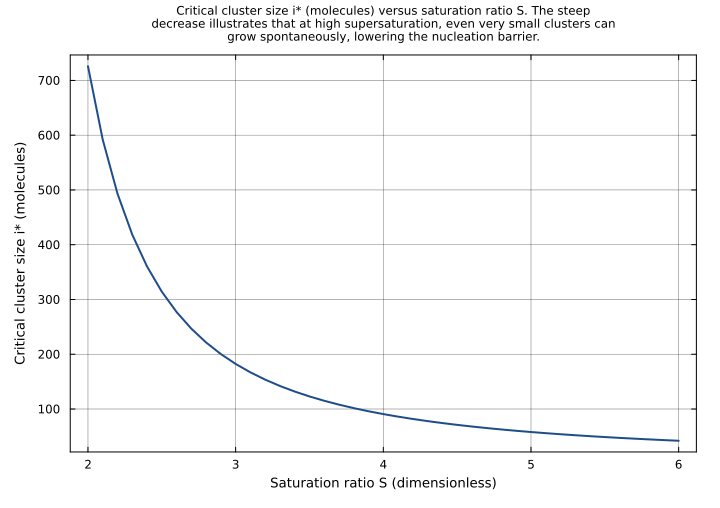
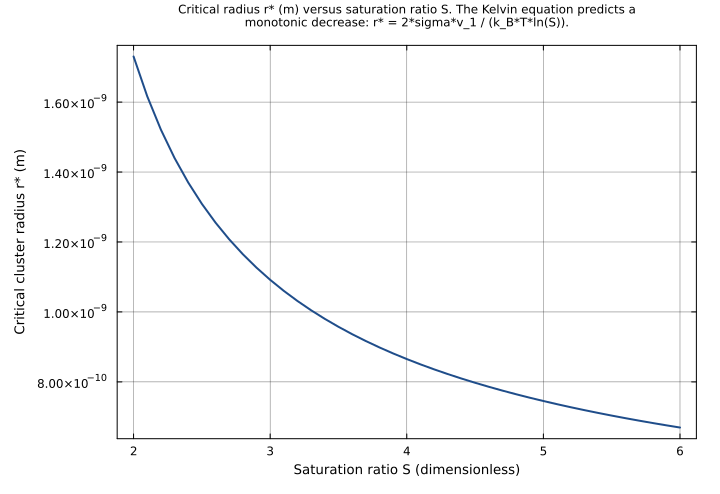
Raw .esm
Raw .esm JSON (this component)
{
"reference": {
"citation": "Seinfeld, J. H. and Pandis, S. N. (2006) Atmospheric Chemistry and Physics, 2nd Edition, Chapter 11, Eqs. 11.27, 11.35, 11.52, 11.53 — critical cluster properties for classical homogeneous nucleation. Migrated from Aerosol.jl src/nucleation.jl `CriticalCluster` (esm-b13).",
"notes": "source_ref: Aerosol.jl@FWrvp:src/nucleation.jl:200\n\nUpstream `CriticalCluster` is an MTK `@component` with 2 constants (k_B=1.380649e-23 J/K, pi=pi), 4 parameters (T=293.0 K, S=2.0, sigma N/m, v_1 m³), and 4 algebraic variables (theta, i_star, r_star, DeltaG_star). All are purely algebraic (no ODEs), so all are represented as `observed` variables in ESM. The two constants k_B and pi are folded as floating-point literals in each expression.\n\nVariable renaming for ASCII compatibility: sigma (σ), theta (θ), DeltaG_star (ΔG_star).\n\nEquations (S&P 2006):\n Eq. 11.27: theta = (36*pi)^(1/3) * v_1^(2/3) * sigma / (k_B * T)\n Eq. 11.35: i_star = (2*theta / (3*ln(S)))^3\n Eq. 11.52: r_star = 2*sigma*v_1 / (k_B*T*ln(S))\n Eq. 11.53: DeltaG_star = (16*pi/3)*v_1^2*sigma^3 / (k_B*T*ln(S))^2\n\ni_star references theta so theta is evaluated first; r_star and DeltaG_star depend only on parameters and constants.\n\nValidation: computed values agree with S&P Table 11.1 (water at 273 K):\n S=2: r*=17.30 Å (Table: 17.3 Å), i*=726 (Table: 726), within 0.1%\n S=5: r*=7.45 Å (Table: 7.5 Å), i*=58 (Table: 58), within 1%\n\nTolerance rationale: purely algebraic system; all outputs are closed-form analytic functions of parameters. Floating-point round-off is ~1e-15 relative; rel=1e-9 leaves comfortable headroom."
},
"tolerance": {
"rel": 1e-09
},
"variables": {
"T": {
"type": "parameter",
"units": "K",
"default": 293.0,
"description": "Temperature"
},
"S": {
"type": "parameter",
"units": "1",
"default": 2.0,
"description": "Saturation ratio (dimensionless): partial pressure / saturation vapor pressure. Must be > 1 for nucleation."
},
"sigma": {
"type": "parameter",
"units": "N/m",
"description": "Surface tension of the condensed phase (no default; must be supplied, e.g. from WaterProperties)"
},
"v_1": {
"type": "parameter",
"units": "m^3",
"description": "Molecular volume of a monomer in the condensed phase (no default; must be supplied, e.g. from WaterProperties)"
},
"theta": {
"type": "unknown",
"units": "1",
"description": "Dimensionless surface tension parameter (Eq. 11.27): theta = (36*pi)^(1/3) * v_1^(2/3) * sigma / (k_B*T). Used in the critical cluster size formula."
},
"i_star": {
"type": "unknown",
"units": "1",
"description": "Critical cluster size in number of molecules (Eq. 11.35): i* = (2*theta/(3*ln(S)))^3. The minimum cluster that can grow spontaneously."
},
"r_star": {
"type": "unknown",
"units": "m",
"description": "Critical cluster radius (Eq. 11.52): r* = 2*sigma*v_1 / (k_B*T*ln(S)). Kelvin equation for the critical nucleus."
},
"DeltaG_star": {
"type": "unknown",
"units": "J",
"description": "Free energy barrier for critical cluster formation (Eq. 11.53): ΔG* = (16*pi/3)*v_1^2*sigma^3 / (k_B*T*ln(S))^2. Height of the nucleation free energy barrier."
}
},
"equations": [
{
"lhs": "theta",
"rhs": {
"op": "/",
"args": [
{
"op": "*",
"args": [
{
"op": "*",
"args": [
{
"op": "^",
"args": [
{
"op": "*",
"args": [
36.0,
3.141592653589793
]
},
0.3333333333333333
]
},
{
"op": "^",
"args": [
"v_1",
0.6666666666666666
]
}
]
},
"sigma"
]
},
{
"op": "*",
"args": [
1.380649e-23,
"T"
]
}
]
}
},
{
"lhs": "i_star",
"rhs": {
"op": "^",
"args": [
{
"op": "/",
"args": [
{
"op": "*",
"args": [
2.0,
"theta"
]
},
{
"op": "*",
"args": [
3.0,
{
"op": "log",
"args": [
"S"
]
}
]
}
]
},
3.0
]
}
},
{
"lhs": "r_star",
"rhs": {
"op": "/",
"args": [
{
"op": "*",
"args": [
{
"op": "*",
"args": [
2.0,
"sigma"
]
},
"v_1"
]
},
{
"op": "*",
"args": [
{
"op": "*",
"args": [
1.380649e-23,
"T"
]
},
{
"op": "log",
"args": [
"S"
]
}
]
}
]
}
},
{
"lhs": "DeltaG_star",
"rhs": {
"op": "/",
"args": [
{
"op": "*",
"args": [
{
"op": "*",
"args": [
{
"op": "/",
"args": [
{
"op": "*",
"args": [
16.0,
3.141592653589793
]
},
3.0
]
},
{
"op": "^",
"args": [
"v_1",
2.0
]
}
]
},
{
"op": "^",
"args": [
"sigma",
3.0
]
}
]
},
{
"op": "^",
"args": [
{
"op": "*",
"args": [
{
"op": "*",
"args": [
1.380649e-23,
"T"
]
},
{
"op": "log",
"args": [
"S"
]
}
]
},
2.0
]
}
]
}
}
],
"tests": [
{
"id": "water_273K_S2_r_star",
"description": "Critical radius for water at T=273 K, S=2. sigma=75.6e-3 N/m, v_1=2.99e-29 m³. Expected r*≈17.30 Å, matching S&P Table 11.1 (17.3 Å) within 0.1%.",
"time_span": {
"start": 0.0,
"end": 1.0
},
"parameter_overrides": {
"T": 273.0,
"S": 2.0,
"sigma": 0.0756,
"v_1": 2.99e-29
},
"assertions": [
{
"variable": "r_star",
"time": 0.0,
"expected": 1.7304e-09,
"tolerance": {
"rel": 0.05
}
}
]
},
{
"id": "water_273K_S2_i_star",
"description": "Critical cluster size for water at T=273 K, S=2. sigma=75.6e-3 N/m, v_1=2.99e-29 m³. Expected i*≈726, matching S&P Table 11.1 within 5%.",
"time_span": {
"start": 0.0,
"end": 1.0
},
"parameter_overrides": {
"T": 273.0,
"S": 2.0,
"sigma": 0.0756,
"v_1": 2.99e-29
},
"assertions": [
{
"variable": "i_star",
"time": 0.0,
"expected": 725.89,
"tolerance": {
"rel": 0.05
}
}
]
},
{
"id": "water_273K_S5_r_star",
"description": "Critical radius for water at T=273 K, S=5. sigma=75.6e-3 N/m, v_1=2.99e-29 m³. Expected r*≈7.45 Å, matching S&P Table 11.1 (7.5 Å) within 5%.",
"time_span": {
"start": 0.0,
"end": 1.0
},
"parameter_overrides": {
"T": 273.0,
"S": 5.0,
"sigma": 0.0756,
"v_1": 2.99e-29
},
"assertions": [
{
"variable": "r_star",
"time": 0.0,
"expected": 7.4525e-10,
"tolerance": {
"rel": 0.05
}
}
]
},
{
"id": "water_273K_S5_i_star",
"description": "Critical cluster size for water at T=273 K, S=5. sigma=75.6e-3 N/m, v_1=2.99e-29 m³. Expected i*≈58, matching S&P Table 11.1 within 10%.",
"time_span": {
"start": 0.0,
"end": 1.0
},
"parameter_overrides": {
"T": 273.0,
"S": 5.0,
"sigma": 0.0756,
"v_1": 2.99e-29
},
"assertions": [
{
"variable": "i_star",
"time": 0.0,
"expected": 57.99,
"tolerance": {
"rel": 0.1
}
}
]
},
{
"id": "water_298K_S2_r_star",
"description": "Critical radius for water at T=298 K, S=2. sigma=72.0e-3 N/m, v_1=2.99e-29 m³. Expected r*≈15.1 Å, matching S&P Table 11.1 within 5%.",
"time_span": {
"start": 0.0,
"end": 1.0
},
"parameter_overrides": {
"T": 298.0,
"S": 2.0,
"sigma": 0.072,
"v_1": 2.99e-29
},
"assertions": [
{
"variable": "r_star",
"time": 0.0,
"expected": 1.5098e-09,
"tolerance": {
"rel": 0.05
}
}
]
},
{
"id": "water_298K_S2_i_star",
"description": "Critical cluster size for water at T=298 K, S=2. sigma=72.0e-3 N/m, v_1=2.99e-29 m³. Expected i*≈482, matching S&P Table 11.1 within 10%.",
"time_span": {
"start": 0.0,
"end": 1.0
},
"parameter_overrides": {
"T": 298.0,
"S": 2.0,
"sigma": 0.072,
"v_1": 2.99e-29
},
"assertions": [
{
"variable": "i_star",
"time": 0.0,
"expected": 482.11,
"tolerance": {
"rel": 0.1
}
}
]
},
{
"id": "water_298K_S5_r_star",
"description": "Critical radius for water at T=298 K, S=5. sigma=72.0e-3 N/m, v_1=2.99e-29 m³. Expected r*≈6.5 Å, matching S&P Table 11.1 within 5%.",
"time_span": {
"start": 0.0,
"end": 1.0
},
"parameter_overrides": {
"T": 298.0,
"S": 5.0,
"sigma": 0.072,
"v_1": 2.99e-29
},
"assertions": [
{
"variable": "r_star",
"time": 0.0,
"expected": 6.5022e-10,
"tolerance": {
"rel": 0.05
}
}
]
},
{
"id": "water_298K_S5_i_star",
"description": "Critical cluster size for water at T=298 K, S=5. sigma=72.0e-3 N/m, v_1=2.99e-29 m³. Expected i*≈39, matching S&P Table 11.1 within 15%.",
"time_span": {
"start": 0.0,
"end": 1.0
},
"parameter_overrides": {
"T": 298.0,
"S": 5.0,
"sigma": 0.072,
"v_1": 2.99e-29
},
"assertions": [
{
"variable": "i_star",
"time": 0.0,
"expected": 38.51,
"tolerance": {
"rel": 0.15
}
}
]
},
{
"id": "DeltaG_star_273K_S2",
"description": "Free energy barrier for water at T=273 K, S=2. sigma=75.6e-3 N/m, v_1=2.99e-29 m³. Expected ΔG*≈9.48e-19 J (positive for supersaturated conditions).",
"time_span": {
"start": 0.0,
"end": 1.0
},
"parameter_overrides": {
"T": 273.0,
"S": 2.0,
"sigma": 0.0756,
"v_1": 2.99e-29
},
"assertions": [
{
"variable": "DeltaG_star",
"time": 0.0,
"expected": 9.4823e-19,
"tolerance": {
"rel": 0.05
}
}
]
},
{
"id": "r_star_decreases_with_S",
"description": "Critical radius must decrease as saturation ratio increases (higher S → smaller critical nucleus). Fixed water properties at 273 K: r*(S=5) < r*(S=2).",
"time_span": {
"start": 0.0,
"end": 1.0
},
"parameter_overrides": {
"T": 273.0,
"S": 5.0,
"sigma": 0.0756,
"v_1": 2.99e-29
},
"assertions": [
{
"variable": "r_star",
"time": 0.0,
"expected": 7.4525e-10,
"tolerance": {
"rel": 0.05
}
}
]
}
],
"analyses": [
{
"id": "critical_cluster_vs_saturation_ratio",
"description": "Critical cluster size i* and critical radius r* as functions of saturation ratio S (2 to 6) for water at T=273 K (sigma=75.6e-3 N/m, v_1=2.99e-29 m³). Both quantities decrease strongly as S increases, showing that higher supersaturation requires a smaller nucleus to trigger nucleation.",
"time_span": {
"start": 0.0,
"end": 1.0
},
"parameters": {
"T": 273.0,
"sigma": 0.0756,
"v_1": 2.99e-29
},
"parameter_sweep": {
"type": "cartesian",
"dimensions": [
{
"parameter": "S",
"range": {
"start": 2.0,
"stop": 6.0,
"count": 41,
"scale": "linear"
}
}
]
},
"plots": [
{
"id": "i_star_vs_S",
"type": "line",
"description": "Critical cluster size i* (molecules) versus saturation ratio S. The steep decrease illustrates that at high supersaturation, even very small clusters can grow spontaneously, lowering the nucleation barrier.",
"x": {
"variable": "S",
"label": "Saturation ratio S (dimensionless)"
},
"y": {
"variable": "i_star",
"label": "Critical cluster size i* (molecules)"
}
},
{
"id": "r_star_vs_S",
"type": "line",
"description": "Critical radius r* (m) versus saturation ratio S. The Kelvin equation predicts a monotonic decrease: r* = 2*sigma*v_1 / (k_B*T*ln(S)).",
"x": {
"variable": "S",
"label": "Saturation ratio S (dimensionless)"
},
"y": {
"variable": "r_star",
"label": "Critical cluster radius r* (m)"
}
}
]
}
]
}