RayleighScattering
Optical scattering, absorption, and extinction properties of small particles in the Rayleigh regime (size parameter α = πD_p/λ << 1), from Seinfeld & Pandis (2006) Atmospheric Chemistry and Physics, 2nd ed., Chapter 15, Eqs. 15.4, 15.5, 15.19, 15.21, and 15.41-15.43. Computes the size parameter α, the Clausius-Mossotti factor (m²-1)/(m²+2), and from them the Rayleigh scattering efficiency Q_scat, absorption efficiency Q_abs, extinction efficiency Q_ext, single-scattering albedo ω, and mass efficiencies E_ext/E_scat/E_abs. The two upstream @register_symbolic helper functions (rayleigh_m2_factor_real, rayleigh_m2_factor_imag) are resolved as closed-form algebraic AST, closing the gt-p3ep blocking gap. Migrated from Aerosol.jl src/mie_scattering.jl.
Description
Optical scattering, absorption, and extinction properties of small particles in the Rayleigh regime (size parameter α = πD_p/λ « 1), from Seinfeld & Pandis (2006) Atmospheric Chemistry and Physics, 2nd ed., Chapter 15, Eqs. 15.4, 15.5, 15.19, 15.21, and 15.41-15.43. Computes the size parameter α, the Clausius-Mossotti factor (m²-1)/(m²+2), and from them the Rayleigh scattering efficiency Q_scat, absorption efficiency Q_abs, extinction efficiency Q_ext, single-scattering albedo ω, and mass efficiencies E_ext/E_scat/E_abs. The two upstream @register_symbolic helper functions (rayleigh_m2_factor_real, rayleigh_m2_factor_imag) are resolved as closed-form algebraic AST, closing the gt-p3ep blocking gap. Migrated from Aerosol.jl src/mie_scattering.jl.
Reference
Seinfeld, J. H. and Pandis, S. N. (2006) Atmospheric Chemistry and Physics, 2nd Edition, Chapter 15. Migrated from Aerosol.jl src/mie_scattering.jl RayleighScattering (esm-8aj).
_source_ref: Aerosol.jl@c8c640bb636b22f2425460e9ed5cba50793bfee1:src/mie_scattering.jl:111
Upstream RayleighScattering is an MTK @component with five @constants (π_val=Float64(π), eight_thirds=8/3, four=4.0, three=3.0, two=2.0) and five @parameters (D_p=0.05e-6 m, λ=550e-9 m, n_refr=1.5, k_refr=0.0, ρ_p=1500 kg/m³). The eleven @variables are all algebraic:
α ~ π_val * D_p / λ [size parameter, Eq. 15.6]
m2_factor_real ~ rayleigh_m2_factor_real(n_refr, k_refr) [@register_symbolic]
m2_factor_imag ~ rayleigh_m2_factor_imag(n_refr, k_refr) [@register_symbolic]
m2_factor_mag_sq ~ m2_factor_real² + m2_factor_imag²
Q_scat ~ eight_thirds * α⁴ * m2_factor_mag_sq [Eq. 15.19]
Q_abs ~ four * α * m2_factor_imag [Eq. 15.21]
Q_ext ~ Q_scat + Q_abs [Eq. 15.4]
ω ~ Q_scat / Q_ext [Eq. 15.5]
E_ext ~ three * Q_ext / (two * ρ_p * D_p) [Eq. 15.41]
E_scat ~ three * Q_scat / (two * ρ_p * D_p) [Eq. 15.42]
E_abs ~ three * Q_abs / (two * ρ_p * D_p) [Eq. 15.43]
gt-p3ep gap resolution: rayleigh_m2_factor_real(n, k) and rayleigh_m2_factor_imag(n, k) compute the real and imaginary parts of the Clausius-Mossotti factor (m²-1)/(m²+2), where m = n_refr + i·k_refr is the complex refractive index. Unlike the Bohren-Huffman Mie functions (mie_Q_ext, mie_Q_scat in AerosolExtinction), these are closed-form algebraic expressions derivable from standard complex arithmetic. With m2_re = n² - k² and m2_im = 2nk:
denom = (m2_re + 2)² + m2_im² [= |m²+2|²]
m2_factor_real = [(m2_re-1)(m2_re+2) + m2_im²] / denom [Re part]
m2_factor_imag = 3·m2_im / denom [Im part]
Derivation of Im[(m²-1)/(m²+2)]: writing (a+bi)/(c+di) = (ac+bd)/(c²+d²) + i(bc-ad)/(c²+d²) with a=(m2_re-1), b=m2_im, c=(m2_re+2), d=m2_im gives Im = [m2_im·(m2_re+2) - (m2_re-1)·m2_im] / denom = 3·m2_im / denom. This resolves the gt-p3ep blocking gap as direct algebraic AST without interp.* primitives or parameter-lifting.
@constants handling: all five upstream @constants migrate to type: parameter with fixed defaults, consistent with the rig-wide convention (aerosol_extinction.esm, rayleigh_atmosphere.esm, etc.).
Dependency order (all acyclic, no ODEs): {n_refr, k_refr} → {m2_re, m2_im} → denom → {m2_factor_real, m2_factor_imag} {D_p, λ} → α {m2_factor_real, m2_factor_imag} → m2_factor_mag_sq {eight_thirds, α, m2_factor_mag_sq} → Q_scat {four, α, m2_factor_imag} → Q_abs {Q_scat, Q_abs} → Q_ext → {ω, E_ext} {Q_scat, ρ_p, D_p} → E_scat; {Q_abs, ρ_p, D_p} → E_abs
Tolerance rationale (rel=1e-9): purely algebraic system, all expressions are +, -, *, /, ^ on float64; round-off is ~1e-15. rel=1e-9 leaves six orders of magnitude of headroom._
Parameters
| Name | Units | Default | Description |
|---|---|---|---|
π_val | 1 | 3.141592653589793 | Pi (dimensionless). Upstream MTK @constants entry π_val = Float64(π); migrated as a fixed-default parameter. |
eight_thirds | 1 | 2.6666666666666665 | Prefactor 8/3 in the Rayleigh scattering efficiency formula (dimensionless, Seinfeld & Pandis Eq. 15.19). Upstream MTK @constants entry eight_thirds = 8.0/3.0. |
four | 1 | 4.0 | Prefactor 4 in the Rayleigh absorption efficiency formula (dimensionless, Seinfeld & Pandis Eq. 15.21). Upstream MTK @constants entry four = 4.0. |
three | 1 | 3.0 | Numerator factor 3 in the mass efficiency formula E = 3Q/(2ρD_p) (dimensionless, Seinfeld & Pandis Eqs. 15.41-15.43). Upstream MTK @constants entry three = 3.0. |
two | 1 | 2.0 | Denominator factor 2 in the mass efficiency formula E = 3Q/(2ρD_p) (dimensionless). Upstream MTK @constants entry two = 2.0. |
D_p | m | 5e-08 | Particle diameter (m). Default 50 nm (0.05 μm) — well within the Rayleigh regime: α = πD_p/λ ≈ 0.286 « 1 at λ=550 nm. The upstream default is 0.05e-6 m. |
λ | m | 5.5e-07 | Wavelength of incident radiation (m). Default 550 nm — visible green light, near the peak of the solar spectrum. The upstream default is 550e-9 m. |
n_refr | 1 | 1.5 | Real part of the complex refractive index m = n_refr + i·k_refr (dimensionless). Default 1.5 — a representative value for many inorganic aerosol constituents (e.g., ammonium sulfate ~1.53, sea salt ~1.54). |
k_refr | 1 | 0.0 | Imaginary part of the complex refractive index m = n_refr + i·k_refr (dimensionless). Default 0 — non-absorbing (purely scattering) particle. Positive values indicate light absorption (e.g., black carbon k ≈ 0.6 at 550 nm). Enters Q_abs linearly. |
ρ_p | kg*m^-3 | 1500.0 | Particle material density (kg/m³). Default 1500 kg/m³ — a representative value for mixed inorganic aerosol. Used only in the mass efficiency calculations E_ext, E_scat, E_abs. |
Observed
| Name | Units | Default | Description |
|---|---|---|---|
m2_re | 1 | Real part of m² = n_refr² - k_refr² (dimensionless). Intermediate quantity for the Clausius-Mossotti factor. At default conditions (n=1.5, k=0): m2_re = 2.25. | |
m2_im | 1 | Imaginary part of m² = 2 n_refr k_refr (dimensionless). Zero for non-absorbing particles (k_refr=0); positive for absorbing particles. | |
denom | 1 | Shared denominator |m²+2|² = (m2_re+2)² + m2_im² (dimensionless) for the Clausius-Mossotti factor (m²-1)/(m²+2). At default conditions (n=1.5, k=0): denom = 4.25² = 18.0625. | |
α | 1 | Size parameter α = π D_p / λ (dimensionless, Seinfeld & Pandis 2006, Eq. 15.6). Characterises the scattering regime: Rayleigh (α « 1), resonance (α ~ 1), geometric (α » 1). At default conditions α = π/11 ≈ 0.286. | |
m2_factor_real | 1 | Real part of the Clausius-Mossotti factor Re[(m²-1)/(m²+2)] = [(m2_re-1)(m2_re+2) + m2_im²] / |m²+2|² (dimensionless). For non-absorbing particles (k=0): Re = (n²-1)/(n²+2); at n=1.5: 1.25/4.25 = 5/17 ≈ 0.294. | |
m2_factor_imag | 1 | Imaginary part of the Clausius-Mossotti factor Im[(m²-1)/(m²+2)] = 3 m2_im / |m²+2|² (dimensionless). Zero for non-absorbing particles; positive for absorbing particles. Enters Q_abs = 4α × m2_factor_imag (Eq. 15.21). | |
m2_factor_mag_sq | 1 | Squared magnitude of the Clausius-Mossotti factor |(m²-1)/(m²+2)|² = m2_factor_real² + m2_factor_imag² (dimensionless). Enters Q_scat via Eq. 15.19. At default conditions: (5/17)² = 25/289 ≈ 0.08651. | |
Q_scat | 1 | Rayleigh scattering efficiency Q_scat = (8/3) α⁴ |(m²-1)/(m²+2)|² (dimensionless, Seinfeld & Pandis 2006, Eq. 15.19). Scales as D_p⁴ and λ⁻⁴ in the Rayleigh regime. For non-absorbing particles equals Q_ext. | |
Q_abs | 1 | Rayleigh absorption efficiency Q_abs = 4 α Im[(m²-1)/(m²+2)] (dimensionless, Seinfeld & Pandis 2006, Eq. 15.21). Scales as D_p and λ⁻¹ — linear in α rather than α⁴, so absorption dominates over scattering for absorbing particles in the Rayleigh limit. Zero when k_refr=0. | |
Q_ext | 1 | Rayleigh extinction efficiency Q_ext = Q_scat + Q_abs (dimensionless, Seinfeld & Pandis 2006, Eq. 15.4). | |
ω | 1 | Single-scattering albedo ω = Q_scat / Q_ext (dimensionless, Seinfeld & Pandis 2006, Eq. 15.5). Equal to 1 for non-absorbing particles (k_refr=0); decreases toward 0 as absorption dominates in the Rayleigh regime. | |
E_ext | m^2*kg^-1 | Mass extinction efficiency E_ext = 3 Q_ext / (2 ρ_p D_p) (m² kg⁻¹, Seinfeld & Pandis 2006, Eq. 15.41). The power extinguished per unit incident irradiance per unit aerosol mass concentration. | |
E_scat | m^2*kg^-1 | Mass scattering efficiency E_scat = 3 Q_scat / (2 ρ_p D_p) (m² kg⁻¹, Seinfeld & Pandis 2006, Eq. 15.42). | |
E_abs | m^2*kg^-1 | Mass absorption efficiency E_abs = 3 Q_abs / (2 ρ_p D_p) (m² kg⁻¹, Seinfeld & Pandis 2006, Eq. 15.43). Zero when k_refr=0. |
Observed expressions
$$ m2_{re} = n_{refr}^{2} - k_{refr}^{2} $$Real part of m² = n_refr² - k_refr² (dimensionless). Intermediate quantity for the Clausius-Mossotti factor. At default conditions (n=1.5, k=0): m2_re = 2.25.
$$ m2_{im} = 2.0 \cdot n_{refr} \cdot k_{refr} $$Imaginary part of m² = 2 n_refr k_refr (dimensionless). Zero for non-absorbing particles (k_refr=0); positive for absorbing particles.
$$ denom = \left(m2_{re} + 2.0\right)^{2} + m2_{im}^{2} $$Shared denominator |m²+2|² = (m2_re+2)² + m2_im² (dimensionless) for the Clausius-Mossotti factor (m²-1)/(m²+2). At default conditions (n=1.5, k=0): denom = 4.25² = 18.0625.
$$ α = \frac{π_{val} \cdot D_{p}}{λ} $$Size parameter α = π D_p / λ (dimensionless, Seinfeld & Pandis 2006, Eq. 15.6). Characterises the scattering regime: Rayleigh (α « 1), resonance (α ~ 1), geometric (α » 1). At default conditions α = π/11 ≈ 0.286.
$$ m2_{factor\,real} = \frac{\left(m2_{re} - 1.0\right) \cdot \left(m2_{re} + 2.0\right) + m2_{im}^{2}}{denom} $$Real part of the Clausius-Mossotti factor Re[(m²-1)/(m²+2)] = [(m2_re-1)(m2_re+2) + m2_im²] / |m²+2|² (dimensionless). For non-absorbing particles (k=0): Re = (n²-1)/(n²+2); at n=1.5: 1.25/4.25 = 5/17 ≈ 0.294.
$$ m2_{factor\,imag} = \frac{3.0 \cdot m2_{im}}{denom} $$Imaginary part of the Clausius-Mossotti factor Im[(m²-1)/(m²+2)] = 3 m2_im / |m²+2|² (dimensionless). Zero for non-absorbing particles; positive for absorbing particles. Enters Q_abs = 4α × m2_factor_imag (Eq. 15.21).
$$ m2_{factor\,mag\,sq} = m2_{factor\,real}^{2} + m2_{factor\,imag}^{2} $$Squared magnitude of the Clausius-Mossotti factor |(m²-1)/(m²+2)|² = m2_factor_real² + m2_factor_imag² (dimensionless). Enters Q_scat via Eq. 15.19. At default conditions: (5/17)² = 25/289 ≈ 0.08651.
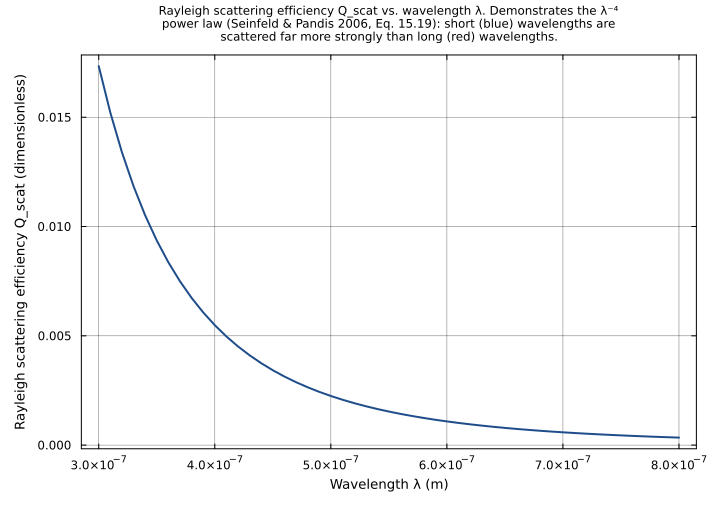
$$ Q_{scat} = eight_{thirds} \cdot α^{4} \cdot m2_{factor\,mag\,sq} $$Rayleigh scattering efficiency Q_scat = (8/3) α⁴ |(m²-1)/(m²+2)|² (dimensionless, Seinfeld & Pandis 2006, Eq. 15.19). Scales as D_p⁴ and λ⁻⁴ in the Rayleigh regime. For non-absorbing particles equals Q_ext.
$$ Q_{abs} = four \cdot α \cdot m2_{factor\,imag} $$Rayleigh absorption efficiency Q_abs = 4 α Im[(m²-1)/(m²+2)] (dimensionless, Seinfeld & Pandis 2006, Eq. 15.21). Scales as D_p and λ⁻¹ — linear in α rather than α⁴, so absorption dominates over scattering for absorbing particles in the Rayleigh limit. Zero when k_refr=0.
$$ Q_{ext} = Q_{scat} + Q_{abs} $$Rayleigh extinction efficiency Q_ext = Q_scat + Q_abs (dimensionless, Seinfeld & Pandis 2006, Eq. 15.4).
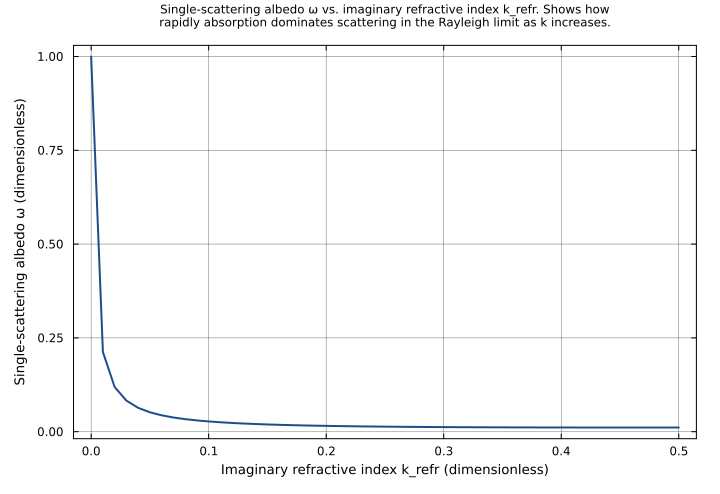
$$ ω = \frac{Q_{scat}}{Q_{ext}} $$Single-scattering albedo ω = Q_scat / Q_ext (dimensionless, Seinfeld & Pandis 2006, Eq. 15.5). Equal to 1 for non-absorbing particles (k_refr=0); decreases toward 0 as absorption dominates in the Rayleigh regime.
$$ E_{ext} = \frac{three \cdot Q_{ext}}{two \cdot ρ_{p} \cdot D_{p}} $$Mass extinction efficiency E_ext = 3 Q_ext / (2 ρ_p D_p) (m² kg⁻¹, Seinfeld & Pandis 2006, Eq. 15.41). The power extinguished per unit incident irradiance per unit aerosol mass concentration.
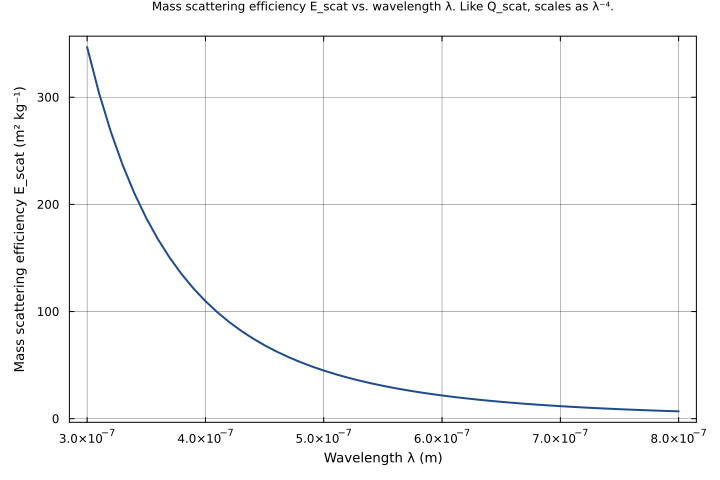
$$ E_{scat} = \frac{three \cdot Q_{scat}}{two \cdot ρ_{p} \cdot D_{p}} $$Mass scattering efficiency E_scat = 3 Q_scat / (2 ρ_p D_p) (m² kg⁻¹, Seinfeld & Pandis 2006, Eq. 15.42).
$$ E_{abs} = \frac{three \cdot Q_{abs}}{two \cdot ρ_{p} \cdot D_{p}} $$Mass absorption efficiency E_abs = 3 Q_abs / (2 ρ_p D_p) (m² kg⁻¹, Seinfeld & Pandis 2006, Eq. 15.43). Zero when k_refr=0.
Analyses
wavelength_dependence_non_absorbing
Rayleigh scattering efficiency Q_scat vs. wavelength λ for a non-absorbing particle (n_refr=1.5, k_refr=0, D_p=5e-8 m). Q_scat ∝ λ⁻⁴: blue light (λ≈400 nm) scatters ~(550/400)⁴ ≈ 3.6× more strongly than green (550 nm), and ~(550/700)⁴ ≈ 2.5× more than red (700 nm). This is the physical origin of the blue sky — Rayleigh scattering of sunlight by air molecules and small aerosols preferentially redirects blue photons.
Time span: 0.0 → 1.0
Swept over: λ
absorbing_particle_omega_vs_k
Single-scattering albedo ω = Q_scat/Q_ext vs. imaginary refractive index k_refr for a Rayleigh particle (n_refr=1.5, D_p=5e-8 m, λ=5.5e-7 m). In the Rayleigh regime Q_scat ∝ α⁴ while Q_abs ∝ α, so even a small k drives ω rapidly toward zero: absorption dominates. At k=0.1, ω ≈ 0.027.
Time span: 0.0 → 1.0
Swept over: k_refr
Raw .esm
Raw .esm JSON (this component)
{
"reference": {
"citation": "Seinfeld, J. H. and Pandis, S. N. (2006) Atmospheric Chemistry and Physics, 2nd Edition, Chapter 15. Migrated from Aerosol.jl src/mie_scattering.jl `RayleighScattering` (esm-8aj).",
"notes": "source_ref: Aerosol.jl@c8c640bb636b22f2425460e9ed5cba50793bfee1:src/mie_scattering.jl:111\n\nUpstream `RayleighScattering` is an MTK `@component` with five `@constants` (π_val=Float64(π), eight_thirds=8/3, four=4.0, three=3.0, two=2.0) and five `@parameters` (D_p=0.05e-6 m, λ=550e-9 m, n_refr=1.5, k_refr=0.0, ρ_p=1500 kg/m³). The eleven `@variables` are all algebraic:\n α ~ π_val * D_p / λ [size parameter, Eq. 15.6]\n m2_factor_real ~ rayleigh_m2_factor_real(n_refr, k_refr) [@register_symbolic]\n m2_factor_imag ~ rayleigh_m2_factor_imag(n_refr, k_refr) [@register_symbolic]\n m2_factor_mag_sq ~ m2_factor_real² + m2_factor_imag²\n Q_scat ~ eight_thirds * α⁴ * m2_factor_mag_sq [Eq. 15.19]\n Q_abs ~ four * α * m2_factor_imag [Eq. 15.21]\n Q_ext ~ Q_scat + Q_abs [Eq. 15.4]\n ω ~ Q_scat / Q_ext [Eq. 15.5]\n E_ext ~ three * Q_ext / (two * ρ_p * D_p) [Eq. 15.41]\n E_scat ~ three * Q_scat / (two * ρ_p * D_p) [Eq. 15.42]\n E_abs ~ three * Q_abs / (two * ρ_p * D_p) [Eq. 15.43]\n\ngt-p3ep gap resolution: `rayleigh_m2_factor_real(n, k)` and `rayleigh_m2_factor_imag(n, k)` compute the real and imaginary parts of the Clausius-Mossotti factor (m²-1)/(m²+2), where m = n_refr + i·k_refr is the complex refractive index. Unlike the Bohren-Huffman Mie functions (`mie_Q_ext`, `mie_Q_scat` in AerosolExtinction), these are closed-form algebraic expressions derivable from standard complex arithmetic. With m2_re = n² - k² and m2_im = 2nk:\n denom = (m2_re + 2)² + m2_im² [= |m²+2|²]\n m2_factor_real = [(m2_re-1)(m2_re+2) + m2_im²] / denom [Re part]\n m2_factor_imag = 3·m2_im / denom [Im part]\nDerivation of Im[(m²-1)/(m²+2)]: writing (a+bi)/(c+di) = (ac+bd)/(c²+d²) + i(bc-ad)/(c²+d²) with a=(m2_re-1), b=m2_im, c=(m2_re+2), d=m2_im gives Im = [m2_im·(m2_re+2) - (m2_re-1)·m2_im] / denom = 3·m2_im / denom. This resolves the gt-p3ep blocking gap as direct algebraic AST without `interp.*` primitives or parameter-lifting.\n\n@constants handling: all five upstream @constants migrate to `type: parameter` with fixed defaults, consistent with the rig-wide convention (aerosol_extinction.esm, rayleigh_atmosphere.esm, etc.).\n\nDependency order (all acyclic, no ODEs):\n {n_refr, k_refr} → {m2_re, m2_im} → denom → {m2_factor_real, m2_factor_imag}\n {D_p, λ} → α\n {m2_factor_real, m2_factor_imag} → m2_factor_mag_sq\n {eight_thirds, α, m2_factor_mag_sq} → Q_scat\n {four, α, m2_factor_imag} → Q_abs\n {Q_scat, Q_abs} → Q_ext → {ω, E_ext}\n {Q_scat, ρ_p, D_p} → E_scat; {Q_abs, ρ_p, D_p} → E_abs\n\nTolerance rationale (rel=1e-9): purely algebraic system, all expressions are +, -, *, /, ^ on float64; round-off is ~1e-15. rel=1e-9 leaves six orders of magnitude of headroom."
},
"tolerance": {
"rel": 1e-09
},
"variables": {
"π_val": {
"type": "parameter",
"units": "1",
"default": 3.141592653589793,
"description": "Pi (dimensionless). Upstream MTK @constants entry π_val = Float64(π); migrated as a fixed-default parameter."
},
"eight_thirds": {
"type": "parameter",
"units": "1",
"default": 2.6666666666666665,
"description": "Prefactor 8/3 in the Rayleigh scattering efficiency formula (dimensionless, Seinfeld & Pandis Eq. 15.19). Upstream MTK @constants entry eight_thirds = 8.0/3.0."
},
"four": {
"type": "parameter",
"units": "1",
"default": 4.0,
"description": "Prefactor 4 in the Rayleigh absorption efficiency formula (dimensionless, Seinfeld & Pandis Eq. 15.21). Upstream MTK @constants entry four = 4.0."
},
"three": {
"type": "parameter",
"units": "1",
"default": 3.0,
"description": "Numerator factor 3 in the mass efficiency formula E = 3Q/(2ρD_p) (dimensionless, Seinfeld & Pandis Eqs. 15.41-15.43). Upstream MTK @constants entry three = 3.0."
},
"two": {
"type": "parameter",
"units": "1",
"default": 2.0,
"description": "Denominator factor 2 in the mass efficiency formula E = 3Q/(2ρD_p) (dimensionless). Upstream MTK @constants entry two = 2.0."
},
"D_p": {
"type": "parameter",
"units": "m",
"default": 5e-08,
"description": "Particle diameter (m). Default 50 nm (0.05 μm) — well within the Rayleigh regime: α = πD_p/λ ≈ 0.286 << 1 at λ=550 nm. The upstream default is 0.05e-6 m."
},
"λ": {
"type": "parameter",
"units": "m",
"default": 5.5e-07,
"description": "Wavelength of incident radiation (m). Default 550 nm — visible green light, near the peak of the solar spectrum. The upstream default is 550e-9 m."
},
"n_refr": {
"type": "parameter",
"units": "1",
"default": 1.5,
"description": "Real part of the complex refractive index m = n_refr + i·k_refr (dimensionless). Default 1.5 — a representative value for many inorganic aerosol constituents (e.g., ammonium sulfate ~1.53, sea salt ~1.54)."
},
"k_refr": {
"type": "parameter",
"units": "1",
"default": 0.0,
"description": "Imaginary part of the complex refractive index m = n_refr + i·k_refr (dimensionless). Default 0 — non-absorbing (purely scattering) particle. Positive values indicate light absorption (e.g., black carbon k ≈ 0.6 at 550 nm). Enters Q_abs linearly."
},
"ρ_p": {
"type": "parameter",
"units": "kg*m^-3",
"default": 1500.0,
"description": "Particle material density (kg/m³). Default 1500 kg/m³ — a representative value for mixed inorganic aerosol. Used only in the mass efficiency calculations E_ext, E_scat, E_abs."
},
"m2_re": {
"type": "unknown",
"units": "1",
"description": "Real part of m² = n_refr² - k_refr² (dimensionless). Intermediate quantity for the Clausius-Mossotti factor. At default conditions (n=1.5, k=0): m2_re = 2.25."
},
"m2_im": {
"type": "unknown",
"units": "1",
"description": "Imaginary part of m² = 2 n_refr k_refr (dimensionless). Zero for non-absorbing particles (k_refr=0); positive for absorbing particles."
},
"denom": {
"type": "unknown",
"units": "1",
"description": "Shared denominator |m²+2|² = (m2_re+2)² + m2_im² (dimensionless) for the Clausius-Mossotti factor (m²-1)/(m²+2). At default conditions (n=1.5, k=0): denom = 4.25² = 18.0625."
},
"α": {
"type": "unknown",
"units": "1",
"description": "Size parameter α = π D_p / λ (dimensionless, Seinfeld & Pandis 2006, Eq. 15.6). Characterises the scattering regime: Rayleigh (α << 1), resonance (α ~ 1), geometric (α >> 1). At default conditions α = π/11 ≈ 0.286."
},
"m2_factor_real": {
"type": "unknown",
"units": "1",
"description": "Real part of the Clausius-Mossotti factor Re[(m²-1)/(m²+2)] = [(m2_re-1)(m2_re+2) + m2_im²] / |m²+2|² (dimensionless). For non-absorbing particles (k=0): Re = (n²-1)/(n²+2); at n=1.5: 1.25/4.25 = 5/17 ≈ 0.294."
},
"m2_factor_imag": {
"type": "unknown",
"units": "1",
"description": "Imaginary part of the Clausius-Mossotti factor Im[(m²-1)/(m²+2)] = 3 m2_im / |m²+2|² (dimensionless). Zero for non-absorbing particles; positive for absorbing particles. Enters Q_abs = 4α × m2_factor_imag (Eq. 15.21)."
},
"m2_factor_mag_sq": {
"type": "unknown",
"units": "1",
"description": "Squared magnitude of the Clausius-Mossotti factor |(m²-1)/(m²+2)|² = m2_factor_real² + m2_factor_imag² (dimensionless). Enters Q_scat via Eq. 15.19. At default conditions: (5/17)² = 25/289 ≈ 0.08651."
},
"Q_scat": {
"type": "unknown",
"units": "1",
"description": "Rayleigh scattering efficiency Q_scat = (8/3) α⁴ |(m²-1)/(m²+2)|² (dimensionless, Seinfeld & Pandis 2006, Eq. 15.19). Scales as D_p⁴ and λ⁻⁴ in the Rayleigh regime. For non-absorbing particles equals Q_ext."
},
"Q_abs": {
"type": "unknown",
"units": "1",
"description": "Rayleigh absorption efficiency Q_abs = 4 α Im[(m²-1)/(m²+2)] (dimensionless, Seinfeld & Pandis 2006, Eq. 15.21). Scales as D_p and λ⁻¹ — linear in α rather than α⁴, so absorption dominates over scattering for absorbing particles in the Rayleigh limit. Zero when k_refr=0."
},
"Q_ext": {
"type": "unknown",
"units": "1",
"description": "Rayleigh extinction efficiency Q_ext = Q_scat + Q_abs (dimensionless, Seinfeld & Pandis 2006, Eq. 15.4)."
},
"ω": {
"type": "unknown",
"units": "1",
"description": "Single-scattering albedo ω = Q_scat / Q_ext (dimensionless, Seinfeld & Pandis 2006, Eq. 15.5). Equal to 1 for non-absorbing particles (k_refr=0); decreases toward 0 as absorption dominates in the Rayleigh regime."
},
"E_ext": {
"type": "unknown",
"units": "m^2*kg^-1",
"description": "Mass extinction efficiency E_ext = 3 Q_ext / (2 ρ_p D_p) (m² kg⁻¹, Seinfeld & Pandis 2006, Eq. 15.41). The power extinguished per unit incident irradiance per unit aerosol mass concentration."
},
"E_scat": {
"type": "unknown",
"units": "m^2*kg^-1",
"description": "Mass scattering efficiency E_scat = 3 Q_scat / (2 ρ_p D_p) (m² kg⁻¹, Seinfeld & Pandis 2006, Eq. 15.42)."
},
"E_abs": {
"type": "unknown",
"units": "m^2*kg^-1",
"description": "Mass absorption efficiency E_abs = 3 Q_abs / (2 ρ_p D_p) (m² kg⁻¹, Seinfeld & Pandis 2006, Eq. 15.43). Zero when k_refr=0."
}
},
"equations": [
{
"lhs": "m2_re",
"rhs": {
"op": "-",
"args": [
{
"op": "^",
"args": [
"n_refr",
2
]
},
{
"op": "^",
"args": [
"k_refr",
2
]
}
]
}
},
{
"lhs": "m2_im",
"rhs": {
"op": "*",
"args": [
2.0,
"n_refr",
"k_refr"
]
}
},
{
"lhs": "denom",
"rhs": {
"op": "+",
"args": [
{
"op": "^",
"args": [
{
"op": "+",
"args": [
"m2_re",
2.0
]
},
2
]
},
{
"op": "^",
"args": [
"m2_im",
2
]
}
]
}
},
{
"lhs": "α",
"rhs": {
"op": "/",
"args": [
{
"op": "*",
"args": [
"π_val",
"D_p"
]
},
"λ"
]
}
},
{
"lhs": "m2_factor_real",
"rhs": {
"op": "/",
"args": [
{
"op": "+",
"args": [
{
"op": "*",
"args": [
{
"op": "-",
"args": [
"m2_re",
1.0
]
},
{
"op": "+",
"args": [
"m2_re",
2.0
]
}
]
},
{
"op": "^",
"args": [
"m2_im",
2
]
}
]
},
"denom"
]
}
},
{
"lhs": "m2_factor_imag",
"rhs": {
"op": "/",
"args": [
{
"op": "*",
"args": [
3.0,
"m2_im"
]
},
"denom"
]
}
},
{
"lhs": "m2_factor_mag_sq",
"rhs": {
"op": "+",
"args": [
{
"op": "^",
"args": [
"m2_factor_real",
2
]
},
{
"op": "^",
"args": [
"m2_factor_imag",
2
]
}
]
}
},
{
"lhs": "Q_scat",
"rhs": {
"op": "*",
"args": [
"eight_thirds",
{
"op": "^",
"args": [
"α",
4
]
},
"m2_factor_mag_sq"
]
}
},
{
"lhs": "Q_abs",
"rhs": {
"op": "*",
"args": [
"four",
"α",
"m2_factor_imag"
]
}
},
{
"lhs": "Q_ext",
"rhs": {
"op": "+",
"args": [
"Q_scat",
"Q_abs"
]
}
},
{
"lhs": "ω",
"rhs": {
"op": "/",
"args": [
"Q_scat",
"Q_ext"
]
}
},
{
"lhs": "E_ext",
"rhs": {
"op": "/",
"args": [
{
"op": "*",
"args": [
"three",
"Q_ext"
]
},
{
"op": "*",
"args": [
"two",
"ρ_p",
"D_p"
]
}
]
}
},
{
"lhs": "E_scat",
"rhs": {
"op": "/",
"args": [
{
"op": "*",
"args": [
"three",
"Q_scat"
]
},
{
"op": "*",
"args": [
"two",
"ρ_p",
"D_p"
]
}
]
}
},
{
"lhs": "E_abs",
"rhs": {
"op": "/",
"args": [
{
"op": "*",
"args": [
"three",
"Q_abs"
]
},
{
"op": "*",
"args": [
"two",
"ρ_p",
"D_p"
]
}
]
}
}
],
"tests": [
{
"id": "default_non_absorbing",
"description": "Default parameters: n_refr=1.5, k_refr=0 (non-absorbing), D_p=5e-8 m (50 nm), λ=5.5e-7 m (550 nm), ρ_p=1500 kg/m³. α = π/11 ≈ 0.2856. m2_factor_real = (n²-1)/(n²+2) = 1.25/4.25 = 5/17 ≈ 0.2941. m2_factor_imag = 0. Q_scat = (8/3)(π/11)⁴(25/289) ≈ 1.535e-3. Q_abs = 0. ω = 1 exactly. E_ext = 3Q_scat/(2ρD_p) ≈ 30.7 m²/kg.",
"time_span": {
"start": 0.0,
"end": 1.0
},
"assertions": [
{
"variable": "α",
"time": 0.0,
"expected": 0.28559933214452665,
"tolerance": {
"rel": 1e-09
}
},
{
"variable": "m2_re",
"time": 0.0,
"expected": 2.25,
"tolerance": {
"rel": 1e-09
}
},
{
"variable": "m2_im",
"time": 0.0,
"expected": 0.0,
"tolerance": {
"abs": 1e-15
}
},
{
"variable": "denom",
"time": 0.0,
"expected": 18.0625,
"tolerance": {
"rel": 1e-09
}
},
{
"variable": "m2_factor_real",
"time": 0.0,
"expected": 0.29411764705882354,
"tolerance": {
"rel": 1e-09
}
},
{
"variable": "m2_factor_imag",
"time": 0.0,
"expected": 0.0,
"tolerance": {
"abs": 1e-15
}
},
{
"variable": "m2_factor_mag_sq",
"time": 0.0,
"expected": 0.08650519031141869,
"tolerance": {
"rel": 1e-09
}
},
{
"variable": "Q_scat",
"time": 0.0,
"expected": 0.001534757089990882,
"tolerance": {
"rel": 1e-09
}
},
{
"variable": "Q_abs",
"time": 0.0,
"expected": 0.0,
"tolerance": {
"abs": 1e-15
}
},
{
"variable": "Q_ext",
"time": 0.0,
"expected": 0.001534757089990882,
"tolerance": {
"rel": 1e-09
}
},
{
"variable": "ω",
"time": 0.0,
"expected": 1.0,
"tolerance": {
"rel": 1e-09
}
},
{
"variable": "E_ext",
"time": 0.0,
"expected": 30.69514179981764,
"tolerance": {
"rel": 1e-09
}
},
{
"variable": "E_scat",
"time": 0.0,
"expected": 30.69514179981764,
"tolerance": {
"rel": 1e-09
}
},
{
"variable": "E_abs",
"time": 0.0,
"expected": 0.0,
"tolerance": {
"abs": 1e-12
}
},
{
"variable": "α",
"time": 1.0,
"expected": 0.28559933214452665,
"tolerance": {
"rel": 1e-09
}
},
{
"variable": "ω",
"time": 1.0,
"expected": 1.0,
"tolerance": {
"rel": 1e-09
}
}
]
},
{
"id": "absorbing_particle",
"description": "Absorbing particle: k_refr=0.1 with n_refr=1.5, D_p=5e-8 m, λ=5.5e-7 m. Q_abs = 4α × Im[(m²-1)/(m²+2)] is now nonzero; ω = Q_scat/Q_ext << 1, showing absorption dominates over scattering in the Rayleigh regime for k > 0 (Q_abs ∝ α but Q_scat ∝ α⁴).",
"time_span": {
"start": 0.0,
"end": 1.0
},
"parameter_overrides": {
"k_refr": 0.1
},
"assertions": [
{
"variable": "m2_factor_imag",
"time": 0.0,
"expected": 0.0498129247935531,
"tolerance": {
"rel": 1e-09
}
},
{
"variable": "m2_factor_mag_sq",
"time": 0.0,
"expected": 0.09008390710443002,
"tolerance": {
"rel": 1e-09
}
},
{
"variable": "Q_scat",
"time": 0.0,
"expected": 0.0015982499388173016,
"tolerance": {
"rel": 1e-09
}
},
{
"variable": "Q_abs",
"time": 0.0,
"expected": 0.056906152212817196,
"tolerance": {
"rel": 1e-09
}
},
{
"variable": "Q_ext",
"time": 0.0,
"expected": 0.0585044021516345,
"tolerance": {
"rel": 1e-09
}
},
{
"variable": "ω",
"time": 0.0,
"expected": 0.02731845604839925,
"tolerance": {
"rel": 1e-09
}
},
{
"variable": "E_ext",
"time": 0.0,
"expected": 1170.0880430326902,
"tolerance": {
"rel": 1e-09
}
},
{
"variable": "E_abs",
"time": 0.0,
"expected": 1138.123044256344,
"tolerance": {
"rel": 1e-09
}
}
]
},
{
"id": "size_parameter_alpha_fourth_scaling",
"description": "Double D_p from 5e-8 to 1e-7 m (n=1.5, k=0, λ=5.5e-7). α doubles → Q_scat scales as α⁴ = 2⁴ = 16×. Verifies: Q_scat(1e-7) = 16 × Q_scat(5e-8) = 16 × 0.001534757 ≈ 0.024556.",
"time_span": {
"start": 0.0,
"end": 1.0
},
"parameter_overrides": {
"D_p": 1e-07
},
"assertions": [
{
"variable": "α",
"time": 0.0,
"expected": 0.5711986642890533,
"tolerance": {
"rel": 1e-09
}
},
{
"variable": "Q_scat",
"time": 0.0,
"expected": 0.024556113439854112,
"tolerance": {
"rel": 1e-09
}
},
{
"variable": "Q_abs",
"time": 0.0,
"expected": 0.0,
"tolerance": {
"abs": 1e-15
}
},
{
"variable": "ω",
"time": 0.0,
"expected": 1.0,
"tolerance": {
"rel": 1e-09
}
},
{
"variable": "E_ext",
"time": 0.0,
"expected": 245.56113439854113,
"tolerance": {
"rel": 1e-09
}
}
]
},
{
"id": "high_refractive_index",
"description": "Higher refractive index n_refr=2.0, k_refr=0. m2_factor_real = (n²-1)/(n²+2) = 3/6 = 0.5 exactly. m2_factor_mag_sq = 0.25. Q_scat is enhanced relative to n=1.5 by the factor (0.25)/(25/289) ≈ 2.89.",
"time_span": {
"start": 0.0,
"end": 1.0
},
"parameter_overrides": {
"n_refr": 2.0
},
"assertions": [
{
"variable": "m2_re",
"time": 0.0,
"expected": 4.0,
"tolerance": {
"rel": 1e-09
}
},
{
"variable": "denom",
"time": 0.0,
"expected": 36.0,
"tolerance": {
"rel": 1e-09
}
},
{
"variable": "m2_factor_real",
"time": 0.0,
"expected": 0.5,
"tolerance": {
"rel": 1e-09
}
},
{
"variable": "m2_factor_mag_sq",
"time": 0.0,
"expected": 0.25,
"tolerance": {
"rel": 1e-09
}
},
{
"variable": "Q_scat",
"time": 0.0,
"expected": 0.004435447990073648,
"tolerance": {
"rel": 1e-09
}
},
{
"variable": "E_ext",
"time": 0.0,
"expected": 88.70895980147297,
"tolerance": {
"rel": 1e-09
}
}
]
},
{
"id": "blue_light_wavelength_minus4",
"description": "Blue light λ=4e-7 m (400 nm) vs default 5.5e-7 m (550 nm), n=1.5, k=0. Q_scat ∝ λ⁻⁴: ratio (5.5/4.0)⁴ = 1.375⁴ ≈ 3.5745. Expected Q_scat ≈ 3.5745 × 0.001534757 ≈ 0.005486. Verifies the λ⁻⁴ power law that explains the blue sky.",
"time_span": {
"start": 0.0,
"end": 1.0
},
"parameter_overrides": {
"λ": 4e-07
},
"assertions": [
{
"variable": "α",
"time": 0.0,
"expected": 0.3926990816987242,
"tolerance": {
"rel": 1e-09
}
},
{
"variable": "Q_scat",
"time": 0.0,
"expected": 0.005485932264296023,
"tolerance": {
"rel": 1e-09
}
},
{
"variable": "Q_abs",
"time": 0.0,
"expected": 0.0,
"tolerance": {
"abs": 1e-15
}
},
{
"variable": "ω",
"time": 0.0,
"expected": 1.0,
"tolerance": {
"rel": 1e-09
}
},
{
"variable": "E_ext",
"time": 0.0,
"expected": 109.71864528592049,
"tolerance": {
"rel": 1e-09
}
}
]
}
],
"analyses": [
{
"id": "wavelength_dependence_non_absorbing",
"description": "Rayleigh scattering efficiency Q_scat vs. wavelength λ for a non-absorbing particle (n_refr=1.5, k_refr=0, D_p=5e-8 m). Q_scat ∝ λ⁻⁴: blue light (λ≈400 nm) scatters ~(550/400)⁴ ≈ 3.6× more strongly than green (550 nm), and ~(550/700)⁴ ≈ 2.5× more than red (700 nm). This is the physical origin of the blue sky — Rayleigh scattering of sunlight by air molecules and small aerosols preferentially redirects blue photons.",
"initial_state": {},
"parameters": {
"n_refr": 1.5,
"k_refr": 0.0,
"D_p": 5e-08,
"ρ_p": 1500.0
},
"time_span": {
"start": 0.0,
"end": 1.0
},
"parameter_sweep": {
"type": "cartesian",
"dimensions": [
{
"parameter": "λ",
"range": {
"start": 3e-07,
"stop": 8e-07,
"count": 51,
"scale": "linear"
}
}
]
},
"plots": [
{
"id": "Q_scat_vs_wavelength",
"type": "line",
"description": "Rayleigh scattering efficiency Q_scat vs. wavelength λ. Demonstrates the λ⁻⁴ power law (Seinfeld & Pandis 2006, Eq. 15.19): short (blue) wavelengths are scattered far more strongly than long (red) wavelengths.",
"x": {
"variable": "λ",
"label": "Wavelength λ (m)"
},
"y": {
"variable": "Q_scat",
"label": "Rayleigh scattering efficiency Q_scat (dimensionless)"
}
},
{
"id": "E_scat_vs_wavelength",
"type": "line",
"description": "Mass scattering efficiency E_scat vs. wavelength λ. Like Q_scat, scales as λ⁻⁴.",
"x": {
"variable": "λ",
"label": "Wavelength λ (m)"
},
"y": {
"variable": "E_scat",
"label": "Mass scattering efficiency E_scat (m² kg⁻¹)"
}
}
]
},
{
"id": "absorbing_particle_omega_vs_k",
"description": "Single-scattering albedo ω = Q_scat/Q_ext vs. imaginary refractive index k_refr for a Rayleigh particle (n_refr=1.5, D_p=5e-8 m, λ=5.5e-7 m). In the Rayleigh regime Q_scat ∝ α⁴ while Q_abs ∝ α, so even a small k drives ω rapidly toward zero: absorption dominates. At k=0.1, ω ≈ 0.027.",
"initial_state": {},
"parameters": {
"n_refr": 1.5,
"D_p": 5e-08,
"λ": 5.5e-07,
"ρ_p": 1500.0
},
"time_span": {
"start": 0.0,
"end": 1.0
},
"parameter_sweep": {
"type": "cartesian",
"dimensions": [
{
"parameter": "k_refr",
"range": {
"start": 0.0,
"stop": 0.5,
"count": 51,
"scale": "linear"
}
}
]
},
"plots": [
{
"id": "omega_vs_k_refr",
"type": "line",
"description": "Single-scattering albedo ω vs. imaginary refractive index k_refr. Shows how rapidly absorption dominates scattering in the Rayleigh limit as k increases.",
"x": {
"variable": "k_refr",
"label": "Imaginary refractive index k_refr (dimensionless)"
},
"y": {
"variable": "ω",
"label": "Single-scattering albedo ω (dimensionless)"
}
}
]
}
]
}