RayleighAtmosphere
Rayleigh scattering coefficient and maximum visual range for a clean Rayleigh atmosphere. The scattering coefficient b_sg scales as λ^-4 (Seinfeld & Pandis 2006, Chapter 15, Problem 15.1A), and the maximum visual range x_v_max = 3.912/b_sg (Eq. 15.36). Both outputs depend only on temperature, pressure, and wavelength — no aerosol loading. Migrated from Aerosol.jl src/mie_scattering.jl `RayleighAtmosphere`.
Description
Rayleigh scattering coefficient and maximum visual range for a clean Rayleigh atmosphere. The scattering coefficient b_sg scales as λ^-4 (Seinfeld & Pandis 2006, Chapter 15, Problem 15.1A), and the maximum visual range x_v_max = 3.912/b_sg (Eq. 15.36). Both outputs depend only on temperature, pressure, and wavelength — no aerosol loading. Migrated from Aerosol.jl src/mie_scattering.jl RayleighAtmosphere.
Reference
Seinfeld, J. H. and Pandis, S. N. (2006) Atmospheric Chemistry and Physics, 2nd Edition, Chapter 15, Problem 15.1A (Rayleigh scattering coefficient b_sg) and Eq. 15.36 (maximum visual range x_v_max). Migrated from Aerosol.jl src/mie_scattering.jl RayleighAtmosphere (esm-8sm).
_source_ref: Aerosol.jl@main:src/mie_scattering.jl:329
Upstream RayleighAtmosphere is an MTK @component with four @constants (b_sg_ref=11.4e-6 m^-1, T_ref=293.0 K, p_ref=101325.0 Pa, λ_ref=550.0e-9 m), three @parameters (T, p, λ), and two time-indexed @variables (b_sg, x_v_max). The two algebraic equations are:
• b_sg ~ b_sg_ref * (T_ref/T) * (p/p_ref) * (λ_ref/λ)^4 [Problem 15.1A]
• x_v_max ~ 3.912 / b_sg [Eq. 15.36]
ESM representation:
The four constants are folded directly into the b_sg expression. T, p, and λ (renamed to λ in this ESM) are parameter variables. b_sg is a state variable (primary computed quantity, with its defining equation in the equations array). x_v_max is an observed variable (diagnostic quantity derived from b_sg, with its expression inline). The system is purely algebraic — no ODE integration.
Physics: Rayleigh scattering arises from molecular-scale density fluctuations. The λ^-4 dependence explains why the sky is blue (stronger scattering at short wavelengths). The b_sg formula is a semi-empirical fit valid at sea-level reference conditions, scaled linearly with p/p_ref (ideal gas: number density ∝ p at fixed T) and inversely with T (number density ∝ 1/T). The reference coefficient b_sg_ref = 11.4×10^-6 m^-1 is the Rayleigh scattering coefficient at T=293 K, p=1 atm, λ=550 nm.
Topological substitution order: b_sg depends only on parameters, so it resolves first; x_v_max then depends on b_sg (now known) and is computed second. The dependency graph is acyclic — no SimulationError.
Tolerance rationale (model-level rel=1e-9): purely algebraic system, no ODE integration. All expressions are finite compositions of *, /, ^ in float64; round-off is ~1e-15 relative. rel=1e-9 leaves six orders of magnitude of headroom._
Parameters
| Name | Units | Default | Description |
|---|---|---|---|
T | K | 293.0 | Atmospheric temperature. Default is the reference temperature 293 K (approximately 20°C). |
p | Pa | 101325.0 | Atmospheric pressure. Default is 1 atm (101325 Pa) at sea level. |
λ | m | 5.5e-07 | Wavelength of light. Default is 550 nm (green light, near the peak of the solar spectrum). |
Observed
| Name | Units | Default | Description |
|---|---|---|---|
b_sg | m^-1 | Rayleigh (gas-phase) scattering coefficient at temperature T, pressure p, and wavelength λ. Scales as λ^-4, giving the characteristic blue colour of the sky. Reference value 11.4×10^-6 m^-1 at T=293 K, p=1 atm, λ=550 nm (Seinfeld & Pandis 2006, Problem 15.1A). | |
x_v_max | m | Maximum visual range in a clean Rayleigh atmosphere. Equal to 3.912/b_sg (Seinfeld & Pandis 2006, Eq. 15.36). Represents the upper bound on visibility in the absence of aerosol scattering and absorption. |
Observed expressions
$$ b_{sg} = 1.14 \times 10^{-5} \cdot \frac{293.0}{T} \cdot \frac{p}{101325.0} \cdot \frac{5.5 \times 10^{-7}}{λ}^{4} $$Rayleigh (gas-phase) scattering coefficient at temperature T, pressure p, and wavelength λ. Scales as λ^-4, giving the characteristic blue colour of the sky. Reference value 11.4×10^-6 m^-1 at T=293 K, p=1 atm, λ=550 nm (Seinfeld & Pandis 2006, Problem 15.1A).
$$ x_{v\,max} = \frac{3.912}{b_{sg}} $$Maximum visual range in a clean Rayleigh atmosphere. Equal to 3.912/b_sg (Seinfeld & Pandis 2006, Eq. 15.36). Represents the upper bound on visibility in the absence of aerosol scattering and absorption.
Analyses
rayleigh_wavelength_dependence
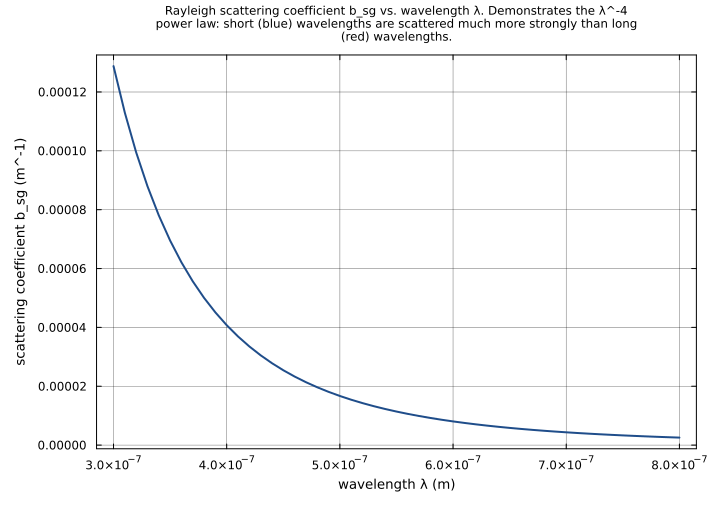
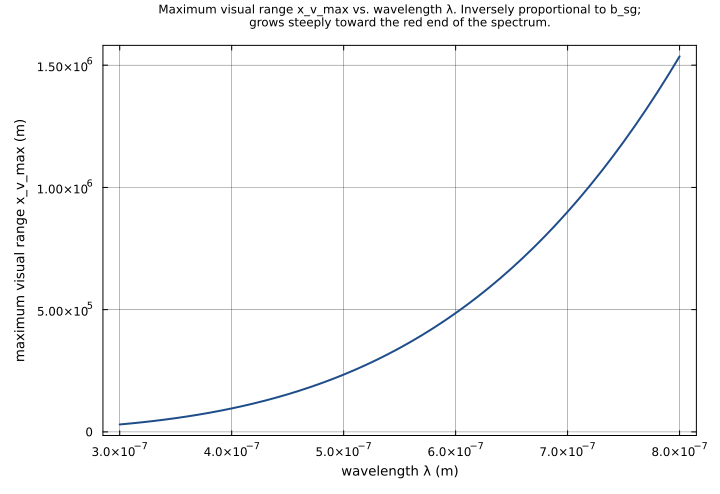
Sweep wavelength λ from 300 nm (near-UV) to 800 nm (near-IR) at reference temperature and pressure. b_sg scales as λ^-4 (Rayleigh scattering), so it drops by a factor of (8/3)^4 ≈ 20 across the visible range. x_v_max correspondingly increases from ≈ 70 km at 300 nm to ≈ 1400 km at 800 nm. The plot illustrates the physical origin of the blue sky: blue light is scattered far more strongly than red.
Time span: 0.0 → 1.0
Swept over: λ
Raw .esm
Raw .esm JSON (this component)
{
  "reference": {
    "citation": "Seinfeld, J. H. and Pandis, S. N. (2006) Atmospheric Chemistry and Physics, 2nd Edition, Chapter 15, Problem 15.1A (Rayleigh scattering coefficient b_sg) and Eq. 15.36 (maximum visual range x_v_max). Migrated from Aerosol.jl src/mie_scattering.jl `RayleighAtmosphere` (esm-8sm).",
    "notes": "source_ref: Aerosol.jl@main:src/mie_scattering.jl:329\n\nUpstream `RayleighAtmosphere` is an MTK `@component` with four `@constants` (b_sg_ref=11.4e-6 m^-1, T_ref=293.0 K, p_ref=101325.0 Pa, λ_ref=550.0e-9 m), three `@parameters` (T, p, λ), and two time-indexed `@variables` (b_sg, x_v_max). The two algebraic equations are:\n  • b_sg ~ b_sg_ref * (T_ref/T) * (p/p_ref) * (λ_ref/λ)^4     [Problem 15.1A]\n  • x_v_max ~ 3.912 / b_sg                                      [Eq. 15.36]\n\nESM representation:\n  The four constants are folded directly into the b_sg expression. T, p, and λ (renamed to `λ` in this ESM) are `parameter` variables. b_sg is a `state` variable (primary computed quantity, with its defining equation in the `equations` array). x_v_max is an `observed` variable (diagnostic quantity derived from b_sg, with its expression inline). The system is purely algebraic — no ODE integration.\n\nPhysics: Rayleigh scattering arises from molecular-scale density fluctuations. The λ^-4 dependence explains why the sky is blue (stronger scattering at short wavelengths). The b_sg formula is a semi-empirical fit valid at sea-level reference conditions, scaled linearly with p/p_ref (ideal gas: number density ∝ p at fixed T) and inversely with T (number density ∝ 1/T). The reference coefficient b_sg_ref = 11.4×10^-6 m^-1 is the Rayleigh scattering coefficient at T=293 K, p=1 atm, λ=550 nm.\n\nTopological substitution order: b_sg depends only on parameters, so it resolves first; x_v_max then depends on b_sg (now known) and is computed second. The dependency graph is acyclic — no SimulationError.\n\nTolerance rationale (model-level rel=1e-9): purely algebraic system, no ODE integration. All expressions are finite compositions of *, /, ^ in float64; round-off is ~1e-15 relative. rel=1e-9 leaves six orders of magnitude of headroom."
  },
  "tolerance": {
    "rel": 1e-09
  },
  "variables": {
    "T": {
      "type": "parameter",
      "units": "K",
      "default": 293.0,
      "description": "Atmospheric temperature. Default is the reference temperature 293 K (approximately 20°C)."
    },
    "p": {
      "type": "parameter",
      "units": "Pa",
      "default": 101325.0,
      "description": "Atmospheric pressure. Default is 1 atm (101325 Pa) at sea level."
    },
    "λ": {
      "type": "parameter",
      "units": "m",
      "default": 5.5e-07,
      "description": "Wavelength of light. Default is 550 nm (green light, near the peak of the solar spectrum)."
    },
    "b_sg": {
      "type": "unknown",
      "units": "m^-1",
      "description": "Rayleigh (gas-phase) scattering coefficient at temperature T, pressure p, and wavelength λ. Scales as λ^-4, giving the characteristic blue colour of the sky. Reference value 11.4×10^-6 m^-1 at T=293 K, p=1 atm, λ=550 nm (Seinfeld & Pandis 2006, Problem 15.1A)."
    },
    "x_v_max": {
      "type": "unknown",
      "units": "m",
      "description": "Maximum visual range in a clean Rayleigh atmosphere. Equal to 3.912/b_sg (Seinfeld & Pandis 2006, Eq. 15.36). Represents the upper bound on visibility in the absence of aerosol scattering and absorption."
    }
  },
  "equations": [
    {
      "lhs": "b_sg",
      "rhs": {
        "op": "*",
        "args": [
          1.14e-05,
          {
            "op": "/",
            "args": [
              293.0,
              "T"
            ]
          },
          {
            "op": "/",
            "args": [
              "p",
              101325.0
            ]
          },
          {
            "op": "^",
            "args": [
              {
                "op": "/",
                "args": [
                  5.5e-07,
                  "λ"
                ]
              },
              4
            ]
          }
        ]
      }
    },
    {
      "lhs": "x_v_max",
      "rhs": {
        "op": "/",
        "args": [
          3.912,
          "b_sg"
        ]
      }
    }
  ],
  "tests": [
    {
      "id": "default_conditions",
      "description": "All parameters at reference values (T=293 K, p=1 atm, λ=550 nm). All scaling ratios are exactly 1, so b_sg = b_sg_ref = 11.4×10^-6 m^-1 exactly. x_v_max = 3.912/11.4e-6 = 343157.89... m ≈ 343 km.",
      "time_span": {
        "start": 0.0,
        "end": 1.0
      },
      "assertions": [
        {
          "variable": "b_sg",
          "time": 0.0,
          "expected": 1.14e-05,
          "tolerance": {
            "rel": 1e-09
          }
        },
        {
          "variable": "x_v_max",
          "time": 0.0,
          "expected": 343157.8947368421,
          "tolerance": {
            "rel": 1e-09
          }
        },
        {
          "variable": "b_sg",
          "time": 1.0,
          "expected": 1.14e-05,
          "tolerance": {
            "rel": 1e-09
          }
        },
        {
          "variable": "x_v_max",
          "time": 1.0,
          "expected": 343157.8947368421,
          "tolerance": {
            "rel": 1e-09
          }
        }
      ]
    },
    {
      "id": "warm_atmosphere",
      "description": "Warm atmosphere: T=310 K, p=1 atm, λ=550 nm. b_sg scales as T_ref/T = 293/310, so b_sg = 11.4e-6*293/310 ≈ 1.0775e-5 m^-1. Higher temperature → lower number density → weaker scattering → longer visual range.",
      "time_span": {
        "start": 0.0,
        "end": 1.0
      },
      "parameter_overrides": {
        "T": 310.0
      },
      "assertions": [
        {
          "variable": "b_sg",
          "time": 0.0,
          "expected": 1.0774838709677418e-05,
          "tolerance": {
            "rel": 1e-09
          }
        },
        {
          "variable": "x_v_max",
          "time": 0.0,
          "expected": 363068.08,
          "tolerance": {
            "rel": 1e-06
          }
        }
      ]
    },
    {
      "id": "half_pressure",
      "description": "Half sea-level pressure: T=293 K, p=50662.5 Pa (= p_ref/2), λ=550 nm. b_sg scales linearly with p, so b_sg = 11.4e-6*0.5 = 5.7e-6 m^-1 exactly. Visual range doubles to 686315.79... m ≈ 686 km.",
      "time_span": {
        "start": 0.0,
        "end": 1.0
      },
      "parameter_overrides": {
        "p": 50662.5
      },
      "assertions": [
        {
          "variable": "b_sg",
          "time": 0.0,
          "expected": 5.7e-06,
          "tolerance": {
            "rel": 1e-09
          }
        },
        {
          "variable": "x_v_max",
          "time": 0.0,
          "expected": 686315.7894736842,
          "tolerance": {
            "rel": 1e-09
          }
        }
      ]
    },
    {
      "id": "blue_light",
      "description": "Blue light: T=293 K, p=1 atm, λ=400 nm. Rayleigh scattering scales as λ^-4; (550/400)^4 = (11/8)^4 = 14641/4096 ≈ 3.5745. b_sg ≈ 4.0749e-5 m^-1, nearly 3.6× stronger than at 550 nm. Visual range drops to ≈ 96 km — the λ^-4 dependence is the physical reason the sky is blue and the Sun appears yellow/red.",
      "time_span": {
        "start": 0.0,
        "end": 1.0
      },
      "parameter_overrides": {
        "λ": 4e-07
      },
      "assertions": [
        {
          "variable": "b_sg",
          "time": 0.0,
          "expected": 4.074887695312499e-05,
          "tolerance": {
            "rel": 1e-06
          }
        },
        {
          "variable": "x_v_max",
          "time": 0.0,
          "expected": 96002.646,
          "tolerance": {
            "rel": 1e-05
          }
        }
      ]
    }
  ],
  "analyses": [
    {
      "id": "rayleigh_wavelength_dependence",
      "description": "Sweep wavelength λ from 300 nm (near-UV) to 800 nm (near-IR) at reference temperature and pressure. b_sg scales as λ^-4 (Rayleigh scattering), so it drops by a factor of (8/3)^4 ≈ 20 across the visible range. x_v_max correspondingly increases from ≈ 70 km at 300 nm to ≈ 1400 km at 800 nm. The plot illustrates the physical origin of the blue sky: blue light is scattered far more strongly than red.",
      "initial_state": {},
      "parameters": {
        "T": 293.0,
        "p": 101325.0
      },
      "time_span": {
        "start": 0.0,
        "end": 1.0
      },
      "parameter_sweep": {
        "type": "cartesian",
        "dimensions": [
          {
            "parameter": "λ",
            "range": {
              "start": 3e-07,
              "stop": 8e-07,
              "count": 51,
              "scale": "linear"
            }
          }
        ]
      },
      "plots": [
        {
          "id": "scattering_coefficient_vs_wavelength",
          "type": "line",
          "description": "Rayleigh scattering coefficient b_sg vs. wavelength λ. Demonstrates the λ^-4 power law: short (blue) wavelengths are scattered much more strongly than long (red) wavelengths.",
          "x": {
            "variable": "λ",
            "label": "wavelength λ (m)"
          },
          "y": {
            "variable": "b_sg",
            "label": "scattering coefficient b_sg (m^-1)"
          }
        },
        {
          "id": "visual_range_vs_wavelength",
          "type": "line",
          "description": "Maximum visual range x_v_max vs. wavelength λ. Inversely proportional to b_sg; grows steeply toward the red end of the spectrum.",
          "x": {
            "variable": "λ",
            "label": "wavelength λ (m)"
          },
          "y": {
            "variable": "x_v_max",
            "label": "maximum visual range x_v_max (m)"
          }
        }
      ]
    }
  ]
}