MassTransfer
Complete transition-regime mass transfer model combining mean molecular speed, air density, mean free path, Knudsen number, Fuchs-Sutugin correction, and continuum-regime flux to produce the transition-regime corrected molar flow rate J for particle growth/evaporation across all Knudsen number regimes (Seinfeld & Pandis 2006, Chapter 12, Sections 12.1.1–12.1.4, Eqs. 12.12, 12.24, 12.31, 12.43). Migrated from Aerosol.jl src/mass_transfer.jl `MassTransfer` (esm-44h).
Description
Complete transition-regime mass transfer model combining mean molecular speed, air density, mean free path, Knudsen number, Fuchs-Sutugin correction, and continuum-regime flux to produce the transition-regime corrected molar flow rate J for particle growth/evaporation across all Knudsen number regimes (Seinfeld & Pandis 2006, Chapter 12, Sections 12.1.1–12.1.4, Eqs. 12.12, 12.24, 12.31, 12.43). Migrated from Aerosol.jl src/mass_transfer.jl MassTransfer (esm-44h).
Reference
Seinfeld, J. H. and Pandis, S. N. (2006) Atmospheric Chemistry and Physics, 2nd Edition, Chapter 12 — transition-regime mass transfer. Eq. 12.24 (mean molecular speed), Eq. 12.12 (continuum flux), Eq. 12.31 (Knudsen number), Eq. 12.43 (Fuchs-Sutugin correction). Migrated from Aerosol.jl src/mass_transfer.jl MassTransfer (esm-44h).
_source_ref: Aerosol.jl@YeW6d:src/mass_transfer.jl:319
Upstream MassTransfer is an MTK @component with 3 constants (R=8.314, k_B=1.380649e-23, N_Av=6.02214076e23), 10 parameters (T, P, M_A, M_air, μ, R_p, D_g, α, c_inf, c_s), and 7 algebraic variables (c_bar, ρ_air, λ, Kn, f_FS, J_c, J). It returns System(eqs, t; name) with no subsystems — a flat system with no couple call. The migration-tracker coupling.couple feature tag and depends_on: MeanMolecularSpeed, Knudsen, FuchsSutugin describe a conceptual relationship, not an implementation dependency; the source equations use only the component’s own parameters and constants. The component is therefore migrated as a standalone flat model, following the same rig convention as wet_deposition_flux.esm.
All 7 source @variables are purely algebraic (no time derivative appears on any left-hand side in the eqs array), so each is migrated as type: observed with an inline expression. The equations array is empty; the ESS runner evaluates observed values by direct expression substitution in topological order.
Constant folding:
- R = 8.314 J/(mol·K) — appears in ρ_air and λ. Folded as the numeric literal 8.314.
- k_B = 1.380649e-23 J/K, N_Av = 6.02214076e23 mol⁻¹ — appear only in c_bar as the product k_B·N_Av. They are NOT folded to R (8.31446261815324) because the upstream uses k_B and N_Av separately with their own values and the product k_B·N_Av ≠ R (upstream R=8.314 is slightly different from k_B·N_Av=8.31446261815324). Both constants are retained as their exact upstream literal values in the c_bar expression.
- π is inlined as the Float64 literal 3.141592653589793 (Julia
pi).
Dynamic viscosity μ is a @parameter in the upstream (default 1.81e-5 Pa·s), not a @constant, so it is migrated as a parameter.
Equation mapping (one observed expression per source equation):
- c_bar ~ sqrt(8·k_B·T·N_Av/(π·M_A)) → Eq. 12.24 — mean molecular speed of species A
- ρ_air ~ P·M_air/(R·T) → ideal gas law for air density
- λ ~ 2·μ/(ρ_air·sqrt(8·R·T/(π·M_air))) → mean free path of air (μ is viscosity, ρ_air is computed above)
- Kn ~ λ/R_p → Eq. 12.31 — Knudsen number
- f_FS ~ 0.75·α·(1+Kn)/(Kn²+Kn+0.283·Kn·α+0.75·α) → Eq. 12.43 — Fuchs-Sutugin correction
- J_c ~ 4·π·R_p·D_g·(c_inf-c_s) → Eq. 12.12 — continuum-regime molar flow rate
- J ~ f_FS·J_c → transition-regime corrected molar flow rate
Topological order of the observed chain: c_bar ← {T, M_A}; rho_air ← {P, M_air, T}; λ ← {μ, rho_air, T, M_air}; Kn ← {λ, R_p}; f_FS ← {α, Kn}; J_c ← {R_p, D_g, c_inf, c_s}; J ← {f_FS, J_c}. Note: c_bar does not feed into λ — the λ formula uses sqrt(8·R·T/(π·M_air)) for the mean speed of air molecules, not c_bar (which uses M_A for species A). These coincide when M_A = M_air (the default case) but are distinct in general. The density variable is spelled rho_air (ASCII) rather than ρ_air (Unicode) following the sibling mean_free_path.esm convention.
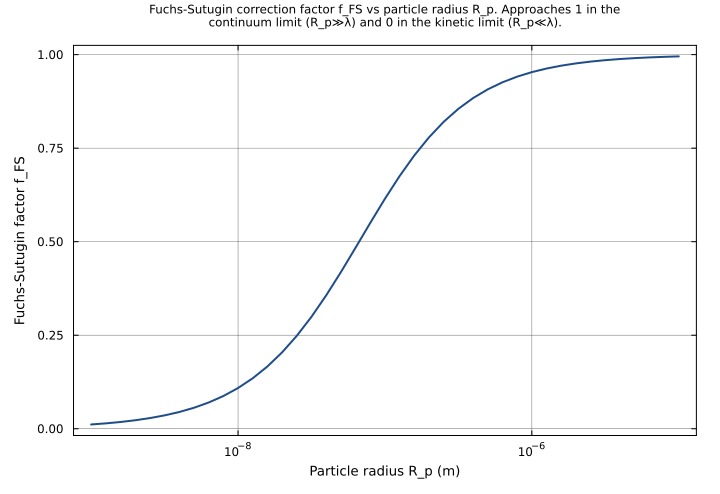
Regime notes: For Kn ≪ 1 (large particles, continuum regime), f_FS → 1 and J → J_c. For Kn ≫ 1 (small particles, kinetic regime), f_FS → 0 and J ≪ J_c. At the default R_p=100 nm, Kn ≈ 0.65 (transition regime); f_FS ≈ 0.615. At R_p=10 μm (continuum), Kn ≈ 0.0065 and f_FS ≈ 0.995. At R_p=10 nm (kinetic), Kn ≈ 6.5 and f_FS ≈ 0.109.
Tolerance rationale (model-level rel=1e-9): purely algebraic system with no ODE integration — each observed variable is evaluated by Float64 arithmetic (sqrt, *, /, +, -). Float64 round-off is ~1e-15 relative; rel=1e-9 leaves six orders of magnitude headroom, matching the sibling mean_molecular_speed.esm._
Parameters
| Name | Units | Default | Description |
|---|---|---|---|
T | K | 298.15 | Temperature of the gas. Affects mean molecular speed (∝ √T), air density (∝ 1/T), mean free path (∝ √T/ρ_air ∝ T^(3/2)/P), and Knudsen number. |
P | Pa | 101325.0 | Total air pressure. Affects air density (∝ P) and mean free path (∝ 1/P via ρ_air). |
M_A | kg/mol | 0.029 | Molar mass of the diffusing species A. Affects mean molecular speed c_bar only (∝ M_A^{-1/2}). Default 0.029 kg/mol is dry air. |
M_air | kg/mol | 0.029 | Molar mass of air. Used in the ideal-gas air density and in the mean-free-path expression for the thermal speed of air molecules. Independent of M_A. |
μ | Pa*s | 1.81e-05 | Dynamic viscosity of air. Used in the mean free path λ = 2μ/(ρ_air·c̄_air). Typical range 1.7–1.95×10⁻⁵ Pa·s over 250–350 K. |
R_p | m | 1e-07 | Particle radius. Controls the Knudsen number Kn = λ/R_p and the continuum flux J_c = 4πR_p D_g Δc. Default 100 nm is a typical accumulation-mode aerosol. |
D_g | m^2/s | 2e-05 | Gas-phase diffusivity of species A in air. Controls the continuum-regime flux J_c (∝ D_g). |
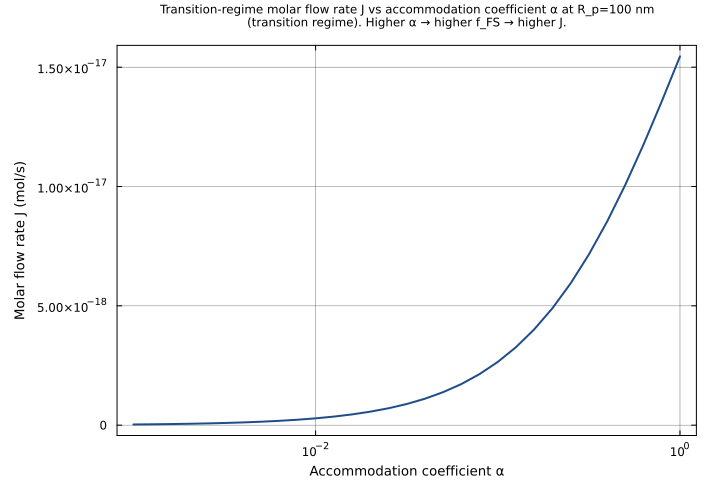
α | 1 | 1.0 | Mass accommodation (sticking) coefficient. Range (0, 1]. α=1 means every collision results in uptake; smaller α reduces the Fuchs-Sutugin correction and the transition-regime flux. |
c_inf | mol/m^3 | 1e-06 | Bulk gas-phase molar concentration of species A far from the particle. |
c_s | mol/m^3 | 0.0 | Molar concentration of species A at the particle surface. The driving force for mass transfer is c_inf - c_s. |
Observed
| Name | Units | Default | Description |
|---|---|---|---|
c_bar | m/s | Mean molecular speed of gas species A: c̄ = √(8k_B N_Av T/(π M_A)) = √(8RT/(π M_A)) using the literal k_B and N_Av values. Identical to the standalone MeanMolecularSpeed component (esm-1i9). Positive-definite for T > 0. | |
rho_air | kg/m^3 | Air density from the ideal gas law: rho_air = P·M_air/(R·T), with R=8.314 J/(mol·K) (upstream @constant value, upstream variable name ρ_air). At standard conditions (T=298.15 K, P=101325 Pa, M_air=0.029 kg/mol), rho_air ≈ 1.185 kg/m³. | |
λ | m | Mean free path of air molecules: λ = 2μ/(rho_air·c̄_air) where c̄_air = √(8RT/(π M_air)) is the mean speed of air molecules (using M_air, distinct from c_bar which uses M_A). At standard conditions, λ ≈ 65 nm. | |
Kn | 1 | Knudsen number: Kn = λ/R_p (Eq. 12.31). Kn ≪ 1 → continuum regime; Kn ≫ 1 → kinetic regime; Kn ~ 1 → transition regime. At 100 nm radius and standard conditions, Kn ≈ 0.65. | |
f_FS | 1 | Fuchs-Sutugin transition-regime correction factor (Eq. 12.43): f_FS = 0.75α(1+Kn)/(Kn²+Kn+0.283Kn·α+0.75α). In the continuum limit (Kn→0), f_FS→1. In the kinetic limit (Kn→∞), f_FS→0. At Kn=1 and α=1, f_FS≈0.494. | |
J_c | mol/s | Continuum-regime molar flow rate to a spherical particle (Eq. 12.12): J_c = 4πR_p D_g (c_inf - c_s). Positive when c_inf > c_s (net condensation). Independent of temperature and viscosity. | |
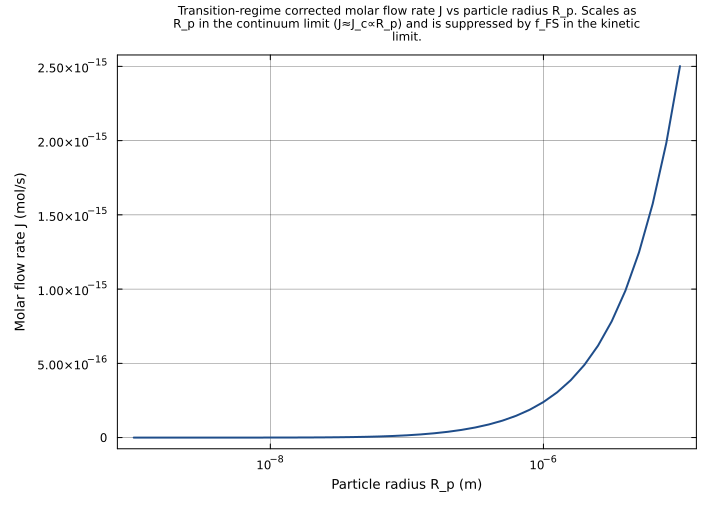
J | mol/s | Transition-regime corrected molar flow rate: J = f_FS·J_c. Equals J_c in the continuum limit (f_FS→1) and approaches 0 in the kinetic limit (f_FS→0). The physically realised flux for particle growth/evaporation across all Knudsen number regimes. |
Observed expressions
$$ c_{bar} = \sqrt{\frac{8 \cdot 1.380649 \times 10^{-23} \cdot 6.02214076 \times 10^{23} \cdot T}{3.141592653589793 \cdot M_{A}}} $$Mean molecular speed of gas species A: c̄ = √(8k_B N_Av T/(π M_A)) = √(8RT/(π M_A)) using the literal k_B and N_Av values. Identical to the standalone MeanMolecularSpeed component (esm-1i9). Positive-definite for T > 0.
$$ rho_{air} = \frac{P \cdot M_{air}}{8.314 \cdot T} $$Air density from the ideal gas law: rho_air = P·M_air/(R·T), with R=8.314 J/(mol·K) (upstream @constant value, upstream variable name ρ_air). At standard conditions (T=298.15 K, P=101325 Pa, M_air=0.029 kg/mol), rho_air ≈ 1.185 kg/m³.
$$ λ = \frac{2 \cdot μ}{rho_{air} \cdot \sqrt{\frac{8 \cdot 8.314 \cdot T}{3.141592653589793 \cdot M_{air}}}} $$Mean free path of air molecules: λ = 2μ/(rho_air·c̄_air) where c̄_air = √(8RT/(π M_air)) is the mean speed of air molecules (using M_air, distinct from c_bar which uses M_A). At standard conditions, λ ≈ 65 nm.
$$ Kn = \frac{λ}{R_{p}} $$Knudsen number: Kn = λ/R_p (Eq. 12.31). Kn ≪ 1 → continuum regime; Kn ≫ 1 → kinetic regime; Kn ~ 1 → transition regime. At 100 nm radius and standard conditions, Kn ≈ 0.65.
$$ f_{FS} = \frac{0.75 \cdot α \cdot \left(1 + Kn\right)}{Kn^{2} + Kn + 0.283 \cdot Kn \cdot α + 0.75 \cdot α} $$Fuchs-Sutugin transition-regime correction factor (Eq. 12.43): f_FS = 0.75α(1+Kn)/(Kn²+Kn+0.283Kn·α+0.75α). In the continuum limit (Kn→0), f_FS→1. In the kinetic limit (Kn→∞), f_FS→0. At Kn=1 and α=1, f_FS≈0.494.
$$ J_{c} = 4 \cdot 3.141592653589793 \cdot R_{p} \cdot D_{g} \cdot \left(c_{inf} - c_{s}\right) $$Continuum-regime molar flow rate to a spherical particle (Eq. 12.12): J_c = 4πR_p D_g (c_inf - c_s). Positive when c_inf > c_s (net condensation). Independent of temperature and viscosity.
$$ J = f_{FS} \cdot J_{c} $$Transition-regime corrected molar flow rate: J = f_FS·J_c. Equals J_c in the continuum limit (f_FS→1) and approaches 0 in the kinetic limit (f_FS→0). The physically realised flux for particle growth/evaporation across all Knudsen number regimes.
Analyses
flux_vs_particle_radius
Transition-regime corrected flux J and Fuchs-Sutugin factor f_FS as a function of particle radius R_p, swept log-spaced from 1 nm to 10 μm. Traces the crossover from the kinetic regime (Kn≫1, f_FS→0, J≪J_c) through the transition regime to the continuum regime (Kn≪1, f_FS→1, J≈J_c). The classical two-regime behaviour is captured by the Eq. 12.43 correction.
Time span: 0.0 → 1.0
Swept over: R_p
flux_vs_accommodation_coefficient
Transition-regime flux J as a function of the mass accommodation coefficient α, swept from 0.001 to 1 (log scale) at the default particle radius (100 nm, transition regime). Shows how incomplete accommodation suppresses the flux: at α=1 (perfect accommodation) J is highest; at small α the Fuchs-Sutugin factor collapses and J decreases substantially.
Time span: 0.0 → 1.0
Swept over: α
flux_over_radius_and_accommodation
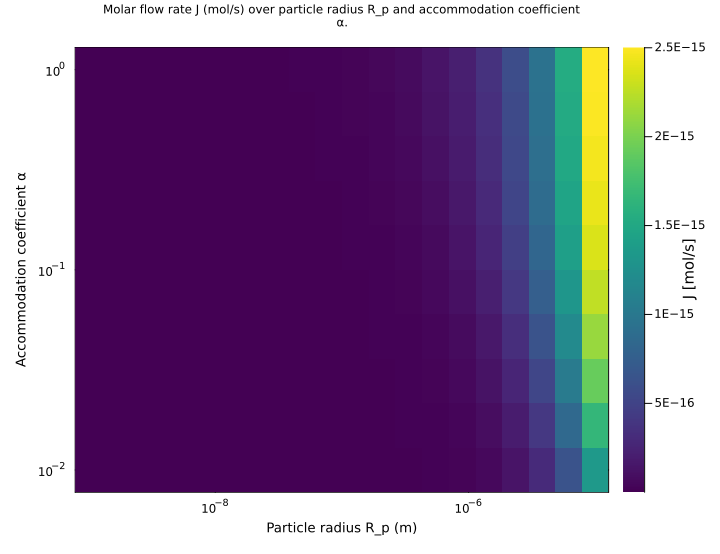
Two-dimensional sweep of the transition-regime flux J over particle radius R_p (1 nm to 10 μm, log) and accommodation coefficient α (0.01 to 1, log). Surfaces the joint dependence: the Fuchs-Sutugin regime boundary shifts with both parameters, and partial accommodation becomes increasingly important in the kinetic regime.
Time span: 0.0 → 1.0
Swept over: R_p, α
Raw .esm
Raw .esm JSON (this component)
{
"reference": {
"citation": "Seinfeld, J. H. and Pandis, S. N. (2006) Atmospheric Chemistry and Physics, 2nd Edition, Chapter 12 — transition-regime mass transfer. Eq. 12.24 (mean molecular speed), Eq. 12.12 (continuum flux), Eq. 12.31 (Knudsen number), Eq. 12.43 (Fuchs-Sutugin correction). Migrated from Aerosol.jl src/mass_transfer.jl `MassTransfer` (esm-44h).",
"notes": "source_ref: Aerosol.jl@YeW6d:src/mass_transfer.jl:319\n\nUpstream `MassTransfer` is an MTK `@component` with 3 constants (R=8.314, k_B=1.380649e-23, N_Av=6.02214076e23), 10 parameters (T, P, M_A, M_air, μ, R_p, D_g, α, c_inf, c_s), and 7 algebraic variables (c_bar, ρ_air, λ, Kn, f_FS, J_c, J). It returns `System(eqs, t; name)` with no subsystems — a flat system with no `couple` call. The migration-tracker `coupling.couple` feature tag and `depends_on: MeanMolecularSpeed, Knudsen, FuchsSutugin` describe a conceptual relationship, not an implementation dependency; the source equations use only the component's own parameters and constants. The component is therefore migrated as a standalone flat model, following the same rig convention as wet_deposition_flux.esm.\n\nAll 7 source `@variables` are purely algebraic (no time derivative appears on any left-hand side in the `eqs` array), so each is migrated as `type: observed` with an inline `expression`. The `equations` array is empty; the ESS runner evaluates observed values by direct expression substitution in topological order.\n\nConstant folding:\n- R = 8.314 J/(mol·K) — appears in ρ_air and λ. Folded as the numeric literal 8.314.\n- k_B = 1.380649e-23 J/K, N_Av = 6.02214076e23 mol⁻¹ — appear only in c_bar as the product k_B·N_Av. They are NOT folded to R (8.31446261815324) because the upstream uses k_B and N_Av separately with their own values and the product k_B·N_Av ≠ R (upstream R=8.314 is slightly different from k_B·N_Av=8.31446261815324). Both constants are retained as their exact upstream literal values in the c_bar expression.\n- π is inlined as the Float64 literal 3.141592653589793 (Julia `pi`).\n\nDynamic viscosity μ is a `@parameter` in the upstream (default 1.81e-5 Pa·s), not a `@constant`, so it is migrated as a parameter.\n\nEquation mapping (one observed expression per source equation):\n - c_bar ~ sqrt(8·k_B·T·N_Av/(π·M_A)) → Eq. 12.24 — mean molecular speed of species A\n - ρ_air ~ P·M_air/(R·T) → ideal gas law for air density\n - λ ~ 2·μ/(ρ_air·sqrt(8·R·T/(π·M_air))) → mean free path of air (μ is viscosity, ρ_air is computed above)\n - Kn ~ λ/R_p → Eq. 12.31 — Knudsen number\n - f_FS ~ 0.75·α·(1+Kn)/(Kn²+Kn+0.283·Kn·α+0.75·α) → Eq. 12.43 — Fuchs-Sutugin correction\n - J_c ~ 4·π·R_p·D_g·(c_inf-c_s) → Eq. 12.12 — continuum-regime molar flow rate\n - J ~ f_FS·J_c → transition-regime corrected molar flow rate\n\nTopological order of the observed chain: c_bar ← {T, M_A}; rho_air ← {P, M_air, T}; λ ← {μ, rho_air, T, M_air}; Kn ← {λ, R_p}; f_FS ← {α, Kn}; J_c ← {R_p, D_g, c_inf, c_s}; J ← {f_FS, J_c}. Note: c_bar does not feed into λ — the λ formula uses sqrt(8·R·T/(π·M_air)) for the mean speed of air molecules, not c_bar (which uses M_A for species A). These coincide when M_A = M_air (the default case) but are distinct in general. The density variable is spelled rho_air (ASCII) rather than ρ_air (Unicode) following the sibling mean_free_path.esm convention.\n\nRegime notes: For Kn ≪ 1 (large particles, continuum regime), f_FS → 1 and J → J_c. For Kn ≫ 1 (small particles, kinetic regime), f_FS → 0 and J ≪ J_c. At the default R_p=100 nm, Kn ≈ 0.65 (transition regime); f_FS ≈ 0.615. At R_p=10 μm (continuum), Kn ≈ 0.0065 and f_FS ≈ 0.995. At R_p=10 nm (kinetic), Kn ≈ 6.5 and f_FS ≈ 0.109.\n\nTolerance rationale (model-level rel=1e-9): purely algebraic system with no ODE integration — each observed variable is evaluated by Float64 arithmetic (sqrt, *, /, +, -). Float64 round-off is ~1e-15 relative; rel=1e-9 leaves six orders of magnitude headroom, matching the sibling mean_molecular_speed.esm."
},
"tolerance": {
"rel": 1e-09
},
"variables": {
"T": {
"type": "parameter",
"units": "K",
"default": 298.15,
"description": "Temperature of the gas. Affects mean molecular speed (∝ √T), air density (∝ 1/T), mean free path (∝ √T/ρ_air ∝ T^(3/2)/P), and Knudsen number."
},
"P": {
"type": "parameter",
"units": "Pa",
"default": 101325.0,
"description": "Total air pressure. Affects air density (∝ P) and mean free path (∝ 1/P via ρ_air)."
},
"M_A": {
"type": "parameter",
"units": "kg/mol",
"default": 0.029,
"description": "Molar mass of the diffusing species A. Affects mean molecular speed c_bar only (∝ M_A^{-1/2}). Default 0.029 kg/mol is dry air."
},
"M_air": {
"type": "parameter",
"units": "kg/mol",
"default": 0.029,
"description": "Molar mass of air. Used in the ideal-gas air density and in the mean-free-path expression for the thermal speed of air molecules. Independent of M_A."
},
"μ": {
"type": "parameter",
"units": "Pa*s",
"default": 1.81e-05,
"description": "Dynamic viscosity of air. Used in the mean free path λ = 2μ/(ρ_air·c̄_air). Typical range 1.7–1.95×10⁻⁵ Pa·s over 250–350 K."
},
"R_p": {
"type": "parameter",
"units": "m",
"default": 1e-07,
"description": "Particle radius. Controls the Knudsen number Kn = λ/R_p and the continuum flux J_c = 4πR_p D_g Δc. Default 100 nm is a typical accumulation-mode aerosol."
},
"D_g": {
"type": "parameter",
"units": "m^2/s",
"default": 2e-05,
"description": "Gas-phase diffusivity of species A in air. Controls the continuum-regime flux J_c (∝ D_g)."
},
"α": {
"type": "parameter",
"units": "1",
"default": 1.0,
"description": "Mass accommodation (sticking) coefficient. Range (0, 1]. α=1 means every collision results in uptake; smaller α reduces the Fuchs-Sutugin correction and the transition-regime flux."
},
"c_inf": {
"type": "parameter",
"units": "mol/m^3",
"default": 1e-06,
"description": "Bulk gas-phase molar concentration of species A far from the particle."
},
"c_s": {
"type": "parameter",
"units": "mol/m^3",
"default": 0.0,
"description": "Molar concentration of species A at the particle surface. The driving force for mass transfer is c_inf - c_s."
},
"c_bar": {
"type": "unknown",
"units": "m/s",
"description": "Mean molecular speed of gas species A: c̄ = √(8k_B N_Av T/(π M_A)) = √(8RT/(π M_A)) using the literal k_B and N_Av values. Identical to the standalone MeanMolecularSpeed component (esm-1i9). Positive-definite for T > 0."
},
"rho_air": {
"type": "unknown",
"units": "kg/m^3",
"description": "Air density from the ideal gas law: rho_air = P·M_air/(R·T), with R=8.314 J/(mol·K) (upstream @constant value, upstream variable name ρ_air). At standard conditions (T=298.15 K, P=101325 Pa, M_air=0.029 kg/mol), rho_air ≈ 1.185 kg/m³."
},
"λ": {
"type": "unknown",
"units": "m",
"description": "Mean free path of air molecules: λ = 2μ/(rho_air·c̄_air) where c̄_air = √(8RT/(π M_air)) is the mean speed of air molecules (using M_air, distinct from c_bar which uses M_A). At standard conditions, λ ≈ 65 nm."
},
"Kn": {
"type": "unknown",
"units": "1",
"description": "Knudsen number: Kn = λ/R_p (Eq. 12.31). Kn ≪ 1 → continuum regime; Kn ≫ 1 → kinetic regime; Kn ~ 1 → transition regime. At 100 nm radius and standard conditions, Kn ≈ 0.65."
},
"f_FS": {
"type": "unknown",
"units": "1",
"description": "Fuchs-Sutugin transition-regime correction factor (Eq. 12.43): f_FS = 0.75α(1+Kn)/(Kn²+Kn+0.283Kn·α+0.75α). In the continuum limit (Kn→0), f_FS→1. In the kinetic limit (Kn→∞), f_FS→0. At Kn=1 and α=1, f_FS≈0.494."
},
"J_c": {
"type": "unknown",
"units": "mol/s",
"description": "Continuum-regime molar flow rate to a spherical particle (Eq. 12.12): J_c = 4πR_p D_g (c_inf - c_s). Positive when c_inf > c_s (net condensation). Independent of temperature and viscosity."
},
"J": {
"type": "unknown",
"units": "mol/s",
"description": "Transition-regime corrected molar flow rate: J = f_FS·J_c. Equals J_c in the continuum limit (f_FS→1) and approaches 0 in the kinetic limit (f_FS→0). The physically realised flux for particle growth/evaporation across all Knudsen number regimes."
}
},
"equations": [
{
"lhs": "c_bar",
"rhs": {
"op": "sqrt",
"args": [
{
"op": "/",
"args": [
{
"op": "*",
"args": [
8,
1.380649e-23,
6.02214076e+23,
"T"
]
},
{
"op": "*",
"args": [
3.141592653589793,
"M_A"
]
}
]
}
]
}
},
{
"lhs": "rho_air",
"rhs": {
"op": "/",
"args": [
{
"op": "*",
"args": [
"P",
"M_air"
]
},
{
"op": "*",
"args": [
8.314,
"T"
]
}
]
}
},
{
"lhs": "λ",
"rhs": {
"op": "/",
"args": [
{
"op": "*",
"args": [
2,
"μ"
]
},
{
"op": "*",
"args": [
"rho_air",
{
"op": "sqrt",
"args": [
{
"op": "/",
"args": [
{
"op": "*",
"args": [
8,
8.314,
"T"
]
},
{
"op": "*",
"args": [
3.141592653589793,
"M_air"
]
}
]
}
]
}
]
}
]
}
},
{
"lhs": "Kn",
"rhs": {
"op": "/",
"args": [
"λ",
"R_p"
]
}
},
{
"lhs": "f_FS",
"rhs": {
"op": "/",
"args": [
{
"op": "*",
"args": [
0.75,
"α",
{
"op": "+",
"args": [
1,
"Kn"
]
}
]
},
{
"op": "+",
"args": [
{
"op": "^",
"args": [
"Kn",
2
]
},
"Kn",
{
"op": "*",
"args": [
0.283,
"Kn",
"α"
]
},
{
"op": "*",
"args": [
0.75,
"α"
]
}
]
}
]
}
},
{
"lhs": "J_c",
"rhs": {
"op": "*",
"args": [
4,
3.141592653589793,
"R_p",
"D_g",
{
"op": "-",
"args": [
"c_inf",
"c_s"
]
}
]
}
},
{
"lhs": "J",
"rhs": {
"op": "*",
"args": [
"f_FS",
"J_c"
]
}
}
],
"tests": [
{
"id": "default_parameters",
"description": "Default parameters: T=298.15 K, P=101325 Pa, M_A=M_air=0.029 kg/mol, μ=1.81e-5 Pa·s, R_p=100 nm, D_g=2e-5 m²/s, α=1, c_inf=1e-6 mol/m³, c_s=0. Kn≈0.655 — transition regime. Anchors all seven observed variables at standard atmospheric conditions.",
"time_span": {
"start": 0.0,
"end": 1.0
},
"assertions": [
{
"variable": "c_bar",
"time": 0.0,
"expected": 466.5579107928379,
"tolerance": {
"rel": 1e-09
}
},
{
"variable": "rho_air",
"time": 0.0,
"expected": 1.1854132477839954,
"tolerance": {
"rel": 1e-09
}
},
{
"variable": "λ",
"time": 0.0,
"expected": 6.545537554702463e-08,
"tolerance": {
"rel": 1e-09
}
},
{
"variable": "Kn",
"time": 0.0,
"expected": 0.6545537554702464,
"tolerance": {
"rel": 1e-09
}
},
{
"variable": "f_FS",
"time": 0.0,
"expected": 0.6148523302653344,
"tolerance": {
"rel": 1e-09
}
},
{
"variable": "J_c",
"time": 0.0,
"expected": 2.5132741228718345e-17,
"tolerance": {
"rel": 1e-09
}
},
{
"variable": "J",
"time": 0.0,
"expected": 1.5452924510433117e-17,
"tolerance": {
"rel": 1e-09
}
}
]
},
{
"id": "continuum_regime_large_particle",
"description": "Large particle R_p=10 μm: Kn=λ/R_p≈0.0065 ≪ 1 (continuum regime). Fuchs-Sutugin correction f_FS→1 and J≈J_c. Exercises the continuum limit of the correction factor. J/J_c > 0.99.",
"time_span": {
"start": 0.0,
"end": 1.0
},
"parameter_overrides": {
"R_p": 1e-05
},
"assertions": [
{
"variable": "Kn",
"time": 0.0,
"expected": 0.0065455375547024625,
"tolerance": {
"rel": 1e-09
}
},
{
"variable": "f_FS",
"time": 0.0,
"expected": 0.9953435842005406,
"tolerance": {
"rel": 1e-09
}
},
{
"variable": "J_c",
"time": 0.0,
"expected": 2.513274122871835e-15,
"tolerance": {
"rel": 1e-09
}
},
{
"variable": "J",
"time": 0.0,
"expected": 2.501571273537722e-15,
"tolerance": {
"rel": 1e-09
}
}
]
},
{
"id": "kinetic_regime_small_particle",
"description": "Small particle R_p=10 nm: Kn=λ/R_p≈6.55 ≫ 1 (kinetic regime). Fuchs-Sutugin correction f_FS≈0.109 and J≈0.109·J_c. J/J_c < 0.15 as expected for the kinetic limit.",
"time_span": {
"start": 0.0,
"end": 1.0
},
"parameter_overrides": {
"R_p": 1e-08
},
"assertions": [
{
"variable": "Kn",
"time": 0.0,
"expected": 6.545537554702463,
"tolerance": {
"rel": 1e-09
}
},
{
"variable": "f_FS",
"time": 0.0,
"expected": 0.10884664234173425,
"tolerance": {
"rel": 1e-09
}
},
{
"variable": "J_c",
"time": 0.0,
"expected": 2.5132741228718344e-18,
"tolerance": {
"rel": 1e-09
}
},
{
"variable": "J",
"time": 0.0,
"expected": 2.735614495589664e-19,
"tolerance": {
"rel": 1e-09
}
}
]
},
{
"id": "partial_accommodation",
"description": "Partial accommodation α=0.1: the Fuchs-Sutugin factor is reduced by ~83% compared to α=1 at the same Kn≈0.655 (f_FS drops from 0.615 to 0.105). Exercises the α dependence of the correction factor; J follows proportionally.",
"time_span": {
"start": 0.0,
"end": 1.0
},
"parameter_overrides": {
"α": 0.1
},
"assertions": [
{
"variable": "Kn",
"time": 0.0,
"expected": 0.6545537554702464,
"tolerance": {
"rel": 1e-09
}
},
{
"variable": "f_FS",
"time": 0.0,
"expected": 0.10547352931380244,
"tolerance": {
"rel": 1e-09
}
},
{
"variable": "J_c",
"time": 0.0,
"expected": 2.5132741228718345e-17,
"tolerance": {
"rel": 1e-09
}
},
{
"variable": "J",
"time": 0.0,
"expected": 2.6508389187234356e-18,
"tolerance": {
"rel": 1e-09
}
}
]
},
{
"id": "hot_atmosphere_350K",
"description": "High temperature T=350 K: c_bar increases as √T (≈505.5 m/s), ρ_air decreases (≈1.010 kg/m³), λ increases (≈70.9 nm), Kn rises (≈0.709), and f_FS drops slightly (≈0.593). J_c is unchanged (no T dependence). Exercises the full temperature dependence of the thermodynamic chain.",
"time_span": {
"start": 0.0,
"end": 1.0
},
"parameter_overrides": {
"T": 350.0
},
"assertions": [
{
"variable": "c_bar",
"time": 0.0,
"expected": 505.5011790653896,
"tolerance": {
"rel": 1e-09
}
},
{
"variable": "rho_air",
"time": 0.0,
"expected": 1.0098027423622806,
"tolerance": {
"rel": 1e-09
}
},
{
"variable": "λ",
"time": 0.0,
"expected": 7.091889077384121e-08,
"tolerance": {
"rel": 1e-09
}
},
{
"variable": "Kn",
"time": 0.0,
"expected": 0.7091889077384121,
"tolerance": {
"rel": 1e-09
}
},
{
"variable": "f_FS",
"time": 0.0,
"expected": 0.5926895669140232,
"tolerance": {
"rel": 1e-09
}
},
{
"variable": "J_c",
"time": 0.0,
"expected": 2.5132741228718345e-17,
"tolerance": {
"rel": 1e-09
}
},
{
"variable": "J",
"time": 0.0,
"expected": 1.4895913514211292e-17,
"tolerance": {
"rel": 1e-09
}
}
]
},
{
"id": "heavy_species_SO2",
"description": "Heavy diffusing species (M_A=0.064 kg/mol, representative of SO₂). c_bar decreases as M_A^{-1/2} (≈314.1 m/s vs 466.6 m/s for air). λ, Kn, f_FS, J_c, and J are unchanged because they depend on M_air (not M_A). Tests that c_bar varies independently of the mass-transfer chain.",
"time_span": {
"start": 0.0,
"end": 1.0
},
"parameter_overrides": {
"M_A": 0.064
},
"assertions": [
{
"variable": "c_bar",
"time": 0.0,
"expected": 314.06140521147375,
"tolerance": {
"rel": 1e-09
}
},
{
"variable": "λ",
"time": 0.0,
"expected": 6.545537554702463e-08,
"tolerance": {
"rel": 1e-09
}
},
{
"variable": "J",
"time": 0.0,
"expected": 1.5452924510433117e-17,
"tolerance": {
"rel": 1e-09
}
}
]
},
{
"id": "nonzero_surface_concentration",
"description": "Surface concentration c_s=0.5e-6 mol/m³ (half of c_inf). The continuum flux J_c = 4πR_p D_g (c_inf-c_s) is halved relative to the default (c_s=0) case, and J follows proportionally. Tests that the (c_inf-c_s) driving force is correctly captured.",
"time_span": {
"start": 0.0,
"end": 1.0
},
"parameter_overrides": {
"c_s": 5e-07
},
"assertions": [
{
"variable": "Kn",
"time": 0.0,
"expected": 0.6545537554702464,
"tolerance": {
"rel": 1e-09
}
},
{
"variable": "f_FS",
"time": 0.0,
"expected": 0.6148523302653344,
"tolerance": {
"rel": 1e-09
}
},
{
"variable": "J_c",
"time": 0.0,
"expected": 1.2566370614359173e-17,
"tolerance": {
"rel": 1e-09
}
},
{
"variable": "J",
"time": 0.0,
"expected": 7.726462255216558e-18,
"tolerance": {
"rel": 1e-09
}
}
]
}
],
"analyses": [
{
"id": "flux_vs_particle_radius",
"description": "Transition-regime corrected flux J and Fuchs-Sutugin factor f_FS as a function of particle radius R_p, swept log-spaced from 1 nm to 10 μm. Traces the crossover from the kinetic regime (Kn≫1, f_FS→0, J≪J_c) through the transition regime to the continuum regime (Kn≪1, f_FS→1, J≈J_c). The classical two-regime behaviour is captured by the Eq. 12.43 correction.",
"initial_state": {},
"parameters": {},
"time_span": {
"start": 0.0,
"end": 1.0
},
"parameter_sweep": {
"type": "cartesian",
"dimensions": [
{
"parameter": "R_p",
"range": {
"start": 1e-09,
"stop": 1e-05,
"count": 41,
"scale": "log"
}
}
]
},
"plots": [
{
"id": "fFS_vs_Rp",
"type": "line",
"description": "Fuchs-Sutugin correction factor f_FS vs particle radius R_p. Approaches 1 in the continuum limit (R_p≫λ) and 0 in the kinetic limit (R_p≪λ).",
"x": {
"variable": "R_p",
"label": "Particle radius R_p (m)"
},
"y": {
"variable": "f_FS",
"label": "Fuchs-Sutugin factor f_FS"
}
},
{
"id": "J_vs_Rp",
"type": "line",
"description": "Transition-regime corrected molar flow rate J vs particle radius R_p. Scales as R_p in the continuum limit (J≈J_c∝R_p) and is suppressed by f_FS in the kinetic limit.",
"x": {
"variable": "R_p",
"label": "Particle radius R_p (m)"
},
"y": {
"variable": "J",
"label": "Molar flow rate J (mol/s)"
}
}
]
},
{
"id": "flux_vs_accommodation_coefficient",
"description": "Transition-regime flux J as a function of the mass accommodation coefficient α, swept from 0.001 to 1 (log scale) at the default particle radius (100 nm, transition regime). Shows how incomplete accommodation suppresses the flux: at α=1 (perfect accommodation) J is highest; at small α the Fuchs-Sutugin factor collapses and J decreases substantially.",
"initial_state": {},
"parameters": {},
"time_span": {
"start": 0.0,
"end": 1.0
},
"parameter_sweep": {
"type": "cartesian",
"dimensions": [
{
"parameter": "α",
"range": {
"start": 0.001,
"stop": 1.0,
"count": 31,
"scale": "log"
}
}
]
},
"plots": [
{
"id": "J_vs_alpha",
"type": "line",
"description": "Transition-regime molar flow rate J vs accommodation coefficient α at R_p=100 nm (transition regime). Higher α → higher f_FS → higher J.",
"x": {
"variable": "α",
"label": "Accommodation coefficient α"
},
"y": {
"variable": "J",
"label": "Molar flow rate J (mol/s)"
}
}
]
},
{
"id": "flux_over_radius_and_accommodation",
"description": "Two-dimensional sweep of the transition-regime flux J over particle radius R_p (1 nm to 10 μm, log) and accommodation coefficient α (0.01 to 1, log). Surfaces the joint dependence: the Fuchs-Sutugin regime boundary shifts with both parameters, and partial accommodation becomes increasingly important in the kinetic regime.",
"initial_state": {},
"parameters": {},
"time_span": {
"start": 0.0,
"end": 1.0
},
"parameter_sweep": {
"type": "cartesian",
"dimensions": [
{
"parameter": "R_p",
"range": {
"start": 1e-09,
"stop": 1e-05,
"count": 20,
"scale": "log"
}
},
{
"parameter": "α",
"range": {
"start": 0.01,
"stop": 1.0,
"count": 10,
"scale": "log"
}
}
]
},
"plots": [
{
"id": "J_heatmap",
"type": "heatmap",
"description": "Molar flow rate J (mol/s) over particle radius R_p and accommodation coefficient α.",
"x": {
"variable": "R_p",
"label": "Particle radius R_p (m)"
},
"y": {
"variable": "α",
"label": "Accommodation coefficient α"
},
"value": {
"variable": "J",
"reduce": "final"
}
}
]
}
]
}