KnudsenNumber
Knudsen number Kn = λ/R_p — the ratio of the gas mean free path λ to the particle radius R_p. Kn determines the transport regime: Kn ≪ 1 (continuum, Fick's law applies), Kn ≫ 1 (free-molecular, kinetic theory applies), Kn ~ 1 (transition regime, interpolation formulas such as Fuchs-Sutugin required). At standard atmospheric conditions λ ≈ 65 nm; Kn ≈ 0.65 for a 100 nm particle and Kn ≈ 0.0065 for a 10 µm droplet. Migrated from Aerosol.jl src/mass_transfer.jl `KnudsenNumber`.
Description
Knudsen number Kn = λ/R_p — the ratio of the gas mean free path λ to the particle radius R_p. Kn determines the transport regime: Kn ≪ 1 (continuum, Fick’s law applies), Kn ≫ 1 (free-molecular, kinetic theory applies), Kn ~ 1 (transition regime, interpolation formulas such as Fuchs-Sutugin required). At standard atmospheric conditions λ ≈ 65 nm; Kn ≈ 0.65 for a 100 nm particle and Kn ≈ 0.0065 for a 10 µm droplet. Migrated from Aerosol.jl src/mass_transfer.jl KnudsenNumber.
Reference
Seinfeld, J. H. and Pandis, S. N. (2006) Atmospheric Chemistry and Physics, 2nd Edition, Chapter 12, Eq. 12.31 — Knudsen number Kn = λ/R_p. Migrated from Aerosol.jl src/mass_transfer.jl KnudsenNumber (esm-1wd).
_source_ref: Aerosol.jl@FWrvp:src/mass_transfer.jl:87
Upstream KnudsenNumber is an MTK @component with 2 parameters (λ, R_p) and 1 algebraic variable Kn(t) determined by one explicit equation with no time derivative — purely observed.
Equation (S&P 2006, Eq. 12.31): Kn = λ / R_p [dimensionless]
Physics: The Knudsen number is the key dimensionless parameter that controls which regime governs aerosol mass transfer: Kn ≪ 1 (continuum): particle radius ≫ mean free path; continuous-fluid equations (Fick’s law) apply; gas-phase diffusivity D_g sets the rate. Kn ≫ 1 (free-molecular): particle radius ≪ mean free path; the particle sees individual molecular collisions; kinetic theory (Maxwell flux) applies. Kn ~ 1 (transition): interpolation formulas (Fuchs-Sutugin, Dahneke) are required — see fuchs_sutugin.esm and dahneke.esm.
At standard atmospheric conditions (T = 298 K, P = 101325 Pa) the mean free path of air is λ ≈ 65–70 nm. Sub-micron aerosol particles (R_p = 0.01–0.5 µm) typically have Kn in the range 0.07–65, spanning all three regimes. Cloud/fog droplets (R_p ~ 10 µm) have Kn ≈ 0.006, firmly in the continuum regime.
Default values: λ = 6.5×10⁻⁸ m (65 nm, representative mean free path at standard conditions), R_p = 1.0×10⁻⁷ m (100 nm particle), giving Kn = 0.65 — solidly in the transition regime where Fuchs-Sutugin corrections are most important.
Tolerance rationale (model-level rel=1e-12): Kn is a single floating-point division λ/R_p. Round-off is ~1 ULP ≈ 1e-16 relative. rel=1e-12 provides four orders of magnitude of headroom above machine epsilon._
Parameters
| Name | Units | Default | Description |
|---|---|---|---|
λ | m | 6.5e-08 | Mean free path of gas molecules. At standard atmospheric conditions (T = 298 K, P = 101325 Pa), λ ≈ 65 nm for air. May be computed from MeanFreePathMassTransfer. Default 6.5×10⁻⁸ m. |
R_p | m | 1e-07 | Particle radius. Sub-micron aerosol spans R_p ≈ 10 nm–500 nm; cloud droplets are R_p ≈ 1–20 µm. Default 1.0×10⁻⁷ m (100 nm), placing Kn = 0.65 in the transition regime. |
Observed
| Name | Units | Default | Description |
|---|---|---|---|
Kn | 1 | Knudsen number Kn = λ/R_p (Eq. 12.31). Dimensionless. Kn ≪ 1: continuum regime; Kn ≫ 1: free-molecular regime; Kn ~ 1: transition regime requiring interpolation correction factors. |
Observed expressions
$$ Kn = \frac{λ}{R_{p}} $$Knudsen number Kn = λ/R_p (Eq. 12.31). Dimensionless. Kn ≪ 1: continuum regime; Kn ≫ 1: free-molecular regime; Kn ~ 1: transition regime requiring interpolation correction factors.
Analyses
Kn_vs_Rp
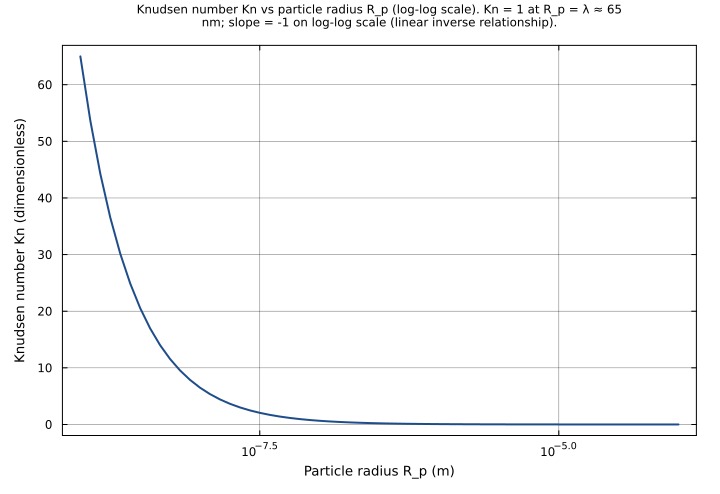
Knudsen number as a function of particle radius R_p (log-spaced from 1 nm to 100 µm) at λ = 6.5×10⁻⁸ m (standard atmospheric conditions). Kn decreases from ~65 (free-molecular) for nanoparticles through the transition regime (0.1 < Kn < 10, roughly 6.5 nm–650 nm) to the continuum limit (Kn < 0.01) for particles larger than ~6.5 µm.
Time span: 0.0 → 1.0
Swept over: R_p
Raw .esm
Raw .esm JSON (this component)
{
  "reference": {
    "citation": "Seinfeld, J. H. and Pandis, S. N. (2006) Atmospheric Chemistry and Physics, 2nd Edition, Chapter 12, Eq. 12.31 — Knudsen number Kn = λ/R_p. Migrated from Aerosol.jl src/mass_transfer.jl `KnudsenNumber` (esm-1wd).",
    "notes": "source_ref: Aerosol.jl@FWrvp:src/mass_transfer.jl:87\n\nUpstream `KnudsenNumber` is an MTK `@component` with 2 parameters (λ, R_p) and 1 algebraic variable Kn(t) determined by one explicit equation with no time derivative — purely observed.\n\nEquation (S&P 2006, Eq. 12.31):\n  Kn = λ / R_p   [dimensionless]\n\nPhysics: The Knudsen number is the key dimensionless parameter that controls which regime governs aerosol mass transfer:\n  Kn ≪ 1 (continuum): particle radius ≫ mean free path; continuous-fluid equations (Fick's law) apply; gas-phase diffusivity D_g sets the rate.\n  Kn ≫ 1 (free-molecular): particle radius ≪ mean free path; the particle sees individual molecular collisions; kinetic theory (Maxwell flux) applies.\n  Kn ~ 1 (transition): interpolation formulas (Fuchs-Sutugin, Dahneke) are required — see fuchs_sutugin.esm and dahneke.esm.\n\nAt standard atmospheric conditions (T = 298 K, P = 101325 Pa) the mean free path of air is λ ≈ 65–70 nm. Sub-micron aerosol particles (R_p = 0.01–0.5 µm) typically have Kn in the range 0.07–65, spanning all three regimes. Cloud/fog droplets (R_p ~ 10 µm) have Kn ≈ 0.006, firmly in the continuum regime.\n\nDefault values: λ = 6.5×10⁻⁸ m (65 nm, representative mean free path at standard conditions), R_p = 1.0×10⁻⁷ m (100 nm particle), giving Kn = 0.65 — solidly in the transition regime where Fuchs-Sutugin corrections are most important.\n\nTolerance rationale (model-level rel=1e-12): Kn is a single floating-point division λ/R_p. Round-off is ~1 ULP ≈ 1e-16 relative. rel=1e-12 provides four orders of magnitude of headroom above machine epsilon."
  },
  "tolerance": {
    "rel": 1e-12
  },
  "variables": {
    "λ": {
      "type": "parameter",
      "units": "m",
      "default": 6.5e-08,
      "description": "Mean free path of gas molecules. At standard atmospheric conditions (T = 298 K, P = 101325 Pa), λ ≈ 65 nm for air. May be computed from MeanFreePathMassTransfer. Default 6.5×10⁻⁸ m."
    },
    "R_p": {
      "type": "parameter",
      "units": "m",
      "default": 1e-07,
      "description": "Particle radius. Sub-micron aerosol spans R_p ≈ 10 nm–500 nm; cloud droplets are R_p ≈ 1–20 µm. Default 1.0×10⁻⁷ m (100 nm), placing Kn = 0.65 in the transition regime."
    },
    "Kn": {
      "type": "unknown",
      "units": "1",
      "description": "Knudsen number Kn = λ/R_p (Eq. 12.31). Dimensionless. Kn ≪ 1: continuum regime; Kn ≫ 1: free-molecular regime; Kn ~ 1: transition regime requiring interpolation correction factors."
    }
  },
  "equations": [
    {
      "lhs": "Kn",
      "rhs": {
        "op": "/",
        "args": [
          "λ",
          "R_p"
        ]
      }
    }
  ],
  "tests": [
    {
      "id": "default_conditions",
      "description": "Default parameters: λ=6.5e-8 m, R_p=1.0e-7 m. Kn = 6.5e-8/1.0e-7 = 0.65. Represents a 100 nm aerosol particle at standard conditions — solidly in the transition regime.",
      "time_span": {
        "start": 0.0,
        "end": 1.0
      },
      "assertions": [
        {
          "variable": "Kn",
          "time": 0.0,
          "expected": 0.65,
          "tolerance": {
            "rel": 1e-12
          }
        }
      ]
    },
    {
      "id": "continuum_regime",
      "description": "Large particle: λ=6.5e-8 m, R_p=1.0e-5 m. Kn = 0.0065 ≪ 1. Represents a 10 µm cloud droplet where the continuum approximation is valid and gas-phase diffusion governs.",
      "time_span": {
        "start": 0.0,
        "end": 1.0
      },
      "parameter_overrides": {
        "R_p": 1e-05
      },
      "assertions": [
        {
          "variable": "Kn",
          "time": 0.0,
          "expected": 0.0065,
          "tolerance": {
            "rel": 1e-12
          }
        }
      ]
    },
    {
      "id": "free_molecular_regime",
      "description": "Ultrafine particle: λ=6.5e-8 m, R_p=6.5e-10 m (0.65 nm). Kn = 100.0 ≫ 1. Deep free-molecular regime where kinetic theory applies. Verifies large Kn handled correctly.",
      "time_span": {
        "start": 0.0,
        "end": 1.0
      },
      "parameter_overrides": {
        "R_p": 6.5e-10
      },
      "assertions": [
        {
          "variable": "Kn",
          "time": 0.0,
          "expected": 100.0,
          "tolerance": {
            "rel": 1e-12
          }
        }
      ]
    },
    {
      "id": "transition_unity",
      "description": "Kn = 1: λ=1.0e-7 m, R_p=1.0e-7 m. Kn = 1.0 exactly — the nominal boundary between regimes. Transition-regime corrections are largest near Kn = 1.",
      "time_span": {
        "start": 0.0,
        "end": 1.0
      },
      "parameter_overrides": {
        "λ": 1e-07,
        "R_p": 1e-07
      },
      "assertions": [
        {
          "variable": "Kn",
          "time": 0.0,
          "expected": 1.0,
          "tolerance": {
            "rel": 1e-12
          }
        }
      ]
    },
    {
      "id": "elevated_mean_free_path",
      "description": "Larger mean free path: λ=1.3e-7 m (doubled), R_p=1.0e-7 m. Kn = 1.3. Exercises λ variation, as occurs at lower pressure (higher altitude) where λ ∝ 1/P increases.",
      "time_span": {
        "start": 0.0,
        "end": 1.0
      },
      "parameter_overrides": {
        "λ": 1.3e-07
      },
      "assertions": [
        {
          "variable": "Kn",
          "time": 0.0,
          "expected": 1.3,
          "tolerance": {
            "rel": 1e-12
          }
        }
      ]
    }
  ],
  "analyses": [
    {
      "id": "Kn_vs_Rp",
      "description": "Knudsen number as a function of particle radius R_p (log-spaced from 1 nm to 100 µm) at λ = 6.5×10⁻⁸ m (standard atmospheric conditions). Kn decreases from ~65 (free-molecular) for nanoparticles through the transition regime (0.1 < Kn < 10, roughly 6.5 nm–650 nm) to the continuum limit (Kn < 0.01) for particles larger than ~6.5 µm.",
      "initial_state": {},
      "parameters": {},
      "time_span": {
        "start": 0.0,
        "end": 1.0
      },
      "parameter_sweep": {
        "type": "cartesian",
        "dimensions": [
          {
            "parameter": "R_p",
            "range": {
              "start": 1e-09,
              "stop": 0.0001,
              "count": 61,
              "scale": "log"
            }
          }
        ]
      },
      "plots": [
        {
          "id": "Kn_vs_Rp_plot",
          "type": "line",
          "description": "Knudsen number Kn vs particle radius R_p (log-log scale). Kn = 1 at R_p = λ ≈ 65 nm; slope = -1 on log-log scale (linear inverse relationship).",
          "x": {
            "variable": "R_p",
            "label": "Particle radius R_p (m)"
          },
          "y": {
            "variable": "Kn",
            "label": "Knudsen number Kn (dimensionless)"
          }
        }
      ]
    }
  ]
}