BrownianCoagulationCoefficient
Brownian coagulation coefficient K_12 for two particles using the Fuchs interpolation formula (Seinfeld & Pandis 2006, Table 13.1). Valid across the continuum, transition, and free-molecular regimes. Computes Knudsen numbers, Cunningham slip corrections, Brownian diffusion coefficients, mean thermal velocities, particle mean free paths, and the Fuchs interpolation parameters g_1, g_2 as intermediate observed variables before assembling K_12. Migrated from Aerosol.jl src/dynamics.jl:75.
Description
Brownian coagulation coefficient K_12 for two particles using the Fuchs interpolation formula (Seinfeld & Pandis 2006, Table 13.1). Valid across the continuum, transition, and free-molecular regimes. Computes Knudsen numbers, Cunningham slip corrections, Brownian diffusion coefficients, mean thermal velocities, particle mean free paths, and the Fuchs interpolation parameters g_1, g_2 as intermediate observed variables before assembling K_12. Migrated from Aerosol.jl src/dynamics.jl:75.
Reference
Seinfeld, J. H. and Pandis, S. N. (2006) Atmospheric Chemistry and Physics, 2nd Edition, Chapter 13, Table 13.1 and Eq. 13.47 — Brownian coagulation coefficient K_12 via the Fuchs interpolation formula. Migrated from Aerosol.jl src/dynamics.jl:75 @ commit c8c640bb636b22f2425460e9ed5cba50793bfee1 (esm-wlo).
_source_ref: Aerosol.jl@c8c640bb:src/dynamics.jl:75
Upstream BrownianCoagulationCoefficient is an MTK @component with 2 constants (k_B=1.380649e-23 J/K, π_val=3.14159265358979), 6 parameters (T, μ, ρ_p, λ_air, D_p1, D_p2), and 14 algebraic variables determined by explicit equations with no time derivative — all purely observed.
Constants k_B and π_val are folded as floating-point literals into the expression trees. π/6 = 0.5235987755982988 is folded into m_1 and m_2.
Equation chain (S&P 2006, Table 13.1 and Eq. 13.47): m_i = ρ_p · (π/6) · D_pi³ [particle mass] Kn_i = 2 λ_air / D_pi [Knudsen number] C_ci = 1 + Kn_i (1.257 + 0.4 exp(-1.1/Kn_i)) [Cunningham slip correction] D_i = k_B T C_ci / (3 π μ D_pi) [diffusion coefficient, Eq. 13.47] c_bar_i = √(8 k_B T / (π m_i)) [mean thermal velocity] l_i = 8 D_i / (π c_bar_i) [particle mean free path] g_i = [(D_pi + l_i)³ - (D_pi² + l_i²)^(3/2)] / (3 D_pi l_i) - D_pi [Fuchs parameter] K_12 = 2π(D_1+D_2)(D_p1+D_p2) / [den1 + den2] [coagulation coefficient] den1 = (D_p1+D_p2) / (D_p1+D_p2 + 2√(g_1²+g_2²)) den2 = 8(D_1+D_2) / (√(c_bar_1²+c_bar_2²) · (D_p1+D_p2))
All 14 variables are algebraic — the system has no state variables and no ODEs. The variable name l_1/l_2 corresponds to ℓ_1/ℓ_2 in the upstream Julia source (ASCII substitution to avoid Unicode in JSON keys).
Topological evaluation order: m_i → Kn_i → C_ci → D_i → c_bar_i → l_i → g_i → K_12. The dependency graph is acyclic.
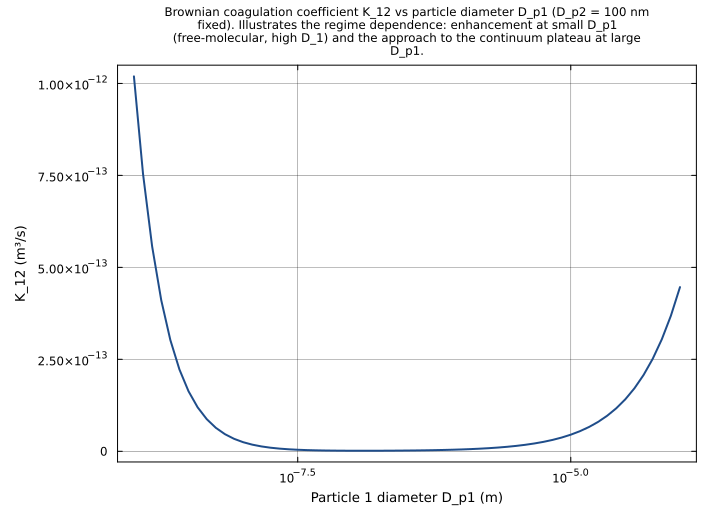
Physics: The Fuchs formula interpolates between the continuum limit (Kn ≪ 1, K → 8kT/3μ for equal sizes, Eq. 13.52) and the free-molecular limit (Kn ≫ 1, K ∝ √T/m). The minimum of K_12 lies in the transition regime (~0.1–1 µm at standard conditions).
Tolerance rationale (model-level rel=1e-9): purely algebraic system. All expressions are finite compositions of *, /, ^, exp, sqrt in float64. Round-off is ~1e-15 relative. rel=1e-9 leaves six orders of magnitude of headroom above machine epsilon._
Parameters
| Name | Units | Default | Description |
|---|---|---|---|
T | K | 298.0 | Temperature. Default 298 K (≈ 25 °C), standard atmospheric. |
μ | Pa*s | 1.83e-05 | Dynamic viscosity of air. Default 1.83×10⁻⁵ Pa·s at 298 K. |
ρ_p | kg/m^3 | 1000.0 | Particle density. Default 1000 kg/m³ (liquid water / ammonium sulfate). |
λ_air | m | 6.86e-08 | Mean free path of air molecules. Default 6.86×10⁻⁸ m at 298 K, 1 atm. |
D_p1 | m | 1e-07 | Diameter of particle 1. Default 100 nm — transition-regime aerosol. |
D_p2 | m | 1e-07 | Diameter of particle 2. Default 100 nm — transition-regime aerosol. |
Observed
| Name | Units | Default | Description |
|---|---|---|---|
m_1 | kg | Mass of particle 1: m_1 = ρ_p (π/6) D_p1³. Derived from diameter assuming a sphere. | |
m_2 | kg | Mass of particle 2: m_2 = ρ_p (π/6) D_p2³. Derived from diameter assuming a sphere. | |
Kn_1 | 1 | Knudsen number for particle 1: Kn_1 = 2λ_air/D_p1. Kn ≪ 1: continuum; Kn ≫ 1: free-molecular; Kn ~ 1: transition. | |
Kn_2 | 1 | Knudsen number for particle 2: Kn_2 = 2λ_air/D_p2. | |
C_c1 | 1 | Cunningham slip correction factor for particle 1: C_c1 = 1 + Kn_1(1.257 + 0.4 exp(−1.1/Kn_1)). Dimensionless correction for non-continuum effects; C_c1 → 1 for large particles (Kn → 0) and grows for small particles (Kn → ∞). | |
C_c2 | 1 | Cunningham slip correction factor for particle 2: C_c2 = 1 + Kn_2(1.257 + 0.4 exp(−1.1/Kn_2)). | |
D_1 | m^2/s | Brownian diffusion coefficient of particle 1 (Eq. 13.47): D_1 = k_B T C_c1 / (3π μ D_p1). k_B = 1.380649×10⁻²³ J/K folded as literal. | |
D_2 | m^2/s | Brownian diffusion coefficient of particle 2 (Eq. 13.47): D_2 = k_B T C_c2 / (3π μ D_p2). | |
c_bar_1 | m/s | Mean thermal velocity of particle 1 (Table 13.1): c_bar_1 = √(8 k_B T / (π m_1)). k_B = 1.380649×10⁻²³ J/K folded as literal. | |
c_bar_2 | m/s | Mean thermal velocity of particle 2 (Table 13.1): c_bar_2 = √(8 k_B T / (π m_2)). | |
l_1 | m | Particle mean free path of particle 1 (Table 13.1, ℓ_1 in source): l_1 = 8 D_1 / (π c_bar_1). | |
l_2 | m | Particle mean free path of particle 2 (Table 13.1, ℓ_2 in source): l_2 = 8 D_2 / (π c_bar_2). | |
g_1 | m | Fuchs interpolation parameter for particle 1 (Table 13.1): g_1 = [(D_p1+l_1)³ − (D_p1²+l_1²)^(3/2)] / (3 D_p1 l_1) − D_p1. Smoothly connects diffusive and kinetic regimes. | |
g_2 | m | Fuchs interpolation parameter for particle 2 (Table 13.1): g_2 = [(D_p2+l_2)³ − (D_p2²+l_2²)^(3/2)] / (3 D_p2 l_2) − D_p2. | |
K_12 | m^3/s | Brownian coagulation coefficient (Table 13.1, Fuchs form): K_12 = 2π(D_1+D_2)(D_p1+D_p2) / [(D_p1+D_p2)/(D_p1+D_p2+2√(g_1²+g_2²)) + 8(D_1+D_2)/(√(c_bar_1²+c_bar_2²)(D_p1+D_p2))]. Units m³/s; rate of formation of doublets per collision pair concentration [m⁻⁶]. |
Observed expressions
$$ m_{1} = ρ_{p} \cdot 0.5235987755982988 \cdot D_{p1}^{3} $$Mass of particle 1: m_1 = ρ_p (π/6) D_p1³. Derived from diameter assuming a sphere.
$$ m_{2} = ρ_{p} \cdot 0.5235987755982988 \cdot D_{p2}^{3} $$Mass of particle 2: m_2 = ρ_p (π/6) D_p2³. Derived from diameter assuming a sphere.
$$ Kn_{1} = \frac{2 \cdot λ_{air}}{D_{p1}} $$Knudsen number for particle 1: Kn_1 = 2λ_air/D_p1. Kn ≪ 1: continuum; Kn ≫ 1: free-molecular; Kn ~ 1: transition.
$$ Kn_{2} = \frac{2 \cdot λ_{air}}{D_{p2}} $$Knudsen number for particle 2: Kn_2 = 2λ_air/D_p2.
$$ C_{c1} = 1 + Kn_{1} \cdot \left(1.257 + 0.4 \cdot e^{\frac{-1.1}{Kn_{1}}}\right) $$Cunningham slip correction factor for particle 1: C_c1 = 1 + Kn_1(1.257 + 0.4 exp(−1.1/Kn_1)). Dimensionless correction for non-continuum effects; C_c1 → 1 for large particles (Kn → 0) and grows for small particles (Kn → ∞).
$$ C_{c2} = 1 + Kn_{2} \cdot \left(1.257 + 0.4 \cdot e^{\frac{-1.1}{Kn_{2}}}\right) $$Cunningham slip correction factor for particle 2: C_c2 = 1 + Kn_2(1.257 + 0.4 exp(−1.1/Kn_2)).
$$ D_{1} = \frac{1.380649 \times 10^{-23} \cdot T \cdot C_{c1}}{3 \cdot 3.14159265358979 \cdot μ \cdot D_{p1}} $$Brownian diffusion coefficient of particle 1 (Eq. 13.47): D_1 = k_B T C_c1 / (3π μ D_p1). k_B = 1.380649×10⁻²³ J/K folded as literal.
$$ D_{2} = \frac{1.380649 \times 10^{-23} \cdot T \cdot C_{c2}}{3 \cdot 3.14159265358979 \cdot μ \cdot D_{p2}} $$Brownian diffusion coefficient of particle 2 (Eq. 13.47): D_2 = k_B T C_c2 / (3π μ D_p2).
$$ c_{bar\,1} = \sqrt{\frac{8 \cdot 1.380649 \times 10^{-23} \cdot T}{3.14159265358979 \cdot m_{1}}} $$Mean thermal velocity of particle 1 (Table 13.1): c_bar_1 = √(8 k_B T / (π m_1)). k_B = 1.380649×10⁻²³ J/K folded as literal.
$$ c_{bar\,2} = \sqrt{\frac{8 \cdot 1.380649 \times 10^{-23} \cdot T}{3.14159265358979 \cdot m_{2}}} $$Mean thermal velocity of particle 2 (Table 13.1): c_bar_2 = √(8 k_B T / (π m_2)).
$$ l_{1} = \frac{8 \cdot D_{1}}{3.14159265358979 \cdot c_{bar\,1}} $$Particle mean free path of particle 1 (Table 13.1, ℓ_1 in source): l_1 = 8 D_1 / (π c_bar_1).
$$ l_{2} = \frac{8 \cdot D_{2}}{3.14159265358979 \cdot c_{bar\,2}} $$Particle mean free path of particle 2 (Table 13.1, ℓ_2 in source): l_2 = 8 D_2 / (π c_bar_2).
$$ g_{1} = \frac{1}{3 \cdot D_{p1} \cdot l_{1}} \cdot \left(\left(D_{p1} + l_{1}\right)^{3} - \left(D_{p1}^{2} + l_{1}^{2}\right)^{1.5}\right) - D_{p1} $$Fuchs interpolation parameter for particle 1 (Table 13.1): g_1 = [(D_p1+l_1)³ − (D_p1²+l_1²)^(3/2)] / (3 D_p1 l_1) − D_p1. Smoothly connects diffusive and kinetic regimes.
$$ g_{2} = \frac{1}{3 \cdot D_{p2} \cdot l_{2}} \cdot \left(\left(D_{p2} + l_{2}\right)^{3} - \left(D_{p2}^{2} + l_{2}^{2}\right)^{1.5}\right) - D_{p2} $$Fuchs interpolation parameter for particle 2 (Table 13.1): g_2 = [(D_p2+l_2)³ − (D_p2²+l_2²)^(3/2)] / (3 D_p2 l_2) − D_p2.
$$ K_{12} = \frac{2 \cdot 3.14159265358979 \cdot \left(D_{1} + D_{2}\right) \cdot \left(D_{p1} + D_{p2}\right)}{\frac{D_{p1} + D_{p2}}{D_{p1} + D_{p2} + 2 \cdot \sqrt{g_{1}^{2} + g_{2}^{2}}} + \frac{8 \cdot \left(D_{1} + D_{2}\right)}{\sqrt{c_{bar\,1}^{2} + c_{bar\,2}^{2}} \cdot \left(D_{p1} + D_{p2}\right)}} $$Brownian coagulation coefficient (Table 13.1, Fuchs form): K_12 = 2π(D_1+D_2)(D_p1+D_p2) / [(D_p1+D_p2)/(D_p1+D_p2+2√(g_1²+g_2²)) + 8(D_1+D_2)/(√(c_bar_1²+c_bar_2²)(D_p1+D_p2))]. Units m³/s; rate of formation of doublets per collision pair concentration [m⁻⁶].
Analyses
K12_vs_particle_diameter
K_12 as a function of particle 1 diameter D_p1 (log sweep 1 nm to 100 µm) with D_p2 fixed at 100 nm. Shows the three transport regimes: free-molecular (D_p1 ≪ λ_air, K_12 large), transition, and continuum (D_p1 ≫ λ_air, K_12 approaches a plateau). The enhancement of K_12 for very small or very large D_p1 relative to D_p2=100 nm demonstrates the size-differential coagulation effect of Table 13.1.
Time span: 0.0 → 1.0
Swept over: D_p1
K12_vs_temperature
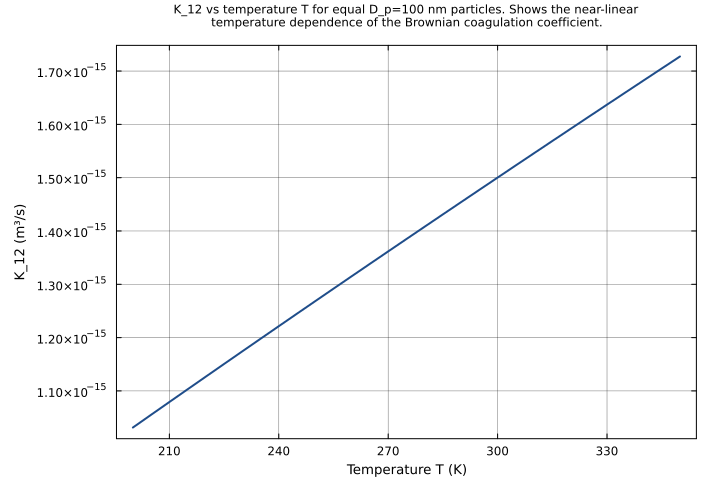
K_12 as a function of temperature T from 200 K to 350 K (linear sweep) for equal 100 nm particles. K_12 increases approximately linearly with T because D_i ∝ T (Eq. 13.47) dominates the weak √T dependence of c_bar. Relevant to cloud-resolving models where particle dynamics vary across the tropospheric temperature range.
Time span: 0.0 → 1.0
Swept over: T
Raw .esm
Raw .esm JSON (this component)
{
"reference": {
"citation": "Seinfeld, J. H. and Pandis, S. N. (2006) Atmospheric Chemistry and Physics, 2nd Edition, Chapter 13, Table 13.1 and Eq. 13.47 — Brownian coagulation coefficient K_12 via the Fuchs interpolation formula. Migrated from Aerosol.jl src/dynamics.jl:75 @ commit c8c640bb636b22f2425460e9ed5cba50793bfee1 (esm-wlo).",
"notes": "source_ref: Aerosol.jl@c8c640bb:src/dynamics.jl:75\n\nUpstream BrownianCoagulationCoefficient is an MTK @component with 2 constants (k_B=1.380649e-23 J/K, π_val=3.14159265358979), 6 parameters (T, μ, ρ_p, λ_air, D_p1, D_p2), and 14 algebraic variables determined by explicit equations with no time derivative — all purely observed.\n\nConstants k_B and π_val are folded as floating-point literals into the expression trees. π/6 = 0.5235987755982988 is folded into m_1 and m_2.\n\nEquation chain (S&P 2006, Table 13.1 and Eq. 13.47):\n m_i = ρ_p · (π/6) · D_pi³ [particle mass]\n Kn_i = 2 λ_air / D_pi [Knudsen number]\n C_ci = 1 + Kn_i (1.257 + 0.4 exp(-1.1/Kn_i)) [Cunningham slip correction]\n D_i = k_B T C_ci / (3 π μ D_pi) [diffusion coefficient, Eq. 13.47]\n c_bar_i = √(8 k_B T / (π m_i)) [mean thermal velocity]\n l_i = 8 D_i / (π c_bar_i) [particle mean free path]\n g_i = [(D_pi + l_i)³ - (D_pi² + l_i²)^(3/2)] / (3 D_pi l_i) - D_pi [Fuchs parameter]\n K_12 = 2π(D_1+D_2)(D_p1+D_p2) / [den1 + den2] [coagulation coefficient]\n den1 = (D_p1+D_p2) / (D_p1+D_p2 + 2√(g_1²+g_2²))\n den2 = 8(D_1+D_2) / (√(c_bar_1²+c_bar_2²) · (D_p1+D_p2))\n\nAll 14 variables are algebraic — the system has no state variables and no ODEs. The variable name l_1/l_2 corresponds to ℓ_1/ℓ_2 in the upstream Julia source (ASCII substitution to avoid Unicode in JSON keys).\n\nTopological evaluation order: m_i → Kn_i → C_ci → D_i → c_bar_i → l_i → g_i → K_12. The dependency graph is acyclic.\n\nPhysics: The Fuchs formula interpolates between the continuum limit (Kn ≪ 1, K → 8kT/3μ for equal sizes, Eq. 13.52) and the free-molecular limit (Kn ≫ 1, K ∝ √T/m). The minimum of K_12 lies in the transition regime (~0.1–1 µm at standard conditions).\n\nTolerance rationale (model-level rel=1e-9): purely algebraic system. All expressions are finite compositions of *, /, ^, exp, sqrt in float64. Round-off is ~1e-15 relative. rel=1e-9 leaves six orders of magnitude of headroom above machine epsilon."
},
"tolerance": {
"rel": 1e-09
},
"variables": {
"T": {
"type": "parameter",
"units": "K",
"default": 298.0,
"description": "Temperature. Default 298 K (≈ 25 °C), standard atmospheric."
},
"μ": {
"type": "parameter",
"units": "Pa*s",
"default": 1.83e-05,
"description": "Dynamic viscosity of air. Default 1.83×10⁻⁵ Pa·s at 298 K."
},
"ρ_p": {
"type": "parameter",
"units": "kg/m^3",
"default": 1000.0,
"description": "Particle density. Default 1000 kg/m³ (liquid water / ammonium sulfate)."
},
"λ_air": {
"type": "parameter",
"units": "m",
"default": 6.86e-08,
"description": "Mean free path of air molecules. Default 6.86×10⁻⁸ m at 298 K, 1 atm."
},
"D_p1": {
"type": "parameter",
"units": "m",
"default": 1e-07,
"description": "Diameter of particle 1. Default 100 nm — transition-regime aerosol."
},
"D_p2": {
"type": "parameter",
"units": "m",
"default": 1e-07,
"description": "Diameter of particle 2. Default 100 nm — transition-regime aerosol."
},
"m_1": {
"type": "unknown",
"units": "kg",
"description": "Mass of particle 1: m_1 = ρ_p (π/6) D_p1³. Derived from diameter assuming a sphere."
},
"m_2": {
"type": "unknown",
"units": "kg",
"description": "Mass of particle 2: m_2 = ρ_p (π/6) D_p2³. Derived from diameter assuming a sphere."
},
"Kn_1": {
"type": "unknown",
"units": "1",
"description": "Knudsen number for particle 1: Kn_1 = 2λ_air/D_p1. Kn ≪ 1: continuum; Kn ≫ 1: free-molecular; Kn ~ 1: transition."
},
"Kn_2": {
"type": "unknown",
"units": "1",
"description": "Knudsen number for particle 2: Kn_2 = 2λ_air/D_p2."
},
"C_c1": {
"type": "unknown",
"units": "1",
"description": "Cunningham slip correction factor for particle 1: C_c1 = 1 + Kn_1(1.257 + 0.4 exp(−1.1/Kn_1)). Dimensionless correction for non-continuum effects; C_c1 → 1 for large particles (Kn → 0) and grows for small particles (Kn → ∞)."
},
"C_c2": {
"type": "unknown",
"units": "1",
"description": "Cunningham slip correction factor for particle 2: C_c2 = 1 + Kn_2(1.257 + 0.4 exp(−1.1/Kn_2))."
},
"D_1": {
"type": "unknown",
"units": "m^2/s",
"description": "Brownian diffusion coefficient of particle 1 (Eq. 13.47): D_1 = k_B T C_c1 / (3π μ D_p1). k_B = 1.380649×10⁻²³ J/K folded as literal."
},
"D_2": {
"type": "unknown",
"units": "m^2/s",
"description": "Brownian diffusion coefficient of particle 2 (Eq. 13.47): D_2 = k_B T C_c2 / (3π μ D_p2)."
},
"c_bar_1": {
"type": "unknown",
"units": "m/s",
"description": "Mean thermal velocity of particle 1 (Table 13.1): c_bar_1 = √(8 k_B T / (π m_1)). k_B = 1.380649×10⁻²³ J/K folded as literal."
},
"c_bar_2": {
"type": "unknown",
"units": "m/s",
"description": "Mean thermal velocity of particle 2 (Table 13.1): c_bar_2 = √(8 k_B T / (π m_2))."
},
"l_1": {
"type": "unknown",
"units": "m",
"description": "Particle mean free path of particle 1 (Table 13.1, ℓ_1 in source): l_1 = 8 D_1 / (π c_bar_1)."
},
"l_2": {
"type": "unknown",
"units": "m",
"description": "Particle mean free path of particle 2 (Table 13.1, ℓ_2 in source): l_2 = 8 D_2 / (π c_bar_2)."
},
"g_1": {
"type": "unknown",
"units": "m",
"description": "Fuchs interpolation parameter for particle 1 (Table 13.1): g_1 = [(D_p1+l_1)³ − (D_p1²+l_1²)^(3/2)] / (3 D_p1 l_1) − D_p1. Smoothly connects diffusive and kinetic regimes."
},
"g_2": {
"type": "unknown",
"units": "m",
"description": "Fuchs interpolation parameter for particle 2 (Table 13.1): g_2 = [(D_p2+l_2)³ − (D_p2²+l_2²)^(3/2)] / (3 D_p2 l_2) − D_p2."
},
"K_12": {
"type": "unknown",
"units": "m^3/s",
"description": "Brownian coagulation coefficient (Table 13.1, Fuchs form): K_12 = 2π(D_1+D_2)(D_p1+D_p2) / [(D_p1+D_p2)/(D_p1+D_p2+2√(g_1²+g_2²)) + 8(D_1+D_2)/(√(c_bar_1²+c_bar_2²)(D_p1+D_p2))]. Units m³/s; rate of formation of doublets per collision pair concentration [m⁻⁶]."
}
},
"equations": [
{
"lhs": "m_1",
"rhs": {
"op": "*",
"args": [
"ρ_p",
0.5235987755982988,
{
"op": "^",
"args": [
"D_p1",
3
]
}
]
}
},
{
"lhs": "m_2",
"rhs": {
"op": "*",
"args": [
"ρ_p",
0.5235987755982988,
{
"op": "^",
"args": [
"D_p2",
3
]
}
]
}
},
{
"lhs": "Kn_1",
"rhs": {
"op": "/",
"args": [
{
"op": "*",
"args": [
2,
"λ_air"
]
},
"D_p1"
]
}
},
{
"lhs": "Kn_2",
"rhs": {
"op": "/",
"args": [
{
"op": "*",
"args": [
2,
"λ_air"
]
},
"D_p2"
]
}
},
{
"lhs": "C_c1",
"rhs": {
"op": "+",
"args": [
1,
{
"op": "*",
"args": [
"Kn_1",
{
"op": "+",
"args": [
1.257,
{
"op": "*",
"args": [
0.4,
{
"op": "exp",
"args": [
{
"op": "/",
"args": [
-1.1,
"Kn_1"
]
}
]
}
]
}
]
}
]
}
]
}
},
{
"lhs": "C_c2",
"rhs": {
"op": "+",
"args": [
1,
{
"op": "*",
"args": [
"Kn_2",
{
"op": "+",
"args": [
1.257,
{
"op": "*",
"args": [
0.4,
{
"op": "exp",
"args": [
{
"op": "/",
"args": [
-1.1,
"Kn_2"
]
}
]
}
]
}
]
}
]
}
]
}
},
{
"lhs": "D_1",
"rhs": {
"op": "/",
"args": [
{
"op": "*",
"args": [
1.380649e-23,
"T",
"C_c1"
]
},
{
"op": "*",
"args": [
3,
3.14159265358979,
"μ",
"D_p1"
]
}
]
}
},
{
"lhs": "D_2",
"rhs": {
"op": "/",
"args": [
{
"op": "*",
"args": [
1.380649e-23,
"T",
"C_c2"
]
},
{
"op": "*",
"args": [
3,
3.14159265358979,
"μ",
"D_p2"
]
}
]
}
},
{
"lhs": "c_bar_1",
"rhs": {
"op": "sqrt",
"args": [
{
"op": "/",
"args": [
{
"op": "*",
"args": [
8,
1.380649e-23,
"T"
]
},
{
"op": "*",
"args": [
3.14159265358979,
"m_1"
]
}
]
}
]
}
},
{
"lhs": "c_bar_2",
"rhs": {
"op": "sqrt",
"args": [
{
"op": "/",
"args": [
{
"op": "*",
"args": [
8,
1.380649e-23,
"T"
]
},
{
"op": "*",
"args": [
3.14159265358979,
"m_2"
]
}
]
}
]
}
},
{
"lhs": "l_1",
"rhs": {
"op": "/",
"args": [
{
"op": "*",
"args": [
8,
"D_1"
]
},
{
"op": "*",
"args": [
3.14159265358979,
"c_bar_1"
]
}
]
}
},
{
"lhs": "l_2",
"rhs": {
"op": "/",
"args": [
{
"op": "*",
"args": [
8,
"D_2"
]
},
{
"op": "*",
"args": [
3.14159265358979,
"c_bar_2"
]
}
]
}
},
{
"lhs": "g_1",
"rhs": {
"op": "-",
"args": [
{
"op": "*",
"args": [
{
"op": "/",
"args": [
1,
{
"op": "*",
"args": [
3,
"D_p1",
"l_1"
]
}
]
},
{
"op": "-",
"args": [
{
"op": "^",
"args": [
{
"op": "+",
"args": [
"D_p1",
"l_1"
]
},
3
]
},
{
"op": "^",
"args": [
{
"op": "+",
"args": [
{
"op": "^",
"args": [
"D_p1",
2
]
},
{
"op": "^",
"args": [
"l_1",
2
]
}
]
},
1.5
]
}
]
}
]
},
"D_p1"
]
}
},
{
"lhs": "g_2",
"rhs": {
"op": "-",
"args": [
{
"op": "*",
"args": [
{
"op": "/",
"args": [
1,
{
"op": "*",
"args": [
3,
"D_p2",
"l_2"
]
}
]
},
{
"op": "-",
"args": [
{
"op": "^",
"args": [
{
"op": "+",
"args": [
"D_p2",
"l_2"
]
},
3
]
},
{
"op": "^",
"args": [
{
"op": "+",
"args": [
{
"op": "^",
"args": [
"D_p2",
2
]
},
{
"op": "^",
"args": [
"l_2",
2
]
}
]
},
1.5
]
}
]
}
]
},
"D_p2"
]
}
},
{
"lhs": "K_12",
"rhs": {
"op": "/",
"args": [
{
"op": "*",
"args": [
2,
3.14159265358979,
{
"op": "+",
"args": [
"D_1",
"D_2"
]
},
{
"op": "+",
"args": [
"D_p1",
"D_p2"
]
}
]
},
{
"op": "+",
"args": [
{
"op": "/",
"args": [
{
"op": "+",
"args": [
"D_p1",
"D_p2"
]
},
{
"op": "+",
"args": [
{
"op": "+",
"args": [
"D_p1",
"D_p2"
]
},
{
"op": "*",
"args": [
2,
{
"op": "sqrt",
"args": [
{
"op": "+",
"args": [
{
"op": "^",
"args": [
"g_1",
2
]
},
{
"op": "^",
"args": [
"g_2",
2
]
}
]
}
]
}
]
}
]
}
]
},
{
"op": "/",
"args": [
{
"op": "*",
"args": [
8,
{
"op": "+",
"args": [
"D_1",
"D_2"
]
}
]
},
{
"op": "*",
"args": [
{
"op": "sqrt",
"args": [
{
"op": "+",
"args": [
{
"op": "^",
"args": [
"c_bar_1",
2
]
},
{
"op": "^",
"args": [
"c_bar_2",
2
]
}
]
}
]
},
{
"op": "+",
"args": [
"D_p1",
"D_p2"
]
}
]
}
]
}
]
}
]
}
}
],
"tests": [
{
"id": "default_conditions",
"description": "Default parameters: T=298 K, μ=1.83×10⁻⁵ Pa·s, ρ_p=1000 kg/m³, λ_air=6.86×10⁻⁸ m, D_p1=D_p2=100 nm. Both particles are identical in the transition regime (Kn=1.372). Checks the full chain: Kn, C_c, D, c_bar, l, g, K_12. K_12 = 1.491×10⁻¹⁵ m³/s (Table 13.1 benchmark).",
"time_span": {
"start": 0.0,
"end": 1.0
},
"assertions": [
{
"variable": "Kn_1",
"time": 0.0,
"expected": 1.372,
"tolerance": {
"rel": 1e-12
}
},
{
"variable": "Kn_2",
"time": 0.0,
"expected": 1.372,
"tolerance": {
"rel": 1e-12
}
},
{
"variable": "C_c1",
"time": 0.0,
"expected": 2.970764756761217,
"tolerance": {
"rel": 1e-09
}
},
{
"variable": "C_c2",
"time": 0.0,
"expected": 2.970764756761217,
"tolerance": {
"rel": 1e-09
}
},
{
"variable": "m_1",
"time": 0.0,
"expected": 5.235987755982983e-19,
"tolerance": {
"rel": 1e-09
}
},
{
"variable": "D_1",
"time": 0.0,
"expected": 7.08672520203204e-10,
"tolerance": {
"rel": 1e-09
}
},
{
"variable": "c_bar_1",
"time": 0.0,
"expected": 0.1414557218874665,
"tolerance": {
"rel": 1e-09
}
},
{
"variable": "l_1",
"time": 0.0,
"expected": 1.275748856179422e-08,
"tolerance": {
"rel": 1e-09
}
},
{
"variable": "g_1",
"time": 0.0,
"expected": 6.895371895082644e-09,
"tolerance": {
"rel": 1e-09
}
},
{
"variable": "K_12",
"time": 0.0,
"expected": 1.491012954151819e-15,
"tolerance": {
"rel": 1e-09
}
}
]
},
{
"id": "continuum_limit",
"description": "Large particles D_p1=D_p2=10 µm: Kn = 2×6.86e-8/10e-6 = 0.01372 ≪ 1, firmly in the continuum regime. K_12 should approach the continuum limit 8kT/(3μ) = 5.995×10⁻¹⁶ m³/s (Eq. 13.52) to within ~2% (slip-correction deviation at Kn=0.014). K_12 = 6.059×10⁻¹⁶; ratio to K_continuum = 1.011.",
"time_span": {
"start": 0.0,
"end": 1.0
},
"parameter_overrides": {
"D_p1": 1e-05,
"D_p2": 1e-05
},
"assertions": [
{
"variable": "K_12",
"time": 0.0,
"expected": 6.058699993308035e-16,
"tolerance": {
"rel": 1e-09
}
}
]
},
{
"id": "equal_size_1um",
"description": "Equal particles D_p1=D_p2=1 µm: transition-to-continuum regime (Kn = 0.137). K_12 = 6.864×10⁻¹⁶ m³/s. This is the benchmark for the size-dependence test: K_12 at unequal sizes must exceed this value.",
"time_span": {
"start": 0.0,
"end": 1.0
},
"parameter_overrides": {
"D_p1": 1e-06,
"D_p2": 1e-06
},
"assertions": [
{
"variable": "K_12",
"time": 0.0,
"expected": 6.863899942138817e-16,
"tolerance": {
"rel": 1e-09
}
}
]
},
{
"id": "unequal_sizes_coag_enhancement",
"description": "Unequal particles D_p1=0.1 µm, D_p2=1 µm: K_12 = 4.997×10⁻¹⁵ m³/s — 7.3× larger than the equal-1-µm case. Physically, the small particle has a much larger D_i and c_bar_i, so it collides far more often with the large particle than two 1-µm particles collide with each other. Confirms the size-dependence physics of Table 13.1.",
"time_span": {
"start": 0.0,
"end": 1.0
},
"parameter_overrides": {
"D_p1": 1e-07,
"D_p2": 1e-06
},
"assertions": [
{
"variable": "K_12",
"time": 0.0,
"expected": 4.996599756674888e-15,
"tolerance": {
"rel": 1e-09
}
}
]
},
{
"id": "temperature_sensitivity",
"description": "Elevated temperature T=350 K with default D_p=100 nm: K_12 = 1.727×10⁻¹⁵ m³/s — 15.8% higher than the 298 K default. K_12 ∝ T (D_i ∝ T, c_bar ∝ √T, the T dominates the denominator Fuchs correction). Exercises the T wiring across the full chain.",
"time_span": {
"start": 0.0,
"end": 1.0
},
"parameter_overrides": {
"T": 350.0
},
"assertions": [
{
"variable": "D_1",
"time": 0.0,
"expected": 8.323334968829579e-10,
"tolerance": {
"rel": 1e-09
}
},
{
"variable": "K_12",
"time": 0.0,
"expected": 1.727344394759691e-15,
"tolerance": {
"rel": 1e-09
}
}
]
}
],
"analyses": [
{
"id": "K12_vs_particle_diameter",
"description": "K_12 as a function of particle 1 diameter D_p1 (log sweep 1 nm to 100 µm) with D_p2 fixed at 100 nm. Shows the three transport regimes: free-molecular (D_p1 ≪ λ_air, K_12 large), transition, and continuum (D_p1 ≫ λ_air, K_12 approaches a plateau). The enhancement of K_12 for very small or very large D_p1 relative to D_p2=100 nm demonstrates the size-differential coagulation effect of Table 13.1.",
"initial_state": {},
"parameters": {},
"time_span": {
"start": 0.0,
"end": 1.0
},
"parameter_sweep": {
"type": "cartesian",
"dimensions": [
{
"parameter": "D_p1",
"range": {
"start": 1e-09,
"stop": 0.0001,
"count": 61,
"scale": "log"
}
}
]
},
"plots": [
{
"id": "K12_vs_Dp1",
"type": "line",
"description": "Brownian coagulation coefficient K_12 vs particle diameter D_p1 (D_p2 = 100 nm fixed). Illustrates the regime dependence: enhancement at small D_p1 (free-molecular, high D_1) and the approach to the continuum plateau at large D_p1.",
"x": {
"variable": "D_p1",
"label": "Particle 1 diameter D_p1 (m)"
},
"y": {
"variable": "K_12",
"label": "K_12 (m³/s)"
}
}
]
},
{
"id": "K12_vs_temperature",
"description": "K_12 as a function of temperature T from 200 K to 350 K (linear sweep) for equal 100 nm particles. K_12 increases approximately linearly with T because D_i ∝ T (Eq. 13.47) dominates the weak √T dependence of c_bar. Relevant to cloud-resolving models where particle dynamics vary across the tropospheric temperature range.",
"initial_state": {},
"parameters": {},
"time_span": {
"start": 0.0,
"end": 1.0
},
"parameter_sweep": {
"type": "cartesian",
"dimensions": [
{
"parameter": "T",
"range": {
"start": 200.0,
"stop": 350.0,
"count": 31,
"scale": "linear"
}
}
]
},
"plots": [
{
"id": "K12_vs_T",
"type": "line",
"description": "K_12 vs temperature T for equal D_p=100 nm particles. Shows the near-linear temperature dependence of the Brownian coagulation coefficient.",
"x": {
"variable": "T",
"label": "Temperature T (K)"
},
"y": {
"variable": "K_12",
"label": "K_12 (m³/s)"
}
}
]
}
]
}