DahnekeMassTransportCorrection
Correction factor β for diffusional mass transport to a sphere, valid across all Knudsen numbers from the continuum to the free-molecular regime (Dahneke 1983, Eq. 5.5). Computes the mean thermal velocity c̄, diffusional mean-free-path ℓ_D, diffusion Knudsen number Kn_D, and the correction factor β = (Kn_D+1)/(2Kn_D(Kn_D+1)/δ_m+1) as purely algebraic observed variables. Migrated from Aerosol.jl src/dahneke_brownian_diffusion.jl:33.
Description
Correction factor β for diffusional mass transport to a sphere, valid across all Knudsen numbers from the continuum to the free-molecular regime (Dahneke 1983, Eq. 5.5). Computes the mean thermal velocity c̄, diffusional mean-free-path ℓ_D, diffusion Knudsen number Kn_D, and the correction factor β = (Kn_D+1)/(2Kn_D(Kn_D+1)/δ_m+1) as purely algebraic observed variables. Migrated from Aerosol.jl src/dahneke_brownian_diffusion.jl:33.
Reference
Dahneke, B. (1983) Simple Kinetic Theory of Brownian Diffusion in Vapors and Aerosols, in Theory of Dispersed Multiphase Flow, Academic Press, pp. 97–133. Eqs. 3.6, 5.5, 6.2. Migrated from Aerosol.jl src/dahneke_brownian_diffusion.jl:33 @ c8c640bb (esm-xn1).
_source_ref: Aerosol.jl@c8c640bb:src/dahneke_brownian_diffusion.jl:33
Upstream DahnekeMassTransportCorrection is an MTK @component with 1 constant (k_B=1.380649e-23 J/K), 5 parameters (T, D_v, m_v, r, δ_m), and 4 algebraic variables determined by explicit equations with no time derivative — all purely observed.
Constant k_B is folded as the floating-point literal 1.380649e-23, and π is folded as 3.14159265358979.
Equation chain: c_bar = sqrt(8 k_B T / (π m_v)) [mean thermal velocity, Eq. 6.2] ℓ_D = 2 D_v / c_bar [diffusional mean-free-path, Eq. 3.6] Kn_D = ℓ_D / r [diffusion Knudsen number] β = (Kn_D+1) / (2 Kn_D(Kn_D+1)/δ_m + 1) [mass transport correction, Eq. 5.5]
Limiting cases: Kn_D → 0: β → 1 (continuum limit, Maxwell’s result) Kn_D → ∞: β → δ_m c̄ r / (4 D_v) (free-molecular limit)
The correction factor β relates the actual transport rate I to the continuum result I_M: I = β I_M = β (4π r D_v (n_∞ - n_s))
Topological evaluation order: T, m_v → c_bar → ℓ_D → Kn_D → β. The dependency graph is acyclic.
Tolerance rationale (model-level rel=1e-9): purely algebraic system with sqrt, *, /, and + in float64. Round-off is ~1e-15 relative; rel=1e-9 leaves six orders of headroom above machine epsilon._
Parameters
| Name | Units | Default | Description |
|---|---|---|---|
T | K | 298.15 | Temperature. Default 298.15 K (25 °C), standard atmospheric. |
D_v | m^2/s | 2e-05 | Diffusion coefficient of vapor molecules. Default 2×10⁻⁵ m²/s (water vapor in air near 298 K). |
m_v | kg | 4.81e-26 | Mass of diffusing vapor molecule. Default 4.81×10⁻²⁶ kg (water molecule, M=18 g/mol). |
r | m | 1e-07 | Sphere (droplet/particle) radius. Default 100 nm — transition-regime aerosol. |
δ_m | 1 | 1.0 | Condensation-evaporation (sticking) coefficient. Dimensionless; range (0, 1]. Default 1.0 (perfect accommodation). Smaller δ_m reduces β, reflecting partial reflection of vapor molecules at the particle surface. |
Observed
| Name | Units | Default | Description |
|---|---|---|---|
c_bar | m/s | Mean thermal velocity of vapor molecules (Eq. 6.2): c̄ = sqrt(8 k_B T / (π m_v)). k_B = 1.380649×10⁻²³ J/K and π = 3.14159265358979 folded as literals. | |
ℓ_D | m | Diffusional mean-free-path of vapor molecules (Eq. 3.6): ℓ_D = 2 D_v / c̄. Characterises the length scale below which diffusive transport becomes ballistic. | |
Kn_D | 1 | Diffusion Knudsen number: Kn_D = ℓ_D / r. Dimensionless; Kn_D ≪ 1 means continuum diffusion dominates (β → 1); Kn_D ≫ 1 means free-molecular transport (β → δ_m c̄ r / (4 D_v)). | |
β | 1 | Mass transport correction factor (Eq. 5.5): β = (Kn_D+1) / (2 Kn_D(Kn_D+1)/δ_m + 1). Dimensionless; β = 1 in the continuum limit and β → δ_m c̄ r / (4 D_v) in the free-molecular limit. Multiplies the Maxwell (continuum) rate I_M to give the actual rate I = β I_M. |
Observed expressions
$$ c_{bar} = \sqrt{\frac{8 \cdot 1.380649 \times 10^{-23} \cdot T}{3.14159265358979 \cdot m_{v}}} $$Mean thermal velocity of vapor molecules (Eq. 6.2): c̄ = sqrt(8 k_B T / (π m_v)). k_B = 1.380649×10⁻²³ J/K and π = 3.14159265358979 folded as literals.
$$ ℓ_{D} = \frac{2 \cdot D_{v}}{c_{bar}} $$Diffusional mean-free-path of vapor molecules (Eq. 3.6): ℓ_D = 2 D_v / c̄. Characterises the length scale below which diffusive transport becomes ballistic.
$$ Kn_{D} = \frac{ℓ_{D}}{r} $$Diffusion Knudsen number: Kn_D = ℓ_D / r. Dimensionless; Kn_D ≪ 1 means continuum diffusion dominates (β → 1); Kn_D ≫ 1 means free-molecular transport (β → δ_m c̄ r / (4 D_v)).
$$ β = \frac{Kn_{D} + 1}{1 + \frac{2 \cdot Kn_{D} \cdot \left(Kn_{D} + 1\right)}{δ_{m}}} $$Mass transport correction factor (Eq. 5.5): β = (Kn_D+1) / (2 Kn_D(Kn_D+1)/δ_m + 1). Dimensionless; β = 1 in the continuum limit and β → δ_m c̄ r / (4 D_v) in the free-molecular limit. Multiplies the Maxwell (continuum) rate I_M to give the actual rate I = β I_M.
Analyses
beta_vs_radius
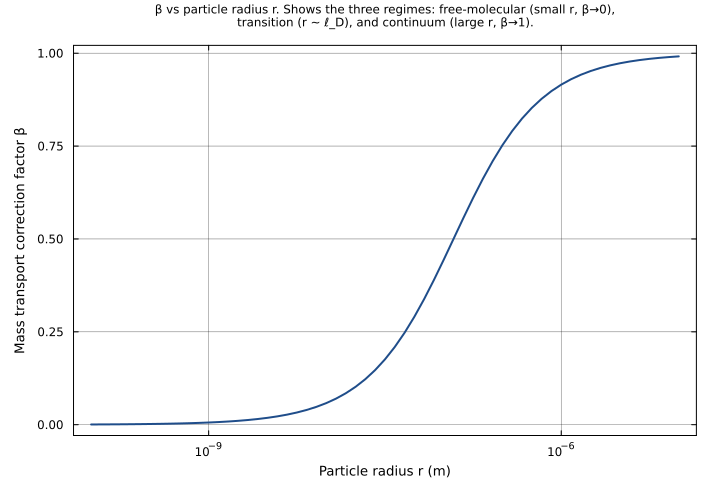
Correction factor β as a function of particle radius r (log sweep 0.1 nm to 10 µm) at T=298 K, D_v=2e-5 m²/s, m_v=4.81e-26 kg, δ_m=1. Shows the transition from the continuum limit (β→1 for large r) to the free-molecular limit (β→0 for small r), with the transition regime near r ~ ℓ_D ≈ 86 nm.
Time span: 0.0 → 1.0
Swept over: r
beta_vs_delta_m
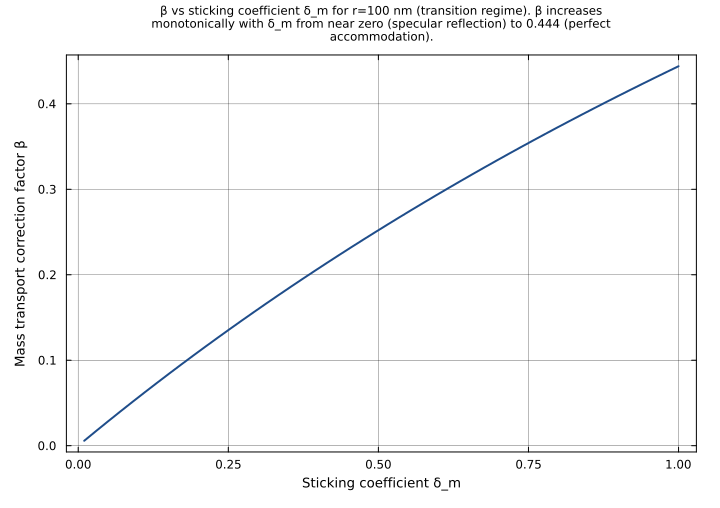
Correction factor β as a function of sticking coefficient δ_m (linear sweep 0.01 to 1.0) at default r=100 nm. Illustrates how partial accommodation (δ_m < 1) suppresses β in the transition regime, with β → 0 as δ_m → 0 (no accommodation).
Time span: 0.0 → 1.0
Swept over: δ_m
Raw .esm
Raw .esm JSON (this component)
{
  "reference": {
    "citation": "Dahneke, B. (1983) Simple Kinetic Theory of Brownian Diffusion in Vapors and Aerosols, in Theory of Dispersed Multiphase Flow, Academic Press, pp. 97–133. Eqs. 3.6, 5.5, 6.2. Migrated from Aerosol.jl src/dahneke_brownian_diffusion.jl:33 @ c8c640bb (esm-xn1).",
    "notes": "source_ref: Aerosol.jl@c8c640bb:src/dahneke_brownian_diffusion.jl:33\n\nUpstream DahnekeMassTransportCorrection is an MTK @component with 1 constant (k_B=1.380649e-23 J/K), 5 parameters (T, D_v, m_v, r, δ_m), and 4 algebraic variables determined by explicit equations with no time derivative — all purely observed.\n\nConstant k_B is folded as the floating-point literal 1.380649e-23, and π is folded as 3.14159265358979.\n\nEquation chain:\n  c_bar = sqrt(8 k_B T / (π m_v))              [mean thermal velocity, Eq. 6.2]\n  ℓ_D   = 2 D_v / c_bar                         [diffusional mean-free-path, Eq. 3.6]\n  Kn_D  = ℓ_D / r                               [diffusion Knudsen number]\n  β     = (Kn_D+1) / (2 Kn_D(Kn_D+1)/δ_m + 1) [mass transport correction, Eq. 5.5]\n\nLimiting cases:\n  Kn_D → 0: β → 1  (continuum limit, Maxwell's result)\n  Kn_D → ∞: β → δ_m c̄ r / (4 D_v)  (free-molecular limit)\n\nThe correction factor β relates the actual transport rate I to the continuum result I_M:\n  I = β I_M = β (4π r D_v (n_∞ - n_s))\n\nTopological evaluation order: T, m_v → c_bar → ℓ_D → Kn_D → β. The dependency graph is acyclic.\n\nTolerance rationale (model-level rel=1e-9): purely algebraic system with sqrt, *, /, and + in float64. Round-off is ~1e-15 relative; rel=1e-9 leaves six orders of headroom above machine epsilon."
  },
  "tolerance": {
    "rel": 1e-09
  },
  "variables": {
    "T": {
      "type": "parameter",
      "units": "K",
      "default": 298.15,
      "description": "Temperature. Default 298.15 K (25 °C), standard atmospheric."
    },
    "D_v": {
      "type": "parameter",
      "units": "m^2/s",
      "default": 2e-05,
      "description": "Diffusion coefficient of vapor molecules. Default 2×10⁻⁵ m²/s (water vapor in air near 298 K)."
    },
    "m_v": {
      "type": "parameter",
      "units": "kg",
      "default": 4.81e-26,
      "description": "Mass of diffusing vapor molecule. Default 4.81×10⁻²⁶ kg (water molecule, M=18 g/mol)."
    },
    "r": {
      "type": "parameter",
      "units": "m",
      "default": 1e-07,
      "description": "Sphere (droplet/particle) radius. Default 100 nm — transition-regime aerosol."
    },
    "δ_m": {
      "type": "parameter",
      "units": "1",
      "default": 1.0,
      "description": "Condensation-evaporation (sticking) coefficient. Dimensionless; range (0, 1]. Default 1.0 (perfect accommodation). Smaller δ_m reduces β, reflecting partial reflection of vapor molecules at the particle surface."
    },
    "c_bar": {
      "type": "unknown",
      "units": "m/s",
      "description": "Mean thermal velocity of vapor molecules (Eq. 6.2): c̄ = sqrt(8 k_B T / (π m_v)). k_B = 1.380649×10⁻²³ J/K and π = 3.14159265358979 folded as literals."
    },
    "ℓ_D": {
      "type": "unknown",
      "units": "m",
      "description": "Diffusional mean-free-path of vapor molecules (Eq. 3.6): ℓ_D = 2 D_v / c̄. Characterises the length scale below which diffusive transport becomes ballistic."
    },
    "Kn_D": {
      "type": "unknown",
      "units": "1",
      "description": "Diffusion Knudsen number: Kn_D = ℓ_D / r. Dimensionless; Kn_D ≪ 1 means continuum diffusion dominates (β → 1); Kn_D ≫ 1 means free-molecular transport (β → δ_m c̄ r / (4 D_v))."
    },
    "β": {
      "type": "unknown",
      "units": "1",
      "description": "Mass transport correction factor (Eq. 5.5): β = (Kn_D+1) / (2 Kn_D(Kn_D+1)/δ_m + 1). Dimensionless; β = 1 in the continuum limit and β → δ_m c̄ r / (4 D_v) in the free-molecular limit. Multiplies the Maxwell (continuum) rate I_M to give the actual rate I = β I_M."
    }
  },
  "equations": [
    {
      "lhs": "c_bar",
      "rhs": {
        "op": "sqrt",
        "args": [
          {
            "op": "/",
            "args": [
              {
                "op": "*",
                "args": [
                  8,
                  1.380649e-23,
                  "T"
                ]
              },
              {
                "op": "*",
                "args": [
                  3.14159265358979,
                  "m_v"
                ]
              }
            ]
          }
        ]
      }
    },
    {
      "lhs": "ℓ_D",
      "rhs": {
        "op": "/",
        "args": [
          {
            "op": "*",
            "args": [
              2,
              "D_v"
            ]
          },
          "c_bar"
        ]
      }
    },
    {
      "lhs": "Kn_D",
      "rhs": {
        "op": "/",
        "args": [
          "ℓ_D",
          "r"
        ]
      }
    },
    {
      "lhs": "β",
      "rhs": {
        "op": "/",
        "args": [
          {
            "op": "+",
            "args": [
              "Kn_D",
              1
            ]
          },
          {
            "op": "+",
            "args": [
              1,
              {
                "op": "/",
                "args": [
                  {
                    "op": "*",
                    "args": [
                      2,
                      "Kn_D",
                      {
                        "op": "+",
                        "args": [
                          "Kn_D",
                          1
                        ]
                      }
                    ]
                  },
                  "δ_m"
                ]
              }
            ]
          }
        ]
      }
    }
  ],
  "tests": [
    {
      "id": "default_conditions",
      "description": "Default parameters: T=298.15 K, D_v=2e-5 m²/s, m_v=4.81e-26 kg, r=100 nm, δ_m=1.0. Checks the full equation chain: c̄=466.83 m/s, ℓ_D=85.68 nm, Kn_D=0.857 (transition regime), β=0.444.",
      "time_span": {
        "start": 0.0,
        "end": 1.0
      },
      "assertions": [
        {
          "variable": "c_bar",
          "time": 0.0,
          "expected": 466.8276456276172,
          "tolerance": {
            "rel": 1e-09
          }
        },
        {
          "variable": "ℓ_D",
          "time": 0.0,
          "expected": 8.568472834598901e-08,
          "tolerance": {
            "rel": 1e-09
          }
        },
        {
          "variable": "Kn_D",
          "time": 0.0,
          "expected": 0.8568472834598901,
          "tolerance": {
            "rel": 1e-09
          }
        },
        {
          "variable": "β",
          "time": 0.0,
          "expected": 0.4440020569957207,
          "tolerance": {
            "rel": 1e-09
          }
        }
      ]
    },
    {
      "id": "continuum_limit",
      "description": "Large particle (r=100 µm): Kn_D = 8.57×10⁻⁴ ≪ 1, firmly continuum. β → 1 (within 0.1% of 1). Confirms the continuum limit of Eq. 5.5.",
      "time_span": {
        "start": 0.0,
        "end": 1.0
      },
      "parameter_overrides": {
        "r": 0.0001
      },
      "assertions": [
        {
          "variable": "Kn_D",
          "time": 0.0,
          "expected": 0.0008568472834598901,
          "tolerance": {
            "rel": 1e-09
          }
        },
        {
          "variable": "β",
          "time": 0.0,
          "expected": 0.9991431539725586,
          "tolerance": {
            "rel": 1e-09
          }
        }
      ]
    },
    {
      "id": "free_molecular_limit",
      "description": "Very small particle (r=0.1 nm): Kn_D = 856.8 ≫ 1, deep free-molecular regime. β ≈ δ_m c̄ r / (4 D_v) = 5.84×10⁻⁴ (asymptotic formula accurate to 0.001% at this Kn_D).",
      "time_span": {
        "start": 0.0,
        "end": 1.0
      },
      "parameter_overrides": {
        "r": 1e-10
      },
      "assertions": [
        {
          "variable": "Kn_D",
          "time": 0.0,
          "expected": 856.84728345989,
          "tolerance": {
            "rel": 1e-09
          }
        },
        {
          "variable": "β",
          "time": 0.0,
          "expected": 0.0005835341600963319,
          "tolerance": {
            "rel": 1e-09
          }
        }
      ]
    },
    {
      "id": "partial_accommodation",
      "description": "Partial sticking coefficient δ_m=0.5 at default r=100 nm: β drops from 0.444 (δ_m=1) to 0.252, reflecting that half of vapor molecules are reflected rather than accommodated. Confirms δ_m enters only the denominator of Eq. 5.5.",
      "time_span": {
        "start": 0.0,
        "end": 1.0
      },
      "parameter_overrides": {
        "δ_m": 0.5
      },
      "assertions": [
        {
          "variable": "Kn_D",
          "time": 0.0,
          "expected": 0.8568472834598901,
          "tolerance": {
            "rel": 1e-09
          }
        },
        {
          "variable": "β",
          "time": 0.0,
          "expected": 0.2521472618237901,
          "tolerance": {
            "rel": 1e-09
          }
        }
      ]
    },
    {
      "id": "temperature_200K",
      "description": "Low temperature T=200 K: c̄ drops to 382.3 m/s, ℓ_D increases to 104.6 nm, Kn_D increases to 1.046 (more free-molecular), β falls to 0.387. Confirms the temperature dependence enters via c̄ ∝ √T and the resulting change in ℓ_D and Kn_D.",
      "time_span": {
        "start": 0.0,
        "end": 1.0
      },
      "parameter_overrides": {
        "T": 200.0
      },
      "assertions": [
        {
          "variable": "c_bar",
          "time": 0.0,
          "expected": 382.343893295089,
          "tolerance": {
            "rel": 1e-09
          }
        },
        {
          "variable": "Kn_D",
          "time": 0.0,
          "expected": 1.0461786025997393,
          "tolerance": {
            "rel": 1e-09
          }
        },
        {
          "variable": "β",
          "time": 0.0,
          "expected": 0.38743575347283044,
          "tolerance": {
            "rel": 1e-09
          }
        }
      ]
    },
    {
      "id": "temperature_400K",
      "description": "High temperature T=400 K: c̄ rises to 540.7 m/s, ℓ_D decreases to 73.98 nm, Kn_D decreases to 0.740 (more continuum), β rises to 0.487. Confirms the temperature-β relationship reversal: higher T → shorter ℓ_D → smaller Kn_D → β closer to 1.",
      "time_span": {
        "start": 0.0,
        "end": 1.0
      },
      "parameter_overrides": {
        "T": 400.0
      },
      "assertions": [
        {
          "variable": "c_bar",
          "time": 0.0,
          "expected": 540.7159193884463,
          "tolerance": {
            "rel": 1e-09
          }
        },
        {
          "variable": "Kn_D",
          "time": 0.0,
          "expected": 0.739759984230542,
          "tolerance": {
            "rel": 1e-09
          }
        },
        {
          "variable": "β",
          "time": 0.0,
          "expected": 0.4867809997545371,
          "tolerance": {
            "rel": 1e-09
          }
        }
      ]
    }
  ],
  "analyses": [
    {
      "id": "beta_vs_radius",
      "description": "Correction factor β as a function of particle radius r (log sweep 0.1 nm to 10 µm) at T=298 K, D_v=2e-5 m²/s, m_v=4.81e-26 kg, δ_m=1. Shows the transition from the continuum limit (β→1 for large r) to the free-molecular limit (β→0 for small r), with the transition regime near r ~ ℓ_D ≈ 86 nm.",
      "initial_state": {},
      "parameters": {},
      "time_span": {
        "start": 0.0,
        "end": 1.0
      },
      "parameter_sweep": {
        "type": "cartesian",
        "dimensions": [
          {
            "parameter": "r",
            "range": {
              "start": 1e-10,
              "stop": 1e-05,
              "count": 61,
              "scale": "log"
            }
          }
        ]
      },
      "plots": [
        {
          "id": "beta_vs_r",
          "type": "line",
          "description": "β vs particle radius r. Shows the three regimes: free-molecular (small r, β→0), transition (r ~ ℓ_D), and continuum (large r, β→1).",
          "x": {
            "variable": "r",
            "label": "Particle radius r (m)"
          },
          "y": {
            "variable": "β",
            "label": "Mass transport correction factor β"
          }
        }
      ]
    },
    {
      "id": "beta_vs_delta_m",
      "description": "Correction factor β as a function of sticking coefficient δ_m (linear sweep 0.01 to 1.0) at default r=100 nm. Illustrates how partial accommodation (δ_m < 1) suppresses β in the transition regime, with β → 0 as δ_m → 0 (no accommodation).",
      "initial_state": {},
      "parameters": {},
      "time_span": {
        "start": 0.0,
        "end": 1.0
      },
      "parameter_sweep": {
        "type": "cartesian",
        "dimensions": [
          {
            "parameter": "δ_m",
            "range": {
              "start": 0.01,
              "stop": 1.0,
              "count": 50,
              "scale": "linear"
            }
          }
        ]
      },
      "plots": [
        {
          "id": "beta_vs_delta_m_plot",
          "type": "line",
          "description": "β vs sticking coefficient δ_m for r=100 nm (transition regime). β increases monotonically with δ_m from near zero (specular reflection) to 0.444 (perfect accommodation).",
          "x": {
            "variable": "δ_m",
            "label": "Sticking coefficient δ_m"
          },
          "y": {
            "variable": "β",
            "label": "Mass transport correction factor β"
          }
        }
      ]
    }
  ]
}