CloudPhysics
Composed cloud microphysics model (Seinfeld & Pandis 2006, Ch. 17). Flat composition of CloudDynamics (adiabatic thermodynamics, LCL height), IcePhysics (freezing point depression, ice nuclei), RainFormation (collision-coalescence, raindrop spectra), and AerosolScavenging (scavenging ratios and coefficient). Shared physical constants M_w and R unify CloudDynamics and IcePhysics. Ice particle diameter (D_p_ice) and collector drop diameter (D_p_rain) are kept as independent parameters. Migrated from Aerosol.jl src/cloud_physics.jl:735 (esm-c8z).
Description
Composed cloud microphysics model (Seinfeld & Pandis 2006, Ch. 17). Flat composition of CloudDynamics (adiabatic thermodynamics, LCL height), IcePhysics (freezing point depression, ice nuclei), RainFormation (collision-coalescence, raindrop spectra), and AerosolScavenging (scavenging ratios and coefficient). Shared physical constants M_w and R unify CloudDynamics and IcePhysics. Ice particle diameter (D_p_ice) and collector drop diameter (D_p_rain) are kept as independent parameters. Migrated from Aerosol.jl src/cloud_physics.jl:735 (esm-c8z).
Reference
Seinfeld, J. H. and Pandis, S. N. (2006). Atmospheric Chemistry and Physics: From Air Pollution to Climate Change, 2nd Edition, John Wiley & Sons, Chapter 17.
_source_ref: Aerosol.jl@c8c640bb636b22f2425460e9ed5cba50793bfee1:src/cloud_physics.jl:735
Upstream CloudPhysics is an MTK @component that calls EarthSciML coupling.couple() on four sub-components: CloudDynamics, IcePhysics, RainFormation, and AerosolScavenging. The couple() call unifies shared parameter names across components — specifically M_w (molecular weight of water) and R (universal gas constant), which appear in both CloudDynamics and IcePhysics with identical values.
This ESM flattens all four sub-models into a single model following the same pattern as aerosol_dynamics.esm:
- CloudDynamics: pure-algebraic observed variables (Γ_d, p_sat, w_vs, T_d, h_LCL). Temperature T_0 (default 293.15 K) is the surface/parcel temperature for the LCL calculation.
- IcePhysics: algebraic state equations (ΔT_f, T_e, kelvin_ice, IN). Temperature T (default 263.15 K) is the ice-phase temperature, kept separate from T_0 as in the upstream composition.
- RainFormation: algebraic state equations (E_t, dm_dt, F_dist, n_MP). The upstream D_p parameter (collector drop diameter) is renamed D_p_rain to avoid collision with IcePhysics.
- AerosolScavenging: algebraic state equations (F_mass, F_number, Λ). No parameter conflicts.
Name collision resolution: Both IcePhysics and RainFormation have a parameter named D_p (units m) but with distinct physical meanings and order-of-magnitude different defaults (1e-6 m for ice particles vs 1e-3 m for rain collector drops). In the upstream MTK system these are namespaced as ice.D_p and rain.D_p. In this flat ESM they are D_p_ice (ice particle diameter) and D_p_rain (collector drop diameter) respectively. All equation expression trees are updated accordingly.
Shared parameters M_w and R are listed once and referenced by both the CloudDynamics observed-variable expressions and the IcePhysics equations.
The coupling.couple feature in the upstream code produces no inter-model ODE coupling for this composition — the four sub-models are thermodynamically related (common M_w, R, and conceptually related T_0/T) but their outputs do not feed into each other’s equations. The composition is primarily a convenience wrapper for downstream coupled atmospheric models.
Tolerance (rel=1e-8, abs=1e-12): all outputs are time-independent algebraic quantities. Inherits the strictest per-assertion tolerance needed across the four sub-models. CloudDynamics observed variables use pure closed-form expressions; 1e-8 easily covers float64 roundoff. The abs=1e-12 floor handles the molality=0 (ΔT_f=0) boundary._
Parameters
| Name | Units | Default | Description |
|---|---|---|---|
M_w | kg/mol | 0.018015 | Molecular weight of water. Shared between CloudDynamics (w_vs, T_d) and IcePhysics (T_e, kelvin_ice). |
R | J/(mol*K) | 8.314 | Universal gas constant. Shared between CloudDynamics (T_d) and IcePhysics (T_e, kelvin_ice). |
M_a | kg/mol | 0.02897 | Molecular weight of dry air (CloudDynamics). |
g | m/s^2 | 9.81 | Gravitational acceleration (CloudDynamics). |
c_p_air | J/(kg*K) | 1005.0 | Specific heat of air at constant pressure (CloudDynamics). |
p_sat_ref | Pa | 610.94 | Magnus formula reference saturation pressure at 0°C (CloudDynamics). |
magnus_a | 1 | 17.625 | Magnus formula coefficient a (CloudDynamics). |
T_magnus_offset | K | 273.15 | Magnus formula temperature offset 0°C in Kelvin (CloudDynamics). |
magnus_b | K | 243.04 | Magnus formula coefficient b (CloudDynamics). |
T_0 | K | 293.15 | Surface/parcel temperature for adiabatic cloud-base thermodynamics (CloudDynamics). Distinct from the ice-phase temperature T. |
RH | 1 | 0.8 | Relative humidity (dimensionless, 0–1) for LCL calculation (CloudDynamics). |
p_a | Pa | 101325.0 | Atmospheric pressure (CloudDynamics). |
ΔH_v | J/kg | 2500000.0 | Latent heat of vaporization (CloudDynamics, S&P Table 17.1). |
ρ_i | kg/m^3 | 917.0 | Density of ice (IcePhysics). |
T_freeze | K | 273.15 | Freezing point of pure water (IcePhysics). |
ΔH_m_mass | J/kg | 333500.0 | Latent heat of fusion of water (IcePhysics). |
K_f | K*kg/mol | 1.86 | Cryoscopic constant of water (IcePhysics). |
IN_ref | 1/m^3 | 1000.0 | Ice nuclei reference concentration at T_IN_ref (IcePhysics, Eq. 17.103). |
IN_coeff | 1/K | 0.6 | Ice nuclei exponential temperature coefficient (IcePhysics, Eq. 17.103). |
T_IN_ref | K | 253.0 | Reference temperature for ice nuclei parameterization (IcePhysics). |
dim_eps | 1 | 1e-30 | Small value added to water activity to prevent log(0) (IcePhysics). |
T | K | 263.15 | Ice-phase temperature (IcePhysics). Separate from T_0 (cloud-dynamics surface temperature). |
σ_ia | N/m | 0.106 | Ice-air surface tension (IcePhysics, Eq. 17.102). |
D_p_ice | m | 1e-06 | Ice particle diameter (IcePhysics, Eq. 17.102). Renamed from D_p to avoid collision with D_p_rain (collector drop diameter) in RainFormation. |
a_w | 1 | 1.0 | Water activity (IcePhysics, Eq. 17.101). |
molality | mol/kg | 0.0 | Solute molality of the solution (IcePhysics, Eq. 17.100). |
π_val | 1 | 3.141592653589793 | Pi (RainFormation). |
F_diam_ref | m | 0.0013 | Best distribution diameter scale (RainFormation, Eq. 17.107: 1.3 mm). |
F_exp | 1 | 2.25 | Best distribution exponent (RainFormation, Eq. 17.107). |
one | 1 | 1.0 | Unity constant for F_dist expression (RainFormation). |
p0_unit | mm/hr | 1.0 | Unit rainfall intensity for nondimensionalization (RainFormation). |
D_p_rain | m | 0.001 | Collector drop diameter (RainFormation). Renamed from D_p to avoid collision with D_p_ice (ice particle diameter) in IcePhysics. |
d_p | m | 1e-05 | Collected droplet diameter (RainFormation, Eq. 17.106). |
E_coll | 1 | 0.5 | Collision efficiency (RainFormation, Eq. 17.104). |
E_coal | 1 | 1.0 | Coalescence efficiency (RainFormation, Eq. 17.105). |
w_L | 1 | 0.001 | Liquid water mass mixing ratio kg/kg (RainFormation, Eq. 17.106). |
v_D | m/s | 5.0 | Fall velocity of collector drop (RainFormation, Eq. 17.106). |
v_d | m/s | 0.01 | Fall velocity of collected droplet (RainFormation, Eq. 17.106). |
ρ_a | kg/m^3 | 1.225 | Air density (RainFormation, Eq. 17.106). |
p_0 | mm/hr | 1.0 | Rainfall intensity (RainFormation, Eq. 17.107). |
n_0 | 1/m^4 | 8000000.0 | Marshall-Palmer intercept parameter (RainFormation, Eq. 17.108: 8000 m⁻³ mm⁻¹). |
ψ | 1/m | 4100.0 | Marshall-Palmer slope parameter (RainFormation, Eq. 17.108). |
C_0 | 1/m^3 | 1000000000.0 | Initial aerosol mass concentration (AerosolScavenging, Eq. 17.84). |
C_int | 1/m^3 | 500000000.0 | Interstitial aerosol mass concentration (AerosolScavenging, Eq. 17.84). |
N_0 | 1/m^3 | 1000000000.0 | Initial aerosol number concentration (AerosolScavenging, Eq. 17.85). |
N_int | 1/m^3 | 300000000.0 | Interstitial aerosol number concentration (AerosolScavenging, Eq. 17.85). |
K_coll | m^3/s | 1e-12 | Collision coefficient (AerosolScavenging, Eq. 17.92). |
N_d | 1/m^3 | 100000000.0 | Cloud droplet number concentration (AerosolScavenging, Eq. 17.92). |
Observed
| Name | Units | Default | Description |
|---|---|---|---|
Γ_d | K/m | Dry adiabatic lapse rate Γ_d = g/c_p_air (CloudDynamics, Eq. 17.44). Constant ≈ 9.76 K/km. | |
p_sat | Pa | Saturation vapor pressure at T_0 via Magnus formula (CloudDynamics). p_sat ≈ 2333 Pa at 20°C. | |
w_vs | 1 | Saturation water vapor mixing ratio w_vs = M_w p_sat / (M_a p_a) (CloudDynamics, Eq. 17.46). | |
T_d | K | Dew-point temperature T_d = T_0 + (R T_0² / (ΔH_v M_w)) ln(RH) (CloudDynamics, Eq. 17.43). | |
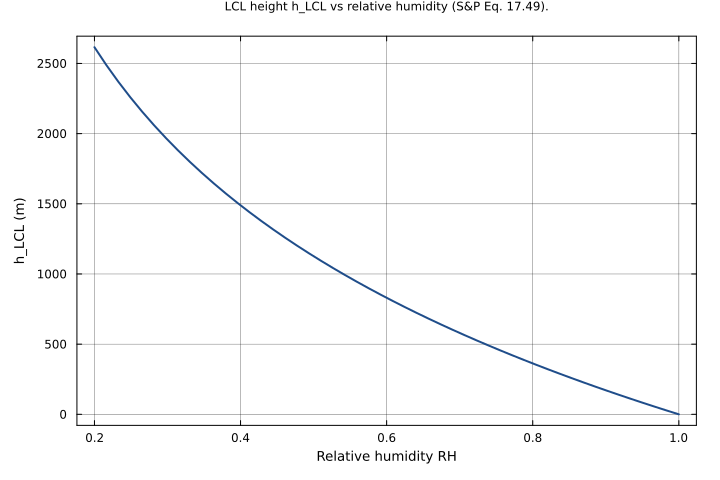
h_LCL | m | Lifting condensation level height h_LCL = (T_0 - T_d) / Γ_d (CloudDynamics, Eq. 17.49). | |
ΔT_f | K | Freezing point depression ΔT_f = K_f * molality (IcePhysics, Eq. 17.100). | |
T_e | K | Equilibrium freezing temperature from water activity (IcePhysics, Eq. 17.101). | |
kelvin_ice | 1 | Kelvin curvature factor for ice particle vapor pressure (IcePhysics, Eq. 17.102). Always > 1. | |
IN | 1/m^3 | Ice nuclei concentration (IcePhysics, Eq. 17.103). | |
E_t | 1 | Collection efficiency E_t = E_coll * E_coal (RainFormation, Eq. 17.106). | |
dm_dt | kg/s | Mass accretion rate by continuous collection (RainFormation, Eq. 17.106). | |
F_dist | 1 | Best raindrop size CDF (RainFormation, Eq. 17.107). | |
n_MP | 1/m^4 | Marshall-Palmer raindrop number density (RainFormation, Eq. 17.108). | |
F_mass | 1 | Mass scavenging ratio F_mass = (C_0 - C_int)/C_0 (AerosolScavenging, Eq. 17.84). | |
F_number | 1 | Number scavenging ratio F_number = (N_0 - N_int)/N_0 (AerosolScavenging, Eq. 17.85). | |
Λ | 1/s | Scavenging coefficient Λ = N_d * K_coll (AerosolScavenging, Eq. 17.92). |
Observed expressions
$$ Γ_{d} = \frac{g}{c_{p\,air}} $$Dry adiabatic lapse rate Γ_d = g/c_p_air (CloudDynamics, Eq. 17.44). Constant ≈ 9.76 K/km.
$$ p_{sat} = p_{sat\,ref} \cdot e^{\frac{magnus_{a} \cdot \left(T_{0} + \left(-1\right) \cdot T_{magnus\,offset}\right)}{T_{0} + \left(-1\right) \cdot T_{magnus\,offset} + magnus_{b}}} $$Saturation vapor pressure at T_0 via Magnus formula (CloudDynamics). p_sat ≈ 2333 Pa at 20°C.
$$ w_{vs} = \frac{M_{w} \cdot p_{sat}}{M_{a} \cdot p_{a}} $$Saturation water vapor mixing ratio w_vs = M_w p_sat / (M_a p_a) (CloudDynamics, Eq. 17.46).
$$ T_{d} = T_{0} + \frac{R \cdot T_{0}^{2}}{ΔH_{v} \cdot M_{w}} \cdot \ln\left(RH\right) $$Dew-point temperature T_d = T_0 + (R T_0² / (ΔH_v M_w)) ln(RH) (CloudDynamics, Eq. 17.43).
$$ h_{LCL} = \frac{T_{0} + \left(-1\right) \cdot T_{d}}{Γ_{d}} $$Lifting condensation level height h_LCL = (T_0 - T_d) / Γ_d (CloudDynamics, Eq. 17.49).
$$ ΔT_{f} = K_{f} \cdot molality $$Freezing point depression ΔT_f = K_f * molality (IcePhysics, Eq. 17.100).
$$ T_{e} = T_{freeze} + \frac{R \cdot T_{freeze}^{2}}{ΔH_{m\,mass} \cdot M_{w}} \cdot \ln\left(a_{w} + dim_{eps}\right) $$Equilibrium freezing temperature from water activity (IcePhysics, Eq. 17.101).
$$ kelvin_{ice} = e^{\frac{4 \cdot M_{w} \cdot σ_{ia}}{R \cdot T \cdot ρ_{i} \cdot D_{p\,ice}}} $$Kelvin curvature factor for ice particle vapor pressure (IcePhysics, Eq. 17.102). Always > 1.
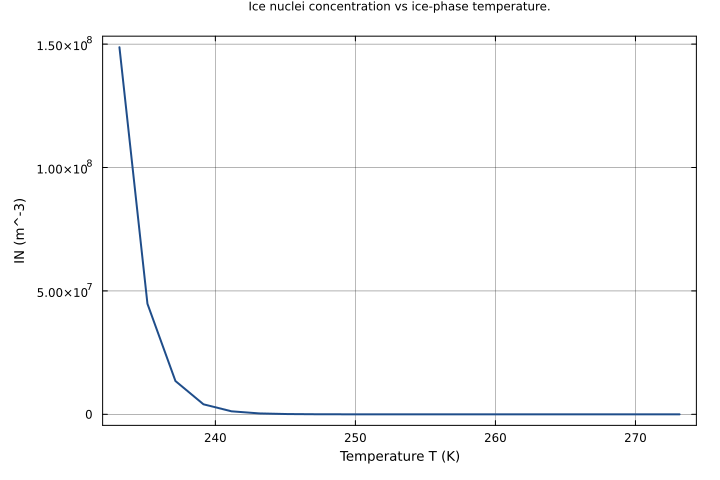
$$ IN = IN_{ref} \cdot e^{IN_{coeff} \cdot \left(T_{IN\,ref} + \left(-1\right) \cdot T\right)} $$Ice nuclei concentration (IcePhysics, Eq. 17.103).
$$ E_{t} = E_{coll} \cdot E_{coal} $$Collection efficiency E_t = E_coll * E_coal (RainFormation, Eq. 17.106).
$$ dm_{dt} = \frac{π_{val}}{4} \cdot E_{t} \cdot \left(D_{p\,rain} + d_{p}\right)^{2} \cdot w_{L} \cdot ρ_{a} \cdot \left|v_{D} + \left(-1\right) \cdot v_{d}\right| $$Mass accretion rate by continuous collection (RainFormation, Eq. 17.106).
$$ F_{dist} = one + \left(-1\right) \cdot e^{\left(-1\right) \cdot \frac{D_{p\,rain}}{F_{diam\,ref} \cdot \frac{p_{0}}{p0_{unit}}^{0.232}}^{F_{exp}}} $$Best raindrop size CDF (RainFormation, Eq. 17.107).
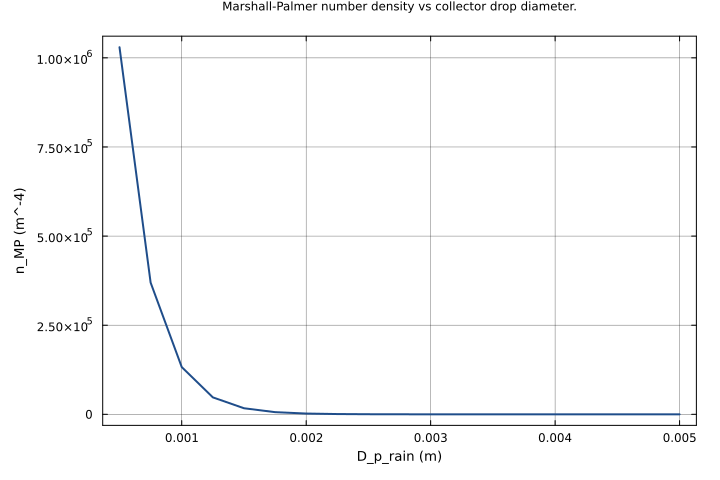
$$ n_{MP} = n_{0} \cdot e^{\left(-1\right) \cdot ψ \cdot D_{p\,rain}} $$Marshall-Palmer raindrop number density (RainFormation, Eq. 17.108).
$$ F_{mass} = \frac{C_{0} + \left(-1\right) \cdot C_{int}}{C_{0}} $$Mass scavenging ratio F_mass = (C_0 - C_int)/C_0 (AerosolScavenging, Eq. 17.84).
$$ F_{number} = \frac{\left(-1\right) \cdot N_{int} + N_{0}}{N_{0}} $$Number scavenging ratio F_number = (N_0 - N_int)/N_0 (AerosolScavenging, Eq. 17.85).
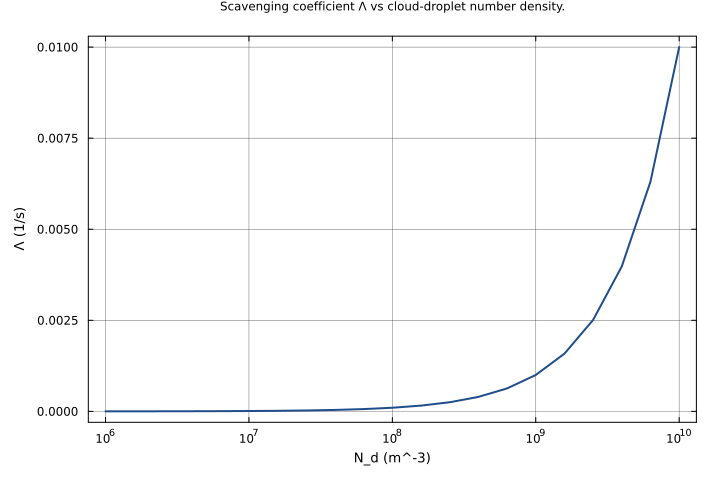
$$ Λ = N_{d} \cdot K_{coll} $$Scavenging coefficient Λ = N_d * K_coll (AerosolScavenging, Eq. 17.92).
Analyses
lcl_height_vs_relative_humidity
LCL height h_LCL as a function of relative humidity RH at T_0=293.15 K. As RH decreases the dew-point depression increases and cloud base rises (S&P Eq. 17.49). Reproduces CloudDynamics example.
Time span: 0.0 → 1.0
Swept over: RH
ice_nuclei_temperature_sweep
Ice nuclei concentration IN vs temperature T (233–273 K) at fixed IN_ref=1000 m^-3 and IN_coeff=0.6 K^-1. Spans ~7 orders of magnitude over 40 K (S&P Eq. 17.103). Reproduces IcePhysics example.
Time span: 0.0 → 60.0
Swept over: T
marshall_palmer_raindrop_spectrum
Marshall-Palmer number density n_MP vs collector drop diameter D_p_rain (0.5–5 mm). Exponential decay n = n_0 * exp(-ψ D) (S&P Eq. 17.108). Reproduces RainFormation example.
Time span: 0.0 → 60.0
Swept over: D_p_rain
scavenging_coefficient_vs_droplet_density
Scavenging coefficient Λ = N_d K_coll vs cloud-droplet number density N_d across four orders of magnitude (1e6–1e10 m^-3). Covers timescales from ~1 second (heavy cumulus) to ~12 days (thin cirrus) (S&P Eq. 17.92). Reproduces AerosolScavenging example.
Time span: 0.0 → 60.0
Swept over: N_d
Raw .esm
Raw .esm JSON (this component)
{
"reference": {
"citation": "Seinfeld, J. H. and Pandis, S. N. (2006). Atmospheric Chemistry and Physics: From Air Pollution to Climate Change, 2nd Edition, John Wiley & Sons, Chapter 17.",
"notes": "source_ref: Aerosol.jl@c8c640bb636b22f2425460e9ed5cba50793bfee1:src/cloud_physics.jl:735\n\nUpstream CloudPhysics is an MTK @component that calls EarthSciML coupling.couple() on four sub-components: CloudDynamics, IcePhysics, RainFormation, and AerosolScavenging. The couple() call unifies shared parameter names across components — specifically M_w (molecular weight of water) and R (universal gas constant), which appear in both CloudDynamics and IcePhysics with identical values.\n\nThis ESM flattens all four sub-models into a single model following the same pattern as aerosol_dynamics.esm:\n- CloudDynamics: pure-algebraic observed variables (Γ_d, p_sat, w_vs, T_d, h_LCL). Temperature T_0 (default 293.15 K) is the surface/parcel temperature for the LCL calculation.\n- IcePhysics: algebraic state equations (ΔT_f, T_e, kelvin_ice, IN). Temperature T (default 263.15 K) is the ice-phase temperature, kept separate from T_0 as in the upstream composition.\n- RainFormation: algebraic state equations (E_t, dm_dt, F_dist, n_MP). The upstream D_p parameter (collector drop diameter) is renamed D_p_rain to avoid collision with IcePhysics.\n- AerosolScavenging: algebraic state equations (F_mass, F_number, Λ). No parameter conflicts.\n\nName collision resolution: Both IcePhysics and RainFormation have a parameter named D_p (units m) but with distinct physical meanings and order-of-magnitude different defaults (1e-6 m for ice particles vs 1e-3 m for rain collector drops). In the upstream MTK system these are namespaced as ice.D_p and rain.D_p. In this flat ESM they are D_p_ice (ice particle diameter) and D_p_rain (collector drop diameter) respectively. All equation expression trees are updated accordingly.\n\nShared parameters M_w and R are listed once and referenced by both the CloudDynamics observed-variable expressions and the IcePhysics equations.\n\nThe coupling.couple feature in the upstream code produces no inter-model ODE coupling for this composition — the four sub-models are thermodynamically related (common M_w, R, and conceptually related T_0/T) but their outputs do not feed into each other's equations. The composition is primarily a convenience wrapper for downstream coupled atmospheric models.\n\nTolerance (rel=1e-8, abs=1e-12): all outputs are time-independent algebraic quantities. Inherits the strictest per-assertion tolerance needed across the four sub-models. CloudDynamics observed variables use pure closed-form expressions; 1e-8 easily covers float64 roundoff. The abs=1e-12 floor handles the molality=0 (ΔT_f=0) boundary."
},
"tolerance": {
"rel": 1e-08,
"abs": 1e-12
},
"variables": {
"M_w": {
"type": "parameter",
"units": "kg/mol",
"default": 0.018015,
"description": "Molecular weight of water. Shared between CloudDynamics (w_vs, T_d) and IcePhysics (T_e, kelvin_ice)."
},
"R": {
"type": "parameter",
"units": "J/(mol*K)",
"default": 8.314,
"description": "Universal gas constant. Shared between CloudDynamics (T_d) and IcePhysics (T_e, kelvin_ice)."
},
"M_a": {
"type": "parameter",
"units": "kg/mol",
"default": 0.02897,
"description": "Molecular weight of dry air (CloudDynamics)."
},
"g": {
"type": "parameter",
"units": "m/s^2",
"default": 9.81,
"description": "Gravitational acceleration (CloudDynamics)."
},
"c_p_air": {
"type": "parameter",
"units": "J/(kg*K)",
"default": 1005.0,
"description": "Specific heat of air at constant pressure (CloudDynamics)."
},
"p_sat_ref": {
"type": "parameter",
"units": "Pa",
"default": 610.94,
"description": "Magnus formula reference saturation pressure at 0°C (CloudDynamics)."
},
"magnus_a": {
"type": "parameter",
"units": "1",
"default": 17.625,
"description": "Magnus formula coefficient a (CloudDynamics)."
},
"T_magnus_offset": {
"type": "parameter",
"units": "K",
"default": 273.15,
"description": "Magnus formula temperature offset 0°C in Kelvin (CloudDynamics)."
},
"magnus_b": {
"type": "parameter",
"units": "K",
"default": 243.04,
"description": "Magnus formula coefficient b (CloudDynamics)."
},
"T_0": {
"type": "parameter",
"units": "K",
"default": 293.15,
"description": "Surface/parcel temperature for adiabatic cloud-base thermodynamics (CloudDynamics). Distinct from the ice-phase temperature T."
},
"RH": {
"type": "parameter",
"units": "1",
"default": 0.8,
"description": "Relative humidity (dimensionless, 0–1) for LCL calculation (CloudDynamics)."
},
"p_a": {
"type": "parameter",
"units": "Pa",
"default": 101325.0,
"description": "Atmospheric pressure (CloudDynamics)."
},
"ΔH_v": {
"type": "parameter",
"units": "J/kg",
"default": 2500000.0,
"description": "Latent heat of vaporization (CloudDynamics, S&P Table 17.1)."
},
"Γ_d": {
"type": "unknown",
"units": "K/m",
"description": "Dry adiabatic lapse rate Γ_d = g/c_p_air (CloudDynamics, Eq. 17.44). Constant ≈ 9.76 K/km."
},
"p_sat": {
"type": "unknown",
"units": "Pa",
"description": "Saturation vapor pressure at T_0 via Magnus formula (CloudDynamics). p_sat ≈ 2333 Pa at 20°C."
},
"w_vs": {
"type": "unknown",
"units": "1",
"description": "Saturation water vapor mixing ratio w_vs = M_w p_sat / (M_a p_a) (CloudDynamics, Eq. 17.46)."
},
"T_d": {
"type": "unknown",
"units": "K",
"description": "Dew-point temperature T_d = T_0 + (R T_0² / (ΔH_v M_w)) ln(RH) (CloudDynamics, Eq. 17.43)."
},
"h_LCL": {
"type": "unknown",
"units": "m",
"description": "Lifting condensation level height h_LCL = (T_0 - T_d) / Γ_d (CloudDynamics, Eq. 17.49)."
},
"ρ_i": {
"type": "parameter",
"units": "kg/m^3",
"default": 917.0,
"description": "Density of ice (IcePhysics)."
},
"T_freeze": {
"type": "parameter",
"units": "K",
"default": 273.15,
"description": "Freezing point of pure water (IcePhysics)."
},
"ΔH_m_mass": {
"type": "parameter",
"units": "J/kg",
"default": 333500.0,
"description": "Latent heat of fusion of water (IcePhysics)."
},
"K_f": {
"type": "parameter",
"units": "K*kg/mol",
"default": 1.86,
"description": "Cryoscopic constant of water (IcePhysics)."
},
"IN_ref": {
"type": "parameter",
"units": "1/m^3",
"default": 1000.0,
"description": "Ice nuclei reference concentration at T_IN_ref (IcePhysics, Eq. 17.103)."
},
"IN_coeff": {
"type": "parameter",
"units": "1/K",
"default": 0.6,
"description": "Ice nuclei exponential temperature coefficient (IcePhysics, Eq. 17.103)."
},
"T_IN_ref": {
"type": "parameter",
"units": "K",
"default": 253.0,
"description": "Reference temperature for ice nuclei parameterization (IcePhysics)."
},
"dim_eps": {
"type": "parameter",
"units": "1",
"default": 1e-30,
"description": "Small value added to water activity to prevent log(0) (IcePhysics)."
},
"T": {
"type": "parameter",
"units": "K",
"default": 263.15,
"description": "Ice-phase temperature (IcePhysics). Separate from T_0 (cloud-dynamics surface temperature)."
},
"σ_ia": {
"type": "parameter",
"units": "N/m",
"default": 0.106,
"description": "Ice-air surface tension (IcePhysics, Eq. 17.102)."
},
"D_p_ice": {
"type": "parameter",
"units": "m",
"default": 1e-06,
"description": "Ice particle diameter (IcePhysics, Eq. 17.102). Renamed from D_p to avoid collision with D_p_rain (collector drop diameter) in RainFormation."
},
"a_w": {
"type": "parameter",
"units": "1",
"default": 1.0,
"description": "Water activity (IcePhysics, Eq. 17.101)."
},
"molality": {
"type": "parameter",
"units": "mol/kg",
"default": 0.0,
"description": "Solute molality of the solution (IcePhysics, Eq. 17.100)."
},
"ΔT_f": {
"type": "unknown",
"units": "K",
"description": "Freezing point depression ΔT_f = K_f * molality (IcePhysics, Eq. 17.100)."
},
"T_e": {
"type": "unknown",
"units": "K",
"description": "Equilibrium freezing temperature from water activity (IcePhysics, Eq. 17.101)."
},
"kelvin_ice": {
"type": "unknown",
"units": "1",
"description": "Kelvin curvature factor for ice particle vapor pressure (IcePhysics, Eq. 17.102). Always > 1."
},
"IN": {
"type": "unknown",
"units": "1/m^3",
"description": "Ice nuclei concentration (IcePhysics, Eq. 17.103)."
},
"π_val": {
"type": "parameter",
"units": "1",
"default": 3.141592653589793,
"description": "Pi (RainFormation)."
},
"F_diam_ref": {
"type": "parameter",
"units": "m",
"default": 0.0013,
"description": "Best distribution diameter scale (RainFormation, Eq. 17.107: 1.3 mm)."
},
"F_exp": {
"type": "parameter",
"units": "1",
"default": 2.25,
"description": "Best distribution exponent (RainFormation, Eq. 17.107)."
},
"one": {
"type": "parameter",
"units": "1",
"default": 1.0,
"description": "Unity constant for F_dist expression (RainFormation)."
},
"p0_unit": {
"type": "parameter",
"units": "mm/hr",
"default": 1.0,
"description": "Unit rainfall intensity for nondimensionalization (RainFormation)."
},
"D_p_rain": {
"type": "parameter",
"units": "m",
"default": 0.001,
"description": "Collector drop diameter (RainFormation). Renamed from D_p to avoid collision with D_p_ice (ice particle diameter) in IcePhysics."
},
"d_p": {
"type": "parameter",
"units": "m",
"default": 1e-05,
"description": "Collected droplet diameter (RainFormation, Eq. 17.106)."
},
"E_coll": {
"type": "parameter",
"units": "1",
"default": 0.5,
"description": "Collision efficiency (RainFormation, Eq. 17.104)."
},
"E_coal": {
"type": "parameter",
"units": "1",
"default": 1.0,
"description": "Coalescence efficiency (RainFormation, Eq. 17.105)."
},
"w_L": {
"type": "parameter",
"units": "1",
"default": 0.001,
"description": "Liquid water mass mixing ratio kg/kg (RainFormation, Eq. 17.106)."
},
"v_D": {
"type": "parameter",
"units": "m/s",
"default": 5.0,
"description": "Fall velocity of collector drop (RainFormation, Eq. 17.106)."
},
"v_d": {
"type": "parameter",
"units": "m/s",
"default": 0.01,
"description": "Fall velocity of collected droplet (RainFormation, Eq. 17.106)."
},
"ρ_a": {
"type": "parameter",
"units": "kg/m^3",
"default": 1.225,
"description": "Air density (RainFormation, Eq. 17.106)."
},
"p_0": {
"type": "parameter",
"units": "mm/hr",
"default": 1.0,
"description": "Rainfall intensity (RainFormation, Eq. 17.107)."
},
"n_0": {
"type": "parameter",
"units": "1/m^4",
"default": 8000000.0,
"description": "Marshall-Palmer intercept parameter (RainFormation, Eq. 17.108: 8000 m⁻³ mm⁻¹)."
},
"ψ": {
"type": "parameter",
"units": "1/m",
"default": 4100.0,
"description": "Marshall-Palmer slope parameter (RainFormation, Eq. 17.108)."
},
"E_t": {
"type": "unknown",
"units": "1",
"description": "Collection efficiency E_t = E_coll * E_coal (RainFormation, Eq. 17.106)."
},
"dm_dt": {
"type": "unknown",
"units": "kg/s",
"description": "Mass accretion rate by continuous collection (RainFormation, Eq. 17.106)."
},
"F_dist": {
"type": "unknown",
"units": "1",
"description": "Best raindrop size CDF (RainFormation, Eq. 17.107)."
},
"n_MP": {
"type": "unknown",
"units": "1/m^4",
"description": "Marshall-Palmer raindrop number density (RainFormation, Eq. 17.108)."
},
"C_0": {
"type": "parameter",
"units": "1/m^3",
"default": 1000000000.0,
"description": "Initial aerosol mass concentration (AerosolScavenging, Eq. 17.84)."
},
"C_int": {
"type": "parameter",
"units": "1/m^3",
"default": 500000000.0,
"description": "Interstitial aerosol mass concentration (AerosolScavenging, Eq. 17.84)."
},
"N_0": {
"type": "parameter",
"units": "1/m^3",
"default": 1000000000.0,
"description": "Initial aerosol number concentration (AerosolScavenging, Eq. 17.85)."
},
"N_int": {
"type": "parameter",
"units": "1/m^3",
"default": 300000000.0,
"description": "Interstitial aerosol number concentration (AerosolScavenging, Eq. 17.85)."
},
"K_coll": {
"type": "parameter",
"units": "m^3/s",
"default": 1e-12,
"description": "Collision coefficient (AerosolScavenging, Eq. 17.92)."
},
"N_d": {
"type": "parameter",
"units": "1/m^3",
"default": 100000000.0,
"description": "Cloud droplet number concentration (AerosolScavenging, Eq. 17.92)."
},
"F_mass": {
"type": "unknown",
"units": "1",
"description": "Mass scavenging ratio F_mass = (C_0 - C_int)/C_0 (AerosolScavenging, Eq. 17.84)."
},
"F_number": {
"type": "unknown",
"units": "1",
"description": "Number scavenging ratio F_number = (N_0 - N_int)/N_0 (AerosolScavenging, Eq. 17.85)."
},
"Λ": {
"type": "unknown",
"units": "1/s",
"description": "Scavenging coefficient Λ = N_d * K_coll (AerosolScavenging, Eq. 17.92)."
}
},
"equations": [
{
"lhs": "ΔT_f",
"rhs": {
"op": "*",
"args": [
"K_f",
"molality"
]
}
},
{
"lhs": "T_e",
"rhs": {
"op": "+",
"args": [
"T_freeze",
{
"op": "*",
"args": [
{
"op": "/",
"args": [
{
"op": "*",
"args": [
"R",
{
"op": "^",
"args": [
"T_freeze",
2
]
}
]
},
{
"op": "*",
"args": [
"ΔH_m_mass",
"M_w"
]
}
]
},
{
"op": "log",
"args": [
{
"op": "+",
"args": [
"a_w",
"dim_eps"
]
}
]
}
]
}
]
}
},
{
"lhs": "kelvin_ice",
"rhs": {
"op": "exp",
"args": [
{
"op": "/",
"args": [
{
"op": "*",
"args": [
4,
"M_w",
"σ_ia"
]
},
{
"op": "*",
"args": [
"R",
"T",
"ρ_i",
"D_p_ice"
]
}
]
}
]
}
},
{
"lhs": "IN",
"rhs": {
"op": "*",
"args": [
"IN_ref",
{
"op": "exp",
"args": [
{
"op": "*",
"args": [
"IN_coeff",
{
"op": "+",
"args": [
"T_IN_ref",
{
"op": "*",
"args": [
-1,
"T"
]
}
]
}
]
}
]
}
]
}
},
{
"lhs": "E_t",
"rhs": {
"op": "*",
"args": [
"E_coll",
"E_coal"
]
}
},
{
"lhs": "dm_dt",
"rhs": {
"op": "*",
"args": [
{
"op": "/",
"args": [
"π_val",
4
]
},
"E_t",
{
"op": "^",
"args": [
{
"op": "+",
"args": [
"D_p_rain",
"d_p"
]
},
2
]
},
"w_L",
"ρ_a",
{
"op": "abs",
"args": [
{
"op": "+",
"args": [
"v_D",
{
"op": "*",
"args": [
-1,
"v_d"
]
}
]
}
]
}
]
}
},
{
"lhs": "F_dist",
"rhs": {
"op": "+",
"args": [
"one",
{
"op": "*",
"args": [
-1,
{
"op": "exp",
"args": [
{
"op": "*",
"args": [
-1,
{
"op": "^",
"args": [
{
"op": "/",
"args": [
"D_p_rain",
{
"op": "*",
"args": [
"F_diam_ref",
{
"op": "^",
"args": [
{
"op": "/",
"args": [
"p_0",
"p0_unit"
]
},
0.232
]
}
]
}
]
},
"F_exp"
]
}
]
}
]
}
]
}
]
}
},
{
"lhs": "n_MP",
"rhs": {
"op": "*",
"args": [
"n_0",
{
"op": "exp",
"args": [
{
"op": "*",
"args": [
-1,
"ψ",
"D_p_rain"
]
}
]
}
]
}
},
{
"lhs": "F_mass",
"rhs": {
"op": "/",
"args": [
{
"op": "+",
"args": [
"C_0",
{
"op": "*",
"args": [
-1,
"C_int"
]
}
]
},
"C_0"
]
}
},
{
"lhs": "F_number",
"rhs": {
"op": "/",
"args": [
{
"op": "+",
"args": [
{
"op": "*",
"args": [
-1,
"N_int"
]
},
"N_0"
]
},
"N_0"
]
}
},
{
"lhs": "Λ",
"rhs": {
"op": "*",
"args": [
"N_d",
"K_coll"
]
}
},
{
"lhs": "Γ_d",
"rhs": {
"op": "/",
"args": [
"g",
"c_p_air"
]
}
},
{
"lhs": "p_sat",
"rhs": {
"op": "*",
"args": [
"p_sat_ref",
{
"op": "exp",
"args": [
{
"op": "/",
"args": [
{
"op": "*",
"args": [
"magnus_a",
{
"op": "+",
"args": [
"T_0",
{
"op": "*",
"args": [
-1,
"T_magnus_offset"
]
}
]
}
]
},
{
"op": "+",
"args": [
{
"op": "+",
"args": [
"T_0",
{
"op": "*",
"args": [
-1,
"T_magnus_offset"
]
}
]
},
"magnus_b"
]
}
]
}
]
}
]
}
},
{
"lhs": "w_vs",
"rhs": {
"op": "/",
"args": [
{
"op": "*",
"args": [
"M_w",
"p_sat"
]
},
{
"op": "*",
"args": [
"M_a",
"p_a"
]
}
]
}
},
{
"lhs": "T_d",
"rhs": {
"op": "+",
"args": [
"T_0",
{
"op": "*",
"args": [
{
"op": "/",
"args": [
{
"op": "*",
"args": [
"R",
{
"op": "^",
"args": [
"T_0",
2
]
}
]
},
{
"op": "*",
"args": [
"ΔH_v",
"M_w"
]
}
]
},
{
"op": "log",
"args": [
"RH"
]
}
]
}
]
}
},
{
"lhs": "h_LCL",
"rhs": {
"op": "/",
"args": [
{
"op": "+",
"args": [
"T_0",
{
"op": "*",
"args": [
-1,
"T_d"
]
}
]
},
"Γ_d"
]
}
}
],
"tests": [
{
"id": "defaults_all_submodels",
"description": "Reference run at upstream Aerosol.jl defaults for all four sub-models simultaneously. Verifies all 13 output variables at t=0 and t=3600 s. All outputs are time-independent algebraic quantities, so values must be identical at both times.\n\nExpected values sourced from cloud_dynamics.esm (Γ_d, p_sat, w_vs, T_d, h_LCL), ice_physics.esm (ΔT_f, T_e, kelvin_ice, IN), rain_formation.esm (E_t, dm_dt, F_dist, n_MP), and aerosol_scavenging.esm (F_mass, F_number, Λ) — each cross-validated against the upstream Aerosol.jl test suite.",
"time_span": {
"start": 0.0,
"end": 3600.0
},
"assertions": [
{
"variable": "Γ_d",
"time": 0.0,
"expected": 0.009761194029850746
},
{
"variable": "Γ_d",
"time": 3600.0,
"expected": 0.009761194029850746
},
{
"variable": "p_sat",
"time": 0.0,
"expected": 2333.4406230993577
},
{
"variable": "p_sat",
"time": 3600.0,
"expected": 2333.4406230993577
},
{
"variable": "w_vs",
"time": 0.0,
"expected": 0.014320754941837679
},
{
"variable": "w_vs",
"time": 3600.0,
"expected": 0.014320754941837679
},
{
"variable": "T_d",
"time": 0.0,
"expected": 289.6100275457325
},
{
"variable": "T_d",
"time": 3600.0,
"expected": 289.6100275457325
},
{
"variable": "h_LCL",
"time": 0.0,
"expected": 362.65772849528986
},
{
"variable": "h_LCL",
"time": 3600.0,
"expected": 362.65772849528986
},
{
"variable": "ΔT_f",
"time": 0.0,
"expected": 0.0,
"tolerance": {
"abs": 1e-12
}
},
{
"variable": "ΔT_f",
"time": 3600.0,
"expected": 0.0,
"tolerance": {
"abs": 1e-12
}
},
{
"variable": "T_e",
"time": 0.0,
"expected": 273.15
},
{
"variable": "T_e",
"time": 3600.0,
"expected": 273.15
},
{
"variable": "kelvin_ice",
"time": 0.0,
"expected": 1.0038145595610195
},
{
"variable": "kelvin_ice",
"time": 3600.0,
"expected": 1.0038145595610195
},
{
"variable": "IN",
"time": 0.0,
"expected": 2.265408914814352
},
{
"variable": "IN",
"time": 3600.0,
"expected": 2.265408914814352
},
{
"variable": "E_t",
"time": 0.0,
"expected": 0.5
},
{
"variable": "E_t",
"time": 3600.0,
"expected": 0.5
},
{
"variable": "dm_dt",
"time": 0.0,
"expected": 2.4487207850181197e-09
},
{
"variable": "dm_dt",
"time": 3600.0,
"expected": 2.4487207850181197e-09
},
{
"variable": "F_dist",
"time": 0.0,
"expected": 0.4254396577227785
},
{
"variable": "F_dist",
"time": 3600.0,
"expected": 0.4254396577227785
},
{
"variable": "n_MP",
"time": 0.0,
"expected": 132581.40321409004
},
{
"variable": "n_MP",
"time": 3600.0,
"expected": 132581.40321409004
},
{
"variable": "F_mass",
"time": 0.0,
"expected": 0.5
},
{
"variable": "F_mass",
"time": 3600.0,
"expected": 0.5
},
{
"variable": "F_number",
"time": 0.0,
"expected": 0.7
},
{
"variable": "F_number",
"time": 3600.0,
"expected": 0.7
},
{
"variable": "Λ",
"time": 0.0,
"expected": 0.0001
},
{
"variable": "Λ",
"time": 3600.0,
"expected": 0.0001
}
]
},
{
"id": "D_p_ice_independent_of_D_p_rain",
"description": "D_p_ice=1e-7 m (100 nm ice particle, 10× smaller than default 1 μm). Verifies that kelvin_ice changes as expected (Kelvin factor scales as exp(1/D_p); smaller particle → larger correction) while n_MP and all RainFormation outputs remain at their default values, confirming that D_p_ice and D_p_rain are independent parameters.\n\nkelvin_ice expected from ice_physics.esm 'kelvin_effect_small_particle' test.",
"parameter_overrides": {
"D_p_ice": 1e-07
},
"time_span": {
"start": 0.0,
"end": 600.0
},
"assertions": [
{
"variable": "kelvin_ice",
"time": 0.0,
"expected": 1.0388070898029664
},
{
"variable": "kelvin_ice",
"time": 600.0,
"expected": 1.0388070898029664
},
{
"variable": "n_MP",
"time": 0.0,
"expected": 132581.40321409004
},
{
"variable": "n_MP",
"time": 600.0,
"expected": 132581.40321409004
},
{
"variable": "dm_dt",
"time": 0.0,
"expected": 2.4487207850181197e-09
},
{
"variable": "dm_dt",
"time": 600.0,
"expected": 2.4487207850181197e-09
}
]
},
{
"id": "D_p_rain_independent_of_D_p_ice",
"description": "D_p_rain=2e-3 m (2 mm collector drop, 2× default). Verifies n_MP drops per the Marshall-Palmer exponential while kelvin_ice and all IcePhysics outputs remain at default values, confirming D_p_rain and D_p_ice are independent parameters.\n\nn_MP expected from rain_formation.esm 'marshall_palmer_decreasing' test.",
"parameter_overrides": {
"D_p_rain": 0.002
},
"time_span": {
"start": 0.0,
"end": 600.0
},
"assertions": [
{
"variable": "n_MP",
"time": 0.0,
"expected": 2197.22855977714
},
{
"variable": "n_MP",
"time": 600.0,
"expected": 2197.22855977714
},
{
"variable": "kelvin_ice",
"time": 0.0,
"expected": 1.0038145595610195
},
{
"variable": "kelvin_ice",
"time": 600.0,
"expected": 1.0038145595610195
},
{
"variable": "IN",
"time": 0.0,
"expected": 2.265408914814352
},
{
"variable": "IN",
"time": 600.0,
"expected": 2.265408914814352
}
]
},
{
"id": "ice_temperature_independent_of_cloud_dynamics",
"description": "T=243.15 K (cold surge, 10 K below T_IN_ref=253 K). Ice nuclei concentration IN spikes per the exponential parameterization (Eq. 17.103). CloudDynamics outputs (Γ_d, p_sat, etc.) must remain unchanged because they depend on T_0 not T, confirming the two temperature parameters are independent.\n\nIN expected from ice_physics.esm 'ice_nuclei_cold_surge' test.",
"parameter_overrides": {
"T": 243.15
},
"time_span": {
"start": 0.0,
"end": 600.0
},
"assertions": [
{
"variable": "IN",
"time": 0.0,
"expected": 368706.1554093557
},
{
"variable": "IN",
"time": 600.0,
"expected": 368706.1554093557
},
{
"variable": "Γ_d",
"time": 0.0,
"expected": 0.009761194029850746
},
{
"variable": "p_sat",
"time": 0.0,
"expected": 2333.4406230993577
},
{
"variable": "h_LCL",
"time": 0.0,
"expected": 362.65772849528986
}
]
},
{
"id": "cloud_dynamics_cold_independent_of_ice",
"description": "T_0=263.15 K (cold parcel). CloudDynamics outputs change (lower p_sat, lower h_LCL). IcePhysics outputs must remain unchanged because they depend on T not T_0. Also confirms Γ_d = g/c_p_air is constant (does not depend on temperature).\n\np_sat and h_LCL expected from cloud_dynamics.esm 'cold_temperature_T0_263' test.",
"parameter_overrides": {
"T_0": 263.15
},
"time_span": {
"start": 0.0,
"end": 600.0
},
"assertions": [
{
"variable": "p_sat",
"time": 0.0,
"expected": 286.77296061847886
},
{
"variable": "p_sat",
"time": 600.0,
"expected": 286.77296061847886
},
{
"variable": "h_LCL",
"time": 0.0,
"expected": 292.22938809413193
},
{
"variable": "h_LCL",
"time": 600.0,
"expected": 292.22938809413193
},
{
"variable": "Γ_d",
"time": 0.0,
"expected": 0.009761194029850746
},
{
"variable": "IN",
"time": 0.0,
"expected": 2.265408914814352
},
{
"variable": "kelvin_ice",
"time": 0.0,
"expected": 1.0038145595610195
}
]
},
{
"id": "scavenging_defaults",
"description": "Spot-check AerosolScavenging at default parameters and at a complete-scavenging boundary (C_int=0, N_int=0). Confirms F_mass=F_number=1 at the upper bound and verifies Λ=N_d*K_coll=1e-4 s^-1 at defaults. Sourced from aerosol_scavenging.esm tests.",
"parameter_overrides": {},
"time_span": {
"start": 0.0,
"end": 600.0
},
"assertions": [
{
"variable": "F_mass",
"time": 600.0,
"expected": 0.5
},
{
"variable": "F_number",
"time": 600.0,
"expected": 0.7
},
{
"variable": "Λ",
"time": 600.0,
"expected": 0.0001
}
]
},
{
"id": "rain_saturation_rh",
"description": "CloudDynamics at RH=1.0 (100% humidity): dew point equals air temperature so h_LCL=0 (parcel already at saturation). RainFormation outputs unchanged. Sourced from cloud_dynamics.esm 'saturation_rh_100' test.",
"parameter_overrides": {
"RH": 1.0
},
"time_span": {
"start": 0.0,
"end": 600.0
},
"assertions": [
{
"variable": "T_d",
"time": 0.0,
"expected": 293.15
},
{
"variable": "h_LCL",
"time": 0.0,
"expected": 0.0,
"tolerance": {
"abs": 1e-10
}
},
{
"variable": "E_t",
"time": 600.0,
"expected": 0.5
},
{
"variable": "n_MP",
"time": 600.0,
"expected": 132581.40321409004
}
]
}
],
"analyses": [
{
"id": "lcl_height_vs_relative_humidity",
"description": "LCL height h_LCL as a function of relative humidity RH at T_0=293.15 K. As RH decreases the dew-point depression increases and cloud base rises (S&P Eq. 17.49). Reproduces CloudDynamics example.",
"time_span": {
"start": 0.0,
"end": 1.0
},
"parameter_sweep": {
"type": "cartesian",
"dimensions": [
{
"parameter": "RH",
"range": {
"start": 0.2,
"stop": 1.0,
"count": 50,
"scale": "linear"
}
}
]
},
"plots": [
{
"id": "h_LCL_vs_RH",
"type": "line",
"description": "LCL height h_LCL vs relative humidity (S&P Eq. 17.49).",
"x": {
"variable": "RH",
"label": "Relative humidity RH"
},
"y": {
"variable": "h_LCL",
"label": "h_LCL (m)"
}
}
]
},
{
"id": "ice_nuclei_temperature_sweep",
"description": "Ice nuclei concentration IN vs temperature T (233–273 K) at fixed IN_ref=1000 m^-3 and IN_coeff=0.6 K^-1. Spans ~7 orders of magnitude over 40 K (S&P Eq. 17.103). Reproduces IcePhysics example.",
"time_span": {
"start": 0.0,
"end": 60.0
},
"parameter_sweep": {
"type": "cartesian",
"dimensions": [
{
"parameter": "T",
"range": {
"start": 233.15,
"stop": 273.15,
"count": 21,
"scale": "linear"
}
}
]
},
"plots": [
{
"id": "IN_vs_T",
"type": "line",
"description": "Ice nuclei concentration vs ice-phase temperature.",
"x": {
"variable": "T",
"label": "Temperature T (K)"
},
"y": {
"variable": "IN",
"label": "IN (m^-3)"
}
}
]
},
{
"id": "marshall_palmer_raindrop_spectrum",
"description": "Marshall-Palmer number density n_MP vs collector drop diameter D_p_rain (0.5–5 mm). Exponential decay n = n_0 * exp(-ψ D) (S&P Eq. 17.108). Reproduces RainFormation example.",
"time_span": {
"start": 0.0,
"end": 60.0
},
"parameter_sweep": {
"type": "cartesian",
"dimensions": [
{
"parameter": "D_p_rain",
"range": {
"start": 0.0005,
"stop": 0.005,
"count": 19,
"scale": "linear"
}
}
]
},
"plots": [
{
"id": "n_MP_vs_D_p_rain",
"type": "line",
"description": "Marshall-Palmer number density vs collector drop diameter.",
"x": {
"variable": "D_p_rain",
"label": "D_p_rain (m)"
},
"y": {
"variable": "n_MP",
"label": "n_MP (m^-4)"
}
}
]
},
{
"id": "scavenging_coefficient_vs_droplet_density",
"description": "Scavenging coefficient Λ = N_d K_coll vs cloud-droplet number density N_d across four orders of magnitude (1e6–1e10 m^-3). Covers timescales from ~1 second (heavy cumulus) to ~12 days (thin cirrus) (S&P Eq. 17.92). Reproduces AerosolScavenging example.",
"time_span": {
"start": 0.0,
"end": 60.0
},
"parameter_sweep": {
"type": "cartesian",
"dimensions": [
{
"parameter": "N_d",
"range": {
"start": 1000000.0,
"stop": 10000000000.0,
"count": 21,
"scale": "log"
}
}
]
},
"plots": [
{
"id": "lambda_vs_Nd",
"type": "line",
"description": "Scavenging coefficient Λ vs cloud-droplet number density.",
"x": {
"variable": "N_d",
"label": "N_d (m^-3)"
},
"y": {
"variable": "Λ",
"label": "Λ (1/s)"
}
}
]
}
]
}