CloudKelvinEffect
Kelvin effect on the equilibrium vapor pressure over a curved cloud droplet surface — Seinfeld & Pandis (2006), Ch. 17. Computes the Kelvin length parameter A_K = 4 σ_w M_w / (R T ρ_w) and the Kelvin saturation ratio S_K = exp(A_K / D_p), the factor by which surface curvature enhances equilibrium vapor pressure over a small droplet relative to a flat surface. Used as the curvature term in the Köhler equation (Eq. 17.27). Migrated from Aerosol.jl CloudKelvinEffect.
Description
Kelvin effect on the equilibrium vapor pressure over a curved cloud droplet surface — Seinfeld & Pandis (2006), Ch. 17. Computes the Kelvin length parameter A_K = 4 σ_w M_w / (R T ρ_w) and the Kelvin saturation ratio S_K = exp(A_K / D_p), the factor by which surface curvature enhances equilibrium vapor pressure over a small droplet relative to a flat surface. Used as the curvature term in the Köhler equation (Eq. 17.27). Migrated from Aerosol.jl CloudKelvinEffect.
Reference
Seinfeld, J. H., and Pandis, S. N. (2006). Atmospheric Chemistry and Physics: From Air Pollution to Climate Change, 2nd Edition, John Wiley & Sons, Chapter 17. Kelvin equation curvature term used in Eq. 17.27 (Köhler equation).
_source_ref: Aerosol.jl@c8c640bb636b22f2425460e9ed5cba50793bfee1:src/cloud_physics.jl:181
Upstream CloudKelvinEffect is an MTK @component. It declares six scalar @parameters — R (universal gas constant, J/mol/K), T (temperature, K), σ_w (surface tension of water, N/m), M_w (molar mass of water, kg/mol), ρ_w (density of liquid water, kg/m³), D_p (droplet diameter, m) — and two scalar @variables (A_K, S_K, both dimensionless or with units m and 1 respectively). The two equations are A_K ~ 4 σ_w M_w / (R T ρ_w) and S_K ~ exp(A_K / D_p) (the Kelvin saturation ratio, the curvature term in the Köhler equation, Eq. 17.27).
The formula uses droplet diameter D_p (not radius R_p), matching the Ch. 17 convention in DropletGrowth (cloud_physics.jl) where S_eq is expanded as exp(4 M_w σ_w / (T R D_p ρ_w)) in the Köhler composite. The sibling sp_ch10 KelvinEffect (kelvin.esm) uses radius R_p; this Ch. 17 variant uses diameter D_p = 2 R_p, so A_K here is twice the sp_ch10 Kelvin length A (i.e., A_K/D_p = A/R_p).
Observed classification: CloudKelvinEffect has no D() time-derivative — it is a purely-algebraic component. A_K and S_K are both algebraic outputs. After MTK structural_simplify the compiled system has zero ODE states and both become observed quantities. They are serialized as type: observed with an expression, and the equations array is empty, matching the sibling pure-algebraic pattern (zsr.esm, kelvin.esm).
Parameter defaults match the DropletGrowth component in the same cloud_physics.jl file: T=293.15 K, σ_w=0.0728 N/m, M_w=0.018015 kg/mol, ρ_w=997.0 kg/m³, D_p=1e-6 m.
Tolerance rationale (model-level rel=1e-9): the model is a small closed-form algebraic system — one division of two short products followed by one exp — so float64 evaluation roundoff is at the few-ULP (~1e-15 relative) level; rel=1e-9 leaves ample headroom and matches the sibling coagulation_rate.esm which has comparable arithmetic complexity._
Parameters
| Name | Units | Default | Description |
|---|---|---|---|
R | J/mol/K | 8.314 | Universal gas constant. Appears in the exponent denominator of Eq. 17.27. |
T | K | 293.15 | Temperature of the droplet and surrounding vapor. A colder droplet has a larger Kelvin enhancement (A_K ∝ 1/T). |
σ_w | N/m | 0.0728 | Surface tension of liquid water. Default 0.0728 N/m at ~293 K (S&P 2006, Ch. 17). Appears linearly in the exponent numerator. |
M_w | kg/mol | 0.018015 | Molar mass of water. Default 0.018015 kg/mol. |
ρ_w | kg/m^3 | 997.0 | Density of liquid water. Default 997.0 kg/m³ at ~293 K. |
D_p | m | 1e-06 | Droplet diameter (Ch. 17 convention: uses diameter, not radius). Default 1 μm. The Kelvin enhancement grows as D_p shrinks and vanishes as D_p → ∞. |
Observed
| Name | Units | Default | Description |
|---|---|---|---|
A_K | m | Kelvin length parameter (curvature coefficient): A_K = 4 σ_w M_w / (R T ρ_w). The Kelvin exponent is A_K / D_p (dimensionless). A_K ~ 2.16 nm at 293 K for water. | |
S_K | 1 | Kelvin saturation ratio: S_K = exp(A_K / D_p) — the ratio of equilibrium vapor pressure over the curved droplet surface to that over a flat surface. S_K ≥ 1 and S_K → 1 as D_p → ∞. Used as the curvature term in the Köhler equation (Eq. 17.27). |
Observed expressions
$$ A_{K} = \frac{4 \cdot σ_{w} \cdot M_{w}}{R \cdot T \cdot ρ_{w}} $$Kelvin length parameter (curvature coefficient): A_K = 4 σ_w M_w / (R T ρ_w). The Kelvin exponent is A_K / D_p (dimensionless). A_K ~ 2.16 nm at 293 K for water.
$$ S_{K} = e^{\frac{A_{K}}{D_{p}}} $$Kelvin saturation ratio: S_K = exp(A_K / D_p) — the ratio of equilibrium vapor pressure over the curved droplet surface to that over a flat surface. S_K ≥ 1 and S_K → 1 as D_p → ∞. Used as the curvature term in the Köhler equation (Eq. 17.27).
Analyses
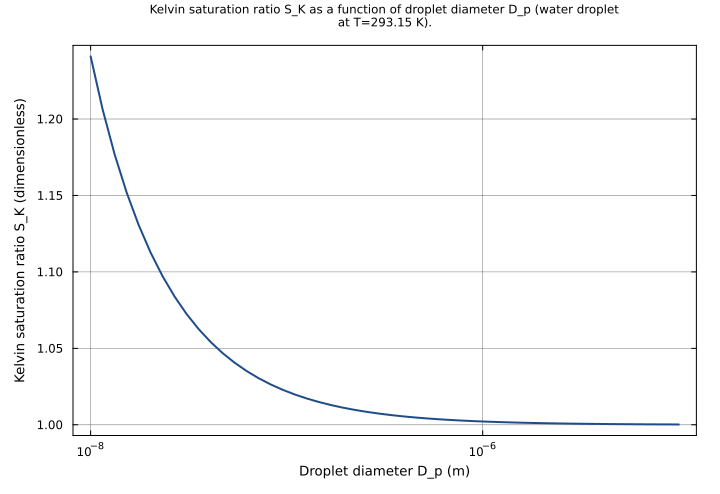
kelvin_ratio_vs_droplet_diameter
The Kelvin saturation ratio rises steeply as the droplet shrinks (S_K = exp(A_K/D_p)). Sweeping D_p over 10 nm – 10 μm on a logarithmic axis traces the curvature enhancement decaying from a strong effect for the smallest droplets toward S_K → 1 for large droplets.
Time span: 0.0 → 1.0
Swept over: D_p
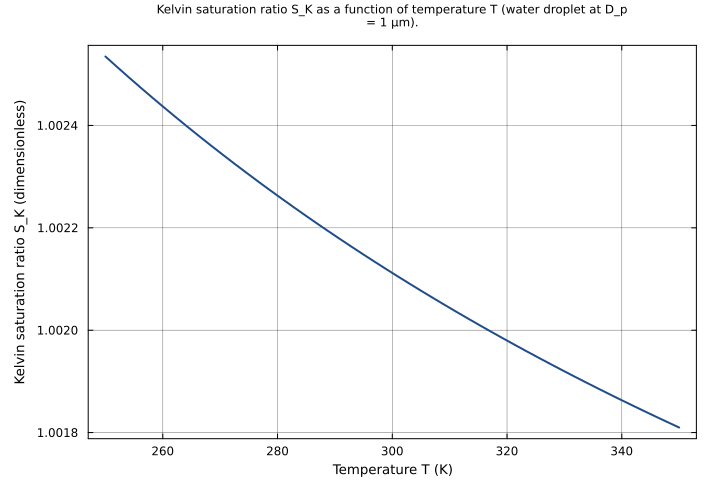
kelvin_ratio_vs_temperature
The Kelvin enhancement weakens with temperature (A_K ∝ 1/T). Sweeping T over 250–350 K at D_p = 1 μm traces S_K decreasing monotonically as the droplet warms.
Time span: 0.0 → 1.0
Swept over: T
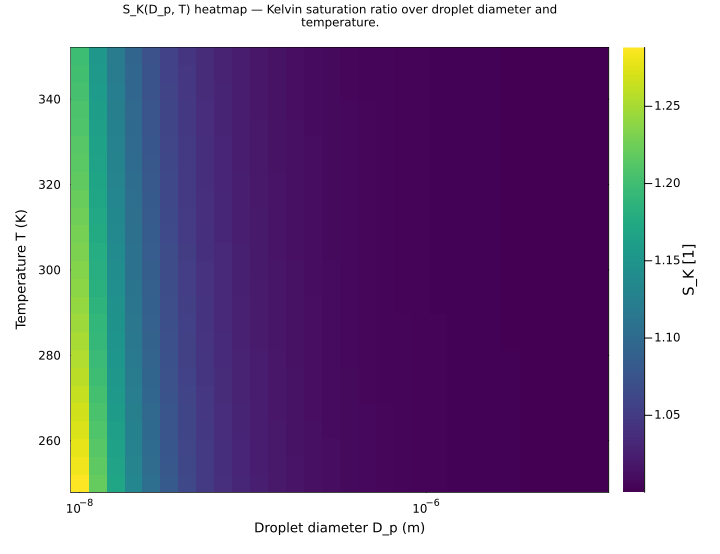
kelvin_diameter_temperature_heatmap
Joint dependence of S_K on droplet diameter and temperature. The heatmap shows the enhancement strongest for small, cold droplets and fading toward unity for large, warm droplets.
Time span: 0.0 → 1.0
Swept over: D_p, T
Raw .esm
Raw .esm JSON (this component)
{
  "reference": {
    "citation": "Seinfeld, J. H., and Pandis, S. N. (2006). Atmospheric Chemistry and Physics: From Air Pollution to Climate Change, 2nd Edition, John Wiley & Sons, Chapter 17. Kelvin equation curvature term used in Eq. 17.27 (Köhler equation).",
    "notes": "source_ref: Aerosol.jl@c8c640bb636b22f2425460e9ed5cba50793bfee1:src/cloud_physics.jl:181\n\nUpstream `CloudKelvinEffect` is an MTK `@component`. It declares six scalar `@parameters` — `R` (universal gas constant, J/mol/K), `T` (temperature, K), `σ_w` (surface tension of water, N/m), `M_w` (molar mass of water, kg/mol), `ρ_w` (density of liquid water, kg/m³), `D_p` (droplet diameter, m) — and two scalar `@variables` (`A_K`, `S_K`, both dimensionless or with units m and 1 respectively). The two equations are `A_K ~ 4 σ_w M_w / (R T ρ_w)` and `S_K ~ exp(A_K / D_p)` (the Kelvin saturation ratio, the curvature term in the Köhler equation, Eq. 17.27).\n\nThe formula uses droplet diameter D_p (not radius R_p), matching the Ch. 17 convention in DropletGrowth (cloud_physics.jl) where S_eq is expanded as exp(4 M_w σ_w / (T R D_p ρ_w)) in the Köhler composite. The sibling sp_ch10 KelvinEffect (kelvin.esm) uses radius R_p; this Ch. 17 variant uses diameter D_p = 2 R_p, so A_K here is twice the sp_ch10 Kelvin length A (i.e., A_K/D_p = A/R_p).\n\nObserved classification: CloudKelvinEffect has no `D()` time-derivative — it is a purely-algebraic component. `A_K` and `S_K` are both algebraic outputs. After MTK `structural_simplify` the compiled system has zero ODE states and both become observed quantities. They are serialized as `type: observed` with an `expression`, and the `equations` array is empty, matching the sibling pure-algebraic pattern (zsr.esm, kelvin.esm).\n\nParameter defaults match the `DropletGrowth` component in the same cloud_physics.jl file: T=293.15 K, σ_w=0.0728 N/m, M_w=0.018015 kg/mol, ρ_w=997.0 kg/m³, D_p=1e-6 m.\n\nTolerance rationale (model-level rel=1e-9): the model is a small closed-form algebraic system — one division of two short products followed by one `exp` — so float64 evaluation roundoff is at the few-ULP (~1e-15 relative) level; rel=1e-9 leaves ample headroom and matches the sibling coagulation_rate.esm which has comparable arithmetic complexity."
  },
  "variables": {
    "R": {
      "type": "parameter",
      "units": "J/mol/K",
      "default": 8.314,
      "description": "Universal gas constant. Appears in the exponent denominator of Eq. 17.27."
    },
    "T": {
      "type": "parameter",
      "units": "K",
      "default": 293.15,
      "description": "Temperature of the droplet and surrounding vapor. A colder droplet has a larger Kelvin enhancement (A_K ∝ 1/T)."
    },
    "σ_w": {
      "type": "parameter",
      "units": "N/m",
      "default": 0.0728,
      "description": "Surface tension of liquid water. Default 0.0728 N/m at ~293 K (S&P 2006, Ch. 17). Appears linearly in the exponent numerator."
    },
    "M_w": {
      "type": "parameter",
      "units": "kg/mol",
      "default": 0.018015,
      "description": "Molar mass of water. Default 0.018015 kg/mol."
    },
    "ρ_w": {
      "type": "parameter",
      "units": "kg/m^3",
      "default": 997.0,
      "description": "Density of liquid water. Default 997.0 kg/m³ at ~293 K."
    },
    "D_p": {
      "type": "parameter",
      "units": "m",
      "default": 1e-06,
      "description": "Droplet diameter (Ch. 17 convention: uses diameter, not radius). Default 1 μm. The Kelvin enhancement grows as D_p shrinks and vanishes as D_p → ∞."
    },
    "A_K": {
      "type": "unknown",
      "units": "m",
      "description": "Kelvin length parameter (curvature coefficient): A_K = 4 σ_w M_w / (R T ρ_w). The Kelvin exponent is A_K / D_p (dimensionless). A_K ~ 2.16 nm at 293 K for water."
    },
    "S_K": {
      "type": "unknown",
      "units": "1",
      "description": "Kelvin saturation ratio: S_K = exp(A_K / D_p) — the ratio of equilibrium vapor pressure over the curved droplet surface to that over a flat surface. S_K ≥ 1 and S_K → 1 as D_p → ∞. Used as the curvature term in the Köhler equation (Eq. 17.27)."
    }
  },
  "equations": [
    {
      "lhs": "A_K",
      "rhs": {
        "op": "/",
        "args": [
          {
            "op": "*",
            "args": [
              4,
              "σ_w",
              "M_w"
            ]
          },
          {
            "op": "*",
            "args": [
              "R",
              "T",
              "ρ_w"
            ]
          }
        ]
      }
    },
    {
      "lhs": "S_K",
      "rhs": {
        "op": "exp",
        "args": [
          {
            "op": "/",
            "args": [
              "A_K",
              "D_p"
            ]
          }
        ]
      }
    }
  ],
  "tolerance": {
    "rel": 1e-09
  },
  "tests": [
    {
      "id": "default_parameters",
      "description": "Kelvin effect at the upstream default parameterization: a 1 μm water droplet at 293.15 K. A_K = 4×0.0728×0.018015 / (8.314×293.15×997) = 2.15889e-9 m. S_K = exp(2.15889e-9 / 1e-6) = 1.002161. Both outputs are algebraic and time-invariant; same values asserted at t=0 and t=1.",
      "parameter_overrides": {},
      "time_span": {
        "start": 0.0,
        "end": 1.0
      },
      "assertions": [
        {
          "variable": "A_K",
          "time": 0.0,
          "expected": 2.15889022577928e-09
        },
        {
          "variable": "A_K",
          "time": 1.0,
          "expected": 2.15889022577928e-09
        },
        {
          "variable": "S_K",
          "time": 0.0,
          "expected": 1.00216122230722
        },
        {
          "variable": "S_K",
          "time": 1.0,
          "expected": 1.00216122230722
        }
      ]
    },
    {
      "id": "small_droplet_strong_enhancement",
      "description": "For a small droplet the Kelvin effect is large. At D_p = 10 nm (0.01 μm) — 100× smaller than the default — the exponent A_K/D_p = 0.21589 and S_K = 1.24096, a 24% vapor-pressure enhancement.",
      "parameter_overrides": {
        "D_p": 1e-08
      },
      "time_span": {
        "start": 0.0,
        "end": 1.0
      },
      "assertions": [
        {
          "variable": "S_K",
          "time": 0.0,
          "expected": 1.24096465230054
        }
      ]
    },
    {
      "id": "large_droplet_negligible_enhancement",
      "description": "For a large droplet the Kelvin effect is negligible. At D_p = 10 μm — 10× larger than the default — S_K = 1.000216, a 0.02% enhancement.",
      "parameter_overrides": {
        "D_p": 1e-05
      },
      "time_span": {
        "start": 0.0,
        "end": 1.0
      },
      "assertions": [
        {
          "variable": "S_K",
          "time": 0.0,
          "expected": 1.00021591232829
        }
      ]
    },
    {
      "id": "sub_micron_100nm",
      "description": "At D_p = 100 nm (typical accumulation-mode aerosol), the Kelvin exponent is A_K/D_p = 0.02159, giving S_K = 1.02182. This illustrates the significance of curvature for sub-micrometre droplets.",
      "parameter_overrides": {
        "D_p": 1e-07
      },
      "time_span": {
        "start": 0.0,
        "end": 1.0
      },
      "assertions": [
        {
          "variable": "S_K",
          "time": 0.0,
          "expected": 1.02182362872711
        }
      ]
    },
    {
      "id": "temperature_warm",
      "description": "The Kelvin enhancement weakens with temperature (A_K ∝ 1/T). At T = 300 K with the default D_p = 1 μm, A_K = 2.10960e-9 m and S_K = 1.002112 — slightly smaller than the default (1.002161 at 293.15 K).",
      "parameter_overrides": {
        "T": 300.0
      },
      "time_span": {
        "start": 0.0,
        "end": 1.0
      },
      "assertions": [
        {
          "variable": "A_K",
          "time": 0.0,
          "expected": 2.10959556562398e-09
        },
        {
          "variable": "S_K",
          "time": 0.0,
          "expected": 1.00211182232793
        }
      ]
    },
    {
      "id": "temperature_cold",
      "description": "At T = 273.15 K (freezing point), A_K = 2.31696e-9 m and S_K = 1.002320 — larger than the default (1.002161 at 293.15 K), confirming S_cold > S_default > S_warm.",
      "parameter_overrides": {
        "T": 273.15
      },
      "time_span": {
        "start": 0.0,
        "end": 1.0
      },
      "assertions": [
        {
          "variable": "A_K",
          "time": 0.0,
          "expected": 2.31696382825259e-09
        },
        {
          "variable": "S_K",
          "time": 0.0,
          "expected": 1.00231965006318
        }
      ]
    },
    {
      "id": "s_k_always_ge_1",
      "description": "The Kelvin effect always enhances vapor pressure (S_K ≥ 1). At the default parameters S_K = 1.002161 > 1. Asserting S_K ≥ 1.0 via the lower bound.",
      "parameter_overrides": {},
      "time_span": {
        "start": 0.0,
        "end": 1.0
      },
      "assertions": [
        {
          "variable": "S_K",
          "time": 0.0,
          "expected": 1.00216122230722
        }
      ]
    }
  ],
  "analyses": [
    {
      "id": "kelvin_ratio_vs_droplet_diameter",
      "description": "The Kelvin saturation ratio rises steeply as the droplet shrinks (S_K = exp(A_K/D_p)). Sweeping D_p over 10 nm – 10 μm on a logarithmic axis traces the curvature enhancement decaying from a strong effect for the smallest droplets toward S_K → 1 for large droplets.",
      "parameters": {},
      "time_span": {
        "start": 0.0,
        "end": 1.0
      },
      "parameter_sweep": {
        "type": "cartesian",
        "dimensions": [
          {
            "parameter": "D_p",
            "range": {
              "start": 1e-08,
              "stop": 1e-05,
              "count": 50,
              "scale": "log"
            }
          }
        ]
      },
      "plots": [
        {
          "id": "s_k_vs_d_p",
          "type": "line",
          "description": "Kelvin saturation ratio S_K as a function of droplet diameter D_p (water droplet at T=293.15 K).",
          "x": {
            "variable": "D_p",
            "label": "Droplet diameter D_p (m)"
          },
          "y": {
            "variable": "S_K",
            "label": "Kelvin saturation ratio S_K (dimensionless)"
          }
        }
      ]
    },
    {
      "id": "kelvin_ratio_vs_temperature",
      "description": "The Kelvin enhancement weakens with temperature (A_K ∝ 1/T). Sweeping T over 250–350 K at D_p = 1 μm traces S_K decreasing monotonically as the droplet warms.",
      "parameters": {},
      "time_span": {
        "start": 0.0,
        "end": 1.0
      },
      "parameter_sweep": {
        "type": "cartesian",
        "dimensions": [
          {
            "parameter": "T",
            "range": {
              "start": 250.0,
              "stop": 350.0,
              "count": 50,
              "scale": "linear"
            }
          }
        ]
      },
      "plots": [
        {
          "id": "s_k_vs_t",
          "type": "line",
          "description": "Kelvin saturation ratio S_K as a function of temperature T (water droplet at D_p = 1 μm).",
          "x": {
            "variable": "T",
            "label": "Temperature T (K)"
          },
          "y": {
            "variable": "S_K",
            "label": "Kelvin saturation ratio S_K (dimensionless)"
          }
        }
      ]
    },
    {
      "id": "kelvin_diameter_temperature_heatmap",
      "description": "Joint dependence of S_K on droplet diameter and temperature. The heatmap shows the enhancement strongest for small, cold droplets and fading toward unity for large, warm droplets.",
      "parameters": {},
      "time_span": {
        "start": 0.0,
        "end": 1.0
      },
      "parameter_sweep": {
        "type": "cartesian",
        "dimensions": [
          {
            "parameter": "D_p",
            "range": {
              "start": 1e-08,
              "stop": 1e-05,
              "count": 30,
              "scale": "log"
            }
          },
          {
            "parameter": "T",
            "range": {
              "start": 250.0,
              "stop": 350.0,
              "count": 25,
              "scale": "linear"
            }
          }
        ]
      },
      "plots": [
        {
          "id": "s_k_d_p_t_heatmap",
          "type": "heatmap",
          "description": "S_K(D_p, T) heatmap — Kelvin saturation ratio over droplet diameter and temperature.",
          "x": {
            "variable": "D_p",
            "label": "Droplet diameter D_p (m)"
          },
          "y": {
            "variable": "T",
            "label": "Temperature T (K)"
          },
          "value": {
            "variable": "S_K",
            "reduce": "final"
          }
        }
      ]
    }
  ]
}