AerosolScavenging
Aerosol scavenging by cloud droplets (Seinfeld & Pandis 2006, Eqs. 17.84-17.92). Computes mass and number scavenging ratios and the scavenging coefficient for a monodisperse cloud-droplet population.
Description
Aerosol scavenging by cloud droplets (Seinfeld & Pandis 2006, Eqs. 17.84-17.92). Computes mass and number scavenging ratios and the scavenging coefficient for a monodisperse cloud-droplet population.
Reference
_source_ref: Aerosol.jl@c8c640bb:src/cloud_physics.jl:693 Seinfeld, J. H. and Pandis, S. N. (2006), Atmospheric Chemistry and Physics: From Air Pollution to Climate Change, 2nd Edition, Wiley, Ch. 17. Key equations 17.84 (mass scavenging ratio), 17.85 (number scavenging ratio), and 17.92 (scavenging coefficient, monodisperse cloud-droplet approximation).
Tolerance rationale (model-level rel=1e-8 / abs=1e-12): time-independent algebraic system (zero ODE states after MTK structural_simplify; RHS depends only on parameters), so 1e-8 captures only float64 roundoff in F = 1 - C_int/C_0 (Eqs. 17.84-17.85) and Λ = N_d·K_coll (Eq. 17.92). abs=1e-12 floors the no-scavenging case (C_int = C_0 → F = 0) where rel comparison is undefined. See no_scavenging_floor test for per-assertion abs=1e-12 overrides on the F=0 boundary._
Parameters
| Name | Units | Default | Description |
|---|---|---|---|
C_0 | 1/m^3 | 1000000000.0 | Initial aerosol mass concentration |
C_int | 1/m^3 | 500000000.0 | Interstitial aerosol mass concentration |
N_0 | 1/m^3 | 1000000000.0 | Initial aerosol number concentration |
N_int | 1/m^3 | 300000000.0 | Interstitial aerosol number concentration |
K_coll | m^3/s | 1e-12 | Collision coefficient |
N_d | 1/m^3 | 100000000.0 | Cloud droplet number concentration |
Observed
| Name | Units | Default | Description |
|---|---|---|---|
F_mass | 1 | Mass scavenging ratio (dimensionless) | |
F_number | 1 | Number scavenging ratio (dimensionless) | |
Λ | 1/s | Scavenging coefficient |
Observed expressions
$$ F_{mass} = \frac{C_{0} + \left(-1\right) \cdot C_{int}}{C_{0}} $$Mass scavenging ratio (dimensionless)
$$ F_{number} = \frac{\left(-1\right) \cdot N_{int} + N_{0}}{N_{0}} $$Number scavenging ratio (dimensionless)
$$ Λ = N_{d} \cdot K_{coll} $$Scavenging coefficient
Analyses
defaults_trajectory
Reference-run trajectories of F_mass, F_number, and Λ at upstream Aerosol.jl defaults over a 1-hour window. All three states are time-independent under S&P Eqs. 17.84-17.92, so the line plots are horizontal and make the algebraic-constraint structure of the model visually obvious.
Time span: 0.0 → 3600.0
mass_scavenging_ratio_sweep
Sweep the interstitial mass concentration from 0 up to C_0 at fixed C_0=1e9 m^-3, tracing out the full physically meaningful range of F_mass (0 to 1). This is the mass-scavenging-efficiency curve implied by S&P Eq. 17.84: F_mass = 1 - C_int/C_0.
Time span: 0.0 → 60.0
Swept over: C_int
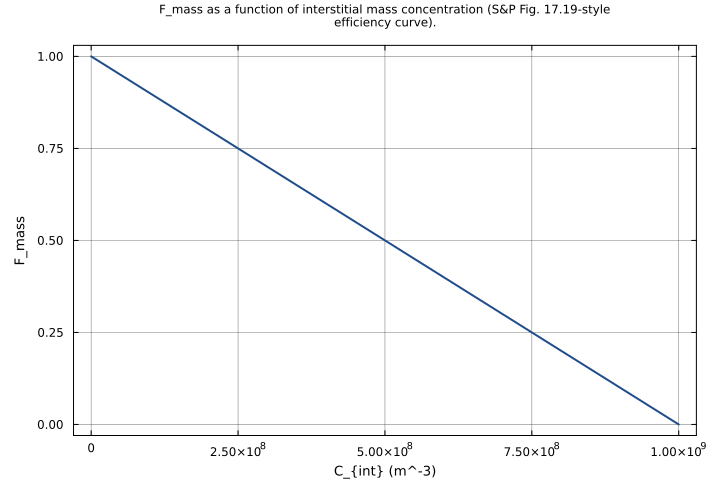
number_scavenging_ratio_sweep
Companion to the mass-efficiency sweep: varies N_int from 0 to N_0 at fixed N_0=1e9 m^-3 to trace the number-scavenging-efficiency curve (S&P Eq. 17.85). Useful for comparing mass vs number scavenging selectivity for representative aerosol size distributions — fine-mode-dominated populations scavenge less efficiently by number than by mass, which shows up as different slopes across this sweep and the mass sweep above.
Time span: 0.0 → 60.0
Swept over: N_int
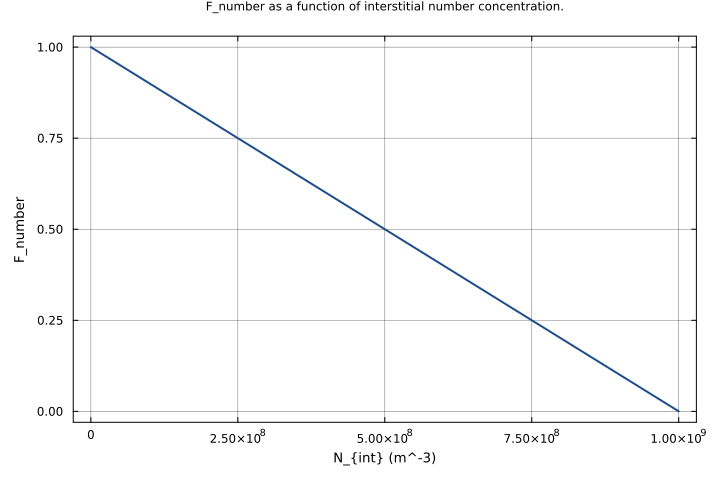
scavenging_coefficient_vs_droplet_density
Sweep cloud-droplet number density N_d across four orders of magnitude (1e6 to 1e10 m^-3) at fixed K_coll=1e-12 m^3/s. Λ = N_d * K_coll (S&P Eq. 17.92 in the monodisperse approximation) gives the canonical linear scaling — on a log-log axis the trajectory is a straight line, covering scavenging timescales from ~1 second (heavy cumulus) to ~12 days (thin cirrus).
Time span: 0.0 → 60.0
Swept over: N_d
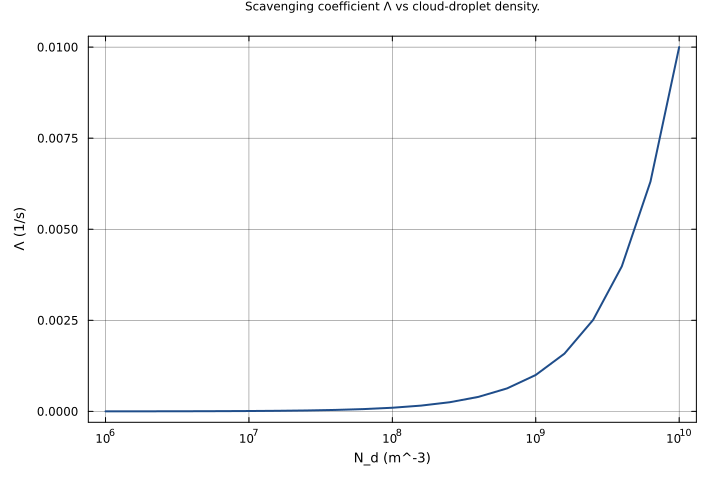
collision_kernel_vs_droplet_density_heatmap
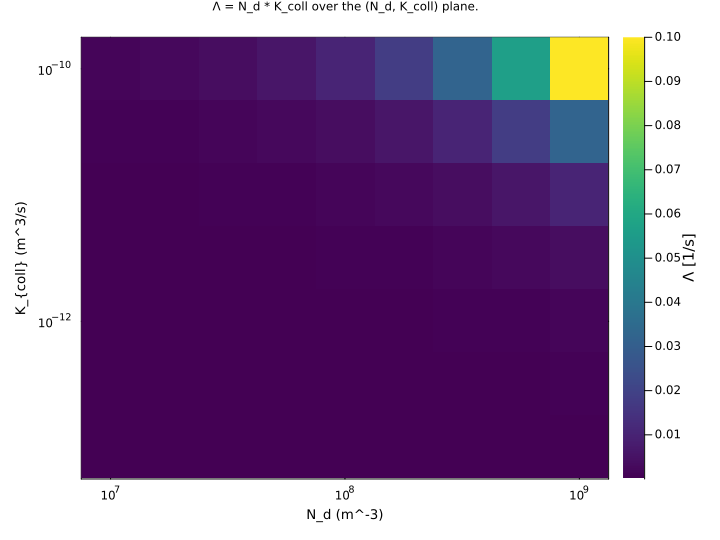
Two-dimensional sweep over cloud-droplet density and collision kernel, producing a heatmap of the scavenging coefficient Λ. Spans the joint range covered by the representative aerosol size distributions in S&P §17.6.2: N_d from stratiform (~1e7 m^-3) to convective (~1e9 m^-3), K_coll from below-cloud impaction of fine aerosols (~1e-13 m^3/s) up to in-cloud Brownian/turbulent scavenging of coarse aerosols (~1e-10 m^3/s). The product structure of Eq. 17.92 makes this a textbook ‘grid of constants’ exhibition — useful for reviewers sanity-checking the parameter ranges implied by a downstream coupled model.
Time span: 0.0 → 60.0
Swept over: N_d, K_coll
Raw .esm
Raw .esm JSON (this component)
{
  "variables": {
    "C_0": {
      "default": 1000000000.0,
      "type": "parameter",
      "units": "1/m^3",
      "description": "Initial aerosol mass concentration"
    },
    "C_int": {
      "default": 500000000.0,
      "type": "parameter",
      "units": "1/m^3",
      "description": "Interstitial aerosol mass concentration"
    },
    "N_0": {
      "default": 1000000000.0,
      "type": "parameter",
      "units": "1/m^3",
      "description": "Initial aerosol number concentration"
    },
    "N_int": {
      "default": 300000000.0,
      "type": "parameter",
      "units": "1/m^3",
      "description": "Interstitial aerosol number concentration"
    },
    "K_coll": {
      "default": 1e-12,
      "type": "parameter",
      "units": "m^3/s",
      "description": "Collision coefficient"
    },
    "N_d": {
      "default": 100000000.0,
      "type": "parameter",
      "units": "1/m^3",
      "description": "Cloud droplet number concentration"
    },
    "F_mass": {
      "type": "unknown",
      "units": "1",
      "description": "Mass scavenging ratio (dimensionless)"
    },
    "F_number": {
      "type": "unknown",
      "units": "1",
      "description": "Number scavenging ratio (dimensionless)"
    },
    "Λ": {
      "type": "unknown",
      "units": "1/s",
      "description": "Scavenging coefficient"
    }
  },
  "equations": [
    {
      "lhs": "F_mass",
      "rhs": {
        "op": "/",
        "args": [
          {
            "op": "+",
            "args": [
              "C_0",
              {
                "op": "*",
                "args": [
                  -1,
                  "C_int"
                ]
              }
            ]
          },
          "C_0"
        ]
      }
    },
    {
      "lhs": "F_number",
      "rhs": {
        "op": "/",
        "args": [
          {
            "op": "+",
            "args": [
              {
                "op": "*",
                "args": [
                  -1,
                  "N_int"
                ]
              },
              "N_0"
            ]
          },
          "N_0"
        ]
      }
    },
    {
      "lhs": "Λ",
      "rhs": {
        "op": "*",
        "args": [
          "N_d",
          "K_coll"
        ]
      }
    }
  ],
  "reference": {
    "notes": "source_ref: Aerosol.jl@c8c640bb:src/cloud_physics.jl:693\nSeinfeld, J. H. and Pandis, S. N. (2006), Atmospheric Chemistry and Physics: From Air Pollution to Climate Change, 2nd Edition, Wiley, Ch. 17. Key equations 17.84 (mass scavenging ratio), 17.85 (number scavenging ratio), and 17.92 (scavenging coefficient, monodisperse cloud-droplet approximation).\n\nTolerance rationale (model-level rel=1e-8 / abs=1e-12): time-independent algebraic system (zero ODE states after MTK structural_simplify; RHS depends only on parameters), so 1e-8 captures only float64 roundoff in F = 1 - C_int/C_0 (Eqs. 17.84-17.85) and Λ = N_d·K_coll (Eq. 17.92). abs=1e-12 floors the no-scavenging case (C_int = C_0 → F = 0) where rel comparison is undefined. See `no_scavenging_floor` test for per-assertion abs=1e-12 overrides on the F=0 boundary."
  },
  "tolerance": {
    "rel": 1e-08,
    "abs": 1e-12
  },
  "tests": [
    {
      "id": "defaults_behavior_multi_time",
      "description": "Reference run at upstream Aerosol.jl defaults (C_0=1e9, C_int=5e8, N_0=1e9, N_int=3e8, N_d=1e8, K_coll=1e-12). Reproduces upstream Aerosol test/cloud_physics_test.jl 'AerosolScavenging physical behavior': F_mass=0.5, F_number=0.7, Λ=1e-4 s^-1. Sampled at t=0, 60, 600, 3600 s to confirm the algebraic constraints hold across the full tspan (the RHS is time-independent, so every sample must return the same constant).",
      "time_span": {
        "start": 0.0,
        "end": 3600.0
      },
      "assertions": [
        {
          "variable": "F_mass",
          "time": 0.0,
          "expected": 0.5
        },
        {
          "variable": "F_mass",
          "time": 60.0,
          "expected": 0.5
        },
        {
          "variable": "F_mass",
          "time": 600.0,
          "expected": 0.5
        },
        {
          "variable": "F_mass",
          "time": 3600.0,
          "expected": 0.5
        },
        {
          "variable": "F_number",
          "time": 0.0,
          "expected": 0.7
        },
        {
          "variable": "F_number",
          "time": 60.0,
          "expected": 0.7
        },
        {
          "variable": "F_number",
          "time": 600.0,
          "expected": 0.7
        },
        {
          "variable": "F_number",
          "time": 3600.0,
          "expected": 0.7
        },
        {
          "variable": "Λ",
          "time": 0.0,
          "expected": 0.0001
        },
        {
          "variable": "Λ",
          "time": 60.0,
          "expected": 0.0001
        },
        {
          "variable": "Λ",
          "time": 600.0,
          "expected": 0.0001
        },
        {
          "variable": "Λ",
          "time": 3600.0,
          "expected": 0.0001
        }
      ]
    },
    {
      "id": "no_scavenging_floor",
      "description": "Interstitial = initial concentration → zero scavenging ratio. Lower bound of S&P Eqs. 17.84-17.85. F_mass and F_number must evaluate to exactly 0 when the cloud fails to remove any aerosol.\n\nPer-assertion tolerance rationale (abs=1.0e-12 on every assertion): expected=0, so the model-level rel comparison is undefined; abs=1e-12 alone gates these assertions and matches the model-level abs floor. abs is set explicitly per-assertion (not inherited) because the spec §6.6.4 precedence resolves the per-assertion `tolerance` block as a complete override, not a merge with the model-level rel.",
      "parameter_overrides": {
        "C_int": 1000000000.0,
        "N_int": 1000000000.0
      },
      "time_span": {
        "start": 0.0,
        "end": 600.0
      },
      "assertions": [
        {
          "variable": "F_mass",
          "time": 60.0,
          "expected": 0.0,
          "tolerance": {
            "abs": 1e-12
          }
        },
        {
          "variable": "F_mass",
          "time": 600.0,
          "expected": 0.0,
          "tolerance": {
            "abs": 1e-12
          }
        },
        {
          "variable": "F_number",
          "time": 60.0,
          "expected": 0.0,
          "tolerance": {
            "abs": 1e-12
          }
        },
        {
          "variable": "F_number",
          "time": 600.0,
          "expected": 0.0,
          "tolerance": {
            "abs": 1e-12
          }
        }
      ]
    },
    {
      "id": "complete_scavenging_ceiling",
      "description": "Interstitial = 0 → full scavenging. Upper bound of S&P Eqs. 17.84-17.85. F_mass and F_number must evaluate to exactly 1 when the cloud removes all aerosol.",
      "parameter_overrides": {
        "C_int": 0.0,
        "N_int": 0.0
      },
      "time_span": {
        "start": 0.0,
        "end": 600.0
      },
      "assertions": [
        {
          "variable": "F_mass",
          "time": 60.0,
          "expected": 1.0
        },
        {
          "variable": "F_mass",
          "time": 600.0,
          "expected": 1.0
        },
        {
          "variable": "F_number",
          "time": 60.0,
          "expected": 1.0
        },
        {
          "variable": "F_number",
          "time": 600.0,
          "expected": 1.0
        }
      ]
    },
    {
      "id": "asymmetric_mass_vs_number",
      "description": "Mass and number scavenging ratios differ when aerosols partition such that different fractions of mass vs number end up in cloud droplets. Exercises S&P Eqs. 17.84 and 17.85 as independent channels. F_mass = (2e9 - 1e9)/2e9 = 0.5; F_number = (1e9 - 2e8)/1e9 = 0.8.",
      "parameter_overrides": {
        "C_0": 2000000000.0,
        "C_int": 1000000000.0,
        "N_0": 1000000000.0,
        "N_int": 200000000.0
      },
      "time_span": {
        "start": 0.0,
        "end": 300.0
      },
      "assertions": [
        {
          "variable": "F_mass",
          "time": 300.0,
          "expected": 0.5
        },
        {
          "variable": "F_number",
          "time": 300.0,
          "expected": 0.8
        }
      ]
    },
    {
      "id": "scavenging_coeff_low_droplet_density",
      "description": "Low cloud-droplet number density (N_d=1e6 m^-3, K_coll=1e-12 m^3/s) yields a much smaller scavenging coefficient. Exercises the monodisperse S&P Eq. 17.92 scaling Λ = N_d * K_coll under a 100x decrease in droplet density.",
      "parameter_overrides": {
        "N_d": 1000000.0,
        "K_coll": 1e-12
      },
      "time_span": {
        "start": 0.0,
        "end": 600.0
      },
      "assertions": [
        {
          "variable": "Λ",
          "time": 60.0,
          "expected": 1e-06
        },
        {
          "variable": "Λ",
          "time": 600.0,
          "expected": 1e-06
        }
      ]
    },
    {
      "id": "scavenging_coeff_high_collision_kernel",
      "description": "High collision kernel (K_coll=5e-11 m^3/s) with default N_d=1e8 m^-3 yields Λ=5e-3 s^-1 (t_scav~200 s). Representative of efficient below-cloud impaction scavenging in S&P §17.6.2. Exercises Eq. 17.92 at the opposite end of the K_coll range from the defaults.",
      "parameter_overrides": {
        "K_coll": 5e-11
      },
      "time_span": {
        "start": 0.0,
        "end": 600.0
      },
      "assertions": [
        {
          "variable": "Λ",
          "time": 60.0,
          "expected": 0.005
        },
        {
          "variable": "Λ",
          "time": 600.0,
          "expected": 0.005
        }
      ]
    },
    {
      "id": "scavenging_ratio_bounds_check",
      "description": "S&P 17.84-17.85 require 0 <= F_mass, F_number <= 1 for all physically meaningful inputs. This test confirms a realistic intermediate case (F_mass=0.25, F_number=0.55) lies strictly in the open interval, complementing the 0-floor and 1-ceiling tests.",
      "parameter_overrides": {
        "C_0": 4000000000.0,
        "C_int": 3000000000.0,
        "N_0": 2000000000.0,
        "N_int": 900000000.0
      },
      "time_span": {
        "start": 0.0,
        "end": 1200.0
      },
      "assertions": [
        {
          "variable": "F_mass",
          "time": 1200.0,
          "expected": 0.25
        },
        {
          "variable": "F_number",
          "time": 1200.0,
          "expected": 0.55
        }
      ]
    }
  ],
  "analyses": [
    {
      "id": "defaults_trajectory",
      "description": "Reference-run trajectories of F_mass, F_number, and Λ at upstream Aerosol.jl defaults over a 1-hour window. All three states are time-independent under S&P Eqs. 17.84-17.92, so the line plots are horizontal and make the algebraic-constraint structure of the model visually obvious.",
      "time_span": {
        "start": 0.0,
        "end": 3600.0
      },
      "plots": [
        {
          "id": "scavenging_ratios_vs_time",
          "type": "line",
          "description": "F_mass and F_number remain at their algebraic values (0.5 and 0.7) for the full hour.",
          "x": {
            "variable": "t",
            "label": "time (s)"
          },
          "y": {
            "variable": "F_mass",
            "label": "scavenging ratio (dimensionless)"
          },
          "series": [
            {
              "name": "F_mass",
              "variable": "F_mass"
            },
            {
              "name": "F_number",
              "variable": "F_number"
            }
          ]
        },
        {
          "id": "scavenging_coefficient_vs_time",
          "type": "line",
          "description": "Λ trajectory at defaults. Constant at N_d * K_coll = 1e-4 s^-1 (timescale ~ 2.8 hours).",
          "x": {
            "variable": "t",
            "label": "time (s)"
          },
          "y": {
            "variable": "Λ",
            "label": "Λ (1/s)"
          }
        }
      ]
    },
    {
      "id": "mass_scavenging_ratio_sweep",
      "description": "Sweep the interstitial mass concentration from 0 up to C_0 at fixed C_0=1e9 m^-3, tracing out the full physically meaningful range of F_mass (0 to 1). This is the mass-scavenging-efficiency curve implied by S&P Eq. 17.84: F_mass = 1 - C_int/C_0.",
      "time_span": {
        "start": 0.0,
        "end": 60.0
      },
      "parameter_sweep": {
        "type": "cartesian",
        "dimensions": [
          {
            "parameter": "C_int",
            "range": {
              "start": 0.0,
              "stop": 1000000000.0,
              "count": 21,
              "scale": "linear"
            }
          }
        ]
      },
      "plots": [
        {
          "id": "F_mass_vs_C_int",
          "type": "line",
          "description": "F_mass as a function of interstitial mass concentration (S&P Fig. 17.19-style efficiency curve).",
          "x": {
            "variable": "C_int",
            "label": "C_{int} (m^-3)"
          },
          "y": {
            "variable": "F_mass",
            "label": "F_mass"
          }
        }
      ]
    },
    {
      "id": "number_scavenging_ratio_sweep",
      "description": "Companion to the mass-efficiency sweep: varies N_int from 0 to N_0 at fixed N_0=1e9 m^-3 to trace the number-scavenging-efficiency curve (S&P Eq. 17.85). Useful for comparing mass vs number scavenging selectivity for representative aerosol size distributions — fine-mode-dominated populations scavenge less efficiently by number than by mass, which shows up as different slopes across this sweep and the mass sweep above.",
      "time_span": {
        "start": 0.0,
        "end": 60.0
      },
      "parameter_sweep": {
        "type": "cartesian",
        "dimensions": [
          {
            "parameter": "N_int",
            "range": {
              "start": 0.0,
              "stop": 1000000000.0,
              "count": 21,
              "scale": "linear"
            }
          }
        ]
      },
      "plots": [
        {
          "id": "F_number_vs_N_int",
          "type": "line",
          "description": "F_number as a function of interstitial number concentration.",
          "x": {
            "variable": "N_int",
            "label": "N_{int} (m^-3)"
          },
          "y": {
            "variable": "F_number",
            "label": "F_number"
          }
        }
      ]
    },
    {
      "id": "scavenging_coefficient_vs_droplet_density",
      "description": "Sweep cloud-droplet number density N_d across four orders of magnitude (1e6 to 1e10 m^-3) at fixed K_coll=1e-12 m^3/s. Λ = N_d * K_coll (S&P Eq. 17.92 in the monodisperse approximation) gives the canonical linear scaling — on a log-log axis the trajectory is a straight line, covering scavenging timescales from ~1 second (heavy cumulus) to ~12 days (thin cirrus).",
      "time_span": {
        "start": 0.0,
        "end": 60.0
      },
      "parameter_sweep": {
        "type": "cartesian",
        "dimensions": [
          {
            "parameter": "N_d",
            "range": {
              "start": 1000000.0,
              "stop": 10000000000.0,
              "count": 21,
              "scale": "log"
            }
          }
        ]
      },
      "plots": [
        {
          "id": "lambda_vs_Nd",
          "type": "line",
          "description": "Scavenging coefficient Λ vs cloud-droplet density.",
          "x": {
            "variable": "N_d",
            "label": "N_d (m^-3)"
          },
          "y": {
            "variable": "Λ",
            "label": "Λ (1/s)"
          }
        }
      ]
    },
    {
      "id": "collision_kernel_vs_droplet_density_heatmap",
      "description": "Two-dimensional sweep over cloud-droplet density and collision kernel, producing a heatmap of the scavenging coefficient Λ. Spans the joint range covered by the representative aerosol size distributions in S&P §17.6.2: N_d from stratiform (~1e7 m^-3) to convective (~1e9 m^-3), K_coll from below-cloud impaction of fine aerosols (~1e-13 m^3/s) up to in-cloud Brownian/turbulent scavenging of coarse aerosols (~1e-10 m^3/s). The product structure of Eq. 17.92 makes this a textbook 'grid of constants' exhibition — useful for reviewers sanity-checking the parameter ranges implied by a downstream coupled model.",
      "time_span": {
        "start": 0.0,
        "end": 60.0
      },
      "parameter_sweep": {
        "type": "cartesian",
        "dimensions": [
          {
            "parameter": "N_d",
            "range": {
              "start": 10000000.0,
              "stop": 1000000000.0,
              "count": 9,
              "scale": "log"
            }
          },
          {
            "parameter": "K_coll",
            "range": {
              "start": 1e-13,
              "stop": 1e-10,
              "count": 7,
              "scale": "log"
            }
          }
        ]
      },
      "plots": [
        {
          "id": "lambda_heatmap",
          "type": "heatmap",
          "description": "Λ = N_d * K_coll over the (N_d, K_coll) plane.",
          "x": {
            "variable": "N_d",
            "label": "N_d (m^-3)"
          },
          "y": {
            "variable": "K_coll",
            "label": "K_{coll} (m^3/s)"
          },
          "value": {
            "variable": "Λ",
            "reduce": "final"
          }
        }
      ]
    }
  ]
}