CloudChemistryODE
Dynamic cloud droplet chemistry: time evolution of sulfate concentration as S(IV) is oxidized to S(VI) via O3, H2O2, and Fe/Mn-catalyzed pathways (Seinfeld & Pandis 2006, Chapter 7, Eqs. 7.79-7.102). Gas-liquid equilibria (SO2, H2O2, O3) are assumed instantaneous; the sulfate ODE tracks the kinetic accumulation. Migrated from Aerosol.jl src/cloud_chemistry.jl:422.
Description
Dynamic cloud droplet chemistry: time evolution of sulfate concentration as S(IV) is oxidized to S(VI) via O3, H2O2, and Fe/Mn-catalyzed pathways (Seinfeld & Pandis 2006, Chapter 7, Eqs. 7.79-7.102). Gas-liquid equilibria (SO2, H2O2, O3) are assumed instantaneous; the sulfate ODE tracks the kinetic accumulation. Migrated from Aerosol.jl src/cloud_chemistry.jl:422.
Reference
Seinfeld, J. H., and Pandis, S. N. (2006). Atmospheric Chemistry and Physics: From Air Pollution to Climate Change, 2nd Edition, John Wiley & Sons. Key equations: 7.33/7.34/7.35 (SO2 equilibria), 7.79 (O3 oxidation rate), 7.84 (H2O2 oxidation rate), 7.102 (Fe/Mn synergistic oxidation). Migrated from Aerosol.jl@c8c640bb636b22f2425460e9ed5cba50793bfee1:src/cloud_chemistry.jl:422 (esm-tum).
_source_ref: Aerosol.jl@c8c640bb636b22f2425460e9ed5cba50793bfee1:src/cloud_chemistry.jl:422
CloudChemistryODE is an ODE model for sulfate accumulation in a cloud droplet. It has one dynamic (ODE) state, SO4_2minus, and a system of algebraic equations capturing SO2/H2O2/O3 gas-liquid equilibria and S(IV) oxidation kinetics.
Flattening: The original MTK model uses four subsystems (SO2Equilibria, H2O2Equilibria, O3Equilibria, SulfateFormation). All subsystem equations are inlined here. Constants that appeared as MTK @constants are promoted to parameters with fixed defaults. The T_ref parameter is shared across all van’t Hoff temperature corrections.
Unit conversions from upstream: Henry’s law constants: converted from M/atm to mol/(m³·Pa): × 1000/101325 Dissociation constants: converted from M to mol/m³: × 1000 O3/Mn rate constant k0: converted from M⁻¹s⁻¹ to m³/(mol·s): ÷ 1000 H2O2 rate constant k: converted from M⁻²s⁻¹ to m⁶/(mol²·s): ÷ 1e6 K_eq for H2O2: converted from M⁻¹ to m³/mol: ÷ 1000 FeMn rate constants: k_Mn/k_Fe: ÷ 1000; k_FeMn: ÷ 1e6
Oxidation pathways: R_O3 = (k0·[SO2·H2O] + k1·[HSO3⁻] + k2·[SO3²⁻]) · [O3(aq)] (Eq 7.79) R_H2O2 = k·[H⁺]·[H2O2]·[HSO3⁻] / (1 + K_eq·[H⁺]) (Eq 7.84) R_FeMn = (k_Mn·[Mn²⁺] + k_Fe·[Fe³⁺] + k_FeMn·[Mn²⁺]·[Fe³⁺])·[S(IV)] (Eq 7.102) R_total = R_O3 + R_H2O2 + R_FeMn d[SO4²⁻]/dt = R_total
Tolerance rationale (model-level rel=1e-6 / abs=1e-14): The system has one ODE state (SO4_2minus) driven by algebraic R_total. R_total is O(1e-4) mol/m³/s at defaults, and SO4_2minus grows O(1e-2 to 0.4) mol/m³ over 300-3600 s. rel=1e-6 captures float64 roundoff in the van’t Hoff exponentials and the nonlinear R_H2O2 denominator; abs=1e-14 floors the zero-metal-catalyst FeMn term._
Variables
| Name | Units | Default | Description |
|---|---|---|---|
SO4_2minus | mol/m^3 | 0.0 | Sulfate concentration [SO4²⁻]; evolves via d[SO4²⁻]/dt = R_total (S(IV) oxidation) |
Parameters
| Name | Units | Default | Description |
|---|---|---|---|
T | K | 298.0 | Temperature |
pH_input | 1 | 4.0 | Cloud droplet pH (input, dimensionless) |
p_SO2 | Pa | 0.000101325 | Partial pressure of SO2 (1 ppb = 101325×10⁻⁹ Pa) |
p_H2O2 | Pa | 0.000101325 | Partial pressure of H2O2 (1 ppb = 101325×10⁻⁹ Pa) |
p_O3 | Pa | 0.00506625 | Partial pressure of O3 (50 ppb = 50×101325×10⁻⁹ Pa) |
Fe_III | mol/m^3 | 0.0 | Fe(III) concentration in cloud droplet |
Mn_II | mol/m^3 | 0.0 | Mn(II) concentration in cloud droplet |
L | g/m^3 | 0.3 | Liquid water content |
xi_SO2 | 1 | 1e-09 | SO2 gas-phase mixing ratio (dimensionless, 1 ppb = 1e-9) |
R_gas | J/(mol*K) | 8.314 | Universal gas constant |
T_ref | K | 298.0 | Reference temperature for van’t Hoff equations (298.15 K rounded) |
C_ref | mol/m^3 | 1000.0 | Reference concentration (1 mol/L = 1000 mol/m³); converts pH to [H⁺] in mol/m³ |
H_SO2_298 | mol/(m^3*Pa) | 0.012139156180606956 | Henry’s law constant for SO2 at 298 K (1.23 M/atm converted to SI) |
dH_H_SO2 | J/mol | -26150.0 | Enthalpy of dissolution for SO2 (−6.25 kcal/mol); negative = exothermic, more soluble at lower T |
K_s1_298 | mol/m^3 | 13.0 | First SO2 dissociation constant at 298 K: SO2·H2O ⇌ H⁺ + HSO3⁻ (1.3×10⁻² M converted to mol/m³) |
K_s2_298 | mol/m^3 | 6.599999999999999e-05 | Second SO2 dissociation constant at 298 K: HSO3⁻ ⇌ H⁺ + SO3²⁻ (6.6×10⁻⁸ M converted to mol/m³) |
dH_Ks1 | J/mol | -17405.44 | Enthalpy for K_s1 (−4.16 kcal/mol) |
dH_Ks2 | J/mol | -9330.32 | Enthalpy for K_s2 (−2.23 kcal/mol) |
H_H2O2_298 | mol/(m^3*Pa) | 986.9232667160128 | Henry’s law constant for H2O2 at 298 K (1×10⁵ M/atm converted to SI) |
dH_H_H2O2 | J/mol | -60668.0 | Enthalpy of dissolution for H2O2 (−14.5 kcal/mol) |
H_O3_298 | mol/(m^3*Pa) | 0.0001085615593387614 | Henry’s law constant for O3 at 298 K (1.1×10⁻² M/atm converted to SI) |
dH_H_O3 | J/mol | -21087.36 | Enthalpy of dissolution for O3 (−5.04 kcal/mol) |
k0_O3 | m^3/(mol*s) | 24.0 | O3 oxidation rate constant for SO2·H2O (2.4×10⁴ M⁻¹s⁻¹ ÷ 1000; S&P Eq 7.79) |
k1_O3 | m^3/(mol*s) | 370.0 | O3 oxidation rate constant for HSO3⁻ (3.7×10⁵ M⁻¹s⁻¹ ÷ 1000; S&P Eq 7.79) |
k2_O3 | m^3/(mol*s) | 1500000.0 | O3 oxidation rate constant for SO3²⁻ (1.5×10⁹ M⁻¹s⁻¹ ÷ 1000; S&P Eq 7.79); dominates at high pH |
k_H2O2 | m^6/(mol^2*s) | 75.0 | H2O2 oxidation rate constant (7.5×10⁷ M⁻²s⁻¹ ÷ 10⁶; S&P Eq 7.84) |
K_eq_H2O2 | m^3/mol | 0.013 | Equilibrium constant in H2O2 rate denominator (13 M⁻¹ ÷ 1000; S&P Eq 7.84) |
k_Mn_SIV | m^3/(mol*s) | 0.75 | Mn(II)-only term rate constant (750 M⁻¹s⁻¹ ÷ 1000; S&P Eq 7.102) |
k_Fe_SIV | m^3/(mol*s) | 2.6 | Fe(III)-only term rate constant (2600 M⁻¹s⁻¹ ÷ 1000; S&P Eq 7.102) |
k_FeMn_SIV | m^6/(mol^2*s) | 10000.0 | Fe/Mn synergistic rate constant (10¹⁰ M⁻²s⁻¹ ÷ 10⁶; S&P Eq 7.102); dominates when both metals present |
Observed
| Name | Units | Default | Description |
|---|---|---|---|
H_plus | mol/m^3 | H⁺ concentration derived from input pH: H_plus = C_ref × 10^(−pH_input) | |
H_SO2 | mol/(m^3*Pa) | Temperature-dependent Henry’s law constant for SO2 (van’t Hoff) | |
K_s1 | mol/m^3 | Temperature-dependent first SO2 dissociation constant (van’t Hoff) | |
K_s2 | mol/m^3 | Temperature-dependent second SO2 dissociation constant (van’t Hoff) | |
SO2_aq | mol/m^3 | Aqueous SO2 concentration [SO2·H2O] from Henry’s law: SO2_aq = H_SO2 × p_SO2 | |
HSO3_minus | mol/m^3 | Bisulfite concentration [HSO3⁻] from first dissociation equilibrium | |
SO3_2minus | mol/m^3 | Sulfite concentration [SO3²⁻] from second dissociation equilibrium | |
S_IV_total | mol/m^3 | Total S(IV) concentration: SO2_aq + HSO3_minus + SO3_2minus | |
H_H2O2 | mol/(m^3*Pa) | Temperature-dependent Henry’s law constant for H2O2 (van’t Hoff) | |
H2O2_aq | mol/m^3 | Aqueous H2O2 concentration from Henry’s law | |
H_O3 | mol/(m^3*Pa) | Temperature-dependent Henry’s law constant for O3 (van’t Hoff) | |
O3_aq | mol/m^3 | Aqueous O3 concentration from Henry’s law | |
R_O3 | mol/(m^3*s) | S(IV) oxidation rate by O3 (S&P Eq 7.79); increases strongly with pH via SO3²⁻ pathway | |
R_H2O2 | mol/(m^3*s) | S(IV) oxidation rate by H2O2 (S&P Eq 7.84); relatively pH-independent | |
R_FeMn | mol/(m^3*s) | S(IV) oxidation rate by Fe/Mn-catalyzed O2 with synergism (S&P Eq 7.102) | |
R_total | mol/(m^3*s) | Total S(IV) oxidation rate; drives sulfate ODE: d[SO4²⁻]/dt = R_total |
Observed expressions
$$ H_{plus} = C_{ref} \cdot 10.0^{\left(-1.0\right) \cdot pH_{input}} $$H⁺ concentration derived from input pH: H_plus = C_ref × 10^(−pH_input)
$$ H_{SO2} = H_{SO2\,298} \cdot e^{\frac{dH_{H\,SO2}}{R_{gas}} \cdot \left(\frac{1}{T_{ref}} + \frac{-1}{T}\right)} $$Temperature-dependent Henry’s law constant for SO2 (van’t Hoff)
$$ K_{s1} = K_{s1\,298} \cdot e^{\left(-1\right) \cdot \frac{dH_{Ks1}}{R_{gas}} \cdot \left(\frac{1}{T} + \frac{-1}{T_{ref}}\right)} $$Temperature-dependent first SO2 dissociation constant (van’t Hoff)
$$ K_{s2} = K_{s2\,298} \cdot e^{\left(-1\right) \cdot \frac{dH_{Ks2}}{R_{gas}} \cdot \left(\frac{1}{T} + \frac{-1}{T_{ref}}\right)} $$Temperature-dependent second SO2 dissociation constant (van’t Hoff)
$$ SO2_{aq} = H_{SO2} \cdot p_{SO2} $$Aqueous SO2 concentration [SO2·H2O] from Henry’s law: SO2_aq = H_SO2 × p_SO2
$$ HSO3_{minus} = \frac{K_{s1} \cdot SO2_{aq}}{H_{plus}} $$Bisulfite concentration [HSO3⁻] from first dissociation equilibrium
$$ SO3_{2minus} = \frac{K_{s2} \cdot HSO3_{minus}}{H_{plus}} $$Sulfite concentration [SO3²⁻] from second dissociation equilibrium
$$ S_{IV\,total} = SO2_{aq} + HSO3_{minus} + SO3_{2minus} $$Total S(IV) concentration: SO2_aq + HSO3_minus + SO3_2minus
$$ H_{H2O2} = H_{H2O2\,298} \cdot e^{\frac{dH_{H\,H2O2}}{R_{gas}} \cdot \left(\frac{1}{T_{ref}} + \frac{-1}{T}\right)} $$Temperature-dependent Henry’s law constant for H2O2 (van’t Hoff)
$$ H2O2_{aq} = H_{H2O2} \cdot p_{H2O2} $$Aqueous H2O2 concentration from Henry’s law
$$ H_{O3} = H_{O3\,298} \cdot e^{\frac{dH_{H\,O3}}{R_{gas}} \cdot \left(\frac{1}{T_{ref}} + \frac{-1}{T}\right)} $$Temperature-dependent Henry’s law constant for O3 (van’t Hoff)
$$ O3_{aq} = H_{O3} \cdot p_{O3} $$Aqueous O3 concentration from Henry’s law
$$ R_{O3} = \left(k0_{O3} \cdot SO2_{aq} + k1_{O3} \cdot HSO3_{minus} + k2_{O3} \cdot SO3_{2minus}\right) \cdot O3_{aq} $$S(IV) oxidation rate by O3 (S&P Eq 7.79); increases strongly with pH via SO3²⁻ pathway
$$ R_{H2O2} = \frac{k_{H2O2} \cdot H_{plus} \cdot H2O2_{aq} \cdot HSO3_{minus}}{1.0 + K_{eq\,H2O2} \cdot H_{plus}} $$S(IV) oxidation rate by H2O2 (S&P Eq 7.84); relatively pH-independent
$$ R_{FeMn} = k_{Mn\,SIV} \cdot Mn_{II} \cdot S_{IV\,total} + k_{Fe\,SIV} \cdot Fe_{III} \cdot S_{IV\,total} + k_{FeMn\,SIV} \cdot Mn_{II} \cdot Fe_{III} \cdot S_{IV\,total} $$S(IV) oxidation rate by Fe/Mn-catalyzed O2 with synergism (S&P Eq 7.102)
$$ R_{total} = R_{O3} + R_{H2O2} + R_{FeMn} $$Total S(IV) oxidation rate; drives sulfate ODE: d[SO4²⁻]/dt = R_total
Equations
$$ \mathrm{D}\left(SO4_{2minus}\right) = R_{total} $$Analyses
sulfate_accumulation_over_cloud_lifetime
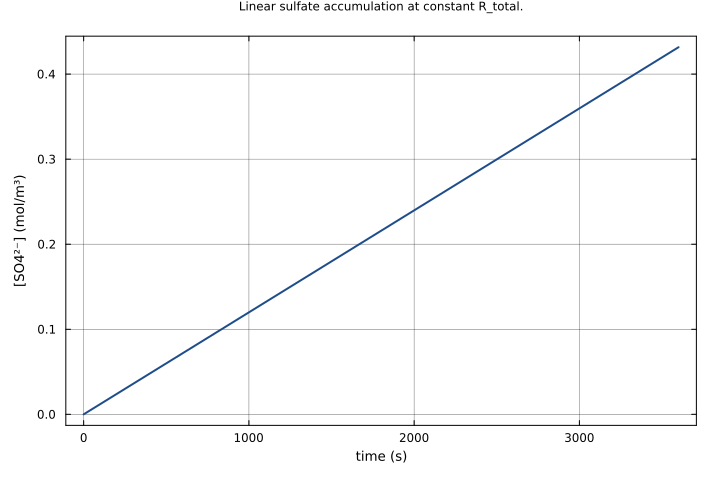
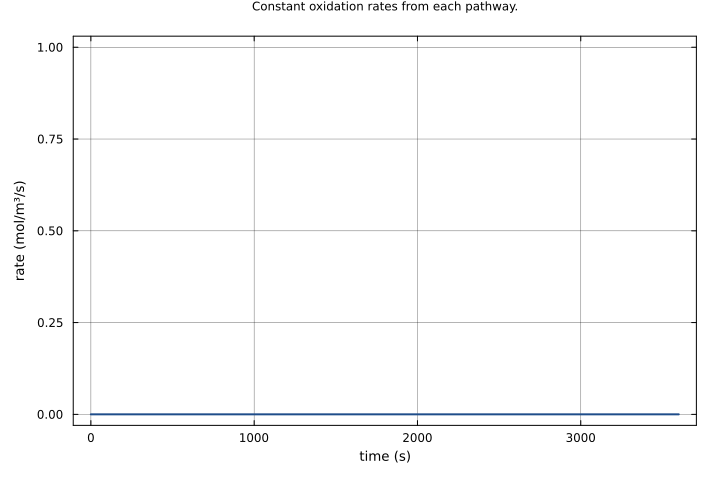
Sulfate concentration trajectory over a 1-hour cloud lifetime at default conditions (T=298 K, pH=4, 1 ppb SO2/H2O2, 50 ppb O3, no metals). SO4_2minus grows linearly since R_total is constant when inputs are fixed. Shows the H2O2 pathway dominance at pH=4.
Time span: 0.0 → 3600.0
pH_sensitivity_sweep
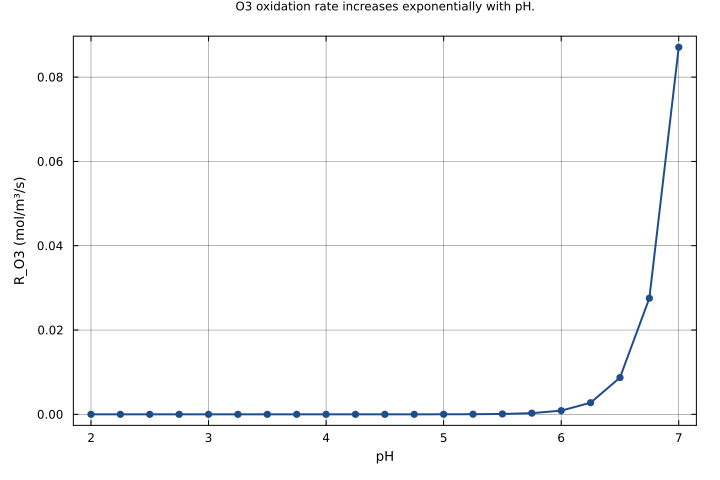
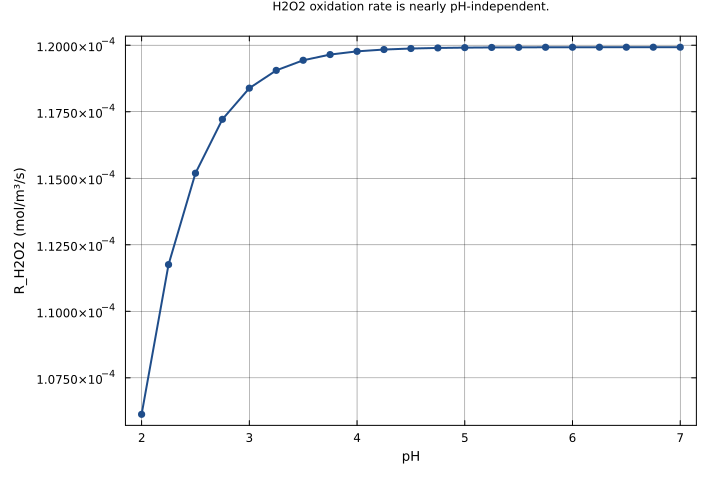
Sweep cloud droplet pH from 2 to 7 to show the strong pH dependence of the O3 pathway (dominates at high pH via SO3²⁻) vs. the near-pH-independent H2O2 pathway. Reproduces the S&P Fig. 7.8 qualitative behavior.
Time span: 0.0 → 60.0
Swept over: pH_input
temperature_sensitivity_sweep
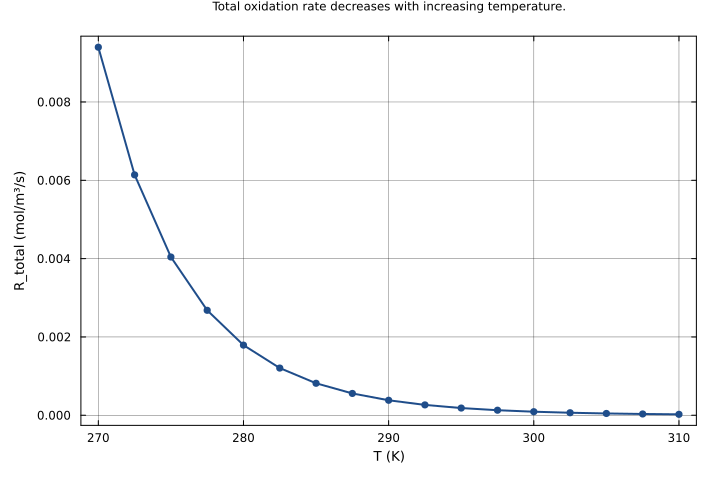
Sweep temperature from 270 to 310 K to show how lower temperatures increase gas-phase solubility (negative dissolution enthalpies) and thus accelerate aqueous-phase oxidation.
Time span: 0.0 → 60.0
Swept over: T
Raw .esm
Raw .esm JSON (this component)
{
"reference": {
"citation": "Seinfeld, J. H., and Pandis, S. N. (2006). Atmospheric Chemistry and Physics: From Air Pollution to Climate Change, 2nd Edition, John Wiley & Sons. Key equations: 7.33/7.34/7.35 (SO2 equilibria), 7.79 (O3 oxidation rate), 7.84 (H2O2 oxidation rate), 7.102 (Fe/Mn synergistic oxidation). Migrated from Aerosol.jl@c8c640bb636b22f2425460e9ed5cba50793bfee1:src/cloud_chemistry.jl:422 (esm-tum).",
"notes": "source_ref: Aerosol.jl@c8c640bb636b22f2425460e9ed5cba50793bfee1:src/cloud_chemistry.jl:422\n\nCloudChemistryODE is an ODE model for sulfate accumulation in a cloud droplet. It has one dynamic (ODE) state, SO4_2minus, and a system of algebraic equations capturing SO2/H2O2/O3 gas-liquid equilibria and S(IV) oxidation kinetics.\n\nFlattening: The original MTK model uses four subsystems (SO2Equilibria, H2O2Equilibria, O3Equilibria, SulfateFormation). All subsystem equations are inlined here. Constants that appeared as MTK @constants are promoted to parameters with fixed defaults. The T_ref parameter is shared across all van't Hoff temperature corrections.\n\nUnit conversions from upstream:\n Henry's law constants: converted from M/atm to mol/(m³·Pa): × 1000/101325\n Dissociation constants: converted from M to mol/m³: × 1000\n O3/Mn rate constant k0: converted from M⁻¹s⁻¹ to m³/(mol·s): ÷ 1000\n H2O2 rate constant k: converted from M⁻²s⁻¹ to m⁶/(mol²·s): ÷ 1e6\n K_eq for H2O2: converted from M⁻¹ to m³/mol: ÷ 1000\n FeMn rate constants: k_Mn/k_Fe: ÷ 1000; k_FeMn: ÷ 1e6\n\nOxidation pathways:\n R_O3 = (k0·[SO2·H2O] + k1·[HSO3⁻] + k2·[SO3²⁻]) · [O3(aq)] (Eq 7.79)\n R_H2O2 = k·[H⁺]·[H2O2]·[HSO3⁻] / (1 + K_eq·[H⁺]) (Eq 7.84)\n R_FeMn = (k_Mn·[Mn²⁺] + k_Fe·[Fe³⁺] + k_FeMn·[Mn²⁺]·[Fe³⁺])·[S(IV)] (Eq 7.102)\n R_total = R_O3 + R_H2O2 + R_FeMn\n d[SO4²⁻]/dt = R_total\n\nTolerance rationale (model-level rel=1e-6 / abs=1e-14): The system has one ODE state (SO4_2minus) driven by algebraic R_total. R_total is O(1e-4) mol/m³/s at defaults, and SO4_2minus grows O(1e-2 to 0.4) mol/m³ over 300-3600 s. rel=1e-6 captures float64 roundoff in the van't Hoff exponentials and the nonlinear R_H2O2 denominator; abs=1e-14 floors the zero-metal-catalyst FeMn term."
},
"tolerance": {
"rel": 1e-06,
"abs": 1e-14
},
"variables": {
"SO4_2minus": {
"type": "unknown",
"units": "mol/m^3",
"default": 0.0,
"description": "Sulfate concentration [SO4²⁻]; evolves via d[SO4²⁻]/dt = R_total (S(IV) oxidation)"
},
"T": {
"type": "parameter",
"units": "K",
"default": 298.0,
"description": "Temperature"
},
"pH_input": {
"type": "parameter",
"units": "1",
"default": 4.0,
"description": "Cloud droplet pH (input, dimensionless)"
},
"p_SO2": {
"type": "parameter",
"units": "Pa",
"default": 0.000101325,
"description": "Partial pressure of SO2 (1 ppb = 101325×10⁻⁹ Pa)"
},
"p_H2O2": {
"type": "parameter",
"units": "Pa",
"default": 0.000101325,
"description": "Partial pressure of H2O2 (1 ppb = 101325×10⁻⁹ Pa)"
},
"p_O3": {
"type": "parameter",
"units": "Pa",
"default": 0.00506625,
"description": "Partial pressure of O3 (50 ppb = 50×101325×10⁻⁹ Pa)"
},
"Fe_III": {
"type": "parameter",
"units": "mol/m^3",
"default": 0.0,
"description": "Fe(III) concentration in cloud droplet"
},
"Mn_II": {
"type": "parameter",
"units": "mol/m^3",
"default": 0.0,
"description": "Mn(II) concentration in cloud droplet"
},
"L": {
"type": "parameter",
"units": "g/m^3",
"default": 0.3,
"description": "Liquid water content"
},
"xi_SO2": {
"type": "parameter",
"units": "1",
"default": 1e-09,
"description": "SO2 gas-phase mixing ratio (dimensionless, 1 ppb = 1e-9)"
},
"R_gas": {
"type": "parameter",
"units": "J/(mol*K)",
"default": 8.314,
"description": "Universal gas constant"
},
"T_ref": {
"type": "parameter",
"units": "K",
"default": 298.0,
"description": "Reference temperature for van't Hoff equations (298.15 K rounded)"
},
"C_ref": {
"type": "parameter",
"units": "mol/m^3",
"default": 1000.0,
"description": "Reference concentration (1 mol/L = 1000 mol/m³); converts pH to [H⁺] in mol/m³"
},
"H_SO2_298": {
"type": "parameter",
"units": "mol/(m^3*Pa)",
"default": 0.012139156180606956,
"description": "Henry's law constant for SO2 at 298 K (1.23 M/atm converted to SI)"
},
"dH_H_SO2": {
"type": "parameter",
"units": "J/mol",
"default": -26150.0,
"description": "Enthalpy of dissolution for SO2 (−6.25 kcal/mol); negative = exothermic, more soluble at lower T"
},
"K_s1_298": {
"type": "parameter",
"units": "mol/m^3",
"default": 13.0,
"description": "First SO2 dissociation constant at 298 K: SO2·H2O ⇌ H⁺ + HSO3⁻ (1.3×10⁻² M converted to mol/m³)"
},
"K_s2_298": {
"type": "parameter",
"units": "mol/m^3",
"default": 6.599999999999999e-05,
"description": "Second SO2 dissociation constant at 298 K: HSO3⁻ ⇌ H⁺ + SO3²⁻ (6.6×10⁻⁸ M converted to mol/m³)"
},
"dH_Ks1": {
"type": "parameter",
"units": "J/mol",
"default": -17405.44,
"description": "Enthalpy for K_s1 (−4.16 kcal/mol)"
},
"dH_Ks2": {
"type": "parameter",
"units": "J/mol",
"default": -9330.32,
"description": "Enthalpy for K_s2 (−2.23 kcal/mol)"
},
"H_H2O2_298": {
"type": "parameter",
"units": "mol/(m^3*Pa)",
"default": 986.9232667160128,
"description": "Henry's law constant for H2O2 at 298 K (1×10⁵ M/atm converted to SI)"
},
"dH_H_H2O2": {
"type": "parameter",
"units": "J/mol",
"default": -60668.0,
"description": "Enthalpy of dissolution for H2O2 (−14.5 kcal/mol)"
},
"H_O3_298": {
"type": "parameter",
"units": "mol/(m^3*Pa)",
"default": 0.0001085615593387614,
"description": "Henry's law constant for O3 at 298 K (1.1×10⁻² M/atm converted to SI)"
},
"dH_H_O3": {
"type": "parameter",
"units": "J/mol",
"default": -21087.36,
"description": "Enthalpy of dissolution for O3 (−5.04 kcal/mol)"
},
"k0_O3": {
"type": "parameter",
"units": "m^3/(mol*s)",
"default": 24.0,
"description": "O3 oxidation rate constant for SO2·H2O (2.4×10⁴ M⁻¹s⁻¹ ÷ 1000; S&P Eq 7.79)"
},
"k1_O3": {
"type": "parameter",
"units": "m^3/(mol*s)",
"default": 370.0,
"description": "O3 oxidation rate constant for HSO3⁻ (3.7×10⁵ M⁻¹s⁻¹ ÷ 1000; S&P Eq 7.79)"
},
"k2_O3": {
"type": "parameter",
"units": "m^3/(mol*s)",
"default": 1500000.0,
"description": "O3 oxidation rate constant for SO3²⁻ (1.5×10⁹ M⁻¹s⁻¹ ÷ 1000; S&P Eq 7.79); dominates at high pH"
},
"k_H2O2": {
"type": "parameter",
"units": "m^6/(mol^2*s)",
"default": 75.0,
"description": "H2O2 oxidation rate constant (7.5×10⁷ M⁻²s⁻¹ ÷ 10⁶; S&P Eq 7.84)"
},
"K_eq_H2O2": {
"type": "parameter",
"units": "m^3/mol",
"default": 0.013,
"description": "Equilibrium constant in H2O2 rate denominator (13 M⁻¹ ÷ 1000; S&P Eq 7.84)"
},
"k_Mn_SIV": {
"type": "parameter",
"units": "m^3/(mol*s)",
"default": 0.75,
"description": "Mn(II)-only term rate constant (750 M⁻¹s⁻¹ ÷ 1000; S&P Eq 7.102)"
},
"k_Fe_SIV": {
"type": "parameter",
"units": "m^3/(mol*s)",
"default": 2.6,
"description": "Fe(III)-only term rate constant (2600 M⁻¹s⁻¹ ÷ 1000; S&P Eq 7.102)"
},
"k_FeMn_SIV": {
"type": "parameter",
"units": "m^6/(mol^2*s)",
"default": 10000.0,
"description": "Fe/Mn synergistic rate constant (10¹⁰ M⁻²s⁻¹ ÷ 10⁶; S&P Eq 7.102); dominates when both metals present"
},
"H_plus": {
"type": "unknown",
"units": "mol/m^3",
"description": "H⁺ concentration derived from input pH: H_plus = C_ref × 10^(−pH_input)"
},
"H_SO2": {
"type": "unknown",
"units": "mol/(m^3*Pa)",
"description": "Temperature-dependent Henry's law constant for SO2 (van't Hoff)"
},
"K_s1": {
"type": "unknown",
"units": "mol/m^3",
"description": "Temperature-dependent first SO2 dissociation constant (van't Hoff)"
},
"K_s2": {
"type": "unknown",
"units": "mol/m^3",
"description": "Temperature-dependent second SO2 dissociation constant (van't Hoff)"
},
"SO2_aq": {
"type": "unknown",
"units": "mol/m^3",
"description": "Aqueous SO2 concentration [SO2·H2O] from Henry's law: SO2_aq = H_SO2 × p_SO2"
},
"HSO3_minus": {
"type": "unknown",
"units": "mol/m^3",
"description": "Bisulfite concentration [HSO3⁻] from first dissociation equilibrium"
},
"SO3_2minus": {
"type": "unknown",
"units": "mol/m^3",
"description": "Sulfite concentration [SO3²⁻] from second dissociation equilibrium"
},
"S_IV_total": {
"type": "unknown",
"units": "mol/m^3",
"description": "Total S(IV) concentration: SO2_aq + HSO3_minus + SO3_2minus"
},
"H_H2O2": {
"type": "unknown",
"units": "mol/(m^3*Pa)",
"description": "Temperature-dependent Henry's law constant for H2O2 (van't Hoff)"
},
"H2O2_aq": {
"type": "unknown",
"units": "mol/m^3",
"description": "Aqueous H2O2 concentration from Henry's law"
},
"H_O3": {
"type": "unknown",
"units": "mol/(m^3*Pa)",
"description": "Temperature-dependent Henry's law constant for O3 (van't Hoff)"
},
"O3_aq": {
"type": "unknown",
"units": "mol/m^3",
"description": "Aqueous O3 concentration from Henry's law"
},
"R_O3": {
"type": "unknown",
"units": "mol/(m^3*s)",
"description": "S(IV) oxidation rate by O3 (S&P Eq 7.79); increases strongly with pH via SO3²⁻ pathway"
},
"R_H2O2": {
"type": "unknown",
"units": "mol/(m^3*s)",
"description": "S(IV) oxidation rate by H2O2 (S&P Eq 7.84); relatively pH-independent"
},
"R_FeMn": {
"type": "unknown",
"units": "mol/(m^3*s)",
"description": "S(IV) oxidation rate by Fe/Mn-catalyzed O2 with synergism (S&P Eq 7.102)"
},
"R_total": {
"type": "unknown",
"units": "mol/(m^3*s)",
"description": "Total S(IV) oxidation rate; drives sulfate ODE: d[SO4²⁻]/dt = R_total"
}
},
"equations": [
{
"lhs": "H_plus",
"rhs": {
"op": "*",
"args": [
"C_ref",
{
"op": "^",
"args": [
10.0,
{
"op": "*",
"args": [
-1.0,
"pH_input"
]
}
]
}
]
}
},
{
"lhs": "H_SO2",
"rhs": {
"op": "*",
"args": [
"H_SO2_298",
{
"op": "exp",
"args": [
{
"op": "*",
"args": [
{
"op": "/",
"args": [
"dH_H_SO2",
"R_gas"
]
},
{
"op": "+",
"args": [
{
"op": "/",
"args": [
1,
"T_ref"
]
},
{
"op": "/",
"args": [
-1,
"T"
]
}
]
}
]
}
]
}
]
}
},
{
"lhs": "K_s1",
"rhs": {
"op": "*",
"args": [
"K_s1_298",
{
"op": "exp",
"args": [
{
"op": "*",
"args": [
-1,
{
"op": "/",
"args": [
"dH_Ks1",
"R_gas"
]
},
{
"op": "+",
"args": [
{
"op": "/",
"args": [
1,
"T"
]
},
{
"op": "/",
"args": [
-1,
"T_ref"
]
}
]
}
]
}
]
}
]
}
},
{
"lhs": "K_s2",
"rhs": {
"op": "*",
"args": [
"K_s2_298",
{
"op": "exp",
"args": [
{
"op": "*",
"args": [
-1,
{
"op": "/",
"args": [
"dH_Ks2",
"R_gas"
]
},
{
"op": "+",
"args": [
{
"op": "/",
"args": [
1,
"T"
]
},
{
"op": "/",
"args": [
-1,
"T_ref"
]
}
]
}
]
}
]
}
]
}
},
{
"lhs": "SO2_aq",
"rhs": {
"op": "*",
"args": [
"H_SO2",
"p_SO2"
]
}
},
{
"lhs": "HSO3_minus",
"rhs": {
"op": "/",
"args": [
{
"op": "*",
"args": [
"K_s1",
"SO2_aq"
]
},
"H_plus"
]
}
},
{
"lhs": "SO3_2minus",
"rhs": {
"op": "/",
"args": [
{
"op": "*",
"args": [
"K_s2",
"HSO3_minus"
]
},
"H_plus"
]
}
},
{
"lhs": "S_IV_total",
"rhs": {
"op": "+",
"args": [
"SO2_aq",
"HSO3_minus",
"SO3_2minus"
]
}
},
{
"lhs": "H_H2O2",
"rhs": {
"op": "*",
"args": [
"H_H2O2_298",
{
"op": "exp",
"args": [
{
"op": "*",
"args": [
{
"op": "/",
"args": [
"dH_H_H2O2",
"R_gas"
]
},
{
"op": "+",
"args": [
{
"op": "/",
"args": [
1,
"T_ref"
]
},
{
"op": "/",
"args": [
-1,
"T"
]
}
]
}
]
}
]
}
]
}
},
{
"lhs": "H2O2_aq",
"rhs": {
"op": "*",
"args": [
"H_H2O2",
"p_H2O2"
]
}
},
{
"lhs": "H_O3",
"rhs": {
"op": "*",
"args": [
"H_O3_298",
{
"op": "exp",
"args": [
{
"op": "*",
"args": [
{
"op": "/",
"args": [
"dH_H_O3",
"R_gas"
]
},
{
"op": "+",
"args": [
{
"op": "/",
"args": [
1,
"T_ref"
]
},
{
"op": "/",
"args": [
-1,
"T"
]
}
]
}
]
}
]
}
]
}
},
{
"lhs": "O3_aq",
"rhs": {
"op": "*",
"args": [
"H_O3",
"p_O3"
]
}
},
{
"lhs": "R_O3",
"rhs": {
"op": "*",
"args": [
{
"op": "+",
"args": [
{
"op": "*",
"args": [
"k0_O3",
"SO2_aq"
]
},
{
"op": "*",
"args": [
"k1_O3",
"HSO3_minus"
]
},
{
"op": "*",
"args": [
"k2_O3",
"SO3_2minus"
]
}
]
},
"O3_aq"
]
}
},
{
"lhs": "R_H2O2",
"rhs": {
"op": "/",
"args": [
{
"op": "*",
"args": [
"k_H2O2",
"H_plus",
"H2O2_aq",
"HSO3_minus"
]
},
{
"op": "+",
"args": [
1.0,
{
"op": "*",
"args": [
"K_eq_H2O2",
"H_plus"
]
}
]
}
]
}
},
{
"lhs": "R_FeMn",
"rhs": {
"op": "+",
"args": [
{
"op": "*",
"args": [
"k_Mn_SIV",
"Mn_II",
"S_IV_total"
]
},
{
"op": "*",
"args": [
"k_Fe_SIV",
"Fe_III",
"S_IV_total"
]
},
{
"op": "*",
"args": [
"k_FeMn_SIV",
"Mn_II",
"Fe_III",
"S_IV_total"
]
}
]
}
},
{
"lhs": "R_total",
"rhs": {
"op": "+",
"args": [
"R_O3",
"R_H2O2",
"R_FeMn"
]
}
},
{
"lhs": {
"op": "D",
"wrt": "t",
"args": [
"SO4_2minus"
]
},
"rhs": "R_total"
}
],
"tests": [
{
"id": "defaults_sulfate_accumulation",
"description": "Reference run at upstream Aerosol.jl CloudChemistryODE defaults: T=298 K, pH=4, p_SO2=1 ppb, p_H2O2=1 ppb, p_O3=50 ppb, no metals. Since all inputs are constant parameters, R_total is constant and SO4_2minus grows linearly: SO4(t) = R_total × t = 1.198889e-04 × t. Tests at t=0, 300, 3600 s. Also pins R_total=1.198889e-04 mol/m³/s (H2O2 pathway dominates: R_H2O2=1.1977e-04, R_O3=1.1962e-07).",
"time_span": {
"start": 0.0,
"end": 3600.0
},
"assertions": [
{
"variable": "SO4_2minus",
"time": 0.0,
"expected": 0.0,
"tolerance": {
"abs": 1e-14
}
},
{
"variable": "SO4_2minus",
"time": 300.0,
"expected": 0.0359666764
},
{
"variable": "SO4_2minus",
"time": 3600.0,
"expected": 0.43160012
},
{
"variable": "R_total",
"time": 300.0,
"expected": 0.00011988892134611679
},
{
"variable": "R_H2O2",
"time": 300.0,
"expected": 0.00011976929991011679
},
{
"variable": "R_O3",
"time": 300.0,
"expected": 1.1962143599999992e-07
},
{
"variable": "R_FeMn",
"time": 300.0,
"expected": 0.0,
"tolerance": {
"abs": 1e-14
}
}
]
},
{
"id": "algebraic_equilibrium_at_defaults",
"description": "Pins key algebraic intermediate variables at default conditions (T=298K, pH=4). Verifies Henry's law equilibria and S(IV) dissociation cascade. At T_ref=298K all van't Hoff factors = 1, so H_SO2=H_SO2_298=1.213916e-02. At pH=4: H_plus=0.1000, HSO3_minus dominates S(IV) by ~130×.",
"time_span": {
"start": 0.0,
"end": 60.0
},
"assertions": [
{
"variable": "H_plus",
"time": 60.0,
"expected": 0.1
},
{
"variable": "H_SO2",
"time": 60.0,
"expected": 0.012139156180606956
},
{
"variable": "K_s1",
"time": 60.0,
"expected": 13.0
},
{
"variable": "K_s2",
"time": 60.0,
"expected": 6.6e-05
},
{
"variable": "SO2_aq",
"time": 60.0,
"expected": 1.2299999999999999e-06
},
{
"variable": "HSO3_minus",
"time": 60.0,
"expected": 0.00015989999999999996
},
{
"variable": "SO3_2minus",
"time": 60.0,
"expected": 1.0553399999999994e-07
},
{
"variable": "S_IV_total",
"time": 60.0,
"expected": 0.00016123553399999995
},
{
"variable": "H2O2_aq",
"time": 60.0,
"expected": 0.09999999999999999
},
{
"variable": "O3_aq",
"time": 60.0,
"expected": 5.499999999999999e-07
}
]
},
{
"id": "higher_pH_increases_O3_pathway",
"description": "At pH=5 vs pH=4, the O3 oxidation rate increases dramatically because SO3²⁻ (with k2=1.5×10⁶ m³/(mol·s)) dominates over HSO3⁻ (k1=370). R_O3 at pH=5: 9.0320e-06 vs 1.1962e-07 at pH=4 (~75× larger). R_H2O2 is relatively pH-independent. Total R_total at pH=5: 1.2894e-04. SO4_2minus at 600 s = 7.736483e-02 mol/m³.",
"parameter_overrides": {
"pH_input": 5.0
},
"time_span": {
"start": 0.0,
"end": 600.0
},
"assertions": [
{
"variable": "R_O3",
"time": 60.0,
"expected": 9.031967735999997e-06
},
{
"variable": "R_H2O2",
"time": 60.0,
"expected": 0.00011990941177646904
},
{
"variable": "R_total",
"time": 60.0,
"expected": 0.00012894137951246904
},
{
"variable": "SO4_2minus",
"time": 600.0,
"expected": 0.077364828
}
]
},
{
"id": "lower_temperature_increases_solubility",
"description": "All three species (SO2, H2O2, O3) have negative enthalpies of dissolution, so they are more soluble at lower temperatures. At T=280 K vs 298 K, H_SO2 doubles from 1.2139e-02 to 2.3926e-02 mol/(m³·Pa) and R_total increases from 1.1989e-04 to 1.7906e-03 mol/(m³·s). SO4_2minus at 600 s = 1.074341e+00 mol/m³.",
"parameter_overrides": {
"T": 280.0
},
"time_span": {
"start": 0.0,
"end": 600.0
},
"assertions": [
{
"variable": "H_SO2",
"time": 60.0,
"expected": 0.023925670142206007
},
{
"variable": "H_H2O2",
"time": 60.0,
"expected": 4763.550867474284
},
{
"variable": "H_O3",
"time": 60.0,
"expected": 0.0001876300896941435
},
{
"variable": "R_total",
"time": 60.0,
"expected": 0.0017905682009499795
},
{
"variable": "SO4_2minus",
"time": 600.0,
"expected": 1.07434092
}
]
},
{
"id": "femn_synergism_enhances_rate",
"description": "With Fe=Mn=0.001 mol/m³ (1 µmol/L), the synergistic Fe/Mn term (k_FeMn=10⁴ m⁶/(mol²·s)) contributes to R_FeMn. R_FeMn=2.1525e-06 > 0. Total R_total=1.2204e-04 > 1.1989e-04 (no-metals baseline). Exercises S&P Eq 7.102 synergistic three-body rate.",
"parameter_overrides": {
"Fe_III": 0.001,
"Mn_II": 0.001
},
"time_span": {
"start": 0.0,
"end": 600.0
},
"assertions": [
{
"variable": "R_FeMn",
"time": 60.0,
"expected": 2.1524943788999995e-06
},
{
"variable": "R_total",
"time": 60.0,
"expected": 0.0001220414157250168
},
{
"variable": "SO4_2minus",
"time": 600.0,
"expected": 0.073224849
}
]
}
],
"analyses": [
{
"id": "sulfate_accumulation_over_cloud_lifetime",
"description": "Sulfate concentration trajectory over a 1-hour cloud lifetime at default conditions (T=298 K, pH=4, 1 ppb SO2/H2O2, 50 ppb O3, no metals). SO4_2minus grows linearly since R_total is constant when inputs are fixed. Shows the H2O2 pathway dominance at pH=4.",
"time_span": {
"start": 0.0,
"end": 3600.0
},
"plots": [
{
"id": "sulfate_vs_time",
"type": "line",
"description": "Linear sulfate accumulation at constant R_total.",
"x": {
"variable": "t",
"label": "time (s)"
},
"y": {
"variable": "SO4_2minus",
"label": "[SO4²⁻] (mol/m³)"
}
},
{
"id": "oxidation_rates_vs_time",
"type": "line",
"description": "Constant oxidation rates from each pathway.",
"x": {
"variable": "t",
"label": "time (s)"
},
"y": {
"variable": "R_total",
"label": "rate (mol/m³/s)"
},
"series": [
{
"name": "R_total",
"variable": "R_total"
},
{
"name": "R_H2O2",
"variable": "R_H2O2"
},
{
"name": "R_O3",
"variable": "R_O3"
}
]
}
]
},
{
"id": "pH_sensitivity_sweep",
"description": "Sweep cloud droplet pH from 2 to 7 to show the strong pH dependence of the O3 pathway (dominates at high pH via SO3²⁻) vs. the near-pH-independent H2O2 pathway. Reproduces the S&P Fig. 7.8 qualitative behavior.",
"time_span": {
"start": 0.0,
"end": 60.0
},
"parameter_sweep": {
"type": "cartesian",
"dimensions": [
{
"parameter": "pH_input",
"range": {
"start": 2.0,
"stop": 7.0,
"count": 21,
"scale": "linear"
}
}
]
},
"plots": [
{
"id": "R_O3_vs_pH",
"type": "line",
"description": "O3 oxidation rate increases exponentially with pH.",
"x": {
"variable": "pH_input",
"label": "pH"
},
"y": {
"variable": "R_O3",
"label": "R_O3 (mol/m³/s)"
}
},
{
"id": "R_H2O2_vs_pH",
"type": "line",
"description": "H2O2 oxidation rate is nearly pH-independent.",
"x": {
"variable": "pH_input",
"label": "pH"
},
"y": {
"variable": "R_H2O2",
"label": "R_H2O2 (mol/m³/s)"
}
}
]
},
{
"id": "temperature_sensitivity_sweep",
"description": "Sweep temperature from 270 to 310 K to show how lower temperatures increase gas-phase solubility (negative dissolution enthalpies) and thus accelerate aqueous-phase oxidation.",
"time_span": {
"start": 0.0,
"end": 60.0
},
"parameter_sweep": {
"type": "cartesian",
"dimensions": [
{
"parameter": "T",
"range": {
"start": 270.0,
"stop": 310.0,
"count": 17,
"scale": "linear"
}
}
]
},
"plots": [
{
"id": "R_total_vs_T",
"type": "line",
"description": "Total oxidation rate decreases with increasing temperature.",
"x": {
"variable": "T",
"label": "T (K)"
},
"y": {
"variable": "R_total",
"label": "R_total (mol/m³/s)"
}
}
]
}
]
}