O3Equilibria
Ozone (O3) aqueous dissolution equilibrium via temperature-dependent Henry's law. Migrated from Aerosol.jl@c8c640bb src/aqueous_equilibria.jl:589 (`O3Equilibria` @component). Implements Seinfeld & Pandis Ch 7 Table 7.3: K_H(O3, 298 K) = 1.1×10⁻² M/atm, ΔH_sol = −5.04 kcal/mol. O3 does not ionize in water; dissolution is purely described by Henry's law with van't Hoff temperature dependence.
Description
Ozone (O3) aqueous dissolution equilibrium via temperature-dependent Henry’s law. Migrated from Aerosol.jl@c8c640bb src/aqueous_equilibria.jl:589 (O3Equilibria @component). Implements Seinfeld & Pandis Ch 7 Table 7.3: K_H(O3, 298 K) = 1.1×10⁻² M/atm, ΔH_sol = −5.04 kcal/mol. O3 does not ionize in water; dissolution is purely described by Henry’s law with van’t Hoff temperature dependence.
Reference
_source_ref: Aerosol.jl@c8c640bb:src/aqueous_equilibria.jl:589
Upstream O3Equilibria is an MTK @component where T and p_O3 are @variables driven by a parent AqueousEquilibria system. For standalone serialization, T and p_O3 are declared as parameters here — matching the bead’s (S, observed-only) classification.
The Henry’s law constant H_O3_298 = 1.1×10⁻² M/atm is converted to SI (mol/m³/Pa): divide by 101325 Pa/atm and multiply by 1000 mol/m³ per M → 1.1e-2 / 101325 × 1000 ≈ 1.086×10⁻⁴ mol/(m³·Pa). The heat of dissolution dH_H_O3 = −5.04 kcal/mol × 4184 J/kcal = −21087.36 J/mol (S&P Table 7.3).
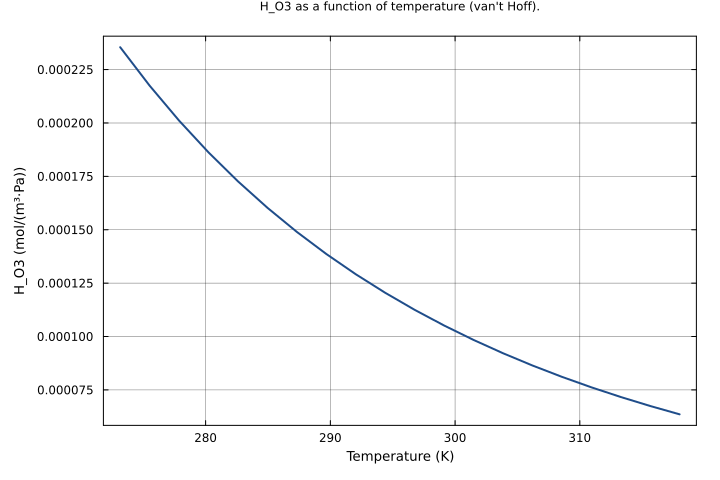
Van’t Hoff form: H_O3(T) = H_O3_298 × exp((dH_H_O3/R) × (1/T_ref − 1/T)). With dH_H_O3 < 0 (exothermic dissolution), H_O3 increases as T decreases — O3 is more soluble in cold clouds.
Tolerance rationale (rel=1e-6): purely algebraic observed-only system; 1e-6 covers float64 roundoff in the chained exp/multiply expressions across the atmospheric T range (273–318 K) and typical tropospheric p_O3 range._
Parameters
| Name | Units | Default | Description |
|---|---|---|---|
T | K | 298.0 | Temperature |
p_O3 | Pa | 0.004053 | Partial pressure of O3 (default ≈ 40 ppb at 1 atm) |
R_gas | J/mol/K | 8.314 | Gas constant |
T_ref | K | 298.0 | Reference temperature |
H_O3_298 | mol/m^3/Pa | 0.0001085615593387614 | Henry’s law constant for O3 at 298 K (1.1e-2 M/atm converted to mol/(m³·Pa)) |
dH_H_O3 | J/mol | -21087.36 | Heat of dissolution for O3 (−5.04 kcal/mol; S&P Table 7.3) |
Observed
| Name | Units | Default | Description |
|---|---|---|---|
H_O3 | mol/m^3/Pa | Temperature-dependent Henry’s law constant for O3 | |
O3_aq | mol/m^3 | Aqueous O3 concentration (Henry’s law: O3_aq = H_O3 × p_O3) |
Observed expressions
$$ H_{O3} = H_{O3\,298} \cdot e^{\frac{dH_{H\,O3} \cdot \left(\frac{1}{T_{ref}} + \frac{-1}{T}\right)}{R_{gas}}} $$Temperature-dependent Henry’s law constant for O3
$$ O3_{aq} = H_{O3} \cdot p_{O3} $$Aqueous O3 concentration (Henry’s law: O3_aq = H_O3 × p_O3)
Analyses
H_O3_vs_temperature
Van’t Hoff temperature dependence of the O3 Henry’s law constant (S&P Table 7.3). H_O3 increases by ~2.2× from 45°C to 0°C, reflecting the exothermic nature of O3 dissolution. Sweep T from 0°C to 45°C holding p_O3 fixed.
Time span: 0.0 → 1.0
Swept over: T
O3_aq_vs_p_O3
Henry’s law linearity: O3_aq = H_O3 × p_O3 at 298 K. Sweep p_O3 over three decades (0.001 to 1.0 Pa, covering sub-ppb to ~10 ppm O3) and verify the linear relationship.
Time span: 0.0 → 1.0
Swept over: p_O3

Raw .esm
Raw .esm JSON (this component)
{
  "reference": {
    "notes": "source_ref: Aerosol.jl@c8c640bb:src/aqueous_equilibria.jl:589\n\nUpstream `O3Equilibria` is an MTK `@component` where T and p_O3 are `@variables` driven by a parent `AqueousEquilibria` system. For standalone serialization, T and p_O3 are declared as parameters here — matching the bead's (S, observed-only) classification.\n\nThe Henry's law constant H_O3_298 = 1.1×10⁻² M/atm is converted to SI (mol/m³/Pa): divide by 101325 Pa/atm and multiply by 1000 mol/m³ per M → 1.1e-2 / 101325 × 1000 ≈ 1.086×10⁻⁴ mol/(m³·Pa). The heat of dissolution dH_H_O3 = −5.04 kcal/mol × 4184 J/kcal = −21087.36 J/mol (S&P Table 7.3).\n\nVan't Hoff form: H_O3(T) = H_O3_298 × exp((dH_H_O3/R) × (1/T_ref − 1/T)). With dH_H_O3 < 0 (exothermic dissolution), H_O3 increases as T decreases — O3 is more soluble in cold clouds.\n\nTolerance rationale (rel=1e-6): purely algebraic observed-only system; 1e-6 covers float64 roundoff in the chained exp/multiply expressions across the atmospheric T range (273–318 K) and typical tropospheric p_O3 range."
  },
  "tolerance": {
    "rel": 1e-06
  },
  "variables": {
    "T": {
      "type": "parameter",
      "units": "K",
      "default": 298.0,
      "description": "Temperature"
    },
    "p_O3": {
      "type": "parameter",
      "units": "Pa",
      "default": 0.004053,
      "description": "Partial pressure of O3 (default ≈ 40 ppb at 1 atm)"
    },
    "R_gas": {
      "type": "parameter",
      "units": "J/mol/K",
      "default": 8.314,
      "description": "Gas constant"
    },
    "T_ref": {
      "type": "parameter",
      "units": "K",
      "default": 298.0,
      "description": "Reference temperature"
    },
    "H_O3_298": {
      "type": "parameter",
      "units": "mol/m^3/Pa",
      "default": 0.0001085615593387614,
      "description": "Henry's law constant for O3 at 298 K (1.1e-2 M/atm converted to mol/(m³·Pa))"
    },
    "dH_H_O3": {
      "type": "parameter",
      "units": "J/mol",
      "default": -21087.36,
      "description": "Heat of dissolution for O3 (−5.04 kcal/mol; S&P Table 7.3)"
    },
    "H_O3": {
      "type": "unknown",
      "units": "mol/m^3/Pa",
      "description": "Temperature-dependent Henry's law constant for O3"
    },
    "O3_aq": {
      "type": "unknown",
      "units": "mol/m^3",
      "description": "Aqueous O3 concentration (Henry's law: O3_aq = H_O3 × p_O3)"
    }
  },
  "equations": [
    {
      "lhs": "H_O3",
      "rhs": {
        "op": "*",
        "args": [
          "H_O3_298",
          {
            "op": "exp",
            "args": [
              {
                "op": "/",
                "args": [
                  {
                    "op": "*",
                    "args": [
                      "dH_H_O3",
                      {
                        "op": "+",
                        "args": [
                          {
                            "op": "/",
                            "args": [
                              1,
                              "T_ref"
                            ]
                          },
                          {
                            "op": "/",
                            "args": [
                              -1,
                              "T"
                            ]
                          }
                        ]
                      }
                    ]
                  },
                  "R_gas"
                ]
              }
            ]
          }
        ]
      }
    },
    {
      "lhs": "O3_aq",
      "rhs": {
        "op": "*",
        "args": [
          "H_O3",
          "p_O3"
        ]
      }
    }
  ],
  "tests": [
    {
      "id": "reference_298K",
      "description": "At T_ref = 298 K the van't Hoff exponent is zero, so H_O3 must equal H_O3_298 exactly. With p_O3 = 1 Pa, O3_aq = H_O3_298 × 1 Pa. Validates the reference-condition identity.",
      "parameter_overrides": {
        "T": 298.0,
        "p_O3": 1.0
      },
      "time_span": {
        "start": 0.0,
        "end": 1.0
      },
      "assertions": [
        {
          "variable": "H_O3",
          "time": 0.0,
          "expected": 0.0001085615593387614
        },
        {
          "variable": "O3_aq",
          "time": 0.0,
          "expected": 0.0001085615593387614
        }
      ]
    },
    {
      "id": "henry_law_linearity_298K",
      "description": "At 298 K with p_O3 = 101.325 Pa (= 1 mbar), O3_aq = H_O3_298 × 101.325 = 1.1e-2 M/atm × 1e-3 atm × 1000 mol/m³/M = 0.011 mol/m³. Validates Henry's law proportionality and the unit conversion.",
      "parameter_overrides": {
        "T": 298.0,
        "p_O3": 101.325
      },
      "time_span": {
        "start": 0.0,
        "end": 1.0
      },
      "assertions": [
        {
          "variable": "H_O3",
          "time": 0.0,
          "expected": 0.0001085615593387614
        },
        {
          "variable": "O3_aq",
          "time": 0.0,
          "expected": 0.011
        }
      ]
    },
    {
      "id": "cold_cloud_273K",
      "description": "Cold cloud at 273.15 K (0°C). With dH_H_O3 < 0 (exothermic dissolution), H_O3 increases as T decreases — O3 is ~2.17× more soluble at 0°C than at 25°C. Validates the sign and magnitude of the van't Hoff temperature correction.",
      "parameter_overrides": {
        "T": 273.15,
        "p_O3": 1.0
      },
      "time_span": {
        "start": 0.0,
        "end": 1.0
      },
      "assertions": [
        {
          "variable": "H_O3",
          "time": 0.0,
          "expected": 0.00023548295179912852
        },
        {
          "variable": "O3_aq",
          "time": 0.0,
          "expected": 0.00023548295179912852
        }
      ]
    },
    {
      "id": "warm_atmosphere_310K",
      "description": "Warm atmosphere at 310 K (37°C). H_O3 decreases to ~0.72× its 298 K value — less O3 dissolves into warmer droplets. Validates the opposite temperature-dependence direction from the cold-cloud case.",
      "parameter_overrides": {
        "T": 310.0,
        "p_O3": 1.0
      },
      "time_span": {
        "start": 0.0,
        "end": 1.0
      },
      "assertions": [
        {
          "variable": "H_O3",
          "time": 0.0,
          "expected": 7.808888111339828e-05
        },
        {
          "variable": "O3_aq",
          "time": 0.0,
          "expected": 7.808888111339828e-05
        }
      ]
    },
    {
      "id": "ambient_o3_298K",
      "description": "Typical tropospheric background O3 at ~40 ppb partial pressure (p_O3 = 40e-9 × 101325 Pa ≈ 4.053e-3 Pa) at 298 K. Validates the model at realistic atmospheric concentrations.",
      "parameter_overrides": {
        "T": 298.0,
        "p_O3": 0.004053
      },
      "time_span": {
        "start": 0.0,
        "end": 1.0
      },
      "assertions": [
        {
          "variable": "H_O3",
          "time": 0.0,
          "expected": 0.0001085615593387614
        },
        {
          "variable": "O3_aq",
          "time": 0.0,
          "expected": 4.400000000000001e-07
        }
      ]
    },
    {
      "id": "cold_ambient_o3_273K",
      "description": "Cold cloud at 273.15 K with ambient O3 at ~40 ppb (p_O3 ≈ 4.053e-3 Pa). Cross-check combining van't Hoff temperature correction with realistic partial pressure: O3_aq = H_O3(273.15) × p_O3.",
      "parameter_overrides": {
        "T": 273.15,
        "p_O3": 0.004053
      },
      "time_span": {
        "start": 0.0,
        "end": 1.0
      },
      "assertions": [
        {
          "variable": "H_O3",
          "time": 0.0,
          "expected": 0.00023548295179912852
        },
        {
          "variable": "O3_aq",
          "time": 0.0,
          "expected": 9.54412403641868e-07
        }
      ]
    },
    {
      "id": "warm_high_o3_310K",
      "description": "Warm droplet at 310 K with elevated O3 at p_O3 = 5.0 Pa (~50 ppm; pollution episode or high-altitude scenario). Exercises both temperature reduction in H_O3 and the Henry's law proportionality at an elevated partial pressure.",
      "parameter_overrides": {
        "T": 310.0,
        "p_O3": 5.0
      },
      "time_span": {
        "start": 0.0,
        "end": 1.0
      },
      "assertions": [
        {
          "variable": "H_O3",
          "time": 0.0,
          "expected": 7.808888111339828e-05
        },
        {
          "variable": "O3_aq",
          "time": 0.0,
          "expected": 0.0003904444055669914
        }
      ]
    },
    {
      "id": "van_t_hoff_ratio_cold",
      "description": "Explicit ratio check: H_O3(273.15) / H_O3(298) should equal exp(dH/R × (1/298 − 1/273.15)) ≈ 2.169. This is confirmed by the pair of tests cold_cloud_273K and reference_298K, but this test states it explicitly at p_O3 = 10.0 Pa so H_O3 can be derived from O3_aq / p_O3.",
      "parameter_overrides": {
        "T": 273.15,
        "p_O3": 10.0
      },
      "time_span": {
        "start": 0.0,
        "end": 1.0
      },
      "assertions": [
        {
          "variable": "H_O3",
          "time": 0.0,
          "expected": 0.00023548295179912852
        },
        {
          "variable": "O3_aq",
          "time": 0.0,
          "expected": 0.0023548295179912854
        }
      ]
    }
  ],
  "analyses": [
    {
      "id": "H_O3_vs_temperature",
      "description": "Van't Hoff temperature dependence of the O3 Henry's law constant (S&P Table 7.3). H_O3 increases by ~2.2× from 45°C to 0°C, reflecting the exothermic nature of O3 dissolution. Sweep T from 0°C to 45°C holding p_O3 fixed.",
      "initial_state": {},
      "parameters": {
        "p_O3": 1.0
      },
      "time_span": {
        "start": 0.0,
        "end": 1.0
      },
      "parameter_sweep": {
        "type": "cartesian",
        "dimensions": [
          {
            "parameter": "T",
            "range": {
              "start": 273.15,
              "stop": 318.0,
              "count": 20,
              "scale": "linear"
            }
          }
        ]
      },
      "plots": [
        {
          "id": "H_O3_curve",
          "type": "line",
          "description": "H_O3 as a function of temperature (van't Hoff).",
          "x": {
            "variable": "T",
            "label": "Temperature (K)"
          },
          "y": {
            "variable": "H_O3",
            "label": "H_O3 (mol/(m³·Pa))"
          }
        }
      ]
    },
    {
      "id": "O3_aq_vs_p_O3",
      "description": "Henry's law linearity: O3_aq = H_O3 × p_O3 at 298 K. Sweep p_O3 over three decades (0.001 to 1.0 Pa, covering sub-ppb to ~10 ppm O3) and verify the linear relationship.",
      "initial_state": {},
      "parameters": {
        "T": 298.0
      },
      "time_span": {
        "start": 0.0,
        "end": 1.0
      },
      "parameter_sweep": {
        "type": "cartesian",
        "dimensions": [
          {
            "parameter": "p_O3",
            "range": {
              "start": 0.001,
              "stop": 1.0,
              "count": 20,
              "scale": "log"
            }
          }
        ]
      },
      "plots": [
        {
          "id": "O3_aq_vs_p_O3",
          "type": "line",
          "description": "Aqueous O3 concentration as a function of partial pressure at 298 K (linear Henry's law).",
          "x": {
            "variable": "p_O3",
            "label": "p(O3) (Pa, log scale)"
          },
          "y": {
            "variable": "O3_aq",
            "label": "[O3_aq] (mol/m³, log scale)"
          }
        }
      ]
    }
  ]
}