HNO3Equilibria
HNO3 gas-aqueous dissolution and dissociation equilibria. Migrated from Aerosol.jl@c8c640bb src/aqueous_equilibria.jl:438 (`HNO3Equilibria` @component). Implements Seinfeld & Pandis Ch 7 §7.3.5 (Eq 7.53–7.54, 7.58, 7.61): K_H(HNO3, 298 K) = 2.1×10⁵ M/atm (temperature-independent, dH≈0), K_n1(HNO3, 298 K) = 15.4 M (temperature-independent). HNO3 is a strong acid (pKa ≈ −1.2) that essentially completely dissociates at all atmospheric pH values. Parameterized as observed-only: T, H_plus, and p_HNO3 are inputs; H_HNO3, K_n1, HNO3_aq, NO3_minus, HNO3_total, H_HNO3_eff are algebraic outputs.
Description
HNO3 gas-aqueous dissolution and dissociation equilibria. Migrated from Aerosol.jl@c8c640bb src/aqueous_equilibria.jl:438 (HNO3Equilibria @component). Implements Seinfeld & Pandis Ch 7 §7.3.5 (Eq 7.53–7.54, 7.58, 7.61): K_H(HNO3, 298 K) = 2.1×10⁵ M/atm (temperature-independent, dH≈0), K_n1(HNO3, 298 K) = 15.4 M (temperature-independent). HNO3 is a strong acid (pKa ≈ −1.2) that essentially completely dissociates at all atmospheric pH values. Parameterized as observed-only: T, H_plus, and p_HNO3 are inputs; H_HNO3, K_n1, HNO3_aq, NO3_minus, HNO3_total, H_HNO3_eff are algebraic outputs.
Reference
_source_ref: Aerosol.jl@c8c640bb:src/aqueous_equilibria.jl:438
Upstream HNO3Equilibria is an MTK @component where T, H_plus, and p_HNO3 are @variables driven by a parent AqueousEquilibria system. For standalone serialization (and to make the component well-posed in isolation), T, H_plus, and p_HNO3 are declared as parameters here — matching the bead’s (S, observed-only) classification. The six algebraic equations are unchanged from upstream.
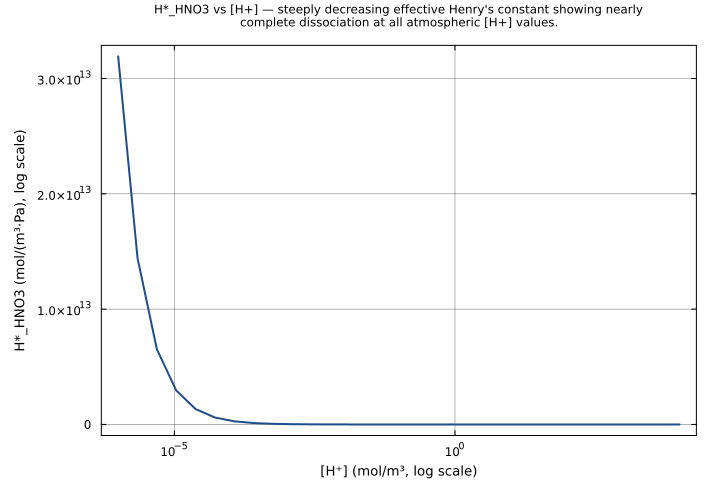
Key property: HNO3 is a strong acid (K_n1 = 15.4 M, pKa ≈ −1.2). At all atmospheric pH values (pH 0–7), K_n1/[H+] ≫ 1: e.g. at pH 4 K_n1/H+ = 1.54×10⁵, at pH 2 K_n1/H+ = 1540. This means NO3⁻ ≫ HNO3(aq) and H*_HNO3 ≫ H_HNO3 for virtually all atmospheric conditions. Only at [H+] ≥ K_n1 (≥ 15.4 mol/L, extremely concentrated acid) does incomplete dissociation occur.
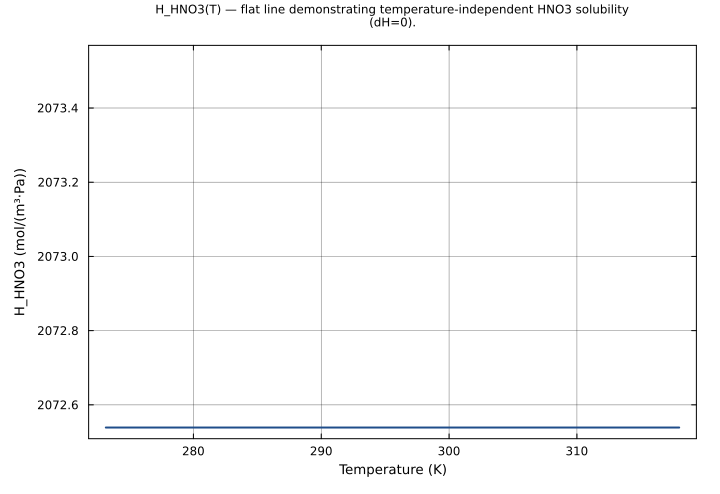
Key difference from SO2/CO2/NH3/H2O2: both dH_H_HNO3 and the temperature dependence of K_n1 are zero (upstream uses K_n1 ~ K_n1_298 with no van’t Hoff correction). The van’t Hoff form for H_HNO3 is retained for interface consistency, but exp(0) = 1 so H_HNO3 = H_HNO3_298 at all temperatures.
H_HNO3_298 = 2.1×10⁵ M/atm × 1000 mol·m⁻³/M ÷ 101325 Pa/atm = 2072.5389 mol/(m³·Pa). K_n1_298 = 15.4 M × 1000 = 15400 mol/m³.
Tolerance rationale (model-level rel=1e-6): observed-only algebraic system (no ODE integration); 1e-6 covers float64 roundoff in the simple arithmetic expressions. Since dH=0 the van’t Hoff exp() evaluates to exactly 1.0 at any T; all other operations are multiplications, divisions, and additions._
Parameters
| Name | Units | Default | Description |
|---|---|---|---|
T | K | 298.0 | Temperature |
H_plus | mol/m^3 | 0.0001 | Hydrogen ion concentration (1e-4 mol/m³ = pH 7 in pure water at 298 K) |
p_HNO3 | Pa | 1.0 | Partial pressure of HNO3 |
R_gas | J/mol/K | 8.314 | Gas constant |
T_ref | K | 298.0 | Reference temperature |
H_HNO3_298 | mol/m^3/Pa | 2072.53886010363 | Henry’s law constant for HNO3 at 298 K (2.1×10⁵ M/atm converted to mol/(m³·Pa): 2.1e5 / 101325.0 * 1000.0) |
dH_H_HNO3 | J/mol | 0.0 | Heat of dissolution for HNO3 (negligible temperature dependence; Seinfeld & Pandis Table 7.4) |
K_n1_298 | mol/m^3 | 15400.0 | Dissociation constant for HNO3 → H⁺ + NO3⁻ at 298 K (15.4 M converted to mol/m³; temperature-independent in upstream source; pKa ≈ −1.2) |
Observed
| Name | Units | Default | Description |
|---|---|---|---|
H_HNO3 | mol/m^3/Pa | Temperature-dependent Henry’s law constant for HNO3 (equals H_HNO3_298 since dH=0) | |
K_n1 | mol/m^3 | Dissociation constant HNO3 → H⁺ + NO3⁻ (temperature-independent: K_n1 = K_n1_298) | |
HNO3_aq | mol/m^3 | Undissociated aqueous HNO3 concentration | |
NO3_minus | mol/m^3 | Nitrate anion concentration [NO3-] | |
HNO3_total | mol/m^3 | Total dissolved nitric acid: [HNO3(aq)] + [NO3-] | |
H_HNO3_eff | mol/m^3/Pa | Effective Henry’s law constant for HNO3 accounting for dissociation: H_HNO3 × (1 + K_n1/[H+]) |
Observed expressions
$$ H_{HNO3} = H_{HNO3\,298} \cdot e^{\frac{dH_{H\,HNO3}}{R_{gas}} \cdot \left(\frac{1}{T_{ref}} + \frac{-1}{T}\right)} $$Temperature-dependent Henry’s law constant for HNO3 (equals H_HNO3_298 since dH=0)
$$ K_{n1} = K_{n1\,298} $$Dissociation constant HNO3 → H⁺ + NO3⁻ (temperature-independent: K_n1 = K_n1_298)
$$ HNO3_{aq} = H_{HNO3} \cdot p_{HNO3} $$Undissociated aqueous HNO3 concentration
$$ NO3_{minus} = \frac{K_{n1} \cdot HNO3_{aq}}{H_{plus}} $$Nitrate anion concentration [NO3-]
$$ HNO3_{total} = HNO3_{aq} + NO3_{minus} $$Total dissolved nitric acid: [HNO3(aq)] + [NO3-]
$$ H_{HNO3\,eff} = H_{HNO3} \cdot \left(1 + \frac{K_{n1}}{H_{plus}}\right) $$Effective Henry’s law constant for HNO3 accounting for dissociation: H_HNO3 × (1 + K_n1/[H+])
Analyses
H_HNO3_eff_vs_pH
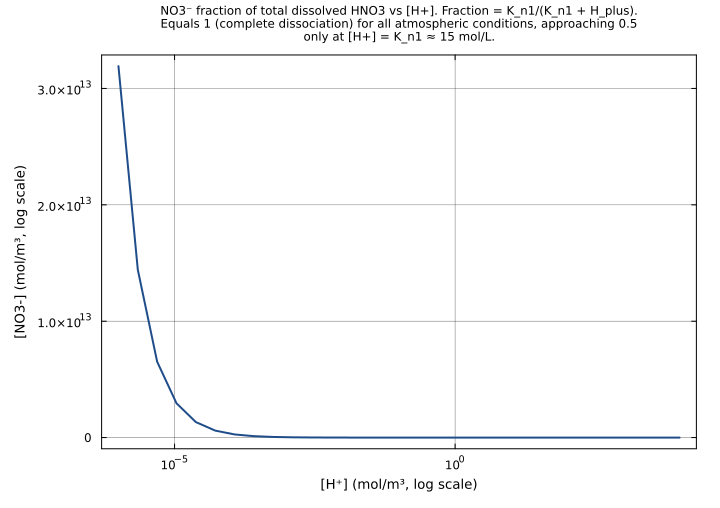
Effective Henry’s constant H*_HNO3 = H_HNO3 × (1 + K_n1/[H+]) vs [H+] at 298 K. HNO3 pKa ≈ −1.2, so K_n1/[H+] ≫ 1 across the entire atmospheric pH range (pH 0–7). H*_HNO3 decreases proportionally with increasing [H+]: at pH 7 H*_HNO3 ≈ 1.54×10⁸ × H_HNO3; at pH 2 H*_HNO3 ≈ 1540 × H_HNO3. Only at [H+] ≥ K_n1 (> 15 mol/L, beyond physically realizable aqueous solutions) does incomplete dissociation occur.
Time span: 0.0 → 1.0
Swept over: H_plus
NO3_minus_vs_p_HNO3
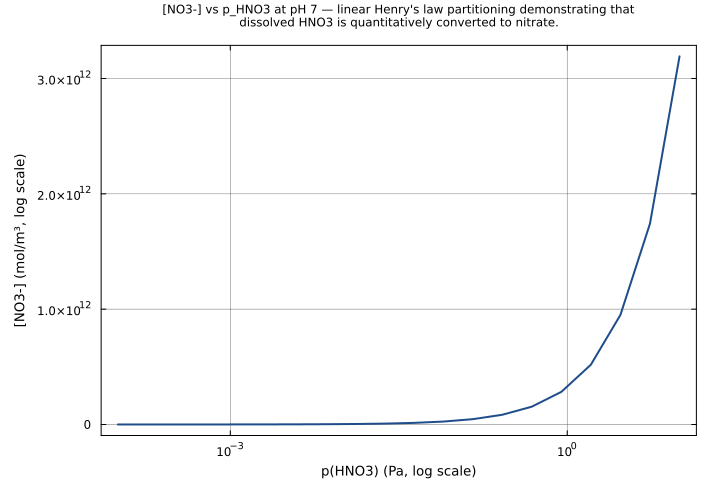
Aqueous nitrate concentration [NO3-] as a function of HNO3 partial pressure at pH 7. Shows perfect linearity: [NO3-] = H_HNO3 × K_n1/[H+] × p_HNO3. Since HNO3 is a strong acid, essentially all dissolved HNO3 appears as NO3⁻ at atmospheric pH, making [NO3-] ≈ HNO3_total. Henry’s law linearity spans the full atmospheric HNO3 range.
Time span: 0.0 → 1.0
Swept over: p_HNO3
temperature_invariance_sweep
H_HNO3 vs temperature from 273 K to 318 K. Unlike SO2, CO2, NH3, and H2O2 (which all have significant van’t Hoff temperature dependencies), HNO3 has dH_H_HNO3 = 0 and remains constant across the full atmospheric temperature range. This flat response is characteristic of strong inorganic acids.
Time span: 0.0 → 1.0
Swept over: T
Raw .esm
Raw .esm JSON (this component)
{
"reference": {
"notes": "source_ref: Aerosol.jl@c8c640bb:src/aqueous_equilibria.jl:438\n\nUpstream `HNO3Equilibria` is an MTK `@component` where T, H_plus, and p_HNO3 are `@variables` driven by a parent `AqueousEquilibria` system. For standalone serialization (and to make the component well-posed in isolation), T, H_plus, and p_HNO3 are declared as parameters here — matching the bead's `(S, observed-only)` classification. The six algebraic equations are unchanged from upstream.\n\nKey property: HNO3 is a strong acid (K_n1 = 15.4 M, pKa ≈ −1.2). At all atmospheric pH values (pH 0–7), K_n1/[H+] ≫ 1: e.g. at pH 4 K_n1/H+ = 1.54×10⁵, at pH 2 K_n1/H+ = 1540. This means NO3⁻ ≫ HNO3(aq) and H*_HNO3 ≫ H_HNO3 for virtually all atmospheric conditions. Only at [H+] ≥ K_n1 (≥ 15.4 mol/L, extremely concentrated acid) does incomplete dissociation occur.\n\nKey difference from SO2/CO2/NH3/H2O2: both dH_H_HNO3 and the temperature dependence of K_n1 are zero (upstream uses K_n1 ~ K_n1_298 with no van't Hoff correction). The van't Hoff form for H_HNO3 is retained for interface consistency, but exp(0) = 1 so H_HNO3 = H_HNO3_298 at all temperatures.\n\nH_HNO3_298 = 2.1×10⁵ M/atm × 1000 mol·m⁻³/M ÷ 101325 Pa/atm = 2072.5389 mol/(m³·Pa). K_n1_298 = 15.4 M × 1000 = 15400 mol/m³.\n\nTolerance rationale (model-level rel=1e-6): observed-only algebraic system (no ODE integration); 1e-6 covers float64 roundoff in the simple arithmetic expressions. Since dH=0 the van't Hoff exp() evaluates to exactly 1.0 at any T; all other operations are multiplications, divisions, and additions."
},
"tolerance": {
"rel": 1e-06
},
"variables": {
"T": {
"type": "parameter",
"units": "K",
"default": 298.0,
"description": "Temperature"
},
"H_plus": {
"type": "parameter",
"units": "mol/m^3",
"default": 0.0001,
"description": "Hydrogen ion concentration (1e-4 mol/m³ = pH 7 in pure water at 298 K)"
},
"p_HNO3": {
"type": "parameter",
"units": "Pa",
"default": 1.0,
"description": "Partial pressure of HNO3"
},
"R_gas": {
"type": "parameter",
"units": "J/mol/K",
"default": 8.314,
"description": "Gas constant"
},
"T_ref": {
"type": "parameter",
"units": "K",
"default": 298.0,
"description": "Reference temperature"
},
"H_HNO3_298": {
"type": "parameter",
"units": "mol/m^3/Pa",
"default": 2072.53886010363,
"description": "Henry's law constant for HNO3 at 298 K (2.1×10⁵ M/atm converted to mol/(m³·Pa): 2.1e5 / 101325.0 * 1000.0)"
},
"dH_H_HNO3": {
"type": "parameter",
"units": "J/mol",
"default": 0.0,
"description": "Heat of dissolution for HNO3 (negligible temperature dependence; Seinfeld & Pandis Table 7.4)"
},
"K_n1_298": {
"type": "parameter",
"units": "mol/m^3",
"default": 15400.0,
"description": "Dissociation constant for HNO3 → H⁺ + NO3⁻ at 298 K (15.4 M converted to mol/m³; temperature-independent in upstream source; pKa ≈ −1.2)"
},
"H_HNO3": {
"type": "unknown",
"units": "mol/m^3/Pa",
"description": "Temperature-dependent Henry's law constant for HNO3 (equals H_HNO3_298 since dH=0)"
},
"K_n1": {
"type": "unknown",
"units": "mol/m^3",
"description": "Dissociation constant HNO3 → H⁺ + NO3⁻ (temperature-independent: K_n1 = K_n1_298)"
},
"HNO3_aq": {
"type": "unknown",
"units": "mol/m^3",
"description": "Undissociated aqueous HNO3 concentration"
},
"NO3_minus": {
"type": "unknown",
"units": "mol/m^3",
"description": "Nitrate anion concentration [NO3-]"
},
"HNO3_total": {
"type": "unknown",
"units": "mol/m^3",
"description": "Total dissolved nitric acid: [HNO3(aq)] + [NO3-]"
},
"H_HNO3_eff": {
"type": "unknown",
"units": "mol/m^3/Pa",
"description": "Effective Henry's law constant for HNO3 accounting for dissociation: H_HNO3 × (1 + K_n1/[H+])"
}
},
"equations": [
{
"lhs": "H_HNO3",
"rhs": {
"op": "*",
"args": [
"H_HNO3_298",
{
"op": "exp",
"args": [
{
"op": "*",
"args": [
{
"op": "/",
"args": [
"dH_H_HNO3",
"R_gas"
]
},
{
"op": "+",
"args": [
{
"op": "/",
"args": [
1,
"T_ref"
]
},
{
"op": "/",
"args": [
-1,
"T"
]
}
]
}
]
}
]
}
]
}
},
{
"lhs": "K_n1",
"rhs": "K_n1_298"
},
{
"lhs": "HNO3_aq",
"rhs": {
"op": "*",
"args": [
"H_HNO3",
"p_HNO3"
]
}
},
{
"lhs": "NO3_minus",
"rhs": {
"op": "/",
"args": [
{
"op": "*",
"args": [
"K_n1",
"HNO3_aq"
]
},
"H_plus"
]
}
},
{
"lhs": "HNO3_total",
"rhs": {
"op": "+",
"args": [
"HNO3_aq",
"NO3_minus"
]
}
},
{
"lhs": "H_HNO3_eff",
"rhs": {
"op": "*",
"args": [
"H_HNO3",
{
"op": "+",
"args": [
1,
{
"op": "/",
"args": [
"K_n1",
"H_plus"
]
}
]
}
]
}
}
],
"tests": [
{
"id": "reference_298K_pH7",
"description": "Reference state at 298 K with neutral water (pH 7, [H+]=1e-4 mol/m³) and 1 Pa HNO3. At T=T_ref the van't Hoff exponent is zero so H_HNO3 = H_HNO3_298. K_n1 is temperature-independent. K_n1/H_plus = 15400/1e-4 = 1.54e8 — HNO3 is essentially completely dissociated (NO3⁻ ≈ 1.54×10⁸ × HNO3_aq). H_HNO3_eff ≈ H_HNO3 × K_n1/H_plus to excellent approximation.",
"parameter_overrides": {
"T": 298.0,
"H_plus": 0.0001,
"p_HNO3": 1.0
},
"time_span": {
"start": 0.0,
"end": 1.0
},
"assertions": [
{
"variable": "H_HNO3",
"time": 0.0,
"expected": 2072.53886010363
},
{
"variable": "K_n1",
"time": 0.0,
"expected": 15400.0
},
{
"variable": "HNO3_aq",
"time": 0.0,
"expected": 2072.53886010363
},
{
"variable": "NO3_minus",
"time": 0.0,
"expected": 319170984455.958
},
{
"variable": "HNO3_total",
"time": 0.0,
"expected": 319170986528.497
},
{
"variable": "H_HNO3_eff",
"time": 0.0,
"expected": 319170986528.497
}
]
},
{
"id": "temperature_invariance_cold",
"description": "Cold cloud water at 273.15 K (0°C), pH 7. Because dH_H_HNO3 = 0, H_HNO3 = H_HNO3_298 exactly at any temperature. K_n1 is also temperature-independent. All state values are identical to the 298 K reference — unique among the aqueous equilibria models.",
"parameter_overrides": {
"T": 273.15,
"H_plus": 0.0001,
"p_HNO3": 1.0
},
"time_span": {
"start": 0.0,
"end": 1.0
},
"assertions": [
{
"variable": "H_HNO3",
"time": 0.0,
"expected": 2072.53886010363
},
{
"variable": "K_n1",
"time": 0.0,
"expected": 15400.0
},
{
"variable": "HNO3_aq",
"time": 0.0,
"expected": 2072.53886010363
},
{
"variable": "NO3_minus",
"time": 0.0,
"expected": 319170984455.958
},
{
"variable": "HNO3_total",
"time": 0.0,
"expected": 319170986528.497
},
{
"variable": "H_HNO3_eff",
"time": 0.0,
"expected": 319170986528.497
}
]
},
{
"id": "temperature_invariance_warm",
"description": "Warm cloud water at 310 K (37°C), pH 7. Same as reference and cold cases — H_HNO3 and all equilibrium values are temperature-independent for HNO3.",
"parameter_overrides": {
"T": 310.0,
"H_plus": 0.0001,
"p_HNO3": 1.0
},
"time_span": {
"start": 0.0,
"end": 1.0
},
"assertions": [
{
"variable": "H_HNO3",
"time": 0.0,
"expected": 2072.53886010363
},
{
"variable": "HNO3_aq",
"time": 0.0,
"expected": 2072.53886010363
},
{
"variable": "H_HNO3_eff",
"time": 0.0,
"expected": 319170986528.497
}
]
},
{
"id": "acidic_pH4",
"description": "Acidic cloud water (pH 4, [H+] = 0.1 mol/m³) at 298 K. K_n1/H_plus = 15400/0.1 = 1.54×10⁵ — still nearly complete dissociation. Represents typical acid-rain conditions.",
"parameter_overrides": {
"T": 298.0,
"H_plus": 0.1,
"p_HNO3": 1.0
},
"time_span": {
"start": 0.0,
"end": 1.0
},
"assertions": [
{
"variable": "H_HNO3",
"time": 0.0,
"expected": 2072.53886010363
},
{
"variable": "HNO3_aq",
"time": 0.0,
"expected": 2072.53886010363
},
{
"variable": "NO3_minus",
"time": 0.0,
"expected": 319170984.455958
},
{
"variable": "HNO3_total",
"time": 0.0,
"expected": 319173056.994819
},
{
"variable": "H_HNO3_eff",
"time": 0.0,
"expected": 319173056.994819
}
]
},
{
"id": "acidic_pH2",
"description": "Strongly acidic (pH 2, [H+] = 10 mol/m³) at 298 K. K_n1/H_plus = 15400/10 = 1540 — still >99.9% dissociated. Exercises the high-acid tail of NO3_minus and H_HNO3_eff.",
"parameter_overrides": {
"T": 298.0,
"H_plus": 10.0,
"p_HNO3": 1.0
},
"time_span": {
"start": 0.0,
"end": 1.0
},
"assertions": [
{
"variable": "HNO3_aq",
"time": 0.0,
"expected": 2072.53886010363
},
{
"variable": "NO3_minus",
"time": 0.0,
"expected": 3191709.84455958
},
{
"variable": "HNO3_total",
"time": 0.0,
"expected": 3193782.38341969
},
{
"variable": "H_HNO3_eff",
"time": 0.0,
"expected": 3193782.38341969
}
]
},
{
"id": "very_acidic_Hplus100",
"description": "Extreme acid regime ([H+] = 100 mol/m³) at 298 K. K_n1/H_plus = 15400/100 = 154 — still 99% dissociated. Stress-tests the NO3_minus and H_HNO3_eff expressions deep into the concentrated-acid tail.",
"parameter_overrides": {
"T": 298.0,
"H_plus": 100.0,
"p_HNO3": 1.0
},
"time_span": {
"start": 0.0,
"end": 1.0
},
"assertions": [
{
"variable": "HNO3_aq",
"time": 0.0,
"expected": 2072.53886010363
},
{
"variable": "NO3_minus",
"time": 0.0,
"expected": 319170.984455958
},
{
"variable": "HNO3_total",
"time": 0.0,
"expected": 321243.523316062
},
{
"variable": "H_HNO3_eff",
"time": 0.0,
"expected": 321243.523316062
}
]
},
{
"id": "pKa_equiv_Hplus15400",
"description": "At [H+] = K_n1 = 15400 mol/m³ (pKa-equivalent point), exactly 50% of dissolved HNO3 is undissociated: NO3_minus = HNO3_aq, HNO3_total = 2 × HNO3_aq, and H_HNO3_eff = 2 × H_HNO3. This extreme concentration (far beyond physical liquids) is a mathematical symmetry check.",
"parameter_overrides": {
"T": 298.0,
"H_plus": 15400.0,
"p_HNO3": 1.0
},
"time_span": {
"start": 0.0,
"end": 1.0
},
"assertions": [
{
"variable": "H_HNO3",
"time": 0.0,
"expected": 2072.53886010363
},
{
"variable": "HNO3_aq",
"time": 0.0,
"expected": 2072.53886010363
},
{
"variable": "NO3_minus",
"time": 0.0,
"expected": 2072.53886010363
},
{
"variable": "HNO3_total",
"time": 0.0,
"expected": 4145.07772020725
},
{
"variable": "H_HNO3_eff",
"time": 0.0,
"expected": 4145.07772020725
}
]
},
{
"id": "pressure_linearity_high",
"description": "Henry's-law linearity check: 10× p_HNO3 at fixed T and H_plus scales HNO3_aq, NO3_minus, HNO3_total by 10× while leaving H_HNO3, K_n1, H_HNO3_eff unchanged.",
"parameter_overrides": {
"T": 298.0,
"H_plus": 0.0001,
"p_HNO3": 10.0
},
"time_span": {
"start": 0.0,
"end": 1.0
},
"assertions": [
{
"variable": "H_HNO3",
"time": 0.0,
"expected": 2072.53886010363
},
{
"variable": "HNO3_aq",
"time": 0.0,
"expected": 20725.3886010363
},
{
"variable": "NO3_minus",
"time": 0.0,
"expected": 3191709844559.58
},
{
"variable": "HNO3_total",
"time": 0.0,
"expected": 3191709865284.97
},
{
"variable": "H_HNO3_eff",
"time": 0.0,
"expected": 319170986528.497
}
]
},
{
"id": "pressure_linearity_low",
"description": "Henry's-law linearity at low partial pressure: p_HNO3 = 0.01 Pa scales HNO3_aq, NO3_minus, HNO3_total by 0.01× from baseline. H_HNO3 and H_HNO3_eff are pressure-independent.",
"parameter_overrides": {
"T": 298.0,
"H_plus": 0.0001,
"p_HNO3": 0.01
},
"time_span": {
"start": 0.0,
"end": 1.0
},
"assertions": [
{
"variable": "HNO3_aq",
"time": 0.0,
"expected": 20.7253886010363
},
{
"variable": "NO3_minus",
"time": 0.0,
"expected": 3191709844.55958
},
{
"variable": "HNO3_total",
"time": 0.0,
"expected": 3191709865.28497
},
{
"variable": "H_HNO3_eff",
"time": 0.0,
"expected": 319170986528.497
}
]
}
],
"analyses": [
{
"id": "H_HNO3_eff_vs_pH",
"description": "Effective Henry's constant H*_HNO3 = H_HNO3 × (1 + K_n1/[H+]) vs [H+] at 298 K. HNO3 pKa ≈ −1.2, so K_n1/[H+] ≫ 1 across the entire atmospheric pH range (pH 0–7). H*_HNO3 decreases proportionally with increasing [H+]: at pH 7 H*_HNO3 ≈ 1.54×10⁸ × H_HNO3; at pH 2 H*_HNO3 ≈ 1540 × H_HNO3. Only at [H+] ≥ K_n1 (> 15 mol/L, beyond physically realizable aqueous solutions) does incomplete dissociation occur.",
"initial_state": {},
"parameters": {
"T": 298.0,
"p_HNO3": 1.0
},
"time_span": {
"start": 0.0,
"end": 1.0
},
"parameter_sweep": {
"type": "cartesian",
"dimensions": [
{
"parameter": "H_plus",
"range": {
"start": 1e-06,
"stop": 10000.0,
"count": 30,
"scale": "log"
}
}
]
},
"plots": [
{
"id": "Hstar_curve",
"type": "line",
"description": "H*_HNO3 vs [H+] — steeply decreasing effective Henry's constant showing nearly complete dissociation at all atmospheric [H+] values.",
"x": {
"variable": "H_plus",
"label": "[H⁺] (mol/m³, log scale)"
},
"y": {
"variable": "H_HNO3_eff",
"label": "H*_HNO3 (mol/(m³·Pa), log scale)"
}
},
{
"id": "dissociation_fraction",
"type": "line",
"description": "NO3⁻ fraction of total dissolved HNO3 vs [H+]. Fraction = K_n1/(K_n1 + H_plus). Equals 1 (complete dissociation) for all atmospheric conditions, approaching 0.5 only at [H+] = K_n1 ≈ 15 mol/L.",
"x": {
"variable": "H_plus",
"label": "[H⁺] (mol/m³, log scale)"
},
"y": {
"variable": "NO3_minus",
"label": "[NO3-] (mol/m³, log scale)"
}
}
]
},
{
"id": "NO3_minus_vs_p_HNO3",
"description": "Aqueous nitrate concentration [NO3-] as a function of HNO3 partial pressure at pH 7. Shows perfect linearity: [NO3-] = H_HNO3 × K_n1/[H+] × p_HNO3. Since HNO3 is a strong acid, essentially all dissolved HNO3 appears as NO3⁻ at atmospheric pH, making [NO3-] ≈ HNO3_total. Henry's law linearity spans the full atmospheric HNO3 range.",
"initial_state": {},
"parameters": {
"T": 298.0,
"H_plus": 0.0001
},
"time_span": {
"start": 0.0,
"end": 1.0
},
"parameter_sweep": {
"type": "cartesian",
"dimensions": [
{
"parameter": "p_HNO3",
"range": {
"start": 0.0001,
"stop": 10.0,
"count": 20,
"scale": "log"
}
}
]
},
"plots": [
{
"id": "NO3_vs_p_HNO3",
"type": "line",
"description": "[NO3-] vs p_HNO3 at pH 7 — linear Henry's law partitioning demonstrating that dissolved HNO3 is quantitatively converted to nitrate.",
"x": {
"variable": "p_HNO3",
"label": "p(HNO3) (Pa, log scale)"
},
"y": {
"variable": "NO3_minus",
"label": "[NO3-] (mol/m³, log scale)"
}
}
]
},
{
"id": "temperature_invariance_sweep",
"description": "H_HNO3 vs temperature from 273 K to 318 K. Unlike SO2, CO2, NH3, and H2O2 (which all have significant van't Hoff temperature dependencies), HNO3 has dH_H_HNO3 = 0 and remains constant across the full atmospheric temperature range. This flat response is characteristic of strong inorganic acids.",
"initial_state": {},
"parameters": {
"H_plus": 0.0001,
"p_HNO3": 1.0
},
"time_span": {
"start": 0.0,
"end": 1.0
},
"parameter_sweep": {
"type": "cartesian",
"dimensions": [
{
"parameter": "T",
"range": {
"start": 273.15,
"stop": 318.0,
"count": 20,
"scale": "linear"
}
}
]
},
"plots": [
{
"id": "H_HNO3_vs_T",
"type": "line",
"description": "H_HNO3(T) — flat line demonstrating temperature-independent HNO3 solubility (dH=0).",
"x": {
"variable": "T",
"label": "Temperature (K)"
},
"y": {
"variable": "H_HNO3",
"label": "H_HNO3 (mol/(m³·Pa))"
}
}
]
}
]
}