Clark1996FireSpread
Coupled atmosphere-fire model for a dry eucalyptus forest implementing the McArthur fire-spread formula and four-fuel-type consumption from Clark et al. (1996). Migrated from WildlandFire.jl@126976f2 src/clark1996.jl:81 (`Clark1996FireSpread` @component). Five ODE states (M_litter, M_trash, M_scrub, M_canopy, Q_cumulative) and seven algebraic state variables (B_ratio, S_f, canopy_burning, ground_burn_rate, total_burn_rate, F_s, F_l). The cumulative ground heat flux Q_cumulative drives an automatic canopy ignition threshold at 170 kJ/m^2 (p. 180, Clark et al. 1996); each ground fuel is gated by an ifelse against eps_fuel so consumption stops cleanly when the pool is depleted.
Description
Coupled atmosphere-fire model for a dry eucalyptus forest implementing the McArthur fire-spread formula and four-fuel-type consumption from Clark et al. (1996). Migrated from WildlandFire.jl@126976f2 src/clark1996.jl:81 (Clark1996FireSpread @component). Five ODE states (M_litter, M_trash, M_scrub, M_canopy, Q_cumulative) and seven algebraic state variables (B_ratio, S_f, canopy_burning, ground_burn_rate, total_burn_rate, F_s, F_l). The cumulative ground heat flux Q_cumulative drives an automatic canopy ignition threshold at 170 kJ/m^2 (p. 180, Clark et al. 1996); each ground fuel is gated by an ifelse against eps_fuel so consumption stops cleanly when the pool is depleted.
Reference
Clark, T.L., Jenkins, M.A., Coen, J.L., and Packham, D.R. (1996). A Coupled Atmosphere-Fire Model: Role of the Convective Froude Number and Dynamic Fingering at the Fireline. International Journal of Wildland Fire, 6(4), 177-190.
_source_ref: WildlandFire.jl@126976f2508ceacca6c486b21ae6da5b168c6f46:src/clark1996.jl:81
Upstream Clark1996FireSpread is an MTK @component with 12 equations and 12 unknowns. Three time-indexed @variables are algebraic (B_ratio, S_f, ground_burn_rate, total_burn_rate, canopy_burning, F_s, F_l — seven total) and five are ODE states (M_litter, M_trash, M_scrub, M_canopy, Q_cumulative). The single MTK @parameter is V_A (15 m AGL wind speed). All other inputs are MTK @constants (18 total) which are preserved here as ESM parameters with their upstream values to maintain 1:1 structural fidelity with the upstream component — the same convention used by sibling Clark1996 migrations (e.g. components/wildland_fire/clark1996/heat_flux_profile.esm).
The twelve equations preserved verbatim from the upstream eqs block:
- B_ratio = sqrt((|V_A| + one_vel) / (|V_A| + four_vel)) (Eq. 8)
- S_f = min(S_a * exp(k_spread * |V_A|), |V_A|) (Eq. 9 with limiting)
- D(M_litter) = -R_litter * B_ratio * ifelse(M_litter > eps_fuel, 1, 0) (p. 180)
- D(M_trash) = -R_trash * B_ratio * ifelse(M_trash > eps_fuel, 1, 0) (p. 180)
- D(M_scrub) = -R_scrub * B_ratio * ifelse(M_scrub > eps_fuel, 1, 0) (p. 180)
- D(Q_cumulative) = (1 - f_evap) * H_c * ground_burn_rate (p. 180)
- canopy_burning = ifelse(Q_cumulative > Q_canopy_threshold, 1, 0) (p. 180)
- D(M_canopy) = -R_canopy * B_ratio * canopy_burning * ifelse(M_canopy > eps_fuel, 1, 0)
- ground_burn_rate = sum over {litter, trash, scrub} of R_iB_ratioifelse(M_i>eps_fuel, 1, 0)
- total_burn_rate = ground_burn_rate + R_canopyB_ratiocanopy_burning*ifelse(M_canopy>eps_fuel, 1, 0)
- F_s = (1 - f_evap) * H_c * total_burn_rate (p. 180)
- F_l = f_water * L_v * total_burn_rate + f_evap * H_c * total_burn_rate (p. 180)
The upstream MTK component leaves the random-spread factor r_f (≈ 1 ± 0.05) out for deterministic simulation; the ESM preserves that choice. The S_f min(...) clamp keeps the forward spread rate from exceeding the wind speed at low |V_A| (consistent with the Clark et al. text describing S_f as a wind-driven advance rate, never faster than the ambient wind itself).
Unused-but-preserved constants: zero_fuel (kg/m^2) and alpha_ext (m, the heat-flux extinction depth used by the sibling Clark1996HeatFluxProfile component) appear in the upstream @constants block but never enter the equations of this component. They are preserved as parameters with their upstream defaults — same fidelity convention as one_m in components/wildland_fire/clark1996/heat_flux_profile.esm.
Defaults for ODE states match the upstream docstring example (a moderately loaded dry eucalyptus stand): M_litter = 2.0, M_trash = 0.5, M_scrub = 0.2, M_canopy = 1.2 kg/m^2; Q_cumulative = 0 J/m^2 (no heat yet accumulated). V_A defaults to 3.0 m/s (the FIR7CR experiment value cited in the upstream docstring).
The canopy-ignition switch (eq. 7) is a hard discontinuity: when Q_cumulative crosses Q_canopy_threshold, canopy_burning flips from 0 to 1 and D(M_canopy) changes sign. Tsit5 with reltol=1e-10 captures this transition by reducing step size around it, but assertions that depend on the exact crossing time (e.g. M_canopy at a t between ignition and the end of the burn) will show small integrator-truncation error. The tests below avoid asserting M_canopy at intermediate times near the switch; ground-fuel masses, Q_cumulative (whose RHS is independent of M_canopy), and canopy_burning itself (a step function in Q) are clean.
Tolerance rationale (model-level rel=1e-6): linear constant-coefficient ODEs for the ground fuels and Q_cumulative (while their gating ifelse arguments are above eps_fuel and Q below the canopy threshold, respectively); the canopy ODE has one discontinuous switch. Tsit5 reltol=1e-10/abstol=1e-12 keeps integrator truncation comfortably below 1e-6 over the tested horizons (≤ 30 s) for all clean assertions; algebraic-only assertions at t=0 are exact to float64 ULP and are checked with the model-level tolerance — no per-test loosening is needed._
Variables
| Name | Units | Default | Description |
|---|---|---|---|
M_litter | kg/m^2 | 2.0 | Litter fuel mass remaining. Default 2.0 kg/m^2 matches the moderately loaded dry-eucalyptus stand used in the upstream docstring example (the FIR7CR experiment ICs). |
M_trash | kg/m^2 | 0.5 | Trash fuel mass remaining. Default 0.5 kg/m^2; upstream docstring example IC. |
M_scrub | kg/m^2 | 0.2 | Scrub fuel mass remaining. Default 0.2 kg/m^2; upstream docstring example IC. |
M_canopy | kg/m^2 | 1.2 | Dry canopy fuel mass remaining. Default 1.2 kg/m^2; upstream docstring example IC. Consumption begins only after Q_cumulative crosses Q_canopy_threshold. |
Q_cumulative | J/m^2 | 0.0 | Cumulative ground-fuel heat flux. Drives the canopy-ignition switch (Q > Q_canopy_threshold). Starts at 0 J/m^2 — no heat accumulated. |
Parameters
| Name | Units | Default | Description |
|---|---|---|---|
V_A | m/s | 3.0 | Tracer-advecting wind speed at 15 m AGL. Drives both the McArthur forward spread rate S_f (Eq. 9) and the burn-rate ratio B_ratio (Eq. 8). Default 3.0 m/s matches the FIR7CR experiment in Clark et al. (1996); upstream has no default. |
S_a | m/s | 0.18 | Backing/base fire spread rate (McArthur). Upstream @constant; preserved for 1:1 structural fidelity. Clark et al. (1996), Eq. 9. |
k_spread | s/m | 0.08424 | McArthur spread-rate coefficient. Upstream @constant; preserved for 1:1 structural fidelity. Clark et al. (1996), Eq. 9. |
R_litter | kg/(m^2*s) | 0.04 | Litter nominal burn rate. Walker (1981); p. 180 of Clark et al. (1996). Upstream @constant. |
R_trash | kg/(m^2*s) | 0.005 | Trash nominal burn rate. Walker (1981); p. 180 of Clark et al. (1996). Upstream @constant. |
R_scrub | kg/(m^2*s) | 0.004 | Scrub nominal burn rate. Walker (1981); p. 180 of Clark et al. (1996). Upstream @constant. |
R_canopy | kg/(m^2*s) | 0.02 | Dry canopy fuel nominal burn rate. Walker (1981); p. 180 of Clark et al. (1996). Upstream @constant. |
H_c | J/kg | 17000000.0 | Combustion coefficient (sensible heat released per kg of dry fuel burned). p. 180 of Clark et al. (1996). Upstream @constant. |
f_evap | 1 | 0.03 | Fraction of combustion sensible heat used to evaporate ground-fuel moisture (dimensionless). p. 180 of Clark et al. (1996). Upstream @constant. |
f_water | 1 | 0.56 | Fraction of dry fuel mass converted to water vapor by cellulose combustion (dimensionless). p. 180 of Clark et al. (1996). Upstream @constant. |
L_v | J/kg | 2500000.0 | Latent heat of vaporization of water. Upstream @constant. |
one_vel | m/s | 1.0 | Reference velocity for unit-balancing the numerator of B_ratio (Eq. 8). Upstream @constant preserved for fidelity. |
four_vel | m/s | 4.0 | Reference velocity for unit-balancing the denominator of B_ratio (Eq. 8). Upstream @constant preserved for fidelity. |
one_dimless | 1 | 1.0 | Dimensionless one (selector value when ifelse condition holds; also (1 - f_evap) in F_s and Q_cumulative ODE). Upstream @constant. |
zero_dimless | 1 | 0.0 | Dimensionless zero (selector value when ifelse condition fails). Upstream @constant. |
zero_fuel | kg/m^2 | 0.0 | Zero fuel mass reference. Upstream @constant declared but unused in the equations — preserved for 1:1 structural fidelity with the upstream component (same convention as one_m in components/wildland_fire/clark1996/heat_flux_profile.esm). |
eps_fuel | kg/m^2 | 1e-10 | Small epsilon for fuel-depletion comparison. Each fuel mass M_i > eps_fuel selects the burning branch of the ifelse (D(M_i) = -R_i * B_ratio); otherwise D(M_i) = 0 and the pool stops draining. Upstream @constant. |
alpha_ext | m | 50.0 | Heat-flux e-folding extinction depth (Clark et al. 1996, Eq. 10). Upstream @constant declared in this component but used only by the sibling Clark1996HeatFluxProfile — preserved here for 1:1 structural fidelity (same convention as one_m in components/wildland_fire/clark1996/heat_flux_profile.esm). |
Q_canopy_threshold | J/m^2 | 170000.0 | Cumulative ground-fuel heat flux at which the canopy ignites (170 kJ/m^2). p. 180 of Clark et al. (1996). Upstream @constant. |
Observed
| Name | Units | Default | Description |
|---|---|---|---|
B_ratio | 1 | Burn-rate modulation factor B_ratio = sqrt((|V_A| + 1)/(|V_A| + 4)) (dimensionless). Eq. 8 of Clark et al. (1996). Algebraic — constant in time when V_A is constant. | |
S_f | m/s | Forward fire spread rate S_f = min(S_a * exp(k_spread * |V_A|), |V_A|). Eq. 9 of Clark et al. (1996); the min(…) clamp keeps the McArthur spread rate from exceeding the wind speed at low |V_A|. Algebraic — constant in time when V_A is constant. | |
canopy_burning | 1 | Canopy ignition flag (1 = burning, 0 = not burning). Algebraic step function in Q_cumulative: canopy_burning = ifelse(Q_cumulative > Q_canopy_threshold, 1, 0). Switches from 0 to 1 when cumulative ground heat flux crosses 170 kJ/m^2 (p. 180 of Clark et al. 1996). | |
ground_burn_rate | kg/(m^2*s) | Total ground-fuel burn rate (litter + trash + scrub contributions, each gated by ifelse(M_i > eps_fuel, 1, 0)). Algebraic; feeds D(Q_cumulative). | |
total_burn_rate | kg/(m^2*s) | Total fuel burn rate = ground_burn_rate + R_canopy * B_ratio * canopy_burning * ifelse(M_canopy > eps_fuel, 1, 0). Algebraic; feeds F_s and F_l. | |
F_s | W/m^2 | Surface sensible heat flux from the fire. F_s = (1 - f_evap) * H_c * total_burn_rate — 97% of combustion heat goes to sensible flux (3% drives moisture evaporation). p. 180 of Clark et al. (1996). Algebraic. | |
F_l | W/m^2 | Surface latent heat flux from the fire. F_l = f_water * L_v * total_burn_rate + f_evap * H_c * total_burn_rate — water vapor from cellulose combustion (56% of dry-fuel mass) plus the evaporated ground-fuel moisture. p. 180 of Clark et al. (1996). Algebraic. |
Observed expressions
$$ B_{ratio} = \sqrt{\frac{\left|V_{A}\right| + one_{vel}}{\left|V_{A}\right| + four_{vel}}} $$Burn-rate modulation factor B_ratio = sqrt((|V_A| + 1)/(|V_A| + 4)) (dimensionless). Eq. 8 of Clark et al. (1996). Algebraic — constant in time when V_A is constant.
$$ S_{f} = \mathrm{min}\left(S_{a} \cdot e^{k_{spread} \cdot \left|V_{A}\right|}, \left|V_{A}\right|\right) $$Forward fire spread rate S_f = min(S_a * exp(k_spread * |V_A|), |V_A|). Eq. 9 of Clark et al. (1996); the min(…) clamp keeps the McArthur spread rate from exceeding the wind speed at low |V_A|. Algebraic — constant in time when V_A is constant.
$$ canopy_{burning} = \mathrm{ifelse}\left(\mathrm{>}\left(Q_{cumulative}, Q_{canopy\,threshold}\right), one_{dimless}, zero_{dimless}\right) $$Canopy ignition flag (1 = burning, 0 = not burning). Algebraic step function in Q_cumulative: canopy_burning = ifelse(Q_cumulative > Q_canopy_threshold, 1, 0). Switches from 0 to 1 when cumulative ground heat flux crosses 170 kJ/m^2 (p. 180 of Clark et al. 1996).
$$ ground_{burn\,rate} = R_{litter} \cdot B_{ratio} \cdot \mathrm{ifelse}\left(\mathrm{>}\left(M_{litter}, eps_{fuel}\right), one_{dimless}, zero_{dimless}\right) + R_{trash} \cdot B_{ratio} \cdot \mathrm{ifelse}\left(\mathrm{>}\left(M_{trash}, eps_{fuel}\right), one_{dimless}, zero_{dimless}\right) + R_{scrub} \cdot B_{ratio} \cdot \mathrm{ifelse}\left(\mathrm{>}\left(M_{scrub}, eps_{fuel}\right), one_{dimless}, zero_{dimless}\right) $$Total ground-fuel burn rate (litter + trash + scrub contributions, each gated by ifelse(M_i > eps_fuel, 1, 0)). Algebraic; feeds D(Q_cumulative).
$$ total_{burn\,rate} = ground_{burn\,rate} + R_{canopy} \cdot B_{ratio} \cdot canopy_{burning} \cdot \mathrm{ifelse}\left(\mathrm{>}\left(M_{canopy}, eps_{fuel}\right), one_{dimless}, zero_{dimless}\right) $$Total fuel burn rate = ground_burn_rate + R_canopy * B_ratio * canopy_burning * ifelse(M_canopy > eps_fuel, 1, 0). Algebraic; feeds F_s and F_l.
$$ F_{s} = \left(one_{dimless} - f_{evap}\right) \cdot H_{c} \cdot total_{burn\,rate} $$Surface sensible heat flux from the fire. F_s = (1 - f_evap) * H_c * total_burn_rate — 97% of combustion heat goes to sensible flux (3% drives moisture evaporation). p. 180 of Clark et al. (1996). Algebraic.
$$ F_{l} = f_{water} \cdot L_{v} \cdot total_{burn\,rate} + f_{evap} \cdot H_{c} \cdot total_{burn\,rate} $$Surface latent heat flux from the fire. F_l = f_water * L_v * total_burn_rate + f_evap * H_c * total_burn_rate — water vapor from cellulose combustion (56% of dry-fuel mass) plus the evaporated ground-fuel moisture. p. 180 of Clark et al. (1996). Algebraic.
Equations
$$ \mathrm{D}\left(M_{litter}\right) = \left(-1.0\right) \cdot R_{litter} \cdot B_{ratio} \cdot \mathrm{ifelse}\left(\mathrm{>}\left(M_{litter}, eps_{fuel}\right), one_{dimless}, zero_{dimless}\right) $$ $$ \mathrm{D}\left(M_{trash}\right) = \left(-1.0\right) \cdot R_{trash} \cdot B_{ratio} \cdot \mathrm{ifelse}\left(\mathrm{>}\left(M_{trash}, eps_{fuel}\right), one_{dimless}, zero_{dimless}\right) $$ $$ \mathrm{D}\left(M_{scrub}\right) = \left(-1.0\right) \cdot R_{scrub} \cdot B_{ratio} \cdot \mathrm{ifelse}\left(\mathrm{>}\left(M_{scrub}, eps_{fuel}\right), one_{dimless}, zero_{dimless}\right) $$ $$ \mathrm{D}\left(Q_{cumulative}\right) = \left(one_{dimless} - f_{evap}\right) \cdot H_{c} \cdot ground_{burn\,rate} $$ $$ \mathrm{D}\left(M_{canopy}\right) = \left(-1.0\right) \cdot R_{canopy} \cdot B_{ratio} \cdot canopy_{burning} \cdot \mathrm{ifelse}\left(\mathrm{>}\left(M_{canopy}, eps_{fuel}\right), one_{dimless}, zero_{dimless}\right) $$Analyses
fir7cr_short_burn
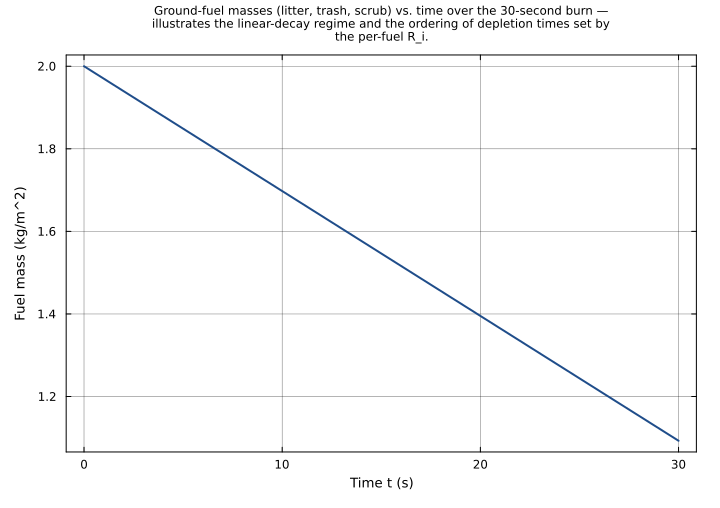
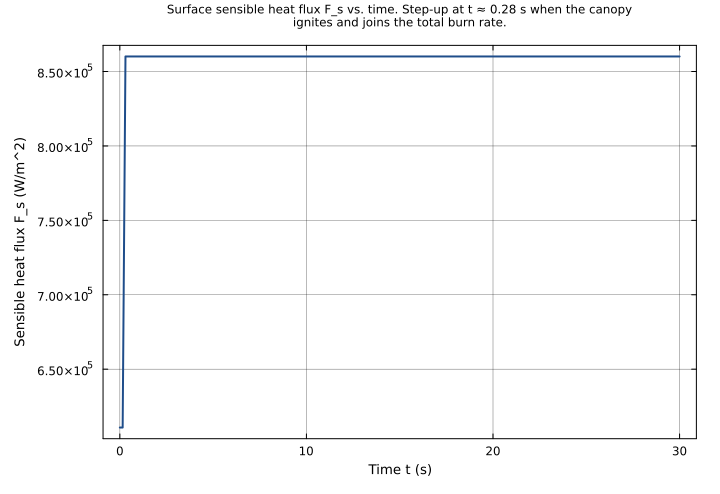
Short 30-second burn at V_A = 3 m/s (the FIR7CR experiment wind), starting from the moderately loaded dry-eucalyptus initial state used in the upstream docstring example (M_litter = 2.0, M_trash = 0.5, M_scrub = 0.2, M_canopy = 1.2 kg/m^2; Q_cumulative = 0). The canopy ignites automatically at t ≈ 0.28 s when Q_cumulative crosses 170 kJ/m^2; the full burn then drives F_s, F_l, and total_burn_rate at canopy-active levels through the end of the run. Reproduces the qualitative behaviour shown in Fig. 6 of Clark et al. (1996) over the first half-minute.
Time span: 0.0 → 30.0
no_wind_baseline
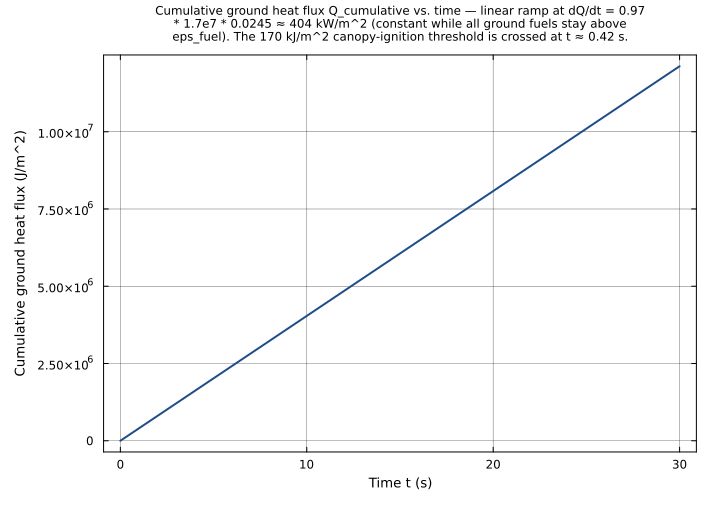
V_A = 0 m/s baseline: the McArthur spread rate S_f collapses to 0 (the wind-speed clamp wins) and B_ratio = 0.5 is the lower bound of the burn-rate ratio. All ground fuels still burn at half their nominal rate; the canopy ignites at t ≈ 0.42 s. Useful for isolating wind-independent terms when interpreting the wind-driven scenarios.
Time span: 0.0 → 30.0
Raw .esm
Raw .esm JSON (this component)
{
"reference": {
"citation": "Clark, T.L., Jenkins, M.A., Coen, J.L., and Packham, D.R. (1996). A Coupled Atmosphere-Fire Model: Role of the Convective Froude Number and Dynamic Fingering at the Fireline. International Journal of Wildland Fire, 6(4), 177-190.",
"notes": "source_ref: WildlandFire.jl@126976f2508ceacca6c486b21ae6da5b168c6f46:src/clark1996.jl:81\nUpstream `Clark1996FireSpread` is an MTK `@component` with 12 equations and 12 unknowns. Three time-indexed @variables are algebraic (B_ratio, S_f, ground_burn_rate, total_burn_rate, canopy_burning, F_s, F_l — seven total) and five are ODE states (M_litter, M_trash, M_scrub, M_canopy, Q_cumulative). The single MTK `@parameter` is V_A (15 m AGL wind speed). All other inputs are MTK `@constants` (18 total) which are preserved here as ESM parameters with their upstream values to maintain 1:1 structural fidelity with the upstream component — the same convention used by sibling Clark1996 migrations (e.g. components/wildland_fire/clark1996/heat_flux_profile.esm).\n\nThe twelve equations preserved verbatim from the upstream `eqs` block:\n\n 1. B_ratio = sqrt((|V_A| + one_vel) / (|V_A| + four_vel)) (Eq. 8)\n 2. S_f = min(S_a * exp(k_spread * |V_A|), |V_A|) (Eq. 9 with limiting)\n 3. D(M_litter) = -R_litter * B_ratio * ifelse(M_litter > eps_fuel, 1, 0) (p. 180)\n 4. D(M_trash) = -R_trash * B_ratio * ifelse(M_trash > eps_fuel, 1, 0) (p. 180)\n 5. D(M_scrub) = -R_scrub * B_ratio * ifelse(M_scrub > eps_fuel, 1, 0) (p. 180)\n 6. D(Q_cumulative) = (1 - f_evap) * H_c * ground_burn_rate (p. 180)\n 7. canopy_burning = ifelse(Q_cumulative > Q_canopy_threshold, 1, 0) (p. 180)\n 8. D(M_canopy) = -R_canopy * B_ratio * canopy_burning * ifelse(M_canopy > eps_fuel, 1, 0)\n 9. ground_burn_rate = sum over {litter, trash, scrub} of R_i*B_ratio*ifelse(M_i>eps_fuel, 1, 0)\n 10. total_burn_rate = ground_burn_rate + R_canopy*B_ratio*canopy_burning*ifelse(M_canopy>eps_fuel, 1, 0)\n 11. F_s = (1 - f_evap) * H_c * total_burn_rate (p. 180)\n 12. F_l = f_water * L_v * total_burn_rate + f_evap * H_c * total_burn_rate (p. 180)\n\nThe upstream MTK component leaves the random-spread factor r_f (≈ 1 ± 0.05) out for deterministic simulation; the ESM preserves that choice. The S_f `min(...)` clamp keeps the forward spread rate from exceeding the wind speed at low |V_A| (consistent with the Clark et al. text describing S_f as a wind-driven advance rate, never faster than the ambient wind itself).\n\nUnused-but-preserved constants: `zero_fuel` (kg/m^2) and `alpha_ext` (m, the heat-flux extinction depth used by the sibling Clark1996HeatFluxProfile component) appear in the upstream `@constants` block but never enter the equations of this component. They are preserved as parameters with their upstream defaults — same fidelity convention as `one_m` in components/wildland_fire/clark1996/heat_flux_profile.esm.\n\nDefaults for ODE states match the upstream docstring example (a moderately loaded dry eucalyptus stand): M_litter = 2.0, M_trash = 0.5, M_scrub = 0.2, M_canopy = 1.2 kg/m^2; Q_cumulative = 0 J/m^2 (no heat yet accumulated). V_A defaults to 3.0 m/s (the FIR7CR experiment value cited in the upstream docstring).\n\nThe canopy-ignition switch (eq. 7) is a hard discontinuity: when Q_cumulative crosses Q_canopy_threshold, canopy_burning flips from 0 to 1 and D(M_canopy) changes sign. Tsit5 with reltol=1e-10 captures this transition by reducing step size around it, but assertions that depend on the exact crossing time (e.g. M_canopy at a t between ignition and the end of the burn) will show small integrator-truncation error. The tests below avoid asserting M_canopy at intermediate times near the switch; ground-fuel masses, Q_cumulative (whose RHS is independent of M_canopy), and canopy_burning itself (a step function in Q) are clean.\n\nTolerance rationale (model-level rel=1e-6): linear constant-coefficient ODEs for the ground fuels and Q_cumulative (while their gating ifelse arguments are above eps_fuel and Q below the canopy threshold, respectively); the canopy ODE has one discontinuous switch. Tsit5 reltol=1e-10/abstol=1e-12 keeps integrator truncation comfortably below 1e-6 over the tested horizons (≤ 30 s) for all clean assertions; algebraic-only assertions at t=0 are exact to float64 ULP and are checked with the model-level tolerance — no per-test loosening is needed."
},
"tolerance": {
"rel": 1e-06
},
"variables": {
"V_A": {
"type": "parameter",
"units": "m/s",
"default": 3.0,
"description": "Tracer-advecting wind speed at 15 m AGL. Drives both the McArthur forward spread rate S_f (Eq. 9) and the burn-rate ratio B_ratio (Eq. 8). Default 3.0 m/s matches the FIR7CR experiment in Clark et al. (1996); upstream has no default."
},
"S_a": {
"type": "parameter",
"units": "m/s",
"default": 0.18,
"description": "Backing/base fire spread rate (McArthur). Upstream `@constant`; preserved for 1:1 structural fidelity. Clark et al. (1996), Eq. 9."
},
"k_spread": {
"type": "parameter",
"units": "s/m",
"default": 0.08424,
"description": "McArthur spread-rate coefficient. Upstream `@constant`; preserved for 1:1 structural fidelity. Clark et al. (1996), Eq. 9."
},
"R_litter": {
"type": "parameter",
"units": "kg/(m^2*s)",
"default": 0.04,
"description": "Litter nominal burn rate. Walker (1981); p. 180 of Clark et al. (1996). Upstream `@constant`."
},
"R_trash": {
"type": "parameter",
"units": "kg/(m^2*s)",
"default": 0.005,
"description": "Trash nominal burn rate. Walker (1981); p. 180 of Clark et al. (1996). Upstream `@constant`."
},
"R_scrub": {
"type": "parameter",
"units": "kg/(m^2*s)",
"default": 0.004,
"description": "Scrub nominal burn rate. Walker (1981); p. 180 of Clark et al. (1996). Upstream `@constant`."
},
"R_canopy": {
"type": "parameter",
"units": "kg/(m^2*s)",
"default": 0.02,
"description": "Dry canopy fuel nominal burn rate. Walker (1981); p. 180 of Clark et al. (1996). Upstream `@constant`."
},
"H_c": {
"type": "parameter",
"units": "J/kg",
"default": 17000000.0,
"description": "Combustion coefficient (sensible heat released per kg of dry fuel burned). p. 180 of Clark et al. (1996). Upstream `@constant`."
},
"f_evap": {
"type": "parameter",
"units": "1",
"default": 0.03,
"description": "Fraction of combustion sensible heat used to evaporate ground-fuel moisture (dimensionless). p. 180 of Clark et al. (1996). Upstream `@constant`."
},
"f_water": {
"type": "parameter",
"units": "1",
"default": 0.56,
"description": "Fraction of dry fuel mass converted to water vapor by cellulose combustion (dimensionless). p. 180 of Clark et al. (1996). Upstream `@constant`."
},
"L_v": {
"type": "parameter",
"units": "J/kg",
"default": 2500000.0,
"description": "Latent heat of vaporization of water. Upstream `@constant`."
},
"one_vel": {
"type": "parameter",
"units": "m/s",
"default": 1.0,
"description": "Reference velocity for unit-balancing the numerator of B_ratio (Eq. 8). Upstream `@constant` preserved for fidelity."
},
"four_vel": {
"type": "parameter",
"units": "m/s",
"default": 4.0,
"description": "Reference velocity for unit-balancing the denominator of B_ratio (Eq. 8). Upstream `@constant` preserved for fidelity."
},
"one_dimless": {
"type": "parameter",
"units": "1",
"default": 1.0,
"description": "Dimensionless one (selector value when ifelse condition holds; also (1 - f_evap) in F_s and Q_cumulative ODE). Upstream `@constant`."
},
"zero_dimless": {
"type": "parameter",
"units": "1",
"default": 0.0,
"description": "Dimensionless zero (selector value when ifelse condition fails). Upstream `@constant`."
},
"zero_fuel": {
"type": "parameter",
"units": "kg/m^2",
"default": 0.0,
"description": "Zero fuel mass reference. Upstream `@constant` declared but unused in the equations — preserved for 1:1 structural fidelity with the upstream component (same convention as `one_m` in components/wildland_fire/clark1996/heat_flux_profile.esm)."
},
"eps_fuel": {
"type": "parameter",
"units": "kg/m^2",
"default": 1e-10,
"description": "Small epsilon for fuel-depletion comparison. Each fuel mass M_i > eps_fuel selects the burning branch of the ifelse (D(M_i) = -R_i * B_ratio); otherwise D(M_i) = 0 and the pool stops draining. Upstream `@constant`."
},
"alpha_ext": {
"type": "parameter",
"units": "m",
"default": 50.0,
"description": "Heat-flux e-folding extinction depth (Clark et al. 1996, Eq. 10). Upstream `@constant` declared in this component but used only by the sibling Clark1996HeatFluxProfile — preserved here for 1:1 structural fidelity (same convention as `one_m` in components/wildland_fire/clark1996/heat_flux_profile.esm)."
},
"Q_canopy_threshold": {
"type": "parameter",
"units": "J/m^2",
"default": 170000.0,
"description": "Cumulative ground-fuel heat flux at which the canopy ignites (170 kJ/m^2). p. 180 of Clark et al. (1996). Upstream `@constant`."
},
"M_litter": {
"type": "unknown",
"units": "kg/m^2",
"default": 2.0,
"description": "Litter fuel mass remaining. Default 2.0 kg/m^2 matches the moderately loaded dry-eucalyptus stand used in the upstream docstring example (the FIR7CR experiment ICs)."
},
"M_trash": {
"type": "unknown",
"units": "kg/m^2",
"default": 0.5,
"description": "Trash fuel mass remaining. Default 0.5 kg/m^2; upstream docstring example IC."
},
"M_scrub": {
"type": "unknown",
"units": "kg/m^2",
"default": 0.2,
"description": "Scrub fuel mass remaining. Default 0.2 kg/m^2; upstream docstring example IC."
},
"M_canopy": {
"type": "unknown",
"units": "kg/m^2",
"default": 1.2,
"description": "Dry canopy fuel mass remaining. Default 1.2 kg/m^2; upstream docstring example IC. Consumption begins only after Q_cumulative crosses Q_canopy_threshold."
},
"Q_cumulative": {
"type": "unknown",
"units": "J/m^2",
"default": 0.0,
"description": "Cumulative ground-fuel heat flux. Drives the canopy-ignition switch (Q > Q_canopy_threshold). Starts at 0 J/m^2 — no heat accumulated."
},
"B_ratio": {
"type": "unknown",
"units": "1",
"description": "Burn-rate modulation factor B_ratio = sqrt((|V_A| + 1)/(|V_A| + 4)) (dimensionless). Eq. 8 of Clark et al. (1996). Algebraic — constant in time when V_A is constant."
},
"S_f": {
"type": "unknown",
"units": "m/s",
"description": "Forward fire spread rate S_f = min(S_a * exp(k_spread * |V_A|), |V_A|). Eq. 9 of Clark et al. (1996); the min(...) clamp keeps the McArthur spread rate from exceeding the wind speed at low |V_A|. Algebraic — constant in time when V_A is constant."
},
"canopy_burning": {
"type": "unknown",
"units": "1",
"description": "Canopy ignition flag (1 = burning, 0 = not burning). Algebraic step function in Q_cumulative: canopy_burning = ifelse(Q_cumulative > Q_canopy_threshold, 1, 0). Switches from 0 to 1 when cumulative ground heat flux crosses 170 kJ/m^2 (p. 180 of Clark et al. 1996)."
},
"ground_burn_rate": {
"type": "unknown",
"units": "kg/(m^2*s)",
"description": "Total ground-fuel burn rate (litter + trash + scrub contributions, each gated by ifelse(M_i > eps_fuel, 1, 0)). Algebraic; feeds D(Q_cumulative)."
},
"total_burn_rate": {
"type": "unknown",
"units": "kg/(m^2*s)",
"description": "Total fuel burn rate = ground_burn_rate + R_canopy * B_ratio * canopy_burning * ifelse(M_canopy > eps_fuel, 1, 0). Algebraic; feeds F_s and F_l."
},
"F_s": {
"type": "unknown",
"units": "W/m^2",
"description": "Surface sensible heat flux from the fire. F_s = (1 - f_evap) * H_c * total_burn_rate — 97% of combustion heat goes to sensible flux (3% drives moisture evaporation). p. 180 of Clark et al. (1996). Algebraic."
},
"F_l": {
"type": "unknown",
"units": "W/m^2",
"description": "Surface latent heat flux from the fire. F_l = f_water * L_v * total_burn_rate + f_evap * H_c * total_burn_rate — water vapor from cellulose combustion (56% of dry-fuel mass) plus the evaporated ground-fuel moisture. p. 180 of Clark et al. (1996). Algebraic."
}
},
"equations": [
{
"lhs": "B_ratio",
"rhs": {
"op": "sqrt",
"args": [
{
"op": "/",
"args": [
{
"op": "+",
"args": [
{
"op": "abs",
"args": [
"V_A"
]
},
"one_vel"
]
},
{
"op": "+",
"args": [
{
"op": "abs",
"args": [
"V_A"
]
},
"four_vel"
]
}
]
}
]
}
},
{
"lhs": "S_f",
"rhs": {
"op": "min",
"args": [
{
"op": "*",
"args": [
"S_a",
{
"op": "exp",
"args": [
{
"op": "*",
"args": [
"k_spread",
{
"op": "abs",
"args": [
"V_A"
]
}
]
}
]
}
]
},
{
"op": "abs",
"args": [
"V_A"
]
}
]
}
},
{
"lhs": {
"op": "D",
"wrt": "t",
"args": [
"M_litter"
]
},
"rhs": {
"op": "*",
"args": [
-1.0,
"R_litter",
"B_ratio",
{
"op": "ifelse",
"args": [
{
"op": ">",
"args": [
"M_litter",
"eps_fuel"
]
},
"one_dimless",
"zero_dimless"
]
}
]
}
},
{
"lhs": {
"op": "D",
"wrt": "t",
"args": [
"M_trash"
]
},
"rhs": {
"op": "*",
"args": [
-1.0,
"R_trash",
"B_ratio",
{
"op": "ifelse",
"args": [
{
"op": ">",
"args": [
"M_trash",
"eps_fuel"
]
},
"one_dimless",
"zero_dimless"
]
}
]
}
},
{
"lhs": {
"op": "D",
"wrt": "t",
"args": [
"M_scrub"
]
},
"rhs": {
"op": "*",
"args": [
-1.0,
"R_scrub",
"B_ratio",
{
"op": "ifelse",
"args": [
{
"op": ">",
"args": [
"M_scrub",
"eps_fuel"
]
},
"one_dimless",
"zero_dimless"
]
}
]
}
},
{
"lhs": {
"op": "D",
"wrt": "t",
"args": [
"Q_cumulative"
]
},
"rhs": {
"op": "*",
"args": [
{
"op": "-",
"args": [
"one_dimless",
"f_evap"
]
},
"H_c",
"ground_burn_rate"
]
}
},
{
"lhs": "canopy_burning",
"rhs": {
"op": "ifelse",
"args": [
{
"op": ">",
"args": [
"Q_cumulative",
"Q_canopy_threshold"
]
},
"one_dimless",
"zero_dimless"
]
}
},
{
"lhs": {
"op": "D",
"wrt": "t",
"args": [
"M_canopy"
]
},
"rhs": {
"op": "*",
"args": [
-1.0,
"R_canopy",
"B_ratio",
"canopy_burning",
{
"op": "ifelse",
"args": [
{
"op": ">",
"args": [
"M_canopy",
"eps_fuel"
]
},
"one_dimless",
"zero_dimless"
]
}
]
}
},
{
"lhs": "ground_burn_rate",
"rhs": {
"op": "+",
"args": [
{
"op": "*",
"args": [
"R_litter",
"B_ratio",
{
"op": "ifelse",
"args": [
{
"op": ">",
"args": [
"M_litter",
"eps_fuel"
]
},
"one_dimless",
"zero_dimless"
]
}
]
},
{
"op": "*",
"args": [
"R_trash",
"B_ratio",
{
"op": "ifelse",
"args": [
{
"op": ">",
"args": [
"M_trash",
"eps_fuel"
]
},
"one_dimless",
"zero_dimless"
]
}
]
},
{
"op": "*",
"args": [
"R_scrub",
"B_ratio",
{
"op": "ifelse",
"args": [
{
"op": ">",
"args": [
"M_scrub",
"eps_fuel"
]
},
"one_dimless",
"zero_dimless"
]
}
]
}
]
}
},
{
"lhs": "total_burn_rate",
"rhs": {
"op": "+",
"args": [
"ground_burn_rate",
{
"op": "*",
"args": [
"R_canopy",
"B_ratio",
"canopy_burning",
{
"op": "ifelse",
"args": [
{
"op": ">",
"args": [
"M_canopy",
"eps_fuel"
]
},
"one_dimless",
"zero_dimless"
]
}
]
}
]
}
},
{
"lhs": "F_s",
"rhs": {
"op": "*",
"args": [
{
"op": "-",
"args": [
"one_dimless",
"f_evap"
]
},
"H_c",
"total_burn_rate"
]
}
},
{
"lhs": "F_l",
"rhs": {
"op": "+",
"args": [
{
"op": "*",
"args": [
"f_water",
"L_v",
"total_burn_rate"
]
},
{
"op": "*",
"args": [
"f_evap",
"H_c",
"total_burn_rate"
]
}
]
}
}
],
"tests": [
{
"id": "zero_wind_initial_algebraic",
"description": "V_A = 0: B_ratio = sqrt(1/4) = 0.5 (Eq. 8 with |V_A|=0); S_f = min(0.18, 0) = 0 (Eq. 9, the |V_A| clamp wins). All ground fuels above eps_fuel so ground_burn_rate = (R_litter + R_trash + R_scrub) * 0.5 = 0.0245 kg/(m^2*s). Q_cumulative = 0 ⇒ canopy_burning = 0 ⇒ total_burn_rate = ground_burn_rate. F_s = 0.97 * 1.7e7 * 0.0245 = 404005 W/m^2; F_l = 0.56*2.5e6*0.0245 + 0.03*1.7e7*0.0245 = 34300 + 12495 = 46795 W/m^2.",
"parameter_overrides": {
"V_A": 0.0
},
"initial_conditions": {
"M_litter": 2.0,
"M_trash": 0.5,
"M_scrub": 0.2,
"M_canopy": 1.2,
"Q_cumulative": 0.0
},
"time_span": {
"start": 0.0,
"end": 1.0
},
"assertions": [
{
"variable": "B_ratio",
"time": 0.0,
"expected": 0.5
},
{
"variable": "S_f",
"time": 0.0,
"expected": 0.0,
"tolerance": {
"abs": 1e-15
}
},
{
"variable": "canopy_burning",
"time": 0.0,
"expected": 0.0,
"tolerance": {
"abs": 1e-15
}
},
{
"variable": "ground_burn_rate",
"time": 0.0,
"expected": 0.0245
},
{
"variable": "total_burn_rate",
"time": 0.0,
"expected": 0.0245
},
{
"variable": "F_s",
"time": 0.0,
"expected": 404005.0
},
{
"variable": "F_l",
"time": 0.0,
"expected": 46795.0
}
]
},
{
"id": "moderate_wind_3ms_algebraic",
"description": "V_A = 3 m/s (FIR7CR experiment value): B_ratio = sqrt(4/7) ≈ 0.7559289460184544 (Eq. 8). S_f = min(0.18 * exp(0.08424*3), 3) = min(0.231754..., 3) = 0.231754... (Eq. 9; the exponential wins, not the |V_A| clamp). ground_burn_rate = 0.049 * 0.755929... = 0.037040518... kg/(m^2*s); F_s = 0.97 * 1.7e7 * 0.037040518 = 610798.148 W/m^2.",
"parameter_overrides": {
"V_A": 3.0
},
"initial_conditions": {
"M_litter": 2.0,
"M_trash": 0.5,
"M_scrub": 0.2,
"M_canopy": 1.2,
"Q_cumulative": 0.0
},
"time_span": {
"start": 0.0,
"end": 1.0
},
"assertions": [
{
"variable": "B_ratio",
"time": 0.0,
"expected": 0.7559289460184544
},
{
"variable": "S_f",
"time": 0.0,
"expected": 0.2317540895995373
},
{
"variable": "canopy_burning",
"time": 0.0,
"expected": 0.0,
"tolerance": {
"abs": 1e-15
}
},
{
"variable": "ground_burn_rate",
"time": 0.0,
"expected": 0.03704051835490427
},
{
"variable": "total_burn_rate",
"time": 0.0,
"expected": 0.03704051835490427
},
{
"variable": "F_s",
"time": 0.0,
"expected": 610798.1476723714
},
{
"variable": "F_l",
"time": 0.0,
"expected": 70747.39005786716
}
]
},
{
"id": "strong_wind_10ms_algebraic",
"description": "V_A = 10 m/s: B_ratio = sqrt(11/14) ≈ 0.886405... ; S_f = min(0.18 * exp(0.8424), 10) = 0.417948... (exp branch wins, well below the |V_A|=10 clamp); ground_burn_rate scales linearly with B_ratio.",
"parameter_overrides": {
"V_A": 10.0
},
"initial_conditions": {
"M_litter": 2.0,
"M_trash": 0.5,
"M_scrub": 0.2,
"M_canopy": 1.2,
"Q_cumulative": 0.0
},
"time_span": {
"start": 0.0,
"end": 1.0
},
"assertions": [
{
"variable": "B_ratio",
"time": 0.0,
"expected": 0.8864052604279183
},
{
"variable": "S_f",
"time": 0.0,
"expected": 0.4179479281204271
},
{
"variable": "ground_burn_rate",
"time": 0.0,
"expected": 0.043433857760968
},
{
"variable": "F_s",
"time": 0.0,
"expected": 716224.3144783623
},
{
"variable": "F_l",
"time": 0.0,
"expected": 82958.66832344889
}
]
},
{
"id": "S_f_clamped_by_wind_speed",
"description": "Low-wind regime where the min(...) clamp in Eq. 9 selects |V_A|, not S_a*exp(k*|V_A|). At V_A = 0.1 m/s, S_a*exp(k_spread*0.1) = 0.18*exp(0.008424) ≈ 0.18152 m/s, which exceeds |V_A| = 0.1. min(0.18152, 0.1) = 0.1. Exercises the clamp branch of S_f.",
"parameter_overrides": {
"V_A": 0.1
},
"initial_conditions": {
"M_litter": 2.0,
"M_trash": 0.5,
"M_scrub": 0.2,
"M_canopy": 1.2,
"Q_cumulative": 0.0
},
"time_span": {
"start": 0.0,
"end": 1.0
},
"assertions": [
{
"variable": "B_ratio",
"time": 0.0,
"expected": 0.5179697702828123
},
{
"variable": "S_f",
"time": 0.0,
"expected": 0.1
}
]
},
{
"id": "depleted_litter_gates_burn",
"description": "M_litter = 0 < eps_fuel (1e-10) so the ifelse selects zero_dimless and the litter contribution to ground_burn_rate vanishes; trash and scrub still burn. V_A = 0 ⇒ B_ratio = 0.5. ground_burn_rate = (R_trash + R_scrub) * 0.5 = 0.0045 kg/(m^2*s); F_s = 0.97 * 1.7e7 * 0.0045 = 74205 W/m^2. Verifies the per-fuel eps_fuel gate stops consumption cleanly at depletion.",
"parameter_overrides": {
"V_A": 0.0
},
"initial_conditions": {
"M_litter": 0.0,
"M_trash": 0.5,
"M_scrub": 0.2,
"M_canopy": 1.2,
"Q_cumulative": 0.0
},
"time_span": {
"start": 0.0,
"end": 1.0
},
"assertions": [
{
"variable": "ground_burn_rate",
"time": 0.0,
"expected": 0.0045
},
{
"variable": "total_burn_rate",
"time": 0.0,
"expected": 0.0045
},
{
"variable": "F_s",
"time": 0.0,
"expected": 74205.0
}
]
},
{
"id": "canopy_burning_when_Q_above_threshold",
"description": "Initialise Q_cumulative = 200000 J/m^2, above the 170000 J/m^2 canopy ignition threshold. canopy_burning flips to 1 at t = 0 and the canopy contributes to total_burn_rate. V_A = 0 ⇒ B_ratio = 0.5; total_burn_rate = ground (0.0245) + R_canopy*B_ratio*1*1 = 0.0245 + 0.01 = 0.0345 kg/(m^2*s); F_s = 0.97 * 1.7e7 * 0.0345 = 568905 W/m^2; F_l = 0.56*2.5e6*0.0345 + 0.03*1.7e7*0.0345 = 48300 + 17595 = 65895 W/m^2. Exercises the canopy_burning step function in Q_cumulative.",
"parameter_overrides": {
"V_A": 0.0
},
"initial_conditions": {
"M_litter": 2.0,
"M_trash": 0.5,
"M_scrub": 0.2,
"M_canopy": 1.2,
"Q_cumulative": 200000.0
},
"time_span": {
"start": 0.0,
"end": 1.0
},
"assertions": [
{
"variable": "canopy_burning",
"time": 0.0,
"expected": 1.0
},
{
"variable": "total_burn_rate",
"time": 0.0,
"expected": 0.0345
},
{
"variable": "F_s",
"time": 0.0,
"expected": 568905.0
},
{
"variable": "F_l",
"time": 0.0,
"expected": 65895.0
}
]
},
{
"id": "pre_ignition_linear_evolution_V_A_3",
"description": "Short-time linear evolution before the canopy-ignition switch. V_A = 3 gives constant B_ratio = sqrt(4/7), ground_burn_rate = 0.037040518... kg/(m^2*s), and dQ/dt = 0.97 * 1.7e7 * 0.037040518 = 610798.148 W/m^2 (J/m^2/s). The threshold (170000 J/m^2) is crossed at t ≈ 0.27832 s; sampling at t = 0.1 stays well inside the pre-ignition regime where every state evolves linearly: M_litter(0.1) = 2 - R_litter*B_ratio*0.1; M_trash(0.1) = 0.5 - R_trash*B_ratio*0.1; M_scrub(0.1) = 0.2 - R_scrub*B_ratio*0.1; Q_cumulative(0.1) = dQ/dt * 0.1 = 61079.81... J/m^2 (below threshold ⇒ canopy_burning = 0, M_canopy unchanged at 1.2).",
"parameter_overrides": {
"V_A": 3.0
},
"initial_conditions": {
"M_litter": 2.0,
"M_trash": 0.5,
"M_scrub": 0.2,
"M_canopy": 1.2,
"Q_cumulative": 0.0
},
"time_span": {
"start": 0.0,
"end": 0.1
},
"assertions": [
{
"variable": "M_litter",
"time": 0.1,
"expected": 1.9969762841759817
},
{
"variable": "M_trash",
"time": 0.1,
"expected": 0.4996221855219977
},
{
"variable": "M_scrub",
"time": 0.1,
"expected": 0.1996977284175982
},
{
"variable": "M_canopy",
"time": 0.1,
"expected": 1.2
},
{
"variable": "Q_cumulative",
"time": 0.1,
"expected": 61079.81476723714
},
{
"variable": "canopy_burning",
"time": 0.1,
"expected": 0.0,
"tolerance": {
"abs": 1e-15
}
}
]
},
{
"id": "post_ignition_canopy_flag_V_A_3",
"description": "Run V_A = 3 m/s long enough to cross the canopy ignition threshold (t_ignite ≈ 0.27832 s) and confirm canopy_burning = 1 at t = 1.0 s. Q_cumulative growth is independent of canopy state (dQ/dt depends only on ground_burn_rate), and all ground fuels remain well-stocked over [0, 1] s ⇒ Q(1.0) = dQ/dt * 1.0 ≈ 610798.15 J/m^2 (well above the 170 kJ/m^2 threshold).",
"parameter_overrides": {
"V_A": 3.0
},
"initial_conditions": {
"M_litter": 2.0,
"M_trash": 0.5,
"M_scrub": 0.2,
"M_canopy": 1.2,
"Q_cumulative": 0.0
},
"time_span": {
"start": 0.0,
"end": 1.0
},
"assertions": [
{
"variable": "canopy_burning",
"time": 1.0,
"expected": 1.0
},
{
"variable": "Q_cumulative",
"time": 1.0,
"expected": 610798.1476723714
}
]
},
{
"id": "ground_fuel_linear_decay_V_A_0",
"description": "Longer-horizon linear decay of the three ground fuels at V_A = 0 (B_ratio = 0.5, all fuels constant-rate). At t = 10 s: M_litter = 2.0 - 0.04*0.5*10 = 1.8; M_trash = 0.5 - 0.005*0.5*10 = 0.475; M_scrub = 0.2 - 0.004*0.5*10 = 0.18 (all comfortably above eps_fuel). Q_cumulative(10) = 404005 * 10 = 4040050 J/m^2 (dQ/dt is constant while ground fuels are all above eps_fuel). canopy_burning(10) = 1 (Q crossed threshold at t ≈ 0.42 s). M_canopy is NOT asserted at this sampling time — the ifelse switch around t ≈ 0.42 s creates small integrator-truncation error in the canopy state.",
"parameter_overrides": {
"V_A": 0.0
},
"initial_conditions": {
"M_litter": 2.0,
"M_trash": 0.5,
"M_scrub": 0.2,
"M_canopy": 1.2,
"Q_cumulative": 0.0
},
"time_span": {
"start": 0.0,
"end": 10.0
},
"assertions": [
{
"variable": "M_litter",
"time": 10.0,
"expected": 1.8
},
{
"variable": "M_trash",
"time": 10.0,
"expected": 0.475
},
{
"variable": "M_scrub",
"time": 10.0,
"expected": 0.18
},
{
"variable": "Q_cumulative",
"time": 10.0,
"expected": 4040050.0
},
{
"variable": "canopy_burning",
"time": 10.0,
"expected": 1.0
}
]
}
],
"analyses": [
{
"id": "fir7cr_short_burn",
"description": "Short 30-second burn at V_A = 3 m/s (the FIR7CR experiment wind), starting from the moderately loaded dry-eucalyptus initial state used in the upstream docstring example (M_litter = 2.0, M_trash = 0.5, M_scrub = 0.2, M_canopy = 1.2 kg/m^2; Q_cumulative = 0). The canopy ignites automatically at t ≈ 0.28 s when Q_cumulative crosses 170 kJ/m^2; the full burn then drives F_s, F_l, and total_burn_rate at canopy-active levels through the end of the run. Reproduces the qualitative behaviour shown in Fig. 6 of Clark et al. (1996) over the first half-minute.",
"initial_state": {},
"parameters": {
"V_A": 3.0
},
"time_span": {
"start": 0.0,
"end": 30.0
},
"plots": [
{
"id": "ground_fuels_vs_time",
"type": "line",
"description": "Ground-fuel masses (litter, trash, scrub) vs. time over the 30-second burn — illustrates the linear-decay regime and the ordering of depletion times set by the per-fuel R_i.",
"x": {
"variable": "t",
"label": "Time t (s)"
},
"y": {
"variable": "M_litter",
"label": "Fuel mass (kg/m^2)"
}
},
{
"id": "F_s_vs_time",
"type": "line",
"description": "Surface sensible heat flux F_s vs. time. Step-up at t ≈ 0.28 s when the canopy ignites and joins the total burn rate.",
"x": {
"variable": "t",
"label": "Time t (s)"
},
"y": {
"variable": "F_s",
"label": "Sensible heat flux F_s (W/m^2)"
}
}
]
},
{
"id": "no_wind_baseline",
"description": "V_A = 0 m/s baseline: the McArthur spread rate S_f collapses to 0 (the wind-speed clamp wins) and B_ratio = 0.5 is the lower bound of the burn-rate ratio. All ground fuels still burn at half their nominal rate; the canopy ignites at t ≈ 0.42 s. Useful for isolating wind-independent terms when interpreting the wind-driven scenarios.",
"initial_state": {},
"parameters": {
"V_A": 0.0
},
"time_span": {
"start": 0.0,
"end": 30.0
},
"plots": [
{
"id": "Q_cumulative_vs_time",
"type": "line",
"description": "Cumulative ground heat flux Q_cumulative vs. time — linear ramp at dQ/dt = 0.97 * 1.7e7 * 0.0245 ≈ 404 kW/m^2 (constant while all ground fuels stay above eps_fuel). The 170 kJ/m^2 canopy-ignition threshold is crossed at t ≈ 0.42 s.",
"x": {
"variable": "t",
"label": "Time t (s)"
},
"y": {
"variable": "Q_cumulative",
"label": "Cumulative ground heat flux (J/m^2)"
}
}
]
}
]
}