Clark1996ConvectiveFroudeNumber
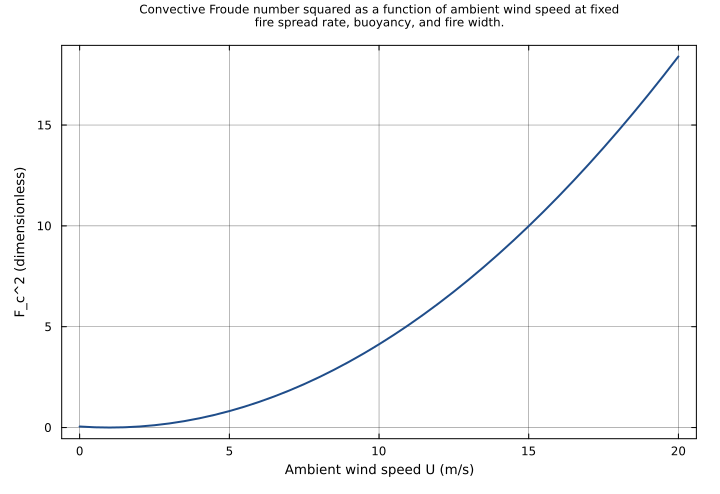
Square of the convective Froude number (Eq. 1, Clark et al., 1996), a diagnostic of fire-atmosphere coupling strength: F_c^2 = (U - S_f)^2 / (g * (Δθ/θ̄) * W_f). Large F_c^2 indicates wind-dominated (weak coupling); small F_c^2 indicates buoyancy-dominated (strong coupling). Migrated from WildlandFire.jl@126976f2 src/clark1996.jl:253 (`Clark1996ConvectiveFroudeNumber` @component). Observed-only: U, S_f, delta_theta_over_theta, W_f are inputs (parameters); F_c_sq is an algebraic output.
Description
Square of the convective Froude number (Eq. 1, Clark et al., 1996), a diagnostic of fire-atmosphere coupling strength: F_c^2 = (U - S_f)^2 / (g * (Δθ/θ̄) * W_f). Large F_c^2 indicates wind-dominated (weak coupling); small F_c^2 indicates buoyancy-dominated (strong coupling). Migrated from WildlandFire.jl@126976f2 src/clark1996.jl:253 (Clark1996ConvectiveFroudeNumber @component). Observed-only: U, S_f, delta_theta_over_theta, W_f are inputs (parameters); F_c_sq is an algebraic output.
Reference
_source_ref: WildlandFire.jl@126976f2508ceacca6c486b21ae6da5b168c6f46:src/clark1996.jl:253
Upstream Clark1996ConvectiveFroudeNumber is an MTK @component whose four inputs (U, S_f, delta_theta_over_theta, W_f) are @parameters and whose single output F_c_sq is a time-indexed @variable with one algebraic equation. Identical structure preserved here; the upstream g @constant (= 9.81 m/s^2) and one_dimless @constant (= 1.0) are exposed as parameters with their upstream default values, mirroring the wind_profile.esm pattern (components/wildland_fire/clark1996/wind_profile.esm) where upstream @constants are preserved as literal-valued parameters to maintain 1:1 fidelity with the upstream component.
The one_dimless parameter is declared upstream but never referenced in the equation (an MTK boilerplate carry-over from sibling Clark1996 components). It is preserved here as a parameter for 1:1 structural fidelity with the upstream @constants block; it does not appear in any equation, mirroring its upstream usage.
Tolerance rationale (model-level rel=1e-12): observed-only single-equation algebraic system (no ODE integration); the equation is one subtraction, one square, three multiplications, and one division on hardware-supported intrinsics — float64 roundoff is at the ULP level (~1e-15). 1e-12 is comfortably above ULP and far below any plausible physical-discrimination scale on a dimensionless Froude-number diagnostic._
Parameters
| Name | Units | Default | Description |
|---|---|---|---|
U | m/s | 0.0 | Ambient wind speed |
S_f | m/s | 0.0 | Fire spread rate |
delta_theta_over_theta | 1 | 0.01 | Convective buoyancy Δθ/θ̄ (dimensionless potential-temperature anomaly relative to mean) |
W_f | m | 1.0 | Fire width |
g | m/s^2 | 9.81 | Gravitational acceleration (upstream @constant; default 9.81 m/s^2) |
one_dimless | 1 | 1.0 | Dimensionless one (upstream @constant declared but unused in the equation; preserved as a parameter for 1:1 structural fidelity with the upstream @constants block) |
Observed
| Name | Units | Default | Description |
|---|---|---|---|
F_c_sq | 1 | Square of convective Froude number (dimensionless). Large = wind-dominated (weak coupling); small = buoyancy-dominated (strong coupling). |
Observed expressions
$$ F_{c\,sq} = \frac{\left(U - S_{f}\right)^{2}}{g \cdot delta_{theta\,over\,theta} \cdot W_{f}} $$Square of convective Froude number (dimensionless). Large = wind-dominated (weak coupling); small = buoyancy-dominated (strong coupling).
Analyses
froude_vs_wind
F_c^2 as a function of ambient wind speed U at fixed fire properties (S_f=1 m/s, Δθ/θ̄=0.02, W_f=100 m) — sweeps U from 0 to 20 m/s, showing the parabolic growth in (U - S_f)^2 that drives the transition from buoyancy-dominated (F_c^2 < 1, near U = S_f) to wind-dominated (F_c^2 » 1) regimes.
Time span: 0.0 → 1.0
Swept over: U
froude_regime_map
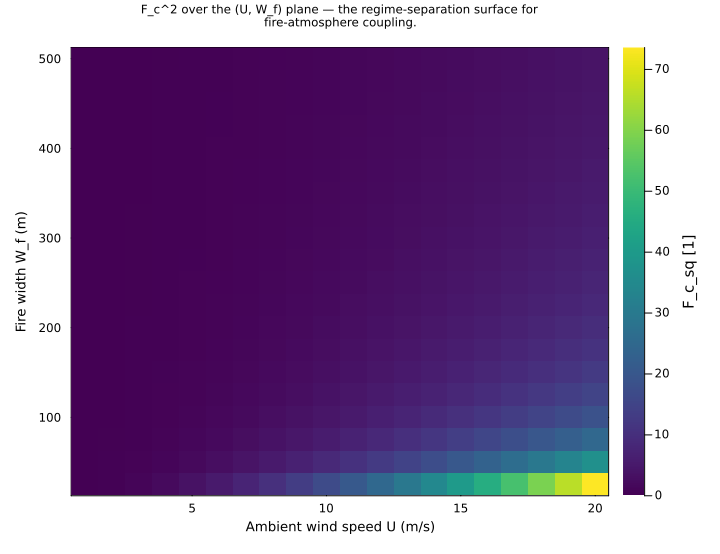
Two-dimensional regime map of F_c^2 over (U, W_f) at fixed S_f=1 m/s and Δθ/θ̄=0.02 — surfaces the (U - S_f)^2 / W_f scaling that separates strong-coupling (small F_c^2; narrow fireline, low excess wind) from weak-coupling (large F_c^2; wide fireline does not change much, but high excess wind dominates) regimes.
Time span: 0.0 → 1.0
Swept over: U, W_f
Raw .esm
Raw .esm JSON (this component)
{
  "reference": {
    "notes": "source_ref: WildlandFire.jl@126976f2508ceacca6c486b21ae6da5b168c6f46:src/clark1996.jl:253\nUpstream `Clark1996ConvectiveFroudeNumber` is an MTK `@component` whose four inputs (U, S_f, delta_theta_over_theta, W_f) are `@parameters` and whose single output F_c_sq is a time-indexed `@variable` with one algebraic equation. Identical structure preserved here; the upstream `g` `@constant` (= 9.81 m/s^2) and `one_dimless` `@constant` (= 1.0) are exposed as parameters with their upstream default values, mirroring the wind_profile.esm pattern (components/wildland_fire/clark1996/wind_profile.esm) where upstream `@constants` are preserved as literal-valued parameters to maintain 1:1 fidelity with the upstream component.\n\nThe `one_dimless` parameter is declared upstream but never referenced in the equation (an MTK boilerplate carry-over from sibling Clark1996 components). It is preserved here as a parameter for 1:1 structural fidelity with the upstream `@constants` block; it does not appear in any equation, mirroring its upstream usage.\n\nTolerance rationale (model-level rel=1e-12): observed-only single-equation algebraic system (no ODE integration); the equation is one subtraction, one square, three multiplications, and one division on hardware-supported intrinsics — float64 roundoff is at the ULP level (~1e-15). 1e-12 is comfortably above ULP and far below any plausible physical-discrimination scale on a dimensionless Froude-number diagnostic."
  },
  "tolerance": {
    "rel": 1e-12
  },
  "variables": {
    "U": {
      "type": "parameter",
      "units": "m/s",
      "default": 0.0,
      "description": "Ambient wind speed"
    },
    "S_f": {
      "type": "parameter",
      "units": "m/s",
      "default": 0.0,
      "description": "Fire spread rate"
    },
    "delta_theta_over_theta": {
      "type": "parameter",
      "units": "1",
      "default": 0.01,
      "description": "Convective buoyancy Δθ/θ̄ (dimensionless potential-temperature anomaly relative to mean)"
    },
    "W_f": {
      "type": "parameter",
      "units": "m",
      "default": 1.0,
      "description": "Fire width"
    },
    "g": {
      "type": "parameter",
      "units": "m/s^2",
      "default": 9.81,
      "description": "Gravitational acceleration (upstream @constant; default 9.81 m/s^2)"
    },
    "one_dimless": {
      "type": "parameter",
      "units": "1",
      "default": 1.0,
      "description": "Dimensionless one (upstream @constant declared but unused in the equation; preserved as a parameter for 1:1 structural fidelity with the upstream @constants block)"
    },
    "F_c_sq": {
      "type": "unknown",
      "units": "1",
      "description": "Square of convective Froude number (dimensionless). Large = wind-dominated (weak coupling); small = buoyancy-dominated (strong coupling)."
    }
  },
  "equations": [
    {
      "lhs": "F_c_sq",
      "rhs": {
        "op": "/",
        "args": [
          {
            "op": "^",
            "args": [
              {
                "op": "-",
                "args": [
                  "U",
                  "S_f"
                ]
              },
              2
            ]
          },
          {
            "op": "*",
            "args": [
              {
                "op": "*",
                "args": [
                  "g",
                  "delta_theta_over_theta"
                ]
              },
              "W_f"
            ]
          }
        ]
      }
    }
  ],
  "tests": [
    {
      "id": "wind_dominates_weak_coupling",
      "description": "Large excess wind over fire spread (U=10 m/s, S_f=0.18 m/s, Δθ/θ̄=0.01, W_f=100 m). F_c_sq = (10-0.18)^2 / (9.81*0.01*100) = 96.4324/9.81 ≈ 9.83 — well above unity, the wind-dominated weak-coupling regime where ambient flow ventilates the fire faster than buoyancy can drive convergent inflow.",
      "parameter_overrides": {
        "U": 10.0,
        "S_f": 0.18,
        "delta_theta_over_theta": 0.01,
        "W_f": 100.0
      },
      "time_span": {
        "start": 0.0,
        "end": 1.0
      },
      "assertions": [
        {
          "variable": "F_c_sq",
          "time": 0.0,
          "expected": 9.830010193679918
        }
      ]
    },
    {
      "id": "strong_coupling_low_wind",
      "description": "Small excess wind with large buoyancy and wide fireline (U=2 m/s, S_f=1.5 m/s, Δθ/θ̄=0.05, W_f=200 m). F_c_sq = 0.25 / 98.1 ≈ 2.55e-3 — well below unity, the buoyancy-dominated strong-coupling regime where fire-induced convection drives the dynamics.",
      "parameter_overrides": {
        "U": 2.0,
        "S_f": 1.5,
        "delta_theta_over_theta": 0.05,
        "W_f": 200.0
      },
      "time_span": {
        "start": 0.0,
        "end": 1.0
      },
      "assertions": [
        {
          "variable": "F_c_sq",
          "time": 0.0,
          "expected": 0.00254841997961264
        }
      ]
    },
    {
      "id": "zero_excess_wind",
      "description": "Wind matches fire spread rate exactly (U = S_f = 5 m/s). Numerator (U-S_f)^2 = 0 → F_c_sq = 0 — the limiting case where buoyancy completely dominates because there is no relative-flow ventilation.",
      "parameter_overrides": {
        "U": 5.0,
        "S_f": 5.0,
        "delta_theta_over_theta": 0.02,
        "W_f": 150.0
      },
      "time_span": {
        "start": 0.0,
        "end": 1.0
      },
      "assertions": [
        {
          "variable": "F_c_sq",
          "time": 0.0,
          "expected": 0.0,
          "tolerance": {
            "abs": 1e-15
          }
        }
      ]
    },
    {
      "id": "thin_buoyant_plume_high_wind",
      "description": "High wind, narrow fireline, weak buoyancy (U=15 m/s, S_f=2 m/s, Δθ/θ̄=0.005, W_f=50 m). F_c_sq = 169 / 2.4525 ≈ 68.9 — strongly wind-dominated; exercises the regime where the diagnostic grows as the squared excess wind divided by the small-W_f, small-Δθ denominator.",
      "parameter_overrides": {
        "U": 15.0,
        "S_f": 2.0,
        "delta_theta_over_theta": 0.005,
        "W_f": 50.0
      },
      "time_span": {
        "start": 0.0,
        "end": 1.0
      },
      "assertions": [
        {
          "variable": "F_c_sq",
          "time": 0.0,
          "expected": 68.90927624872579
        }
      ]
    },
    {
      "id": "downstream_wind_negative_U",
      "description": "Negative ambient wind component (U = -5 m/s, S_f = 2 m/s). Excess (U - S_f) = -7 squares to +49; F_c_sq = 49/9.81 ≈ 4.99 — verifies the (·)^2 in the numerator collapses both upstream- and downstream-relative flow into the same diagnostic magnitude.",
      "parameter_overrides": {
        "U": -5.0,
        "S_f": 2.0,
        "delta_theta_over_theta": 0.01,
        "W_f": 100.0
      },
      "time_span": {
        "start": 0.0,
        "end": 1.0
      },
      "assertions": [
        {
          "variable": "F_c_sq",
          "time": 0.0,
          "expected": 4.994903160040774
        }
      ]
    },
    {
      "id": "override_g_lunar",
      "description": "Override the upstream @constant g via parameter override (g = 1.62 m/s^2, lunar gravity) while holding other inputs fixed (U=5, S_f=0.5, Δθ/θ̄=0.03, W_f=300). F_c_sq = 20.25 / (1.62*0.03*300) = 20.25/14.58 ≈ 1.389 — verifies g is wired as an overridable parameter rather than a hard-coded literal.",
      "parameter_overrides": {
        "U": 5.0,
        "S_f": 0.5,
        "delta_theta_over_theta": 0.03,
        "W_f": 300.0,
        "g": 1.62
      },
      "time_span": {
        "start": 0.0,
        "end": 1.0
      },
      "assertions": [
        {
          "variable": "F_c_sq",
          "time": 0.0,
          "expected": 1.3888888888888886
        }
      ]
    },
    {
      "id": "indicative_fireline_regime",
      "description": "Indicative fireline regime (U=8 m/s, S_f=0.7 m/s, Δθ/θ̄=0.02, W_f=80 m) representative of the experiments in Clark et al. (1996). F_c_sq = 53.29 / 15.696 ≈ 3.40 — order-unity-or-larger Froude squared, consistent with the transitional regime where neither wind nor buoyancy completely dominates.",
      "parameter_overrides": {
        "U": 8.0,
        "S_f": 0.7,
        "delta_theta_over_theta": 0.02,
        "W_f": 80.0
      },
      "time_span": {
        "start": 0.0,
        "end": 1.0
      },
      "assertions": [
        {
          "variable": "F_c_sq",
          "time": 0.0,
          "expected": 3.3951325178389395
        }
      ]
    }
  ],
  "analyses": [
    {
      "id": "froude_vs_wind",
      "description": "F_c^2 as a function of ambient wind speed U at fixed fire properties (S_f=1 m/s, Δθ/θ̄=0.02, W_f=100 m) — sweeps U from 0 to 20 m/s, showing the parabolic growth in (U - S_f)^2 that drives the transition from buoyancy-dominated (F_c^2 < 1, near U = S_f) to wind-dominated (F_c^2 >> 1) regimes.",
      "initial_state": {},
      "parameters": {
        "S_f": 1.0,
        "delta_theta_over_theta": 0.02,
        "W_f": 100.0
      },
      "time_span": {
        "start": 0.0,
        "end": 1.0
      },
      "parameter_sweep": {
        "type": "cartesian",
        "dimensions": [
          {
            "parameter": "U",
            "range": {
              "start": 0.0,
              "stop": 20.0,
              "count": 41,
              "scale": "linear"
            }
          }
        ]
      },
      "plots": [
        {
          "id": "F_c_sq_vs_U",
          "type": "line",
          "description": "Convective Froude number squared as a function of ambient wind speed at fixed fire spread rate, buoyancy, and fire width.",
          "x": {
            "variable": "U",
            "label": "Ambient wind speed U (m/s)"
          },
          "y": {
            "variable": "F_c_sq",
            "label": "F_c^2 (dimensionless)"
          }
        }
      ]
    },
    {
      "id": "froude_regime_map",
      "description": "Two-dimensional regime map of F_c^2 over (U, W_f) at fixed S_f=1 m/s and Δθ/θ̄=0.02 — surfaces the (U - S_f)^2 / W_f scaling that separates strong-coupling (small F_c^2; narrow fireline, low excess wind) from weak-coupling (large F_c^2; wide fireline does not change much, but high excess wind dominates) regimes.",
      "initial_state": {},
      "parameters": {
        "S_f": 1.0,
        "delta_theta_over_theta": 0.02
      },
      "time_span": {
        "start": 0.0,
        "end": 1.0
      },
      "parameter_sweep": {
        "type": "cartesian",
        "dimensions": [
          {
            "parameter": "U",
            "range": {
              "start": 1.0,
              "stop": 20.0,
              "count": 20,
              "scale": "linear"
            }
          },
          {
            "parameter": "W_f",
            "range": {
              "start": 25.0,
              "stop": 500.0,
              "count": 20,
              "scale": "linear"
            }
          }
        ]
      },
      "plots": [
        {
          "id": "F_c_sq_heatmap",
          "type": "heatmap",
          "description": "F_c^2 over the (U, W_f) plane — the regime-separation surface for fire-atmosphere coupling.",
          "x": {
            "variable": "U",
            "label": "Ambient wind speed U (m/s)"
          },
          "y": {
            "variable": "W_f",
            "label": "Fire width W_f (m)"
          },
          "value": {
            "variable": "F_c_sq",
            "reduce": "final"
          }
        }
      ]
    }
  ]
}