FreezingPointDepression
Maximum liquid water content in a soil layer below the freezing point, following the supercooled-soil-water freezing-point depression treatment of Niu and Yang (2006). Below T_f, liquid coexists with ice via the matric-potential / latent-heat balance of Oleson et al. (2010) Eq. 4.58; above T_f, the layer holds the fully-saturated maximum Δz·θ_sat·ρ_liq. Migrated from UrbanCanopy.jl@9200edd4 src/roof_wall_road_snow_temperatures.jl:949 (`FreezingPointDepression` @component). Parameterized as observed-only: T_i, θ_sat, Δz, ψ_sat, B_i, ρ_liq are inputs (parameters); w_liq_max is the algebraic output.
Description
Maximum liquid water content in a soil layer below the freezing point, following the supercooled-soil-water freezing-point depression treatment of Niu and Yang (2006). Below T_f, liquid coexists with ice via the matric-potential / latent-heat balance of Oleson et al. (2010) Eq. 4.58; above T_f, the layer holds the fully-saturated maximum Δz·θ_sat·ρ_liq. Migrated from UrbanCanopy.jl@9200edd4 src/roof_wall_road_snow_temperatures.jl:949 (FreezingPointDepression @component). Parameterized as observed-only: T_i, θ_sat, Δz, ψ_sat, B_i, ρ_liq are inputs (parameters); w_liq_max is the algebraic output.
Reference
_source_ref: UrbanCanopy.jl@9200edd4f15609f20339d3a7d104de8064544310:src/roof_wall_road_snow_temperatures.jl:949
Upstream FreezingPointDepression is an MTK @component whose six inputs (T_i, θ_sat, Δz, ψ_sat, B_i, ρ_liq) are @parameters and whose single output (w_liq_max) is a time-indexed @variable with one algebraic equation (Eq. 4.58 with an ifelse branch on T_i < T_f). Identical equation structure preserved here.
The upstream component declares four @constants: T_f (273.15 K), L_f (3.337e5 J/kg), g (9.80616 m/s^2), and one_ref (1.0, dimensionless reference for non-dimensionalization of the bracket prior to the fractional exponent). They are encoded here as parameters with the upstream values as default. one_ref is kept in the equation to maintain 1:1 fidelity with the upstream MTK unit-balancing pattern (the same convention used by snow_melt_no_layers.esm for its zero_kgm2/zero_m literals): the fractional exponent in Eq. 4.58 is well-defined only on a dimensionless argument, and one_ref makes the dimensional cancellation explicit to MTK’s unit checker upstream.
Unicode parameter names (Δz, θ_sat, ψ_sat, ρ_liq) are preserved from upstream — peer ESM components in this rig (snow_melt_no_layers.esm uses Δt, snow_density.esm uses ρ_*) already use unicode in identifiers and the schema’s identifier pattern allows it.
The upstream comment maps the equation to CLM Tech Note Eq. 4.58 and notes a unit subtlety: the paper uses ψ_sat in mm but the upstream component takes ψ_sat in SI (m); the 10^3 mm→m conversion factor is absorbed (so no factor-of-1000 appears in the equation). ψ_sat is conventionally negative (soil matric potential); the equation negates it to keep the base of the fractional exponent positive. These are preserved in the equation as-is.
Observability classification: this component is functionally observed-only — the single output variable is given by a single algebraic equation in terms of the parameters (the (t) time index has no role since there is no derivative). Test scenarios use time_span: [0, 1] and sample at t=0 to mirror the convention used by sibling observed-only ESM files in this rig (snow_melt_no_layers.esm, total_phase_change_energy.esm, ideal_gas.esm).
Tolerance rationale (model-level rel=1e-9): observed-only single-equation algebraic system (no ODE integration); the Eq. 4.58 evaluation is a chain of multiplies/divides plus one fractional-power call. Roundoff is at the ULP level (~1e-16) for the multiplicative parts and ~1e-15 for pow. 1e-9 leaves comfortable headroom and matches sibling temps files (total_phase_change_energy.esm uses 1e-9). Tighter abs: 1e-12 is asserted on the ifelse-else branch outputs (T_i > T_f cases) where the value reduces to the exact product Δz·θ_sat·ρ_liq with no fractional-power term — the assertion would not silently accept a stuck-at-1e-3 regression. Reference values one-shot generated from the canonical formula (identical to upstream MTK eq.) to IEEE-754 double precision.
The T_i = T_f exact-boundary cannot be tested through the canonical Python runner: the runner’s sympy.Piecewise eagerly evaluates both branches symbolically, and at T_i = T_f the cold branch’s bracket is 0 raised to the negative power -1/B_i — undefined. The upstream Julia MTK runtime ifelse only evaluates the selected branch and is unaffected. To still anchor the boundary convention (the upstream uses strict <, so equality belongs to the saturated else branch), the test pair epsilon_below_freezing (T_i = 273.149, cold branch, 191.4 kg/m^2) and just_above_freezing (T_i = 273.151, else branch, exactly 200 kg/m^2) brackets the boundary at the 1-mK scale — tight enough to detect any swap of < and ≤._
Parameters
| Name | Units | Default | Description |
|---|---|---|---|
T_i | K | 280.0 | Layer temperature |
θ_sat | 1 | 0.4 | Porosity (dimensionless) |
Δz | m | 0.5 | Layer thickness |
ψ_sat | m | -0.1 | Saturated matric potential (negative by convention; SI m, not mm) |
B_i | 1 | 5.0 | Clapp and Hornberger exponent (dimensionless) |
ρ_liq | kg/m^3 | 1000.0 | Density of liquid water |
T_f | K | 273.15 | Freezing temperature of water (Oleson et al. 2010 Table 1.4 — 273.15 K) |
L_f | J/kg | 333700.0 | Latent heat of fusion of water (Oleson et al. 2010 Table 1.4 — 3.337e5 J/kg) |
g | m/s^2 | 9.80616 | Gravitational acceleration (Oleson et al. 2010 Table 1.4 — 9.80616 m/s^2) |
one_ref | 1 | 1.0 | Dimensionless reference for non-dimensionalization of the bracket in Eq. 4.58 prior to the fractional exponent — preserved 1:1 from upstream MTK unit-balancing pattern |
Observed
| Name | Units | Default | Description |
|---|---|---|---|
w_liq_max | kg/m^2 | Maximum liquid water content when T_i < T_f (Oleson Eq. 4.58); above T_f equals fully-saturated Δz·θ_sat·ρ_liq |
Observed expressions
$$ w_{liq\,max} = \mathrm{ifelse}\left(\mathrm{<}\left(T_{i}, T_{f}\right), Δz \cdot θ_{sat} \cdot ρ_{liq} \cdot \left(\frac{L_{f} \cdot \left(T_{f} - T_{i}\right)}{g \cdot T_{i} \cdot \left(-ψ_{sat}\right)} \cdot one_{ref}\right)^{\frac{-1}{B_{i}}}, Δz \cdot θ_{sat} \cdot ρ_{liq}\right) $$Maximum liquid water content when T_i < T_f (Oleson Eq. 4.58); above T_f equals fully-saturated Δz·θ_sat·ρ_liq
Analyses
w_liq_max_vs_T_i
Sweep T_i across the full supercooled-soil-water regime — from 250 K (deep freeze) through 273.15 (T_f boundary) and into 280 K (above freezing). Reproduces the canonical Niu-Yang (2006) supercooled-water curve: w_liq_max rises monotonically with T_i in the cold branch, hits a discontinuity at T_f (the ifelse boundary), and plateaus at Δz·θ_sat·ρ_liq above freezing.
Time span: 0.0 → 1.0
Swept over: T_i

w_liq_max_vs_B_i
Sweep the Clapp-Hornberger exponent B_i across realistic soil-texture range (3 sand → 12 clay) at fixed deep-cold T_i = 263.15 K. Surfaces the role of B_i in compressing w_liq_max via the (-1/B_i) fractional power: low B_i → large compression, high B_i → exponent → 0, w_liq_max → saturated max.
Time span: 0.0 → 1.0
Swept over: B_i

two_d_sweep_T_B
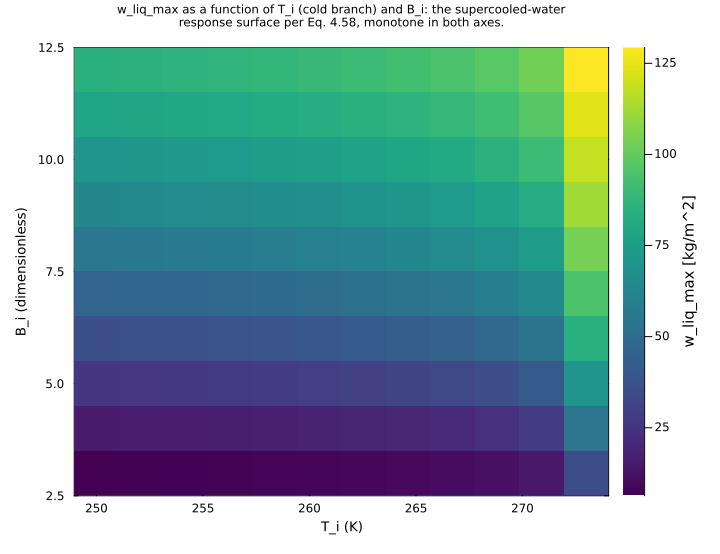
Joint sweep over T_i (cold branch only, 250-273 K) and B_i (sand-to-clay, 3-12) at fixed θ_sat = 0.4, Δz = 0.5, ψ_sat = -0.1, ρ_liq = 1000. Surfaces the supercooled-water response surface — w_liq_max increasing toward the upper-right (warmer T_i and more clay-like B_i) and shrinking toward the lower-left (colder T_i and more sand-like B_i).
Time span: 0.0 → 1.0
Swept over: T_i, B_i
Raw .esm
Raw .esm JSON (this component)
{
"reference": {
"notes": "source_ref: UrbanCanopy.jl@9200edd4f15609f20339d3a7d104de8064544310:src/roof_wall_road_snow_temperatures.jl:949\nUpstream `FreezingPointDepression` is an MTK `@component` whose six inputs (T_i, θ_sat, Δz, ψ_sat, B_i, ρ_liq) are `@parameters` and whose single output (w_liq_max) is a time-indexed `@variable` with one algebraic equation (Eq. 4.58 with an `ifelse` branch on T_i < T_f). Identical equation structure preserved here.\n\nThe upstream component declares four `@constants`: T_f (273.15 K), L_f (3.337e5 J/kg), g (9.80616 m/s^2), and one_ref (1.0, dimensionless reference for non-dimensionalization of the bracket prior to the fractional exponent). They are encoded here as parameters with the upstream values as `default`. one_ref is kept in the equation to maintain 1:1 fidelity with the upstream MTK unit-balancing pattern (the same convention used by snow_melt_no_layers.esm for its `zero_kgm2`/`zero_m` literals): the fractional exponent in Eq. 4.58 is well-defined only on a dimensionless argument, and one_ref makes the dimensional cancellation explicit to MTK's unit checker upstream.\n\nUnicode parameter names (Δz, θ_sat, ψ_sat, ρ_liq) are preserved from upstream — peer ESM components in this rig (snow_melt_no_layers.esm uses Δt, snow_density.esm uses ρ_*) already use unicode in identifiers and the schema's identifier pattern allows it.\n\nThe upstream comment maps the equation to CLM Tech Note Eq. 4.58 and notes a unit subtlety: the paper uses ψ_sat in mm but the upstream component takes ψ_sat in SI (m); the 10^3 mm→m conversion factor is absorbed (so no factor-of-1000 appears in the equation). ψ_sat is conventionally negative (soil matric potential); the equation negates it to keep the base of the fractional exponent positive. These are preserved in the equation as-is.\n\nObservability classification: this component is functionally observed-only — the single output variable is given by a single algebraic equation in terms of the parameters (the `(t)` time index has no role since there is no derivative). Test scenarios use `time_span: [0, 1]` and sample at t=0 to mirror the convention used by sibling observed-only ESM files in this rig (snow_melt_no_layers.esm, total_phase_change_energy.esm, ideal_gas.esm).\n\nTolerance rationale (model-level rel=1e-9): observed-only single-equation algebraic system (no ODE integration); the Eq. 4.58 evaluation is a chain of multiplies/divides plus one fractional-power call. Roundoff is at the ULP level (~1e-16) for the multiplicative parts and ~1e-15 for `pow`. 1e-9 leaves comfortable headroom and matches sibling temps files (total_phase_change_energy.esm uses 1e-9). Tighter `abs: 1e-12` is asserted on the `ifelse`-else branch outputs (T_i > T_f cases) where the value reduces to the exact product Δz·θ_sat·ρ_liq with no fractional-power term — the assertion would not silently accept a stuck-at-1e-3 regression. Reference values one-shot generated from the canonical formula (identical to upstream MTK eq.) to IEEE-754 double precision.\n\nThe `T_i = T_f` exact-boundary cannot be tested through the canonical Python runner: the runner's sympy.Piecewise eagerly evaluates both branches symbolically, and at T_i = T_f the cold branch's bracket is 0 raised to the negative power -1/B_i — undefined. The upstream Julia MTK runtime ifelse only evaluates the selected branch and is unaffected. To still anchor the boundary convention (the upstream uses strict `<`, so equality belongs to the saturated `else` branch), the test pair `epsilon_below_freezing` (T_i = 273.149, cold branch, 191.4 kg/m^2) and `just_above_freezing` (T_i = 273.151, else branch, exactly 200 kg/m^2) brackets the boundary at the 1-mK scale — tight enough to detect any swap of `<` and `≤`."
},
"tolerance": {
"rel": 1e-09
},
"variables": {
"T_i": {
"type": "parameter",
"units": "K",
"default": 280.0,
"description": "Layer temperature"
},
"θ_sat": {
"type": "parameter",
"units": "1",
"default": 0.4,
"description": "Porosity (dimensionless)"
},
"Δz": {
"type": "parameter",
"units": "m",
"default": 0.5,
"description": "Layer thickness"
},
"ψ_sat": {
"type": "parameter",
"units": "m",
"default": -0.1,
"description": "Saturated matric potential (negative by convention; SI m, not mm)"
},
"B_i": {
"type": "parameter",
"units": "1",
"default": 5.0,
"description": "Clapp and Hornberger exponent (dimensionless)"
},
"ρ_liq": {
"type": "parameter",
"units": "kg/m^3",
"default": 1000.0,
"description": "Density of liquid water"
},
"T_f": {
"type": "parameter",
"units": "K",
"default": 273.15,
"description": "Freezing temperature of water (Oleson et al. 2010 Table 1.4 — 273.15 K)"
},
"L_f": {
"type": "parameter",
"units": "J/kg",
"default": 333700.0,
"description": "Latent heat of fusion of water (Oleson et al. 2010 Table 1.4 — 3.337e5 J/kg)"
},
"g": {
"type": "parameter",
"units": "m/s^2",
"default": 9.80616,
"description": "Gravitational acceleration (Oleson et al. 2010 Table 1.4 — 9.80616 m/s^2)"
},
"one_ref": {
"type": "parameter",
"units": "1",
"default": 1.0,
"description": "Dimensionless reference for non-dimensionalization of the bracket in Eq. 4.58 prior to the fractional exponent — preserved 1:1 from upstream MTK unit-balancing pattern"
},
"w_liq_max": {
"type": "unknown",
"units": "kg/m^2",
"description": "Maximum liquid water content when T_i < T_f (Oleson Eq. 4.58); above T_f equals fully-saturated Δz·θ_sat·ρ_liq"
}
},
"equations": [
{
"lhs": "w_liq_max",
"rhs": {
"op": "ifelse",
"args": [
{
"op": "<",
"args": [
"T_i",
"T_f"
]
},
{
"op": "*",
"args": [
{
"op": "*",
"args": [
{
"op": "*",
"args": [
"Δz",
"θ_sat"
]
},
"ρ_liq"
]
},
{
"op": "^",
"args": [
{
"op": "*",
"args": [
{
"op": "/",
"args": [
{
"op": "*",
"args": [
"L_f",
{
"op": "-",
"args": [
"T_f",
"T_i"
]
}
]
},
{
"op": "*",
"args": [
{
"op": "*",
"args": [
"g",
"T_i"
]
},
{
"op": "-",
"args": [
"ψ_sat"
]
}
]
}
]
},
"one_ref"
]
},
{
"op": "/",
"args": [
-1,
"B_i"
]
}
]
}
]
},
{
"op": "*",
"args": [
{
"op": "*",
"args": [
"Δz",
"θ_sat"
]
},
"ρ_liq"
]
}
]
}
}
],
"tests": [
{
"id": "above_freezing_saturated",
"description": "Reproduces upstream `FreezingPointDepression - Above Freezing` test (UrbanCanopy.jl test/roof_wall_road_snow_temperatures_test.jl:1052). T_i = 280 K (above T_f), θ_sat = 0.4, Δz = 0.5 m, ψ_sat = -0.1 m, B_i = 5.0, ρ_liq = 1000 kg/m^3 → w_liq_max = Δz·θ_sat·ρ_liq = 200 kg/m^2 exactly (else branch of the ifelse, no fractional-power evaluation).",
"parameter_overrides": {
"T_i": 280.0,
"θ_sat": 0.4,
"Δz": 0.5,
"ψ_sat": -0.1,
"B_i": 5.0,
"ρ_liq": 1000.0
},
"time_span": {
"start": 0.0,
"end": 1.0
},
"assertions": [
{
"variable": "w_liq_max",
"time": 0.0,
"expected": 200.0,
"tolerance": {
"abs": 1e-12
}
}
]
},
{
"id": "just_above_freezing",
"description": "T_i = 273.151 K (1 mK above T_f) — the just-above-freezing side of the boundary. Falls into the `else` branch (saturated max = 200 kg/m^2). Paired with `epsilon_below_freezing` (1 mK on the other side, 191.4 kg/m^2) to anchor the discontinuity at T_f imposed by the upstream `ifelse(T_i < T_f, …)`. (T_i = T_f exactly cannot be tested through the canonical Python runner — the runner's sympy.Piecewise eagerly evaluates both branches symbolically, and the cold branch's `(0)^(-1/B_i)` is undefined; the upstream Julia MTK ifelse only evaluates the selected branch at runtime, so the upstream is unaffected. The 1-mK pair brackets the boundary tightly enough.)",
"parameter_overrides": {
"T_i": 273.151,
"θ_sat": 0.4,
"Δz": 0.5,
"ψ_sat": -0.1,
"B_i": 5.0,
"ρ_liq": 1000.0
},
"time_span": {
"start": 0.0,
"end": 1.0
},
"assertions": [
{
"variable": "w_liq_max",
"time": 0.0,
"expected": 200.0,
"tolerance": {
"abs": 1e-12
}
}
]
},
{
"id": "below_freezing_5K",
"description": "Reproduces upstream `FreezingPointDepression - Below Freezing` test (UrbanCanopy.jl test/roof_wall_road_snow_temperatures_test.jl:1073). T_i = 268.15 K (5 K below T_f), θ_sat = 0.4, Δz = 0.5 m, ψ_sat = -0.1 m, B_i = 5.0, ρ_liq = 1000 kg/m^3. The upstream test only checks 0 < w_liq_max < 200 (max_possible); we anchor the exact value computed from the canonical Eq. 4.58 formula. Verifies the fractional-power branch of the ifelse.",
"parameter_overrides": {
"T_i": 268.15,
"θ_sat": 0.4,
"Δz": 0.5,
"ψ_sat": -0.1,
"B_i": 5.0,
"ρ_liq": 1000.0
},
"time_span": {
"start": 0.0,
"end": 1.0
},
"assertions": [
{
"variable": "w_liq_max",
"time": 0.0,
"expected": 34.71683367120432
}
]
},
{
"id": "slightly_below_freezing_1K",
"description": "T_i = 272.15 K (1 K below T_f) — the warm-end of the supercooled-water regime. Anchors the upstream `Colder Means Less Liquid` first-anchor (UrbanCanopy.jl test:1118): w_liq_max at T_i = 272.15 must exceed the value at T_i = 263.15 (paired with `colder_means_less_liquid_anchor` below). Reference value computed from Eq. 4.58.",
"parameter_overrides": {
"T_i": 272.15,
"θ_sat": 0.4,
"Δz": 0.5,
"ψ_sat": -0.1,
"B_i": 5.0,
"ρ_liq": 1000.0
},
"time_span": {
"start": 0.0,
"end": 1.0
},
"assertions": [
{
"variable": "w_liq_max",
"time": 0.0,
"expected": 48.04190466488627
}
]
},
{
"id": "colder_means_less_liquid_anchor",
"description": "T_i = 263.15 K (10 K below T_f) — the cold-end anchor of the upstream `Colder Means Less Liquid` test (UrbanCanopy.jl test:1123). Paired with `slightly_below_freezing_1K`: 30.109 < 48.042 confirms the monotone-decreasing relation between w_liq_max and (T_f - T_i) that Niu and Yang (2006) require.",
"parameter_overrides": {
"T_i": 263.15,
"θ_sat": 0.4,
"Δz": 0.5,
"ψ_sat": -0.1,
"B_i": 5.0,
"ρ_liq": 1000.0
},
"time_span": {
"start": 0.0,
"end": 1.0
},
"assertions": [
{
"variable": "w_liq_max",
"time": 0.0,
"expected": 30.109200535801378
}
]
},
{
"id": "deep_freeze",
"description": "T_i = 253.15 K (20 K below T_f) — extreme winter regime. The fractional power compresses w_liq_max further to ~26 kg/m^2. Stress-tests the formula in the regime where (T_f - T_i) is large and the bracket inside the (-1/B_i) power is at its largest, ensuring no overflow / loss of precision in the deep-cold corner.",
"parameter_overrides": {
"T_i": 253.15,
"θ_sat": 0.4,
"Δz": 0.5,
"ψ_sat": -0.1,
"B_i": 5.0,
"ρ_liq": 1000.0
},
"time_span": {
"start": 0.0,
"end": 1.0
},
"assertions": [
{
"variable": "w_liq_max",
"time": 0.0,
"expected": 26.00926841246697
}
]
},
{
"id": "epsilon_below_freezing",
"description": "T_i = 273.149 K — 1 mK below T_f. (T_f - T_i) is at the small-ΔT scale; w_liq_max is just barely below the saturated max (191.4 vs 200). Verifies the smooth limit of Eq. 4.58 as T_i → T_f^- and that the `<` branch evaluates without spurious cancellation in the small-ΔT regime.",
"parameter_overrides": {
"T_i": 273.149,
"θ_sat": 0.4,
"Δz": 0.5,
"ψ_sat": -0.1,
"B_i": 5.0,
"ρ_liq": 1000.0
},
"time_span": {
"start": 0.0,
"end": 1.0
},
"assertions": [
{
"variable": "w_liq_max",
"time": 0.0,
"expected": 191.39847463987002
}
]
},
{
"id": "clay_soil_high_B",
"description": "Clay-rich soil regime: B_i = 10 (high Clapp-Hornberger exponent), θ_sat = 0.5, Δz = 1 m, ψ_sat = -0.3 m at T_i = 263.15 K. The high B_i drives the (-1/B_i) exponent toward 0, so the fractional-power factor approaches 1 and w_liq_max approaches the full saturation Δz·θ_sat·ρ_liq = 500. Result 216.5 < 500 anchors the high-B_i regime.",
"parameter_overrides": {
"T_i": 263.15,
"θ_sat": 0.5,
"Δz": 1.0,
"ψ_sat": -0.3,
"B_i": 10.0,
"ρ_liq": 1000.0
},
"time_span": {
"start": 0.0,
"end": 1.0
},
"assertions": [
{
"variable": "w_liq_max",
"time": 0.0,
"expected": 216.5293359874589
}
]
},
{
"id": "sandy_soil_low_B_thin",
"description": "Sandy soil regime: B_i = 3 (low Clapp-Hornberger exponent), θ_sat = 0.3, Δz = 0.05 m (thin), ψ_sat = -0.05 m at T_i = 270 K (3.15 K below T_f). The low B_i drives the (-1/B_i) exponent toward larger negative values, strongly compressing the fractional-power factor; combined with low porosity and thin layer, w_liq_max ~0.75 kg/m^2 is small. Anchors the low-B_i / thin-layer corner.",
"parameter_overrides": {
"T_i": 270.0,
"θ_sat": 0.3,
"Δz": 0.05,
"ψ_sat": -0.05,
"B_i": 3.0,
"ρ_liq": 1000.0
},
"time_span": {
"start": 0.0,
"end": 1.0
},
"assertions": [
{
"variable": "w_liq_max",
"time": 0.0,
"expected": 0.7518766309616047
}
]
}
],
"analyses": [
{
"id": "w_liq_max_vs_T_i",
"description": "Sweep T_i across the full supercooled-soil-water regime — from 250 K (deep freeze) through 273.15 (T_f boundary) and into 280 K (above freezing). Reproduces the canonical Niu-Yang (2006) supercooled-water curve: w_liq_max rises monotonically with T_i in the cold branch, hits a discontinuity at T_f (the ifelse boundary), and plateaus at Δz·θ_sat·ρ_liq above freezing.",
"initial_state": {},
"parameters": {
"θ_sat": 0.4,
"Δz": 0.5,
"ψ_sat": -0.1,
"B_i": 5.0,
"ρ_liq": 1000.0
},
"time_span": {
"start": 0.0,
"end": 1.0
},
"parameter_sweep": {
"type": "cartesian",
"dimensions": [
{
"parameter": "T_i",
"range": {
"start": 250.0,
"stop": 280.0,
"count": 31,
"scale": "linear"
}
}
]
},
"plots": [
{
"id": "w_liq_max_curve",
"type": "line",
"description": "w_liq_max vs T_i: smooth rise in the supercooled-water branch (T_i < T_f), discontinuity at T_f = 273.15 K (ifelse boundary), plateau at 200 kg/m^2 above T_f.",
"x": {
"variable": "T_i",
"label": "T_i (K)"
},
"y": {
"variable": "w_liq_max",
"label": "w_liq,max (kg/m^2)"
}
}
]
},
{
"id": "w_liq_max_vs_B_i",
"description": "Sweep the Clapp-Hornberger exponent B_i across realistic soil-texture range (3 sand → 12 clay) at fixed deep-cold T_i = 263.15 K. Surfaces the role of B_i in compressing w_liq_max via the (-1/B_i) fractional power: low B_i → large compression, high B_i → exponent → 0, w_liq_max → saturated max.",
"initial_state": {},
"parameters": {
"T_i": 263.15,
"θ_sat": 0.4,
"Δz": 0.5,
"ψ_sat": -0.1,
"ρ_liq": 1000.0
},
"time_span": {
"start": 0.0,
"end": 1.0
},
"parameter_sweep": {
"type": "cartesian",
"dimensions": [
{
"parameter": "B_i",
"range": {
"start": 3.0,
"stop": 12.0,
"count": 19,
"scale": "linear"
}
}
]
},
"plots": [
{
"id": "w_liq_max_vs_B_curve",
"type": "line",
"description": "w_liq_max vs B_i at T_i = 263.15 K: monotone rise toward the saturated max as B_i increases — the (-1/B_i) exponent → 0 limit.",
"x": {
"variable": "B_i",
"label": "B_i (dimensionless)"
},
"y": {
"variable": "w_liq_max",
"label": "w_liq,max (kg/m^2)"
}
}
]
},
{
"id": "two_d_sweep_T_B",
"description": "Joint sweep over T_i (cold branch only, 250-273 K) and B_i (sand-to-clay, 3-12) at fixed θ_sat = 0.4, Δz = 0.5, ψ_sat = -0.1, ρ_liq = 1000. Surfaces the supercooled-water response surface — w_liq_max increasing toward the upper-right (warmer T_i and more clay-like B_i) and shrinking toward the lower-left (colder T_i and more sand-like B_i).",
"initial_state": {},
"parameters": {
"θ_sat": 0.4,
"Δz": 0.5,
"ψ_sat": -0.1,
"ρ_liq": 1000.0
},
"time_span": {
"start": 0.0,
"end": 1.0
},
"parameter_sweep": {
"type": "cartesian",
"dimensions": [
{
"parameter": "T_i",
"range": {
"start": 250.0,
"stop": 273.0,
"count": 12,
"scale": "linear"
}
},
{
"parameter": "B_i",
"range": {
"start": 3.0,
"stop": 12.0,
"count": 10,
"scale": "linear"
}
}
]
},
"plots": [
{
"id": "w_liq_max_surface",
"type": "heatmap",
"description": "w_liq_max as a function of T_i (cold branch) and B_i: the supercooled-water response surface per Eq. 4.58, monotone in both axes.",
"x": {
"variable": "T_i",
"label": "T_i (K)"
},
"y": {
"variable": "B_i",
"label": "B_i (dimensionless)"
},
"value": {
"variable": "w_liq_max",
"reduce": "final"
}
}
]
}
]
}