AdjustedLayerThickness
Adjusted top layer thickness for pervious and impervious road surfaces in the urban canopy thermal scheme. The adjustment compensates for the offset between the layer-averaged temperature carried by the finite-volume soil column and the surface temperature used in the surface-energy-balance kernel, using the tunable Yang (1998) coefficient c_a = 0.34. Migrated from UrbanCanopy.jl@9200edd4 src/roof_wall_road_snow_temperatures.jl:601 (`AdjustedLayerThickness` @component). Implements Oleson et al. (2010, CLM Tech Note Ch. 4) Eq. 4.30. Parameterized as observed-only: z_i, z_h_im1, z_ip1, c_a are inputs (parameters); Δz_star is the algebraic output.
Description
Adjusted top layer thickness for pervious and impervious road surfaces in the urban canopy thermal scheme. The adjustment compensates for the offset between the layer-averaged temperature carried by the finite-volume soil column and the surface temperature used in the surface-energy-balance kernel, using the tunable Yang (1998) coefficient c_a = 0.34. Migrated from UrbanCanopy.jl@9200edd4 src/roof_wall_road_snow_temperatures.jl:601 (AdjustedLayerThickness @component). Implements Oleson et al. (2010, CLM Tech Note Ch. 4) Eq. 4.30. Parameterized as observed-only: z_i, z_h_im1, z_ip1, c_a are inputs (parameters); Δz_star is the algebraic output.
Reference
_source_ref: UrbanCanopy.jl@9200edd4f15609f20339d3a7d104de8064544310:src/roof_wall_road_snow_temperatures.jl:601
Upstream AdjustedLayerThickness is an MTK @component whose three geometry inputs (z_i, z_h_im1, z_ip1) are @parameters and whose single output (Δz_star) is a time-indexed @variable with one algebraic equation (Eq. 4.30). Identical equation structure preserved here.
The upstream component declares one @constant: c_a = 0.34 (dimensionless tunable coefficient from Yang 1998). It is encoded here as a fixed-default parameter with the upstream value, matching the convention used by sibling observed-only ESM files in this rig that translate @constants to parameters (snow_soil_blended_heat_capacity.esm encodes C_ice the same way, snow_melt_no_layers.esm encodes L_f, zero_kgm2, zero_m the same way).
Unicode Δz_star (adjusted top layer thickness) is preserved from upstream — the schema’s identifier pattern allows it and other ESM components in this rig already use unicode delta in identifiers (e.g. snow_soil_blended_heat_capacity.esm uses Δz, snow_melt_no_layers.esm uses Δt).
Observability classification: this component is functionally observed-only — the single output variable is given by a single algebraic equation in terms of the parameters (and the (t) time index has no role since there is no derivative). Test scenarios use time_span: [0, 1] and sample at t=0 to mirror the convention used by sibling observed-only ESM files (snow_soil_blended_heat_capacity.esm, snow_melt_no_layers.esm, total_phase_change_energy.esm).
Tolerance rationale (model-level rel=1e-10): observed-only single-equation algebraic system (no ODE integration); the equation is two subtractions, one multiplication, one addition, and one halving, so roundoff is at the IEEE-754 ULP level (~1e-16). The upstream tests use rtol = 1.0e-10 (test/roof_wall_road_snow_temperatures_test.jl:566) and we mirror that for fidelity. Tighter abs: 1e-9 is asserted on outputs that are exactly zero by construction (degenerate equal-z case) so the assertion does not silently accept a stuck-at-zero regression._
Parameters
| Name | Units | Default | Description |
|---|---|---|---|
z_i | m | 0.0 | Node depth of top layer i (depth at which the layer-averaged temperature is carried) |
z_h_im1 | m | 0.0 | Interface depth above layer i (z_{h,i-1} — the upper boundary of the top layer, i.e. the surface for a surface-layer column where z_h_im1 = 0) |
z_ip1 | m | 0.0 | Node depth of layer i+1 (the second-from-top layer used in the Eq. 4.30 averaging stencil) |
c_a | 1 | 0.34 | Tunable Yang (1998) coefficient. Dimensionless. Default 0.34 from Oleson Eq. 4.30. |
Observed
| Name | Units | Default | Description |
|---|---|---|---|
Δz_star | m | Adjusted top layer thickness (Oleson Eq. 4.30): 0.5 * (z_i - z_h_im1 + c_a * (z_ip1 - z_h_im1)) |
Observed expressions
$$ Δz_{star} = 0.5 \cdot \left(z_{i} - z_{h\,im1} + c_{a} \cdot \left(z_{ip1} - z_{h\,im1}\right)\right) $$Adjusted top layer thickness (Oleson Eq. 4.30): 0.5 * (z_i - z_h_im1 + c_a * (z_ip1 - z_h_im1))
Analyses
delta_z_star_vs_z_ip1
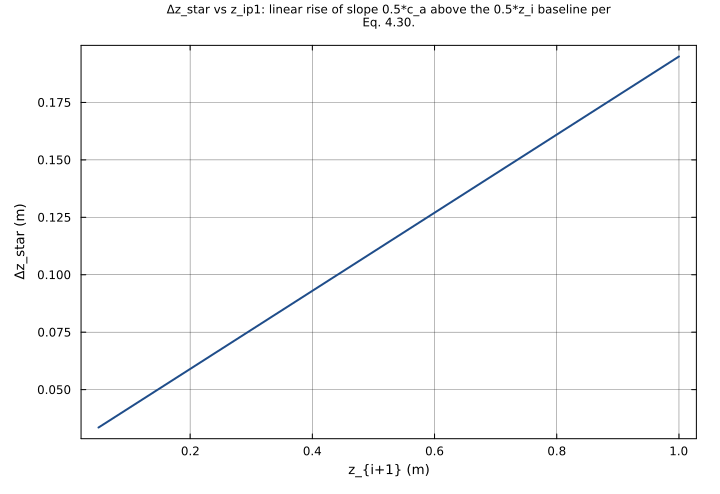
Sweep the node depth of layer i+1 across a typical CLM road-column range (0.05 m to 1.0 m) at fixed z_i = 0.05 m, z_h_im1 = 0.0 m, c_a = 0.34. Δz_star = 0.5 * (z_i + c_a * z_ip1) is a line of slope 0.5 * c_a = 0.17 above the intercept 0.5 * z_i = 0.025 m, surfacing the linear sensitivity of the adjusted thickness to the spacing of the second-from-top layer per Eq. 4.30.
Time span: 0.0 → 1.0
Swept over: z_ip1
two_d_sweep_zi_zip1
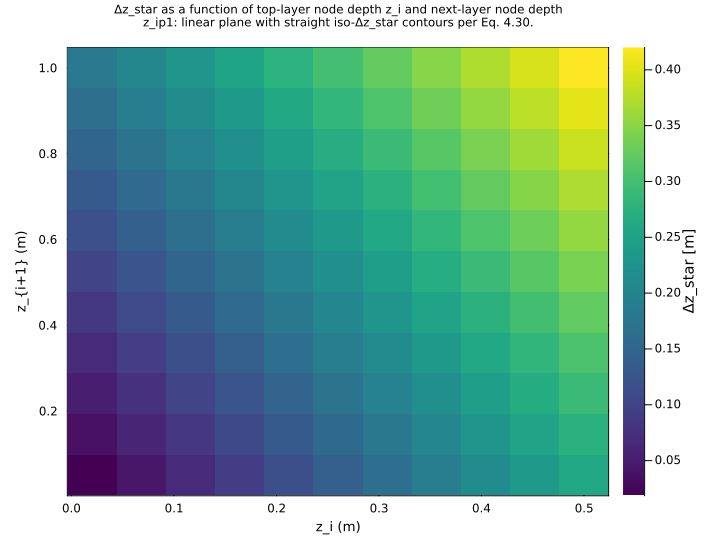
Joint sweep over z_i and z_ip1 at fixed z_h_im1 = 0.0 m and c_a = 0.34. Δz_star = 0.5 * (z_i + c_a * z_ip1) is a plane in (z_i, z_ip1) with slope 0.5 along z_i and slope 0.5 * c_a = 0.17 along z_ip1, so iso-Δz_star contours are straight lines z_i + 0.34 * z_ip1 = const. Maps the adjusted thickness across the CLM road-layer geometry plane.
Time span: 0.0 → 1.0
Swept over: z_i, z_ip1
c_a_sensitivity
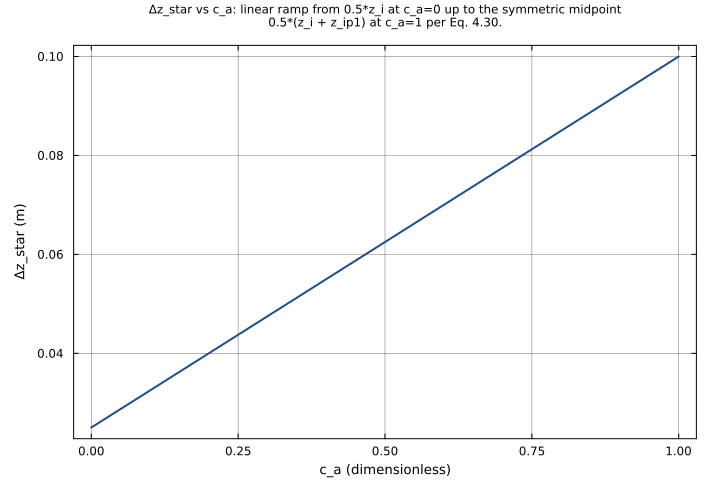
Sensitivity of the adjusted thickness to the Yang (1998) tuning coefficient c_a, swept from 0 (drops the Yang term) to 1 (full symmetric midpoint thickness) at fixed road-surface geometry (z_i = 0.05, z_h_im1 = 0.0, z_ip1 = 0.15). Δz_star = 0.5 * (z_i + c_a * z_ip1) traces a line from 0.025 m at c_a = 0 up to 0.10 m at c_a = 1, with the upstream default c_a = 0.34 landing at 0.0505 m (matching the upstream_equation_verification test).
Time span: 0.0 → 1.0
Swept over: c_a
Raw .esm
Raw .esm JSON (this component)
{
  "reference": {
    "notes": "source_ref: UrbanCanopy.jl@9200edd4f15609f20339d3a7d104de8064544310:src/roof_wall_road_snow_temperatures.jl:601\nUpstream `AdjustedLayerThickness` is an MTK `@component` whose three geometry inputs (z_i, z_h_im1, z_ip1) are `@parameters` and whose single output (Δz_star) is a time-indexed `@variable` with one algebraic equation (Eq. 4.30). Identical equation structure preserved here.\n\nThe upstream component declares one `@constant`: c_a = 0.34 (dimensionless tunable coefficient from Yang 1998). It is encoded here as a fixed-default parameter with the upstream value, matching the convention used by sibling observed-only ESM files in this rig that translate `@constants` to parameters (snow_soil_blended_heat_capacity.esm encodes C_ice the same way, snow_melt_no_layers.esm encodes L_f, zero_kgm2, zero_m the same way).\n\nUnicode `Δz_star` (adjusted top layer thickness) is preserved from upstream — the schema's identifier pattern allows it and other ESM components in this rig already use unicode delta in identifiers (e.g. snow_soil_blended_heat_capacity.esm uses `Δz`, snow_melt_no_layers.esm uses `Δt`).\n\nObservability classification: this component is functionally observed-only — the single output variable is given by a single algebraic equation in terms of the parameters (and the `(t)` time index has no role since there is no derivative). Test scenarios use `time_span: [0, 1]` and sample at t=0 to mirror the convention used by sibling observed-only ESM files (snow_soil_blended_heat_capacity.esm, snow_melt_no_layers.esm, total_phase_change_energy.esm).\n\nTolerance rationale (model-level rel=1e-10): observed-only single-equation algebraic system (no ODE integration); the equation is two subtractions, one multiplication, one addition, and one halving, so roundoff is at the IEEE-754 ULP level (~1e-16). The upstream tests use `rtol = 1.0e-10` (test/roof_wall_road_snow_temperatures_test.jl:566) and we mirror that for fidelity. Tighter `abs: 1e-9` is asserted on outputs that are exactly zero by construction (degenerate equal-z case) so the assertion does not silently accept a stuck-at-zero regression."
  },
  "tolerance": {
    "rel": 1e-10
  },
  "variables": {
    "z_i": {
      "type": "parameter",
      "units": "m",
      "default": 0.0,
      "description": "Node depth of top layer i (depth at which the layer-averaged temperature is carried)"
    },
    "z_h_im1": {
      "type": "parameter",
      "units": "m",
      "default": 0.0,
      "description": "Interface depth above layer i (z_{h,i-1} — the upper boundary of the top layer, i.e. the surface for a surface-layer column where z_h_im1 = 0)"
    },
    "z_ip1": {
      "type": "parameter",
      "units": "m",
      "default": 0.0,
      "description": "Node depth of layer i+1 (the second-from-top layer used in the Eq. 4.30 averaging stencil)"
    },
    "c_a": {
      "type": "parameter",
      "units": "1",
      "default": 0.34,
      "description": "Tunable Yang (1998) coefficient. Dimensionless. Default 0.34 from Oleson Eq. 4.30."
    },
    "Δz_star": {
      "type": "unknown",
      "units": "m",
      "description": "Adjusted top layer thickness (Oleson Eq. 4.30): 0.5 * (z_i - z_h_im1 + c_a * (z_ip1 - z_h_im1))"
    }
  },
  "equations": [
    {
      "lhs": "Δz_star",
      "rhs": {
        "op": "*",
        "args": [
          0.5,
          {
            "op": "+",
            "args": [
              {
                "op": "-",
                "args": [
                  "z_i",
                  "z_h_im1"
                ]
              },
              {
                "op": "*",
                "args": [
                  "c_a",
                  {
                    "op": "-",
                    "args": [
                      "z_ip1",
                      "z_h_im1"
                    ]
                  }
                ]
              }
            ]
          }
        ]
      }
    }
  ],
  "tests": [
    {
      "id": "upstream_equation_verification",
      "description": "Reproduces upstream `AdjustedLayerThickness - Equation Verification` test (UrbanCanopy.jl test/roof_wall_road_snow_temperatures_test.jl:546-567). Inputs: z_i = 0.05 m, z_h_im1 = 0.0 m, z_ip1 = 0.15 m, c_a = 0.34. Expected Δz_star = 0.5 * (0.05 - 0.0 + 0.34 * (0.15 - 0.0)) = 0.5 * 0.101 = 0.0505 m. Anchors fidelity to the upstream Julia component at the same parameter values.",
      "parameter_overrides": {
        "z_i": 0.05,
        "z_h_im1": 0.0,
        "z_ip1": 0.15
      },
      "time_span": {
        "start": 0.0,
        "end": 1.0
      },
      "assertions": [
        {
          "variable": "Δz_star",
          "time": 0.0,
          "expected": 0.0505
        }
      ]
    },
    {
      "id": "upstream_positive_output",
      "description": "Reproduces upstream `AdjustedLayerThickness - Positive Output` test (UrbanCanopy.jl test/roof_wall_road_snow_temperatures_test.jl:569-584). With a typical road geometry (z_i = 0.1, z_h_im1 = 0.0, z_ip1 = 0.3), the adjusted thickness is 0.5 * (0.1 + 0.34 * 0.3) = 0.5 * 0.202 = 0.101 m. Upstream only asserts >0; this entry pins the exact expected value so any sign-flip or coefficient regression is caught.",
      "parameter_overrides": {
        "z_i": 0.1,
        "z_h_im1": 0.0,
        "z_ip1": 0.3
      },
      "time_span": {
        "start": 0.0,
        "end": 1.0
      },
      "assertions": [
        {
          "variable": "Δz_star",
          "time": 0.0,
          "expected": 0.101
        }
      ]
    },
    {
      "id": "nonzero_upper_interface",
      "description": "Sub-surface layer geometry with a non-zero upper interface (z_h_im1 = 0.02 m): z_i = 0.05, z_ip1 = 0.20, c_a = 0.34. Expected Δz_star = 0.5 * (0.05 - 0.02 + 0.34 * (0.20 - 0.02)) = 0.5 * (0.03 + 0.0612) = 0.5 * 0.0912 = 0.0456 m. Exercises the full subtraction structure of Eq. 4.30 — the upstream tests only cover z_h_im1 = 0 (top-surface) cases.",
      "parameter_overrides": {
        "z_i": 0.05,
        "z_h_im1": 0.02,
        "z_ip1": 0.2
      },
      "time_span": {
        "start": 0.0,
        "end": 1.0
      },
      "assertions": [
        {
          "variable": "Δz_star",
          "time": 0.0,
          "expected": 0.0456
        }
      ]
    },
    {
      "id": "degenerate_equal_z",
      "description": "Degenerate geometry where all three depths are equal (z_i = z_h_im1 = z_ip1 = 0.1): both differences in Eq. 4.30 vanish, so Δz_star = 0 exactly. Confirms the equation collapses to zero in the trivial case and catches any spurious additive offset.",
      "parameter_overrides": {
        "z_i": 0.1,
        "z_h_im1": 0.1,
        "z_ip1": 0.1
      },
      "time_span": {
        "start": 0.0,
        "end": 1.0
      },
      "assertions": [
        {
          "variable": "Δz_star",
          "time": 0.0,
          "expected": 0.0,
          "tolerance": {
            "abs": 1e-12
          }
        }
      ]
    },
    {
      "id": "c_a_zero_override",
      "description": "Override c_a = 0 (drops the Yang correction term): Δz_star reduces to the plain half-layer thickness 0.5 * (z_i - z_h_im1). At z_i = 0.04, z_h_im1 = 0.0, z_ip1 = 0.12 the expected value is 0.5 * 0.04 = 0.02 m. Exercises the c_a-as-parameter override path and confirms the Yang-coefficient term is what it claims to be.",
      "parameter_overrides": {
        "z_i": 0.04,
        "z_h_im1": 0.0,
        "z_ip1": 0.12,
        "c_a": 0.0
      },
      "time_span": {
        "start": 0.0,
        "end": 1.0
      },
      "assertions": [
        {
          "variable": "Δz_star",
          "time": 0.0,
          "expected": 0.02
        }
      ]
    },
    {
      "id": "c_a_unity_override",
      "description": "Override c_a = 1 (full Yang weight): Δz_star = 0.5 * (z_i + z_ip1 - 2*z_h_im1). At z_i = 0.05, z_h_im1 = 0.0, z_ip1 = 0.15 the expected value is 0.5 * (0.05 + 0.15) = 0.10 m — the simple symmetric midpoint thickness. Pairs with `c_a_zero_override` to bracket the tuning-coefficient sensitivity.",
      "parameter_overrides": {
        "z_i": 0.05,
        "z_h_im1": 0.0,
        "z_ip1": 0.15,
        "c_a": 1.0
      },
      "time_span": {
        "start": 0.0,
        "end": 1.0
      },
      "assertions": [
        {
          "variable": "Δz_star",
          "time": 0.0,
          "expected": 0.1
        }
      ]
    },
    {
      "id": "deep_subgrade",
      "description": "Deep subgrade layer geometry representative of mid-column CLM levels (z_i = 1.0 m, z_h_im1 = 0.6 m, z_ip1 = 1.5 m, c_a = 0.34). Expected Δz_star = 0.5 * (1.0 - 0.6 + 0.34 * (1.5 - 0.6)) = 0.5 * (0.4 + 0.306) = 0.5 * 0.706 = 0.353 m. Exercises the equation away from the surface-layer regime covered by the upstream tests.",
      "parameter_overrides": {
        "z_i": 1.0,
        "z_h_im1": 0.6,
        "z_ip1": 1.5
      },
      "time_span": {
        "start": 0.0,
        "end": 1.0
      },
      "assertions": [
        {
          "variable": "Δz_star",
          "time": 0.0,
          "expected": 0.353
        }
      ]
    },
    {
      "id": "intermediate_layer",
      "description": "Intermediate-depth layer geometry with non-zero upper interface and substantial spacing to layer i+1 (z_i = 0.3, z_h_im1 = 0.1, z_ip1 = 0.7, c_a = 0.34): Δz_star = 0.5 * (0.3 - 0.1 + 0.34 * (0.7 - 0.1)) = 0.5 * (0.2 + 0.204) = 0.5 * 0.404 = 0.202 m. Provides a third independent (z_i, z_h_im1, z_ip1) triple in the typical CLM road-column range, complementing `nonzero_upper_interface` and `deep_subgrade`.",
      "parameter_overrides": {
        "z_i": 0.3,
        "z_h_im1": 0.1,
        "z_ip1": 0.7
      },
      "time_span": {
        "start": 0.0,
        "end": 1.0
      },
      "assertions": [
        {
          "variable": "Δz_star",
          "time": 0.0,
          "expected": 0.202
        }
      ]
    }
  ],
  "analyses": [
    {
      "id": "delta_z_star_vs_z_ip1",
      "description": "Sweep the node depth of layer i+1 across a typical CLM road-column range (0.05 m to 1.0 m) at fixed z_i = 0.05 m, z_h_im1 = 0.0 m, c_a = 0.34. Δz_star = 0.5 * (z_i + c_a * z_ip1) is a line of slope 0.5 * c_a = 0.17 above the intercept 0.5 * z_i = 0.025 m, surfacing the linear sensitivity of the adjusted thickness to the spacing of the second-from-top layer per Eq. 4.30.",
      "initial_state": {},
      "parameters": {
        "z_i": 0.05,
        "z_h_im1": 0.0
      },
      "time_span": {
        "start": 0.0,
        "end": 1.0
      },
      "parameter_sweep": {
        "type": "cartesian",
        "dimensions": [
          {
            "parameter": "z_ip1",
            "range": {
              "start": 0.05,
              "stop": 1.0,
              "count": 11,
              "scale": "linear"
            }
          }
        ]
      },
      "plots": [
        {
          "id": "delta_z_star_curve",
          "type": "line",
          "description": "Δz_star vs z_ip1: linear rise of slope 0.5*c_a above the 0.5*z_i baseline per Eq. 4.30.",
          "x": {
            "variable": "z_ip1",
            "label": "z_{i+1} (m)"
          },
          "y": {
            "variable": "Δz_star",
            "label": "Δz_star (m)"
          }
        }
      ]
    },
    {
      "id": "two_d_sweep_zi_zip1",
      "description": "Joint sweep over z_i and z_ip1 at fixed z_h_im1 = 0.0 m and c_a = 0.34. Δz_star = 0.5 * (z_i + c_a * z_ip1) is a plane in (z_i, z_ip1) with slope 0.5 along z_i and slope 0.5 * c_a = 0.17 along z_ip1, so iso-Δz_star contours are straight lines z_i + 0.34 * z_ip1 = const. Maps the adjusted thickness across the CLM road-layer geometry plane.",
      "initial_state": {},
      "parameters": {
        "z_h_im1": 0.0
      },
      "time_span": {
        "start": 0.0,
        "end": 1.0
      },
      "parameter_sweep": {
        "type": "cartesian",
        "dimensions": [
          {
            "parameter": "z_i",
            "range": {
              "start": 0.02,
              "stop": 0.5,
              "count": 11,
              "scale": "linear"
            }
          },
          {
            "parameter": "z_ip1",
            "range": {
              "start": 0.05,
              "stop": 1.0,
              "count": 11,
              "scale": "linear"
            }
          }
        ]
      },
      "plots": [
        {
          "id": "delta_z_star_heatmap",
          "type": "heatmap",
          "description": "Δz_star as a function of top-layer node depth z_i and next-layer node depth z_ip1: linear plane with straight iso-Δz_star contours per Eq. 4.30.",
          "x": {
            "variable": "z_i",
            "label": "z_i (m)"
          },
          "y": {
            "variable": "z_ip1",
            "label": "z_{i+1} (m)"
          },
          "value": {
            "variable": "Δz_star",
            "reduce": "final"
          }
        }
      ]
    },
    {
      "id": "c_a_sensitivity",
      "description": "Sensitivity of the adjusted thickness to the Yang (1998) tuning coefficient c_a, swept from 0 (drops the Yang term) to 1 (full symmetric midpoint thickness) at fixed road-surface geometry (z_i = 0.05, z_h_im1 = 0.0, z_ip1 = 0.15). Δz_star = 0.5 * (z_i + c_a * z_ip1) traces a line from 0.025 m at c_a = 0 up to 0.10 m at c_a = 1, with the upstream default c_a = 0.34 landing at 0.0505 m (matching the `upstream_equation_verification` test).",
      "initial_state": {},
      "parameters": {
        "z_i": 0.05,
        "z_h_im1": 0.0,
        "z_ip1": 0.15
      },
      "time_span": {
        "start": 0.0,
        "end": 1.0
      },
      "parameter_sweep": {
        "type": "cartesian",
        "dimensions": [
          {
            "parameter": "c_a",
            "range": {
              "start": 0.0,
              "stop": 1.0,
              "count": 11,
              "scale": "linear"
            }
          }
        ]
      },
      "plots": [
        {
          "id": "c_a_sensitivity_curve",
          "type": "line",
          "description": "Δz_star vs c_a: linear ramp from 0.5*z_i at c_a=0 up to the symmetric midpoint 0.5*(z_i + z_ip1) at c_a=1 per Eq. 4.30.",
          "x": {
            "variable": "c_a",
            "label": "c_a (dimensionless)"
          },
          "y": {
            "variable": "Δz_star",
            "label": "Δz_star (m)"
          }
        }
      ]
    }
  ]
}