SnowLayerCombination
Combined-layer properties when two snow layers are merged (Oleson et al. 2010, Section 5.1.5.1, Eqs. 5.38–5.42). Migrated from UrbanCanopy.jl@9200edd4 src/hydrology.jl:253 (`SnowLayerCombination` @component). Observed-only: per-layer thicknesses, water/ice contents, and temperatures are inputs (parameters); combined thickness/water/ice/enthalpies/temperature are algebraic outputs.
Description
Combined-layer properties when two snow layers are merged (Oleson et al. 2010, Section 5.1.5.1, Eqs. 5.38–5.42). Migrated from UrbanCanopy.jl@9200edd4 src/hydrology.jl:253 (SnowLayerCombination @component). Observed-only: per-layer thicknesses, water/ice contents, and temperatures are inputs (parameters); combined thickness/water/ice/enthalpies/temperature are algebraic outputs.
Reference
_source_ref: UrbanCanopy.jl@9200edd4f15609f20339d3a7d104de8064544310:src/hydrology.jl:253
Upstream SnowLayerCombination is an MTK @component whose per-layer inputs (Δz_1, Δz_2, w_liq_1, w_liq_2, w_ice_1, w_ice_2, T_1, T_2) are @parameters and whose outputs (Δz_c, w_liq_c, w_ice_c, T_c, h_1, h_2) are time-indexed @variables with algebraic-only equations. Identical structure preserved here; the unicode Δz symbol is rendered as ASCII Dz (other ESM components in this rig use ASCII identifiers — see e.g. components/wildland_fire/terrain_slope.esm tan_phi). The upstream @constants block (T_f, L_f, C_ice, C_liq) is preserved as zero-tolerance parameters with the upstream default values; they are physical constants from Oleson 2010 Table 1.4 and are not intended to be tuned.
The combined-temperature equation T_c = T_f + (h_1 + h_2 - L_f * w_liq_c) / (C_ice * w_ice_c + C_liq * w_liq_c) requires a non-zero denominator C_ice * w_ice_c + C_liq * w_liq_c — i.e. the merged layer must contain at least some ice or liquid water. All test cases below preserve that invariant.
Tolerance rationale (model-level rel=1e-9): observed-only algebraic system (no ODE integration); the equations are products, sums, and one division — five floating-point operations on hardware-supported intrinsics — so float64 roundoff is ~1e-15. 1e-9 leaves comfortable headroom above ULP roundoff and is well below any plausible physical-discrimination scale on snow layer enthalpies (which are O(1e5–1e6 J/m^2) and combined temperatures (which carry K resolution ~1e-2 in practice)._
Parameters
| Name | Units | Default | Description |
|---|---|---|---|
T_f | K | 273.15 | Freezing temperature of water (Oleson et al. 2010 Table 1.4) |
L_f | J/kg | 333700.0 | Latent heat of fusion of water (Oleson et al. 2010 Table 1.4; 3.337e5 J/kg) |
C_ice | J/kg/K | 2117.27 | Specific heat of ice (Oleson et al. 2010 Table 1.4) |
C_liq | J/kg/K | 4188.0 | Specific heat of liquid water (Oleson et al. 2010 Table 1.4) |
Dz_1 | m | 0.05 | Thickness of layer 1 |
Dz_2 | m | 0.05 | Thickness of layer 2 |
w_liq_1 | kg/m^2 | 1.0 | Liquid water in layer 1 |
w_liq_2 | kg/m^2 | 1.0 | Liquid water in layer 2 |
w_ice_1 | kg/m^2 | 5.0 | Ice content in layer 1 |
w_ice_2 | kg/m^2 | 5.0 | Ice content in layer 2 |
T_1 | K | 270.0 | Temperature of layer 1 |
T_2 | K | 270.0 | Temperature of layer 2 |
Observed
| Name | Units | Default | Description |
|---|---|---|---|
Dz_c | m | Combined thickness (Eq. 5.38) | |
w_liq_c | kg/m^2 | Combined liquid water (Eq. 5.39) | |
w_ice_c | kg/m^2 | Combined ice content (Eq. 5.40) | |
T_c | K | Combined temperature (Eq. 5.41) | |
h_1 | J/m^2 | Enthalpy of layer 1 (Eq. 5.42) | |
h_2 | J/m^2 | Enthalpy of layer 2 (Eq. 5.42) |
Observed expressions
$$ Dz_{c} = Dz_{1} + Dz_{2} $$Combined thickness (Eq. 5.38)
$$ w_{liq\,c} = w_{liq\,1} + w_{liq\,2} $$Combined liquid water (Eq. 5.39)
$$ w_{ice\,c} = w_{ice\,1} + w_{ice\,2} $$Combined ice content (Eq. 5.40)
$$ T_{c} = T_{f} + \frac{h_{1} + h_{2} - L_{f} \cdot w_{liq\,c}}{C_{ice} \cdot w_{ice\,c} + C_{liq} \cdot w_{liq\,c}} $$Combined temperature (Eq. 5.41)
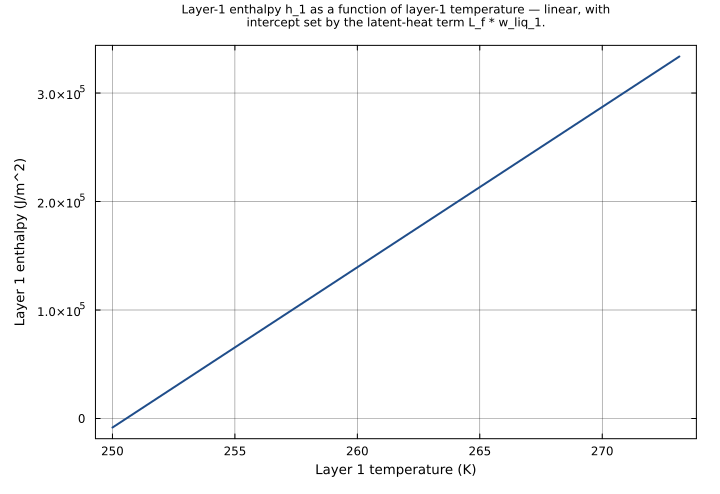
$$ h_{1} = \left(C_{ice} \cdot w_{ice\,1} + C_{liq} \cdot w_{liq\,1}\right) \cdot \left(T_{1} - T_{f}\right) + L_{f} \cdot w_{liq\,1} $$Enthalpy of layer 1 (Eq. 5.42)
$$ h_{2} = \left(C_{ice} \cdot w_{ice\,2} + C_{liq} \cdot w_{liq\,2}\right) \cdot \left(T_{2} - T_{f}\right) + L_{f} \cdot w_{liq\,2} $$Enthalpy of layer 2 (Eq. 5.42)
Analyses
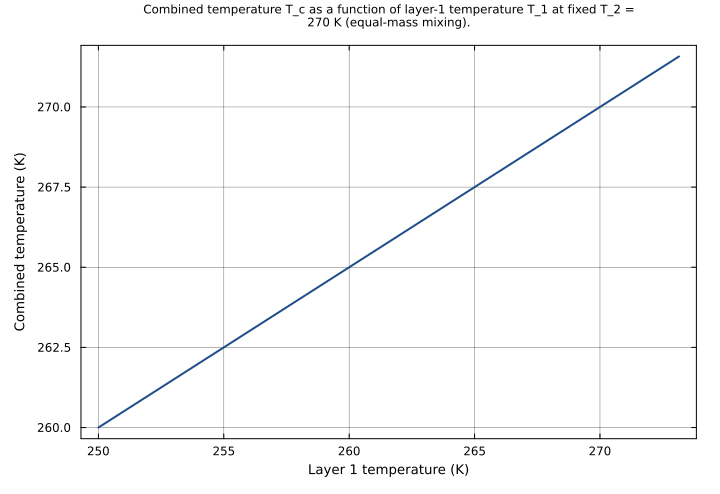
Tc_vs_T1_isothermal_pair_T2
Sweep T_1 across the cold-snow range (250–273.15 K) at fixed T_2 = 270 K with equal-mass layers. The combined temperature traces the mass-weighted average — a straight line from (250, 260) to (273.15, 271.575) on the T_1 axis, demonstrating linear blending when the two heat capacities are matched.
Time span: 0.0 → 1.0
Swept over: T_1
Tc_heatmap_T1_T2
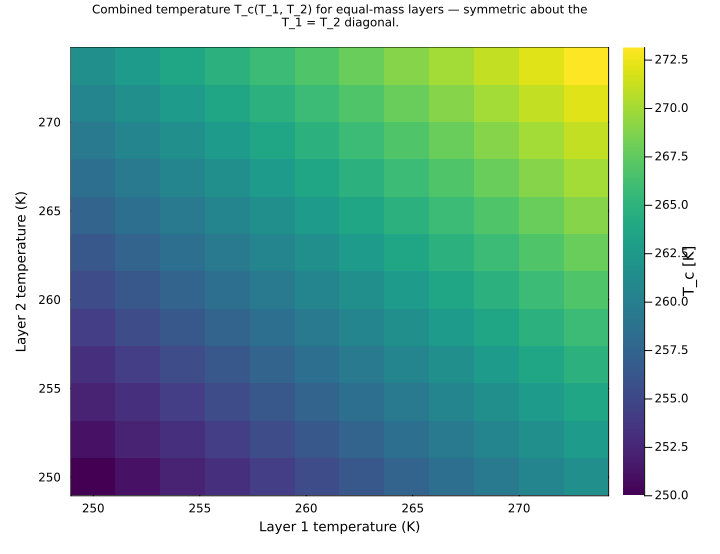
Two-dimensional sweep over (T_1, T_2) covering the cold-snow range (250–273.15 K) — surfaces the planar mass-weighted T_c surface that drives the layer-merging step in the CLM4-Urban snow scheme.
Time span: 0.0 → 1.0
Swept over: T_1, T_2
Raw .esm
Raw .esm JSON (this component)
{
"reference": {
"notes": "source_ref: UrbanCanopy.jl@9200edd4f15609f20339d3a7d104de8064544310:src/hydrology.jl:253\nUpstream `SnowLayerCombination` is an MTK `@component` whose per-layer inputs (Δz_1, Δz_2, w_liq_1, w_liq_2, w_ice_1, w_ice_2, T_1, T_2) are `@parameters` and whose outputs (Δz_c, w_liq_c, w_ice_c, T_c, h_1, h_2) are time-indexed `@variables` with algebraic-only equations. Identical structure preserved here; the unicode `Δz` symbol is rendered as ASCII `Dz` (other ESM components in this rig use ASCII identifiers — see e.g. components/wildland_fire/terrain_slope.esm `tan_phi`). The upstream `@constants` block (T_f, L_f, C_ice, C_liq) is preserved as zero-tolerance parameters with the upstream default values; they are physical constants from Oleson 2010 Table 1.4 and are not intended to be tuned.\n\nThe combined-temperature equation T_c = T_f + (h_1 + h_2 - L_f * w_liq_c) / (C_ice * w_ice_c + C_liq * w_liq_c) requires a non-zero denominator C_ice * w_ice_c + C_liq * w_liq_c — i.e. the merged layer must contain at least some ice or liquid water. All test cases below preserve that invariant.\n\nTolerance rationale (model-level rel=1e-9): observed-only algebraic system (no ODE integration); the equations are products, sums, and one division — five floating-point operations on hardware-supported intrinsics — so float64 roundoff is ~1e-15. 1e-9 leaves comfortable headroom above ULP roundoff and is well below any plausible physical-discrimination scale on snow layer enthalpies (which are O(1e5–1e6 J/m^2) and combined temperatures (which carry K resolution ~1e-2 in practice)."
},
"tolerance": {
"rel": 1e-09
},
"variables": {
"T_f": {
"type": "parameter",
"units": "K",
"default": 273.15,
"description": "Freezing temperature of water (Oleson et al. 2010 Table 1.4)"
},
"L_f": {
"type": "parameter",
"units": "J/kg",
"default": 333700.0,
"description": "Latent heat of fusion of water (Oleson et al. 2010 Table 1.4; 3.337e5 J/kg)"
},
"C_ice": {
"type": "parameter",
"units": "J/kg/K",
"default": 2117.27,
"description": "Specific heat of ice (Oleson et al. 2010 Table 1.4)"
},
"C_liq": {
"type": "parameter",
"units": "J/kg/K",
"default": 4188.0,
"description": "Specific heat of liquid water (Oleson et al. 2010 Table 1.4)"
},
"Dz_1": {
"type": "parameter",
"units": "m",
"default": 0.05,
"description": "Thickness of layer 1"
},
"Dz_2": {
"type": "parameter",
"units": "m",
"default": 0.05,
"description": "Thickness of layer 2"
},
"w_liq_1": {
"type": "parameter",
"units": "kg/m^2",
"default": 1.0,
"description": "Liquid water in layer 1"
},
"w_liq_2": {
"type": "parameter",
"units": "kg/m^2",
"default": 1.0,
"description": "Liquid water in layer 2"
},
"w_ice_1": {
"type": "parameter",
"units": "kg/m^2",
"default": 5.0,
"description": "Ice content in layer 1"
},
"w_ice_2": {
"type": "parameter",
"units": "kg/m^2",
"default": 5.0,
"description": "Ice content in layer 2"
},
"T_1": {
"type": "parameter",
"units": "K",
"default": 270.0,
"description": "Temperature of layer 1"
},
"T_2": {
"type": "parameter",
"units": "K",
"default": 270.0,
"description": "Temperature of layer 2"
},
"Dz_c": {
"type": "unknown",
"units": "m",
"description": "Combined thickness (Eq. 5.38)"
},
"w_liq_c": {
"type": "unknown",
"units": "kg/m^2",
"description": "Combined liquid water (Eq. 5.39)"
},
"w_ice_c": {
"type": "unknown",
"units": "kg/m^2",
"description": "Combined ice content (Eq. 5.40)"
},
"T_c": {
"type": "unknown",
"units": "K",
"description": "Combined temperature (Eq. 5.41)"
},
"h_1": {
"type": "unknown",
"units": "J/m^2",
"description": "Enthalpy of layer 1 (Eq. 5.42)"
},
"h_2": {
"type": "unknown",
"units": "J/m^2",
"description": "Enthalpy of layer 2 (Eq. 5.42)"
}
},
"equations": [
{
"lhs": "Dz_c",
"rhs": {
"op": "+",
"args": [
"Dz_1",
"Dz_2"
]
}
},
{
"lhs": "w_liq_c",
"rhs": {
"op": "+",
"args": [
"w_liq_1",
"w_liq_2"
]
}
},
{
"lhs": "w_ice_c",
"rhs": {
"op": "+",
"args": [
"w_ice_1",
"w_ice_2"
]
}
},
{
"lhs": "h_1",
"rhs": {
"op": "+",
"args": [
{
"op": "*",
"args": [
{
"op": "+",
"args": [
{
"op": "*",
"args": [
"C_ice",
"w_ice_1"
]
},
{
"op": "*",
"args": [
"C_liq",
"w_liq_1"
]
}
]
},
{
"op": "-",
"args": [
"T_1",
"T_f"
]
}
]
},
{
"op": "*",
"args": [
"L_f",
"w_liq_1"
]
}
]
}
},
{
"lhs": "h_2",
"rhs": {
"op": "+",
"args": [
{
"op": "*",
"args": [
{
"op": "+",
"args": [
{
"op": "*",
"args": [
"C_ice",
"w_ice_2"
]
},
{
"op": "*",
"args": [
"C_liq",
"w_liq_2"
]
}
]
},
{
"op": "-",
"args": [
"T_2",
"T_f"
]
}
]
},
{
"op": "*",
"args": [
"L_f",
"w_liq_2"
]
}
]
}
},
{
"lhs": "T_c",
"rhs": {
"op": "+",
"args": [
"T_f",
{
"op": "/",
"args": [
{
"op": "-",
"args": [
{
"op": "+",
"args": [
"h_1",
"h_2"
]
},
{
"op": "*",
"args": [
"L_f",
"w_liq_c"
]
}
]
},
{
"op": "+",
"args": [
{
"op": "*",
"args": [
"C_ice",
"w_ice_c"
]
},
{
"op": "*",
"args": [
"C_liq",
"w_liq_c"
]
}
]
}
]
}
]
}
}
],
"tests": [
{
"id": "equal_layers_isothermal_270K",
"description": "Two identical layers at 270 K. Combined T_c must equal each layer's T (no thermal mixing); combined Δz/w_liq/w_ice are simple sums; h_1 and h_2 must be equal.",
"parameter_overrides": {
"Dz_1": 0.05,
"Dz_2": 0.05,
"w_liq_1": 1.0,
"w_liq_2": 1.0,
"w_ice_1": 5.0,
"w_ice_2": 5.0,
"T_1": 270.0,
"T_2": 270.0
},
"time_span": {
"start": 0.0,
"end": 1.0
},
"assertions": [
{
"variable": "Dz_c",
"time": 0.0,
"expected": 0.1
},
{
"variable": "w_liq_c",
"time": 0.0,
"expected": 2.0
},
{
"variable": "w_ice_c",
"time": 0.0,
"expected": 10.0
},
{
"variable": "h_1",
"time": 0.0,
"expected": 287160.79750000034
},
{
"variable": "h_2",
"time": 0.0,
"expected": 287160.79750000034
},
{
"variable": "T_c",
"time": 0.0,
"expected": 270.0
}
]
},
{
"id": "upstream_test_reference",
"description": "Reproduces the parameter point used by the upstream Julia `SnowLayerCombination - Equation Verification` testitem (UrbanCanopy.jl test/hydrology_test.jl:571). Asymmetric layers (Δz, w_liq, w_ice, T all differ) — exercises the full mixing formula end-to-end.",
"parameter_overrides": {
"Dz_1": 0.05,
"Dz_2": 0.1,
"w_liq_1": 0.5,
"w_liq_2": 1.0,
"w_ice_1": 3.0,
"w_ice_2": 5.0,
"T_1": 270.0,
"T_2": 265.0
},
"time_span": {
"start": 0.0,
"end": 1.0
},
"assertions": [
{
"variable": "Dz_c",
"time": 0.0,
"expected": 0.15000000000000002
},
{
"variable": "w_liq_c",
"time": 0.0,
"expected": 1.5
},
{
"variable": "w_ice_c",
"time": 0.0,
"expected": 8.0
},
{
"variable": "h_1",
"time": 0.0,
"expected": 140245.6985000002
},
{
"variable": "h_2",
"time": 0.0,
"expected": 213289.04750000034
},
{
"variable": "T_c",
"time": 0.0,
"expected": 266.8186373392776
}
]
},
{
"id": "freezing_isothermal",
"description": "Both layers at the freezing point (T_1 = T_2 = T_f = 273.15 K). The (T_i - T_f) term collapses to zero, leaving only the latent-heat term: h_i = L_f * w_liq_i. T_c = T_f exactly.",
"parameter_overrides": {
"Dz_1": 0.05,
"Dz_2": 0.05,
"w_liq_1": 1.0,
"w_liq_2": 1.0,
"w_ice_1": 5.0,
"w_ice_2": 5.0,
"T_1": 273.15,
"T_2": 273.15
},
"time_span": {
"start": 0.0,
"end": 1.0
},
"assertions": [
{
"variable": "h_1",
"time": 0.0,
"expected": 333700.0
},
{
"variable": "h_2",
"time": 0.0,
"expected": 333700.0
},
{
"variable": "T_c",
"time": 0.0,
"expected": 273.15
}
]
},
{
"id": "no_liquid_cold",
"description": "Dry-snow regime: w_liq_1 = w_liq_2 = 0 (no latent-heat contribution). Mass-weighted temperature mixing reduces to T_c = T_f + (C_ice * (w_ice_1 * (T_1 - T_f) + w_ice_2 * (T_2 - T_f))) / (C_ice * w_ice_c) = T_f + ((10 * (-13.15) + 20 * (-23.15)) / 30) = 253.333... K. Exercises the C_liq * w_liq term collapsing to zero on both sides of the division.",
"parameter_overrides": {
"Dz_1": 0.1,
"Dz_2": 0.2,
"w_liq_1": 0.0,
"w_liq_2": 0.0,
"w_ice_1": 10.0,
"w_ice_2": 20.0,
"T_1": 260.0,
"T_2": 250.0
},
"time_span": {
"start": 0.0,
"end": 1.0
},
"assertions": [
{
"variable": "Dz_c",
"time": 0.0,
"expected": 0.30000000000000004
},
{
"variable": "w_liq_c",
"time": 0.0,
"expected": 0.0,
"tolerance": {
"abs": 1e-15
}
},
{
"variable": "w_ice_c",
"time": 0.0,
"expected": 30.0
},
{
"variable": "h_1",
"time": 0.0,
"expected": -278421.00499999954
},
{
"variable": "h_2",
"time": 0.0,
"expected": -980296.0099999991
},
{
"variable": "T_c",
"time": 0.0,
"expected": 253.33333333333331
}
]
},
{
"id": "no_ice_warm",
"description": "Slush/melt-pool regime: w_ice = 0 in both layers (only liquid water). The (h_1 + h_2 - L_f * w_liq_c) numerator cancels the latent-heat term, leaving the sensible-heat balance over C_liq alone. T_c collapses to the common T = 274 K.",
"parameter_overrides": {
"Dz_1": 0.05,
"Dz_2": 0.05,
"w_liq_1": 5.0,
"w_liq_2": 5.0,
"w_ice_1": 0.0,
"w_ice_2": 0.0,
"T_1": 274.0,
"T_2": 274.0
},
"time_span": {
"start": 0.0,
"end": 1.0
},
"assertions": [
{
"variable": "w_ice_c",
"time": 0.0,
"expected": 0.0,
"tolerance": {
"abs": 1e-15
}
},
{
"variable": "h_1",
"time": 0.0,
"expected": 1686299.0000000005
},
{
"variable": "h_2",
"time": 0.0,
"expected": 1686299.0000000005
},
{
"variable": "T_c",
"time": 0.0,
"expected": 274.0
}
]
},
{
"id": "asymmetric_thickness",
"description": "Highly asymmetric thicknesses (Δz_1 = 0.02 m vs Δz_2 = 0.18 m, 9× ratio) with proportionally scaled water/ice contents (w_*_2 = 9 * w_*_1). The mass-weighted T_c lies near the temperature of the larger thermal mass (T_2 = 271 K) — exercises the heat-capacity-weighted mixing in the (h_1 + h_2)/(C_ice w_ice_c + C_liq w_liq_c) division.",
"parameter_overrides": {
"Dz_1": 0.02,
"Dz_2": 0.18,
"w_liq_1": 0.5,
"w_liq_2": 4.5,
"w_ice_1": 2.0,
"w_ice_2": 18.0,
"T_1": 268.0,
"T_2": 271.0
},
"time_span": {
"start": 0.0,
"end": 1.0
},
"assertions": [
{
"variable": "Dz_c",
"time": 0.0,
"expected": 0.19999999999999998
},
{
"variable": "w_liq_c",
"time": 0.0,
"expected": 5.0
},
{
"variable": "w_ice_c",
"time": 0.0,
"expected": 20.0
},
{
"variable": "h_1",
"time": 0.0,
"expected": 134258.01900000015
},
{
"variable": "h_2",
"time": 0.0,
"expected": 1379192.7510000013
},
{
"variable": "T_c",
"time": 0.0,
"expected": 270.7
}
]
},
{
"id": "different_temps_equal_mass",
"description": "Equal-mass layers at different temperatures (T_1 = 268 K, T_2 = 272 K). Heat capacities cancel; T_c = (T_1 + T_2)/2 = 270 K. Cross-checks that the latent-heat term contributes equally to both numerator (via h_1, h_2) and the L_f * w_liq_c subtraction in the (h_1+h_2-L_f*w_liq_c) numerator.",
"parameter_overrides": {
"Dz_1": 0.05,
"Dz_2": 0.05,
"w_liq_1": 1.0,
"w_liq_2": 1.0,
"w_ice_1": 5.0,
"w_ice_2": 5.0,
"T_1": 268.0,
"T_2": 272.0
},
"time_span": {
"start": 0.0,
"end": 1.0
},
"assertions": [
{
"variable": "h_1",
"time": 0.0,
"expected": 257612.09750000032
},
{
"variable": "h_2",
"time": 0.0,
"expected": 316709.49750000035
},
{
"variable": "T_c",
"time": 0.0,
"expected": 270.0
}
]
},
{
"id": "thick_warm_thin_cold",
"description": "Thin cold layer (Δz_1 = 0.01 m, T_1 = 265 K) merged with a thick warm layer (Δz_2 = 0.20 m, T_2 = 272.5 K). Combined T_c is heavily weighted toward the larger-mass warm layer (T_c ≈ 272.21 K, much closer to T_2 than to (T_1+T_2)/2 = 268.75 K). Exercises mass-weighted mixing across a 20× thickness ratio.",
"parameter_overrides": {
"Dz_1": 0.01,
"Dz_2": 0.2,
"w_liq_1": 0.1,
"w_liq_2": 5.0,
"w_ice_1": 1.0,
"w_ice_2": 20.0,
"T_1": 265.0,
"T_2": 272.5
},
"time_span": {
"start": 0.0,
"end": 1.0
},
"assertions": [
{
"variable": "Dz_c",
"time": 0.0,
"expected": 0.21000000000000002
},
{
"variable": "w_liq_c",
"time": 0.0,
"expected": 5.1
},
{
"variable": "w_ice_c",
"time": 0.0,
"expected": 21.0
},
{
"variable": "h_1",
"time": 0.0,
"expected": 12701.029500000055
},
{
"variable": "h_2",
"time": 0.0,
"expected": 1627364.4900000014
},
{
"variable": "T_c",
"time": 0.0,
"expected": 272.21102855952626
}
]
}
],
"analyses": [
{
"id": "Tc_vs_T1_isothermal_pair_T2",
"description": "Sweep T_1 across the cold-snow range (250–273.15 K) at fixed T_2 = 270 K with equal-mass layers. The combined temperature traces the mass-weighted average — a straight line from (250, 260) to (273.15, 271.575) on the T_1 axis, demonstrating linear blending when the two heat capacities are matched.",
"initial_state": {},
"parameters": {
"Dz_1": 0.05,
"Dz_2": 0.05,
"w_liq_1": 1.0,
"w_liq_2": 1.0,
"w_ice_1": 5.0,
"w_ice_2": 5.0,
"T_2": 270.0
},
"time_span": {
"start": 0.0,
"end": 1.0
},
"parameter_sweep": {
"type": "cartesian",
"dimensions": [
{
"parameter": "T_1",
"range": {
"start": 250.0,
"stop": 273.15,
"count": 24,
"scale": "linear"
}
}
]
},
"plots": [
{
"id": "Tc_curve",
"type": "line",
"description": "Combined temperature T_c as a function of layer-1 temperature T_1 at fixed T_2 = 270 K (equal-mass mixing).",
"x": {
"variable": "T_1",
"label": "Layer 1 temperature (K)"
},
"y": {
"variable": "T_c",
"label": "Combined temperature (K)"
}
},
{
"id": "h1_curve",
"type": "line",
"description": "Layer-1 enthalpy h_1 as a function of layer-1 temperature — linear, with intercept set by the latent-heat term L_f * w_liq_1.",
"x": {
"variable": "T_1",
"label": "Layer 1 temperature (K)"
},
"y": {
"variable": "h_1",
"label": "Layer 1 enthalpy (J/m^2)"
}
}
]
},
{
"id": "Tc_heatmap_T1_T2",
"description": "Two-dimensional sweep over (T_1, T_2) covering the cold-snow range (250–273.15 K) — surfaces the planar mass-weighted T_c surface that drives the layer-merging step in the CLM4-Urban snow scheme.",
"initial_state": {},
"parameters": {
"Dz_1": 0.05,
"Dz_2": 0.05,
"w_liq_1": 1.0,
"w_liq_2": 1.0,
"w_ice_1": 5.0,
"w_ice_2": 5.0
},
"time_span": {
"start": 0.0,
"end": 1.0
},
"parameter_sweep": {
"type": "cartesian",
"dimensions": [
{
"parameter": "T_1",
"range": {
"start": 250.0,
"stop": 273.15,
"count": 12,
"scale": "linear"
}
},
{
"parameter": "T_2",
"range": {
"start": 250.0,
"stop": 273.15,
"count": 12,
"scale": "linear"
}
}
]
},
"plots": [
{
"id": "Tc_surface",
"type": "heatmap",
"description": "Combined temperature T_c(T_1, T_2) for equal-mass layers — symmetric about the T_1 = T_2 diagonal.",
"x": {
"variable": "T_1",
"label": "Layer 1 temperature (K)"
},
"y": {
"variable": "T_2",
"label": "Layer 2 temperature (K)"
},
"value": {
"variable": "T_c",
"reduce": "final"
}
}
]
}
]
}