SnowCompaction
Total fractional snow-layer compaction rate combining destructive metamorphism (Eq. 5.26), overburden pressure (Eq. 5.28), and melt-induced compaction (Eq. 5.31). Migrated from UrbanCanopy.jl@9200edd4 src/hydrology.jl:174 (`SnowCompaction` @component). Implements Oleson et al. (2010) CLM4 Tech Note Chapter 5, Section 5.1.4, Eqs. 5.24–5.33. Parameterized as observed-only: T_i, w_ice, w_liq, dz, P_s, f_ice_n, f_ice_n1 are inputs; c_1, c_2, C_R1, eta, C_R2, C_R3, C_R are algebraic outputs.
Description
Total fractional snow-layer compaction rate combining destructive metamorphism (Eq. 5.26), overburden pressure (Eq. 5.28), and melt-induced compaction (Eq. 5.31). Migrated from UrbanCanopy.jl@9200edd4 src/hydrology.jl:174 (SnowCompaction @component). Implements Oleson et al. (2010) CLM4 Tech Note Chapter 5, Section 5.1.4, Eqs. 5.24–5.33. Parameterized as observed-only: T_i, w_ice, w_liq, dz, P_s, f_ice_n, f_ice_n1 are inputs; c_1, c_2, C_R1, eta, C_R2, C_R3, C_R are algebraic outputs.
Reference
_source_ref: UrbanCanopy.jl@9200edd4:src/hydrology.jl:174
Upstream SnowCompaction is an MTK @component where T_i, w_ice, w_liq, Δz, P_s, f_ice_n, and f_ice_n1 are @parameters (driven by a parent layer/timestepper). For standalone serialization (and to make the component well-posed in isolation), they are declared as parameters here — matching the migration tracker’s (M, equations) classification. The seven algebraic equations are unchanged from upstream. Δz is renamed to dz and η to eta for ASCII parameter names.
Tolerance rationale (model-level rel=1e-6): observed-only algebraic system (no ODE integration); 1e-6 covers float64 roundoff in the chained exp/ifelse/max closed-form expressions across the relevant snow regimes (T_i 230–273 K, snow densities 50–500 kg/m³, overburden pressures 0–10⁴ kg/m²)._
Parameters
| Name | Units | Default | Description |
|---|---|---|---|
T_i | K | 263.15 | Snow layer temperature |
w_ice | kg/m^2 | 50.0 | Mass of ice in layer |
w_liq | kg/m^2 | 1.0 | Mass of liquid water in layer |
dz | m | 0.5 | Snow layer thickness (Δz in upstream Julia source) |
P_s | kg/m^2 | 100.0 | Snow load pressure on this layer (Eq. 5.30) |
f_ice_n | 1 | 0.9 | Ice fraction at time n (dimensionless) |
f_ice_n1 | 1 | 0.9 | Ice fraction at time n+1 (dimensionless) |
T_f | K | 273.15 | Freezing temperature of water (Oleson et al. 2010 Table 1.4) |
c_3 | s^-1 | 2.777e-06 | Fractional compaction rate at T_f (Eq. 5.26) |
c_4 | K^-1 | 0.04 | Temperature coefficient for metamorphism (Eq. 5.26) |
eta_0 | kg*s/m^2 | 900000.0 | Reference viscosity (Eq. 5.29) |
c_5 | K^-1 | 0.08 | Viscosity temperature coefficient (Eq. 5.29) |
c_6 | m^3/kg | 0.023 | Viscosity density coefficient (Eq. 5.29) |
hundred_kgpm3 | kg/m^3 | 100.0 | Reference density 100 kg/m^3 (Eq. 5.27 threshold) |
thresh_liq_density | kg/m^3 | 0.01 | Liquid water density threshold (Eq. 5.27) |
coeff_0046 | m^3/kg | 0.046 | Density coefficient (Eq. 5.27) |
one_per_s | s^-1 | 1.0 | Unit rate for nondimensionalization (Eq. 5.31) |
Observed
| Name | Units | Default | Description |
|---|---|---|---|
c_1 | 1 | Density-dependent coefficient (Eq. 5.27, dimensionless) | |
c_2 | 1 | Liquid-dependent coefficient (Eq. 5.27, dimensionless) | |
C_R1 | s^-1 | Destructive metamorphism compaction rate (Eq. 5.26) | |
eta | kg*s/m^2 | Viscosity coefficient (Eq. 5.29; η in upstream Julia source) | |
C_R2 | s^-1 | Overburden compaction rate (Eq. 5.28) | |
C_R3 | s^-1 | Melt compaction rate (Eq. 5.31) | |
C_R | s^-1 | Total fractional compaction rate (Eq. 5.24) |
Observed expressions
$$ c_{1} = \mathrm{ifelse}\left(\mathrm{>}\left(\frac{w_{ice}}{dz}, hundred_{kgpm3}\right), e^{\left(-1\right) \cdot coeff_{0046} \cdot \left(\frac{w_{ice}}{dz} - hundred_{kgpm3}\right)}, 1.0\right) $$Density-dependent coefficient (Eq. 5.27, dimensionless)
$$ c_{2} = \mathrm{ifelse}\left(\mathrm{>}\left(\frac{w_{liq}}{dz}, thresh_{liq\,density}\right), 2.0, 1.0\right) $$Liquid-dependent coefficient (Eq. 5.27, dimensionless)
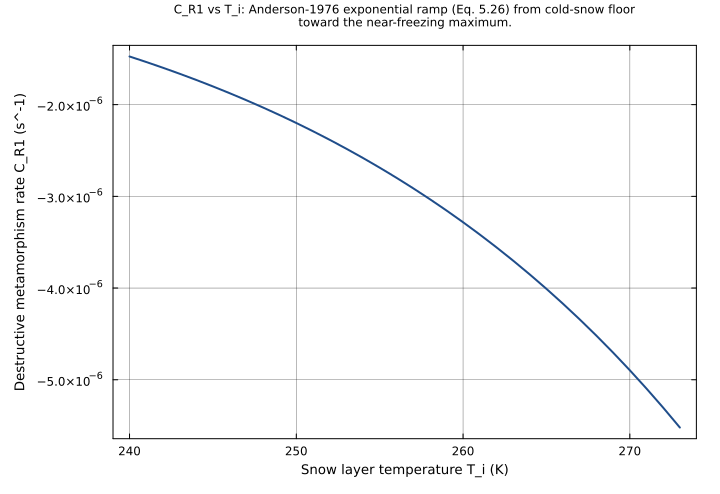
$$ C_{R1} = \left(-1\right) \cdot c_{3} \cdot c_{1} \cdot c_{2} \cdot e^{\left(-1\right) \cdot c_{4} \cdot \left(T_{f} - T_{i}\right)} $$Destructive metamorphism compaction rate (Eq. 5.26)
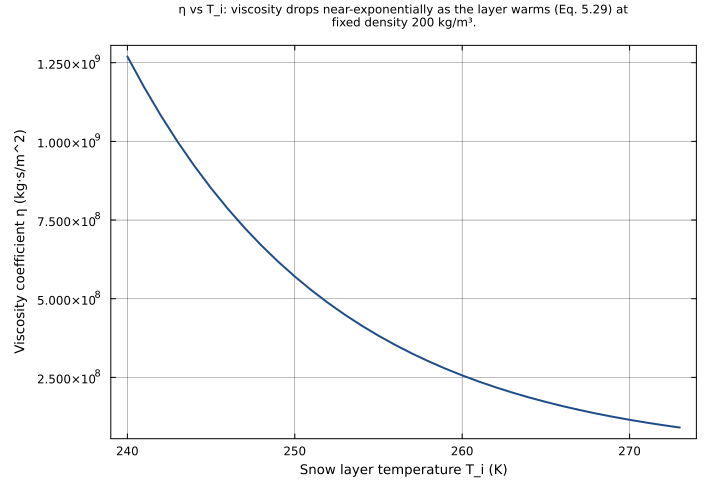
$$ eta = eta_{0} \cdot e^{c_{5} \cdot \left(T_{f} - T_{i}\right) + c_{6} \cdot \frac{w_{ice}}{dz}} $$Viscosity coefficient (Eq. 5.29; η in upstream Julia source)
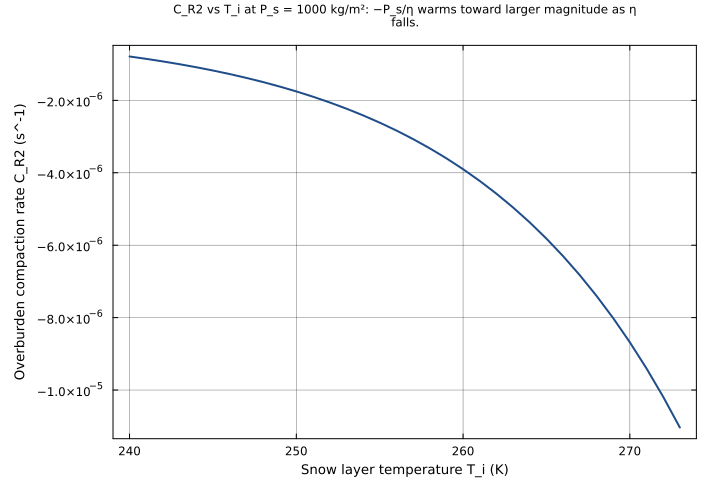
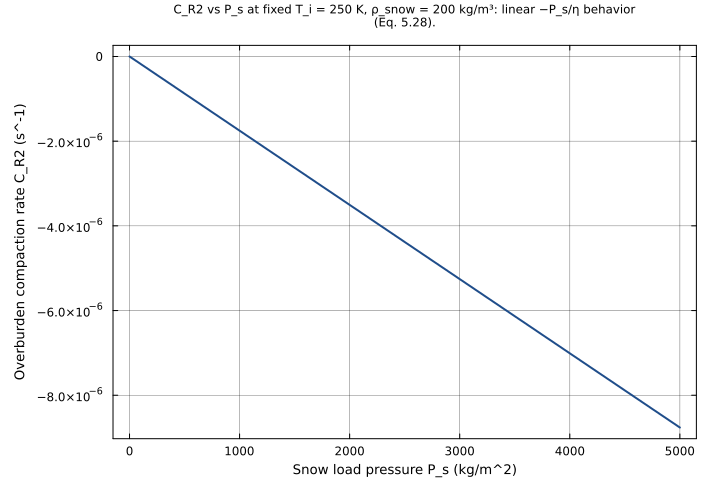
$$ C_{R2} = \frac{\left(-1\right) \cdot P_{s}}{eta} $$Overburden compaction rate (Eq. 5.28)
$$ C_{R3} = \left(-1\right) \cdot one_{per\,s} \cdot \mathrm{max}\left(0.0, \frac{f_{ice\,n} - f_{ice\,n1}}{\mathrm{max}\left(f_{ice\,n}, 1 \times 10^{-10}\right)}\right) $$Melt compaction rate (Eq. 5.31)
$$ C_{R} = C_{R1} + C_{R2} + C_{R3} $$Total fractional compaction rate (Eq. 5.24)
Analyses
metamorphism_vs_temperature
Destructive-metamorphism compaction rate C_R1 as a function of snow layer temperature T_i, sweeping the cold-pack to near-freezing range (240–273 K). Holds the c_1 = 1 (w_ice/Δz ≤ 100 kg/m³) and c_2 = 2 (wet) branches of Eq. 5.27 by using the default w_ice/dz = 100 kg/m³ and w_liq/dz = 2 kg/m³. Overburden and melt contributions are zeroed (P_s = 0, f_ice_n = f_ice_n1 = 0.5) so the C_R1 curve stands alone. Surfaces the canonical Anderson-1976 exp(−c_4 (T_f − T_i)) temperature dependence of Eq. 5.26 — C_R1 grows by ≈ exp(c_4 × 33) ≈ 3.7× across the 240→273 K sweep.
Time span: 0.0 → 1.0
Swept over: T_i
viscosity_temperature_sweep
Snow viscosity coefficient η (Eq. 5.29) and the resulting overburden compaction rate C_R2 (Eq. 5.28) as functions of layer temperature, sweeping 240–273 K at a fixed mid-pack snow density (w_ice/Δz = 200 kg/m³) and fixed overburden P_s = 1000 kg/m². η decreases by ≈ exp(c_5 × 33) ≈ 14× as T_i warms, so |C_R2| = P_s / η grows by the same factor. Surfaces the strong temperature suppression of viscosity-controlled compaction in cold snowpacks. Melt is zeroed (f_ice_n = f_ice_n1 = 0.5) so C_R2 stands alone aside from a weak C_R1 contribution.
Time span: 0.0 → 1.0
Swept over: T_i
overburden_load_sweep
Overburden compaction rate C_R2 as a function of snow load pressure P_s at a fixed cold (T_i = 250 K) mid-density (w_ice/Δz = 200 kg/m³) layer. With temperature and density fixed, η is constant, so C_R2 = −P_s/η is a unit-slope line through the origin (Eq. 5.28). Sweeps 0–5000 kg/m² — the upper end is representative of a deep snowpack column overburden. Surfaces the linear P_s dependence and the magnitude of overburden compaction relative to metamorphism. Melt zeroed (f_ice_n = f_ice_n1 = 0.5).
Time span: 0.0 → 1.0
Swept over: P_s
melt_compaction_ramp
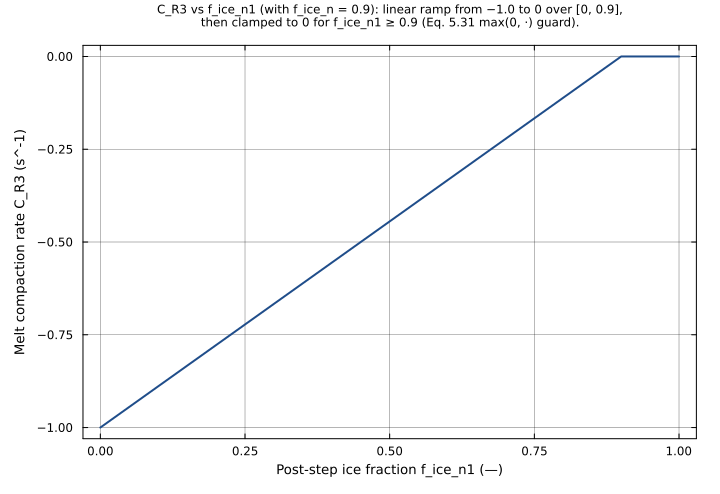
Melt-induced compaction rate C_R3 as a function of the post-melt ice fraction f_ice_n1, holding the pre-melt fraction f_ice_n = 0.9 fixed and sweeping f_ice_n1 across the full physical range [0, 1] in 21 points. For f_ice_n1 < f_ice_n, C_R3 = −(f_ice_n − f_ice_n1)/f_ice_n is a unit-slope ramp from −1.0 (complete ice loss in one step) to 0 (no melt). For f_ice_n1 ≥ f_ice_n (refreezing), the max(0, ·) clamp of Eq. 5.31 pins C_R3 = 0 — the no-negative-melt-rate guard. The two regimes meet at f_ice_n1 = 0.9 with a hinge in the curve. Metamorphism and overburden terms are zeroed at the canonical-cold defaults so C_R3 stands alone.
Time span: 0.0 → 1.0
Swept over: f_ice_n1
total_compaction_T_Ps_heatmap
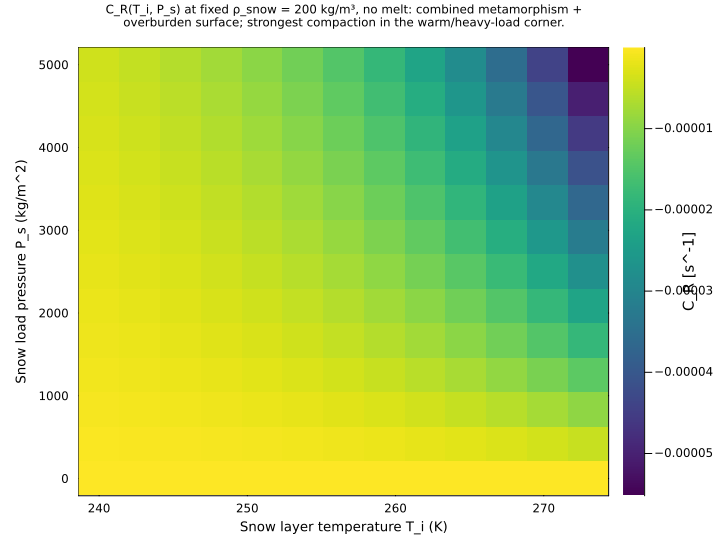
Total fractional compaction rate C_R = C_R1 + C_R2 + C_R3 (Eq. 5.24) on the (T_i, P_s) plane at no-melt (f_ice_n = f_ice_n1 = 0.5) and fixed mid-pack density (w_ice/Δz = 200 kg/m³). 13×13 Cartesian sweep of T_i ∈ [240, 273] K against P_s ∈ [0, 5000] kg/m². Surfaces the joint behavior of the two non-melt mechanisms: at P_s = 0 the surface reduces to the C_R1(T_i) temperature curve; along the temperature-fixed axis the slope vs P_s is −1/η, with the slope steepening rapidly toward T_f as η drops. The result is a strongly bowed surface where the largest compaction magnitudes concentrate in the warm, heavily-loaded corner — the operational regime where overburden compaction dominates the snowpack mass-budget.
Time span: 0.0 → 1.0
Swept over: T_i, P_s
Raw .esm
Raw .esm JSON (this component)
{
"reference": {
"notes": "source_ref: UrbanCanopy.jl@9200edd4:src/hydrology.jl:174\nUpstream `SnowCompaction` is an MTK `@component` where T_i, w_ice, w_liq, Δz, P_s, f_ice_n, and f_ice_n1 are `@parameters` (driven by a parent layer/timestepper). For standalone serialization (and to make the component well-posed in isolation), they are declared as parameters here — matching the migration tracker's `(M, equations)` classification. The seven algebraic equations are unchanged from upstream. Δz is renamed to `dz` and η to `eta` for ASCII parameter names.\n\nTolerance rationale (model-level rel=1e-6): observed-only algebraic system (no ODE integration); 1e-6 covers float64 roundoff in the chained exp/ifelse/max closed-form expressions across the relevant snow regimes (T_i 230–273 K, snow densities 50–500 kg/m³, overburden pressures 0–10⁴ kg/m²)."
},
"tolerance": {
"rel": 1e-06
},
"variables": {
"T_i": {
"type": "parameter",
"units": "K",
"default": 263.15,
"description": "Snow layer temperature"
},
"w_ice": {
"type": "parameter",
"units": "kg/m^2",
"default": 50.0,
"description": "Mass of ice in layer"
},
"w_liq": {
"type": "parameter",
"units": "kg/m^2",
"default": 1.0,
"description": "Mass of liquid water in layer"
},
"dz": {
"type": "parameter",
"units": "m",
"default": 0.5,
"description": "Snow layer thickness (Δz in upstream Julia source)"
},
"P_s": {
"type": "parameter",
"units": "kg/m^2",
"default": 100.0,
"description": "Snow load pressure on this layer (Eq. 5.30)"
},
"f_ice_n": {
"type": "parameter",
"units": "1",
"default": 0.9,
"description": "Ice fraction at time n (dimensionless)"
},
"f_ice_n1": {
"type": "parameter",
"units": "1",
"default": 0.9,
"description": "Ice fraction at time n+1 (dimensionless)"
},
"T_f": {
"type": "parameter",
"units": "K",
"default": 273.15,
"description": "Freezing temperature of water (Oleson et al. 2010 Table 1.4)"
},
"c_3": {
"type": "parameter",
"units": "s^-1",
"default": 2.777e-06,
"description": "Fractional compaction rate at T_f (Eq. 5.26)"
},
"c_4": {
"type": "parameter",
"units": "K^-1",
"default": 0.04,
"description": "Temperature coefficient for metamorphism (Eq. 5.26)"
},
"eta_0": {
"type": "parameter",
"units": "kg*s/m^2",
"default": 900000.0,
"description": "Reference viscosity (Eq. 5.29)"
},
"c_5": {
"type": "parameter",
"units": "K^-1",
"default": 0.08,
"description": "Viscosity temperature coefficient (Eq. 5.29)"
},
"c_6": {
"type": "parameter",
"units": "m^3/kg",
"default": 0.023,
"description": "Viscosity density coefficient (Eq. 5.29)"
},
"hundred_kgpm3": {
"type": "parameter",
"units": "kg/m^3",
"default": 100.0,
"description": "Reference density 100 kg/m^3 (Eq. 5.27 threshold)"
},
"thresh_liq_density": {
"type": "parameter",
"units": "kg/m^3",
"default": 0.01,
"description": "Liquid water density threshold (Eq. 5.27)"
},
"coeff_0046": {
"type": "parameter",
"units": "m^3/kg",
"default": 0.046,
"description": "Density coefficient (Eq. 5.27)"
},
"one_per_s": {
"type": "parameter",
"units": "s^-1",
"default": 1.0,
"description": "Unit rate for nondimensionalization (Eq. 5.31)"
},
"c_1": {
"type": "unknown",
"units": "1",
"description": "Density-dependent coefficient (Eq. 5.27, dimensionless)"
},
"c_2": {
"type": "unknown",
"units": "1",
"description": "Liquid-dependent coefficient (Eq. 5.27, dimensionless)"
},
"C_R1": {
"type": "unknown",
"units": "s^-1",
"description": "Destructive metamorphism compaction rate (Eq. 5.26)"
},
"eta": {
"type": "unknown",
"units": "kg*s/m^2",
"description": "Viscosity coefficient (Eq. 5.29; η in upstream Julia source)"
},
"C_R2": {
"type": "unknown",
"units": "s^-1",
"description": "Overburden compaction rate (Eq. 5.28)"
},
"C_R3": {
"type": "unknown",
"units": "s^-1",
"description": "Melt compaction rate (Eq. 5.31)"
},
"C_R": {
"type": "unknown",
"units": "s^-1",
"description": "Total fractional compaction rate (Eq. 5.24)"
}
},
"equations": [
{
"lhs": "c_1",
"rhs": {
"op": "ifelse",
"args": [
{
"op": ">",
"args": [
{
"op": "/",
"args": [
"w_ice",
"dz"
]
},
"hundred_kgpm3"
]
},
{
"op": "exp",
"args": [
{
"op": "*",
"args": [
-1,
"coeff_0046",
{
"op": "-",
"args": [
{
"op": "/",
"args": [
"w_ice",
"dz"
]
},
"hundred_kgpm3"
]
}
]
}
]
},
1.0
]
}
},
{
"lhs": "c_2",
"rhs": {
"op": "ifelse",
"args": [
{
"op": ">",
"args": [
{
"op": "/",
"args": [
"w_liq",
"dz"
]
},
"thresh_liq_density"
]
},
2.0,
1.0
]
}
},
{
"lhs": "C_R1",
"rhs": {
"op": "*",
"args": [
-1,
"c_3",
"c_1",
"c_2",
{
"op": "exp",
"args": [
{
"op": "*",
"args": [
-1,
"c_4",
{
"op": "-",
"args": [
"T_f",
"T_i"
]
}
]
}
]
}
]
}
},
{
"lhs": "eta",
"rhs": {
"op": "*",
"args": [
"eta_0",
{
"op": "exp",
"args": [
{
"op": "+",
"args": [
{
"op": "*",
"args": [
"c_5",
{
"op": "-",
"args": [
"T_f",
"T_i"
]
}
]
},
{
"op": "*",
"args": [
"c_6",
{
"op": "/",
"args": [
"w_ice",
"dz"
]
}
]
}
]
}
]
}
]
}
},
{
"lhs": "C_R2",
"rhs": {
"op": "/",
"args": [
{
"op": "*",
"args": [
-1,
"P_s"
]
},
"eta"
]
}
},
{
"lhs": "C_R3",
"rhs": {
"op": "*",
"args": [
-1,
"one_per_s",
{
"op": "max",
"args": [
0.0,
{
"op": "/",
"args": [
{
"op": "-",
"args": [
"f_ice_n",
"f_ice_n1"
]
},
{
"op": "max",
"args": [
"f_ice_n",
1e-10
]
}
]
}
]
}
]
}
},
{
"lhs": "C_R",
"rhs": {
"op": "+",
"args": [
"C_R1",
"C_R2",
"C_R3"
]
}
}
],
"tests": [
{
"id": "default_state",
"description": "Default parameter values: cold (T_i=263.15 K), boundary-density snow (w_ice/dz = 100 kg/m³ — branch FALSE → c_1 = 1.0), wet (w_liq/dz = 2.0 kg/m³ > 0.01 → c_2 = 2.0), moderate overburden, no melt (f_ice_n = f_ice_n1 = 0.9 → C_R3 = 0).",
"parameter_overrides": {
"T_i": 263.15,
"w_ice": 50.0,
"w_liq": 1.0,
"dz": 0.5,
"P_s": 100.0,
"f_ice_n": 0.9,
"f_ice_n1": 0.9
},
"time_span": {
"start": 0.0,
"end": 1.0
},
"assertions": [
{
"variable": "c_1",
"time": 0.0,
"expected": 1.0
},
{
"variable": "c_2",
"time": 0.0,
"expected": 2.0
},
{
"variable": "C_R1",
"time": 0.0,
"expected": -3.7229575356819407e-06
},
{
"variable": "eta",
"time": 0.0,
"expected": 19978156.15329746
},
{
"variable": "C_R2",
"time": 0.0,
"expected": -5.005466932617536e-06
},
{
"variable": "C_R3",
"time": 0.0,
"expected": 0.0
},
{
"variable": "C_R",
"time": 0.0,
"expected": -8.728424468299477e-06
}
]
},
{
"id": "dense_snow_metamorphism",
"description": "Higher-density snow (w_ice/dz = 200 kg/m³ > 100 → c_1 < 1 branch), dry layer (w_liq/dz < threshold → c_2 = 1), no overburden, no melt. Isolates the destructive-metamorphism path with the density-suppression factor.",
"parameter_overrides": {
"T_i": 263.15,
"w_ice": 200.0,
"w_liq": 0.001,
"dz": 1.0,
"P_s": 0.0,
"f_ice_n": 0.5,
"f_ice_n1": 0.5
},
"time_span": {
"start": 0.0,
"end": 1.0
},
"assertions": [
{
"variable": "c_1",
"time": 0.0,
"expected": 0.010051835744633586
},
{
"variable": "c_2",
"time": 0.0,
"expected": 1.0
},
{
"variable": "C_R1",
"time": 0.0,
"expected": -1.871127881646035e-08
},
{
"variable": "C_R2",
"time": 0.0,
"expected": 0.0
},
{
"variable": "C_R3",
"time": 0.0,
"expected": 0.0
}
]
},
{
"id": "warm_low_density",
"description": "Near-freezing layer (T_i = 272 K), low density (w_ice/dz = 80 kg/m³ < 100 → c_1 = 1), wet layer (c_2 = 2). Maximizes destructive metamorphism rate (T_i close to T_f).",
"parameter_overrides": {
"T_i": 272.0,
"w_ice": 40.0,
"w_liq": 5.0,
"dz": 0.5,
"P_s": 0.0,
"f_ice_n": 0.5,
"f_ice_n1": 0.5
},
"time_span": {
"start": 0.0,
"end": 1.0
},
"assertions": [
{
"variable": "c_1",
"time": 0.0,
"expected": 1.0
},
{
"variable": "c_2",
"time": 0.0,
"expected": 2.0
},
{
"variable": "C_R1",
"time": 0.0,
"expected": -5.304303058007234e-06
}
]
},
{
"id": "overburden_dominated",
"description": "Heavy overburden pressure (P_s = 5000 kg/m²) with cold dense snow. Eta is high (cold + dense), but P_s/eta still dominates the total rate.",
"parameter_overrides": {
"T_i": 250.0,
"w_ice": 150.0,
"w_liq": 0.0,
"dz": 0.5,
"P_s": 5000.0,
"f_ice_n": 0.5,
"f_ice_n1": 0.5
},
"time_span": {
"start": 0.0,
"end": 1.0
},
"assertions": [
{
"variable": "eta",
"time": 0.0,
"expected": 5690989902.689874
},
{
"variable": "C_R2",
"time": 0.0,
"expected": -8.785817732055239e-07
},
{
"variable": "C_R",
"time": 0.0,
"expected": -8.786929233306654e-07
}
]
},
{
"id": "melt_compaction",
"description": "Active melt: f_ice drops from 0.9 to 0.7 in one step → C_R3 = -1.0 * (0.2/0.9). C_R1 and C_R2 are smaller-magnitude contributions; melt dominates.",
"parameter_overrides": {
"T_i": 272.0,
"w_ice": 50.0,
"w_liq": 5.0,
"dz": 0.5,
"P_s": 100.0,
"f_ice_n": 0.9,
"f_ice_n1": 0.7
},
"time_span": {
"start": 0.0,
"end": 1.0
},
"assertions": [
{
"variable": "C_R3",
"time": 0.0,
"expected": -0.2222222222222223
},
{
"variable": "C_R",
"time": 0.0,
"expected": -0.2222376872594633
}
]
},
{
"id": "no_melt_negative_diff",
"description": "f_ice_n1 > f_ice_n (refreezing): the max(0, ...) clamps C_R3 to zero. Verifies the no-negative-melt-rate guard from Eq. 5.31.",
"parameter_overrides": {
"T_i": 263.15,
"w_ice": 50.0,
"w_liq": 1.0,
"dz": 0.5,
"P_s": 0.0,
"f_ice_n": 0.7,
"f_ice_n1": 0.9
},
"time_span": {
"start": 0.0,
"end": 1.0
},
"assertions": [
{
"variable": "C_R3",
"time": 0.0,
"expected": 0.0
}
]
},
{
"id": "very_cold",
"description": "Very cold layer (T_i = 230 K, 43 K below T_f). Both metamorphism and viscosity-driven overburden compaction are strongly suppressed (exp(-0.04*43) ≈ 0.179; exp(0.08*43) ≈ 31).",
"parameter_overrides": {
"T_i": 230.0,
"w_ice": 60.0,
"w_liq": 0.001,
"dz": 0.5,
"P_s": 200.0,
"f_ice_n": 0.5,
"f_ice_n1": 0.5
},
"time_span": {
"start": 0.0,
"end": 1.0
},
"assertions": [
{
"variable": "C_R1",
"time": 0.0,
"expected": -1.9698478402571534e-07
},
{
"variable": "eta",
"time": 0.0,
"expected": 448827884.87023425
},
{
"variable": "C_R2",
"time": 0.0,
"expected": -4.4560511220871287e-07
}
]
},
{
"id": "all_three_processes_active",
"description": "All three compaction mechanisms simultaneously active: dense wet snow (c_1<1, c_2=2), nontrivial overburden, and active melt. Verifies C_R = C_R1 + C_R2 + C_R3 sum (Eq. 5.24).",
"parameter_overrides": {
"T_i": 270.0,
"w_ice": 200.0,
"w_liq": 10.0,
"dz": 1.0,
"P_s": 1000.0,
"f_ice_n": 0.85,
"f_ice_n1": 0.8
},
"time_span": {
"start": 0.0,
"end": 1.0
},
"assertions": [
{
"variable": "c_1",
"time": 0.0,
"expected": 0.010051835744633586
},
{
"variable": "c_2",
"time": 0.0,
"expected": 2.0
},
{
"variable": "C_R1",
"time": 0.0,
"expected": -4.921870173644911e-08
},
{
"variable": "eta",
"time": 0.0,
"expected": 115196513.64921543
},
{
"variable": "C_R2",
"time": 0.0,
"expected": -8.680818267166463e-06
},
{
"variable": "C_R3",
"time": 0.0,
"expected": -0.05882352941176463
},
{
"variable": "C_R",
"time": 0.0,
"expected": -0.058832259448733534
}
]
}
],
"analyses": [
{
"id": "metamorphism_vs_temperature",
"description": "Destructive-metamorphism compaction rate C_R1 as a function of snow layer temperature T_i, sweeping the cold-pack to near-freezing range (240–273 K). Holds the c_1 = 1 (w_ice/Δz ≤ 100 kg/m³) and c_2 = 2 (wet) branches of Eq. 5.27 by using the default w_ice/dz = 100 kg/m³ and w_liq/dz = 2 kg/m³. Overburden and melt contributions are zeroed (P_s = 0, f_ice_n = f_ice_n1 = 0.5) so the C_R1 curve stands alone. Surfaces the canonical Anderson-1976 exp(−c_4 (T_f − T_i)) temperature dependence of Eq. 5.26 — C_R1 grows by ≈ exp(c_4 × 33) ≈ 3.7× across the 240→273 K sweep.",
"initial_state": {},
"parameters": {
"w_ice": 50.0,
"w_liq": 1.0,
"dz": 0.5,
"P_s": 0.0,
"f_ice_n": 0.5,
"f_ice_n1": 0.5
},
"time_span": {
"start": 0.0,
"end": 1.0
},
"parameter_sweep": {
"type": "cartesian",
"dimensions": [
{
"parameter": "T_i",
"range": {
"start": 240.0,
"stop": 273.0,
"count": 34,
"scale": "linear"
}
}
]
},
"plots": [
{
"id": "C_R1_curve",
"type": "line",
"description": "C_R1 vs T_i: Anderson-1976 exponential ramp (Eq. 5.26) from cold-snow floor toward the near-freezing maximum.",
"x": {
"variable": "T_i",
"label": "Snow layer temperature T_i (K)"
},
"y": {
"variable": "C_R1",
"label": "Destructive metamorphism rate C_R1 (s^-1)"
}
}
]
},
{
"id": "viscosity_temperature_sweep",
"description": "Snow viscosity coefficient η (Eq. 5.29) and the resulting overburden compaction rate C_R2 (Eq. 5.28) as functions of layer temperature, sweeping 240–273 K at a fixed mid-pack snow density (w_ice/Δz = 200 kg/m³) and fixed overburden P_s = 1000 kg/m². η decreases by ≈ exp(c_5 × 33) ≈ 14× as T_i warms, so |C_R2| = P_s / η grows by the same factor. Surfaces the strong temperature suppression of viscosity-controlled compaction in cold snowpacks. Melt is zeroed (f_ice_n = f_ice_n1 = 0.5) so C_R2 stands alone aside from a weak C_R1 contribution.",
"initial_state": {},
"parameters": {
"w_ice": 100.0,
"w_liq": 0.0,
"dz": 0.5,
"P_s": 1000.0,
"f_ice_n": 0.5,
"f_ice_n1": 0.5
},
"time_span": {
"start": 0.0,
"end": 1.0
},
"parameter_sweep": {
"type": "cartesian",
"dimensions": [
{
"parameter": "T_i",
"range": {
"start": 240.0,
"stop": 273.0,
"count": 34,
"scale": "linear"
}
}
]
},
"plots": [
{
"id": "eta_curve",
"type": "line",
"description": "η vs T_i: viscosity drops near-exponentially as the layer warms (Eq. 5.29) at fixed density 200 kg/m³.",
"x": {
"variable": "T_i",
"label": "Snow layer temperature T_i (K)"
},
"y": {
"variable": "eta",
"label": "Viscosity coefficient η (kg·s/m^2)"
}
},
{
"id": "C_R2_curve",
"type": "line",
"description": "C_R2 vs T_i at P_s = 1000 kg/m²: −P_s/η warms toward larger magnitude as η falls.",
"x": {
"variable": "T_i",
"label": "Snow layer temperature T_i (K)"
},
"y": {
"variable": "C_R2",
"label": "Overburden compaction rate C_R2 (s^-1)"
}
}
]
},
{
"id": "overburden_load_sweep",
"description": "Overburden compaction rate C_R2 as a function of snow load pressure P_s at a fixed cold (T_i = 250 K) mid-density (w_ice/Δz = 200 kg/m³) layer. With temperature and density fixed, η is constant, so C_R2 = −P_s/η is a unit-slope line through the origin (Eq. 5.28). Sweeps 0–5000 kg/m² — the upper end is representative of a deep snowpack column overburden. Surfaces the linear P_s dependence and the magnitude of overburden compaction relative to metamorphism. Melt zeroed (f_ice_n = f_ice_n1 = 0.5).",
"initial_state": {},
"parameters": {
"T_i": 250.0,
"w_ice": 100.0,
"w_liq": 0.0,
"dz": 0.5,
"f_ice_n": 0.5,
"f_ice_n1": 0.5
},
"time_span": {
"start": 0.0,
"end": 1.0
},
"parameter_sweep": {
"type": "cartesian",
"dimensions": [
{
"parameter": "P_s",
"range": {
"start": 0.0,
"stop": 5000.0,
"count": 21,
"scale": "linear"
}
}
]
},
"plots": [
{
"id": "C_R2_line",
"type": "line",
"description": "C_R2 vs P_s at fixed T_i = 250 K, ρ_snow = 200 kg/m³: linear −P_s/η behavior (Eq. 5.28).",
"x": {
"variable": "P_s",
"label": "Snow load pressure P_s (kg/m^2)"
},
"y": {
"variable": "C_R2",
"label": "Overburden compaction rate C_R2 (s^-1)"
}
}
]
},
{
"id": "melt_compaction_ramp",
"description": "Melt-induced compaction rate C_R3 as a function of the post-melt ice fraction f_ice_n1, holding the pre-melt fraction f_ice_n = 0.9 fixed and sweeping f_ice_n1 across the full physical range [0, 1] in 21 points. For f_ice_n1 < f_ice_n, C_R3 = −(f_ice_n − f_ice_n1)/f_ice_n is a unit-slope ramp from −1.0 (complete ice loss in one step) to 0 (no melt). For f_ice_n1 ≥ f_ice_n (refreezing), the max(0, ·) clamp of Eq. 5.31 pins C_R3 = 0 — the no-negative-melt-rate guard. The two regimes meet at f_ice_n1 = 0.9 with a hinge in the curve. Metamorphism and overburden terms are zeroed at the canonical-cold defaults so C_R3 stands alone.",
"initial_state": {},
"parameters": {
"T_i": 263.15,
"w_ice": 50.0,
"w_liq": 1.0,
"dz": 0.5,
"P_s": 0.0,
"f_ice_n": 0.9
},
"time_span": {
"start": 0.0,
"end": 1.0
},
"parameter_sweep": {
"type": "cartesian",
"dimensions": [
{
"parameter": "f_ice_n1",
"range": {
"start": 0.0,
"stop": 1.0,
"count": 21,
"scale": "linear"
}
}
]
},
"plots": [
{
"id": "C_R3_curve",
"type": "line",
"description": "C_R3 vs f_ice_n1 (with f_ice_n = 0.9): linear ramp from −1.0 to 0 over [0, 0.9], then clamped to 0 for f_ice_n1 ≥ 0.9 (Eq. 5.31 max(0, ·) guard).",
"x": {
"variable": "f_ice_n1",
"label": "Post-step ice fraction f_ice_n1 (—)"
},
"y": {
"variable": "C_R3",
"label": "Melt compaction rate C_R3 (s^-1)"
}
}
]
},
{
"id": "total_compaction_T_Ps_heatmap",
"description": "Total fractional compaction rate C_R = C_R1 + C_R2 + C_R3 (Eq. 5.24) on the (T_i, P_s) plane at no-melt (f_ice_n = f_ice_n1 = 0.5) and fixed mid-pack density (w_ice/Δz = 200 kg/m³). 13×13 Cartesian sweep of T_i ∈ [240, 273] K against P_s ∈ [0, 5000] kg/m². Surfaces the joint behavior of the two non-melt mechanisms: at P_s = 0 the surface reduces to the C_R1(T_i) temperature curve; along the temperature-fixed axis the slope vs P_s is −1/η, with the slope steepening rapidly toward T_f as η drops. The result is a strongly bowed surface where the largest compaction magnitudes concentrate in the warm, heavily-loaded corner — the operational regime where overburden compaction dominates the snowpack mass-budget.",
"initial_state": {},
"parameters": {
"w_ice": 100.0,
"w_liq": 0.0,
"dz": 0.5,
"f_ice_n": 0.5,
"f_ice_n1": 0.5
},
"time_span": {
"start": 0.0,
"end": 1.0
},
"parameter_sweep": {
"type": "cartesian",
"dimensions": [
{
"parameter": "T_i",
"range": {
"start": 240.0,
"stop": 273.0,
"count": 13,
"scale": "linear"
}
},
{
"parameter": "P_s",
"range": {
"start": 0.0,
"stop": 5000.0,
"count": 13,
"scale": "linear"
}
}
]
},
"plots": [
{
"id": "C_R_surface",
"type": "heatmap",
"description": "C_R(T_i, P_s) at fixed ρ_snow = 200 kg/m³, no melt: combined metamorphism + overburden surface; strongest compaction in the warm/heavy-load corner.",
"x": {
"variable": "T_i",
"label": "Snow layer temperature T_i (K)"
},
"y": {
"variable": "P_s",
"label": "Snow load pressure P_s (kg/m^2)"
},
"value": {
"variable": "C_R",
"reduce": "final"
}
}
]
}
]
}