GroundwaterDrainage
Sub-surface drainage out of the soil column as an exponential function of water table depth, modulated by an impermeable-fraction reduction in frozen soils, following Oleson et al. (2010, CLM Tech Note Ch. 5) Eqs. 5.140 (drainage) and 5.141 (impermeable fraction). q_drai = (1 - f_imp) * q_drai_max * exp(-f_drai * z_v); f_imp = max((exp(-α(1 - f_ice_weighted)) - exp(-α)) / (1 - exp(-α)), 0). Migrated from UrbanCanopy.jl@9200edd4 src/hydrology.jl:698 (`GroundwaterDrainage` @component). Observed-only: both inputs are parameters and both outputs are given by single algebraic equations.
Description
Sub-surface drainage out of the soil column as an exponential function of water table depth, modulated by an impermeable-fraction reduction in frozen soils, following Oleson et al. (2010, CLM Tech Note Ch. 5) Eqs. 5.140 (drainage) and 5.141 (impermeable fraction). q_drai = (1 - f_imp) * q_drai_max * exp(-f_drai * z_v); f_imp = max((exp(-α(1 - f_ice_weighted)) - exp(-α)) / (1 - exp(-α)), 0). Migrated from UrbanCanopy.jl@9200edd4 src/hydrology.jl:698 (GroundwaterDrainage @component). Observed-only: both inputs are parameters and both outputs are given by single algebraic equations.
Reference
_source_ref: UrbanCanopy.jl@9200edd4f15609f20339d3a7d104de8064544310:src/hydrology.jl:698
Upstream GroundwaterDrainage is an MTK @component whose two inputs (z_v, f_ice_weighted) are @parameters and whose two outputs (f_imp, q_drai) are time-indexed @variables with algebraic-only equations (no derivatives). Identical structure preserved here.
The upstream component declares three @constants: f_drai = 2.5 m^-1 (drainage decay factor, Oleson 2010 p. 142), q_drai_max = 5.5e-3 kg/(m^2*s) (maximum drainage rate at the surface, Oleson 2010 p. 142), and α = 3.0 dimensionless (scale-dependent impermeable-fraction parameter, Oleson 2010 Eq. 5.141). They are encoded here as parameters with the upstream default values, mirroring the convention used by sibling files in this directory (impervious_runoff.esm, surface_layer_update.esm) for @constants-to-parameter promotion.
The f_ice_weighted input is a unit-less ice-weighted impermeable fraction in [0, 1]; values outside that range are accepted but produce non-physical results (the upstream MTK component imposes no clamp, and this file follows that convention). The max(..., 0.0) floor in Eq. 5.141 protects against underflow when f_ice_weighted ≈ 0 — at exactly f_ice_weighted = 0 the numerator (exp(-α) - exp(-α)) is mathematically zero but can be a tiny negative due to round-off in the upstream MTK lowering; the max ensures f_imp is never negative.
Observability classification: this component is functionally observed-only — both output variables are given by single algebraic equations in terms of the parameters (the (t) time index has no role since there is no derivative). Test scenarios use time_span: [0, 1] and sample at t=0 to mirror the convention used by the other observed-only ESM files in this directory (interface_hydraulic_conductivity.esm, soil_water_content_calc.esm, snow_density.esm).
Default parameter values: z_v = 1.0 m and f_ice_weighted = 0.0 are mid-range starting values that match the upstream GroundwaterDrainage - Equation Verification test fixture (UrbanCanopy.jl test/hydrology_test.jl:519). The constants take their upstream Oleson 2010 values verbatim.
Tolerance rationale (model-level rel=1e-9): observed-only algebraic system (no ODE integration); the equations involve O(10) IEEE-754 float64 operations including two exp() calls (which carry ≈1 ULP of relative error) — worst-case roundoff is ~10*ULP ≈ 1e-15. 1e-9 leaves comfortable headroom. Tighter abs: 1e-15 is asserted on q_drai and f_imp in branches where they are exactly zero by construction (fully-frozen shutdown of drainage, fully-unfrozen identity for f_imp) so the assertion does not silently accept a stuck-at-1e-3 regression._
Parameters
| Name | Units | Default | Description |
|---|---|---|---|
z_v | m | 1.0 | Water table depth (Oleson Eq. 5.140 input) |
f_ice_weighted | 1 | 0.0 | Ice-weighted impermeable fraction in [0, 1] (Oleson Eq. 5.141 input, dimensionless) |
f_drai | m^-1 | 2.5 | Drainage decay factor (Oleson 2010 p. 142) |
q_drai_max | kg/(m^2*s) | 0.0055 | Maximum drainage rate at the surface (Oleson 2010 p. 142) |
α | 1 | 3.0 | Scale-dependent impermeable-fraction parameter of Eq. 5.141 (dimensionless) |
Observed
| Name | Units | Default | Description |
|---|---|---|---|
f_imp | 1 | Impermeable fraction for drainage (Oleson Eq. 5.141, dimensionless) | |
q_drai | kg/(m^2*s) | Sub-surface drainage (Oleson Eq. 5.140) |
Observed expressions
$$ f_{imp} = \mathrm{max}\left(\frac{e^{\left(0.0 - α\right) \cdot \left(1.0 - f_{ice\,weighted}\right)} - e^{0.0 - α}}{1.0 - e^{0.0 - α}}, 0.0\right) $$Impermeable fraction for drainage (Oleson Eq. 5.141, dimensionless)
$$ q_{drai} = \left(1.0 - f_{imp}\right) \cdot q_{drai\,max} \cdot e^{\left(0.0 - f_{drai}\right) \cdot z_{v}} $$Sub-surface drainage (Oleson Eq. 5.140)
Analyses
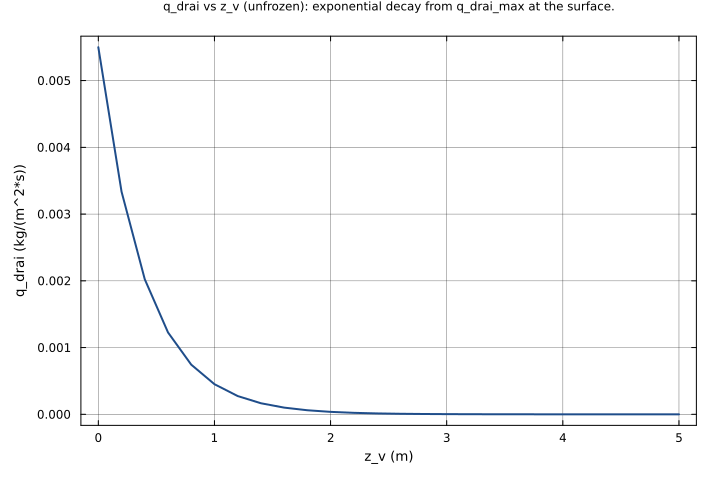
q_drai_vs_z_v
Sub-surface drainage q_drai vs. water table depth z_v at fixed unfrozen soil (f_ice_weighted = 0). Reproduces the canonical exponential-decay curve of Oleson Eq. 5.140 — the dominant feature of the groundwater-drainage formulation. Sweeps z_v from 0 m (surface) to 5 m (deep), showing the q_drai_max anchor at the surface and the strong exponential roll-off with depth.
Time span: 0.0 → 1.0
Swept over: z_v
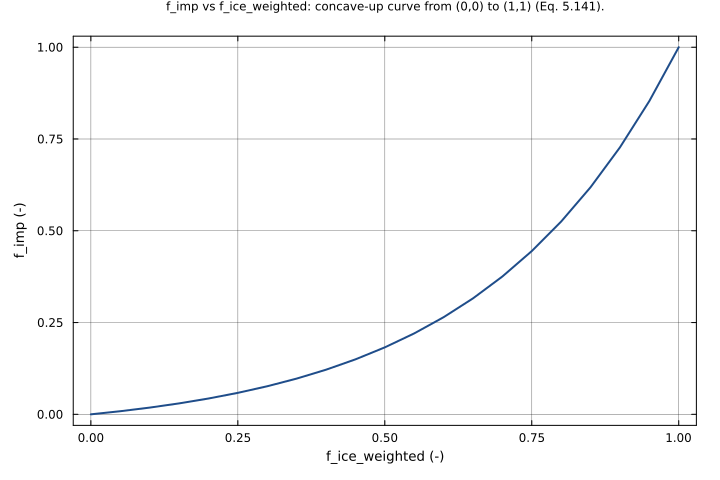
f_imp_vs_f_ice
Impermeable fraction f_imp vs. ice-weighted impermeable fraction f_ice_weighted. Reproduces the canonical concave-up curve of Oleson Eq. 5.141: f_imp grows slowly at low f_ice and accelerates toward 1 as f_ice → 1. The curve passes through (0, 0) and (1, 1) by construction. Independent of z_v, so this sweep is at the default depth.
Time span: 0.0 → 1.0
Swept over: f_ice_weighted
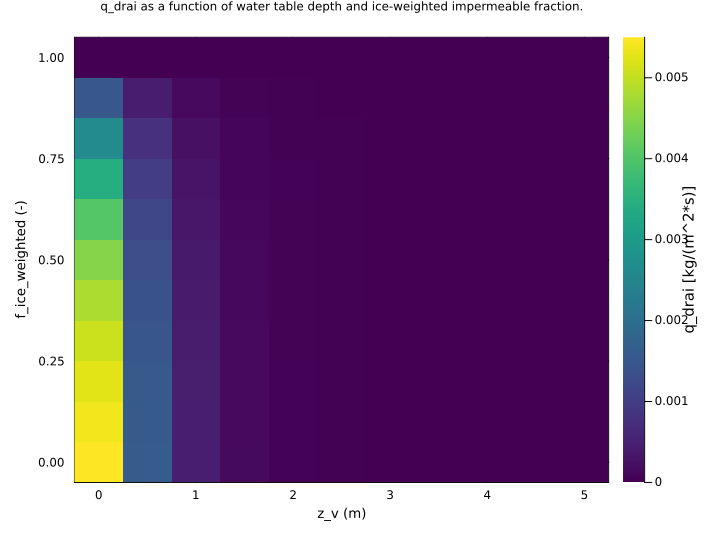
q_drai_2d
Joint sweep over depth z_v and ice-weighted impermeable fraction f_ice_weighted. Surfaces the iso-q_drai contours of Eq. 5.140: the iso-curves run along lines of approximately constant log(q_drai), with the freezing factor (1 - f_imp) acting as a multiplicative damper on top of the depth-driven exp-decay.
Time span: 0.0 → 1.0
Swept over: z_v, f_ice_weighted
Raw .esm
Raw .esm JSON (this component)
{
"reference": {
"notes": "source_ref: UrbanCanopy.jl@9200edd4f15609f20339d3a7d104de8064544310:src/hydrology.jl:698\nUpstream `GroundwaterDrainage` is an MTK `@component` whose two inputs (z_v, f_ice_weighted) are `@parameters` and whose two outputs (f_imp, q_drai) are time-indexed `@variables` with algebraic-only equations (no derivatives). Identical structure preserved here.\n\nThe upstream component declares three `@constants`: f_drai = 2.5 m^-1 (drainage decay factor, Oleson 2010 p. 142), q_drai_max = 5.5e-3 kg/(m^2*s) (maximum drainage rate at the surface, Oleson 2010 p. 142), and α = 3.0 dimensionless (scale-dependent impermeable-fraction parameter, Oleson 2010 Eq. 5.141). They are encoded here as parameters with the upstream default values, mirroring the convention used by sibling files in this directory (impervious_runoff.esm, surface_layer_update.esm) for `@constants`-to-parameter promotion.\n\nThe `f_ice_weighted` input is a unit-less ice-weighted impermeable fraction in [0, 1]; values outside that range are accepted but produce non-physical results (the upstream MTK component imposes no clamp, and this file follows that convention). The `max(..., 0.0)` floor in Eq. 5.141 protects against underflow when f_ice_weighted ≈ 0 — at exactly f_ice_weighted = 0 the numerator (exp(-α) - exp(-α)) is mathematically zero but can be a tiny negative due to round-off in the upstream MTK lowering; the `max` ensures f_imp is never negative.\n\nObservability classification: this component is functionally observed-only — both output variables are given by single algebraic equations in terms of the parameters (the `(t)` time index has no role since there is no derivative). Test scenarios use `time_span: [0, 1]` and sample at t=0 to mirror the convention used by the other observed-only ESM files in this directory (interface_hydraulic_conductivity.esm, soil_water_content_calc.esm, snow_density.esm).\n\nDefault parameter values: z_v = 1.0 m and f_ice_weighted = 0.0 are mid-range starting values that match the upstream `GroundwaterDrainage - Equation Verification` test fixture (UrbanCanopy.jl test/hydrology_test.jl:519). The constants take their upstream Oleson 2010 values verbatim.\n\nTolerance rationale (model-level rel=1e-9): observed-only algebraic system (no ODE integration); the equations involve O(10) IEEE-754 float64 operations including two `exp()` calls (which carry ≈1 ULP of relative error) — worst-case roundoff is ~10*ULP ≈ 1e-15. 1e-9 leaves comfortable headroom. Tighter `abs: 1e-15` is asserted on q_drai and f_imp in branches where they are exactly zero by construction (fully-frozen shutdown of drainage, fully-unfrozen identity for f_imp) so the assertion does not silently accept a stuck-at-1e-3 regression."
},
"tolerance": {
"rel": 1e-09
},
"variables": {
"z_v": {
"type": "parameter",
"units": "m",
"default": 1.0,
"description": "Water table depth (Oleson Eq. 5.140 input)"
},
"f_ice_weighted": {
"type": "parameter",
"units": "1",
"default": 0.0,
"description": "Ice-weighted impermeable fraction in [0, 1] (Oleson Eq. 5.141 input, dimensionless)"
},
"f_drai": {
"type": "parameter",
"units": "m^-1",
"default": 2.5,
"description": "Drainage decay factor (Oleson 2010 p. 142)"
},
"q_drai_max": {
"type": "parameter",
"units": "kg/(m^2*s)",
"default": 0.0055,
"description": "Maximum drainage rate at the surface (Oleson 2010 p. 142)"
},
"α": {
"type": "parameter",
"units": "1",
"default": 3.0,
"description": "Scale-dependent impermeable-fraction parameter of Eq. 5.141 (dimensionless)"
},
"f_imp": {
"type": "unknown",
"units": "1",
"description": "Impermeable fraction for drainage (Oleson Eq. 5.141, dimensionless)"
},
"q_drai": {
"type": "unknown",
"units": "kg/(m^2*s)",
"description": "Sub-surface drainage (Oleson Eq. 5.140)"
}
},
"equations": [
{
"lhs": "f_imp",
"rhs": {
"op": "max",
"args": [
{
"op": "/",
"args": [
{
"op": "-",
"args": [
{
"op": "exp",
"args": [
{
"op": "*",
"args": [
{
"op": "-",
"args": [
0.0,
"α"
]
},
{
"op": "-",
"args": [
1.0,
"f_ice_weighted"
]
}
]
}
]
},
{
"op": "exp",
"args": [
{
"op": "-",
"args": [
0.0,
"α"
]
}
]
}
]
},
{
"op": "-",
"args": [
1.0,
{
"op": "exp",
"args": [
{
"op": "-",
"args": [
0.0,
"α"
]
}
]
}
]
}
]
},
0.0
]
}
},
{
"lhs": "q_drai",
"rhs": {
"op": "*",
"args": [
{
"op": "-",
"args": [
1.0,
"f_imp"
]
},
"q_drai_max",
{
"op": "exp",
"args": [
{
"op": "*",
"args": [
{
"op": "-",
"args": [
0.0,
"f_drai"
]
},
"z_v"
]
}
]
}
]
}
}
],
"tests": [
{
"id": "shallow_unfrozen",
"description": "Reproduces upstream Equation Verification fixture (`hydrology_test.jl:519`). Shallow water table, no frozen soil: z_v = 1.0 m, f_ice_weighted = 0. f_imp = max((exp(-3) - exp(-3))/(1-exp(-3)), 0) = 0 (numerator is identically zero). q_drai = (1-0) * 5.5e-3 * exp(-2.5 * 1.0) = 5.5e-3 * exp(-2.5) ≈ 4.5147e-4 kg/(m^2*s). Anchors the no-freeze decay limit of Eq. 5.140.",
"parameter_overrides": {
"z_v": 1.0,
"f_ice_weighted": 0.0
},
"time_span": {
"start": 0.0,
"end": 1.0
},
"assertions": [
{
"variable": "f_imp",
"time": 0.0,
"expected": 0.0,
"tolerance": {
"abs": 1e-15
}
},
{
"variable": "q_drai",
"time": 0.0,
"expected": 0.0004514674924314434
}
]
},
{
"id": "fully_frozen",
"description": "Reproduces upstream Equation Verification fixture (`hydrology_test.jl:537`). Fully ice-impermeable soil: z_v = 1.0 m, f_ice_weighted = 1.0. f_imp = max((exp(0) - exp(-3))/(1-exp(-3)), 0) = (1 - exp(-3))/(1 - exp(-3)) = 1.0 — drainage is completely shut off. q_drai = (1 - 1) * ... = 0 exactly (asserted at IEEE-754 zero, abs=1e-15). Anchors the frozen-shutdown limit of Eq. 5.141.",
"parameter_overrides": {
"z_v": 1.0,
"f_ice_weighted": 1.0
},
"time_span": {
"start": 0.0,
"end": 1.0
},
"assertions": [
{
"variable": "f_imp",
"time": 0.0,
"expected": 1.0
},
{
"variable": "q_drai",
"time": 0.0,
"expected": 0.0,
"tolerance": {
"abs": 1e-15
}
}
]
},
{
"id": "surface_unfrozen",
"description": "Reproduces upstream Equation Verification fixture (`hydrology_test.jl:546`). Water table at the surface, no frozen soil: z_v = 0, f_ice_weighted = 0. q_drai = 5.5e-3 * exp(0) = 5.5e-3 kg/(m^2*s) — drainage saturates at the maximum rate q_drai_max. Anchors the surface limit of the exponential decay (Eq. 5.140 at z_v = 0).",
"parameter_overrides": {
"z_v": 0.0,
"f_ice_weighted": 0.0
},
"time_span": {
"start": 0.0,
"end": 1.0
},
"assertions": [
{
"variable": "f_imp",
"time": 0.0,
"expected": 0.0,
"tolerance": {
"abs": 1e-15
}
},
{
"variable": "q_drai",
"time": 0.0,
"expected": 0.0055
}
]
},
{
"id": "deep_unfrozen",
"description": "Deep water table, no frozen soil: z_v = 5.0 m, f_ice_weighted = 0. q_drai = 5.5e-3 * exp(-12.5) ≈ 2.05e-8 kg/(m^2*s) — five exp-decay constants below the surface, drainage has dropped by ~5 orders of magnitude. Stress-tests the small-output regime of the exponential.",
"parameter_overrides": {
"z_v": 5.0,
"f_ice_weighted": 0.0
},
"time_span": {
"start": 0.0,
"end": 1.0
},
"assertions": [
{
"variable": "f_imp",
"time": 0.0,
"expected": 0.0,
"tolerance": {
"abs": 1e-15
}
},
{
"variable": "q_drai",
"time": 0.0,
"expected": 2.049659244643269e-08
}
]
},
{
"id": "half_frozen",
"description": "Half ice-impermeable soil at moderate depth: z_v = 1.0 m, f_ice_weighted = 0.5. f_imp = (exp(-1.5) - exp(-3))/(1 - exp(-3)) ≈ 0.18243. q_drai = (1 - f_imp) * 5.5e-3 * exp(-2.5) ≈ 3.6911e-4 kg/(m^2*s). Exercises the nonlinear `f_imp` rise from 0 (unfrozen) to 1 (fully frozen) — at f_ice = 0.5 the impermeable fraction is well below 0.5 because the exp-curve is concave-up.",
"parameter_overrides": {
"z_v": 1.0,
"f_ice_weighted": 0.5
},
"time_span": {
"start": 0.0,
"end": 1.0
},
"assertions": [
{
"variable": "f_imp",
"time": 0.0,
"expected": 0.18242552380635632
},
{
"variable": "q_drai",
"time": 0.0,
"expected": 0.0003691082986430951
}
]
},
{
"id": "moderate_depth_unfrozen",
"description": "Moderate water table, no frozen soil: z_v = 2.0 m, f_ice_weighted = 0. q_drai = 5.5e-3 * exp(-5.0) ≈ 3.706e-5 kg/(m^2*s). Exercises the typical CLMU mid-column drainage regime — about 2 e-folding lengths below the surface, drainage has dropped by ~2 orders of magnitude.",
"parameter_overrides": {
"z_v": 2.0,
"f_ice_weighted": 0.0
},
"time_span": {
"start": 0.0,
"end": 1.0
},
"assertions": [
{
"variable": "f_imp",
"time": 0.0,
"expected": 0.0,
"tolerance": {
"abs": 1e-15
}
},
{
"variable": "q_drai",
"time": 0.0,
"expected": 3.7058708494970066e-05
}
]
},
{
"id": "quarter_frozen_shallow",
"description": "Quarter-frozen soil with shallow water table: z_v = 0.5 m, f_ice_weighted = 0.25. f_imp = (exp(-2.25) - exp(-3))/(1-exp(-3)) ≈ 0.05853 — at low f_ice the impermeable fraction is much smaller than f_ice (concave-up curve). q_drai ≈ (1 - 0.05853) * 5.5e-3 * exp(-1.25) ≈ 1.4836e-3 kg/(m^2*s). Verifies the early-freeze regime where partial ice has only a small drainage-suppression effect.",
"parameter_overrides": {
"z_v": 0.5,
"f_ice_weighted": 0.25
},
"time_span": {
"start": 0.0,
"end": 1.0
},
"assertions": [
{
"variable": "f_imp",
"time": 0.0,
"expected": 0.05852599385116555
},
{
"variable": "q_drai",
"time": 0.0,
"expected": 0.0014835525038445162
}
]
},
{
"id": "three_quarter_frozen",
"description": "Mostly-frozen soil at moderate depth: z_v = 1.0 m, f_ice_weighted = 0.75. f_imp = (exp(-0.75) - exp(-3))/(1-exp(-3)) ≈ 0.4447 — at high f_ice the impermeable fraction grows rapidly toward 1. q_drai ≈ (1 - 0.4447) * 5.5e-3 * exp(-2.5) ≈ 2.507e-4 kg/(m^2*s) — the freezing factor dominates over depth in suppressing drainage. Verifies the late-freeze regime.",
"parameter_overrides": {
"z_v": 1.0,
"f_ice_weighted": 0.75
},
"time_span": {
"start": 0.0,
"end": 1.0
},
"assertions": [
{
"variable": "f_imp",
"time": 0.0,
"expected": 0.4447208307797978
},
{
"variable": "q_drai",
"time": 0.0,
"expected": 0.00025069049412725975
}
]
},
{
"id": "shallow_partial_frozen",
"description": "Very shallow water table with a thin frozen surface layer: z_v = 0.2 m, f_ice_weighted = 0.3. f_imp ≈ 0.07648; q_drai ≈ (1 - 0.07648) * 5.5e-3 * exp(-0.5) ≈ 3.0808e-3 kg/(m^2*s). Spring-thaw scenario — high drainage potential modulated by lingering surface freezing.",
"parameter_overrides": {
"z_v": 0.2,
"f_ice_weighted": 0.3
},
"time_span": {
"start": 0.0,
"end": 1.0
},
"assertions": [
{
"variable": "f_imp",
"time": 0.0,
"expected": 0.07647692160987249
},
{
"variable": "q_drai",
"time": 0.0,
"expected": 0.003080797840976933
}
]
},
{
"id": "very_deep_unfrozen",
"description": "Very deep water table, no frozen soil: z_v = 10.0 m, f_ice_weighted = 0. q_drai = 5.5e-3 * exp(-25) ≈ 7.64e-14 kg/(m^2*s) — ten e-folding lengths below the surface, drainage is essentially zero. Stress-tests the small-output limit of the exp pathway and confirms no underflow-to-NaN at the deep tail.",
"parameter_overrides": {
"z_v": 10.0,
"f_ice_weighted": 0.0
},
"time_span": {
"start": 0.0,
"end": 1.0
},
"assertions": [
{
"variable": "f_imp",
"time": 0.0,
"expected": 0.0,
"tolerance": {
"abs": 1e-15
}
},
{
"variable": "q_drai",
"time": 0.0,
"expected": 7.638369125730211e-14
}
]
},
{
"id": "typical_clmu_state",
"description": "Realistic CLMU summer state: water table at z_v = 1.5 m with a small residual ice fraction f_ice_weighted = 0.1 (deep frost remnant). f_imp ≈ 0.01833 (linear-regime small impermeable fraction). q_drai ≈ (1 - 0.01833) * 5.5e-3 * exp(-3.75) ≈ 1.270e-4 kg/(m^2*s). Represents the mid-summer drainage regime where drainage is largely depth-limited and freezing is a small correction.",
"parameter_overrides": {
"z_v": 1.5,
"f_ice_weighted": 0.1
},
"time_span": {
"start": 0.0,
"end": 1.0
},
"assertions": [
{
"variable": "f_imp",
"time": 0.0,
"expected": 0.018331095896544965
},
{
"variable": "q_drai",
"time": 0.0,
"expected": 0.00012697651890798619
}
]
}
],
"analyses": [
{
"id": "q_drai_vs_z_v",
"description": "Sub-surface drainage q_drai vs. water table depth z_v at fixed unfrozen soil (f_ice_weighted = 0). Reproduces the canonical exponential-decay curve of Oleson Eq. 5.140 — the dominant feature of the groundwater-drainage formulation. Sweeps z_v from 0 m (surface) to 5 m (deep), showing the q_drai_max anchor at the surface and the strong exponential roll-off with depth.",
"initial_state": {},
"parameters": {
"f_ice_weighted": 0.0
},
"time_span": {
"start": 0.0,
"end": 1.0
},
"parameter_sweep": {
"type": "cartesian",
"dimensions": [
{
"parameter": "z_v",
"range": {
"start": 0.0,
"stop": 5.0,
"count": 26,
"scale": "linear"
}
}
]
},
"plots": [
{
"id": "q_drai_curve",
"type": "line",
"description": "q_drai vs z_v (unfrozen): exponential decay from q_drai_max at the surface.",
"x": {
"variable": "z_v",
"label": "z_v (m)"
},
"y": {
"variable": "q_drai",
"label": "q_drai (kg/(m^2*s))"
}
}
]
},
{
"id": "f_imp_vs_f_ice",
"description": "Impermeable fraction f_imp vs. ice-weighted impermeable fraction f_ice_weighted. Reproduces the canonical concave-up curve of Oleson Eq. 5.141: f_imp grows slowly at low f_ice and accelerates toward 1 as f_ice → 1. The curve passes through (0, 0) and (1, 1) by construction. Independent of z_v, so this sweep is at the default depth.",
"initial_state": {},
"parameters": {
"z_v": 1.0
},
"time_span": {
"start": 0.0,
"end": 1.0
},
"parameter_sweep": {
"type": "cartesian",
"dimensions": [
{
"parameter": "f_ice_weighted",
"range": {
"start": 0.0,
"stop": 1.0,
"count": 21,
"scale": "linear"
}
}
]
},
"plots": [
{
"id": "f_imp_curve",
"type": "line",
"description": "f_imp vs f_ice_weighted: concave-up curve from (0,0) to (1,1) (Eq. 5.141).",
"x": {
"variable": "f_ice_weighted",
"label": "f_ice_weighted (-)"
},
"y": {
"variable": "f_imp",
"label": "f_imp (-)"
}
}
]
},
{
"id": "q_drai_2d",
"description": "Joint sweep over depth z_v and ice-weighted impermeable fraction f_ice_weighted. Surfaces the iso-q_drai contours of Eq. 5.140: the iso-curves run along lines of approximately constant log(q_drai), with the freezing factor (1 - f_imp) acting as a multiplicative damper on top of the depth-driven exp-decay.",
"initial_state": {},
"parameters": {},
"time_span": {
"start": 0.0,
"end": 1.0
},
"parameter_sweep": {
"type": "cartesian",
"dimensions": [
{
"parameter": "z_v",
"range": {
"start": 0.0,
"stop": 5.0,
"count": 11,
"scale": "linear"
}
},
{
"parameter": "f_ice_weighted",
"range": {
"start": 0.0,
"stop": 1.0,
"count": 11,
"scale": "linear"
}
}
]
},
"plots": [
{
"id": "q_drai_heatmap",
"type": "heatmap",
"description": "q_drai as a function of water table depth and ice-weighted impermeable fraction.",
"x": {
"variable": "z_v",
"label": "z_v (m)"
},
"y": {
"variable": "f_ice_weighted",
"label": "f_ice_weighted (-)"
},
"value": {
"variable": "q_drai",
"reduce": "final"
}
}
]
}
]
}