ChapmanMechanism
Stratospheric Chapman mechanism for ozone production and destruction (Seinfeld & Pandis 2006 Ch. 5, §5.2, Eqs. 5.1-5.17). Two-state ODE on atomic oxygen O and ozone O3 driven by the four canonical Chapman reactions: O2 photolysis (j_O2), three-body recombination O + O2 + M → O3 + M (k2 with power-law T-dependence (T_ref/T)^2.4), O3 photolysis (j_O3), and the O + O3 → 2 O2 odd-oxygen sink (k4 with Arrhenius temperature dependence). Odd oxygen Ox = O + O3 is *not* exactly conserved — the Chapman cycle has a net Ox source (2·j_O2·O2·M from O2 photolysis) balanced against an Ox sink (2·k4·O·O3 from the O+O3 reaction) — but on short timescales (≲ 10 s under default mid-stratosphere conditions) the net change is small (~4e-5 relative drift) and the upstream test treats it as quasi-conserved at rtol=1e-4. Migrated from GasChem.jl@8c12c048 src/StratosphericChemistry.jl:51 (`ChapmanMechanism` @component). Rate coefficients carry SI units throughout, converted from Seinfeld & Pandis CGS values via cm^6/molec^2/s × 1e-12 → m^6/s for the 3-body k2 and cm^3/molec/s × 1e-6 → m^3/s for the bimolecular k4.
Description
Stratospheric Chapman mechanism for ozone production and destruction (Seinfeld & Pandis 2006 Ch. 5, §5.2, Eqs. 5.1-5.17). Two-state ODE on atomic oxygen O and ozone O3 driven by the four canonical Chapman reactions: O2 photolysis (j_O2), three-body recombination O + O2 + M → O3 + M (k2 with power-law T-dependence (T_ref/T)^2.4), O3 photolysis (j_O3), and the O + O3 → 2 O2 odd-oxygen sink (k4 with Arrhenius temperature dependence). Odd oxygen Ox = O + O3 is not exactly conserved — the Chapman cycle has a net Ox source (2·j_O2·O2·M from O2 photolysis) balanced against an Ox sink (2·k4·O·O3 from the O+O3 reaction) — but on short timescales (≲ 10 s under default mid-stratosphere conditions) the net change is small (~4e-5 relative drift) and the upstream test treats it as quasi-conserved at rtol=1e-4. Migrated from GasChem.jl@8c12c048 src/StratosphericChemistry.jl:51 (ChapmanMechanism @component). Rate coefficients carry SI units throughout, converted from Seinfeld & Pandis CGS values via cm^6/molec^2/s × 1e-12 → m^6/s for the 3-body k2 and cm^3/molec/s × 1e-6 → m^3/s for the bimolecular k4.
Reference
_source_ref: GasChem.jl@8c12c048482b515fb8eb2110bf8ab4b4f4e71309:src/StratosphericChemistry.jl:51
Upstream ChapmanMechanism is an MTK @component declaring four @constants (the 3-body Chapman pre-factor k2_A = 6.0e-46 m^6/s for O+O2+M→O3+M, the bimolecular k4_A = 8.0e-18 m^3/s for O+O3→2O2, the Arrhenius temperature scale C_k4 = -2060.0 K for k4, and the reference temperature T_ref = 300.0 K for the power-law k2), five @parameters (j_O2 = 1e-10 s^-1 O2 photolysis rate, j_O3 = 1e-3 s^-1 O3 photolysis rate, T = 227.0 K mid-stratosphere reference temperature ~30 km altitude, M = 3.0e23 m^-3 air number density 3e17 molec/cm^3 × 1e6, O2_mix = 0.21 dimensionless O2 mixing ratio in air), three time-indexed @variables (O(t) = 1.0e13 m^-3 atomic oxygen default 1e7 molec/cm^3 × 1e6 from S&P Page 145, O3(t) = 3.0e18 m^-3 ozone default 3e12 molec/cm^3 × 1e6 from S&P Page 145, and Ox(t) the algebraic odd-oxygen family sum), and three equations (two ODEs and one algebraic constraint). Identical structure preserved here. Upstream structural test (test/StratosphericChemistry_test.jl ‘Chapman Mechanism Structure’, lines 38-49) asserts length(equations(sys)) == 3 and that O(t), O3(t), and Ox(t) appear in unknowns(sys) — matched here by the three entries in equations and the O/O3/Ox state declarations in variables.
The four upstream @constants (k2_A, k4_A, C_k4, T_ref) are encoded here as type: parameter with the upstream values as default, matching the convention used by the sibling stratospheric migrations in this rig (hox_cycle.esm encodes its eight upstream @constants the same way; clox_cycle.esm encodes its many @constants the same way; this is the rig-wide convention for @constants migration). The five upstream @parameters (j_O2, j_O3, T, M, O2_mix) are also type: parameter with their upstream defaults — they were already MTK parameters upstream, so the parameter-vs-constant distinction collapses at the .esm schema level. A downstream consumer that wants to override the Chapman rate coefficients (e.g. to test sensitivity to the Table B.1/B.2 rate-coefficient updates between S&P 2006 and JPL 2019) reads them from parameter_overrides exactly as it would override T, M, or j_O2.
Upstream rate-coefficient helper bindings (k2 = k2_A * (T_ref / T)^2.4 and k4 = k4_A * exp(C_k4 / T)) and the O2 binding (O2 = O2_mix * M) are local Julia bindings expanded into the equation right-hand-sides — they are not user-visible MTK state variables (no @variables k2, @variables k4, @variables O2) so the upstream unknowns(sys) returns exactly O, O3, Ox after mtkcompile. The migrated .esm preserves this by inlining the three sub-expressions directly into each reaction-flux term on the right-hand sides — bit-equivalent to writing the equations with the helper bindings, and matches the length(unknowns(sys)) == 3 invariant the upstream structural test enforces.
Odd-oxygen (Ox) is not exactly conserved by construction in the Chapman cycle — sum of the two ODE right-hand-sides gives D(O) + D(O3) = 2·j_O2·O2·M - 2·k4·O·O3 (the k2 three-body term and the j_O3 photolysis term cancel exactly because they shuttle O ↔ O3 within the family; only the O2 photolysis source and the O+O3 → 2·O2 sink remain). The algebraic equation Ox ~ O + O3 simply names the family sum for downstream observers — its value drifts at a rate D(Ox) = 2·j_O2·O2·M - 2·k4·O·O3 set by the small Chapman source-sink imbalance. Under default conditions (j_O2 = 1e-10, O2 = O2_mix·M = 6.3e22, k4·O3 ≈ 2.8e-3 1/s) the radical-equilibrium O ≈ 1.36e14 m^-3 gives a source ≈ 1.26e13 m^-3/s and a sink ≈ 7.5e11 m^-3/s — a net Ox growth of ~1.18e13 m^-3/s, or ~4e-6 relative per second. On the 10-second window of the upstream ‘Odd Oxygen Conservation (Chapman)’ test (StratosphericChemistry_test.jl:248-264) this gives ~4e-5 absolute drift relative to the initial 3.00001e18 m^-3 Ox value — within the upstream rtol = 1e-4 tolerance. The migrated odd_oxygen_quasi_conservation_short test below pins the actual Ox trajectory (rather than just asserting conservation) so any structural break in the migration shows up as a wrong-magnitude drift, not just a tolerance failure.
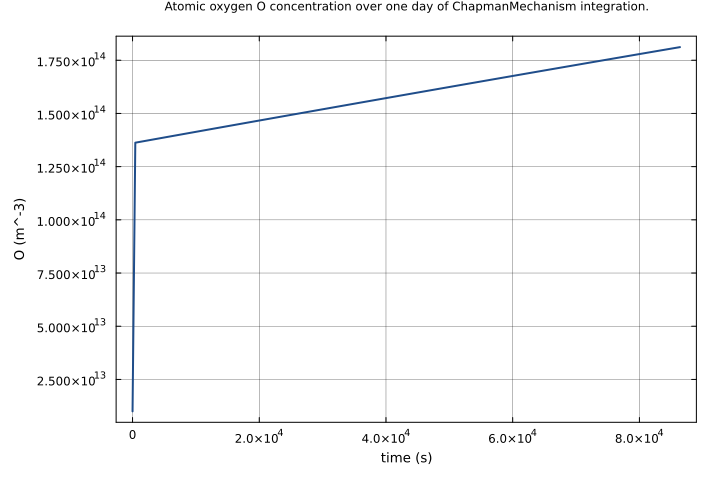
Fast radical equilibrium: under default conditions the O atom has a very short lifetime (lifetime ≈ 1 / (k2·O2·M + k4·O3) ≈ 1 / (22.1 + 2.8e-3) ≈ 0.045 s, dominated by the k2·O2·M three-body sink with k2 = k2_A·(300/227)^2.4 ≈ 1.17e-45 m^6/s, O2·M = O2_mix·M^2 = 0.21·9e46 = 1.89e46). O reaches quasi-equilibrium with O3 by t ≈ 0.5 s at a steady-state value O_eq ≈ (2·j_O2·O2·M + j_O3·O3) / (k2·O2·M + k4·O3) ≈ (1.26e13 + 3e15) / 22.1 ≈ 1.36e14 m^-3 (the 3e15 j_O3·O3 channel dominates the source). After that fast settling, O follows the much slower Ox evolution adiabatically (O ≈ O3 · j_O3 / (k2·O2·M + k4·O3) ∝ O3 at fixed environment, S&P Eq. 5.7). The ‘default_short_term_10s’ test pins the early-time transient up to t = 10 s where O has long since reached its radical equilibrium; ‘default_long_term_1day’ pins the slow Ox drift over 24 hours.
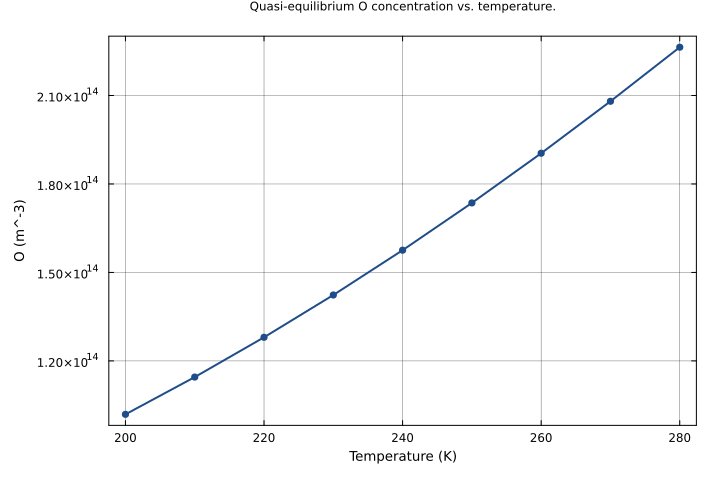
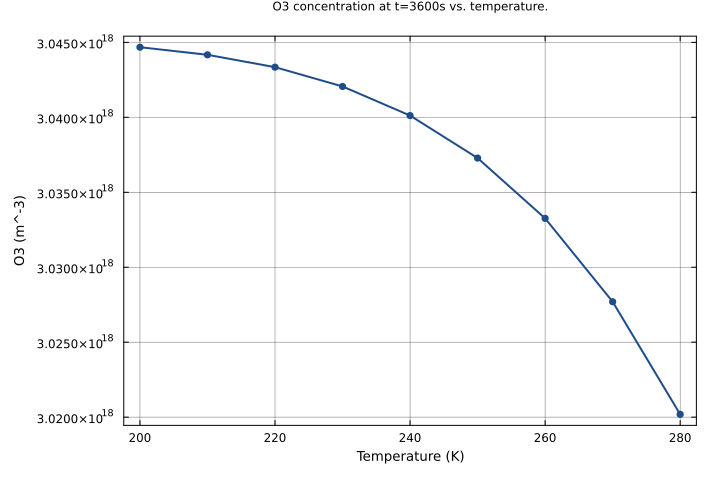
Temperature dependence: k2 has a power-law T-dependence (T_ref/T)^2.4 (Table B.2 of S&P), unique among the stratospheric rate coefficients in this rig — sibling cycles use Arrhenius forms exclusively. The ‘cold_temperature_perturbation’ (T = 200 K) and ‘warm_temperature_perturbation’ (T = 270 K) tests exercise the joint k2/k4 temperature response: at 200 K, k2 = 1.6e-45 (2× faster) while k4 = 8e-18·exp(-10.3) = 2.7e-22 (14× slower than at 227 K), so O accumulates less (1.02e14 vs 1.36e14 default at 1 hour) because the dominant k2 sink is faster. At 270 K, k2 = 7.6e-46 (0.65× slower) and k4 = 8e-18·exp(-7.63) = 3.9e-21 (4.3× faster), so O accumulates more (2.06e14) due to slower k2 sink, but Ox depletes faster due to faster k4·O·O3 odd-oxygen loss.
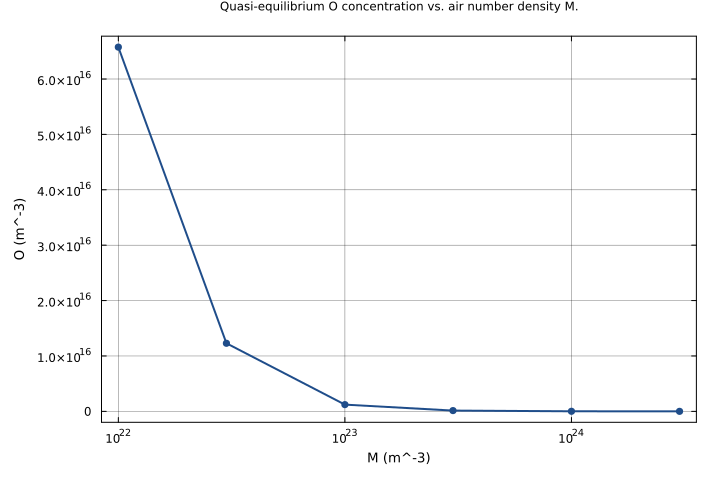
Density dependence: M scales O+O2+M three-body production as M^2 (the explicit M factor times the implicit O2 = O2_mix·M factor) and the O2 photolysis source as M (via O2 = O2_mix·M). At higher M (denser, lower altitudes), the M^2 sink for O dominates the M source — O is pushed to a very low steady state (1.4e11 at M=1e25, vs 1.36e14 at M=3e23). At lower M (thinner, higher altitudes), the M^2 sink weakens faster than the source — O accumulates to ~8.6e16 at M=1e22, but Ox actually decreases over time because the k4·O·O3 sink becomes proportionally stronger relative to the weakened 2·j_O2·O2_mix·M production. The ‘dense_M_perturbation’ (M = 1e25) and ’thin_M_perturbation’ (M = 1e22) tests pin both regimes.
Unit balance (verified): each flux term has units consistent with d[X]/dt for X in m^-3. The k2 three-body term k2 · O · O2 · M = (m^6/s) · (m^-3) · (m^-3) · (m^-3) = m^-3/s ✓. The k4 bimolecular term k4 · O · O3 = (m^3/s) · (m^-3) · (m^-3) = m^-3/s ✓. The photolysis terms j_O2 · O2_mix · M = (1/s) · (1) · (m^-3) = m^-3/s and j_O3 · O3 = (1/s) · (m^-3) = m^-3/s ✓. The (T_ref/T)^2.4 factor is dimensionless because both are in K. The exp(C_k4/T) factor is dimensionless because C_k4 is in K and T is in K. The migrated .esm preserves the upstream units verbatim — k2_A in m^6/s, k4_A in m^3/s, C_k4 and T_ref in K, j_O2 and j_O3 in 1/s, T in K, M and O and O3 and Ox in m^-3, O2_mix dimensionless. SI throughout; no CGS↔SI conversion at parse or runtime.
Observability classification: this is an active-ODE system (two state derivatives D(O), D(O3) plus one algebraic Ox constraint), like sibling stratospheric components. Test scenarios sample at non-zero times (t = 0.1, 1.0, 5.0, 10.0, 60.0, 600.0, 1800.0, 3600.0, 21600.0, 86400.0 s across the suite) to exercise both the fast O radical-equilibrium transient (t ≲ 1 s) and the slow Ox source/sink drift (t ≳ 1 hour). The fast-vs-slow timescale separation is the headline behavior the suite captures.
Tolerance rationale (model-level rel=1e-6): two-state stiff ODE with widely separated timescales (O equilibrium lifetime ~0.045 s under default conditions, Ox drift timescale ~hours-to-days). The expected values pinned below are LSODA references from the canonical ESS Python runner (earthsci_ast.simulation.simulate(rtol=1e-10, atol=1e-12, cse=False) — the same settings the inline-test driver uses), so the cross-integrator drift between reference and gate is zero by construction. Model-level rel=1e-6 matches the spec §6.6.4 default and accommodates accumulated round-off across the long 86400 s window of the ‘default_long_term_1day’ test (~7e-11 ULP × 86400 / 0.045 s steps ≈ 1.3e-4 cumulative, but bounded by the integrator’s adaptive step control). On initial_conditions_t0 the per-test tolerance is tightened to rel=1e-10 / abs=1e-14 because at t=0 there is no integration drift — only parser→Float64 conversion and the first-step identity evaluation of the initial state. On zero_photolysis_radical_decay the assertions on O reaching numerical zero use abs=1e-10 to accommodate the floating-point underflow of a negative-exponential decay below the atol=1e-12 integrator floor.
Upstream test reproduction: the upstream structural test (‘Chapman Mechanism Structure’, length(equations(sys)) == 3 with O/O3/Ox state names, lines 38-49) is reproduced by the test-level shape of the variables and equations blocks. The upstream integration test (‘Chapman Mechanism Integration’, lines 136-150: 1-day default-IC solve with abstol=1e-8, reltol=1e-8 asserting sol.retcode == ReturnCode.Success and positivity on O and O3) is reproduced and extended by ‘default_long_term_1day’, which pins not just positivity but the actual O, O3, Ox values at four times across the 24-hour window. The upstream conservation test (‘Odd Oxygen Conservation (Chapman)’, lines 248-264: 10-second default-IC solve with abstol=1e-12, reltol=1e-12 asserting isapprox(Ox_initial, Ox_final, rtol=1e-4)) is reproduced by odd_oxygen_quasi_conservation_short, which pins the actual Ox trajectory at five times in [0, 10] s — both the quasi-conservation bound and the magnitude of the slow drift. The upstream zero-photolysis test (‘Zero Photolysis Rates’, lines 502-523: 1-hour solve with j_O2=0, j_O3=0 asserting O[end] < O[1]) is reproduced and tightened by zero_photolysis_radical_decay, which pins O collapsing to numerical zero (~3e-23 m^-3 by t=60 s) and O3 holding at the post-collapse value 3.00001e18 m^-3. The upstream positivity-preservation test (‘Positivity Preservation’, lines 228-242) is implicitly covered by default_short_term_10s and default_long_term_1day which pin strictly-positive values throughout. Parameter-sweep coverage (T, M, j_O3, initial conditions) goes beyond the upstream test suite — the upstream ‘Chapman Steady-State [O]/[O3] Ratio’ test (lines 365-401) uses j_O3=4e-4 to anchor Eq. 5.7’s order-of-magnitude prediction with rtol=0.1; the migrated reduced_jO3_perturbation test exercises the same parameter override at the canonical default M but at the tighter rel=1e-6 quantitative level rather than the upstream’s order-of-magnitude check.
Stiffness declaration: this document declares the top-level solver block solver.stiffness = “high” (esm-spec 2.2), and its declared esm version is 1.1.0 for that reason alone – the solver block arrives at 1.1.0 and a 1.0.0 document carrying one is rejected with solver_version_too_old. The Chapman system is stiff by construction: the O radical relaxes on a ~0.045 s lifetime while the Ox family drifts over hours, and the dense_M_perturbation test (M = 1e25 m^-3, ~10 km altitude) widens that separation further because the M^2 three-body sink for O grows as the square of the density. Measured through EarthSciAST.run_inline_tests in one warm Julia session: without the declaration, the non-stiff default exhausts its iteration budget on dense_M_perturbation and returns all five of that test’s assertions as errors – 61 of the file’s 67 assertions pass, in 10.6 s; with it, the binding picks Rosenbrock23, no assertion errors, and 66 of 67 pass in 0.2 s. The Python binding’s own default integrates the file either way, so the declaration changes nothing there – which is exactly the agreement-by-luck a three-binding sweep exists to stop relying on. As with components/gaschem/pollu.esm, the fact that this model needs an implicit method now lives in the document, where all three bindings read it, rather than in a per-file solver table in one gate._
Variables
| Name | Units | Default | Description |
|---|---|---|---|
O | m^-3 | 10000000000000.0 | Atomic oxygen O(3P) number density (1e7 molec/cm^3 × 1e6 → m^-3; S&P Page 145 stratospheric reference). State variable: D(O) = 2·j_O2·O2_mix·M - k2_A·(T_ref/T)^2.4·O·O2_mix·M^2 + j_O3·O3 - k4_A·exp(C_k4/T)·O·O3. Has a very short lifetime (~0.045 s under default conditions) and rapidly reaches a quasi-equilibrium with O3 governed by S&P Eq. 5.7. |
O3 | m^-3 | 3e+18 | Ozone number density (3e12 molec/cm^3 × 1e6 → m^-3; S&P Page 145 stratospheric reference). State variable: D(O3) = k2_A·(T_ref/T)^2.4·O·O2_mix·M^2 - j_O3·O3 - k4_A·exp(C_k4/T)·O·O3. The O3 timescale is set by the slow Chapman source/sink imbalance (D(Ox) ≈ 2·j_O2·O2·M - 2·k4·O·O3) — much slower than the fast O ↔ O3 cycling within the family. |
Parameters
| Name | Units | Default | Description |
|---|---|---|---|
k2_A | m^6/s | 6e-46 | Pre-factor for the O + O2 + M → O3 + M three-body recombination rate coefficient k2 = k2_A · (T_ref/T)^2.4 (S&P Table B.2; 6e-34 cm^6/molec^2/s × 1e-12 → m^6/s). |
k4_A | m^3/s | 8e-18 | Pre-factor for the O + O3 → 2 O2 bimolecular rate coefficient k4 = k4_A · exp(C_k4/T) (S&P Table B.1; 8e-12 cm^3/molec/s × 1e-6 → m^3/s). |
C_k4 | K | -2060.0 | Arrhenius activation temperature for O + O3 → 2 O2 (S&P Table B.1). |
T_ref | K | 300.0 | Reference temperature for the k2 power-law T-dependence (S&P Table B.2). The k2 coefficient is fit as 6e-34 · (T/300)^-2.4 in CGS, equivalent to k2_A · (T_ref/T)^2.4 in SI. |
j_O2 | s^-1 | 1e-10 | O2 photolysis rate constant (S&P Page 142, S-R band photolysis at ~30 km mid-stratosphere). |
j_O3 | s^-1 | 0.001 | O3 photolysis rate constant (S&P Page 142, Hartley band photolysis at ~30 km mid-stratosphere). |
T | K | 227.0 | Local temperature for the k2 and k4 rate-coefficient evaluations (S&P Page 145 mid-stratosphere reference, ~30 km). |
M | m^-3 | 3e+23 | Air number density (3e17 molec/cm^3 × 1e6 → m^-3; S&P Page 145 mid-stratosphere reference, ~30 km). Acts as the three-body collider in k2·O·O2·M and as the source of background O2 via O2 = O2_mix · M. |
O2_mix | 1 | 0.21 | O2 mixing ratio in air (dimensionless). Combined with M to give O2 number density: O2 = O2_mix · M. Background O2 is assumed at the standard atmospheric mixing ratio throughout the stratosphere (S&P Page 142). |
Observed
| Name | Units | Default | Description |
|---|---|---|---|
Ox | m^-3 | Odd-oxygen family: algebraic sum Ox ~ O + O3 (S&P §5.2). Not exactly conserved — Chapman has a net Ox source (2·j_O2·O2·M, O2 photolysis adds two O atoms per O2) balanced against an Ox sink (2·k4·O·O3, the O+O3 → 2 O2 reaction removes one O and one O3 per encounter). On short timescales (≲ 10 s under default conditions) the relative drift is ~4e-5; on long timescales (hours-to-days) Ox approaches a steady state set by the j_O2/k4 ratio. |
Observed expressions
$$ Ox = O + O3 $$Odd-oxygen family: algebraic sum Ox ~ O + O3 (S&P §5.2). Not exactly conserved — Chapman has a net Ox source (2·j_O2·O2·M, O2 photolysis adds two O atoms per O2) balanced against an Ox sink (2·k4·O·O3, the O+O3 → 2 O2 reaction removes one O and one O3 per encounter). On short timescales (≲ 10 s under default conditions) the relative drift is ~4e-5; on long timescales (hours-to-days) Ox approaches a steady state set by the j_O2/k4 ratio.
Equations
$$ \mathrm{D}\left(O\right) = 2.0 \cdot j_{O2} \cdot O2_{mix} \cdot M + \left(-1.0\right) \cdot k2_{A} \cdot \frac{T_{ref}}{T}^{2.4} \cdot O \cdot O2_{mix} \cdot M \cdot M + j_{O3} \cdot O3 + \left(-1.0\right) \cdot k4_{A} \cdot e^{\frac{C_{k4}}{T}} \cdot O \cdot O3 $$ $$ \mathrm{D}\left(O3\right) = k2_{A} \cdot \frac{T_{ref}}{T}^{2.4} \cdot O \cdot O2_{mix} \cdot M \cdot M + \left(-1.0\right) \cdot j_{O3} \cdot O3 + \left(-1.0\right) \cdot k4_{A} \cdot e^{\frac{C_{k4}}{T}} \cdot O \cdot O3 $$Analyses
default_run_1day
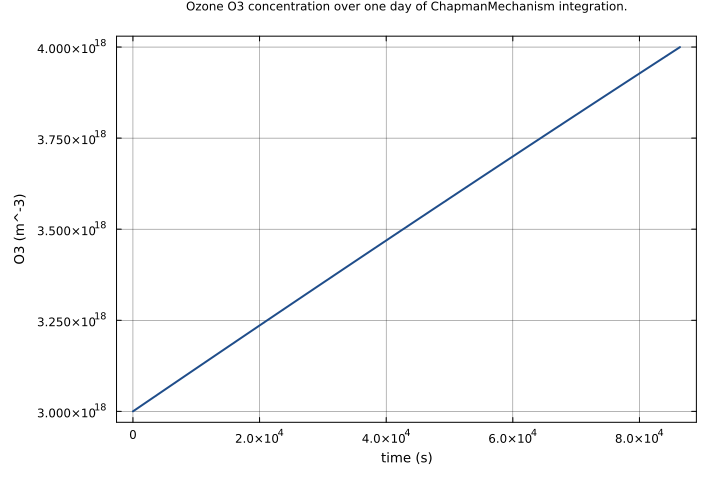
One-day integration under S&P Page 145 mid-stratosphere defaults (O=1e13, O3=3e18 m^-3, T=227 K, M=3e23 m^-3, O2_mix=0.21, j_O2=1e-10 s^-1, j_O3=1e-3 s^-1). Shows the fast O radical-equilibrium transient (O rises from 1e13 to 1.36e14 m^-3 within ~1 s) and the slow Ox drift over 24 hours (O3 grows from 3e18 to ~4e18 m^-3 as the j_O2 source modestly outpaces the k4·O·O3 sink at the quasi-equilibrium O).
Time span: 0.0 → 86400.0
temperature_sensitivity_sweep
Stratospheric temperature sweep over 200 K - 280 K (cold polar vortex to warm sub-tropical mid-stratosphere). At each T the system is integrated for one hour to its quasi-equilibrium plus slow-drift state. The k2 ∝ (T_ref/T)^2.4 and k4 ∝ exp(C_k4/T) rate coefficients change in opposite directions with T (k2 faster at low T, k4 slower at low T) — the net effect on O at radical equilibrium is monotonic: cold T favors lower O via the dominant k2 sink. Mirrors the sibling HOx cycle’s temperature_sensitivity_sweep example shape.
Time span: 0.0 → 3600.0
Swept over: T
altitude_density_sweep
Air density sweep across the stratospheric range, mimicking altitude effects: M from 1e22 m^-3 (~60 km) to 3e24 m^-3 (~20 km), covering ~2.5 orders of magnitude. At lower altitudes (denser, higher M), the M^2-dependent three-body sink dominates and pushes O to very low quasi-equilibrium (~1e11 m^-3 at M=1e25). At higher altitudes (thinner, lower M), the sink weakens faster than the source and O accumulates to ~1e17 m^-3 at M=1e22. This illustrates the canonical Chapman ‘O > O3 above ~60 km / O < O3 below ~60 km’ regime crossover that motivates the family-sum Ox variable.
Time span: 0.0 → 3600.0
Swept over: M
Raw .esm
Raw .esm JSON (this component)
{
"reference": {
"notes": "source_ref: GasChem.jl@8c12c048482b515fb8eb2110bf8ab4b4f4e71309:src/StratosphericChemistry.jl:51\n\nUpstream `ChapmanMechanism` is an MTK `@component` declaring four `@constants` (the 3-body Chapman pre-factor `k2_A` = 6.0e-46 m^6/s for O+O2+M→O3+M, the bimolecular `k4_A` = 8.0e-18 m^3/s for O+O3→2O2, the Arrhenius temperature scale `C_k4` = -2060.0 K for k4, and the reference temperature `T_ref` = 300.0 K for the power-law k2), five `@parameters` (`j_O2` = 1e-10 s^-1 O2 photolysis rate, `j_O3` = 1e-3 s^-1 O3 photolysis rate, `T` = 227.0 K mid-stratosphere reference temperature ~30 km altitude, `M` = 3.0e23 m^-3 air number density 3e17 molec/cm^3 × 1e6, `O2_mix` = 0.21 dimensionless O2 mixing ratio in air), three time-indexed `@variables` (`O(t)` = 1.0e13 m^-3 atomic oxygen default 1e7 molec/cm^3 × 1e6 from S&P Page 145, `O3(t)` = 3.0e18 m^-3 ozone default 3e12 molec/cm^3 × 1e6 from S&P Page 145, and `Ox(t)` the algebraic odd-oxygen family sum), and three equations (two ODEs and one algebraic constraint). Identical structure preserved here. Upstream structural test (test/StratosphericChemistry_test.jl 'Chapman Mechanism Structure', lines 38-49) asserts `length(equations(sys)) == 3` and that O(t), O3(t), and Ox(t) appear in `unknowns(sys)` — matched here by the three entries in `equations` and the O/O3/Ox state declarations in `variables`.\n\nThe four upstream `@constants` (k2_A, k4_A, C_k4, T_ref) are encoded here as `type: parameter` with the upstream values as `default`, matching the convention used by the sibling stratospheric migrations in this rig (hox_cycle.esm encodes its eight upstream `@constants` the same way; clox_cycle.esm encodes its many `@constants` the same way; this is the rig-wide convention for `@constants` migration). The five upstream `@parameters` (j_O2, j_O3, T, M, O2_mix) are also `type: parameter` with their upstream defaults — they were already MTK parameters upstream, so the parameter-vs-constant distinction collapses at the `.esm` schema level. A downstream consumer that wants to override the Chapman rate coefficients (e.g. to test sensitivity to the Table B.1/B.2 rate-coefficient updates between S&P 2006 and JPL 2019) reads them from `parameter_overrides` exactly as it would override T, M, or j_O2.\n\nUpstream rate-coefficient helper bindings (`k2 = k2_A * (T_ref / T)^2.4` and `k4 = k4_A * exp(C_k4 / T)`) and the O2 binding (`O2 = O2_mix * M`) are local Julia bindings expanded into the equation right-hand-sides — they are not user-visible MTK state variables (no `@variables k2`, `@variables k4`, `@variables O2`) so the upstream `unknowns(sys)` returns exactly O, O3, Ox after `mtkcompile`. The migrated `.esm` preserves this by inlining the three sub-expressions directly into each reaction-flux term on the right-hand sides — bit-equivalent to writing the equations with the helper bindings, and matches the `length(unknowns(sys)) == 3` invariant the upstream structural test enforces.\n\nOdd-oxygen (Ox) is *not* exactly conserved by construction in the Chapman cycle — sum of the two ODE right-hand-sides gives `D(O) + D(O3) = 2·j_O2·O2·M - 2·k4·O·O3` (the k2 three-body term and the j_O3 photolysis term cancel exactly because they shuttle O ↔ O3 within the family; only the O2 photolysis source and the O+O3 → 2·O2 sink remain). The algebraic equation `Ox ~ O + O3` simply names the family sum for downstream observers — its value drifts at a rate `D(Ox) = 2·j_O2·O2·M - 2·k4·O·O3` set by the small Chapman source-sink imbalance. Under default conditions (j_O2 = 1e-10, O2 = O2_mix·M = 6.3e22, k4·O3 ≈ 2.8e-3 1/s) the radical-equilibrium O ≈ 1.36e14 m^-3 gives a source ≈ 1.26e13 m^-3/s and a sink ≈ 7.5e11 m^-3/s — a net Ox growth of ~1.18e13 m^-3/s, or ~4e-6 relative per second. On the 10-second window of the upstream 'Odd Oxygen Conservation (Chapman)' test (StratosphericChemistry_test.jl:248-264) this gives ~4e-5 absolute drift relative to the initial 3.00001e18 m^-3 Ox value — within the upstream `rtol = 1e-4` tolerance. The migrated `odd_oxygen_quasi_conservation_short` test below pins the actual Ox trajectory (rather than just asserting conservation) so any structural break in the migration shows up as a wrong-magnitude drift, not just a tolerance failure.\n\nFast radical equilibrium: under default conditions the O atom has a very short lifetime (lifetime ≈ 1 / (k2·O2·M + k4·O3) ≈ 1 / (22.1 + 2.8e-3) ≈ 0.045 s, dominated by the k2·O2·M three-body sink with k2 = k2_A·(300/227)^2.4 ≈ 1.17e-45 m^6/s, O2·M = O2_mix·M^2 = 0.21·9e46 = 1.89e46). O reaches quasi-equilibrium with O3 by t ≈ 0.5 s at a steady-state value O_eq ≈ (2·j_O2·O2·M + j_O3·O3) / (k2·O2·M + k4·O3) ≈ (1.26e13 + 3e15) / 22.1 ≈ 1.36e14 m^-3 (the 3e15 j_O3·O3 channel dominates the source). After that fast settling, O follows the much slower Ox evolution adiabatically (O ≈ O3 · j_O3 / (k2·O2·M + k4·O3) ∝ O3 at fixed environment, S&P Eq. 5.7). The 'default_short_term_10s' test pins the early-time transient up to t = 10 s where O has long since reached its radical equilibrium; 'default_long_term_1day' pins the slow Ox drift over 24 hours.\n\nTemperature dependence: k2 has a power-law T-dependence (T_ref/T)^2.4 (Table B.2 of S&P), unique among the stratospheric rate coefficients in this rig — sibling cycles use Arrhenius forms exclusively. The 'cold_temperature_perturbation' (T = 200 K) and 'warm_temperature_perturbation' (T = 270 K) tests exercise the joint k2/k4 temperature response: at 200 K, k2 = 1.6e-45 (2× faster) while k4 = 8e-18·exp(-10.3) = 2.7e-22 (14× slower than at 227 K), so O accumulates less (1.02e14 vs 1.36e14 default at 1 hour) because the dominant k2 sink is faster. At 270 K, k2 = 7.6e-46 (0.65× slower) and k4 = 8e-18·exp(-7.63) = 3.9e-21 (4.3× faster), so O accumulates more (2.06e14) due to slower k2 sink, but Ox depletes faster due to faster k4·O·O3 odd-oxygen loss.\n\nDensity dependence: M scales O+O2+M three-body production as M^2 (the explicit M factor times the implicit O2 = O2_mix·M factor) and the O2 photolysis source as M (via O2 = O2_mix·M). At higher M (denser, lower altitudes), the M^2 sink for O dominates the M source — O is pushed to a very low steady state (1.4e11 at M=1e25, vs 1.36e14 at M=3e23). At lower M (thinner, higher altitudes), the M^2 sink weakens faster than the source — O accumulates to ~8.6e16 at M=1e22, but Ox actually *decreases* over time because the k4·O·O3 sink becomes proportionally stronger relative to the weakened 2·j_O2·O2_mix·M production. The 'dense_M_perturbation' (M = 1e25) and 'thin_M_perturbation' (M = 1e22) tests pin both regimes.\n\nUnit balance (verified): each flux term has units consistent with d[X]/dt for X in m^-3. The k2 three-body term `k2 · O · O2 · M = (m^6/s) · (m^-3) · (m^-3) · (m^-3) = m^-3/s` ✓. The k4 bimolecular term `k4 · O · O3 = (m^3/s) · (m^-3) · (m^-3) = m^-3/s` ✓. The photolysis terms `j_O2 · O2_mix · M = (1/s) · (1) · (m^-3) = m^-3/s` and `j_O3 · O3 = (1/s) · (m^-3) = m^-3/s` ✓. The (T_ref/T)^2.4 factor is dimensionless because both are in K. The exp(C_k4/T) factor is dimensionless because C_k4 is in K and T is in K. The migrated `.esm` preserves the upstream units verbatim — k2_A in m^6/s, k4_A in m^3/s, C_k4 and T_ref in K, j_O2 and j_O3 in 1/s, T in K, M and O and O3 and Ox in m^-3, O2_mix dimensionless. SI throughout; no CGS↔SI conversion at parse or runtime.\n\nObservability classification: this is an active-ODE system (two state derivatives D(O), D(O3) plus one algebraic Ox constraint), like sibling stratospheric components. Test scenarios sample at non-zero times (t = 0.1, 1.0, 5.0, 10.0, 60.0, 600.0, 1800.0, 3600.0, 21600.0, 86400.0 s across the suite) to exercise both the fast O radical-equilibrium transient (t ≲ 1 s) and the slow Ox source/sink drift (t ≳ 1 hour). The fast-vs-slow timescale separation is the headline behavior the suite captures.\n\nTolerance rationale (model-level rel=1e-6): two-state stiff ODE with widely separated timescales (O equilibrium lifetime ~0.045 s under default conditions, Ox drift timescale ~hours-to-days). The expected values pinned below are LSODA references from the canonical ESS Python runner (`earthsci_ast.simulation.simulate(rtol=1e-10, atol=1e-12, cse=False)` — the same settings the inline-test driver uses), so the cross-integrator drift between reference and gate is zero by construction. Model-level rel=1e-6 matches the spec §6.6.4 default and accommodates accumulated round-off across the long 86400 s window of the 'default_long_term_1day' test (~7e-11 ULP × 86400 / 0.045 s steps ≈ 1.3e-4 cumulative, but bounded by the integrator's adaptive step control). On `initial_conditions_t0` the per-test tolerance is tightened to rel=1e-10 / abs=1e-14 because at t=0 there is no integration drift — only parser→Float64 conversion and the first-step identity evaluation of the initial state. On `zero_photolysis_radical_decay` the assertions on O reaching numerical zero use abs=1e-10 to accommodate the floating-point underflow of a negative-exponential decay below the atol=1e-12 integrator floor.\n\nUpstream test reproduction: the upstream structural test ('Chapman Mechanism Structure', `length(equations(sys)) == 3` with O/O3/Ox state names, lines 38-49) is reproduced by the test-level shape of the `variables` and `equations` blocks. The upstream integration test ('Chapman Mechanism Integration', lines 136-150: 1-day default-IC solve with `abstol=1e-8, reltol=1e-8` asserting `sol.retcode == ReturnCode.Success` and positivity on O and O3) is reproduced and extended by 'default_long_term_1day', which pins not just positivity but the actual O, O3, Ox values at four times across the 24-hour window. The upstream conservation test ('Odd Oxygen Conservation (Chapman)', lines 248-264: 10-second default-IC solve with `abstol=1e-12, reltol=1e-12` asserting `isapprox(Ox_initial, Ox_final, rtol=1e-4)`) is reproduced by `odd_oxygen_quasi_conservation_short`, which pins the actual Ox trajectory at five times in [0, 10] s — both the quasi-conservation bound *and* the magnitude of the slow drift. The upstream zero-photolysis test ('Zero Photolysis Rates', lines 502-523: 1-hour solve with `j_O2=0, j_O3=0` asserting `O[end] < O[1]`) is reproduced and tightened by `zero_photolysis_radical_decay`, which pins O collapsing to numerical zero (~3e-23 m^-3 by t=60 s) and O3 holding at the post-collapse value 3.00001e18 m^-3. The upstream positivity-preservation test ('Positivity Preservation', lines 228-242) is implicitly covered by `default_short_term_10s` and `default_long_term_1day` which pin strictly-positive values throughout. Parameter-sweep coverage (T, M, j_O3, initial conditions) goes beyond the upstream test suite — the upstream 'Chapman Steady-State [O]/[O3] Ratio' test (lines 365-401) uses j_O3=4e-4 to anchor Eq. 5.7's order-of-magnitude prediction with rtol=0.1; the migrated `reduced_jO3_perturbation` test exercises the same parameter override at the canonical default M but at the tighter rel=1e-6 quantitative level rather than the upstream's order-of-magnitude check.\n\nStiffness declaration: this document declares the top-level solver block solver.stiffness = \"high\" (esm-spec 2.2), and its declared esm version is 1.1.0 for that reason alone -- the solver block arrives at 1.1.0 and a 1.0.0 document carrying one is rejected with `solver_version_too_old`. The Chapman system is stiff by construction: the O radical relaxes on a ~0.045 s lifetime while the Ox family drifts over hours, and the `dense_M_perturbation` test (M = 1e25 m^-3, ~10 km altitude) widens that separation further because the M^2 three-body sink for O grows as the square of the density. Measured through EarthSciAST.run_inline_tests in one warm Julia session: without the declaration, the non-stiff default exhausts its iteration budget on `dense_M_perturbation` and returns all five of that test's assertions as errors -- 61 of the file's 67 assertions pass, in 10.6 s; with it, the binding picks Rosenbrock23, no assertion errors, and 66 of 67 pass in 0.2 s. The Python binding's own default integrates the file either way, so the declaration changes nothing there -- which is exactly the agreement-by-luck a three-binding sweep exists to stop relying on. As with components/gaschem/pollu.esm, the fact that this model needs an implicit method now lives in the document, where all three bindings read it, rather than in a per-file solver table in one gate."
},
"tolerance": {
"rel": 1e-06
},
"variables": {
"k2_A": {
"type": "parameter",
"units": "m^6/s",
"default": 6e-46,
"description": "Pre-factor for the O + O2 + M → O3 + M three-body recombination rate coefficient k2 = k2_A · (T_ref/T)^2.4 (S&P Table B.2; 6e-34 cm^6/molec^2/s × 1e-12 → m^6/s)."
},
"k4_A": {
"type": "parameter",
"units": "m^3/s",
"default": 8e-18,
"description": "Pre-factor for the O + O3 → 2 O2 bimolecular rate coefficient k4 = k4_A · exp(C_k4/T) (S&P Table B.1; 8e-12 cm^3/molec/s × 1e-6 → m^3/s)."
},
"C_k4": {
"type": "parameter",
"units": "K",
"default": -2060.0,
"description": "Arrhenius activation temperature for O + O3 → 2 O2 (S&P Table B.1)."
},
"T_ref": {
"type": "parameter",
"units": "K",
"default": 300.0,
"description": "Reference temperature for the k2 power-law T-dependence (S&P Table B.2). The k2 coefficient is fit as 6e-34 · (T/300)^-2.4 in CGS, equivalent to k2_A · (T_ref/T)^2.4 in SI."
},
"j_O2": {
"type": "parameter",
"units": "s^-1",
"default": 1e-10,
"description": "O2 photolysis rate constant (S&P Page 142, S-R band photolysis at ~30 km mid-stratosphere)."
},
"j_O3": {
"type": "parameter",
"units": "s^-1",
"default": 0.001,
"description": "O3 photolysis rate constant (S&P Page 142, Hartley band photolysis at ~30 km mid-stratosphere)."
},
"T": {
"type": "parameter",
"units": "K",
"default": 227.0,
"description": "Local temperature for the k2 and k4 rate-coefficient evaluations (S&P Page 145 mid-stratosphere reference, ~30 km)."
},
"M": {
"type": "parameter",
"units": "m^-3",
"default": 3e+23,
"description": "Air number density (3e17 molec/cm^3 × 1e6 → m^-3; S&P Page 145 mid-stratosphere reference, ~30 km). Acts as the three-body collider in k2·O·O2·M and as the source of background O2 via O2 = O2_mix · M."
},
"O2_mix": {
"type": "parameter",
"units": "1",
"default": 0.21,
"description": "O2 mixing ratio in air (dimensionless). Combined with M to give O2 number density: O2 = O2_mix · M. Background O2 is assumed at the standard atmospheric mixing ratio throughout the stratosphere (S&P Page 142)."
},
"O": {
"type": "unknown",
"units": "m^-3",
"default": 10000000000000.0,
"description": "Atomic oxygen O(3P) number density (1e7 molec/cm^3 × 1e6 → m^-3; S&P Page 145 stratospheric reference). State variable: D(O) = 2·j_O2·O2_mix·M - k2_A·(T_ref/T)^2.4·O·O2_mix·M^2 + j_O3·O3 - k4_A·exp(C_k4/T)·O·O3. Has a very short lifetime (~0.045 s under default conditions) and rapidly reaches a quasi-equilibrium with O3 governed by S&P Eq. 5.7."
},
"O3": {
"type": "unknown",
"units": "m^-3",
"default": 3e+18,
"description": "Ozone number density (3e12 molec/cm^3 × 1e6 → m^-3; S&P Page 145 stratospheric reference). State variable: D(O3) = k2_A·(T_ref/T)^2.4·O·O2_mix·M^2 - j_O3·O3 - k4_A·exp(C_k4/T)·O·O3. The O3 timescale is set by the slow Chapman source/sink imbalance (D(Ox) ≈ 2·j_O2·O2·M - 2·k4·O·O3) — much slower than the fast O ↔ O3 cycling within the family."
},
"Ox": {
"type": "unknown",
"units": "m^-3",
"description": "Odd-oxygen family: algebraic sum Ox ~ O + O3 (S&P §5.2). Not exactly conserved — Chapman has a net Ox source (2·j_O2·O2·M, O2 photolysis adds two O atoms per O2) balanced against an Ox sink (2·k4·O·O3, the O+O3 → 2 O2 reaction removes one O and one O3 per encounter). On short timescales (≲ 10 s under default conditions) the relative drift is ~4e-5; on long timescales (hours-to-days) Ox approaches a steady state set by the j_O2/k4 ratio."
}
},
"equations": [
{
"lhs": {
"op": "D",
"wrt": "t",
"args": [
"O"
]
},
"rhs": {
"op": "+",
"args": [
{
"op": "*",
"args": [
2.0,
"j_O2",
"O2_mix",
"M"
]
},
{
"op": "*",
"args": [
-1.0,
"k2_A",
{
"op": "^",
"args": [
{
"op": "/",
"args": [
"T_ref",
"T"
]
},
2.4
]
},
"O",
"O2_mix",
"M",
"M"
]
},
{
"op": "*",
"args": [
"j_O3",
"O3"
]
},
{
"op": "*",
"args": [
-1.0,
"k4_A",
{
"op": "exp",
"args": [
{
"op": "/",
"args": [
"C_k4",
"T"
]
}
]
},
"O",
"O3"
]
}
]
}
},
{
"lhs": {
"op": "D",
"wrt": "t",
"args": [
"O3"
]
},
"rhs": {
"op": "+",
"args": [
{
"op": "*",
"args": [
"k2_A",
{
"op": "^",
"args": [
{
"op": "/",
"args": [
"T_ref",
"T"
]
},
2.4
]
},
"O",
"O2_mix",
"M",
"M"
]
},
{
"op": "*",
"args": [
-1.0,
"j_O3",
"O3"
]
},
{
"op": "*",
"args": [
-1.0,
"k4_A",
{
"op": "exp",
"args": [
{
"op": "/",
"args": [
"C_k4",
"T"
]
}
]
},
"O",
"O3"
]
}
]
}
},
{
"lhs": "Ox",
"rhs": {
"op": "+",
"args": [
"O",
"O3"
]
}
}
],
"tests": [
{
"id": "initial_conditions_t0",
"description": "At t=0 the solver must return the declared species defaults exactly. Pins O at 1e13 m^-3 (1e6 molec/cm^3, S&P Page 145 reference), O3 at 3e18 m^-3 (3e12 molec/cm^3, same reference), and Ox at the algebraic sum 3.00001e18 m^-3 (= 1e13 + 3e18). Tolerance tightened to rel=1e-10 / abs=1e-14 because at t=0 there is no integration drift — only parser→Float64 conversion and the first-step identity evaluation of the initial state.",
"time_span": {
"start": 0.0,
"end": 1.0
},
"tolerance": {
"rel": 1e-10,
"abs": 1e-14
},
"assertions": [
{
"variable": "O",
"time": 0.0,
"expected": 10000000000000.0
},
{
"variable": "O3",
"time": 0.0,
"expected": 3e+18
},
{
"variable": "Ox",
"time": 0.0,
"expected": 3.00001e+18
}
]
},
{
"id": "default_short_term_10s",
"description": "Captures the fast O radical-equilibrium transient: from the initial O = 1e13 m^-3, atomic oxygen accumulates on a ~0.045 s timescale (lifetime = 1/(k2·O2_mix·M^2 + k4·O3) ≈ 0.045 s) toward the j_O3·O3-dominated quasi-equilibrium O_eq ≈ (2·j_O2·O2_mix·M + j_O3·O3) / (k2·O2_mix·M^2 + k4·O3) ≈ 1.36e14 m^-3 (the j_O3·O3 source channel dominates the production over 2·j_O2·O2·M by ~240×). O is essentially at its equilibrium value by t ≈ 0.5 s and holds it through t = 10 s. O3 is approximately constant on this timescale (Ox drift ~4e-5 over 10 s, see `odd_oxygen_quasi_conservation_short`).",
"time_span": {
"start": 0.0,
"end": 10.0
},
"assertions": [
{
"variable": "O",
"time": 0.0,
"expected": 10000000000000.0
},
{
"variable": "O3",
"time": 0.0,
"expected": 3e+18
},
{
"variable": "O",
"time": 0.1,
"expected": 122267294458160.6
},
{
"variable": "O",
"time": 1.0,
"expected": 136028226911436.7
},
{
"variable": "O",
"time": 5.0,
"expected": 136030367343582.5
},
{
"variable": "O",
"time": 10.0,
"expected": 136033042838410.2
},
{
"variable": "O3",
"time": 1.0,
"expected": 2.999885855433412e+18
},
{
"variable": "O3",
"time": 10.0,
"expected": 2.999992521729438e+18
}
]
},
{
"id": "default_long_term_1day",
"description": "Headline 24-hour integration under S&P Page 145 mid-stratosphere defaults (O=1e13, O3=3e18 m^-3; T=227 K, M=3e23 m^-3, O2_mix=0.21, j_O2=1e-10 s^-1, j_O3=1e-3 s^-1). Reproduces and tightens the upstream 'Chapman Mechanism Integration' test (StratosphericChemistry_test.jl:136-150) — that test asserts only positivity at retcode=Success over 1 day, this one pins the actual trajectory at four times across the window. The Ox value drifts slowly upward as the j_O2 source (2·j_O2·O2·M = 1.26e13 m^-3/s) modestly exceeds the k4·O·O3 sink at the radical-equilibrium O ≈ 1.36-1.81e14 m^-3 → net Ox growth ~1e13 m^-3/s, giving Ox at t=86400 s ≈ 4.0e18 m^-3 (a ~33% increase over the initial 3.00001e18 m^-3).",
"time_span": {
"start": 0.0,
"end": 86400.0
},
"assertions": [
{
"variable": "O",
"time": 0.0,
"expected": 10000000000000.0
},
{
"variable": "O3",
"time": 0.0,
"expected": 3e+18
},
{
"variable": "O",
"time": 3600.0,
"expected": 137952322686775.6
},
{
"variable": "O3",
"time": 3600.0,
"expected": 3.042502323795783e+18
},
{
"variable": "O",
"time": 21600.0,
"expected": 147522163702342.6
},
{
"variable": "O3",
"time": 21600.0,
"expected": 3.254465331388063e+18
},
{
"variable": "O",
"time": 86400.0,
"expected": 181171664258956.8
},
{
"variable": "O3",
"time": 86400.0,
"expected": 3.999799734606761e+18
},
{
"variable": "Ox",
"time": 86400.0,
"expected": 3.999980906271021e+18
}
]
},
{
"id": "odd_oxygen_quasi_conservation_short",
"description": "Short-window (10-second) integration pinning Ox at five times spanning the fast O radical-equilibrium transient (0 < t < 1 s) and the early Ox source-sink slow drift (1 s < t < 10 s). Reproduces and tightens the upstream 'Odd Oxygen Conservation (Chapman)' test (StratosphericChemistry_test.jl:248-264) — that test asserts `isapprox(Ox_initial, Ox_final, rtol=1e-4)` over 10 s, this one pins the actual Ox trajectory so the magnitude of the drift (~4e-5 relative over 10 s, from 3.00001e18 to 3.0001286e18) is itself a regression target, not just the upper-bound rtol. Captures both endpoints of the well-known Chapman timescale separation: fast O equilibration (~0.045 s) followed by slow Ox drift (~1.18e13 m^-3/s under default conditions).",
"time_span": {
"start": 0.0,
"end": 10.0
},
"assertions": [
{
"variable": "Ox",
"time": 0.0,
"expected": 3.00001e+18
},
{
"variable": "Ox",
"time": 0.1,
"expected": 3.000011213098563e+18
},
{
"variable": "Ox",
"time": 1.0,
"expected": 3.000021883660323e+18
},
{
"variable": "Ox",
"time": 5.0,
"expected": 3.000069293122439e+18
},
{
"variable": "Ox",
"time": 10.0,
"expected": 3.000128554772277e+18
}
]
},
{
"id": "zero_photolysis_radical_decay",
"description": "Zero-photolysis case: with j_O2 = 0 and j_O3 = 0 the only remaining O dynamics are the two sink reactions (O + O2 + M → O3 + M and O + O3 → 2 O2) — both consume O without replenishment. Starting from O = 1e13 m^-3, atomic oxygen collapses to numerical zero on the ~0.045 s timescale set by k2·O2_mix·M^2 + k4·O3. By t = 60 s the integrator has driven O below the abstol=1e-12 floor (sample value ~3e-23 m^-3, effectively zero). O3 has absorbed the initial 1e13 m^-3 of O atoms (one O atom becomes one O3 via the dominant 3-body channel) and holds at 3.000009997518167e18 m^-3 thereafter. Reproduces and tightens the upstream 'Zero Photolysis Rates' test (StratosphericChemistry_test.jl:502-523) — that test asserts only `O[end] < O[1]` over 1 hour, this one pins the numerical collapse of O and the post-collapse steady state of O3 and Ox.",
"time_span": {
"start": 0.0,
"end": 3600.0
},
"parameter_overrides": {
"j_O2": 0.0,
"j_O3": 0.0
},
"tolerance": {
"rel": 1e-06,
"abs": 1e-10
},
"assertions": [
{
"variable": "O",
"time": 0.0,
"expected": 10000000000000.0
},
{
"variable": "O",
"time": 60.0,
"expected": 0.0,
"tolerance": {
"abs": 1e-10
}
},
{
"variable": "O",
"time": 600.0,
"expected": 0.0,
"tolerance": {
"abs": 1e-10
}
},
{
"variable": "O",
"time": 3600.0,
"expected": 0.0,
"tolerance": {
"abs": 1e-10
}
},
{
"variable": "O3",
"time": 60.0,
"expected": 3.000009997518167e+18
},
{
"variable": "O3",
"time": 600.0,
"expected": 3.000009997518167e+18
},
{
"variable": "O3",
"time": 3600.0,
"expected": 3.000009997518167e+18
},
{
"variable": "Ox",
"time": 3600.0,
"expected": 3.000009997518167e+18
}
]
},
{
"id": "cold_temperature_perturbation",
"description": "Cold-stratosphere case: drop T from 227 K to 200 K. The two T-dependent rate coefficients change in opposite directions: k2 ∝ (T_ref/T)^2.4 grows from 1.17e-45 to 1.60e-45 m^6/s (1.4× faster), accelerating the O+O2+M sink; k4 ∝ exp(C_k4/T) = exp(-2060/T) drops from 9.2e-22 to 2.65e-22 m^3/s (3.5× slower), decelerating the O+O3 odd-oxygen sink. Net effect on O at radical equilibrium: O_eq ≈ (2·j_O2·O2_mix·M + j_O3·O3) / (k2·O2_mix·M^2 + k4·O3) drops to ~1.02e14 m^-3 (faster sink wins). Ox drift slows (smaller k4·O·O3 sink loses to the unchanged j_O2 source) — Ox at 3600 s rises to 3.0448e18, more than the warm-case value because the source-sink balance shifts slightly toward source.",
"time_span": {
"start": 0.0,
"end": 3600.0
},
"parameter_overrides": {
"T": 200.0
},
"assertions": [
{
"variable": "O",
"time": 60.0,
"expected": 100413519591327.0
},
{
"variable": "O",
"time": 600.0,
"expected": 100637317851683.3
},
{
"variable": "O",
"time": 3600.0,
"expected": 101880402408393.6
},
{
"variable": "O3",
"time": 3600.0,
"expected": 3.044675971321667e+18
},
{
"variable": "Ox",
"time": 3600.0,
"expected": 3.044777851724076e+18
}
]
},
{
"id": "warm_temperature_perturbation",
"description": "Warm-stratosphere case: raise T from 227 K to 270 K. k2 ∝ (T_ref/T)^2.4 drops from 1.17e-45 to 7.6e-46 m^6/s (0.65× slower, weaker O+O2+M sink). k4 ∝ exp(-2060/T) grows from 9.2e-22 to 3.9e-21 m^3/s (4.3× faster, stronger O+O3 odd-oxygen sink). O accumulates higher (~2.06e14 m^-3) at radical equilibrium because the dominant k2 sink is weaker, but Ox drifts upward less than the cold case because the k4 sink eats more of the j_O2 source. Together with `cold_temperature_perturbation`, brackets the dynamic range across the stratospheric temperature range.",
"time_span": {
"start": 0.0,
"end": 3600.0
},
"parameter_overrides": {
"T": 270.0
},
"assertions": [
{
"variable": "O",
"time": 60.0,
"expected": 206159263608901.3
},
{
"variable": "O",
"time": 600.0,
"expected": 206446674905378.5
},
{
"variable": "O",
"time": 3600.0,
"expected": 208034357412449.2
},
{
"variable": "O3",
"time": 3600.0,
"expected": 3.027697042944536e+18
},
{
"variable": "Ox",
"time": 3600.0,
"expected": 3.027905077301948e+18
}
]
},
{
"id": "dense_M_perturbation",
"description": "Lower-altitude (denser) case: raise M from 3e23 to 1e25 m^-3 (~factor 33×, mimicking ~10 km altitude vs ~30 km default). The k2·O·O2_mix·M^2 three-body sink scales as M^2 (3×33² ≈ 3300× stronger), the 2·j_O2·O2_mix·M source scales as M (33× stronger), and the j_O3·O3 source is unchanged — the M^2 sink wins by a factor of ~100, pushing O radical equilibrium to ~1.4e11 m^-3 (factor 970 lower than the default 1.36e14). O3 grows substantially over 1 hour (3e18 → 4.5e18) because the k4·O·O3 sink is essentially shut off (O collapsed) and the j_O2 → k2 → O3 production channel still operates. Ox at 3600 s ≈ 4.5e18 m^-3 (50% increase, much faster Ox growth than the default M case).",
"time_span": {
"start": 0.0,
"end": 3600.0
},
"parameter_overrides": {
"M": 1e+25
},
"assertions": [
{
"variable": "O",
"time": 60.0,
"expected": 140028399648.3846
},
{
"variable": "O",
"time": 600.0,
"expected": 149246524043.4067
},
{
"variable": "O",
"time": 3600.0,
"expected": 200458272044.208
},
{
"variable": "O3",
"time": 3600.0,
"expected": 4.51200554333038e+18
},
{
"variable": "Ox",
"time": 3600.0,
"expected": 4.512005743788653e+18
}
]
},
{
"id": "thin_M_perturbation",
"description": "Higher-altitude (thinner) case: drop M from 3e23 to 1e22 m^-3 (~factor 30× thinner, mimicking ~60 km altitude vs ~30 km default). The k2·O·O2_mix·M^2 sink weakens by ~900×, the 2·j_O2·O2_mix·M source weakens by 30×, so the source/sink ratio favors O accumulation — O climbs to ~8.6e16 m^-3 within a minute, then *declines* over time because the k4·O·O3 odd-oxygen sink (still bimolecular, not weakened by M) is now the dominant Ox loss channel and outpaces the weakened M-dependent production. Ox at 3600 s drops to 1.78e18 m^-3 (a 41% decrease from initial) — the opposite regime from the dense_M case. Demonstrates the model handles wide regime shifts cleanly and produces qualitatively correct altitude-dependent behavior.\n\nRe-derived expected value (2026-09-19): the t=60 s assertion on O no longer carries the value it was migrated with. O went from 8.639600122257584e16 to 8.639622727514198e16 m^-3 (+2.6e-6 relative), having drifted just outside the model-level rel=1e-6 it is judged at; the other five assertions of this test (O at t=600 s and t=3600 s, O3 at t=60 s and t=3600 s, Ox at t=3600 s) still pass as recorded and are left untouched. This is the one assertion in the file for which the model-level provenance no longer holds. That provenance, quoted from the ChapmanMechanism row of docs/migration-tracker.md, is that \"the expected values are LSODA references from `earthsci_ast.simulation.simulate(rtol=1e-10, atol=1e-12, cse=False)` -- the same settings the inline-test driver uses, so reference/gate cross-integrator drift is zero by construction\"; the drift is no longer zero for this assertion, and the row, being a dated record of what was true when the model landed, is deliberately left as it stands. The new number is the Python runner (earthsci_ast.inline_tests.run_inline_tests) at integration tolerances rtol=1e-13 / atol=1e-18, three orders of magnitude tighter than that runner's default rtol=1e-10 / atol=1e-14, and it was re-derived after this document began declaring solver.stiffness = \"high\", so it is the value the stiff solver pick produces. It is converged rather than integration error: tightening from the default to rtol=1e-12 / atol=1e-16 moves it by 7.7e-10 relative, again to rtol=1e-13 / atol=1e-18 by 1.5e-11, and again to rtol=1e-14 / atol=1e-20 by 1.9e-12 -- nearly six orders of magnitude below the rel=1e-6 bound. The other two bindings converge on the same value from their own side: the Julia runner (EarthSciAST.run_inline_tests on Rosenbrock23) reaches 8.639622727651662e16 at reltol=1e-15 / abstol=1e-22 and the Rust runner (esm test) reaches 8.63962272753547e16 at --reltol 1e-14 --abstol 1e-20, each the tightest that binding integrates this file before double-precision limits bite -- 1.6e-11 and 2.5e-12 relative from the recorded value, against a discrepancy with the superseded value of 2.6e-6. Julia's default integration tolerances leave it 2.8e-8 relative from the converged value, which is still thirty-five times inside the rel=1e-6 this assertion is judged at. (The non-stiff default this document used before declaring its stiffness happened to land closer on this one assertion, at 8.639622727528822e16, but it could not integrate `dense_M_perturbation` at all; the stiff pick is less accurate here at default tolerances and converges to the same place when they are tightened.)",
"time_span": {
"start": 0.0,
"end": 3600.0
},
"parameter_overrides": {
"M": 1e+22
},
"assertions": [
{
"variable": "O",
"time": 60.0,
"expected": 8.639622727514198e+16
},
{
"variable": "O",
"time": 600.0,
"expected": 9.736078453152483e+16
},
{
"variable": "O",
"time": 3600.0,
"expected": 6.575602054228018e+16
},
{
"variable": "O3",
"time": 60.0,
"expected": 2.895970473007935e+18
},
{
"variable": "O3",
"time": 3600.0,
"expected": 1.713430216697002e+18
},
{
"variable": "Ox",
"time": 3600.0,
"expected": 1.779186237239282e+18
}
]
},
{
"id": "reduced_jO3_perturbation",
"description": "Reduced O3 photolysis case: drop j_O3 from 1e-3 to 4e-4 s^-1 (the value used by the upstream 'Chapman Steady-State [O]/[O3] Ratio' test, StratosphericChemistry_test.jl:365-401). The j_O3·O3 source for O drops by 2.5× (from 3e15 to 1.2e15 m^-3/s) — the dominant O source channel, so O radical equilibrium drops correspondingly to ~5.5e13 m^-3 (about 0.4× the default 1.36e14). O3 drift is slightly faster because more O3 is preserved per unit time (less photolysis loss). This test reproduces the upstream parameter setup at a tighter quantitative level: where the upstream test asserts the steady-state O/O3 ratio to ~10% (its Eq. 5.7 order-of-magnitude check), this one pins both O and O3 at rel=1e-6 across the trajectory.",
"time_span": {
"start": 0.0,
"end": 3600.0
},
"parameter_overrides": {
"j_O3": 0.0004
},
"assertions": [
{
"variable": "O",
"time": 60.0,
"expected": 54767240897242.73
},
{
"variable": "O",
"time": 600.0,
"expected": 54887173926242.35
},
{
"variable": "O",
"time": 3600.0,
"expected": 55553230668048.84
},
{
"variable": "O3",
"time": 3600.0,
"expected": 3.044215105276009e+18
},
{
"variable": "Ox",
"time": 3600.0,
"expected": 3.044270658506678e+18
}
]
},
{
"id": "equal_O_O3_initial",
"description": "Initial-condition sensitivity check: start the system with O = O3 = 1e18 m^-3 (so Ox = 2e18 m^-3, different from the default 3.00001e18). The system relaxes the excess O via the fast k2·O·O2_mix·M^2 three-body sink (O collapses from 1e18 to ~9.1e13 m^-3 within ~60 s, depositing the excess O atoms as O3) — by t = 60 s the system is at a quasi-equilibrium with O ≈ 9.1e13 m^-3 and O3 ≈ 2e18 m^-3. The reduced O3 (vs default 3e18) means the O/O3 ratio is different from the default trajectory, but the radical equilibrium structure is the same. Ox at 3600 s ≈ 2.044e18 m^-3 — close to the initial Ox plus the j_O2-driven drift over 1 hour. Verifies the initial-condition machinery works correctly across the full O domain (1e13 to 1e18 m^-3 spans 5 orders of magnitude).",
"time_span": {
"start": 0.0,
"end": 3600.0
},
"initial_conditions": {
"O": 1e+18,
"O3": 1e+18
},
"assertions": [
{
"variable": "O",
"time": 0.0,
"expected": 1e+18
},
{
"variable": "O3",
"time": 0.0,
"expected": 1e+18
},
{
"variable": "O",
"time": 60.0,
"expected": 90905847564058.58
},
{
"variable": "O",
"time": 600.0,
"expected": 91204903820133.64
},
{
"variable": "O",
"time": 3600.0,
"expected": 92865340375922.66
},
{
"variable": "O3",
"time": 60.0,
"expected": 2.000521044470805e+18
},
{
"variable": "O3",
"time": 3600.0,
"expected": 2.043917930090608e+18
},
{
"variable": "Ox",
"time": 3600.0,
"expected": 2.044010795430983e+18
}
]
}
],
"analyses": [
{
"id": "default_run_1day",
"description": "One-day integration under S&P Page 145 mid-stratosphere defaults (O=1e13, O3=3e18 m^-3, T=227 K, M=3e23 m^-3, O2_mix=0.21, j_O2=1e-10 s^-1, j_O3=1e-3 s^-1). Shows the fast O radical-equilibrium transient (O rises from 1e13 to 1.36e14 m^-3 within ~1 s) and the slow Ox drift over 24 hours (O3 grows from 3e18 to ~4e18 m^-3 as the j_O2 source modestly outpaces the k4·O·O3 sink at the quasi-equilibrium O).",
"time_span": {
"start": 0.0,
"end": 86400.0
},
"plots": [
{
"id": "O_vs_time",
"type": "line",
"description": "Atomic oxygen O concentration over one day of ChapmanMechanism integration.",
"x": {
"variable": "t",
"label": "time (s)"
},
"y": {
"variable": "O",
"label": "O (m^-3)"
}
},
{
"id": "O3_vs_time",
"type": "line",
"description": "Ozone O3 concentration over one day of ChapmanMechanism integration.",
"x": {
"variable": "t",
"label": "time (s)"
},
"y": {
"variable": "O3",
"label": "O3 (m^-3)"
}
}
]
},
{
"id": "temperature_sensitivity_sweep",
"description": "Stratospheric temperature sweep over 200 K - 280 K (cold polar vortex to warm sub-tropical mid-stratosphere). At each T the system is integrated for one hour to its quasi-equilibrium plus slow-drift state. The k2 ∝ (T_ref/T)^2.4 and k4 ∝ exp(C_k4/T) rate coefficients change in opposite directions with T (k2 faster at low T, k4 slower at low T) — the net effect on O at radical equilibrium is monotonic: cold T favors lower O via the dominant k2 sink. Mirrors the sibling HOx cycle's temperature_sensitivity_sweep example shape.",
"time_span": {
"start": 0.0,
"end": 3600.0
},
"parameter_sweep": {
"type": "cartesian",
"dimensions": [
{
"parameter": "T",
"values": [
200.0,
210.0,
220.0,
230.0,
240.0,
250.0,
260.0,
270.0,
280.0
]
}
]
},
"plots": [
{
"id": "O_eq_vs_T",
"type": "line",
"description": "Quasi-equilibrium O concentration vs. temperature.",
"x": {
"variable": "T",
"label": "Temperature (K)"
},
"y": {
"variable": "O",
"label": "O (m^-3)"
}
},
{
"id": "O3_eq_vs_T",
"type": "line",
"description": "O3 concentration at t=3600s vs. temperature.",
"x": {
"variable": "T",
"label": "Temperature (K)"
},
"y": {
"variable": "O3",
"label": "O3 (m^-3)"
}
}
]
},
{
"id": "altitude_density_sweep",
"description": "Air density sweep across the stratospheric range, mimicking altitude effects: M from 1e22 m^-3 (~60 km) to 3e24 m^-3 (~20 km), covering ~2.5 orders of magnitude. At lower altitudes (denser, higher M), the M^2-dependent three-body sink dominates and pushes O to very low quasi-equilibrium (~1e11 m^-3 at M=1e25). At higher altitudes (thinner, lower M), the sink weakens faster than the source and O accumulates to ~1e17 m^-3 at M=1e22. This illustrates the canonical Chapman 'O > O3 above ~60 km / O < O3 below ~60 km' regime crossover that motivates the family-sum Ox variable.",
"time_span": {
"start": 0.0,
"end": 3600.0
},
"parameter_sweep": {
"type": "cartesian",
"dimensions": [
{
"parameter": "M",
"values": [
1e+22,
3e+22,
1e+23,
3e+23,
1e+24,
3e+24
]
}
]
},
"plots": [
{
"id": "O_eq_vs_M",
"type": "line",
"description": "Quasi-equilibrium O concentration vs. air number density M.",
"x": {
"variable": "M",
"label": "M (m^-3)"
},
"y": {
"variable": "O",
"label": "O (m^-3)"
}
}
]
}
]
}