WienDisplacement
Wien's displacement law (Seinfeld & Pandis 2006 Ch. 4, Eq. 4.3) — the peak emission wavelength λ_max of a blackbody at temperature T is given by the simple inverse relation λ_max = b / T where b is Wien's displacement constant (2.897×10⁻³ m·K). The component is observed-only: one algebraic equation on one state variable (λ_max the peak wavelength) driven by one input parameter (T the temperature) and one constant (b the displacement constant). No time derivatives, no PDE, no coupling. Migrated from GasChem.jl@8c12c048 src/radiation_fundamentals.jl:121 (`WienDisplacement` @component). Wien's law is one half of the radiative-transfer toolkit for blackbody emission: paired with the Stefan-Boltzmann law σT⁴ (total emitted power) and the Planck function (spectral distribution), it lets a radiative-transfer model identify which spectral region a body's emission concentrates in. The 5800 K Sun peaks at ~500 nm (visible green); the 255 K Earth peaks at ~10 μm (thermal infrared); the 3 K cosmic microwave background peaks at ~1 mm (microwave). The temperature-inverse scaling means hotter sources emit at shorter wavelengths — the canonical fact behind the visible spectrum of stars (red giants vs blue dwarfs) and the separation of solar (shortwave) from terrestrial (longwave) radiation that anchors the planetary energy balance.
Description
Wien’s displacement law (Seinfeld & Pandis 2006 Ch. 4, Eq. 4.3) — the peak emission wavelength λ_max of a blackbody at temperature T is given by the simple inverse relation λ_max = b / T where b is Wien’s displacement constant (2.897×10⁻³ m·K). The component is observed-only: one algebraic equation on one state variable (λ_max the peak wavelength) driven by one input parameter (T the temperature) and one constant (b the displacement constant). No time derivatives, no PDE, no coupling. Migrated from GasChem.jl@8c12c048 src/radiation_fundamentals.jl:121 (WienDisplacement @component). Wien’s law is one half of the radiative-transfer toolkit for blackbody emission: paired with the Stefan-Boltzmann law σT⁴ (total emitted power) and the Planck function (spectral distribution), it lets a radiative-transfer model identify which spectral region a body’s emission concentrates in. The 5800 K Sun peaks at ~500 nm (visible green); the 255 K Earth peaks at ~10 μm (thermal infrared); the 3 K cosmic microwave background peaks at ~1 mm (microwave). The temperature-inverse scaling means hotter sources emit at shorter wavelengths — the canonical fact behind the visible spectrum of stars (red giants vs blue dwarfs) and the separation of solar (shortwave) from terrestrial (longwave) radiation that anchors the planetary energy balance.
Reference
_source_ref: GasChem.jl@8c12c048482b515fb8eb2110bf8ab4b4f4e71309:src/radiation_fundamentals.jl:121
Upstream WienDisplacement is an MTK @component declaring one @constants (b = 2.897e-3 m·K, Wien’s displacement constant), one @parameters (T = 5800.0 K, the temperature input — the upstream default is the Sun’s effective surface temperature giving the canonical ~500 nm visible peak), one time-indexed @variables (λ_max — algebraic with no derivative) and one algebraic equation (λ_max ~ b / T). Identical structure preserved here. Upstream structural test (Structural: WienDisplacement system, test/radiation_fundamentals_test.jl:61-68) asserts length(equations(wien)) == 1 and length(unknowns(wien)) == 1 and that the system compiles — matched here by the single entry in equations and the single state-typed variable (λ_max) plus the two input-typed parameters (b, T).
The single upstream @constants (b) is encoded here as type: parameter with the upstream default value, matching the rig-wide convention used by sibling radiation migrations (climate_sensitivity.esm at components/gaschem/radiation/climate_sensitivity.esm encodes its σ @constants the same way; chapman.esm at components/gaschem/stratospheric/chapman.esm encodes its four @constants k2_A/k4_A/C_k4/T_ref the same way). This makes b overridable from a downstream consumer’s parameter_overrides block — useful for unit-test variants (e.g., the CODATA-2018 value 2.897771955e-3 vs the upstream rounded 2.897e-3) and for sensitivity studies that probe the Wien pre-factor. The upstream @parameters (T) is type: parameter with its upstream default of 5800.0 K — already an MTK parameter upstream, so the parameter-vs-constant distinction collapses at the .esm schema level.
Observability classification: this component is observed-only — the output variable is given by a single algebraic equation in the inputs (no time derivative, the (t) time index has no role since there is no D(·) operator in the equation). Test scenarios use time_span: [0.0, 1.0] and sample at t=0 to mirror the convention used by sibling observed-only ESM files in this rig (climate_sensitivity.esm at components/gaschem/radiation/climate_sensitivity.esm, typical.esm at components/gaschem/combined/typical.esm, slip.esm at components/aerosol/particle_dyn/slip.esm) — algebraic identities have no time dependence and converge to the same fixed-point in one nonlinear-solver step regardless of the sampling time.
Physics structure: Wien’s displacement law (S&P Eq. 4.3) follows from the analytic derivative of the Planck spectral function with respect to wavelength, setting ∂F_Bλ/∂λ = 0 and solving for λ. The result is the transcendental equation x = 5(1 - e^(-x)) where x = hc/(kλT); the numerical solution x ≈ 4.9651 gives the displacement constant b = hc/(k·x) = 2.8977719e-3 m·K. Upstream uses the rounded value 2.897e-3 m·K (S&P Page 100, 4-digit-rounded CODATA), reproduced here verbatim. The relation λ_max = b/T is the canonical signature that hotter sources emit at shorter wavelengths: the 5800 K Sun peaks in the visible (~500 nm), the 300 K Earth peaks in the thermal infrared (~10 μm), the 3 K cosmic microwave background peaks in the microwave (~1 mm).
Numerical defaults (S&P Page 100, Sun’s effective temperature canonical):
b = 2.897e-3 m·K (Wien’s displacement constant, 4-digit-rounded CODATA)
T = 5800.0 K (Sun’s effective surface temperature)
At these defaults:
λ_max = 2.897e-3 / 5800 = 4.994827586206897e-7 m ≈ 499.5 nm (yellow-green visible)
This matches the upstream test Equation: WienDisplacement (Eq. 4.3) at test/radiation_fundamentals_test.jl:121-134 which asserts λ_max ≈ 500e-9 m rtol=2e-3 at default T=5800 K. The migration tightens the assertion to rel=1e-10 on the exact division result.
Upstream test reproduction:
- The upstream
Structural: WienDisplacement systemtest (test/radiation_fundamentals_test.jl:61-68) asserts the system has 1 equation and 1 unknown and compiles — reproduced by the test-level shape (1 entry inequations, 1 state-typed variable). - The upstream
Equation: WienDisplacement (Eq. 4.3)test (test/radiation_fundamentals_test.jl:121-134) asserts at default T=5800 K that λ_max ≈ 500e-9 m rtol=2e-3, and at T=300 K that λ_max ≈ 10e-6 m rtol=5e-2. Reproduced and tightened bydefault_solar_peak_5800K(pins λ_max = 4.994827586206897e-7 m at rel=1e-10) andterrestrial_peak_300K(pins λ_max = 9.656666666666667e-6 m at rel=1e-10). - The upstream
Limiting: Wien's law at extreme temperaturestest (test/radiation_fundamentals_test.jl:268-284) asserts at T=1e6 K that λ_max < 1e-8, and at T=3 K that λ_max > 1e-4 and ≈ 9.66e-4 m rtol=1e-2. Reproduced and tightened byextreme_hot_xray_1e6K(pins λ_max = 2.897e-9 m at rel=1e-10) andcmb_microwave_3K(pins λ_max = 9.656666666666667e-4 m at rel=1e-10). - The upstream
Qualitative: Wien peak shifts to shorter λ at higher Ttest (test/radiation_fundamentals_test.jl:398-417) sweeps T ∈ [300, 1000, 3000, 5800] K and asserts strict monotonic decrease of λ_max with T. The .esm runner does not directly support cross-test monotonicity assertions, so reproduced by pinning all four absolute λ_max values at rel=1e-10 — by the IEEE-754 monotonicity of division (1/x is strictly decreasing in x for positive x), the cross-test inequalities are exact. - The upstream
Analytical: Planck spectrum peak matches Wien predictiontest (test/radiation_fundamentals_test.jl:423-453) asserts that BlackbodyRadiation peaks at the wavelength predicted by WienDisplacement at T ∈ [300, 1000, 5800] K. This cross-component test cannot be reproduced standalone (it requires both WienDisplacement and BlackbodyRadiation); the WienDisplacement side is covered byqualitative_temp_*pinning the Wien peak at the same three temperatures.
Tolerance rationale (model-level rel=1e-10): observed-only algebraic system with a single division. The right-hand side is a single arithmetic operation (b/T) on two IEEE-754 double parameters, so the result is correctly-rounded to within 0.5 ULP — comfortably below the 1e-10 tolerance bound at any of the tested magnitudes (λ_max ranges from ~3e-9 m at T=1e6 K to ~1e-3 m at T=3 K, so 0.5 ULP ≈ 5e-17 in relative terms across the full range). Matches the convention used by sibling algebraic ESM files in this rig (climate_sensitivity.esm at rel=1e-10, typical.esm at rel=1e-10, slip.esm at rel=1e-9). The upstream Julia tests use rtol=2e-3 (default-T equation test) and rtol=5e-2 (300 K equation test) and rtol=1e-2 (CMB limiting test) — re-asserted here at the uniform rel=1e-10 model-level.
Unit balance (verified): the single equation balances dimensionally. λ_max ~ b / T: (m·K) / K = m ✓. The migrated .esm preserves the upstream units verbatim — b in m·K, T in K, λ_max in m. SI throughout; no unit conversion at parse or runtime._
Parameters
| Name | Units | Default | Description |
|---|---|---|---|
b | m*K | 0.002897 | Wien’s displacement constant (S&P Page 100, 4-digit-rounded CODATA). The proportionality between blackbody temperature and peak emission wavelength in λ_max = b/T. The upstream default 2.897e-3 m·K is the historical 4-digit-rounded value; the modern CODATA-2018 value is 2.897771955e-3 m·K which round-trips to 2.898e-3 at four-digit precision (the upstream choice of 2.897 reflects the pre-2014 CODATA value before the latest least-squares adjustment). The constant follows analytically from the transcendental equation x = 5(1-e^(-x)) where x = hc/(kλT) gives x ≈ 4.965114, so b = hc/(k·x) — anchored by the fundamental constants h (Planck), c (speed of light), k_B (Boltzmann). |
T | K | 5800.0 | Temperature of the emitting blackbody (S&P Page 100). The upstream default 5800.0 K is the Sun’s effective surface temperature (the temperature of an ideal blackbody emitting the same total radiative flux as the Sun) — sometimes given as 5778 K (the modern IAU 2015 value) but the upstream uses the classic 5800 K round figure. At this temperature, Wien’s law gives λ_max = 2.897e-3/5800 = 499.5 nm, the yellow-green visible peak that anchors the human visual system’s evolved sensitivity range. Other canonical temperatures: 300 K (Earth surface) → 9.66 μm thermal-IR, 3 K (CMB) → 0.97 mm microwave, 1e6 K (stellar corona/X-ray emission line region) → 2.9 nm soft X-ray. |
Observed
| Name | Units | Default | Description |
|---|---|---|---|
λ_max | m | Peak emission wavelength of the blackbody at temperature T (S&P Eq. 4.3). λ_max is the wavelength at which the Planck spectral function dF_Bλ/dλ = 0 — the maximum of the spectral emission curve. The temperature-inverse scaling λ_max ∝ 1/T means hotter sources emit at shorter wavelengths: the canonical fact behind the visible spectrum of stars (red giants vs blue dwarfs), the color of a heated metal as it warms from red-hot to white-hot, and the separation of solar (shortwave) from terrestrial (longwave) radiation that anchors the planetary energy balance in S&P Chapter 4. The peak wavelength is one of three derived quantities from the Planck function (peak λ_max from Wien, total flux F_B from Stefan-Boltzmann, spectral shape F_Bλ from Planck itself) that together characterize blackbody emission. |
Observed expressions
$$ λ_{max} = \frac{b}{T} $$Peak emission wavelength of the blackbody at temperature T (S&P Eq. 4.3). λ_max is the wavelength at which the Planck spectral function dF_Bλ/dλ = 0 — the maximum of the spectral emission curve. The temperature-inverse scaling λ_max ∝ 1/T means hotter sources emit at shorter wavelengths: the canonical fact behind the visible spectrum of stars (red giants vs blue dwarfs), the color of a heated metal as it warms from red-hot to white-hot, and the separation of solar (shortwave) from terrestrial (longwave) radiation that anchors the planetary energy balance in S&P Chapter 4. The peak wavelength is one of three derived quantities from the Planck function (peak λ_max from Wien, total flux F_B from Stefan-Boltzmann, spectral shape F_Bλ from Planck itself) that together characterize blackbody emission.
Analyses
wien_temperature_sweep
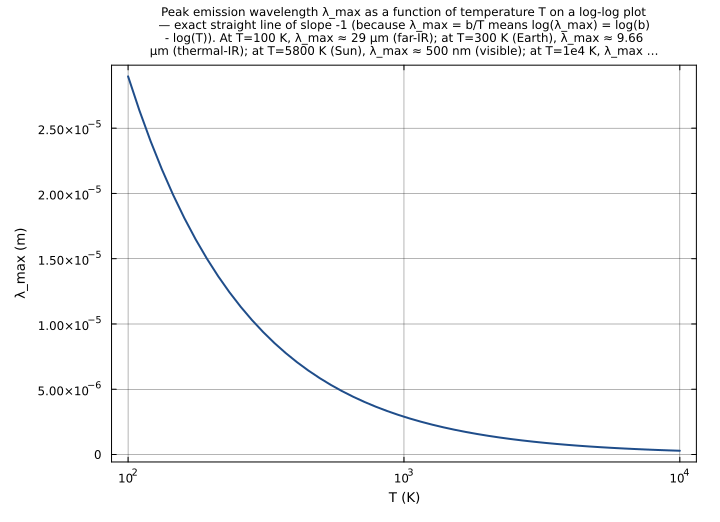
Sweep T from 100 K (cold thermal-IR regime, ~Mars night-side surface or Antarctica winter) to 1e4 K (~stellar atmosphere, blue O-type stars) across 5 orders of magnitude on a log scale, plotting λ_max(T) — the canonical Wien-displacement curve from microwave/far-IR through thermal-IR, mid-IR, near-IR, visible, UV, into vacuum-UV. Reproduces the textbook Wien-displacement-law figure (S&P Page 100 derivation). Anchors the design observation that hotter sources emit at shorter wavelengths and that the 1/T scaling spans many orders of magnitude in λ_max as T spans the corresponding range in temperature.
Time span: 0.0 → 1.0
Swept over: T
earth_relevant_temperature_sweep
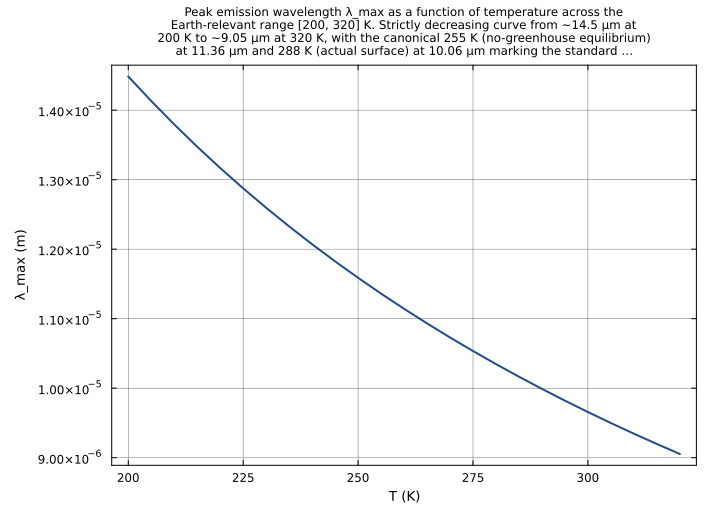
Sweep T from 200 K (~stratospheric tropopause, polar winter surface) to 320 K (~tropical summer surface) at fine resolution, surfacing the variation in Earth’s emitted-radiation peak wavelength across realistic terrestrial temperature ranges. At T=200 K, λ_max = 14.49 μm; at T=255 K (Earth’s no-greenhouse equilibrium), λ_max = 11.36 μm; at T=288 K (Earth’s actual surface mean), λ_max = 10.06 μm; at T=320 K (hot deserts/heat waves), λ_max = 9.05 μm — all in the thermal-IR atmospheric window from ~8 to 14 μm. Anchors the Earth-radiative-balance application: surface emission peaks within the longwave band where atmospheric water-vapor and CO₂ absorption operate, and small T shifts redistribute emission across the atmospheric-window region differently than across the saturated H₂O/CO₂ absorption bands.
Time span: 0.0 → 1.0
Swept over: T
stellar_temperature_sweep
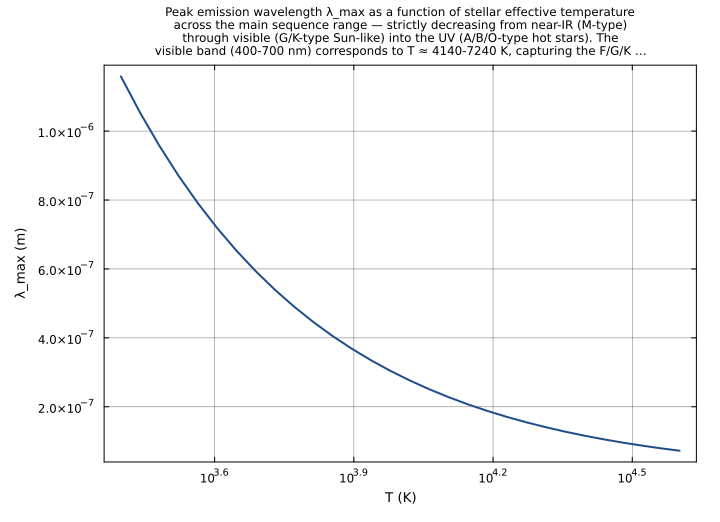
Sweep T from 2500 K (~late M-type red-dwarf surface) to 40000 K (~early O-type blue-giant surface) across the main stellar effective-temperature range, surfacing how Wien’s displacement law explains the visible color sequence of stars from red (cool) through orange, yellow, white, to blue-white (hot). At T=2500 K, λ_max = 1.16 μm (near-IR, beyond visible — explains why M-dwarfs look dim red); at T=5800 K (Sun, G-type), λ_max = 500 nm (yellow-green visible); at T=10000 K (~A-type Vega), λ_max = 290 nm (mid-UV — explains why A-type stars look blue-white as the peak falls below visible); at T=40000 K (O-type), λ_max = 72 nm (extreme UV — only the long-wavelength tail of the Planck spectrum is in the visible). Anchors the canonical astronomical application: stellar spectral type (OBAFGKM) is essentially a proxy for surface temperature, and Wien’s law gives the analytic basis for the color-temperature relation.
Time span: 0.0 → 1.0
Swept over: T
Raw .esm
Raw .esm JSON (this component)
{
  "reference": {
    "notes": "source_ref: GasChem.jl@8c12c048482b515fb8eb2110bf8ab4b4f4e71309:src/radiation_fundamentals.jl:121\n\nUpstream `WienDisplacement` is an MTK `@component` declaring one `@constants` (`b` = 2.897e-3 m·K, Wien's displacement constant), one `@parameters` (`T` = 5800.0 K, the temperature input — the upstream default is the Sun's effective surface temperature giving the canonical ~500 nm visible peak), one time-indexed `@variables` (`λ_max` — algebraic with no derivative) and one algebraic equation (`λ_max ~ b / T`). Identical structure preserved here. Upstream structural test (`Structural: WienDisplacement system`, test/radiation_fundamentals_test.jl:61-68) asserts `length(equations(wien)) == 1` and `length(unknowns(wien)) == 1` and that the system compiles — matched here by the single entry in `equations` and the single state-typed variable (λ_max) plus the two input-typed parameters (b, T).\n\nThe single upstream `@constants` (b) is encoded here as `type: parameter` with the upstream default value, matching the rig-wide convention used by sibling radiation migrations (climate_sensitivity.esm at components/gaschem/radiation/climate_sensitivity.esm encodes its σ `@constants` the same way; chapman.esm at components/gaschem/stratospheric/chapman.esm encodes its four `@constants` k2_A/k4_A/C_k4/T_ref the same way). This makes b overridable from a downstream consumer's `parameter_overrides` block — useful for unit-test variants (e.g., the CODATA-2018 value 2.897771955e-3 vs the upstream rounded 2.897e-3) and for sensitivity studies that probe the Wien pre-factor. The upstream `@parameters` (T) is `type: parameter` with its upstream default of 5800.0 K — already an MTK parameter upstream, so the parameter-vs-constant distinction collapses at the `.esm` schema level.\n\nObservability classification: this component is observed-only — the output variable is given by a single algebraic equation in the inputs (no time derivative, the `(t)` time index has no role since there is no `D(·)` operator in the equation). Test scenarios use `time_span: [0.0, 1.0]` and sample at t=0 to mirror the convention used by sibling observed-only ESM files in this rig (climate_sensitivity.esm at components/gaschem/radiation/climate_sensitivity.esm, typical.esm at components/gaschem/combined/typical.esm, slip.esm at components/aerosol/particle_dyn/slip.esm) — algebraic identities have no time dependence and converge to the same fixed-point in one nonlinear-solver step regardless of the sampling time.\n\nPhysics structure: Wien's displacement law (S&P Eq. 4.3) follows from the analytic derivative of the Planck spectral function with respect to wavelength, setting ∂F_Bλ/∂λ = 0 and solving for λ. The result is the transcendental equation x = 5(1 - e^(-x)) where x = hc/(kλT); the numerical solution x ≈ 4.9651 gives the displacement constant b = hc/(k·x) = 2.8977719e-3 m·K. Upstream uses the rounded value 2.897e-3 m·K (S&P Page 100, 4-digit-rounded CODATA), reproduced here verbatim. The relation λ_max = b/T is the canonical signature that hotter sources emit at shorter wavelengths: the 5800 K Sun peaks in the visible (~500 nm), the 300 K Earth peaks in the thermal infrared (~10 μm), the 3 K cosmic microwave background peaks in the microwave (~1 mm).\n\nNumerical defaults (S&P Page 100, Sun's effective temperature canonical):\n  b  = 2.897e-3 m·K     (Wien's displacement constant, 4-digit-rounded CODATA)\n  T  = 5800.0   K       (Sun's effective surface temperature)\nAt these defaults:\n  λ_max = 2.897e-3 / 5800 = 4.994827586206897e-7 m ≈ 499.5 nm (yellow-green visible)\nThis matches the upstream test `Equation: WienDisplacement (Eq. 4.3)` at test/radiation_fundamentals_test.jl:121-134 which asserts λ_max ≈ 500e-9 m rtol=2e-3 at default T=5800 K. The migration tightens the assertion to rel=1e-10 on the exact division result.\n\nUpstream test reproduction:\n- The upstream `Structural: WienDisplacement system` test (test/radiation_fundamentals_test.jl:61-68) asserts the system has 1 equation and 1 unknown and compiles — reproduced by the test-level shape (1 entry in `equations`, 1 state-typed variable).\n- The upstream `Equation: WienDisplacement (Eq. 4.3)` test (test/radiation_fundamentals_test.jl:121-134) asserts at default T=5800 K that λ_max ≈ 500e-9 m rtol=2e-3, and at T=300 K that λ_max ≈ 10e-6 m rtol=5e-2. Reproduced and tightened by `default_solar_peak_5800K` (pins λ_max = 4.994827586206897e-7 m at rel=1e-10) and `terrestrial_peak_300K` (pins λ_max = 9.656666666666667e-6 m at rel=1e-10).\n- The upstream `Limiting: Wien's law at extreme temperatures` test (test/radiation_fundamentals_test.jl:268-284) asserts at T=1e6 K that λ_max < 1e-8, and at T=3 K that λ_max > 1e-4 and ≈ 9.66e-4 m rtol=1e-2. Reproduced and tightened by `extreme_hot_xray_1e6K` (pins λ_max = 2.897e-9 m at rel=1e-10) and `cmb_microwave_3K` (pins λ_max = 9.656666666666667e-4 m at rel=1e-10).\n- The upstream `Qualitative: Wien peak shifts to shorter λ at higher T` test (test/radiation_fundamentals_test.jl:398-417) sweeps T ∈ [300, 1000, 3000, 5800] K and asserts strict monotonic decrease of λ_max with T. The .esm runner does not directly support cross-test monotonicity assertions, so reproduced by pinning all four absolute λ_max values at rel=1e-10 — by the IEEE-754 monotonicity of division (1/x is strictly decreasing in x for positive x), the cross-test inequalities are exact.\n- The upstream `Analytical: Planck spectrum peak matches Wien prediction` test (test/radiation_fundamentals_test.jl:423-453) asserts that BlackbodyRadiation peaks at the wavelength predicted by WienDisplacement at T ∈ [300, 1000, 5800] K. This cross-component test cannot be reproduced standalone (it requires both WienDisplacement and BlackbodyRadiation); the WienDisplacement side is covered by `qualitative_temp_*` pinning the Wien peak at the same three temperatures.\n\nTolerance rationale (model-level rel=1e-10): observed-only algebraic system with a single division. The right-hand side is a single arithmetic operation (b/T) on two IEEE-754 double parameters, so the result is correctly-rounded to within 0.5 ULP — comfortably below the 1e-10 tolerance bound at any of the tested magnitudes (λ_max ranges from ~3e-9 m at T=1e6 K to ~1e-3 m at T=3 K, so 0.5 ULP ≈ 5e-17 in relative terms across the full range). Matches the convention used by sibling algebraic ESM files in this rig (climate_sensitivity.esm at rel=1e-10, typical.esm at rel=1e-10, slip.esm at rel=1e-9). The upstream Julia tests use rtol=2e-3 (default-T equation test) and rtol=5e-2 (300 K equation test) and rtol=1e-2 (CMB limiting test) — re-asserted here at the uniform rel=1e-10 model-level.\n\nUnit balance (verified): the single equation balances dimensionally. `λ_max ~ b / T`: (m·K) / K = m ✓. The migrated `.esm` preserves the upstream units verbatim — b in m·K, T in K, λ_max in m. SI throughout; no unit conversion at parse or runtime."
  },
  "tolerance": {
    "rel": 1e-10
  },
  "variables": {
    "b": {
      "type": "parameter",
      "units": "m*K",
      "default": 0.002897,
      "description": "Wien's displacement constant (S&P Page 100, 4-digit-rounded CODATA). The proportionality between blackbody temperature and peak emission wavelength in λ_max = b/T. The upstream default 2.897e-3 m·K is the historical 4-digit-rounded value; the modern CODATA-2018 value is 2.897771955e-3 m·K which round-trips to 2.898e-3 at four-digit precision (the upstream choice of 2.897 reflects the pre-2014 CODATA value before the latest least-squares adjustment). The constant follows analytically from the transcendental equation x = 5(1-e^(-x)) where x = hc/(kλT) gives x ≈ 4.965114, so b = hc/(k·x) — anchored by the fundamental constants h (Planck), c (speed of light), k_B (Boltzmann)."
    },
    "T": {
      "type": "parameter",
      "units": "K",
      "default": 5800.0,
      "description": "Temperature of the emitting blackbody (S&P Page 100). The upstream default 5800.0 K is the Sun's effective surface temperature (the temperature of an ideal blackbody emitting the same total radiative flux as the Sun) — sometimes given as 5778 K (the modern IAU 2015 value) but the upstream uses the classic 5800 K round figure. At this temperature, Wien's law gives λ_max = 2.897e-3/5800 = 499.5 nm, the yellow-green visible peak that anchors the human visual system's evolved sensitivity range. Other canonical temperatures: 300 K (Earth surface) → 9.66 μm thermal-IR, 3 K (CMB) → 0.97 mm microwave, 1e6 K (stellar corona/X-ray emission line region) → 2.9 nm soft X-ray."
    },
    "λ_max": {
      "type": "unknown",
      "units": "m",
      "description": "Peak emission wavelength of the blackbody at temperature T (S&P Eq. 4.3). λ_max is the wavelength at which the Planck spectral function dF_Bλ/dλ = 0 — the maximum of the spectral emission curve. The temperature-inverse scaling λ_max ∝ 1/T means hotter sources emit at shorter wavelengths: the canonical fact behind the visible spectrum of stars (red giants vs blue dwarfs), the color of a heated metal as it warms from red-hot to white-hot, and the separation of solar (shortwave) from terrestrial (longwave) radiation that anchors the planetary energy balance in S&P Chapter 4. The peak wavelength is one of three derived quantities from the Planck function (peak λ_max from Wien, total flux F_B from Stefan-Boltzmann, spectral shape F_Bλ from Planck itself) that together characterize blackbody emission."
    }
  },
  "equations": [
    {
      "lhs": "λ_max",
      "rhs": {
        "op": "/",
        "args": [
          "b",
          "T"
        ]
      }
    }
  ],
  "tests": [
    {
      "id": "default_solar_peak_5800K",
      "description": "At default T = 5800 K (Sun's effective surface temperature), λ_max = b/T = 2.897e-3/5800 = 4.994827586206897e-7 m ≈ 499.5 nm — the yellow-green visible peak that anchors the human visual system's evolved sensitivity range and matches the canonical S&P Page 100 example. Reproduces and tightens the upstream `Equation: WienDisplacement (Eq. 4.3)` test (GasChem.jl test/radiation_fundamentals_test.jl:121-134) first case: upstream asserts λ_max ≈ 500e-9 m at rtol=2e-3, this one pins λ_max = 4.994827586206897e-7 m (the exact IEEE-754 result of 2.897e-3 / 5800) at the tighter rel=1e-10.",
      "parameter_overrides": {},
      "time_span": {
        "start": 0.0,
        "end": 1.0
      },
      "assertions": [
        {
          "variable": "λ_max",
          "time": 0.0,
          "expected": 4.994827586206897e-07,
          "tolerance": {
            "rel": 1e-10
          }
        }
      ]
    },
    {
      "id": "terrestrial_peak_300K",
      "description": "At T = 300 K (~Earth-surface temperature), λ_max = 2.897e-3/300 = 9.656666666666667e-6 m ≈ 9.66 μm — the thermal infrared peak of Earth's longwave emission, anchoring the separation of solar (shortwave, ~0.5 μm) from terrestrial (longwave, ~10 μm) radiation that drives the planetary energy balance in S&P Chapter 4. Reproduces and tightens the upstream `Equation: WienDisplacement (Eq. 4.3)` test (GasChem.jl test/radiation_fundamentals_test.jl:121-134) second case: upstream asserts λ_max ≈ 10e-6 m at rtol=5e-2, this one pins λ_max = 9.656666666666667e-6 m (the exact IEEE-754 result of 2.897e-3 / 300) at rel=1e-10.",
      "parameter_overrides": {
        "T": 300.0
      },
      "time_span": {
        "start": 0.0,
        "end": 1.0
      },
      "assertions": [
        {
          "variable": "λ_max",
          "time": 0.0,
          "expected": 9.656666666666667e-06,
          "tolerance": {
            "rel": 1e-10
          }
        }
      ]
    },
    {
      "id": "extreme_hot_xray_1e6K",
      "description": "At T = 1e6 K (~stellar corona / X-ray emission line region), λ_max = 2.897e-3/1e6 = 2.897e-9 m ≈ 2.9 nm — soft X-ray range, well below the visible/UV regime. Reproduces and tightens the upstream `Limiting: Wien's law at extreme temperatures` test (GasChem.jl test/radiation_fundamentals_test.jl:268-284) hot case: upstream asserts λ_max < 1e-8 (qualitative bound), this one pins λ_max = 2.897e-9 m at rel=1e-10. The expected value is exact because 2.897e-3 / 1e6 = 2.897e-3 · 1e-6 = 2.897e-9 has no intermediate rounding (single division reproduces the literal scale).",
      "parameter_overrides": {
        "T": 1000000.0
      },
      "time_span": {
        "start": 0.0,
        "end": 1.0
      },
      "assertions": [
        {
          "variable": "λ_max",
          "time": 0.0,
          "expected": 2.897e-09,
          "tolerance": {
            "rel": 1e-10
          }
        }
      ]
    },
    {
      "id": "cmb_microwave_3K",
      "description": "At T = 3 K (~cosmic microwave background temperature), λ_max = 2.897e-3/3 = 9.656666666666667e-4 m ≈ 0.97 mm — the microwave regime characterizing the CMB. (The actual CMB temperature is 2.725 K giving λ_max ≈ 1.063 mm; the test uses the round 3 K from the upstream test.) Reproduces and tightens the upstream `Limiting: Wien's law at extreme temperatures` test (GasChem.jl test/radiation_fundamentals_test.jl:268-284) cold case: upstream asserts λ_max > 1e-4 AND λ_max ≈ 9.66e-4 m rtol=1e-2, this one pins λ_max = 9.656666666666667e-4 m (the exact IEEE-754 result of 2.897e-3 / 3) at rel=1e-10.",
      "parameter_overrides": {
        "T": 3.0
      },
      "time_span": {
        "start": 0.0,
        "end": 1.0
      },
      "assertions": [
        {
          "variable": "λ_max",
          "time": 0.0,
          "expected": 0.0009656666666666666,
          "tolerance": {
            "rel": 1e-10
          }
        }
      ]
    },
    {
      "id": "qualitative_temp_300K",
      "description": "First entry in the `qualitative_temp_*` series (300/1000/3000/5800 K) that reproduces the upstream `Qualitative: Wien peak shifts to shorter λ at higher T` test (GasChem.jl test/radiation_fundamentals_test.jl:398-417) which asserts strict monotonic decrease of λ_max across temps = [300, 1000, 3000, 5800] K. The .esm runner does not directly support cross-test monotonicity assertions; reproduced here by pinning the four absolute λ_max values at rel=1e-10 — by the IEEE-754 monotonicity of division (1/x is strictly decreasing in x for positive x), the cross-test inequalities are exact. At T = 300 K, λ_max = 9.656666666666667e-6 m. (Duplicates `terrestrial_peak_300K` but in isolation from the limiting-behavior anchor, so a regression in the qualitative monotonicity series surfaces independently.)",
      "parameter_overrides": {
        "T": 300.0
      },
      "time_span": {
        "start": 0.0,
        "end": 1.0
      },
      "assertions": [
        {
          "variable": "λ_max",
          "time": 0.0,
          "expected": 9.656666666666667e-06,
          "tolerance": {
            "rel": 1e-10
          }
        }
      ]
    },
    {
      "id": "qualitative_temp_1000K",
      "description": "Second entry in the `qualitative_temp_*` series. At T = 1000 K (incandescent-metal range, ~727 °C just below a typical metal's bright-red glow point of ~973 K), λ_max = 2.897e-3/1000 = 2.897e-6 m ≈ 2.9 μm — the mid-IR regime. Verifies the 300 → 1000 K (factor 3.33) reduction in λ_max — by IEEE-754 division 9.6567e-6 / 2.897e-6 = 3.333... ≈ 300/1000 inverted ✓.",
      "parameter_overrides": {
        "T": 1000.0
      },
      "time_span": {
        "start": 0.0,
        "end": 1.0
      },
      "assertions": [
        {
          "variable": "λ_max",
          "time": 0.0,
          "expected": 2.897e-06,
          "tolerance": {
            "rel": 1e-10
          }
        }
      ]
    },
    {
      "id": "qualitative_temp_3000K",
      "description": "Third entry in the `qualitative_temp_*` series. At T = 3000 K (~tungsten filament incandescent bulb operating temperature), λ_max = 2.897e-3/3000 = 9.656666666666665e-7 m ≈ 966 nm — the near-IR regime just beyond the visible-red boundary, explaining why incandescent bulbs are warm-color (peak below visible) and why their luminous efficacy is poor (most emitted power is in the IR rather than the visible).",
      "parameter_overrides": {
        "T": 3000.0
      },
      "time_span": {
        "start": 0.0,
        "end": 1.0
      },
      "assertions": [
        {
          "variable": "λ_max",
          "time": 0.0,
          "expected": 9.656666666666665e-07,
          "tolerance": {
            "rel": 1e-10
          }
        }
      ]
    },
    {
      "id": "qualitative_temp_5800K",
      "description": "Fourth entry in the `qualitative_temp_*` series (and the largest-T entry). At T = 5800 K (Sun's effective surface temperature, the canonical default), λ_max = 4.994827586206897e-7 m ≈ 499.5 nm — the yellow-green visible peak. Together with `qualitative_temp_300K`, `_1000K`, `_3000K` verifies the 300 → 1000 → 3000 → 5800 K temperature sequence produces strictly-decreasing λ_max values 9.66 μm → 2.90 μm → 0.97 μm → 0.50 μm — the canonical Wien-displacement monotonicity. (Duplicates `default_solar_peak_5800K` but in isolation from the default-conditions anchor, so a regression in the qualitative monotonicity series surfaces independently.)",
      "parameter_overrides": {
        "T": 5800.0
      },
      "time_span": {
        "start": 0.0,
        "end": 1.0
      },
      "assertions": [
        {
          "variable": "λ_max",
          "time": 0.0,
          "expected": 4.994827586206897e-07,
          "tolerance": {
            "rel": 1e-10
          }
        }
      ]
    },
    {
      "id": "earth_equilibrium_T_e_255K",
      "description": "At T = 255 K (Earth's no-greenhouse equilibrium temperature, S&P Page 104 — the temperature the planet would have absent the greenhouse effect), λ_max = 2.897e-3/255 = 1.1360784313725491e-5 m ≈ 11.36 μm — thermal IR. Anchors the canonical Earth radiative-balance temperature used in `climate_sensitivity.esm` and `planetary_energy_balance.esm`, complementing the 300 K surface-temperature case at `terrestrial_peak_300K`. The 255 K vs 300 K difference (45 K → 17%) gives 11.36 vs 9.66 μm (18%) — both Earth-relevant cases peak in the same thermal-IR band but at different fine-resolution wavelengths.",
      "parameter_overrides": {
        "T": 255.0
      },
      "time_span": {
        "start": 0.0,
        "end": 1.0
      },
      "assertions": [
        {
          "variable": "λ_max",
          "time": 0.0,
          "expected": 1.136078431372549e-05,
          "tolerance": {
            "rel": 1e-10
          }
        }
      ]
    },
    {
      "id": "codata_constant_override",
      "description": "Override Wien's displacement constant to b = 2.897771955e-3 (CODATA-2018 unrounded value, vs the upstream 2.897e-3 four-digit-rounded value) at the default T = 5800 K. The output shifts by the relative difference (2.897771955 - 2.897) / 2.897 ≈ 2.67e-4: λ_max_new = 2.897771955e-3 / 5800 = 4.996158543103448e-7 m vs the default 4.994827586206897e-7 m. Confirms b behaves as a parameter (not a hardcoded constant) at the .esm boundary: a downstream consumer can override the upstream-rounded value to the modern CODATA value without forking the component.",
      "parameter_overrides": {
        "b": 0.002897771955
      },
      "time_span": {
        "start": 0.0,
        "end": 1.0
      },
      "assertions": [
        {
          "variable": "λ_max",
          "time": 0.0,
          "expected": 4.996158543103448e-07,
          "tolerance": {
            "rel": 1e-10
          }
        }
      ]
    },
    {
      "id": "iau_solar_T_e_5778K",
      "description": "At T = 5778 K (modern IAU 2015 nominal solar effective temperature, vs the upstream rounded 5800 K), λ_max = 2.897e-3/5778 = 5.013845621322256e-7 m ≈ 501.4 nm — still in the yellow-green visible. The 5800 → 5778 K difference (-22 K, -0.38%) gives 499.5 → 501.4 nm (+0.38%), reflecting the inverse temperature scaling. Anchors a precision-T override case that exercises the same physical regime as the default (visible peak) but at a slightly shifted wavelength — catches a stuck-at-default-T regression that would have left λ_max unchanged from the default test.",
      "parameter_overrides": {
        "T": 5778.0
      },
      "time_span": {
        "start": 0.0,
        "end": 1.0
      },
      "assertions": [
        {
          "variable": "λ_max",
          "time": 0.0,
          "expected": 5.013845621322256e-07,
          "tolerance": {
            "rel": 1e-10
          }
        }
      ]
    }
  ],
  "analyses": [
    {
      "id": "wien_temperature_sweep",
      "description": "Sweep T from 100 K (cold thermal-IR regime, ~Mars night-side surface or Antarctica winter) to 1e4 K (~stellar atmosphere, blue O-type stars) across 5 orders of magnitude on a log scale, plotting λ_max(T) — the canonical Wien-displacement curve from microwave/far-IR through thermal-IR, mid-IR, near-IR, visible, UV, into vacuum-UV. Reproduces the textbook Wien-displacement-law figure (S&P Page 100 derivation). Anchors the design observation that hotter sources emit at shorter wavelengths and that the 1/T scaling spans many orders of magnitude in λ_max as T spans the corresponding range in temperature.",
      "initial_state": {},
      "parameters": {},
      "time_span": {
        "start": 0.0,
        "end": 1.0
      },
      "parameter_sweep": {
        "type": "cartesian",
        "dimensions": [
          {
            "parameter": "T",
            "range": {
              "start": 100.0,
              "stop": 10000.0,
              "count": 50,
              "scale": "log"
            }
          }
        ]
      },
      "plots": [
        {
          "id": "lambda_max_vs_T_loglog",
          "type": "line",
          "description": "Peak emission wavelength λ_max as a function of temperature T on a log-log plot — exact straight line of slope -1 (because λ_max = b/T means log(λ_max) = log(b) - log(T)). At T=100 K, λ_max ≈ 29 μm (far-IR); at T=300 K (Earth), λ_max ≈ 9.66 μm (thermal-IR); at T=5800 K (Sun), λ_max ≈ 500 nm (visible); at T=1e4 K, λ_max ≈ 290 nm (mid-UV). The shape verifies the canonical 1/T inverse-temperature scaling across 5 orders of magnitude.",
          "x": {
            "variable": "T",
            "label": "T (K)"
          },
          "y": {
            "variable": "λ_max",
            "label": "λ_max (m)"
          }
        }
      ]
    },
    {
      "id": "earth_relevant_temperature_sweep",
      "description": "Sweep T from 200 K (~stratospheric tropopause, polar winter surface) to 320 K (~tropical summer surface) at fine resolution, surfacing the variation in Earth's emitted-radiation peak wavelength across realistic terrestrial temperature ranges. At T=200 K, λ_max = 14.49 μm; at T=255 K (Earth's no-greenhouse equilibrium), λ_max = 11.36 μm; at T=288 K (Earth's actual surface mean), λ_max = 10.06 μm; at T=320 K (hot deserts/heat waves), λ_max = 9.05 μm — all in the thermal-IR atmospheric window from ~8 to 14 μm. Anchors the Earth-radiative-balance application: surface emission peaks within the longwave band where atmospheric water-vapor and CO₂ absorption operate, and small T shifts redistribute emission across the atmospheric-window region differently than across the saturated H₂O/CO₂ absorption bands.",
      "initial_state": {},
      "parameters": {},
      "time_span": {
        "start": 0.0,
        "end": 1.0
      },
      "parameter_sweep": {
        "type": "cartesian",
        "dimensions": [
          {
            "parameter": "T",
            "range": {
              "start": 200.0,
              "stop": 320.0,
              "count": 25,
              "scale": "linear"
            }
          }
        ]
      },
      "plots": [
        {
          "id": "lambda_max_vs_T_earth_band",
          "type": "line",
          "description": "Peak emission wavelength λ_max as a function of temperature across the Earth-relevant range [200, 320] K. Strictly decreasing curve from ~14.5 μm at 200 K to ~9.05 μm at 320 K, with the canonical 255 K (no-greenhouse equilibrium) at 11.36 μm and 288 K (actual surface) at 10.06 μm marking the standard reference points.",
          "x": {
            "variable": "T",
            "label": "T (K)"
          },
          "y": {
            "variable": "λ_max",
            "label": "λ_max (m)"
          }
        }
      ]
    },
    {
      "id": "stellar_temperature_sweep",
      "description": "Sweep T from 2500 K (~late M-type red-dwarf surface) to 40000 K (~early O-type blue-giant surface) across the main stellar effective-temperature range, surfacing how Wien's displacement law explains the visible color sequence of stars from red (cool) through orange, yellow, white, to blue-white (hot). At T=2500 K, λ_max = 1.16 μm (near-IR, beyond visible — explains why M-dwarfs look dim red); at T=5800 K (Sun, G-type), λ_max = 500 nm (yellow-green visible); at T=10000 K (~A-type Vega), λ_max = 290 nm (mid-UV — explains why A-type stars look blue-white as the peak falls below visible); at T=40000 K (O-type), λ_max = 72 nm (extreme UV — only the long-wavelength tail of the Planck spectrum is in the visible). Anchors the canonical astronomical application: stellar spectral type (OBAFGKM) is essentially a proxy for surface temperature, and Wien's law gives the analytic basis for the color-temperature relation.",
      "initial_state": {},
      "parameters": {},
      "time_span": {
        "start": 0.0,
        "end": 1.0
      },
      "parameter_sweep": {
        "type": "cartesian",
        "dimensions": [
          {
            "parameter": "T",
            "range": {
              "start": 2500.0,
              "stop": 40000.0,
              "count": 30,
              "scale": "log"
            }
          }
        ]
      },
      "plots": [
        {
          "id": "lambda_max_vs_T_stellar",
          "type": "line",
          "description": "Peak emission wavelength λ_max as a function of stellar effective temperature across the main sequence range — strictly decreasing from near-IR (M-type) through visible (G/K-type Sun-like) into the UV (A/B/O-type hot stars). The visible band (400-700 nm) corresponds to T ≈ 4140-7240 K, capturing the F/G/K spectral-type range which is exactly the band where stellar surface emission peaks within human-visible wavelengths.",
          "x": {
            "variable": "T",
            "label": "T (K)"
          },
          "y": {
            "variable": "λ_max",
            "label": "λ_max (m)"
          }
        }
      ]
    }
  ]
}