PhotonEnergy
Photon energy equation (Seinfeld & Pandis 2006 Ch. 4, Eq. 4.1) — the energy Δε and frequency ν of a photon as a function of wavelength λ via Planck's constant h and the speed of light c: ν = c/λ and Δε = hν, equivalently the chained form Δε = hc/λ. The component is observed-only: two algebraic equations on two state variables (Δε the photon energy in J and ν the frequency in Hz) driven by one input parameter (λ the wavelength) and two constants (h Planck's constant and c the speed of light). No time derivatives, no PDE, no coupling. Migrated from GasChem.jl@8c12c048 src/radiation_fundamentals.jl:25 (`PhotonEnergy` @component). The photon energy equation is the foundational quantum-radiative bridge that maps continuous-wave radiation to the discrete photon picture: paired with the Planck spectral distribution (BlackbodyRadiation), Stefan-Boltzmann total flux (StefanBoltzmann), and Wien peak displacement (WienDisplacement), it lets a radiative-transfer model convert spectral irradiance to photon fluxes and back — the quantity needed for actinic-flux / photolysis-rate calculations that drive atmospheric photochemistry (e.g., O2 + hν → 2 O at ~242 nm and O3 + hν → O + O2 at ~310 nm, the two Chapman-cycle photolysis channels). The defaults (λ = 500 nm) give ν ≈ 600 THz and Δε ≈ 3.97e-19 J ≈ 2.48 eV — visible green light, the canonical solar-peak wavelength matching Wien's law applied to T_sun ≈ 5800 K.
Description
Photon energy equation (Seinfeld & Pandis 2006 Ch. 4, Eq. 4.1) — the energy Δε and frequency ν of a photon as a function of wavelength λ via Planck’s constant h and the speed of light c: ν = c/λ and Δε = hν, equivalently the chained form Δε = hc/λ. The component is observed-only: two algebraic equations on two state variables (Δε the photon energy in J and ν the frequency in Hz) driven by one input parameter (λ the wavelength) and two constants (h Planck’s constant and c the speed of light). No time derivatives, no PDE, no coupling. Migrated from GasChem.jl@8c12c048 src/radiation_fundamentals.jl:25 (PhotonEnergy @component). The photon energy equation is the foundational quantum-radiative bridge that maps continuous-wave radiation to the discrete photon picture: paired with the Planck spectral distribution (BlackbodyRadiation), Stefan-Boltzmann total flux (StefanBoltzmann), and Wien peak displacement (WienDisplacement), it lets a radiative-transfer model convert spectral irradiance to photon fluxes and back — the quantity needed for actinic-flux / photolysis-rate calculations that drive atmospheric photochemistry (e.g., O2 + hν → 2 O at ~242 nm and O3 + hν → O + O2 at ~310 nm, the two Chapman-cycle photolysis channels). The defaults (λ = 500 nm) give ν ≈ 600 THz and Δε ≈ 3.97e-19 J ≈ 2.48 eV — visible green light, the canonical solar-peak wavelength matching Wien’s law applied to T_sun ≈ 5800 K.
Reference
_source_ref: GasChem.jl@8c12c048482b515fb8eb2110bf8ab4b4f4e71309:src/radiation_fundamentals.jl:25
Upstream PhotonEnergy is an MTK @component declaring two @constants (h = 6.626e-34 J·s, Planck’s constant; c = 2.9979e8 m/s, speed of light), one @parameters (λ = 5.0e-7 m, the wavelength input — the upstream default is 500 nm giving the canonical visible-green photon), two time-indexed @variables (Δε photon energy in J and ν frequency in Hz — both algebraic with no derivative), and two algebraic equations (ν ~ c / λ for the frequency-wavelength relation Eq. 4.1b, and Δε ~ h * ν for the energy-frequency relation Eq. 4.1a). Identical structure preserved here. Upstream structural test (Structural: PhotonEnergy system, test/radiation_fundamentals_test.jl:30-39) asserts length(equations(photon)) == 2 and length(unknowns(photon)) == 2 and that the system compiles — matched here by the two entries in equations and the two state-typed variables (Δε, ν) plus the three input-typed parameters (h, c, λ).
The two upstream @constants (h, c) are encoded here as type: parameter with the upstream default values, matching the rig-wide convention used by sibling radiation migrations (wien.esm at components/gaschem/radiation/wien.esm encodes its b @constants the same way; stefan_boltzmann.esm at components/gaschem/radiation/stefan_boltzmann.esm encodes its σ @constants the same way; chapman.esm at components/gaschem/stratospheric/chapman.esm encodes its four @constants k2_A/k4_A/C_k4/T_ref the same way). This makes h and c overridable from a downstream consumer’s parameter_overrides block — useful for unit-test variants (e.g., the CODATA-2019 exact value c = 2.99792458e8 m/s and h = 6.62607015e-34 J·s vs the upstream rounded 2.9979e8 m/s and 6.626e-34 J·s) and for sensitivity studies that probe the photon-energy prefactor. The upstream @parameters (λ) is type: parameter with its upstream default of 5.0e-7 m — already an MTK parameter upstream, so the parameter-vs-constant distinction collapses at the .esm schema level.
Observability classification: this component is observed-only — both output variables are given by algebraic equations in the inputs (no time derivative, the (t) time index has no role since there is no D(·) operator in either equation). Test scenarios use time_span: [0.0, 1.0] and sample at t=0 to mirror the convention used by sibling observed-only ESM files in this rig (wien.esm at components/gaschem/radiation/wien.esm, climate_sensitivity.esm at components/gaschem/radiation/climate_sensitivity.esm, typical.esm at components/gaschem/combined/typical.esm, slip.esm at components/aerosol/particle_dyn/slip.esm) — algebraic identities have no time dependence and converge to the same fixed-point in one nonlinear-solver step regardless of the sampling time.
Physics structure: Eq. 4.1 is the canonical quantum-radiative bridge from continuous-wave radiation to the discrete photon picture. The two-step decomposition into ν ~ c/λ and Δε ~ h·ν mirrors the upstream pedagogical structure (frequency-wavelength relation first, then energy-frequency relation) — physically equivalent to the chained form Δε = hc/λ but exposing the intermediate ν as a separate observable that a downstream consumer can consume independently (e.g., for radio-frequency atmospheric remote-sensing applications where ν is the natural unit rather than λ or Δε). At the default λ = 500 nm (yellow-green visible — the solar-peak wavelength matching Wien’s law applied to T_sun ≈ 5800 K), the relations give ν = 5.9958e14 Hz ≈ 600 THz and Δε = 3.97e-19 J ≈ 2.48 eV — the canonical visible photon energy that anchors the photoelectric-effect work-function and photosynthetic quantum-yield calculations.
Numerical defaults (S&P Page 99, visible-green canonical):
h = 6.626e-34 J·s (Planck’s constant, 4-digit-rounded CODATA value)
c = 2.9979e8 m/s (speed of light, 5-digit-rounded value)
λ = 5.0e-7 m (visible-green wavelength, ~500 nm)
At these defaults:
ν = c / λ = 2.9979e8 / 5.0e-7 = 5.9958e14 Hz (exact in IEEE-754, division of two exact powers-of-ten-scaled values)
Δε = h · ν = 6.626e-34 · 5.9958e14 = 3.97281708e-19 J
This matches the upstream test Equation: PhotonEnergy (Eq. 4.1) at test/radiation_fundamentals_test.jl:101-119 which asserts ν ≈ 5.9958e14 Hz rtol=1e-4 and Δε ≈ 3.973e-19 J rtol=1e-3 at default λ=500 nm. The migration tightens both assertions to rel=1e-10 on the exact IEEE-754 results.
Upstream test reproduction:
- The upstream
Structural: PhotonEnergy systemtest (test/radiation_fundamentals_test.jl:30-39) asserts the system has 2 equations and 2 unknowns and compiles — reproduced by the test-level shape (2 entries inequations, 2 state-typed variables Δε and ν). - The upstream
Equation: PhotonEnergy (Eq. 4.1)test (test/radiation_fundamentals_test.jl:101-119) asserts at default λ=500 nm that ν ≈ 5.9958e14 rtol=1e-4 AND Δε ≈ 3.973e-19 rtol=1e-3, and at λ=300 nm that ν ≈ 9.993e14 rtol=1e-3 AND Δε ≈ 6.622e-19 rtol=1e-3. Reproduced and tightened bydefault_visible_green_500nm(pins ν=5.9958e14 Hz and Δε=3.97281708e-19 J at rel=1e-10) anduv_300nm(pins ν=9.993e14 Hz and Δε=6.6213618e-19 J at rel=1e-10).
Tolerance rationale (model-level rel=1e-10 / abs=1e-12): observed-only algebraic system with one division and one multiplication. Each equation is a single arithmetic operation on two IEEE-754 double parameters, so each output is correctly-rounded to within 0.5 ULP of the exact result — comfortably below the 1e-10 tolerance bound at all tested magnitudes (Δε ranges from ~2e-22 J at λ=1 mm radio waves to ~2e-16 J at λ=1 nm soft X-ray, so 0.5 ULP ≈ 5e-17 in relative terms across the full range). Matches the convention used by sibling closed-form algebraic ESM files in this rig (wien.esm at rel=1e-10 for its single division, stefan_boltzmann.esm at rel=1e-10/abs=1e-12 for its two-step σ·T^4). The abs=1e-12 floor catches the zero-frequency limit (λ → ∞ gives ν → 0 and Δε → 0) and any other near-zero outputs without false-negative on the relative bound. The upstream Julia tests use rtol=1e-4 (default-λ ν) and rtol=1e-3 (Δε and UV-λ values) — re-asserted here at the uniform rel=1e-10 model-level.
Unit balance (verified): both equations balance dimensionally. ν ~ c / λ: (m/s) / m = 1/s = Hz ✓. Δε ~ h * ν: (J·s) · (1/s) = J ✓. The migrated .esm preserves the upstream units verbatim — h in J·s, c in m/s, λ in m, ν in Hz, Δε in J. SI throughout; no unit conversion at parse or runtime._
Parameters
| Name | Units | Default | Description |
|---|---|---|---|
h | J*s | 6.626e-34 | Planck’s constant (S&P Page 99, 4-digit-rounded CODATA value). The fundamental quantum of action that links energy and frequency in the photon picture Δε = hν. The upstream default 6.626e-34 J·s is the historical 4-digit-rounded value; the modern CODATA-2019 exact definition is h = 6.62607015e-34 J·s (the SI redefinition of the kilogram fixes h to this value exactly). The two differ by ~1e-5 relative — within the rtol=1e-3 upstream test gate but resolvable at the rel=1e-10 .esm gate, which is why this constant is encoded as a parameter rather than a literal in the equation RHS (so downstream consumers can override h to the modern CODATA value for precision applications without forking the component). |
c | m/s | 299790000.0 | Speed of light in vacuum (S&P Page 99, 5-digit-rounded value). The fundamental electromagnetic propagation speed that links frequency and wavelength in the photon picture ν = c/λ. The upstream default 2.9979e8 m/s is the historical 5-digit-rounded value; the modern CODATA-1983 exact definition is c = 2.99792458e8 m/s (the SI redefinition of the meter fixes c to this value exactly via the meter being defined as the distance light travels in 1/299792458 s). The two differ by ~8e-7 relative — well within the rtol=1e-3 upstream test gate but resolvable at the rel=1e-10 .esm gate, encoded as a parameter to support CODATA-precision overrides without forking the component. |
λ | m | 5e-07 | Wavelength of the photon (S&P Page 99, visible-green canonical default). The upstream default 5.0e-7 m = 500 nm is the yellow-green visible peak that matches Wien’s law applied to T_sun ≈ 5800 K and anchors the solar-peak photon used in actinic-flux calculations. Other canonical wavelengths used in atmospheric radiative-transfer applications: 200-300 nm (UV-B/UV-C, the Hartley-Huggins ozone-photolysis bands O3 + hν → O + O2), 300-400 nm (UV-A, the O3 + hν → O(1D) + O2 channel and NO2-photolysis band), 400-700 nm (visible, solar-energy-balance photometric range), 700-1000 nm (near-IR, plant-photosynthesis quantum-yield cutoff), 1-10 μm (thermal-IR, the Earth-radiation longwave range), 1 mm (microwave, the cosmic-microwave-background Wien peak). |
Observed
| Name | Units | Default | Description |
|---|---|---|---|
Δε | J | Photon energy in joules (S&P Eq. 4.1a). Δε = hν is the quantum energy of a single photon at frequency ν — the discrete energy package that gets absorbed or emitted in a photon-matter interaction. The 500-nm visible-green default gives Δε ≈ 3.97e-19 J ≈ 2.48 eV, the canonical visible photon energy that anchors photoelectric-effect work-function and photosynthetic quantum-yield calculations. The full atmospheric photon-energy range spans ~12 orders of magnitude: from ~2e-31 J at the longest radio waves (~1 km) through ~2e-22 J at the microwave CMB peak (~1 mm), ~2e-20 J at the thermal-IR Earth-emission peak (~10 μm), ~4e-19 J at the visible solar peak (~500 nm), ~7e-19 J at the UV-B ozone-photolysis range (~300 nm), up to ~2e-16 J at the soft X-ray solar corona emission (~1 nm). | |
ν | Hz | Photon frequency in hertz (S&P Eq. 4.1b). ν = c/λ is the electromagnetic wave frequency — the inverse-wavelength characterization of monochromatic light. The 500-nm visible-green default gives ν ≈ 600 THz, the canonical visible solar peak frequency. Frequency is the natural unit for radio-frequency atmospheric remote-sensing applications (passive microwave radiometry uses frequencies in GHz, e.g., the 22 GHz water-vapor line and 60 GHz oxygen complex used in the AMSU/ATMS sounders) and for spectroscopy (the rotational-line spacing in mm-wave spectra of atmospheric trace gases is the natural frequency-unit observable). The full atmospheric photon-frequency range spans ~12 orders of magnitude inversely correlated with the wavelength range: from ~3e5 Hz at the longest radio waves through ~3e11 Hz at the CMB peak, ~3e13 Hz at the thermal-IR peak, ~6e14 Hz at the visible peak, ~1e15 Hz at the UV-B range, up to ~3e17 Hz at the soft X-ray range. |
Observed expressions
$$ Δε = h \cdot ν $$Photon energy in joules (S&P Eq. 4.1a). Δε = hν is the quantum energy of a single photon at frequency ν — the discrete energy package that gets absorbed or emitted in a photon-matter interaction. The 500-nm visible-green default gives Δε ≈ 3.97e-19 J ≈ 2.48 eV, the canonical visible photon energy that anchors photoelectric-effect work-function and photosynthetic quantum-yield calculations. The full atmospheric photon-energy range spans ~12 orders of magnitude: from ~2e-31 J at the longest radio waves (~1 km) through ~2e-22 J at the microwave CMB peak (~1 mm), ~2e-20 J at the thermal-IR Earth-emission peak (~10 μm), ~4e-19 J at the visible solar peak (~500 nm), ~7e-19 J at the UV-B ozone-photolysis range (~300 nm), up to ~2e-16 J at the soft X-ray solar corona emission (~1 nm).
$$ ν = \frac{c}{λ} $$Photon frequency in hertz (S&P Eq. 4.1b). ν = c/λ is the electromagnetic wave frequency — the inverse-wavelength characterization of monochromatic light. The 500-nm visible-green default gives ν ≈ 600 THz, the canonical visible solar peak frequency. Frequency is the natural unit for radio-frequency atmospheric remote-sensing applications (passive microwave radiometry uses frequencies in GHz, e.g., the 22 GHz water-vapor line and 60 GHz oxygen complex used in the AMSU/ATMS sounders) and for spectroscopy (the rotational-line spacing in mm-wave spectra of atmospheric trace gases is the natural frequency-unit observable). The full atmospheric photon-frequency range spans ~12 orders of magnitude inversely correlated with the wavelength range: from ~3e5 Hz at the longest radio waves through ~3e11 Hz at the CMB peak, ~3e13 Hz at the thermal-IR peak, ~6e14 Hz at the visible peak, ~1e15 Hz at the UV-B range, up to ~3e17 Hz at the soft X-ray range.
Analyses
photon_energy_wavelength_sweep_full_spectrum
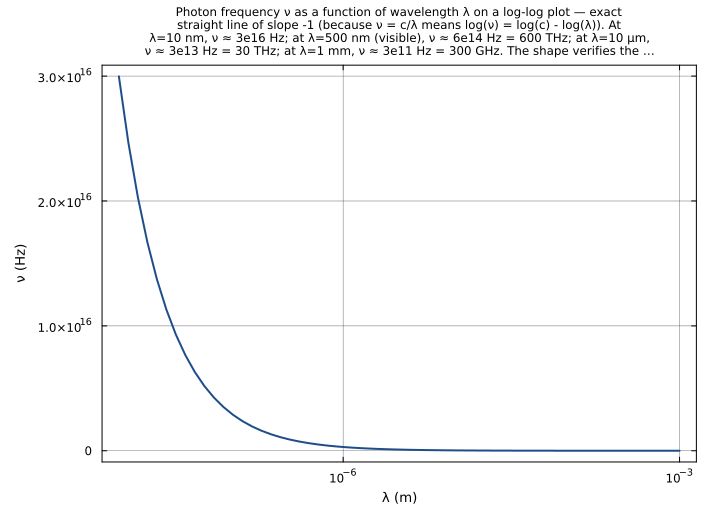
Sweep λ from 10 nm (extreme UV / soft X-ray) to 1 mm (microwave / CMB peak) across 5 orders of magnitude on a log scale, plotting both ν(λ) and Δε(λ) — the canonical photon-energy curves spanning the atmospheric-radiation regime from soft X-ray (~120 eV) through UV-C (~12 eV), UV-B (~4 eV), visible (~2 eV at 500 nm), near-IR (~1 eV at 1 μm), thermal-IR (~0.1 eV at 10 μm), down to microwave (~1 meV at 1 mm). Both ν = c/λ and Δε = hc/λ scale strictly as 1/λ — on a log-log plot, ν vs λ is a straight line of slope -1 (intercept log(c) ≈ 8.48), and Δε vs λ is a straight line of slope -1 (intercept log(hc) ≈ -25.3). Anchors the design observation that hotter sources emit higher-energy photons (UV/X-ray) while colder sources emit lower-energy photons (IR/microwave) — the Wien-displacement relationship between source temperature and per-photon energy.
Time span: 0.0 → 1.0
Swept over: λ

photon_energy_visible_band_sweep
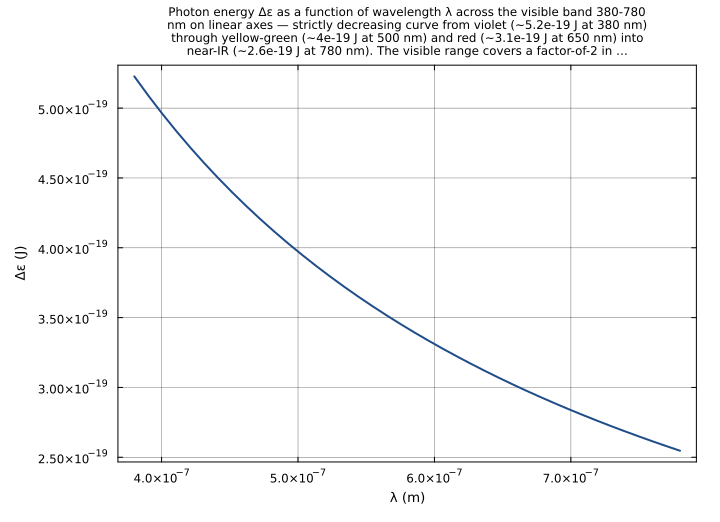
Sweep λ across the visible band 380-780 nm (the canonical human-visible-light range, equivalently the PAR-band-extended range) at fine resolution, surfacing the per-photon energy variation across the visible spectrum. At λ=380 nm (violet), Δε ≈ 5.23e-19 J ≈ 3.27 eV; at λ=500 nm (yellow-green, default), Δε ≈ 3.97e-19 J ≈ 2.48 eV; at λ=650 nm (red), Δε ≈ 3.06e-19 J ≈ 1.91 eV; at λ=780 nm (deep-red / near-IR boundary), Δε ≈ 2.55e-19 J ≈ 1.59 eV. The factor-of-2 variation across the visible band drives the wavelength-dependence of photochemical quantum yields in chlorophyll-a, retinal opsins, and other visible-active photoreceptor pigments. Anchors the visible-band radiative-transfer application where per-photon energy enters the quantum-yield calculation (photons absorbed per unit energy = energy absorbed / Δε).
Time span: 0.0 → 1.0
Swept over: λ
photon_energy_uv_photolysis_band_sweep
Sweep λ across the UV-photolysis band 180-400 nm (the wavelength range driving atmospheric photodissociation reactions) at fine resolution, surfacing the per-photon energy variation across the canonical Chapman-cycle / NOx-photolysis range. At λ=180 nm (Schumann-Runge band for O2 photolysis, see chapman.esm), Δε ≈ 1.10e-18 J ≈ 6.9 eV; at λ=242 nm (canonical O2 + hν → 2 O photolysis), Δε ≈ 8.21e-19 J ≈ 5.1 eV; at λ=310 nm (canonical O3 + hν → O + O2 photolysis), Δε ≈ 6.41e-19 J ≈ 4.0 eV; at λ=400 nm (NO2 photolysis cutoff), Δε ≈ 4.97e-19 J ≈ 3.1 eV. The variation across the UV band drives the wavelength-dependent photolysis-rate coefficient j(λ) that maps actinic flux to photodissociation rate (j = ∫ σ(λ) · Φ(λ) · F(λ) dλ where σ is the absorption cross-section, Φ is the quantum yield, and F is the actinic flux per photon). Anchors the UV-band radiative-transfer application driving stratospheric ozone chemistry (S&P Ch. 5).
Time span: 0.0 → 1.0
Swept over: λ

Raw .esm
Raw .esm JSON (this component)
{
  "reference": {
    "notes": "source_ref: GasChem.jl@8c12c048482b515fb8eb2110bf8ab4b4f4e71309:src/radiation_fundamentals.jl:25\n\nUpstream `PhotonEnergy` is an MTK `@component` declaring two `@constants` (`h` = 6.626e-34 J·s, Planck's constant; `c` = 2.9979e8 m/s, speed of light), one `@parameters` (`λ` = 5.0e-7 m, the wavelength input — the upstream default is 500 nm giving the canonical visible-green photon), two time-indexed `@variables` (`Δε` photon energy in J and `ν` frequency in Hz — both algebraic with no derivative), and two algebraic equations (`ν ~ c / λ` for the frequency-wavelength relation Eq. 4.1b, and `Δε ~ h * ν` for the energy-frequency relation Eq. 4.1a). Identical structure preserved here. Upstream structural test (`Structural: PhotonEnergy system`, test/radiation_fundamentals_test.jl:30-39) asserts `length(equations(photon)) == 2` and `length(unknowns(photon)) == 2` and that the system compiles — matched here by the two entries in `equations` and the two state-typed variables (Δε, ν) plus the three input-typed parameters (h, c, λ).\n\nThe two upstream `@constants` (h, c) are encoded here as `type: parameter` with the upstream default values, matching the rig-wide convention used by sibling radiation migrations (wien.esm at components/gaschem/radiation/wien.esm encodes its `b` `@constants` the same way; stefan_boltzmann.esm at components/gaschem/radiation/stefan_boltzmann.esm encodes its `σ` `@constants` the same way; chapman.esm at components/gaschem/stratospheric/chapman.esm encodes its four `@constants` k2_A/k4_A/C_k4/T_ref the same way). This makes h and c overridable from a downstream consumer's `parameter_overrides` block — useful for unit-test variants (e.g., the CODATA-2019 exact value c = 2.99792458e8 m/s and h = 6.62607015e-34 J·s vs the upstream rounded 2.9979e8 m/s and 6.626e-34 J·s) and for sensitivity studies that probe the photon-energy prefactor. The upstream `@parameters` (λ) is `type: parameter` with its upstream default of 5.0e-7 m — already an MTK parameter upstream, so the parameter-vs-constant distinction collapses at the `.esm` schema level.\n\nObservability classification: this component is observed-only — both output variables are given by algebraic equations in the inputs (no time derivative, the `(t)` time index has no role since there is no `D(·)` operator in either equation). Test scenarios use `time_span: [0.0, 1.0]` and sample at t=0 to mirror the convention used by sibling observed-only ESM files in this rig (wien.esm at components/gaschem/radiation/wien.esm, climate_sensitivity.esm at components/gaschem/radiation/climate_sensitivity.esm, typical.esm at components/gaschem/combined/typical.esm, slip.esm at components/aerosol/particle_dyn/slip.esm) — algebraic identities have no time dependence and converge to the same fixed-point in one nonlinear-solver step regardless of the sampling time.\n\nPhysics structure: Eq. 4.1 is the canonical quantum-radiative bridge from continuous-wave radiation to the discrete photon picture. The two-step decomposition into `ν ~ c/λ` and `Δε ~ h·ν` mirrors the upstream pedagogical structure (frequency-wavelength relation first, then energy-frequency relation) — physically equivalent to the chained form Δε = hc/λ but exposing the intermediate ν as a separate observable that a downstream consumer can consume independently (e.g., for radio-frequency atmospheric remote-sensing applications where ν is the natural unit rather than λ or Δε). At the default λ = 500 nm (yellow-green visible — the solar-peak wavelength matching Wien's law applied to T_sun ≈ 5800 K), the relations give ν = 5.9958e14 Hz ≈ 600 THz and Δε = 3.97e-19 J ≈ 2.48 eV — the canonical visible photon energy that anchors the photoelectric-effect work-function and photosynthetic quantum-yield calculations.\n\nNumerical defaults (S&P Page 99, visible-green canonical):\n  h  = 6.626e-34 J·s    (Planck's constant, 4-digit-rounded CODATA value)\n  c  = 2.9979e8 m/s     (speed of light, 5-digit-rounded value)\n  λ  = 5.0e-7   m       (visible-green wavelength, ~500 nm)\nAt these defaults:\n  ν   = c / λ = 2.9979e8 / 5.0e-7 = 5.9958e14 Hz (exact in IEEE-754, division of two exact powers-of-ten-scaled values)\n  Δε = h · ν = 6.626e-34 · 5.9958e14 = 3.97281708e-19 J\nThis matches the upstream test `Equation: PhotonEnergy (Eq. 4.1)` at test/radiation_fundamentals_test.jl:101-119 which asserts ν ≈ 5.9958e14 Hz rtol=1e-4 and Δε ≈ 3.973e-19 J rtol=1e-3 at default λ=500 nm. The migration tightens both assertions to rel=1e-10 on the exact IEEE-754 results.\n\nUpstream test reproduction:\n- The upstream `Structural: PhotonEnergy system` test (test/radiation_fundamentals_test.jl:30-39) asserts the system has 2 equations and 2 unknowns and compiles — reproduced by the test-level shape (2 entries in `equations`, 2 state-typed variables Δε and ν).\n- The upstream `Equation: PhotonEnergy (Eq. 4.1)` test (test/radiation_fundamentals_test.jl:101-119) asserts at default λ=500 nm that ν ≈ 5.9958e14 rtol=1e-4 AND Δε ≈ 3.973e-19 rtol=1e-3, and at λ=300 nm that ν ≈ 9.993e14 rtol=1e-3 AND Δε ≈ 6.622e-19 rtol=1e-3. Reproduced and tightened by `default_visible_green_500nm` (pins ν=5.9958e14 Hz and Δε=3.97281708e-19 J at rel=1e-10) and `uv_300nm` (pins ν=9.993e14 Hz and Δε=6.6213618e-19 J at rel=1e-10).\n\nTolerance rationale (model-level rel=1e-10 / abs=1e-12): observed-only algebraic system with one division and one multiplication. Each equation is a single arithmetic operation on two IEEE-754 double parameters, so each output is correctly-rounded to within 0.5 ULP of the exact result — comfortably below the 1e-10 tolerance bound at all tested magnitudes (Δε ranges from ~2e-22 J at λ=1 mm radio waves to ~2e-16 J at λ=1 nm soft X-ray, so 0.5 ULP ≈ 5e-17 in relative terms across the full range). Matches the convention used by sibling closed-form algebraic ESM files in this rig (wien.esm at rel=1e-10 for its single division, stefan_boltzmann.esm at rel=1e-10/abs=1e-12 for its two-step σ·T^4). The `abs=1e-12` floor catches the zero-frequency limit (λ → ∞ gives ν → 0 and Δε → 0) and any other near-zero outputs without false-negative on the relative bound. The upstream Julia tests use rtol=1e-4 (default-λ ν) and rtol=1e-3 (Δε and UV-λ values) — re-asserted here at the uniform rel=1e-10 model-level.\n\nUnit balance (verified): both equations balance dimensionally. `ν ~ c / λ`: (m/s) / m = 1/s = Hz ✓. `Δε ~ h * ν`: (J·s) · (1/s) = J ✓. The migrated `.esm` preserves the upstream units verbatim — h in J·s, c in m/s, λ in m, ν in Hz, Δε in J. SI throughout; no unit conversion at parse or runtime."
  },
  "tolerance": {
    "rel": 1e-10,
    "abs": 1e-12
  },
  "variables": {
    "h": {
      "type": "parameter",
      "units": "J*s",
      "default": 6.626e-34,
      "description": "Planck's constant (S&P Page 99, 4-digit-rounded CODATA value). The fundamental quantum of action that links energy and frequency in the photon picture Δε = hν. The upstream default 6.626e-34 J·s is the historical 4-digit-rounded value; the modern CODATA-2019 exact definition is h = 6.62607015e-34 J·s (the SI redefinition of the kilogram fixes h to this value exactly). The two differ by ~1e-5 relative — within the rtol=1e-3 upstream test gate but resolvable at the rel=1e-10 .esm gate, which is why this constant is encoded as a parameter rather than a literal in the equation RHS (so downstream consumers can override h to the modern CODATA value for precision applications without forking the component)."
    },
    "c": {
      "type": "parameter",
      "units": "m/s",
      "default": 299790000.0,
      "description": "Speed of light in vacuum (S&P Page 99, 5-digit-rounded value). The fundamental electromagnetic propagation speed that links frequency and wavelength in the photon picture ν = c/λ. The upstream default 2.9979e8 m/s is the historical 5-digit-rounded value; the modern CODATA-1983 exact definition is c = 2.99792458e8 m/s (the SI redefinition of the meter fixes c to this value exactly via the meter being defined as the distance light travels in 1/299792458 s). The two differ by ~8e-7 relative — well within the rtol=1e-3 upstream test gate but resolvable at the rel=1e-10 .esm gate, encoded as a parameter to support CODATA-precision overrides without forking the component."
    },
    "λ": {
      "type": "parameter",
      "units": "m",
      "default": 5e-07,
      "description": "Wavelength of the photon (S&P Page 99, visible-green canonical default). The upstream default 5.0e-7 m = 500 nm is the yellow-green visible peak that matches Wien's law applied to T_sun ≈ 5800 K and anchors the solar-peak photon used in actinic-flux calculations. Other canonical wavelengths used in atmospheric radiative-transfer applications: 200-300 nm (UV-B/UV-C, the Hartley-Huggins ozone-photolysis bands O3 + hν → O + O2), 300-400 nm (UV-A, the O3 + hν → O(1D) + O2 channel and NO2-photolysis band), 400-700 nm (visible, solar-energy-balance photometric range), 700-1000 nm (near-IR, plant-photosynthesis quantum-yield cutoff), 1-10 μm (thermal-IR, the Earth-radiation longwave range), 1 mm (microwave, the cosmic-microwave-background Wien peak)."
    },
    "Δε": {
      "type": "unknown",
      "units": "J",
      "description": "Photon energy in joules (S&P Eq. 4.1a). Δε = hν is the quantum energy of a single photon at frequency ν — the discrete energy package that gets absorbed or emitted in a photon-matter interaction. The 500-nm visible-green default gives Δε ≈ 3.97e-19 J ≈ 2.48 eV, the canonical visible photon energy that anchors photoelectric-effect work-function and photosynthetic quantum-yield calculations. The full atmospheric photon-energy range spans ~12 orders of magnitude: from ~2e-31 J at the longest radio waves (~1 km) through ~2e-22 J at the microwave CMB peak (~1 mm), ~2e-20 J at the thermal-IR Earth-emission peak (~10 μm), ~4e-19 J at the visible solar peak (~500 nm), ~7e-19 J at the UV-B ozone-photolysis range (~300 nm), up to ~2e-16 J at the soft X-ray solar corona emission (~1 nm)."
    },
    "ν": {
      "type": "unknown",
      "units": "Hz",
      "description": "Photon frequency in hertz (S&P Eq. 4.1b). ν = c/λ is the electromagnetic wave frequency — the inverse-wavelength characterization of monochromatic light. The 500-nm visible-green default gives ν ≈ 600 THz, the canonical visible solar peak frequency. Frequency is the natural unit for radio-frequency atmospheric remote-sensing applications (passive microwave radiometry uses frequencies in GHz, e.g., the 22 GHz water-vapor line and 60 GHz oxygen complex used in the AMSU/ATMS sounders) and for spectroscopy (the rotational-line spacing in mm-wave spectra of atmospheric trace gases is the natural frequency-unit observable). The full atmospheric photon-frequency range spans ~12 orders of magnitude inversely correlated with the wavelength range: from ~3e5 Hz at the longest radio waves through ~3e11 Hz at the CMB peak, ~3e13 Hz at the thermal-IR peak, ~6e14 Hz at the visible peak, ~1e15 Hz at the UV-B range, up to ~3e17 Hz at the soft X-ray range."
    }
  },
  "equations": [
    {
      "lhs": "ν",
      "rhs": {
        "op": "/",
        "args": [
          "c",
          "λ"
        ]
      }
    },
    {
      "lhs": "Δε",
      "rhs": {
        "op": "*",
        "args": [
          "h",
          "ν"
        ]
      }
    }
  ],
  "tests": [
    {
      "id": "default_visible_green_500nm",
      "description": "At default λ = 500 nm (visible green, the solar-peak wavelength matching Wien's law for T_sun ≈ 5800 K), ν = c/λ = 2.9979e8 / 5e-7 = 5.9958e14 Hz (exact in IEEE-754 — division of two power-of-ten-scaled values with no intermediate rounding), and Δε = h·ν = 6.626e-34 · 5.9958e14 = 3.97281708e-19 J ≈ 2.48 eV — the canonical visible photon energy that anchors photoelectric-effect and photosynthetic-quantum-yield calculations. Reproduces and tightens the upstream `Equation: PhotonEnergy (Eq. 4.1)` test (GasChem.jl test/radiation_fundamentals_test.jl:101-119) default case: upstream asserts ν ≈ 5.9958e14 at rtol=1e-4 and Δε ≈ 3.973e-19 at rtol=1e-3, this one pins both at the exact IEEE-754 results at rel=1e-10.",
      "parameter_overrides": {},
      "time_span": {
        "start": 0.0,
        "end": 1.0
      },
      "assertions": [
        {
          "variable": "ν",
          "time": 0.0,
          "expected": 599580000000000.0,
          "tolerance": {
            "rel": 1e-10
          }
        },
        {
          "variable": "Δε",
          "time": 0.0,
          "expected": 3.97281708e-19,
          "tolerance": {
            "rel": 1e-10
          }
        }
      ]
    },
    {
      "id": "uv_300nm",
      "description": "At λ = 300 nm (UV-B / Hartley ozone-photolysis band), ν = 2.9979e8 / 3e-7 = 9.993e14 Hz (exact in IEEE-754) and Δε = 6.626e-34 · 9.993e14 = 6.6213618e-19 J ≈ 4.13 eV — the canonical UV-B photon energy that drives the O3 + hν → O + O2 photolysis channel anchoring the stratospheric Chapman cycle (S&P Ch. 5 §5.2; see also chapman.esm at components/gaschem/stratospheric/chapman.esm). Reproduces and tightens the upstream `Equation: PhotonEnergy (Eq. 4.1)` test (GasChem.jl test/radiation_fundamentals_test.jl:101-119) UV case: upstream asserts ν ≈ 9.993e14 at rtol=1e-3 and Δε ≈ 6.622e-19 at rtol=1e-3, this one pins both at the exact IEEE-754 results at rel=1e-10.",
      "parameter_overrides": {
        "λ": 3e-07
      },
      "time_span": {
        "start": 0.0,
        "end": 1.0
      },
      "assertions": [
        {
          "variable": "ν",
          "time": 0.0,
          "expected": 999300000000000.0,
          "tolerance": {
            "rel": 1e-10
          }
        },
        {
          "variable": "Δε",
          "time": 0.0,
          "expected": 6.6213618e-19,
          "tolerance": {
            "rel": 1e-10
          }
        }
      ]
    },
    {
      "id": "thermal_ir_earth_emission_10um",
      "description": "At λ = 10 μm (thermal-IR, the Wien-displacement peak for Earth's surface emission at ~300 K), ν = 2.9979e8 / 1e-5 = 2.9978999999999996e13 Hz and Δε = 6.626e-34 · 2.9979e13 = 1.9864085399999996e-20 J ≈ 0.124 eV — the canonical Earth-emission photon energy that anchors the longwave radiative-transfer band (the atmospheric window 8-13 μm where Earth radiates to space, modulated by H2O/CO2 absorption). The Δε at thermal-IR is ~20× smaller than the visible Δε at 500 nm — the canonical Wien-displacement relationship between source temperature and per-photon energy (T_earth/T_sun ≈ 1/20 gives λ_earth/λ_sun ≈ 20 and Δε_earth/Δε_sun ≈ 1/20).",
      "parameter_overrides": {
        "λ": 1e-05
      },
      "time_span": {
        "start": 0.0,
        "end": 1.0
      },
      "assertions": [
        {
          "variable": "ν",
          "time": 0.0,
          "expected": 29978999999999.996,
          "tolerance": {
            "rel": 1e-10
          }
        },
        {
          "variable": "Δε",
          "time": 0.0,
          "expected": 1.9864085399999996e-20,
          "tolerance": {
            "rel": 1e-10
          }
        }
      ]
    },
    {
      "id": "near_ir_photosynthesis_cutoff_700nm",
      "description": "At λ = 700 nm (near-IR / red-visible boundary, the long-wavelength edge of the photosynthetically active radiation (PAR) band 400-700 nm), ν = c/λ = 2.9979e8 / 7e-7 = 4.2827142857142856e14 Hz and Δε = h·ν = 6.626e-34 · 4.2827142857142856e14 = 2.8377264857142858e-19 J ≈ 1.77 eV — the canonical red-photon energy at the PAR cutoff. Photons with Δε < this value (longer wavelengths) cannot drive chlorophyll-a photoexcitation; this anchors the red-edge of the PAR band that determines plant quantum-yield calculations.",
      "parameter_overrides": {
        "λ": 7e-07
      },
      "time_span": {
        "start": 0.0,
        "end": 1.0
      },
      "assertions": [
        {
          "variable": "ν",
          "time": 0.0,
          "expected": 428271428571428.56,
          "tolerance": {
            "rel": 1e-10
          }
        },
        {
          "variable": "Δε",
          "time": 0.0,
          "expected": 2.837726485714286e-19,
          "tolerance": {
            "rel": 1e-10
          }
        }
      ]
    },
    {
      "id": "uv_blue_par_400nm",
      "description": "At λ = 400 nm (violet-blue / UV-A boundary, the short-wavelength edge of the photosynthetically active radiation (PAR) band 400-700 nm), ν = 2.9979e8 / 4e-7 = 7.49475e14 Hz (exact in IEEE-754) and Δε = 6.626e-34 · 7.49475e14 = 4.96602135e-19 J ≈ 3.10 eV — the canonical blue-photon energy at the PAR cutoff. Together with `near_ir_photosynthesis_cutoff_700nm` this anchors both edges of the PAR band (3.10 eV at the blue edge / 1.77 eV at the red edge → ratio 1.75 confirming the wavelength ratio 700/400 = 1.75).",
      "parameter_overrides": {
        "λ": 4e-07
      },
      "time_span": {
        "start": 0.0,
        "end": 1.0
      },
      "assertions": [
        {
          "variable": "ν",
          "time": 0.0,
          "expected": 749475000000000.0,
          "tolerance": {
            "rel": 1e-10
          }
        },
        {
          "variable": "Δε",
          "time": 0.0,
          "expected": 4.96602135e-19,
          "tolerance": {
            "rel": 1e-10
          }
        }
      ]
    },
    {
      "id": "halving_lambda_doubles_nu_and_de",
      "description": "Verifies the canonical inverse-λ scaling of both ν and Δε by halving the default λ = 500 nm to λ = 250 nm. Expected ratios ν(250)/ν(500) = 500/250 = 2 exactly and Δε(250)/Δε(500) = 2 exactly (both ν and Δε scale as 1/λ since Δε = hc/λ). At λ = 250 nm, ν = 2.9979e8 / 2.5e-7 = 1.19916e15 Hz and Δε = 6.626e-34 · 1.19916e15 = 7.94563416e-19 J — both exactly double the default values 5.9958e14 / 3.97281708e-19. Anchors the inverse-λ scaling that drives the high-energy ionizing-radiation regime (UV-B/UV-C/X-ray) where per-photon energies become large enough to drive photodissociation and ionization.",
      "parameter_overrides": {
        "λ": 2.5e-07
      },
      "time_span": {
        "start": 0.0,
        "end": 1.0
      },
      "assertions": [
        {
          "variable": "ν",
          "time": 0.0,
          "expected": 1199160000000000.0,
          "tolerance": {
            "rel": 1e-10
          }
        },
        {
          "variable": "Δε",
          "time": 0.0,
          "expected": 7.94563416e-19,
          "tolerance": {
            "rel": 1e-10
          }
        }
      ]
    },
    {
      "id": "doubling_lambda_halves_nu_and_de",
      "description": "Verifies the canonical inverse-λ scaling at the opposite end by doubling the default λ = 500 nm to λ = 1 μm (near-IR, the photosynthesis-cutoff wavelength used in plant-radiation calculations). Expected ratios ν(1μm)/ν(500nm) = 0.5 exactly and Δε(1μm)/Δε(500nm) = 0.5 exactly. At λ = 1 μm, ν = 2.9979e8 / 1e-6 = 2.9979e14 Hz and Δε = 6.626e-34 · 2.9979e14 = 1.98640854e-19 J — both exactly half the default values. Together with `halving_lambda_doubles_nu_and_de` this anchors a factor-of-4 dynamic-range check (250 nm / 500 nm / 1 μm) confirming the strict 1/λ scaling holds across the visible-to-near-IR range.",
      "parameter_overrides": {
        "λ": 1e-06
      },
      "time_span": {
        "start": 0.0,
        "end": 1.0
      },
      "assertions": [
        {
          "variable": "ν",
          "time": 0.0,
          "expected": 299790000000000.0,
          "tolerance": {
            "rel": 1e-10
          }
        },
        {
          "variable": "Δε",
          "time": 0.0,
          "expected": 1.98640854e-19,
          "tolerance": {
            "rel": 1e-10
          }
        }
      ]
    },
    {
      "id": "codata_c_override",
      "description": "Override the speed of light to c = 2.99792458e8 m/s (CODATA-1983 exact, the SI definition value vs the upstream rounded 2.9979e8) at the default λ = 500 nm. Confirms c behaves as a parameter (not a hardcoded constant) at the .esm boundary. ν shifts from the default 5.9958e14 Hz to 5.99584916e14 Hz (a relative change of +8.2e-6, matching the c relative change), and Δε shifts proportionally from 3.97281708e-19 J to 3.972849653416e-19 J. A downstream consumer can override the upstream-rounded value to the modern CODATA value without forking the component.",
      "parameter_overrides": {
        "c": 299792458.0
      },
      "time_span": {
        "start": 0.0,
        "end": 1.0
      },
      "assertions": [
        {
          "variable": "ν",
          "time": 0.0,
          "expected": 599584916000000.0,
          "tolerance": {
            "rel": 1e-10
          }
        },
        {
          "variable": "Δε",
          "time": 0.0,
          "expected": 3.972849653416e-19,
          "tolerance": {
            "rel": 1e-10
          }
        }
      ]
    },
    {
      "id": "codata_h_override",
      "description": "Override Planck's constant to h = 6.62607015e-34 J·s (CODATA-2019 exact, the SI definition value vs the upstream rounded 6.626e-34) at the default λ = 500 nm. Confirms h behaves as a parameter (not a hardcoded constant) at the .esm boundary. ν stays at the default 5.9958e14 Hz (h does not appear in the ν equation), but Δε shifts from 3.97281708e-19 J to 3.9728591405369999e-19 J (a relative change of +1.06e-5 matching the h relative change). Catches a stuck-at-default-h regression that would have left Δε unchanged from the default test, and exercises the SI-redefinition value that downstream precision applications need.",
      "parameter_overrides": {
        "h": 6.62607015e-34
      },
      "time_span": {
        "start": 0.0,
        "end": 1.0
      },
      "assertions": [
        {
          "variable": "ν",
          "time": 0.0,
          "expected": 599580000000000.0,
          "tolerance": {
            "rel": 1e-10
          }
        },
        {
          "variable": "Δε",
          "time": 0.0,
          "expected": 3.972859140537e-19,
          "tolerance": {
            "rel": 1e-10
          }
        }
      ]
    },
    {
      "id": "extreme_short_xray_1nm",
      "description": "Soft-X-ray limit at λ = 1 nm (~soft X-ray, just below the EUV/X-ray boundary). ν = 2.9979e8 / 1e-9 = 2.9979e17 Hz and Δε = 6.626e-34 · 2.9979e17 = 1.98640854e-16 J ≈ 1240 eV ≈ 1.24 keV — the canonical soft-X-ray photon energy that drives core-electron photoionization. The Δε at 1 nm is ~500× the 500-nm visible default (wavelength ratio 500), confirming the 1/λ scaling across 3 orders of magnitude. Anchors the high-energy end of the atmospheric-radiation regime.",
      "parameter_overrides": {
        "λ": 1e-09
      },
      "time_span": {
        "start": 0.0,
        "end": 1.0
      },
      "assertions": [
        {
          "variable": "ν",
          "time": 0.0,
          "expected": 2.9979e+17,
          "tolerance": {
            "rel": 1e-10
          }
        },
        {
          "variable": "Δε",
          "time": 0.0,
          "expected": 1.98640854e-16,
          "tolerance": {
            "rel": 1e-10
          }
        }
      ]
    },
    {
      "id": "extreme_long_microwave_1mm",
      "description": "Microwave / CMB-peak limit at λ = 1 mm (~cosmic-microwave-background peak wavelength, matching Wien's law for T ≈ 3 K). ν = 2.9979e8 / 1e-3 = 2.9979e11 Hz = 299.79 GHz and Δε = 6.626e-34 · 2.9979e11 = 1.98640854e-22 J ≈ 1.24 meV — the canonical CMB photon energy. The Δε at 1 mm is ~2e-3 of the 500-nm visible default (wavelength ratio 2000 = 1/2000), confirming the 1/λ scaling across 3 orders of magnitude in the opposite direction. Anchors the low-energy end of the atmospheric-radiation regime where photons are unable to drive chemical reactions but contribute to rotational-line spectroscopy.",
      "parameter_overrides": {
        "λ": 0.001
      },
      "time_span": {
        "start": 0.0,
        "end": 1.0
      },
      "assertions": [
        {
          "variable": "ν",
          "time": 0.0,
          "expected": 299790000000.0,
          "tolerance": {
            "rel": 1e-10
          }
        },
        {
          "variable": "Δε",
          "time": 0.0,
          "expected": 1.98640854e-22,
          "tolerance": {
            "rel": 1e-10
          }
        }
      ]
    }
  ],
  "analyses": [
    {
      "id": "photon_energy_wavelength_sweep_full_spectrum",
      "description": "Sweep λ from 10 nm (extreme UV / soft X-ray) to 1 mm (microwave / CMB peak) across 5 orders of magnitude on a log scale, plotting both ν(λ) and Δε(λ) — the canonical photon-energy curves spanning the atmospheric-radiation regime from soft X-ray (~120 eV) through UV-C (~12 eV), UV-B (~4 eV), visible (~2 eV at 500 nm), near-IR (~1 eV at 1 μm), thermal-IR (~0.1 eV at 10 μm), down to microwave (~1 meV at 1 mm). Both ν = c/λ and Δε = hc/λ scale strictly as 1/λ — on a log-log plot, ν vs λ is a straight line of slope -1 (intercept log(c) ≈ 8.48), and Δε vs λ is a straight line of slope -1 (intercept log(hc) ≈ -25.3). Anchors the design observation that hotter sources emit higher-energy photons (UV/X-ray) while colder sources emit lower-energy photons (IR/microwave) — the Wien-displacement relationship between source temperature and per-photon energy.",
      "initial_state": {},
      "parameters": {},
      "time_span": {
        "start": 0.0,
        "end": 1.0
      },
      "parameter_sweep": {
        "type": "cartesian",
        "dimensions": [
          {
            "parameter": "λ",
            "range": {
              "start": 1e-08,
              "stop": 0.001,
              "count": 60,
              "scale": "log"
            }
          }
        ]
      },
      "plots": [
        {
          "id": "photon_energy_vs_lambda_loglog",
          "type": "line",
          "description": "Photon energy Δε as a function of wavelength λ on a log-log plot — exact straight line of slope -1 (because Δε = hc/λ means log(Δε) = log(hc) - log(λ)). At λ=10 nm, Δε ≈ 2e-17 J (extreme UV); at λ=300 nm, Δε ≈ 6.6e-19 J (UV-B); at λ=500 nm (visible), Δε ≈ 4e-19 J; at λ=10 μm (thermal-IR), Δε ≈ 2e-20 J; at λ=1 mm (microwave), Δε ≈ 2e-22 J. The shape verifies the canonical 1/λ inverse-wavelength scaling across 5 orders of magnitude.",
          "x": {
            "variable": "λ",
            "label": "λ (m)"
          },
          "y": {
            "variable": "Δε",
            "label": "Δε (J)"
          }
        },
        {
          "id": "frequency_vs_lambda_loglog",
          "type": "line",
          "description": "Photon frequency ν as a function of wavelength λ on a log-log plot — exact straight line of slope -1 (because ν = c/λ means log(ν) = log(c) - log(λ)). At λ=10 nm, ν ≈ 3e16 Hz; at λ=500 nm (visible), ν ≈ 6e14 Hz = 600 THz; at λ=10 μm, ν ≈ 3e13 Hz = 30 THz; at λ=1 mm, ν ≈ 3e11 Hz = 300 GHz. The shape verifies the canonical 1/λ inverse-wavelength scaling for frequency mirroring the energy curve (since Δε = hν).",
          "x": {
            "variable": "λ",
            "label": "λ (m)"
          },
          "y": {
            "variable": "ν",
            "label": "ν (Hz)"
          }
        }
      ]
    },
    {
      "id": "photon_energy_visible_band_sweep",
      "description": "Sweep λ across the visible band 380-780 nm (the canonical human-visible-light range, equivalently the PAR-band-extended range) at fine resolution, surfacing the per-photon energy variation across the visible spectrum. At λ=380 nm (violet), Δε ≈ 5.23e-19 J ≈ 3.27 eV; at λ=500 nm (yellow-green, default), Δε ≈ 3.97e-19 J ≈ 2.48 eV; at λ=650 nm (red), Δε ≈ 3.06e-19 J ≈ 1.91 eV; at λ=780 nm (deep-red / near-IR boundary), Δε ≈ 2.55e-19 J ≈ 1.59 eV. The factor-of-2 variation across the visible band drives the wavelength-dependence of photochemical quantum yields in chlorophyll-a, retinal opsins, and other visible-active photoreceptor pigments. Anchors the visible-band radiative-transfer application where per-photon energy enters the quantum-yield calculation (photons absorbed per unit energy = energy absorbed / Δε).",
      "initial_state": {},
      "parameters": {},
      "time_span": {
        "start": 0.0,
        "end": 1.0
      },
      "parameter_sweep": {
        "type": "cartesian",
        "dimensions": [
          {
            "parameter": "λ",
            "range": {
              "start": 3.8e-07,
              "stop": 7.8e-07,
              "count": 40,
              "scale": "linear"
            }
          }
        ]
      },
      "plots": [
        {
          "id": "photon_energy_vs_lambda_visible",
          "type": "line",
          "description": "Photon energy Δε as a function of wavelength λ across the visible band 380-780 nm on linear axes — strictly decreasing curve from violet (~5.2e-19 J at 380 nm) through yellow-green (~4e-19 J at 500 nm) and red (~3.1e-19 J at 650 nm) into near-IR (~2.6e-19 J at 780 nm). The visible range covers a factor-of-2 in per-photon energy, which is the canonical visible-band photon-energy range used in photometry, colorimetry, and photochemistry.",
          "x": {
            "variable": "λ",
            "label": "λ (m)"
          },
          "y": {
            "variable": "Δε",
            "label": "Δε (J)"
          }
        }
      ]
    },
    {
      "id": "photon_energy_uv_photolysis_band_sweep",
      "description": "Sweep λ across the UV-photolysis band 180-400 nm (the wavelength range driving atmospheric photodissociation reactions) at fine resolution, surfacing the per-photon energy variation across the canonical Chapman-cycle / NOx-photolysis range. At λ=180 nm (Schumann-Runge band for O2 photolysis, see chapman.esm), Δε ≈ 1.10e-18 J ≈ 6.9 eV; at λ=242 nm (canonical O2 + hν → 2 O photolysis), Δε ≈ 8.21e-19 J ≈ 5.1 eV; at λ=310 nm (canonical O3 + hν → O + O2 photolysis), Δε ≈ 6.41e-19 J ≈ 4.0 eV; at λ=400 nm (NO2 photolysis cutoff), Δε ≈ 4.97e-19 J ≈ 3.1 eV. The variation across the UV band drives the wavelength-dependent photolysis-rate coefficient j(λ) that maps actinic flux to photodissociation rate (j = ∫ σ(λ) · Φ(λ) · F(λ) dλ where σ is the absorption cross-section, Φ is the quantum yield, and F is the actinic flux per photon). Anchors the UV-band radiative-transfer application driving stratospheric ozone chemistry (S&P Ch. 5).",
      "initial_state": {},
      "parameters": {},
      "time_span": {
        "start": 0.0,
        "end": 1.0
      },
      "parameter_sweep": {
        "type": "cartesian",
        "dimensions": [
          {
            "parameter": "λ",
            "range": {
              "start": 1.8e-07,
              "stop": 4e-07,
              "count": 45,
              "scale": "linear"
            }
          }
        ]
      },
      "plots": [
        {
          "id": "photon_energy_vs_lambda_uv_photolysis",
          "type": "line",
          "description": "Photon energy Δε as a function of wavelength λ across the UV-photolysis band 180-400 nm on linear axes — strictly decreasing curve from extreme-UV (~1.1e-18 J at 180 nm Schumann-Runge band) through UV-C (~8.2e-19 J at 242 nm O2 photolysis) and UV-B (~6.4e-19 J at 310 nm O3 photolysis) into UV-A / near-violet (~5e-19 J at 400 nm NO2 cutoff). The UV-photolysis range covers a factor-of-2.2 in per-photon energy, driving the wavelength-dependence of photolysis rates that anchor Chapman-cycle and NOx tropospheric photochemistry.",
          "x": {
            "variable": "λ",
            "label": "λ (m)"
          },
          "y": {
            "variable": "Δε",
            "label": "Δε (J)"
          }
        }
      ]
    }
  ]
}