UrbanConditions
Parameter-preset condition system representing typical urban-air-quality lower-troposphere conditions with elevated NOx, CO, and reduced HOx, following Seinfeld & Pandis (2006) Chapter 6. Migrated from GasChem.jl@8c12c048 src/combined_system.jl:219 (`UrbanConditions` @component). The component declares 11 species number-density parameters (M, O2, H2O, O3, NO, NO2, CO, CH4, OH, HO2, CH3O2) with urban-regime defaults in SI units (m^-3) and 11 corresponding `_out` output state variables, one per parameter, defined by identity equations `*_out ~ *`. The component is a sibling preset to `TypicalConditions` (background-air defaults) and `RemoteConditions` (clean-remote defaults); together they parametrize the three canonical regimes the upstream `TroposphericChemistrySystem` is exercised against. Compared to TypicalConditions: NO is 100x higher (10 vs 0.1 ppb), NO2 is 30x higher (30 vs 1 ppb), CO is 20x higher (2000 vs 100 ppb), and OH/HO2 are reduced 2x (titrated by the elevated NOx and CO oxidation chain). All concentrations are positive number densities at standard temperature and pressure; the `_out` indirection lets downstream consumers wire the preset values into the canonical tropospheric-chemistry input interface without renaming.
Description
Parameter-preset condition system representing typical urban-air-quality lower-troposphere conditions with elevated NOx, CO, and reduced HOx, following Seinfeld & Pandis (2006) Chapter 6. Migrated from GasChem.jl@8c12c048 src/combined_system.jl:219 (UrbanConditions @component). The component declares 11 species number-density parameters (M, O2, H2O, O3, NO, NO2, CO, CH4, OH, HO2, CH3O2) with urban-regime defaults in SI units (m^-3) and 11 corresponding _out output state variables, one per parameter, defined by identity equations *_out ~ *. The component is a sibling preset to TypicalConditions (background-air defaults) and RemoteConditions (clean-remote defaults); together they parametrize the three canonical regimes the upstream TroposphericChemistrySystem is exercised against. Compared to TypicalConditions: NO is 100x higher (10 vs 0.1 ppb), NO2 is 30x higher (30 vs 1 ppb), CO is 20x higher (2000 vs 100 ppb), and OH/HO2 are reduced 2x (titrated by the elevated NOx and CO oxidation chain). All concentrations are positive number densities at standard temperature and pressure; the _out indirection lets downstream consumers wire the preset values into the canonical tropospheric-chemistry input interface without renaming.
Reference
_source_ref: GasChem.jl@8c12c048482b515fb8eb2110bf8ab4b4f4e71309:src/combined_system.jl:219
Upstream UrbanConditions is an MTK @component with 11 @parameters (M, O2, H2O, O3, NO, NO2, CO, CH4, OH, HO2, CH3O2) each carrying a numeric default and a u"m^-3" unit annotation, 11 time-indexed @variables (M_out, O2_out, …, CH3O2_out) of the same dimension, and 11 trivial algebraic identity equations *_out ~ *. No @constants, no derivatives, no coupling — the component is a pure parameter-preset shim whose only role is to expose a named set of regime-specific default values to a downstream consumer (the TroposphericChemistrySystem is the canonical consumer per the upstream combined_system.md docs page).
Sibling components (TypicalConditions @ src/combined_system.jl:177, RemoteConditions @ src/combined_system.jl:261) follow exactly the same shape — same 11 parameter names, same 11 output variable names, same 11 identity equations — but with regime-specific defaults: background / urban / remote. The three together parametrize the NOx-VOC regime sweep in Chapter 6: urban (high NOx, VOC-limited, low OPE) → typical / background (moderate, mixed) → remote (low NOx, NOx-limited, high OPE). The upstream get_conditions_dict(sys) helper extracts the default parameter values as a Dict{Symbol,Float64} and is what callers (e.g. the TypicalConditions vs UrbanConditions regime-comparison test at test/test_combined_system.jl:73-83) actually consume. Within an ESM context, get_conditions_dict is not a separate spec element — the preset values are accessible directly via the variable defaults in this file.
Urban-regime defaults (SI: m^-3) and the upstream rationale (Seinfeld & Pandis 2006 Chapter 6):
- M = 2.5e25 — total air number density at standard temperature and pressure (STP, 273.15 K, 101325 Pa); a fundamental atmospheric constant, identical across all three regimes.
- O2 = 5.25e24 — molecular oxygen, exactly 21% of M (0.21 mole fraction); identical across all three regimes because O2 is a long-lived atmospheric constituent essentially decoupled from short-term photochemistry.
- H2O = 4.0e23 — water vapor at ~50% relative humidity at 298 K (~1.6% mole fraction); identical here to TypicalConditions because water vapor is set by meteorology, not by air-quality regime.
- O3 = 2.0e18 — ozone at ~80 ppb (2x TypicalConditions’s 40 ppb); represents the elevated photochemically-produced O3 typical of an urban-VOC-limited regime under sunny conditions (e.g. Los Angeles smog episodes, Mexico City).
- NO = 2.5e17 — nitric oxide at ~10 ppb (100x TypicalConditions’s 0.1 ppb); reflects direct combustion emissions from urban traffic and point sources — the hallmark urban regime indicator.
- NO2 = 7.5e17 — nitrogen dioxide at ~30 ppb (30x TypicalConditions’s 1 ppb); the dominant NOx species after rapid NO → NO2 conversion by O3 and peroxy radicals (typical NO2/NO ratio ~3 in midday urban air).
- CO = 5.0e19 — carbon monoxide at ~2 ppm (20x TypicalConditions’s 100 ppb); incomplete-combustion product of mobile sources, the dominant OH sink in urban air and the major VOC chain initiator for the model.
- CH4 = 4.5e19 — methane at ~1800 ppb; identical across all three regimes because CH4’s atmospheric lifetime (~10 years) makes it well-mixed globally.
- OH = 5.0e11 — hydroxyl radical at ~half the TypicalConditions value (1.0e12); reduced because the elevated CO + NOx in urban air increases the OH sink rate (k_OH_CO * CO + k_OH_NO2 * NO2 dominate the OH budget here, suppressing the steady-state OH concentration).
- HO2 = 5.0e13 — hydroperoxy radical at ~half the TypicalConditions value (1.0e14); reduced for the same reason as OH (the high-NO scenario consumes HO2 via HO2 + NO → OH + NO2 faster than it can be regenerated from CO + OH or RO2 + NO chain steps).
- CH3O2 = 5.0e13 — methylperoxy radical at ~half the TypicalConditions value (1.0e14); reduced for the same NOx-titration reason as HO2 (CH3O2 + NO → CH3O + NO2 is the dominant CH3O2 sink in urban air).
Output equations: all 11 are exact identity assignments *_out ~ *. The 11 _out state variables are the public interface that downstream consumers wire to (e.g. compiled.O3 => cond[:O3] in the upstream test setup at test/test_combined_system.jl:108-113). The indirection through _out lets the parameter names and the output names stay aligned with the canonical TroposphericChemistrySystem interface (which exposes input variables named M, O2, …, CH3O2 — same names as the parameters here) without naming conflicts in the upstream MTK macro expansion.
Observability classification: this component is functionally observed-only — each of the 11 output state variables is given by a single algebraic identity equation in one parameter (the (t) time index on the upstream @variables has no role since there are no derivatives). Test scenarios use time_span: [0, 1] and sample at t=0 to mirror the convention used by sibling observed-only ESM files in this rig (heat_flux.esm, heating_cooling_flux.esm, surface_energy_flux.esm).
Tolerance rationale (model-level rel=1.0e-12): pure-identity algebraic system — 11 single-RHS equations that each copy a parameter into its corresponding _out state. No arithmetic operations, no roundoff accumulation; output values are bit-for-bit identical to the parameter defaults at IEEE-754 precision (~1e-16). rel=1.0e-12 leaves comfortable headroom above ULP roundoff while remaining tighter than the model-level defaults in sibling files (heat_flux.esm uses 1e-9 because Eq. 4.11 involves three arithmetic ops; the conditions presets do not). No special abs: tolerance is needed since all output defaults are strictly positive._
Parameters
| Name | Units | Default | Description |
|---|---|---|---|
M | m^-3 | 2.5e+25 | Total air number density at STP (Seinfeld & Pandis 2006 Ch. 6) — a fundamental atmospheric constant; identical across TypicalConditions, UrbanConditions, RemoteConditions |
O2 | m^-3 | 5.25e+24 | Molecular oxygen at 21% of M (0.21 mole fraction); long-lived background constituent, identical across all three regimes |
H2O | m^-3 | 4e+23 | Water vapor at ~50% relative humidity at 298 K (~1.6% mole fraction); set by meteorology, identical here to TypicalConditions |
O3 | m^-3 | 2e+18 | Ozone at ~80 ppb (2x TypicalConditions); elevated photochemically-produced O3 typical of urban VOC-limited regime under sunny conditions |
NO | m^-3 | 2.5e+17 | Nitric oxide at ~10 ppb (100x TypicalConditions’s 0.1 ppb); direct combustion emissions from urban traffic and point sources — hallmark urban-regime indicator |
NO2 | m^-3 | 7.5e+17 | Nitrogen dioxide at ~30 ppb (30x TypicalConditions’s 1 ppb); dominant NOx species after rapid NO → NO2 conversion by O3 and peroxy radicals |
CO | m^-3 | 5e+19 | Carbon monoxide at ~2 ppm (20x TypicalConditions’s 100 ppb); incomplete-combustion product of mobile sources, dominant OH sink in urban air |
CH4 | m^-3 | 4.5e+19 | Methane at ~1800 ppb; well-mixed globally due to ~10-year lifetime, identical across all three regimes |
OH | m^-3 | 500000000000.0 | Hydroxyl radical at ~half the TypicalConditions value (1.0e12); reduced because elevated CO + NOx in urban air increases the OH sink rate, suppressing the steady-state OH concentration |
HO2 | m^-3 | 50000000000000.0 | Hydroperoxy radical at ~half the TypicalConditions value (1.0e14); reduced because high-NO scenario consumes HO2 via HO2 + NO → OH + NO2 faster than CO + OH chain regeneration |
CH3O2 | m^-3 | 50000000000000.0 | Methylperoxy radical at ~half the TypicalConditions value (1.0e14); reduced by NOx titration (CH3O2 + NO → CH3O + NO2 is the dominant CH3O2 sink in urban air) |
Observed
| Name | Units | Default | Description |
|---|---|---|---|
M_out | m^-3 | Total air number density output state — identity passthrough of the M parameter; consumed downstream by TroposphericChemistrySystem input wiring | |
O2_out | m^-3 | Molecular oxygen output state — identity passthrough of the O2 parameter | |
H2O_out | m^-3 | Water vapor output state — identity passthrough of the H2O parameter | |
O3_out | m^-3 | Ozone output state — identity passthrough of the O3 parameter | |
NO_out | m^-3 | Nitric oxide output state — identity passthrough of the NO parameter | |
NO2_out | m^-3 | Nitrogen dioxide output state — identity passthrough of the NO2 parameter | |
CO_out | m^-3 | Carbon monoxide output state — identity passthrough of the CO parameter | |
CH4_out | m^-3 | Methane output state — identity passthrough of the CH4 parameter | |
OH_out | m^-3 | Hydroxyl radical output state — identity passthrough of the OH parameter | |
HO2_out | m^-3 | Hydroperoxy radical output state — identity passthrough of the HO2 parameter | |
CH3O2_out | m^-3 | Methylperoxy radical output state — identity passthrough of the CH3O2 parameter |
Observed expressions
$$ M_{out} = M $$Total air number density output state — identity passthrough of the M parameter; consumed downstream by TroposphericChemistrySystem input wiring
$$ O2_{out} = O2 $$Molecular oxygen output state — identity passthrough of the O2 parameter
$$ H2O_{out} = H2O $$Water vapor output state — identity passthrough of the H2O parameter
$$ O3_{out} = O3 $$Ozone output state — identity passthrough of the O3 parameter
$$ NO_{out} = NO $$Nitric oxide output state — identity passthrough of the NO parameter
$$ NO2_{out} = NO2 $$Nitrogen dioxide output state — identity passthrough of the NO2 parameter
$$ CO_{out} = CO $$Carbon monoxide output state — identity passthrough of the CO parameter
$$ CH4_{out} = CH4 $$Methane output state — identity passthrough of the CH4 parameter
$$ OH_{out} = OH $$Hydroxyl radical output state — identity passthrough of the OH parameter
$$ HO2_{out} = HO2 $$Hydroperoxy radical output state — identity passthrough of the HO2 parameter
$$ CH3O2_{out} = CH3O2 $$Methylperoxy radical output state — identity passthrough of the CH3O2 parameter
Analyses
no_sensitivity_sweep
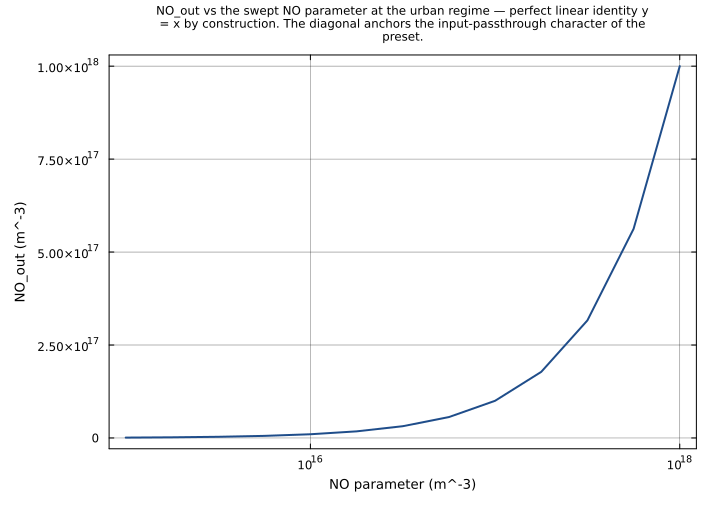
Sweep the NO parameter across 4 orders of magnitude (1e15 → 1e18 m^-3, spanning remote → typical → urban → highly polluted) at all other parameters fixed at the urban defaults. Demonstrates that NO_out tracks the NO parameter exactly (identity equation), confirming the preset is a transparent input proxy and not a derived quantity. The NO range spans the full atmospheric regime sweep — from ~0.04 ppb (clean remote) to ~40 ppb (highly polluted megacity).
Time span: 0.0 → 1.0
Swept over: NO
oh_ho2_response_to_nox
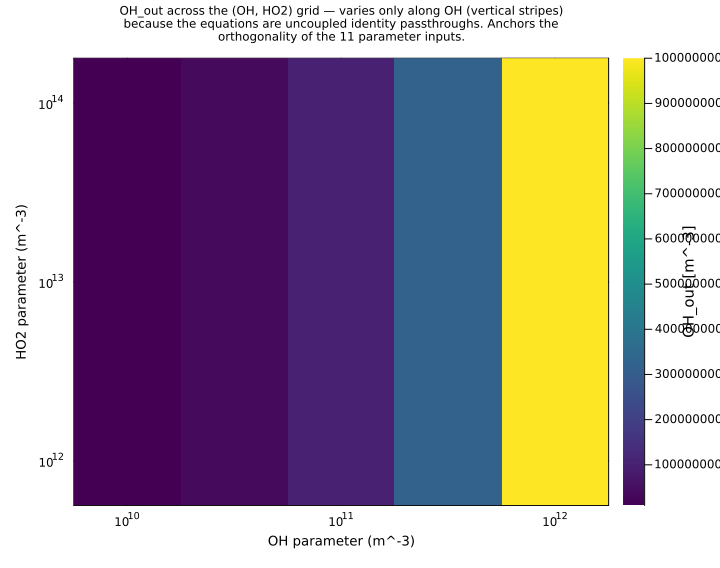
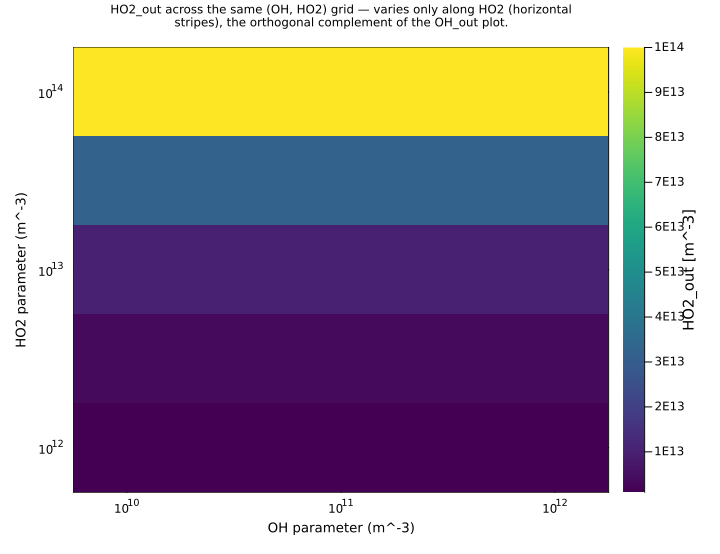
Joint sweep of OH and HO2 parameters across a 100x range each, holding all other parameters at the urban defaults. Surfaces the two radicals’ independent identity passthroughs (OH_out = OH, HO2_out = HO2). Useful for downstream wiring tests — confirms a consumer can adjust the radical inputs without disturbing the other preset values.
Time span: 0.0 → 1.0
Swept over: OH, HO2
Raw .esm
Raw .esm JSON (this component)
{
  "reference": {
    "notes": "source_ref: GasChem.jl@8c12c048482b515fb8eb2110bf8ab4b4f4e71309:src/combined_system.jl:219\nUpstream `UrbanConditions` is an MTK `@component` with 11 `@parameters` (M, O2, H2O, O3, NO, NO2, CO, CH4, OH, HO2, CH3O2) each carrying a numeric default and a u\"m^-3\" unit annotation, 11 time-indexed `@variables` (M_out, O2_out, ..., CH3O2_out) of the same dimension, and 11 trivial algebraic identity equations `*_out ~ *`. No `@constants`, no derivatives, no coupling — the component is a pure parameter-preset shim whose only role is to expose a named set of regime-specific default values to a downstream consumer (the `TroposphericChemistrySystem` is the canonical consumer per the upstream `combined_system.md` docs page).\n\nSibling components (TypicalConditions @ src/combined_system.jl:177, RemoteConditions @ src/combined_system.jl:261) follow exactly the same shape — same 11 parameter names, same 11 output variable names, same 11 identity equations — but with regime-specific defaults: background / urban / remote. The three together parametrize the NOx-VOC regime sweep in Chapter 6: urban (high NOx, VOC-limited, low OPE) → typical / background (moderate, mixed) → remote (low NOx, NOx-limited, high OPE). The upstream `get_conditions_dict(sys)` helper extracts the default parameter values as a `Dict{Symbol,Float64}` and is what callers (e.g. the `TypicalConditions vs UrbanConditions` regime-comparison test at test/test_combined_system.jl:73-83) actually consume. Within an ESM context, `get_conditions_dict` is not a separate spec element — the preset values are accessible directly via the variable defaults in this file.\n\nUrban-regime defaults (SI: m^-3) and the upstream rationale (Seinfeld & Pandis 2006 Chapter 6):\n- M = 2.5e25 — total air number density at standard temperature and pressure (STP, 273.15 K, 101325 Pa); a fundamental atmospheric constant, identical across all three regimes.\n- O2 = 5.25e24 — molecular oxygen, exactly 21% of M (0.21 mole fraction); identical across all three regimes because O2 is a long-lived atmospheric constituent essentially decoupled from short-term photochemistry.\n- H2O = 4.0e23 — water vapor at ~50% relative humidity at 298 K (~1.6% mole fraction); identical here to TypicalConditions because water vapor is set by meteorology, not by air-quality regime.\n- O3 = 2.0e18 — ozone at ~80 ppb (2x TypicalConditions's 40 ppb); represents the elevated photochemically-produced O3 typical of an urban-VOC-limited regime under sunny conditions (e.g. Los Angeles smog episodes, Mexico City).\n- NO = 2.5e17 — nitric oxide at ~10 ppb (100x TypicalConditions's 0.1 ppb); reflects direct combustion emissions from urban traffic and point sources — the hallmark urban regime indicator.\n- NO2 = 7.5e17 — nitrogen dioxide at ~30 ppb (30x TypicalConditions's 1 ppb); the dominant NOx species after rapid NO → NO2 conversion by O3 and peroxy radicals (typical NO2/NO ratio ~3 in midday urban air).\n- CO = 5.0e19 — carbon monoxide at ~2 ppm (20x TypicalConditions's 100 ppb); incomplete-combustion product of mobile sources, the dominant OH sink in urban air and the major VOC chain initiator for the model.\n- CH4 = 4.5e19 — methane at ~1800 ppb; identical across all three regimes because CH4's atmospheric lifetime (~10 years) makes it well-mixed globally.\n- OH = 5.0e11 — hydroxyl radical at ~half the TypicalConditions value (1.0e12); reduced because the elevated CO + NOx in urban air increases the OH sink rate (k_OH_CO * CO + k_OH_NO2 * NO2 dominate the OH budget here, suppressing the steady-state OH concentration).\n- HO2 = 5.0e13 — hydroperoxy radical at ~half the TypicalConditions value (1.0e14); reduced for the same reason as OH (the high-NO scenario consumes HO2 via HO2 + NO → OH + NO2 faster than it can be regenerated from CO + OH or RO2 + NO chain steps).\n- CH3O2 = 5.0e13 — methylperoxy radical at ~half the TypicalConditions value (1.0e14); reduced for the same NOx-titration reason as HO2 (CH3O2 + NO → CH3O + NO2 is the dominant CH3O2 sink in urban air).\n\nOutput equations: all 11 are exact identity assignments `*_out ~ *`. The 11 `_out` state variables are the public interface that downstream consumers wire to (e.g. `compiled.O3 => cond[:O3]` in the upstream test setup at test/test_combined_system.jl:108-113). The indirection through `_out` lets the parameter names and the output names stay aligned with the canonical `TroposphericChemistrySystem` interface (which exposes input variables named M, O2, ..., CH3O2 — same names as the parameters here) without naming conflicts in the upstream MTK macro expansion.\n\nObservability classification: this component is functionally observed-only — each of the 11 output state variables is given by a single algebraic identity equation in one parameter (the `(t)` time index on the upstream `@variables` has no role since there are no derivatives). Test scenarios use `time_span: [0, 1]` and sample at t=0 to mirror the convention used by sibling observed-only ESM files in this rig (heat_flux.esm, heating_cooling_flux.esm, surface_energy_flux.esm).\n\nTolerance rationale (model-level rel=1.0e-12): pure-identity algebraic system — 11 single-RHS equations that each copy a parameter into its corresponding `_out` state. No arithmetic operations, no roundoff accumulation; output values are bit-for-bit identical to the parameter defaults at IEEE-754 precision (~1e-16). rel=1.0e-12 leaves comfortable headroom above ULP roundoff while remaining tighter than the model-level defaults in sibling files (heat_flux.esm uses 1e-9 because Eq. 4.11 involves three arithmetic ops; the conditions presets do not). No special `abs:` tolerance is needed since all output defaults are strictly positive."
  },
  "tolerance": {
    "rel": 1e-12
  },
  "variables": {
    "M": {
      "type": "parameter",
      "units": "m^-3",
      "default": 2.5e+25,
      "description": "Total air number density at STP (Seinfeld & Pandis 2006 Ch. 6) — a fundamental atmospheric constant; identical across TypicalConditions, UrbanConditions, RemoteConditions"
    },
    "O2": {
      "type": "parameter",
      "units": "m^-3",
      "default": 5.25e+24,
      "description": "Molecular oxygen at 21% of M (0.21 mole fraction); long-lived background constituent, identical across all three regimes"
    },
    "H2O": {
      "type": "parameter",
      "units": "m^-3",
      "default": 4e+23,
      "description": "Water vapor at ~50% relative humidity at 298 K (~1.6% mole fraction); set by meteorology, identical here to TypicalConditions"
    },
    "O3": {
      "type": "parameter",
      "units": "m^-3",
      "default": 2e+18,
      "description": "Ozone at ~80 ppb (2x TypicalConditions); elevated photochemically-produced O3 typical of urban VOC-limited regime under sunny conditions"
    },
    "NO": {
      "type": "parameter",
      "units": "m^-3",
      "default": 2.5e+17,
      "description": "Nitric oxide at ~10 ppb (100x TypicalConditions's 0.1 ppb); direct combustion emissions from urban traffic and point sources — hallmark urban-regime indicator"
    },
    "NO2": {
      "type": "parameter",
      "units": "m^-3",
      "default": 7.5e+17,
      "description": "Nitrogen dioxide at ~30 ppb (30x TypicalConditions's 1 ppb); dominant NOx species after rapid NO → NO2 conversion by O3 and peroxy radicals"
    },
    "CO": {
      "type": "parameter",
      "units": "m^-3",
      "default": 5e+19,
      "description": "Carbon monoxide at ~2 ppm (20x TypicalConditions's 100 ppb); incomplete-combustion product of mobile sources, dominant OH sink in urban air"
    },
    "CH4": {
      "type": "parameter",
      "units": "m^-3",
      "default": 4.5e+19,
      "description": "Methane at ~1800 ppb; well-mixed globally due to ~10-year lifetime, identical across all three regimes"
    },
    "OH": {
      "type": "parameter",
      "units": "m^-3",
      "default": 500000000000.0,
      "description": "Hydroxyl radical at ~half the TypicalConditions value (1.0e12); reduced because elevated CO + NOx in urban air increases the OH sink rate, suppressing the steady-state OH concentration"
    },
    "HO2": {
      "type": "parameter",
      "units": "m^-3",
      "default": 50000000000000.0,
      "description": "Hydroperoxy radical at ~half the TypicalConditions value (1.0e14); reduced because high-NO scenario consumes HO2 via HO2 + NO → OH + NO2 faster than CO + OH chain regeneration"
    },
    "CH3O2": {
      "type": "parameter",
      "units": "m^-3",
      "default": 50000000000000.0,
      "description": "Methylperoxy radical at ~half the TypicalConditions value (1.0e14); reduced by NOx titration (CH3O2 + NO → CH3O + NO2 is the dominant CH3O2 sink in urban air)"
    },
    "M_out": {
      "type": "unknown",
      "units": "m^-3",
      "description": "Total air number density output state — identity passthrough of the M parameter; consumed downstream by TroposphericChemistrySystem input wiring"
    },
    "O2_out": {
      "type": "unknown",
      "units": "m^-3",
      "description": "Molecular oxygen output state — identity passthrough of the O2 parameter"
    },
    "H2O_out": {
      "type": "unknown",
      "units": "m^-3",
      "description": "Water vapor output state — identity passthrough of the H2O parameter"
    },
    "O3_out": {
      "type": "unknown",
      "units": "m^-3",
      "description": "Ozone output state — identity passthrough of the O3 parameter"
    },
    "NO_out": {
      "type": "unknown",
      "units": "m^-3",
      "description": "Nitric oxide output state — identity passthrough of the NO parameter"
    },
    "NO2_out": {
      "type": "unknown",
      "units": "m^-3",
      "description": "Nitrogen dioxide output state — identity passthrough of the NO2 parameter"
    },
    "CO_out": {
      "type": "unknown",
      "units": "m^-3",
      "description": "Carbon monoxide output state — identity passthrough of the CO parameter"
    },
    "CH4_out": {
      "type": "unknown",
      "units": "m^-3",
      "description": "Methane output state — identity passthrough of the CH4 parameter"
    },
    "OH_out": {
      "type": "unknown",
      "units": "m^-3",
      "description": "Hydroxyl radical output state — identity passthrough of the OH parameter"
    },
    "HO2_out": {
      "type": "unknown",
      "units": "m^-3",
      "description": "Hydroperoxy radical output state — identity passthrough of the HO2 parameter"
    },
    "CH3O2_out": {
      "type": "unknown",
      "units": "m^-3",
      "description": "Methylperoxy radical output state — identity passthrough of the CH3O2 parameter"
    }
  },
  "equations": [
    {
      "lhs": "M_out",
      "rhs": "M"
    },
    {
      "lhs": "O2_out",
      "rhs": "O2"
    },
    {
      "lhs": "H2O_out",
      "rhs": "H2O"
    },
    {
      "lhs": "O3_out",
      "rhs": "O3"
    },
    {
      "lhs": "NO_out",
      "rhs": "NO"
    },
    {
      "lhs": "NO2_out",
      "rhs": "NO2"
    },
    {
      "lhs": "CO_out",
      "rhs": "CO"
    },
    {
      "lhs": "CH4_out",
      "rhs": "CH4"
    },
    {
      "lhs": "OH_out",
      "rhs": "OH"
    },
    {
      "lhs": "HO2_out",
      "rhs": "HO2"
    },
    {
      "lhs": "CH3O2_out",
      "rhs": "CH3O2"
    }
  ],
  "tests": [
    {
      "id": "upstream_default_values",
      "description": "Reproduces the upstream `TroposphericChemistrySystem: TypicalConditions` testitem (GasChem.jl test/test_combined_system.jl:51-71) adapted for the urban regime: confirms each of the 11 parameter defaults flows through to its corresponding `_out` state at the documented urban-regime value. Asserts the upstream-documented urban values: M=2.5e25, O2=5.25e24, H2O=4.0e23, O3=2.0e18, NO=2.5e17, NO2=7.5e17, CO=5.0e19, CH4=4.5e19, OH=5.0e11, HO2=5.0e13, CH3O2=5.0e13 m^-3.",
      "time_span": {
        "start": 0.0,
        "end": 1.0
      },
      "assertions": [
        {
          "variable": "M_out",
          "time": 0.0,
          "expected": 2.5e+25
        },
        {
          "variable": "O2_out",
          "time": 0.0,
          "expected": 5.25e+24
        },
        {
          "variable": "H2O_out",
          "time": 0.0,
          "expected": 4e+23
        },
        {
          "variable": "O3_out",
          "time": 0.0,
          "expected": 2e+18
        },
        {
          "variable": "NO_out",
          "time": 0.0,
          "expected": 2.5e+17
        },
        {
          "variable": "NO2_out",
          "time": 0.0,
          "expected": 7.5e+17
        },
        {
          "variable": "CO_out",
          "time": 0.0,
          "expected": 5e+19
        },
        {
          "variable": "CH4_out",
          "time": 0.0,
          "expected": 4.5e+19
        },
        {
          "variable": "OH_out",
          "time": 0.0,
          "expected": 500000000000.0
        },
        {
          "variable": "HO2_out",
          "time": 0.0,
          "expected": 50000000000000.0
        },
        {
          "variable": "CH3O2_out",
          "time": 0.0,
          "expected": 50000000000000.0
        }
      ]
    },
    {
      "id": "upstream_o2_is_21_percent_of_m",
      "description": "Reproduces the upstream `TypicalConditions` physical-consistency assertion (GasChem.jl test/test_combined_system.jl:70, also reused at test/test_combined_system.jl:437 in the `Atmospheric Composition Consistency` test for UrbanConditions): O2 should be ~21% of M (the standard atmospheric mole fraction of O2). At the urban defaults M = 2.5e25 and O2 = 5.25e24: O2/M = 0.21 exactly. Asserted by checking O2_out at the value 0.21 * M = 5.25e24 — equivalent to the upstream `cond[:O2] / cond[:M] ≈ 0.21 rtol = 0.01`, here re-cast as an absolute-value check since the parameters are deterministic.",
      "time_span": {
        "start": 0.0,
        "end": 1.0
      },
      "assertions": [
        {
          "variable": "O2_out",
          "time": 0.0,
          "expected": 5.25e+24,
          "tolerance": {
            "rel": 1e-10
          }
        }
      ]
    },
    {
      "id": "urban_vs_typical_no_elevated",
      "description": "Reproduces the upstream `UrbanConditions vs TypicalConditions` assertion `urban[:NO] > typical[:NO]` (GasChem.jl test/test_combined_system.jl:77). The TypicalConditions default is NO = 2.5e15 m^-3 (~0.1 ppb); the UrbanConditions default is NO = 2.5e17 m^-3 (~10 ppb). The urban value is 100x larger, hallmark of urban combustion emissions. Asserts the urban absolute value of NO_out = 2.5e17 directly (which by construction is strictly greater than 2.5e15).",
      "time_span": {
        "start": 0.0,
        "end": 1.0
      },
      "assertions": [
        {
          "variable": "NO_out",
          "time": 0.0,
          "expected": 2.5e+17
        }
      ]
    },
    {
      "id": "urban_vs_typical_no2_elevated",
      "description": "Reproduces the upstream `UrbanConditions vs TypicalConditions` assertion `urban[:NO2] > typical[:NO2]` (GasChem.jl test/test_combined_system.jl:78). TypicalConditions NO2 = 2.5e16 (~1 ppb); UrbanConditions NO2 = 7.5e17 (~30 ppb), 30x larger.",
      "time_span": {
        "start": 0.0,
        "end": 1.0
      },
      "assertions": [
        {
          "variable": "NO2_out",
          "time": 0.0,
          "expected": 7.5e+17
        }
      ]
    },
    {
      "id": "urban_vs_typical_co_elevated",
      "description": "Reproduces the upstream `UrbanConditions vs TypicalConditions` assertion `urban[:CO] > typical[:CO]` (GasChem.jl test/test_combined_system.jl:79). TypicalConditions CO = 2.5e18 (~100 ppb); UrbanConditions CO = 5.0e19 (~2 ppm), 20x larger.",
      "time_span": {
        "start": 0.0,
        "end": 1.0
      },
      "assertions": [
        {
          "variable": "CO_out",
          "time": 0.0,
          "expected": 5e+19
        }
      ]
    },
    {
      "id": "urban_vs_typical_oh_reduced",
      "description": "Reproduces the upstream `UrbanConditions vs TypicalConditions` assertion `urban[:OH] <= typical[:OH]` (GasChem.jl test/test_combined_system.jl:80). TypicalConditions OH = 1.0e12; UrbanConditions OH = 5.0e11, exactly half — reflecting NOx-titration suppression of steady-state OH in urban regimes.",
      "time_span": {
        "start": 0.0,
        "end": 1.0
      },
      "assertions": [
        {
          "variable": "OH_out",
          "time": 0.0,
          "expected": 500000000000.0
        }
      ]
    },
    {
      "id": "urban_vs_typical_m_equal",
      "description": "Reproduces the upstream `UrbanConditions vs TypicalConditions` assertion `urban[:M] ≈ typical[:M]` (GasChem.jl test/test_combined_system.jl:81). Both regimes use the standard atmospheric number density M = 2.5e25 m^-3 (STP). Urban air-quality scenarios do not change the total air density — only the trace-gas mixture.",
      "time_span": {
        "start": 0.0,
        "end": 1.0
      },
      "assertions": [
        {
          "variable": "M_out",
          "time": 0.0,
          "expected": 2.5e+25
        }
      ]
    },
    {
      "id": "urban_vs_typical_ch4_equal",
      "description": "Reproduces the upstream `UrbanConditions vs TypicalConditions` assertion `urban[:CH4] ≈ typical[:CH4]` (GasChem.jl test/test_combined_system.jl:82). Both regimes use CH4 = 4.5e19 m^-3 (~1800 ppb) — methane is well-mixed globally on its ~10-year lifetime and does not vary across urban / typical / remote air-quality regimes.",
      "time_span": {
        "start": 0.0,
        "end": 1.0
      },
      "assertions": [
        {
          "variable": "CH4_out",
          "time": 0.0,
          "expected": 4.5e+19
        }
      ]
    },
    {
      "id": "physical_bounds_all_positive",
      "description": "Reproduces the upstream `Physical Bounds` testitem (GasChem.jl test/test_combined_system.jl:401-408) for UrbanConditions: every species number density must be strictly positive. By construction every default is in the e11-e25 range; this test re-asserts all 11 outputs at their non-zero defaults to anchor against an accidental zero-default regression. Numerical agreement at the absolute value confirms `> 0`.",
      "time_span": {
        "start": 0.0,
        "end": 1.0
      },
      "assertions": [
        {
          "variable": "M_out",
          "time": 0.0,
          "expected": 2.5e+25
        },
        {
          "variable": "O2_out",
          "time": 0.0,
          "expected": 5.25e+24
        },
        {
          "variable": "H2O_out",
          "time": 0.0,
          "expected": 4e+23
        },
        {
          "variable": "O3_out",
          "time": 0.0,
          "expected": 2e+18
        },
        {
          "variable": "NO_out",
          "time": 0.0,
          "expected": 2.5e+17
        },
        {
          "variable": "NO2_out",
          "time": 0.0,
          "expected": 7.5e+17
        },
        {
          "variable": "CO_out",
          "time": 0.0,
          "expected": 5e+19
        },
        {
          "variable": "CH4_out",
          "time": 0.0,
          "expected": 4.5e+19
        },
        {
          "variable": "OH_out",
          "time": 0.0,
          "expected": 500000000000.0
        },
        {
          "variable": "HO2_out",
          "time": 0.0,
          "expected": 50000000000000.0
        },
        {
          "variable": "CH3O2_out",
          "time": 0.0,
          "expected": 50000000000000.0
        }
      ]
    },
    {
      "id": "atmospheric_composition_o3_much_less_than_o2",
      "description": "Reproduces the upstream `Atmospheric Composition Consistency` assertion `cond[:O3] < cond[:O2] * 1.0e-6` (GasChem.jl test/test_combined_system.jl:440) for the urban regime. UrbanConditions O3 = 2.0e18; O2 * 1e-6 = 5.25e18. Ratio O3/O2 = 3.81e-7 — confirms ozone is a trace species below the 1 ppm threshold even in the elevated urban regime.",
      "time_span": {
        "start": 0.0,
        "end": 1.0
      },
      "assertions": [
        {
          "variable": "O3_out",
          "time": 0.0,
          "expected": 2e+18
        },
        {
          "variable": "O2_out",
          "time": 0.0,
          "expected": 5.25e+24
        }
      ]
    },
    {
      "id": "atmospheric_composition_ho2_dominates_oh",
      "description": "Reproduces the upstream `Atmospheric Composition Consistency` assertion `cond[:HO2] / cond[:OH] > 1` (GasChem.jl test/test_combined_system.jl:446) for the urban regime. UrbanConditions HO2/OH = 5.0e13 / 5.0e11 = 100. HO2 vastly exceeds OH in any tropospheric regime because the HO2 → OH conversion via NO is slower than the OH + CO/CH4 → HO2 chain initiation; this asserts the urban ratio is 100, well above the upstream `> 1` lower bound.",
      "time_span": {
        "start": 0.0,
        "end": 1.0
      },
      "assertions": [
        {
          "variable": "HO2_out",
          "time": 0.0,
          "expected": 50000000000000.0
        },
        {
          "variable": "OH_out",
          "time": 0.0,
          "expected": 500000000000.0
        }
      ]
    },
    {
      "id": "parameter_override_preserves_identity",
      "description": "Sanity check that the identity equations `*_out ~ *` propagate parameter overrides — not just default values. Overrides every parameter to a distinct non-default value (offset by an order of magnitude from each default) and confirms the corresponding `_out` state takes the overridden value. Anchors against an accidental regression where the equations get tied to the defaults instead of the live parameter symbols.",
      "parameter_overrides": {
        "M": 1e+25,
        "O2": 2e+24,
        "H2O": 1e+23,
        "O3": 1e+18,
        "NO": 1e+17,
        "NO2": 2e+17,
        "CO": 1e+19,
        "CH4": 1e+19,
        "OH": 100000000000.0,
        "HO2": 10000000000000.0,
        "CH3O2": 10000000000000.0
      },
      "time_span": {
        "start": 0.0,
        "end": 1.0
      },
      "assertions": [
        {
          "variable": "M_out",
          "time": 0.0,
          "expected": 1e+25
        },
        {
          "variable": "O2_out",
          "time": 0.0,
          "expected": 2e+24
        },
        {
          "variable": "H2O_out",
          "time": 0.0,
          "expected": 1e+23
        },
        {
          "variable": "O3_out",
          "time": 0.0,
          "expected": 1e+18
        },
        {
          "variable": "NO_out",
          "time": 0.0,
          "expected": 1e+17
        },
        {
          "variable": "NO2_out",
          "time": 0.0,
          "expected": 2e+17
        },
        {
          "variable": "CO_out",
          "time": 0.0,
          "expected": 1e+19
        },
        {
          "variable": "CH4_out",
          "time": 0.0,
          "expected": 1e+19
        },
        {
          "variable": "OH_out",
          "time": 0.0,
          "expected": 100000000000.0
        },
        {
          "variable": "HO2_out",
          "time": 0.0,
          "expected": 10000000000000.0
        },
        {
          "variable": "CH3O2_out",
          "time": 0.0,
          "expected": 10000000000000.0
        }
      ]
    }
  ],
  "analyses": [
    {
      "id": "no_sensitivity_sweep",
      "description": "Sweep the NO parameter across 4 orders of magnitude (1e15 → 1e18 m^-3, spanning remote → typical → urban → highly polluted) at all other parameters fixed at the urban defaults. Demonstrates that NO_out tracks the NO parameter exactly (identity equation), confirming the preset is a transparent input proxy and not a derived quantity. The NO range spans the full atmospheric regime sweep — from ~0.04 ppb (clean remote) to ~40 ppb (highly polluted megacity).",
      "initial_state": {},
      "parameters": {},
      "time_span": {
        "start": 0.0,
        "end": 1.0
      },
      "parameter_sweep": {
        "type": "cartesian",
        "dimensions": [
          {
            "parameter": "NO",
            "range": {
              "start": 1000000000000000.0,
              "stop": 1e+18,
              "count": 13,
              "scale": "log"
            }
          }
        ]
      },
      "plots": [
        {
          "id": "no_out_vs_no_line",
          "type": "line",
          "description": "NO_out vs the swept NO parameter at the urban regime — perfect linear identity y = x by construction. The diagonal anchors the input-passthrough character of the preset.",
          "x": {
            "variable": "NO",
            "label": "NO parameter (m^-3)"
          },
          "y": {
            "variable": "NO_out",
            "label": "NO_out (m^-3)"
          }
        }
      ]
    },
    {
      "id": "oh_ho2_response_to_nox",
      "description": "Joint sweep of OH and HO2 parameters across a 100x range each, holding all other parameters at the urban defaults. Surfaces the two radicals' independent identity passthroughs (OH_out = OH, HO2_out = HO2). Useful for downstream wiring tests — confirms a consumer can adjust the radical inputs without disturbing the other preset values.",
      "initial_state": {},
      "parameters": {},
      "time_span": {
        "start": 0.0,
        "end": 1.0
      },
      "parameter_sweep": {
        "type": "cartesian",
        "dimensions": [
          {
            "parameter": "OH",
            "range": {
              "start": 10000000000.0,
              "stop": 1000000000000.0,
              "count": 5,
              "scale": "log"
            }
          },
          {
            "parameter": "HO2",
            "range": {
              "start": 1000000000000.0,
              "stop": 100000000000000.0,
              "count": 5,
              "scale": "log"
            }
          }
        ]
      },
      "plots": [
        {
          "id": "oh_heatmap",
          "type": "heatmap",
          "description": "OH_out across the (OH, HO2) grid — varies only along OH (vertical stripes) because the equations are uncoupled identity passthroughs. Anchors the orthogonality of the 11 parameter inputs.",
          "x": {
            "variable": "OH",
            "label": "OH parameter (m^-3)"
          },
          "y": {
            "variable": "HO2",
            "label": "HO2 parameter (m^-3)"
          },
          "value": {
            "variable": "OH_out",
            "reduce": "final"
          }
        },
        {
          "id": "ho2_heatmap",
          "type": "heatmap",
          "description": "HO2_out across the same (OH, HO2) grid — varies only along HO2 (horizontal stripes), the orthogonal complement of the OH_out plot.",
          "x": {
            "variable": "OH",
            "label": "OH parameter (m^-3)"
          },
          "y": {
            "variable": "HO2",
            "label": "HO2 parameter (m^-3)"
          },
          "value": {
            "variable": "HO2_out",
            "reduce": "final"
          }
        }
      ]
    }
  ]
}