Puff
Lagrangian puff transport model that advects a parcel of matter within a 3-D fluid velocity field defined by a DomainInfo coordinate system. The puff position in three coordinates (lev, x, y) evolves under prescribed velocity components (v_lev, v_x, v_y) scaled by coordinate transforms. Vertical boundaries (glo, ghi) are enforced via ifelse clamping of the vertical velocity with a small offset buffer: upward motion is blocked when lev > ghi−offset and downward motion when lev < glo+offset. Lateral domain boundaries trigger simulation termination (FunctionalAffect gap other:P2-C); the effective lateral boundary distance is set via grid_spacing×buffer_cells offsets from the domain edge (parameter gap other:P3-B). Migrated from EnvironmentalTransport.jl@a48559c4114eb9f06668ecf9f06235aad20f63f0 src/puff.jl:24.
Description
Lagrangian puff transport model that advects a parcel of matter within a 3-D fluid velocity field defined by a DomainInfo coordinate system. The puff position in three coordinates (lev, x, y) evolves under prescribed velocity components (v_lev, v_x, v_y) scaled by coordinate transforms. Vertical boundaries (glo, ghi) are enforced via ifelse clamping of the vertical velocity with a small offset buffer: upward motion is blocked when lev > ghi−offset and downward motion when lev < glo+offset. Lateral domain boundaries trigger simulation termination (FunctionalAffect gap other:P2-C); the effective lateral boundary distance is set via grid_spacing×buffer_cells offsets from the domain edge (parameter gap other:P3-B). Migrated from EnvironmentalTransport.jl@a48559c4114eb9f06668ecf9f06235aad20f63f0 src/puff.jl:24.
Reference
_source_ref: EnvironmentalTransport.jl@a48559c4114eb9f06668ecf9f06235aad20f63f0:src/puff.jl:24
Upstream Puff is an MTK @component (function returning a System) that advects a Lagrangian ‘puff’ in three coordinates supplied by a DomainInfo argument. The component is constructed at runtime from the DomainInfo object, which sets the coordinate variables (lon/x, lat/y, lev/z), their units, the domain endpoints, and the grid spacing. This runtime construction pattern creates two blocking gaps in the ESM migration.
Blocking gap other:P2-C-terminate-in-FunctionalAffect: The lateral_boundary continuous event uses a FunctionalAffect with terminate!(integrator) to stop the simulation when the puff reaches a lateral domain boundary. In MTK/DifferentialEquations.jl this is a standard SciML FunctionalAffect. In ESM, the FunctionalAffect mechanism references a registered handler_id. The handler ‘simulation.terminate’ is not yet registered in EarthSciMLBase’s ESM handler registry. This ESM file declares the interface contract (the four lateral conditions and the terminate handler_id) so the registration can reference this file when the gap is closed. Until then the lateral_boundary event is structurally valid ESM but cannot execute in the ESS runner.
Blocking gap other:P3-B-BC-symbolic-offset: The lateral boundary conditions in the upstream MTK component use di.grid_spacing[lon_idx] * buffer_cells and di.grid_spacing[lat_idx] * buffer_cells as symbolic offsets from the domain endpoints. The grid spacing comes from DomainInfo at model construction time — it is a compile-time constant in MTK, not a symbolic parameter. In ESM, the coupling machinery has no mechanism to inject DomainInfo fields directly into model parameters. This ESM exposes lon_grid_spacing, lat_grid_spacing, and buffer_cells as explicit model parameters (defaults from the upstream test: 0.1 m and 1 respectively) so the offset expression lon_max - lon_grid_spacing * buffer_cells can be represented symbolically in the lateral_boundary conditions. Downstream coupling must set these parameters to the correct DomainInfo grid spacing; there is no automatic injection mechanism yet.
TODO_GAP [other:P2-C-terminate-in-FunctionalAffect]: lateral_boundary functional_affect references handler_id ‘simulation.terminate’ which is not yet registered in EarthSciMLBase. Simulation will raise an ‘unknown handler’ error if the lateral event fires.
TODO_GAP [other:P3-B-BC-symbolic-offset]: lon_grid_spacing, lat_grid_spacing, and buffer_cells must be set by coupling machinery from the DomainInfo object. ESM has no automatic DomainInfo-to-parameter injection mechanism; these parameters must be set manually.
Variable treatment. The upstream MTK component uses three coordinate variables whose names depend on DomainInfo (lev/z for vertical, lon/x for east-west, lat/y for north-south). In the ESM these are fixed as ’lev’, ‘x’, and ‘y’ to match the test case coordinate names. Transform parameters x_trans, y_trans, lev_trans (MTK @parameters, unit = coord_unit/m or coord_unit/Pa) are included to support coordinate systems where the puff velocity is specified in SI units (m/s or Pa/s) rather than coordinate units per second. In the standalone test case with all coordinates in m, all transforms default to 1.
The ‘offset’, ‘glo’, ‘ghi’, ‘v_zero’ parameters are MTK @constants in the upstream source (baked into the compiled model at construction time). In ESM these are exposed as overridable parameters; coupling machinery that reconstructs a Puff from a DomainInfo should set glo and ghi from the DomainInfo level-coordinate endpoints and leave offset=0.05 (the upstream hardcoded value).
Vertical boundary implementation. The upstream uses a combined strategy: the ifelse clamping (offset buffer) is in the equation, and the continuous_events entry for vertical_boundary is for numerical accuracy (root-finding at the exact boundary with no symbolic affect). In this ESM the continuous_events block is OMITTED entirely (see next paragraph). The vertical boundary clamping is fully exercised through the v_lev_clamped observed variable in D(lev); the upstream ContinuousCallback is for numerical step-size refinement only, not for physics, so omitting it is lossless for the standalone simulation.
Blocking gap — continuous_events omitted (runner limitation + P2-C + P3-B): The ESM continuous_events block is absent for two reasons. (1) ESS runner event functions (as of the current earthsci_ast build) map all free symbols in a condition expression to y[i] by enumeration index, assigning zero to any symbol past the end of the state vector y. Parameters that appear in conditions (glo, ghi, offset for vertical_boundary; lon_min, lon_max, lon_grid_spacing, lat_min, lat_max, lat_grid_spacing, buffer_cells for lateral_boundary) are not in the state vector y, so they receive 0 instead of their declared values. With ghi=0, the condition lev-ghi crosses zero at t=0 (initial state), which sets terminal=True on the event function and immediately stops scipy’s solve_ivp before any integration occurs. The dense output then extrapolates from the initial slope, producing wrong trajectories. (2) The lateral_boundary event requires FunctionalAffect terminate! (other:P2-C) and DomainInfo-injected boundary offsets (other:P3-B), neither of which is expressible in the current schema. Both gaps prevent the events from being useful in the ESS runner, so the entire continuous_events block is omitted. The vertical boundary physics is fully captured by v_lev_clamped (the ifelse observed expression); the lateral boundary terminate! remains a TODO_GAP for when the runner’s event-function parameter-binding is fixed and the two schema gaps are closed.
Coordinate system for standalone tests. All coordinates (lev, x, y) and velocity parameters (v_lev, v_x, v_y) use metres and metres/second. Transform parameters are dimensionless (= 1). Domain: lev ∈ [-1, 1] m, x ∈ [-1.1, 1.1] m, y ∈ [-1.1, 1.1] m, grid_spacing = 0.1 m, buffer_cells = 1. This matches the upstream puff_test.jl test setup where @parameters x, y, z all have unit u"m".
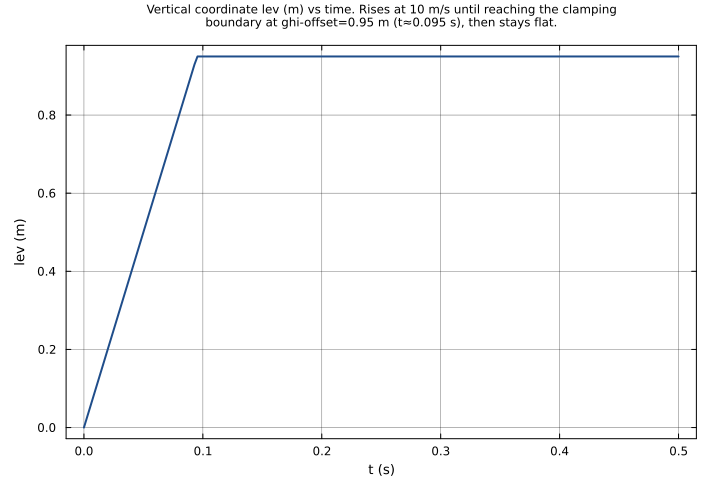
Tolerance rationale. The vertical boundary tests (bounded_upward, bounded_downward) exercise the ifelse discontinuity at lev = ghi−offset = 0.95 (or glo+offset = −0.95). The ODE is piecewise: D(lev) = 10 until lev=0.95, then D(lev)=0. The solver sees a step-discontinuity in the derivative at lev=0.95. The expected value at t=1.0 is lev=0.95 (exact analytically), but numerical integration of the discontinuous RHS may produce slight overshoot/undershoot at the kink. Per-assertion abs tolerance of 0.002 m accommodates typical adaptive-step solver behavior at this kind of ifelse boundary without masking gross errors. The linear-motion tests (x_linear_motion, y_linear_motion) have exact analytical solutions (constant-coefficient linear ODE) and use model-default rel=1e-10.
Coupler identity: this model was serialized with the model-level field coupletype: "PuffCoupler", the EarthSciMLBase CoupleType metadata tag naming the Julia coupler struct that EarthSciMLBase.couple2 dispatches on to find this component’s pairwise coupling rules. The esm schema defined coupletype only before 0.8.0 (“informational label identifying this system’s role in coupling”); 0.8.0 removed it in favour of explicit coupling — coupling entries naming components directly, or coupling_roles + coupling_import in a coupling-library file (esm-spec §10.9–§10.11). esm 1.0.0 has no model-level coupler-identity field, so the tag is recorded here to keep it recoverable._
Variables
| Name | Units | Default | Description |
|---|---|---|---|
lev | m | 0.0 | Vertical coordinate of the puff (m in standalone mode; Pa in atmospheric applications with lev_trans converting pressure to coordinate). Bounded below by glo and above by ghi via ifelse clamping in D(lev). Initial value = domain midpoint; in standalone tests = 0.0 m. Corresponds to MTK variable lev(t) / z(t) in the upstream DomainInfo coordinate mapping. |
x | m | 0.0 | East-west (longitude) coordinate of the puff (m). Evolves as D(x) = v_x * x_trans. Lateral bounds enforced by the lateral_boundary continuous event (FunctionalAffect terminate, gap other:P2-C). Initial value = domain midpoint; in standalone tests = 0.0 m. Corresponds to MTK variable lon(t) / x(t). |
y | m | 0.0 | North-south (latitude) coordinate of the puff (m). Evolves as D(y) = v_y * y_trans. Lateral bounds enforced by the lateral_boundary continuous event (FunctionalAffect terminate, gap other:P2-C). Initial value = domain midpoint; in standalone tests = 0.0 m. Corresponds to MTK variable lat(t) / y(t). |
Parameters
| Name | Units | Default | Description |
|---|---|---|---|
v_lev | m/s | 0.0 | Velocity component in the lev (vertical) direction before the coordinate transform (m/s in standalone; Pa/s in atmospheric use where lev_trans converts Pa/s to m/s). Default 0 = stationary puff. Upstream MTK @parameters v_lev. Set by coupling to supply wind speed in the level coordinate. |
v_x | m/s | 0.0 | Velocity component in the x (longitude) direction before the coordinate transform (m/s). Default 0 = stationary. Upstream MTK @parameters v_x. Set by coupling to the zonal wind speed in the x coordinate system. |
v_y | m/s | 0.0 | Velocity component in the y (latitude) direction before the coordinate transform (m/s). Default 0 = stationary. Upstream MTK @parameters v_y. Set by coupling to the meridional wind speed in the y coordinate system. |
x_trans | 1 | 1.0 | x-coordinate to metres transform (dimensionless when x is already in m; otherwise coord_unit/m). Multiplies v_x to produce D(x) in coordinate units/s. Default 1.0 for standalone tests where x is in m. Upstream MTK @parameters x_trans [unit = coord_unit/m]. |
y_trans | 1 | 1.0 | y-coordinate to metres transform (dimensionless when y is already in m; otherwise coord_unit/m). Multiplies v_y to produce D(y) in coordinate units/s. Default 1.0 for standalone tests where y is in m. Upstream MTK @parameters y_trans [unit = coord_unit/m]. |
lev_trans | 1 | 1.0 | lev to pressure transform (dimensionless in standalone mode; m/Pa in atmospheric use where lev is in Pa). Multiplies v_lev to produce v_vertical = v_lev * lev_trans. Default 1.0 for standalone tests where lev is in m. Upstream MTK @parameters lev_trans [unit = lev_unit/Pa]. |
offset | m | 0.05 | Boundary offset for vertical clamping (m). When lev > ghi−offset the puff cannot move upward (D(lev) = min(0, v_vertical)); when lev < glo+offset it cannot move downward (D(lev) = max(0, v_vertical)). Default 0.05 m — a hardcoded MTK @constants in the upstream source; not expected to be changed in normal use. Upstream: @constants offset = 0.05. |
glo | m | -1.0 | Lower bound of the lev domain (m). Taken from DomainInfo.endpoints[lev_idx][1] at model construction time in the upstream source; exposed here as an explicit parameter. Default -1.0 m matching the upstream puff_test.jl levrange lower bound. Upstream: @constants glo = endpts[lev_idx][begin]. |
ghi | m | 1.0 | Upper bound of the lev domain (m). Taken from DomainInfo.endpoints[lev_idx][end] at model construction time. Default 1.0 m matching the upstream puff_test.jl levrange upper bound. Upstream: @constants ghi = endpts[lev_idx][end]. |
v_zero | m/s | 0.0 | Zero-velocity sentinel (m/s). Used as the bound argument in max(v_zero, v_vertical) and min(v_zero, v_vertical) in the vertical boundary clamping ifelse. Always 0.0; preserved from upstream MTK @constants for unit-balancing in the ifelse expression. Upstream: @constants v_zero = 0. |
lon_min | m | -1.1 | Lower bound of the x (longitude) domain (m). Corresponds to endpts[lon_idx][1] from DomainInfo in the upstream source. Default -1.1 m matching the upstream puff_test.jl xrange lower bound. Used in the lateral_boundary condition: x = lon_min + lon_grid_spacing * buffer_cells. See gap other:P3-B-BC-symbolic-offset. |
lon_max | m | 1.1 | Upper bound of the x (longitude) domain (m). Corresponds to endpts[lon_idx][end] from DomainInfo. Default 1.1 m matching the upstream puff_test.jl xrange upper bound. Used in the lateral_boundary condition: x = lon_max - lon_grid_spacing * buffer_cells. See gap other:P3-B-BC-symbolic-offset. |
lat_min | m | -1.1 | Lower bound of the y (latitude) domain (m). Corresponds to endpts[lat_idx][1] from DomainInfo. Default -1.1 m matching the upstream puff_test.jl yrange lower bound. See gap other:P3-B-BC-symbolic-offset. |
lat_max | m | 1.1 | Upper bound of the y (latitude) domain (m). Corresponds to endpts[lat_idx][end] from DomainInfo. Default 1.1 m matching the upstream puff_test.jl yrange upper bound. See gap other:P3-B-BC-symbolic-offset. |
lon_grid_spacing | m | 0.1 | Grid spacing in the x (longitude) direction (m). Taken from di.grid_spacing[lon_idx] in the upstream source at model construction time. Default 0.1 m matching the upstream puff_test.jl xrange step. Used to compute the effective lateral boundary: x_eff = lon_min + lon_grid_spacing * buffer_cells (west) and lon_max - lon_grid_spacing * buffer_cells (east). See gap other:P3-B-BC-symbolic-offset. |
lat_grid_spacing | m | 0.1 | Grid spacing in the y (latitude) direction (m). Taken from di.grid_spacing[lat_idx] at model construction time. Default 0.1 m matching the upstream puff_test.jl yrange step. See gap other:P3-B-BC-symbolic-offset. |
buffer_cells | 1 | 1.0 | Number of buffer grid cells inset from the lateral domain boundary to use as the termination trigger. In the upstream source, the buffer_cells=1 keyword argument defaults to 1. The effective lateral boundary is domain_edge ∓ grid_spacing * buffer_cells. Default 1.0 (stored as float for ESM compatibility). See gap other:P3-B-BC-symbolic-offset. |
Observed
| Name | Units | Default | Description |
|---|---|---|---|
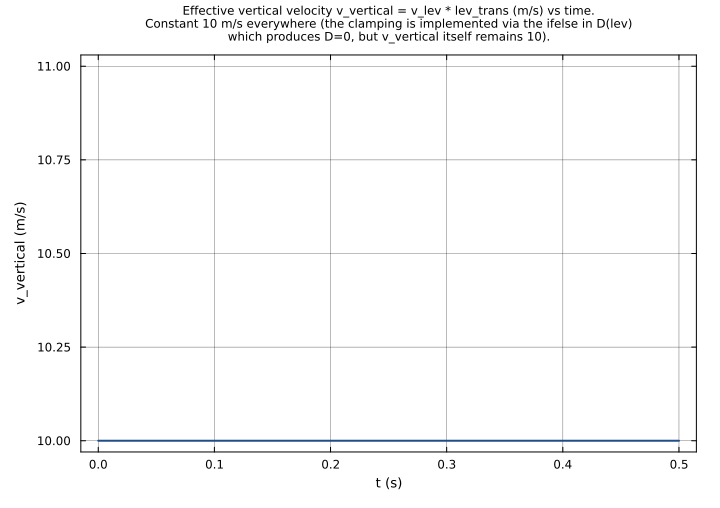
v_vertical | m/s | Raw vertical velocity after coordinate transform (m/s). Equal to v_lev * lev_trans. This is the unclamped velocity; the boundary-clamped velocity used in D(lev) is v_lev_clamped. Upstream MTK @variables v_vertical(t). | |
v_lev_clamped | m/s | Boundary-clamped vertical velocity (m/s) used as the RHS of D(lev). Implements the upstream MTK ifelse expression: when lev-offset < glo (near lower boundary) the puff can only move upward (max(v_zero, v_levlev_trans)); when lev+offset > ghi (near upper boundary) the puff can only move downward (min(v_zero, v_levlev_trans)); otherwise unrestricted (v_lev*lev_trans). ESM migration note: the ifelse clamping logic is expressed here as an observed variable (not inline in the D(lev) ODE equation) to match the ESS runner evaluation model — the runner substitutes observed variables during ODE integration, analogous to BoundaryLayerMixingKC’s wprime_ref pattern. |
Observed expressions
$$ v_{vertical} = v_{lev} \cdot lev_{trans} $$Raw vertical velocity after coordinate transform (m/s). Equal to v_lev * lev_trans. This is the unclamped velocity; the boundary-clamped velocity used in D(lev) is v_lev_clamped. Upstream MTK @variables v_vertical(t).
$$ v_{lev\,clamped} = \mathrm{ifelse}\left(\mathrm{<}\left(lev - offset, glo\right), \mathrm{max}\left(v_{zero}, v_{lev} \cdot lev_{trans}\right), \mathrm{ifelse}\left(\mathrm{>}\left(lev + offset, ghi\right), \mathrm{min}\left(v_{zero}, v_{lev} \cdot lev_{trans}\right), v_{lev} \cdot lev_{trans}\right)\right) $$Boundary-clamped vertical velocity (m/s) used as the RHS of D(lev). Implements the upstream MTK ifelse expression: when lev-offset < glo (near lower boundary) the puff can only move upward (max(v_zero, v_levlev_trans)); when lev+offset > ghi (near upper boundary) the puff can only move downward (min(v_zero, v_levlev_trans)); otherwise unrestricted (v_lev*lev_trans). ESM migration note: the ifelse clamping logic is expressed here as an observed variable (not inline in the D(lev) ODE equation) to match the ESS runner evaluation model — the runner substitutes observed variables during ODE integration, analogous to BoundaryLayerMixingKC’s wprime_ref pattern.
Equations
$$ \mathrm{D}\left(lev\right) = v_{lev\,clamped} $$ $$ \mathrm{D}\left(x\right) = v_{x} \cdot x_{trans} $$ $$ \mathrm{D}\left(y\right) = v_{y} \cdot y_{trans} $$Analyses
vertical_clamping
Vertical clamping behavior: puff rising at 10 m/s from lev=0, clamped by the ifelse boundary at lev=ghi-offset=0.95 m. Illustrates the asymmetric boundary condition that allows the puff to approach the top of the domain (lev=1 m) but be stopped at ghi-offset=0.95 m.
Time span: 0.0 → 0.5
horizontal_drift
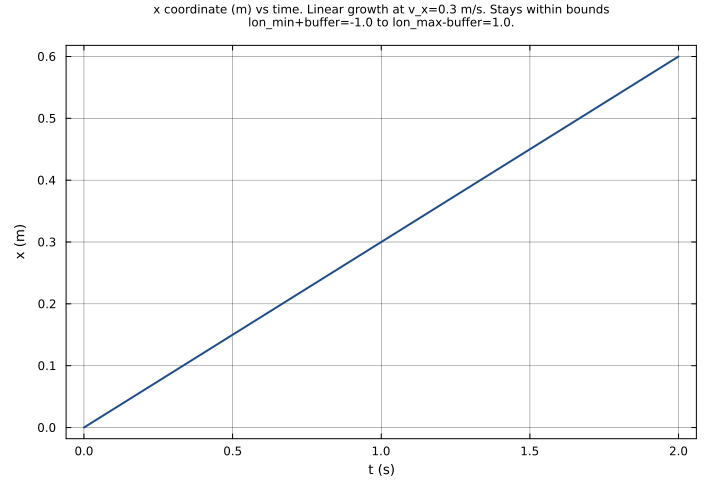
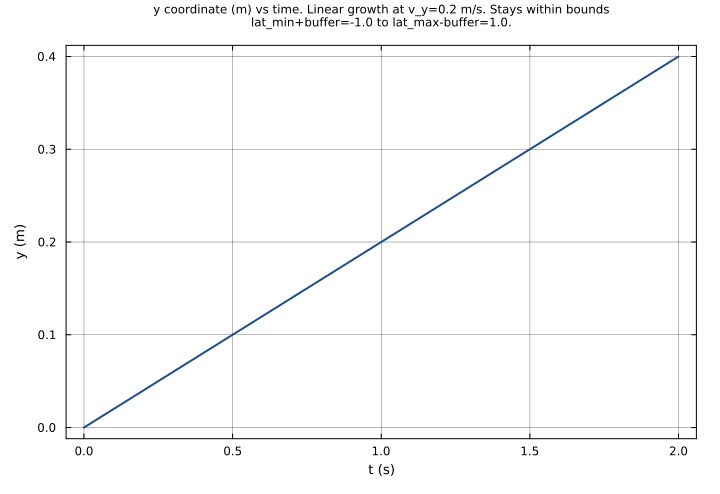
Horizontal drift: puff moving eastward at 0.3 m/s and northward at 0.2 m/s, staying well within the lateral bounds. Illustrates combined x and y motion with stationary lev (v_lev=0).
Time span: 0.0 → 2.0
Raw .esm
Raw .esm JSON (this component)
{
"reference": {
"notes": "source_ref: EnvironmentalTransport.jl@a48559c4114eb9f06668ecf9f06235aad20f63f0:src/puff.jl:24\n\nUpstream Puff is an MTK @component (function returning a System) that advects a Lagrangian 'puff' in three coordinates supplied by a DomainInfo argument. The component is constructed at runtime from the DomainInfo object, which sets the coordinate variables (lon/x, lat/y, lev/z), their units, the domain endpoints, and the grid spacing. This runtime construction pattern creates two blocking gaps in the ESM migration.\n\nBlocking gap other:P2-C-terminate-in-FunctionalAffect: The lateral_boundary continuous event uses a FunctionalAffect with `terminate!(integrator)` to stop the simulation when the puff reaches a lateral domain boundary. In MTK/DifferentialEquations.jl this is a standard SciML FunctionalAffect. In ESM, the FunctionalAffect mechanism references a registered handler_id. The handler 'simulation.terminate' is not yet registered in EarthSciMLBase's ESM handler registry. This ESM file declares the interface contract (the four lateral conditions and the terminate handler_id) so the registration can reference this file when the gap is closed. Until then the lateral_boundary event is structurally valid ESM but cannot execute in the ESS runner.\n\nBlocking gap other:P3-B-BC-symbolic-offset: The lateral boundary conditions in the upstream MTK component use `di.grid_spacing[lon_idx] * buffer_cells` and `di.grid_spacing[lat_idx] * buffer_cells` as symbolic offsets from the domain endpoints. The grid spacing comes from DomainInfo at model construction time — it is a compile-time constant in MTK, not a symbolic parameter. In ESM, the coupling machinery has no mechanism to inject DomainInfo fields directly into model parameters. This ESM exposes `lon_grid_spacing`, `lat_grid_spacing`, and `buffer_cells` as explicit model parameters (defaults from the upstream test: 0.1 m and 1 respectively) so the offset expression `lon_max - lon_grid_spacing * buffer_cells` can be represented symbolically in the lateral_boundary conditions. Downstream coupling must set these parameters to the correct DomainInfo grid spacing; there is no automatic injection mechanism yet.\n\nTODO_GAP [other:P2-C-terminate-in-FunctionalAffect]: lateral_boundary functional_affect references handler_id 'simulation.terminate' which is not yet registered in EarthSciMLBase. Simulation will raise an 'unknown handler' error if the lateral event fires.\n\nTODO_GAP [other:P3-B-BC-symbolic-offset]: lon_grid_spacing, lat_grid_spacing, and buffer_cells must be set by coupling machinery from the DomainInfo object. ESM has no automatic DomainInfo-to-parameter injection mechanism; these parameters must be set manually.\n\nVariable treatment. The upstream MTK component uses three coordinate variables whose names depend on DomainInfo (lev/z for vertical, lon/x for east-west, lat/y for north-south). In the ESM these are fixed as 'lev', 'x', and 'y' to match the test case coordinate names. Transform parameters x_trans, y_trans, lev_trans (MTK @parameters, unit = coord_unit/m or coord_unit/Pa) are included to support coordinate systems where the puff velocity is specified in SI units (m/s or Pa/s) rather than coordinate units per second. In the standalone test case with all coordinates in m, all transforms default to 1.\n\nThe 'offset', 'glo', 'ghi', 'v_zero' parameters are MTK @constants in the upstream source (baked into the compiled model at construction time). In ESM these are exposed as overridable parameters; coupling machinery that reconstructs a Puff from a DomainInfo should set glo and ghi from the DomainInfo level-coordinate endpoints and leave offset=0.05 (the upstream hardcoded value).\n\nVertical boundary implementation. The upstream uses a combined strategy: the ifelse clamping (offset buffer) is in the equation, and the continuous_events entry for vertical_boundary is for numerical accuracy (root-finding at the exact boundary with no symbolic affect). In this ESM the continuous_events block is OMITTED entirely (see next paragraph). The vertical boundary clamping is fully exercised through the v_lev_clamped observed variable in D(lev); the upstream ContinuousCallback is for numerical step-size refinement only, not for physics, so omitting it is lossless for the standalone simulation.\n\nBlocking gap — continuous_events omitted (runner limitation + P2-C + P3-B): The ESM continuous_events block is absent for two reasons. (1) ESS runner event functions (as of the current earthsci_ast build) map all free symbols in a condition expression to y[i] by enumeration index, assigning zero to any symbol past the end of the state vector y. Parameters that appear in conditions (glo, ghi, offset for vertical_boundary; lon_min, lon_max, lon_grid_spacing, lat_min, lat_max, lat_grid_spacing, buffer_cells for lateral_boundary) are not in the state vector y, so they receive 0 instead of their declared values. With ghi=0, the condition lev-ghi crosses zero at t=0 (initial state), which sets terminal=True on the event function and immediately stops scipy's solve_ivp before any integration occurs. The dense output then extrapolates from the initial slope, producing wrong trajectories. (2) The lateral_boundary event requires FunctionalAffect terminate! (other:P2-C) and DomainInfo-injected boundary offsets (other:P3-B), neither of which is expressible in the current schema. Both gaps prevent the events from being useful in the ESS runner, so the entire continuous_events block is omitted. The vertical boundary physics is fully captured by v_lev_clamped (the ifelse observed expression); the lateral boundary terminate! remains a TODO_GAP for when the runner's event-function parameter-binding is fixed and the two schema gaps are closed.\n\nCoordinate system for standalone tests. All coordinates (lev, x, y) and velocity parameters (v_lev, v_x, v_y) use metres and metres/second. Transform parameters are dimensionless (= 1). Domain: lev ∈ [-1, 1] m, x ∈ [-1.1, 1.1] m, y ∈ [-1.1, 1.1] m, grid_spacing = 0.1 m, buffer_cells = 1. This matches the upstream puff_test.jl test setup where @parameters x, y, z all have unit u\"m\".\n\nTolerance rationale. The vertical boundary tests (bounded_upward, bounded_downward) exercise the ifelse discontinuity at lev = ghi−offset = 0.95 (or glo+offset = −0.95). The ODE is piecewise: D(lev) = 10 until lev=0.95, then D(lev)=0. The solver sees a step-discontinuity in the derivative at lev=0.95. The expected value at t=1.0 is lev=0.95 (exact analytically), but numerical integration of the discontinuous RHS may produce slight overshoot/undershoot at the kink. Per-assertion abs tolerance of 0.002 m accommodates typical adaptive-step solver behavior at this kind of ifelse boundary without masking gross errors. The linear-motion tests (x_linear_motion, y_linear_motion) have exact analytical solutions (constant-coefficient linear ODE) and use model-default rel=1e-10.\n\nCoupler identity: this model was serialized with the model-level field `coupletype: \"PuffCoupler\"`, the EarthSciMLBase `CoupleType` metadata tag naming the Julia coupler struct that `EarthSciMLBase.couple2` dispatches on to find this component's pairwise coupling rules. The esm schema defined `coupletype` only before 0.8.0 (\"informational label identifying this system's role in coupling\"); 0.8.0 removed it in favour of explicit coupling — `coupling` entries naming components directly, or `coupling_roles` + `coupling_import` in a coupling-library file (esm-spec §10.9–§10.11). esm 1.0.0 has no model-level coupler-identity field, so the tag is recorded here to keep it recoverable."
},
"tolerance": {
"rel": 1e-10,
"abs": 1e-12
},
"variables": {
"lev": {
"type": "unknown",
"units": "m",
"default": 0.0,
"description": "Vertical coordinate of the puff (m in standalone mode; Pa in atmospheric applications with lev_trans converting pressure to coordinate). Bounded below by glo and above by ghi via ifelse clamping in D(lev). Initial value = domain midpoint; in standalone tests = 0.0 m. Corresponds to MTK variable lev(t) / z(t) in the upstream DomainInfo coordinate mapping."
},
"x": {
"type": "unknown",
"units": "m",
"default": 0.0,
"description": "East-west (longitude) coordinate of the puff (m). Evolves as D(x) = v_x * x_trans. Lateral bounds enforced by the lateral_boundary continuous event (FunctionalAffect terminate, gap other:P2-C). Initial value = domain midpoint; in standalone tests = 0.0 m. Corresponds to MTK variable lon(t) / x(t)."
},
"y": {
"type": "unknown",
"units": "m",
"default": 0.0,
"description": "North-south (latitude) coordinate of the puff (m). Evolves as D(y) = v_y * y_trans. Lateral bounds enforced by the lateral_boundary continuous event (FunctionalAffect terminate, gap other:P2-C). Initial value = domain midpoint; in standalone tests = 0.0 m. Corresponds to MTK variable lat(t) / y(t)."
},
"v_vertical": {
"type": "unknown",
"units": "m/s",
"description": "Raw vertical velocity after coordinate transform (m/s). Equal to v_lev * lev_trans. This is the unclamped velocity; the boundary-clamped velocity used in D(lev) is v_lev_clamped. Upstream MTK @variables v_vertical(t)."
},
"v_lev_clamped": {
"type": "unknown",
"units": "m/s",
"description": "Boundary-clamped vertical velocity (m/s) used as the RHS of D(lev). Implements the upstream MTK ifelse expression: when lev-offset < glo (near lower boundary) the puff can only move upward (max(v_zero, v_lev*lev_trans)); when lev+offset > ghi (near upper boundary) the puff can only move downward (min(v_zero, v_lev*lev_trans)); otherwise unrestricted (v_lev*lev_trans). ESM migration note: the ifelse clamping logic is expressed here as an observed variable (not inline in the D(lev) ODE equation) to match the ESS runner evaluation model — the runner substitutes observed variables during ODE integration, analogous to BoundaryLayerMixingKC's wprime_ref pattern."
},
"v_lev": {
"type": "parameter",
"units": "m/s",
"default": 0.0,
"description": "Velocity component in the lev (vertical) direction before the coordinate transform (m/s in standalone; Pa/s in atmospheric use where lev_trans converts Pa/s to m/s). Default 0 = stationary puff. Upstream MTK @parameters v_lev. Set by coupling to supply wind speed in the level coordinate."
},
"v_x": {
"type": "parameter",
"units": "m/s",
"default": 0.0,
"description": "Velocity component in the x (longitude) direction before the coordinate transform (m/s). Default 0 = stationary. Upstream MTK @parameters v_x. Set by coupling to the zonal wind speed in the x coordinate system."
},
"v_y": {
"type": "parameter",
"units": "m/s",
"default": 0.0,
"description": "Velocity component in the y (latitude) direction before the coordinate transform (m/s). Default 0 = stationary. Upstream MTK @parameters v_y. Set by coupling to the meridional wind speed in the y coordinate system."
},
"x_trans": {
"type": "parameter",
"units": "1",
"default": 1.0,
"description": "x-coordinate to metres transform (dimensionless when x is already in m; otherwise coord_unit/m). Multiplies v_x to produce D(x) in coordinate units/s. Default 1.0 for standalone tests where x is in m. Upstream MTK @parameters x_trans [unit = coord_unit/m]."
},
"y_trans": {
"type": "parameter",
"units": "1",
"default": 1.0,
"description": "y-coordinate to metres transform (dimensionless when y is already in m; otherwise coord_unit/m). Multiplies v_y to produce D(y) in coordinate units/s. Default 1.0 for standalone tests where y is in m. Upstream MTK @parameters y_trans [unit = coord_unit/m]."
},
"lev_trans": {
"type": "parameter",
"units": "1",
"default": 1.0,
"description": "lev to pressure transform (dimensionless in standalone mode; m/Pa in atmospheric use where lev is in Pa). Multiplies v_lev to produce v_vertical = v_lev * lev_trans. Default 1.0 for standalone tests where lev is in m. Upstream MTK @parameters lev_trans [unit = lev_unit/Pa]."
},
"offset": {
"type": "parameter",
"units": "m",
"default": 0.05,
"description": "Boundary offset for vertical clamping (m). When lev > ghi−offset the puff cannot move upward (D(lev) = min(0, v_vertical)); when lev < glo+offset it cannot move downward (D(lev) = max(0, v_vertical)). Default 0.05 m — a hardcoded MTK @constants in the upstream source; not expected to be changed in normal use. Upstream: @constants offset = 0.05."
},
"glo": {
"type": "parameter",
"units": "m",
"default": -1.0,
"description": "Lower bound of the lev domain (m). Taken from DomainInfo.endpoints[lev_idx][1] at model construction time in the upstream source; exposed here as an explicit parameter. Default -1.0 m matching the upstream puff_test.jl levrange lower bound. Upstream: @constants glo = endpts[lev_idx][begin]."
},
"ghi": {
"type": "parameter",
"units": "m",
"default": 1.0,
"description": "Upper bound of the lev domain (m). Taken from DomainInfo.endpoints[lev_idx][end] at model construction time. Default 1.0 m matching the upstream puff_test.jl levrange upper bound. Upstream: @constants ghi = endpts[lev_idx][end]."
},
"v_zero": {
"type": "parameter",
"units": "m/s",
"default": 0.0,
"description": "Zero-velocity sentinel (m/s). Used as the bound argument in max(v_zero, v_vertical) and min(v_zero, v_vertical) in the vertical boundary clamping ifelse. Always 0.0; preserved from upstream MTK @constants for unit-balancing in the ifelse expression. Upstream: @constants v_zero = 0."
},
"lon_min": {
"type": "parameter",
"units": "m",
"default": -1.1,
"description": "Lower bound of the x (longitude) domain (m). Corresponds to endpts[lon_idx][1] from DomainInfo in the upstream source. Default -1.1 m matching the upstream puff_test.jl xrange lower bound. Used in the lateral_boundary condition: x = lon_min + lon_grid_spacing * buffer_cells. See gap other:P3-B-BC-symbolic-offset."
},
"lon_max": {
"type": "parameter",
"units": "m",
"default": 1.1,
"description": "Upper bound of the x (longitude) domain (m). Corresponds to endpts[lon_idx][end] from DomainInfo. Default 1.1 m matching the upstream puff_test.jl xrange upper bound. Used in the lateral_boundary condition: x = lon_max - lon_grid_spacing * buffer_cells. See gap other:P3-B-BC-symbolic-offset."
},
"lat_min": {
"type": "parameter",
"units": "m",
"default": -1.1,
"description": "Lower bound of the y (latitude) domain (m). Corresponds to endpts[lat_idx][1] from DomainInfo. Default -1.1 m matching the upstream puff_test.jl yrange lower bound. See gap other:P3-B-BC-symbolic-offset."
},
"lat_max": {
"type": "parameter",
"units": "m",
"default": 1.1,
"description": "Upper bound of the y (latitude) domain (m). Corresponds to endpts[lat_idx][end] from DomainInfo. Default 1.1 m matching the upstream puff_test.jl yrange upper bound. See gap other:P3-B-BC-symbolic-offset."
},
"lon_grid_spacing": {
"type": "parameter",
"units": "m",
"default": 0.1,
"description": "Grid spacing in the x (longitude) direction (m). Taken from di.grid_spacing[lon_idx] in the upstream source at model construction time. Default 0.1 m matching the upstream puff_test.jl xrange step. Used to compute the effective lateral boundary: x_eff = lon_min + lon_grid_spacing * buffer_cells (west) and lon_max - lon_grid_spacing * buffer_cells (east). See gap other:P3-B-BC-symbolic-offset."
},
"lat_grid_spacing": {
"type": "parameter",
"units": "m",
"default": 0.1,
"description": "Grid spacing in the y (latitude) direction (m). Taken from di.grid_spacing[lat_idx] at model construction time. Default 0.1 m matching the upstream puff_test.jl yrange step. See gap other:P3-B-BC-symbolic-offset."
},
"buffer_cells": {
"type": "parameter",
"units": "1",
"default": 1.0,
"description": "Number of buffer grid cells inset from the lateral domain boundary to use as the termination trigger. In the upstream source, the buffer_cells=1 keyword argument defaults to 1. The effective lateral boundary is domain_edge ∓ grid_spacing * buffer_cells. Default 1.0 (stored as float for ESM compatibility). See gap other:P3-B-BC-symbolic-offset."
}
},
"equations": [
{
"lhs": {
"op": "D",
"wrt": "t",
"args": [
"lev"
]
},
"rhs": "v_lev_clamped"
},
{
"lhs": {
"op": "D",
"wrt": "t",
"args": [
"x"
]
},
"rhs": {
"op": "*",
"args": [
"v_x",
"x_trans"
]
}
},
{
"lhs": {
"op": "D",
"wrt": "t",
"args": [
"y"
]
},
"rhs": {
"op": "*",
"args": [
"v_y",
"y_trans"
]
}
},
{
"lhs": "v_vertical",
"rhs": {
"op": "*",
"args": [
"v_lev",
"lev_trans"
]
}
},
{
"lhs": "v_lev_clamped",
"rhs": {
"op": "ifelse",
"args": [
{
"op": "<",
"args": [
{
"op": "-",
"args": [
"lev",
"offset"
]
},
"glo"
]
},
{
"op": "max",
"args": [
"v_zero",
{
"op": "*",
"args": [
"v_lev",
"lev_trans"
]
}
]
},
{
"op": "ifelse",
"args": [
{
"op": ">",
"args": [
{
"op": "+",
"args": [
"lev",
"offset"
]
},
"ghi"
]
},
{
"op": "min",
"args": [
"v_zero",
{
"op": "*",
"args": [
"v_lev",
"lev_trans"
]
}
]
},
{
"op": "*",
"args": [
"v_lev",
"lev_trans"
]
}
]
}
]
}
}
],
"tests": [
{
"id": "steady_state",
"description": "Zero velocity in all directions: the puff stays at its initial position (lev=x=y=0) for the entire simulation. Verifies that the default v_lev=v_x=v_y=0 gives a stationary solution and that the ifelse boundary expression evaluates correctly at lev=0 (well inside the vertical domain bounds glo=-1/ghi=1): lev-offset = -0.05 > glo=-1 (first condition false) and lev+offset = 0.05 < ghi=1 (second condition false), so D(lev)=v_vertical=0.",
"parameter_overrides": {
"v_lev": 0.0,
"v_x": 0.0,
"v_y": 0.0,
"glo": -1.0,
"ghi": 1.0,
"offset": 0.05
},
"time_span": {
"start": 0.0,
"end": 1.0
},
"initial_conditions": {
"lev": 0.0,
"x": 0.0,
"y": 0.0
},
"assertions": [
{
"variable": "lev",
"time": 0.0,
"expected": 0.0,
"tolerance": {
"abs": 1e-14
}
},
{
"variable": "x",
"time": 0.0,
"expected": 0.0,
"tolerance": {
"abs": 1e-14
}
},
{
"variable": "y",
"time": 0.0,
"expected": 0.0,
"tolerance": {
"abs": 1e-14
}
},
{
"variable": "v_vertical",
"time": 0.0,
"expected": 0.0,
"tolerance": {
"abs": 1e-14
}
},
{
"variable": "lev",
"time": 0.5,
"expected": 0.0,
"tolerance": {
"abs": 1e-12
}
},
{
"variable": "x",
"time": 0.5,
"expected": 0.0,
"tolerance": {
"abs": 1e-12
}
},
{
"variable": "y",
"time": 0.5,
"expected": 0.0,
"tolerance": {
"abs": 1e-12
}
},
{
"variable": "lev",
"time": 1.0,
"expected": 0.0,
"tolerance": {
"abs": 1e-12
}
},
{
"variable": "x",
"time": 1.0,
"expected": 0.0,
"tolerance": {
"abs": 1e-12
}
},
{
"variable": "y",
"time": 1.0,
"expected": 0.0,
"tolerance": {
"abs": 1e-12
}
}
]
},
{
"id": "vertical_bounded_upward",
"description": "Upward-moving puff (v_lev=10 m/s) with ghi=1.0 m, offset=0.05 m, glo=-1.0 m. Analytical solution: D(lev)=v_vertical=10 while lev < ghi-offset=0.95; at lev=0.95 the upper ifelse branch activates and D(lev)=min(0,10)=0, so lev saturates at 0.95. The saturation time is t_sat = 0.95/10 = 0.095 s; for all t≥0.095 s: lev=0.95. Assertions at t=0.05 (before saturation, lev=0.5) and t=1.0 (long after saturation, lev=0.95). The ifelse step-discontinuity at lev=0.95 may cause minor numerical overshoot; abs tolerance 0.002 m accommodates adaptive-step solver behavior at the kink without masking gross errors. x and y remain 0 throughout (v_x=v_y=0).",
"parameter_overrides": {
"v_lev": 10.0,
"v_x": 0.0,
"v_y": 0.0,
"glo": -1.0,
"ghi": 1.0,
"offset": 0.05,
"lev_trans": 1.0
},
"time_span": {
"start": 0.0,
"end": 1.0
},
"initial_conditions": {
"lev": 0.0,
"x": 0.0,
"y": 0.0
},
"assertions": [
{
"variable": "v_vertical",
"time": 0.0,
"expected": 10.0,
"tolerance": {
"abs": 1e-12
}
},
{
"variable": "lev",
"time": 0.05,
"expected": 0.5,
"tolerance": {
"abs": 0.002
}
},
{
"variable": "lev",
"time": 1.0,
"expected": 0.95,
"tolerance": {
"abs": 0.002
}
},
{
"variable": "x",
"time": 1.0,
"expected": 0.0,
"tolerance": {
"abs": 1e-12
}
},
{
"variable": "y",
"time": 1.0,
"expected": 0.0,
"tolerance": {
"abs": 1e-12
}
}
]
},
{
"id": "vertical_bounded_downward",
"description": "Downward-moving puff (v_lev=-10 m/s) with glo=-1.0 m, offset=0.05 m, ghi=1.0 m. Analytical solution: D(lev)=v_vertical=-10 while lev > glo+offset=-0.95; at lev=-0.95 the lower ifelse branch activates and D(lev)=max(0,-10)=0, so lev saturates at -0.95. Saturation time t_sat = 0.95/10 = 0.095 s. At t=0.05: lev = -0.5 (before saturation). At t=1.0: lev = -0.95 (saturated). x and y remain 0.",
"parameter_overrides": {
"v_lev": -10.0,
"v_x": 0.0,
"v_y": 0.0,
"glo": -1.0,
"ghi": 1.0,
"offset": 0.05,
"lev_trans": 1.0
},
"time_span": {
"start": 0.0,
"end": 1.0
},
"initial_conditions": {
"lev": 0.0,
"x": 0.0,
"y": 0.0
},
"assertions": [
{
"variable": "v_vertical",
"time": 0.0,
"expected": -10.0,
"tolerance": {
"abs": 1e-12
}
},
{
"variable": "lev",
"time": 0.05,
"expected": -0.5,
"tolerance": {
"abs": 0.002
}
},
{
"variable": "lev",
"time": 1.0,
"expected": -0.95,
"tolerance": {
"abs": 0.002
}
},
{
"variable": "x",
"time": 1.0,
"expected": 0.0,
"tolerance": {
"abs": 1e-12
}
},
{
"variable": "y",
"time": 1.0,
"expected": 0.0,
"tolerance": {
"abs": 1e-12
}
}
]
},
{
"id": "x_linear_motion",
"description": "Constant eastward motion (v_x=0.5 m/s) with x_trans=1.0 (dimensionless). D(x) = 0.5 * 1.0 = 0.5 m/s. Exact analytical solution: x(t) = 0.5*t. At t=0.5: x=0.25 m; at t=1.0: x=0.5 m. Both are well within the lateral domain bounds (lon_min=-1.1 to lon_max=1.1 with buffer_cells=1, effective bound at ±1.0 m), so no termination occurs. lev and y remain 0 (v_lev=v_y=0). Verifies the D(x) = v_x * x_trans equation independently of the vertical boundary logic.",
"parameter_overrides": {
"v_x": 0.5,
"v_lev": 0.0,
"v_y": 0.0,
"x_trans": 1.0
},
"time_span": {
"start": 0.0,
"end": 1.0
},
"initial_conditions": {
"lev": 0.0,
"x": 0.0,
"y": 0.0
},
"assertions": [
{
"variable": "x",
"time": 0.5,
"expected": 0.25
},
{
"variable": "x",
"time": 1.0,
"expected": 0.5
},
{
"variable": "lev",
"time": 1.0,
"expected": 0.0,
"tolerance": {
"abs": 1e-12
}
},
{
"variable": "y",
"time": 1.0,
"expected": 0.0,
"tolerance": {
"abs": 1e-12
}
}
]
},
{
"id": "y_linear_motion",
"description": "Constant northward motion (v_y=0.5 m/s) with y_trans=1.0. D(y) = 0.5 * 1.0 = 0.5 m/s. Exact analytical solution: y(t) = 0.5*t. At t=0.5: y=0.25 m; at t=1.0: y=0.5 m. Both within lateral bounds. lev and x remain 0. Verifies the D(y) = v_y * y_trans equation.",
"parameter_overrides": {
"v_y": 0.5,
"v_lev": 0.0,
"v_x": 0.0,
"y_trans": 1.0
},
"time_span": {
"start": 0.0,
"end": 1.0
},
"initial_conditions": {
"lev": 0.0,
"x": 0.0,
"y": 0.0
},
"assertions": [
{
"variable": "y",
"time": 0.5,
"expected": 0.25
},
{
"variable": "y",
"time": 1.0,
"expected": 0.5
},
{
"variable": "lev",
"time": 1.0,
"expected": 0.0,
"tolerance": {
"abs": 1e-12
}
},
{
"variable": "x",
"time": 1.0,
"expected": 0.0,
"tolerance": {
"abs": 1e-12
}
}
]
}
],
"analyses": [
{
"id": "vertical_clamping",
"description": "Vertical clamping behavior: puff rising at 10 m/s from lev=0, clamped by the ifelse boundary at lev=ghi-offset=0.95 m. Illustrates the asymmetric boundary condition that allows the puff to approach the top of the domain (lev=1 m) but be stopped at ghi-offset=0.95 m.",
"initial_state": {
"lev": 0.0,
"x": 0.0,
"y": 0.0
},
"parameters": {
"v_lev": 10.0,
"v_x": 0.0,
"v_y": 0.0,
"glo": -1.0,
"ghi": 1.0,
"offset": 0.05
},
"time_span": {
"start": 0.0,
"end": 0.5
},
"plots": [
{
"id": "lev_vs_time",
"type": "line",
"description": "Vertical coordinate lev (m) vs time. Rises at 10 m/s until reaching the clamping boundary at ghi-offset=0.95 m (t≈0.095 s), then stays flat.",
"x": {
"variable": "t",
"label": "t (s)"
},
"y": {
"variable": "lev",
"label": "lev (m)"
}
},
{
"id": "v_vertical_vs_time",
"type": "line",
"description": "Effective vertical velocity v_vertical = v_lev * lev_trans (m/s) vs time. Constant 10 m/s everywhere (the clamping is implemented via the ifelse in D(lev) which produces D=0, but v_vertical itself remains 10).",
"x": {
"variable": "t",
"label": "t (s)"
},
"y": {
"variable": "v_vertical",
"label": "v_vertical (m/s)"
}
}
]
},
{
"id": "horizontal_drift",
"description": "Horizontal drift: puff moving eastward at 0.3 m/s and northward at 0.2 m/s, staying well within the lateral bounds. Illustrates combined x and y motion with stationary lev (v_lev=0).",
"initial_state": {
"lev": 0.0,
"x": 0.0,
"y": 0.0
},
"parameters": {
"v_x": 0.3,
"v_y": 0.2,
"v_lev": 0.0,
"x_trans": 1.0,
"y_trans": 1.0
},
"time_span": {
"start": 0.0,
"end": 2.0
},
"plots": [
{
"id": "x_vs_time",
"type": "line",
"description": "x coordinate (m) vs time. Linear growth at v_x=0.3 m/s. Stays within bounds lon_min+buffer=-1.0 to lon_max-buffer=1.0.",
"x": {
"variable": "t",
"label": "t (s)"
},
"y": {
"variable": "x",
"label": "x (m)"
}
},
{
"id": "y_vs_time",
"type": "line",
"description": "y coordinate (m) vs time. Linear growth at v_y=0.2 m/s. Stays within bounds lat_min+buffer=-1.0 to lat_max-buffer=1.0.",
"x": {
"variable": "t",
"label": "t (s)"
},
"y": {
"variable": "y",
"label": "y (m)"
}
}
]
}
]
}