Sofiev2012PlumeRise
Wildfire plume-rise model based on Sofiev et al. (2012). Computes plume top height H_p (m) as a function of atmospheric boundary-layer height H_abl (m), free-troposphere Brunt-Väisälä frequency N_ft (s⁻¹), and fire radiative power P_fr (W) via one empirical algebraic equation: H_p = α·H_abl + β·(P_fr/P_f0)^γ · exp(−δ·N_ft²/N_0²). The five empirical constants (α=0.24, β=170 m, γ=0.35, δ=0.6, N_0=√(2.5×10⁻⁴) s⁻¹) are from Sofiev et al. (2012). In a coupled model H_abl and N_ft are supplied by GEOSFP reanalysis; the additional variable lev_p (plume-top pressure level index) is computed from H_p by the GEOSFP coupler via a Newton-iteration height-to-level mapping. Migrated from EnvironmentalTransport.jl@a48559c4114eb9f06668ecf9f06235aad20f63f0 src/plume_rise/sofiev_2012.jl:14.
Description
Wildfire plume-rise model based on Sofiev et al. (2012). Computes plume top height H_p (m) as a function of atmospheric boundary-layer height H_abl (m), free-troposphere Brunt-Väisälä frequency N_ft (s⁻¹), and fire radiative power P_fr (W) via one empirical algebraic equation: H_p = α·H_abl + β·(P_fr/P_f0)^γ · exp(−δ·N_ft²/N_0²). The five empirical constants (α=0.24, β=170 m, γ=0.35, δ=0.6, N_0=√(2.5×10⁻⁴) s⁻¹) are from Sofiev et al. (2012). In a coupled model H_abl and N_ft are supplied by GEOSFP reanalysis; the additional variable lev_p (plume-top pressure level index) is computed from H_p by the GEOSFP coupler via a Newton-iteration height-to-level mapping. Migrated from EnvironmentalTransport.jl@a48559c4114eb9f06668ecf9f06235aad20f63f0 src/plume_rise/sofiev_2012.jl:14.
Reference
_source_ref: EnvironmentalTransport.jl@a48559c4114eb9f06668ecf9f06235aad20f63f0:src/plume_rise/sofiev_2012.jl:14
Upstream Sofiev2012PlumeRise is an MTK @component (function returning a System) that computes wildfire plume-top height using the Sofiev et al. (2012) empirical formula. The component declares 11 @parameters and 4 time-indexed @variables, with a single algebraic equation: H_p ~ α·H_abl + β·(P_fr/P_f0)^γ · exp(−δ·N_ft²/N_0²).
Variable and parameter treatment. The upstream source declares H_abl and N_ft as @variables (time-dependent), supplied at runtime via GEOSFP coupling (EarthSciDataExt.jl: s12.H_abl ~ _parent_scope(gfp.A1₊PBLH_itp)(...), s12.N_ft ~ sqrt(0.5*(N2+abs(N2))) where N2 is from a virtual-potential-temperature gradient). In the standalone ESM these are declared as parameter (constant in tests), following the precedent of GaussianKC where coupling inputs are parameters in the isolated component.
The variable lev_p (plume-top pressure-level index) has NO equation in the standalone component. When coupled to GEOSFP (EarthSciDataExt.jl), lev_p is driven by s12.lev_p ~ lev_from_height(s12.H_p), a Newton-iteration height-to-level mapping built from GEOSFP hybrid Ap/Bp coefficients and the hypsometric equation. This non-trivial mapping cannot be expressed as a standalone ESM equation without the GEOSFP function tables, so lev_p is declared as a state variable with a default initial value of 5.0 (the solver guess from the upstream test) and is not asserted in inline tests.
The parameter h_to_lev=100 m is used in the GEOSFP coupler as an initial linear guess for the height-to-level Newton iteration (ℓ0 = clamp(H_p / h_to_lev, LMIN, LMAX)). It does not appear in the standalone equation. Similarly Rd, g, and Punit are constants exported to the GEOSFP coupler for the hypsometric equation but are not used in the standalone H_p formula.
Note on migration tracker blocking gap. The tracker lists this bead as gt-ebuq (init_eq/system_kind). Investigation of the upstream source (sofiev_2012.jl:14) confirms the initialization_equations and guesses appear ONLY in the upstream test (sofiev_2012_test.jl): ODEProblem(..., initialization_eqs=[sys.Puff₊lev ~ sys.Sofiev2012PlumeRise₊lev_p], guesses=[sys.Puff₊lev => 5.0]). These belong to the COUPLED system (Puff + Sofiev2012PlumeRise + GEOSFP), not to the Sofiev2012PlumeRise component itself. The System(eqs, t, ...) call in the upstream source has no initialization_equations or guesses arguments. The gt-ebuq label is therefore inapplicable to this standalone component, analogous to the MogiModel/McTigueModel precedent.
System kind: the single upstream equation is an explicit algebraic assignment with no D(.) operator. H_p is purely a function of parameters and coupling inputs H_abl / N_ft. system_kind is left unset (default ‘ode’, zero differential states), matching all other explicit-algebraic components.
Parameter defaults. P_f0=1 MW and N_0=√(2.5×10⁻⁴) s⁻¹ are reference constants from Sofiev et al. (2012). P_fr=5 MW is the default fire radiative power. H_abl=1000 m and N_ft=N_0 are representative mid-latitude daytime values used for standalone testing.
Tolerance rationale. Closed-form algebraic evaluation via a single exp/power chain — no ODE integration, no implicit solve. Relative tolerance 1e-10 covers float64 round-off.
Coupler identity: this model was serialized with the model-level field coupletype: "Sofiev2012PlumeRiseCoupler", the EarthSciMLBase CoupleType metadata tag naming the Julia coupler struct that EarthSciMLBase.couple2 dispatches on to find this component’s pairwise coupling rules. The esm schema defined coupletype only before 0.8.0 (“informational label identifying this system’s role in coupling”); 0.8.0 removed it in favour of explicit coupling — coupling entries naming components directly, or coupling_roles + coupling_import in a coupling-library file (esm-spec §10.9–§10.11). esm 1.0.0 has no model-level coupler-identity field, so the tag is recorded here to keep it recoverable._
Parameters
| Name | Units | Default | Description |
|---|---|---|---|
P_f0 | W | 1000000.0 | Reference fire radiative power (W). Appears as the denominator in the dimensionless power ratio (P_fr/P_f0)^γ. Sofiev et al. (2012) calibrated the formula using P_f0 = 1 MW as the normalisation constant. Upstream MTK @parameter. |
N_0 | 1/s | 0.015811388300841896 | Reference Brunt-Väisälä frequency (s⁻¹), N_0 = √(2.5×10⁻⁴) s⁻¹ ≈ 0.0158 s⁻¹. Appears squared in the stability exponent exp(−δ·N_ft²/N_0²). When N_ft = N_0 the exponent is exp(−δ) ≈ 0.549 (δ=0.6). Upstream MTK @parameter; default from Sofiev et al. (2012). |
α | 1 | 0.24 | Empirical scaling coefficient for the boundary-layer contribution to plume height (dimensionless). H_p = α·H_abl + β·(…): α controls how much of the boundary-layer height is incorporated into the plume top. Sofiev et al. (2012) fit α = 0.24 from a global satellite-detected injection-height dataset. Upstream MTK @parameter. |
β | m | 170.0 | Empirical amplitude coefficient for the fire-power contribution to plume height (m). β·(P_fr/P_f0)^γ is the power-dependent term before the stability correction. β = 170 m from Sofiev et al. (2012). Upstream MTK @parameter. |
γ | 1 | 0.35 | Empirical exponent for the fire-power scaling (dimensionless). Appears as the exponent of the normalised fire power (P_fr/P_f0)^γ. γ = 0.35 from Sofiev et al. (2012): sub-linear scaling means doubling fire power increases plume height by a factor of 2^0.35 ≈ 1.27. Upstream MTK @parameter. |
δ | 1 | 0.6 | Empirical stability-suppression exponent (dimensionless). Appears in the atmospheric-stability correction exp(−δ·N_ft²/N_0²): larger δ increases the suppression of plume rise by free-tropospheric stability. δ = 0.6 from Sofiev et al. (2012). Upstream MTK @parameter. |
Rd | J/(kg*K) | 287.05 | Specific gas constant for dry air (J kg⁻¹ K⁻¹). Not used in the standalone H_p equation; exported as a coupling constant for the GEOSFP coupler, which uses it in the hypsometric height computation for the lev_p Newton iteration. Upstream MTK @parameter. |
g | m/s^2 | 9.80665 | Gravitational acceleration (m s⁻²). Not used in the standalone H_p equation; exported for the GEOSFP coupler (hypsometric height). Upstream MTK @parameter. |
Punit | Pa | 1.0 | Unit pressure constant (Pa). Not used in the standalone H_p equation; exported for the GEOSFP coupler to satisfy DynamicQuantities dimensional consistency in the hybrid-pressure level formula. Upstream MTK @parameter. |
P_fr | W | 5000000.0 | Fire radiative power (W). Primary fire-intensity input to the plume-rise formula. P_fr drives the power-dependent term β·(P_fr/P_f0)^γ. Default 5 MW is the typical radiative power for a moderate wildfire. Upstream MTK @parameter. |
h_to_lev | m | 100.0 | Height-to-level scale factor (m per level index unit). Not used in the standalone H_p equation; used by the GEOSFP coupler as the linear initial guess for the Newton iteration that maps H_p (m) to lev_p (level index): ℓ_0 = clamp(H_p / h_to_lev, l_min, l_max). A value of 100 m per level is a first-order approximation of the GEOS-FP 72-level hybrid grid. Upstream MTK @parameter. |
H_abl | m | 1000.0 | Atmospheric boundary-layer height (m). Appears linearly in H_p = α·H_abl + β·(…). In a coupled model this is supplied by GEOSFP (A1 diagnostic PBLH interpolated to the current lon/lat/time). In standalone tests it is held constant at the default. Upstream declared as MTK @variable (time-dependent via coupling); mapped to parameter here following the GaussianKC precedent for coupling inputs. |
N_ft | 1/s | 0.015811388300841896 | Free-troposphere Brunt-Väisälä frequency (s⁻¹). Appears squared in the stability correction exp(−δ·N_ft²/N_0²). In a coupled model N_ft is computed from the GEOSFP virtual-potential-temperature vertical gradient near 2×H_abl: N_ft = sqrt(max((g/θv)·∂θv/∂z, 0)). Larger N_ft (stronger stability) suppresses the plume rise. In standalone tests it is held constant at N_0 (= √(2.5×10⁻⁴) s⁻¹) as the reference frequency. Upstream declared as MTK @variable; mapped to parameter here following the GaussianKC precedent. |
lev_p | 1 | 5.0 | Vertical pressure-level index of the plume top height (dimensionless). In a coupled model this is driven by the Newton-iteration height-to-level mapping in EarthSciDataExt.jl: lev_p ~ lev_from_height(H_p), where lev_from_height uses GEOSFP hybrid Ap/Bp coefficients and the hypsometric equation. The linear h_to_lev=100 m scale factor is the initial guess in that Newton iteration. This mapping requires GEOSFP function tables and cannot be expressed as a standalone ESM equation. In standalone context lev_p is held at its default (5.0, matching the upstream solver guess) and is not asserted in inline tests. lev_p is the output referenced via Puff coupling (initialization_eqs: Puff₊lev ~ Sofiev2012PlumeRise₊lev_p) to initialise the Puff particle’s vertical coordinate. |
Observed
| Name | Units | Default | Description |
|---|---|---|---|
H_p | m | Plume top height (m). Primary output of the Sofiev et al. (2012) formula: H_p = α·H_abl + β·(P_fr/P_f0)^γ · exp(−δ·N_ft²/N_0²). Combines the boundary-layer contribution α·H_abl with the fire-power and stability-corrected term. Plume injection height for fire-emission modelling. Upstream MTK @variable with a single algebraic equation (no D(.)). |
Observed expressions
$$ H_{p} = α \cdot H_{abl} + β \cdot \frac{P_{fr}}{P_{f0}}^{γ} \cdot e^{\left(-δ\right) \cdot \frac{N_{ft}^{2}}{N_{0}^{2}}} $$Plume top height (m). Primary output of the Sofiev et al. (2012) formula: H_p = α·H_abl + β·(P_fr/P_f0)^γ · exp(−δ·N_ft²/N_0²). Combines the boundary-layer contribution α·H_abl with the fire-power and stability-corrected term. Plume injection height for fire-emission modelling. Upstream MTK @variable with a single algebraic equation (no D(.)).
Analyses
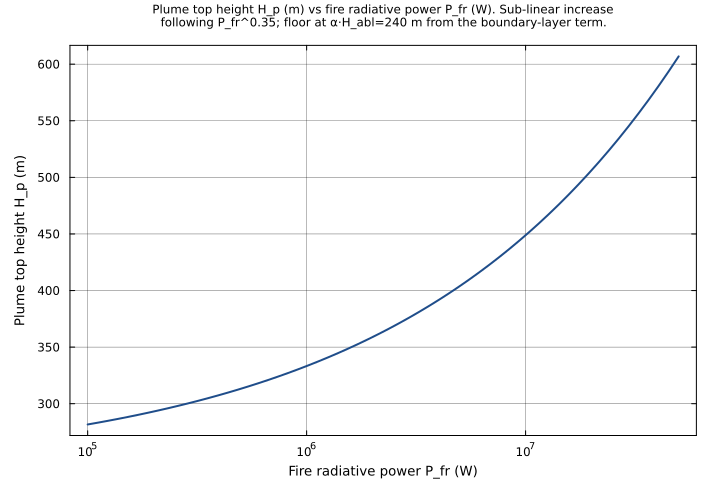
plume_height_vs_fire_power
Plume top height H_p as a function of fire radiative power P_fr, for representative daytime conditions (H_abl=1000 m, N_ft=N_0). Illustrates Figure 3a from Sofiev et al. (2012): H_p increases sub-linearly with fire power due to the γ=0.35 exponent. Range: 0.1 MW (smoldering low-intensity fire) to 50 MW (large crown fire). The boundary-layer contribution α·H_abl=240 m sets the floor.
Time span: 0.0 → 0.0
Swept over: P_fr
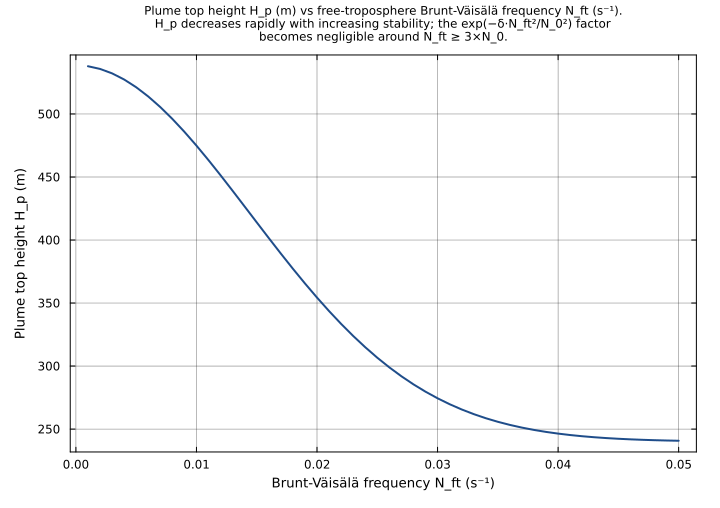
plume_height_vs_stability
Plume top height H_p as a function of free-troposphere Brunt-Väisälä frequency N_ft, for P_fr=5 MW and H_abl=1000 m. Shows how atmospheric stability suppresses plume rise via the exp(−δ·N_ft²/N_0²) factor. As N_ft increases from near-neutral (N_ft≈0) to strongly stable (N_ft=3×N_0), H_p decreases from ~539 m (full fire-power contribution) toward the floor ~240 m (only boundary-layer contribution). Illustrates the atmospheric stability correction in Figure 3b of Sofiev et al. (2012).
Time span: 0.0 → 0.0
Swept over: N_ft
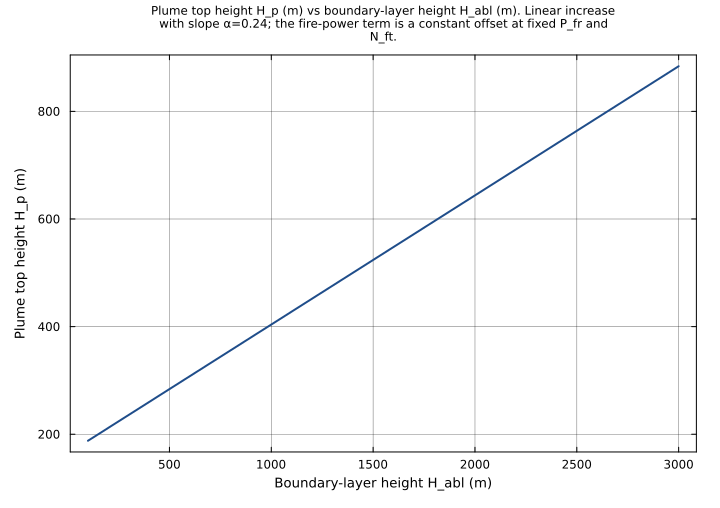
plume_height_vs_boundary_layer
Plume top height H_p as a function of atmospheric boundary-layer height H_abl, for P_fr=5 MW and N_ft=N_0. The linear α·H_abl term shifts H_p upward proportionally as the boundary layer deepens during the day. Shows that deeper boundary layers (e.g., H_abl=2000 m in hot, dry climates) can significantly increase plume injection heights even for moderate fires.
Time span: 0.0 → 0.0
Swept over: H_abl
Raw .esm
Raw .esm JSON (this component)
{
  "reference": {
    "notes": "source_ref: EnvironmentalTransport.jl@a48559c4114eb9f06668ecf9f06235aad20f63f0:src/plume_rise/sofiev_2012.jl:14\n\nUpstream `Sofiev2012PlumeRise` is an MTK `@component` (function returning a `System`) that computes wildfire plume-top height using the Sofiev et al. (2012) empirical formula. The component declares 11 `@parameters` and 4 time-indexed `@variables`, with a single algebraic equation: H_p ~ α·H_abl + β·(P_fr/P_f0)^γ · exp(−δ·N_ft²/N_0²).\n\nVariable and parameter treatment. The upstream source declares H_abl and N_ft as `@variables` (time-dependent), supplied at runtime via GEOSFP coupling (EarthSciDataExt.jl: `s12.H_abl ~ _parent_scope(gfp.A1₊PBLH_itp)(...)`, `s12.N_ft ~ sqrt(0.5*(N2+abs(N2)))` where N2 is from a virtual-potential-temperature gradient). In the standalone ESM these are declared as `parameter` (constant in tests), following the precedent of GaussianKC where coupling inputs are parameters in the isolated component.\n\nThe variable lev_p (plume-top pressure-level index) has NO equation in the standalone component. When coupled to GEOSFP (EarthSciDataExt.jl), lev_p is driven by `s12.lev_p ~ lev_from_height(s12.H_p)`, a Newton-iteration height-to-level mapping built from GEOSFP hybrid Ap/Bp coefficients and the hypsometric equation. This non-trivial mapping cannot be expressed as a standalone ESM equation without the GEOSFP function tables, so lev_p is declared as a `state` variable with a default initial value of 5.0 (the solver guess from the upstream test) and is not asserted in inline tests.\n\nThe parameter h_to_lev=100 m is used in the GEOSFP coupler as an initial linear guess for the height-to-level Newton iteration (`ℓ0 = clamp(H_p / h_to_lev, LMIN, LMAX)`). It does not appear in the standalone equation. Similarly Rd, g, and Punit are constants exported to the GEOSFP coupler for the hypsometric equation but are not used in the standalone H_p formula.\n\nNote on migration tracker blocking gap. The tracker lists this bead as `gt-ebuq (init_eq/system_kind)`. Investigation of the upstream source (sofiev_2012.jl:14) confirms the `initialization_equations` and `guesses` appear ONLY in the upstream test (sofiev_2012_test.jl): `ODEProblem(..., initialization_eqs=[sys.Puff₊lev ~ sys.Sofiev2012PlumeRise₊lev_p], guesses=[sys.Puff₊lev => 5.0])`. These belong to the COUPLED system (Puff + Sofiev2012PlumeRise + GEOSFP), not to the Sofiev2012PlumeRise component itself. The `System(eqs, t, ...)` call in the upstream source has no `initialization_equations` or `guesses` arguments. The gt-ebuq label is therefore inapplicable to this standalone component, analogous to the MogiModel/McTigueModel precedent.\n\nSystem kind: the single upstream equation is an explicit algebraic assignment with no D(.) operator. H_p is purely a function of parameters and coupling inputs H_abl / N_ft. system_kind is left unset (default 'ode', zero differential states), matching all other explicit-algebraic components.\n\nParameter defaults. P_f0=1 MW and N_0=√(2.5×10⁻⁴) s⁻¹ are reference constants from Sofiev et al. (2012). P_fr=5 MW is the default fire radiative power. H_abl=1000 m and N_ft=N_0 are representative mid-latitude daytime values used for standalone testing.\n\nTolerance rationale. Closed-form algebraic evaluation via a single exp/power chain — no ODE integration, no implicit solve. Relative tolerance 1e-10 covers float64 round-off.\n\nCoupler identity: this model was serialized with the model-level field `coupletype: \"Sofiev2012PlumeRiseCoupler\"`, the EarthSciMLBase `CoupleType` metadata tag naming the Julia coupler struct that `EarthSciMLBase.couple2` dispatches on to find this component's pairwise coupling rules. The esm schema defined `coupletype` only before 0.8.0 (\"informational label identifying this system's role in coupling\"); 0.8.0 removed it in favour of explicit coupling — `coupling` entries naming components directly, or `coupling_roles` + `coupling_import` in a coupling-library file (esm-spec §10.9–§10.11). esm 1.0.0 has no model-level coupler-identity field, so the tag is recorded here to keep it recoverable."
  },
  "tolerance": {
    "rel": 1e-10
  },
  "variables": {
    "P_f0": {
      "type": "parameter",
      "units": "W",
      "default": 1000000.0,
      "description": "Reference fire radiative power (W). Appears as the denominator in the dimensionless power ratio (P_fr/P_f0)^γ. Sofiev et al. (2012) calibrated the formula using P_f0 = 1 MW as the normalisation constant. Upstream MTK `@parameter`."
    },
    "N_0": {
      "type": "parameter",
      "units": "1/s",
      "default": 0.015811388300841896,
      "description": "Reference Brunt-Väisälä frequency (s⁻¹), N_0 = √(2.5×10⁻⁴) s⁻¹ ≈ 0.0158 s⁻¹. Appears squared in the stability exponent exp(−δ·N_ft²/N_0²). When N_ft = N_0 the exponent is exp(−δ) ≈ 0.549 (δ=0.6). Upstream MTK `@parameter`; default from Sofiev et al. (2012)."
    },
    "α": {
      "type": "parameter",
      "units": "1",
      "default": 0.24,
      "description": "Empirical scaling coefficient for the boundary-layer contribution to plume height (dimensionless). H_p = α·H_abl + β·(...): α controls how much of the boundary-layer height is incorporated into the plume top. Sofiev et al. (2012) fit α = 0.24 from a global satellite-detected injection-height dataset. Upstream MTK `@parameter`."
    },
    "β": {
      "type": "parameter",
      "units": "m",
      "default": 170.0,
      "description": "Empirical amplitude coefficient for the fire-power contribution to plume height (m). β·(P_fr/P_f0)^γ is the power-dependent term before the stability correction. β = 170 m from Sofiev et al. (2012). Upstream MTK `@parameter`."
    },
    "γ": {
      "type": "parameter",
      "units": "1",
      "default": 0.35,
      "description": "Empirical exponent for the fire-power scaling (dimensionless). Appears as the exponent of the normalised fire power (P_fr/P_f0)^γ. γ = 0.35 from Sofiev et al. (2012): sub-linear scaling means doubling fire power increases plume height by a factor of 2^0.35 ≈ 1.27. Upstream MTK `@parameter`."
    },
    "δ": {
      "type": "parameter",
      "units": "1",
      "default": 0.6,
      "description": "Empirical stability-suppression exponent (dimensionless). Appears in the atmospheric-stability correction exp(−δ·N_ft²/N_0²): larger δ increases the suppression of plume rise by free-tropospheric stability. δ = 0.6 from Sofiev et al. (2012). Upstream MTK `@parameter`."
    },
    "Rd": {
      "type": "parameter",
      "units": "J/(kg*K)",
      "default": 287.05,
      "description": "Specific gas constant for dry air (J kg⁻¹ K⁻¹). Not used in the standalone H_p equation; exported as a coupling constant for the GEOSFP coupler, which uses it in the hypsometric height computation for the lev_p Newton iteration. Upstream MTK `@parameter`."
    },
    "g": {
      "type": "parameter",
      "units": "m/s^2",
      "default": 9.80665,
      "description": "Gravitational acceleration (m s⁻²). Not used in the standalone H_p equation; exported for the GEOSFP coupler (hypsometric height). Upstream MTK `@parameter`."
    },
    "Punit": {
      "type": "parameter",
      "units": "Pa",
      "default": 1.0,
      "description": "Unit pressure constant (Pa). Not used in the standalone H_p equation; exported for the GEOSFP coupler to satisfy DynamicQuantities dimensional consistency in the hybrid-pressure level formula. Upstream MTK `@parameter`."
    },
    "P_fr": {
      "type": "parameter",
      "units": "W",
      "default": 5000000.0,
      "description": "Fire radiative power (W). Primary fire-intensity input to the plume-rise formula. P_fr drives the power-dependent term β·(P_fr/P_f0)^γ. Default 5 MW is the typical radiative power for a moderate wildfire. Upstream MTK `@parameter`."
    },
    "h_to_lev": {
      "type": "parameter",
      "units": "m",
      "default": 100.0,
      "description": "Height-to-level scale factor (m per level index unit). Not used in the standalone H_p equation; used by the GEOSFP coupler as the linear initial guess for the Newton iteration that maps H_p (m) to lev_p (level index): ℓ_0 = clamp(H_p / h_to_lev, l_min, l_max). A value of 100 m per level is a first-order approximation of the GEOS-FP 72-level hybrid grid. Upstream MTK `@parameter`."
    },
    "H_abl": {
      "type": "parameter",
      "units": "m",
      "default": 1000.0,
      "description": "Atmospheric boundary-layer height (m). Appears linearly in H_p = α·H_abl + β·(...). In a coupled model this is supplied by GEOSFP (A1 diagnostic PBLH interpolated to the current lon/lat/time). In standalone tests it is held constant at the default. Upstream declared as MTK `@variable` (time-dependent via coupling); mapped to `parameter` here following the GaussianKC precedent for coupling inputs."
    },
    "N_ft": {
      "type": "parameter",
      "units": "1/s",
      "default": 0.015811388300841896,
      "description": "Free-troposphere Brunt-Väisälä frequency (s⁻¹). Appears squared in the stability correction exp(−δ·N_ft²/N_0²). In a coupled model N_ft is computed from the GEOSFP virtual-potential-temperature vertical gradient near 2×H_abl: N_ft = sqrt(max((g/θv)·∂θv/∂z, 0)). Larger N_ft (stronger stability) suppresses the plume rise. In standalone tests it is held constant at N_0 (= √(2.5×10⁻⁴) s⁻¹) as the reference frequency. Upstream declared as MTK `@variable`; mapped to `parameter` here following the GaussianKC precedent."
    },
    "H_p": {
      "type": "unknown",
      "units": "m",
      "description": "Plume top height (m). Primary output of the Sofiev et al. (2012) formula: H_p = α·H_abl + β·(P_fr/P_f0)^γ · exp(−δ·N_ft²/N_0²). Combines the boundary-layer contribution α·H_abl with the fire-power and stability-corrected term. Plume injection height for fire-emission modelling. Upstream MTK `@variable` with a single algebraic equation (no D(.))."
    },
    "lev_p": {
      "type": "parameter",
      "units": "1",
      "default": 5.0,
      "description": "Vertical pressure-level index of the plume top height (dimensionless). In a coupled model this is driven by the Newton-iteration height-to-level mapping in EarthSciDataExt.jl: lev_p ~ lev_from_height(H_p), where lev_from_height uses GEOSFP hybrid Ap/Bp coefficients and the hypsometric equation. The linear h_to_lev=100 m scale factor is the initial guess in that Newton iteration. This mapping requires GEOSFP function tables and cannot be expressed as a standalone ESM equation. In standalone context lev_p is held at its default (5.0, matching the upstream solver guess) and is not asserted in inline tests. lev_p is the output referenced via Puff coupling (initialization_eqs: Puff₊lev ~ Sofiev2012PlumeRise₊lev_p) to initialise the Puff particle's vertical coordinate."
    }
  },
  "equations": [
    {
      "lhs": "H_p",
      "rhs": {
        "op": "+",
        "args": [
          {
            "op": "*",
            "args": [
              "α",
              "H_abl"
            ]
          },
          {
            "op": "*",
            "args": [
              "β",
              {
                "op": "^",
                "args": [
                  {
                    "op": "/",
                    "args": [
                      "P_fr",
                      "P_f0"
                    ]
                  },
                  "γ"
                ]
              },
              {
                "op": "exp",
                "args": [
                  {
                    "op": "*",
                    "args": [
                      {
                        "op": "-",
                        "args": [
                          "δ"
                        ]
                      },
                      {
                        "op": "/",
                        "args": [
                          {
                            "op": "^",
                            "args": [
                              "N_ft",
                              2
                            ]
                          },
                          {
                            "op": "^",
                            "args": [
                              "N_0",
                              2
                            ]
                          }
                        ]
                      }
                    ]
                  }
                ]
              }
            ]
          }
        ]
      }
    }
  ],
  "tests": [
    {
      "id": "default_conditions",
      "description": "Primary correctness test at representative mid-latitude daytime conditions: H_abl=1000 m (typical mixed-layer depth), N_ft=N_0=√(2.5×10⁻⁴) s⁻¹ (reference free-troposphere stability), P_fr=5 MW (moderate wildfire). Expected: H_p = 0.24×1000 + 170×5^0.35×exp(−0.6) = 240 + 170×1.75647×0.54881 ≈ 403.875 m. Verifies the algebraic formula end-to-end.",
      "time_span": {
        "start": 0.0,
        "end": 0.0
      },
      "parameter_overrides": {
        "H_abl": 1000.0,
        "N_ft": 0.015811388300841896,
        "P_fr": 5000000.0,
        "P_f0": 1000000.0,
        "α": 0.24,
        "β": 170.0,
        "γ": 0.35,
        "δ": 0.6,
        "N_0": 0.015811388300841896
      },
      "assertions": [
        {
          "variable": "H_p",
          "time": 0.0,
          "expected": 403.87463362807637,
          "tolerance": {
            "rel": 1e-10
          }
        }
      ]
    },
    {
      "id": "shallow_boundary_layer",
      "description": "Lower boundary layer H_abl=500 m (stable nighttime / shallow morning ML), same fire power and stability. H_p = 0.24×500 + 170×5^0.35×exp(−0.6) = 120 + 163.875 = 283.875 m. Verifies linearity in H_abl: reducing H_abl by 500 m reduces H_p by α×500 = 120 m.",
      "time_span": {
        "start": 0.0,
        "end": 0.0
      },
      "parameter_overrides": {
        "H_abl": 500.0,
        "N_ft": 0.015811388300841896,
        "P_fr": 5000000.0
      },
      "assertions": [
        {
          "variable": "H_p",
          "time": 0.0,
          "expected": 283.87463362807637,
          "tolerance": {
            "rel": 1e-10
          }
        }
      ]
    },
    {
      "id": "zero_stability_max_plume",
      "description": "N_ft=0 (neutral free troposphere, maximum plume rise): exp(−δ×0/N_0²)=exp(0)=1. H_p = 0.24×1000 + 170×5^0.35×1 = 240 + 298.600 = 538.600 m. Verifies the upper bound of the stability correction — when N_ft=0 the fire-power term reaches its maximum. This is the theoretical maximum H_p for the given H_abl and P_fr.",
      "time_span": {
        "start": 0.0,
        "end": 0.0
      },
      "parameter_overrides": {
        "H_abl": 1000.0,
        "N_ft": 0.0,
        "P_fr": 5000000.0
      },
      "assertions": [
        {
          "variable": "H_p",
          "time": 0.0,
          "expected": 538.5990508408247,
          "tolerance": {
            "rel": 1e-10
          }
        }
      ]
    },
    {
      "id": "linearity_in_H_abl",
      "description": "Doubling H_abl from 1000 m to 2000 m increases H_p by exactly α×1000 = 240 m (the formula is linear in H_abl). Expected H_p = 643.875 m = 403.875 + 240. Verifies correct coefficient α in the boundary-layer term.",
      "time_span": {
        "start": 0.0,
        "end": 0.0
      },
      "parameter_overrides": {
        "H_abl": 2000.0,
        "N_ft": 0.015811388300841896,
        "P_fr": 5000000.0
      },
      "assertions": [
        {
          "variable": "H_p",
          "time": 0.0,
          "expected": 643.8746336280764,
          "tolerance": {
            "rel": 1e-10
          }
        }
      ]
    },
    {
      "id": "high_fire_power",
      "description": "Doubled fire radiative power P_fr=10 MW (large crown fire). H_p = 0.24×1000 + 170×(10)^0.35×exp(−0.6) = 240 + 170×2.23872×0.54881 = 240 + 208.868 = 448.868 m. Verifies the sub-linear power-law scaling: doubling P_fr from 5 MW to 10 MW multiplies the fire term by 2^0.35 ≈ 1.274, not by 2.",
      "time_span": {
        "start": 0.0,
        "end": 0.0
      },
      "parameter_overrides": {
        "H_abl": 1000.0,
        "N_ft": 0.015811388300841896,
        "P_fr": 10000000.0
      },
      "assertions": [
        {
          "variable": "H_p",
          "time": 0.0,
          "expected": 448.8681558387152,
          "tolerance": {
            "rel": 1e-10
          }
        }
      ]
    },
    {
      "id": "strong_stability",
      "description": "N_ft=3×N_0 (strongly stable free troposphere): exp(−δ×9) = exp(−5.4) ≈ 0.00452. This nearly kills the fire-power term. H_p = 0.24×1000 + 170×5^0.35×0.00452 = 240 + 1.349 = 241.349 m. Verifies the exponential stability-suppression: even a large fire barely raises the plume above the boundary layer under strong inversions.",
      "time_span": {
        "start": 0.0,
        "end": 0.0
      },
      "parameter_overrides": {
        "H_abl": 1000.0,
        "N_ft": 0.04743416490252569,
        "P_fr": 5000000.0
      },
      "assertions": [
        {
          "variable": "H_p",
          "time": 0.0,
          "expected": 241.3486467825099,
          "tolerance": {
            "rel": 1e-10
          }
        }
      ]
    }
  ],
  "analyses": [
    {
      "id": "plume_height_vs_fire_power",
      "description": "Plume top height H_p as a function of fire radiative power P_fr, for representative daytime conditions (H_abl=1000 m, N_ft=N_0). Illustrates Figure 3a from Sofiev et al. (2012): H_p increases sub-linearly with fire power due to the γ=0.35 exponent. Range: 0.1 MW (smoldering low-intensity fire) to 50 MW (large crown fire). The boundary-layer contribution α·H_abl=240 m sets the floor.",
      "time_span": {
        "start": 0.0,
        "end": 0.0
      },
      "parameters": {
        "H_abl": 1000.0,
        "N_ft": 0.015811388300841896
      },
      "parameter_sweep": {
        "type": "cartesian",
        "dimensions": [
          {
            "parameter": "P_fr",
            "range": {
              "start": 100000.0,
              "stop": 50000000.0,
              "count": 60,
              "scale": "log"
            }
          }
        ]
      },
      "plots": [
        {
          "id": "H_p_vs_P_fr",
          "type": "line",
          "description": "Plume top height H_p (m) vs fire radiative power P_fr (W). Sub-linear increase following P_fr^0.35; floor at α·H_abl=240 m from the boundary-layer term.",
          "x": {
            "variable": "P_fr",
            "label": "Fire radiative power P_fr (W)"
          },
          "y": {
            "variable": "H_p",
            "label": "Plume top height H_p (m)"
          }
        }
      ]
    },
    {
      "id": "plume_height_vs_stability",
      "description": "Plume top height H_p as a function of free-troposphere Brunt-Väisälä frequency N_ft, for P_fr=5 MW and H_abl=1000 m. Shows how atmospheric stability suppresses plume rise via the exp(−δ·N_ft²/N_0²) factor. As N_ft increases from near-neutral (N_ft≈0) to strongly stable (N_ft=3×N_0), H_p decreases from ~539 m (full fire-power contribution) toward the floor ~240 m (only boundary-layer contribution). Illustrates the atmospheric stability correction in Figure 3b of Sofiev et al. (2012).",
      "time_span": {
        "start": 0.0,
        "end": 0.0
      },
      "parameters": {
        "H_abl": 1000.0,
        "P_fr": 5000000.0
      },
      "parameter_sweep": {
        "type": "cartesian",
        "dimensions": [
          {
            "parameter": "N_ft",
            "range": {
              "start": 0.001,
              "stop": 0.05,
              "count": 50,
              "scale": "linear"
            }
          }
        ]
      },
      "plots": [
        {
          "id": "H_p_vs_N_ft",
          "type": "line",
          "description": "Plume top height H_p (m) vs free-troposphere Brunt-Väisälä frequency N_ft (s⁻¹). H_p decreases rapidly with increasing stability; the exp(−δ·N_ft²/N_0²) factor becomes negligible around N_ft ≥ 3×N_0.",
          "x": {
            "variable": "N_ft",
            "label": "Brunt-Väisälä frequency N_ft (s⁻¹)"
          },
          "y": {
            "variable": "H_p",
            "label": "Plume top height H_p (m)"
          }
        }
      ]
    },
    {
      "id": "plume_height_vs_boundary_layer",
      "description": "Plume top height H_p as a function of atmospheric boundary-layer height H_abl, for P_fr=5 MW and N_ft=N_0. The linear α·H_abl term shifts H_p upward proportionally as the boundary layer deepens during the day. Shows that deeper boundary layers (e.g., H_abl=2000 m in hot, dry climates) can significantly increase plume injection heights even for moderate fires.",
      "time_span": {
        "start": 0.0,
        "end": 0.0
      },
      "parameters": {
        "P_fr": 5000000.0,
        "N_ft": 0.015811388300841896
      },
      "parameter_sweep": {
        "type": "cartesian",
        "dimensions": [
          {
            "parameter": "H_abl",
            "range": {
              "start": 100.0,
              "stop": 3000.0,
              "count": 50,
              "scale": "linear"
            }
          }
        ]
      },
      "plots": [
        {
          "id": "H_p_vs_H_abl",
          "type": "line",
          "description": "Plume top height H_p (m) vs boundary-layer height H_abl (m). Linear increase with slope α=0.24; the fire-power term is a constant offset at fixed P_fr and N_ft.",
          "x": {
            "variable": "H_abl",
            "label": "Boundary-layer height H_abl (m)"
          },
          "y": {
            "variable": "H_p",
            "label": "Plume top height H_p (m)"
          }
        }
      ]
    }
  ]
}