BoundaryLayerMixingKC
Kantha-Clayson & Garratt boundary-layer turbulence parameterization for Lagrangian particle dispersion, as described in NOAA ARL-224 and the HYSPLIT documentation. Computes turbulent velocity standard deviations (sigmaw, sigma_u, sigma_v), Lagrangian vertical time scale (TL_v), Monin-Obukhov length (Lmo), and convective velocity scale (wstar) from surface-layer similarity theory; integrates stochastic Langevin equations for the turbulent velocity components (wprime, uprime_x, uprime_y) and the resulting Lagrangian particle position (lon, lat, lev). The upstream Julia source uses a single @brownians Bw term on all three velocity ODEs (gt-kuxo gap); this ESM migrates the deterministic drift equations only. Migrated from EnvironmentalTransport.jl@a48559c4114eb9f06668ecf9f06235aad20f63f0:src/BoundaryLayerMixingKC.jl:15.
Description
Kantha-Clayson & Garratt boundary-layer turbulence parameterization for Lagrangian particle dispersion, as described in NOAA ARL-224 and the HYSPLIT documentation. Computes turbulent velocity standard deviations (sigmaw, sigma_u, sigma_v), Lagrangian vertical time scale (TL_v), Monin-Obukhov length (Lmo), and convective velocity scale (wstar) from surface-layer similarity theory; integrates stochastic Langevin equations for the turbulent velocity components (wprime, uprime_x, uprime_y) and the resulting Lagrangian particle position (lon, lat, lev). The upstream Julia source uses a single @brownians Bw term on all three velocity ODEs (gt-kuxo gap); this ESM migrates the deterministic drift equations only. Migrated from EnvironmentalTransport.jl@a48559c4114eb9f06668ecf9f06235aad20f63f0:src/BoundaryLayerMixingKC.jl:15.
Reference
Draxler and Rolph (2003). NOAA ARL-224.
_source_ref: EnvironmentalTransport.jl@a48559c4114eb9f06668ecf9f06235aad20f63f0:src/BoundaryLayerMixingKC.jl:15
Upstream BoundaryLayerMixingKC is an MTK @component implementing the Kantha-Clayson & Garratt turbulence closure for HYSPLIT Lagrangian transport. It declares:
- 9 @constants (kappa, one, m0, m1, ms0, kms0, kms1e_8, S, offset) used as MTK unit sentinels
- 26 @parameters (PBLH, USTAR, HFLUX, EFLUX, PS, T2M, QV2M, z2lev, TL_h, TL_v_min, TL_v_max, Rd, cp, Lv, g, R_inv, KMIX0, TKEMIN, x_trans, y_trans, z_agl, lev_gnd, lev_top, w_damp)
- 20 @variables (wprime, sigmaw, sigma_u, sigma_v, TL_v, zi, wprime_ref, Tv2m, rho, wth, wq, wthv, wthv_eff, Lmo, wstar, uprime_x, uprime_y, lon, lat, lev)
- 1 @brownians Bw (single Wiener process for all three velocity components; upstream TODO notes intent to replace with separate Bx, By)
Migration approach:
The 9 MTK @constants are substituted as literal values in expressions (kappa = 0.4 retained as named parameter for legibility; one=1.0, m0=0.0, m1=1.0, ms0=0.0, kms0=0.0, kms1e_8=1e-8, S=1.0, offset=0.05 inlined directly). All 14 non-ODE @variables (zi, Tv2m, rho, wth, wq, wthv, wthv_eff, Lmo, wstar, sigmaw, sigma_u, sigma_v, TL_v, wprime_ref) are migrated as observed type, with their expressions computed from parameters and ODE states. Three additional observed intermediates (zeta_clip, sigma_w2, sigma_u2) are added for readability; they correspond to Julia local variables zeta_clip, sigma_w2_expr, sigma_u2_expr. sigma_v2 is the same expression as sigma_u2 in both stable and unstable regimes (both use 0.36*wstar^2 unstable, and differ only by coefficient in stable: 4.0 vs 5.0 for USTAR^2 term). Unicode variable names mapped to ASCII: sigma_u (from Julia sigma_u), sigma_v (from Julia sigma_v).
Key physics:
- Stability regime determined by Lmo: unstable (Lmo < 0), stable/neutral (Lmo >= 0)
- Within unstable regime: surface layer (zeta_clip < 0.1, uses Hanna 1982 USL / ARL-224 Eq. 92) vs mixed layer (Kantha-Clayson / ARL-224 Eq. 90)
- Lagrangian time scale TL_v clamped to [TL_v_min, TL_v_max] to prevent singular behavior
- wprime_ref implements boundary reflection: partial absorption at ground (lev <= lev_gnd + 0.05) and lid (lev >= lev_top - 0.05)
TODO_GAP: gt-kuxo — Upstream Julia component uses @brownians Bw (single Wiener process) to add diffusion noise to the three velocity Langevin equations:
D(wprime) ~ -(wprime/TL_v) + sqrt(2sigmaw^2/TL_v/1s) * Bw
D(uprime_x) ~ -(uprime_x/TL_h) + sqrt(2sigma_u2/TL_h/1s) * Bw
D(uprime_y) ~ -(uprime_y/TL_h) + sqrt(2*sigma_v2/TL_h/1s) * Bw
The ESM schema v0.4.0 has no brownian variable type (gap gt-kuxo). This ESM migrates the deterministic drift only:
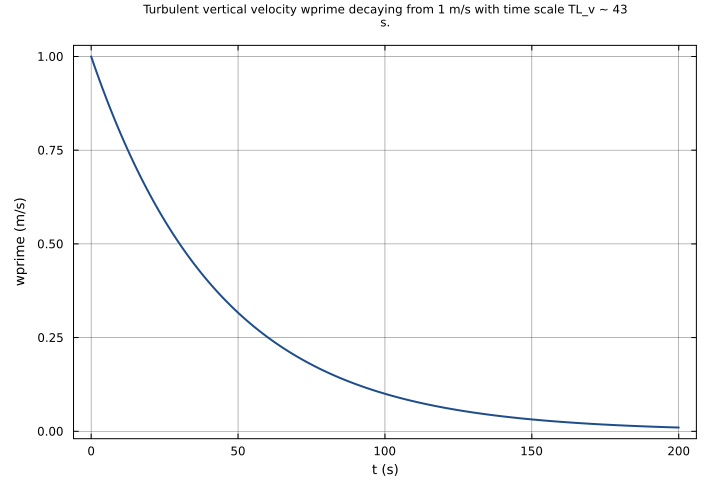
D(wprime)/dt = -wprime/TL_v
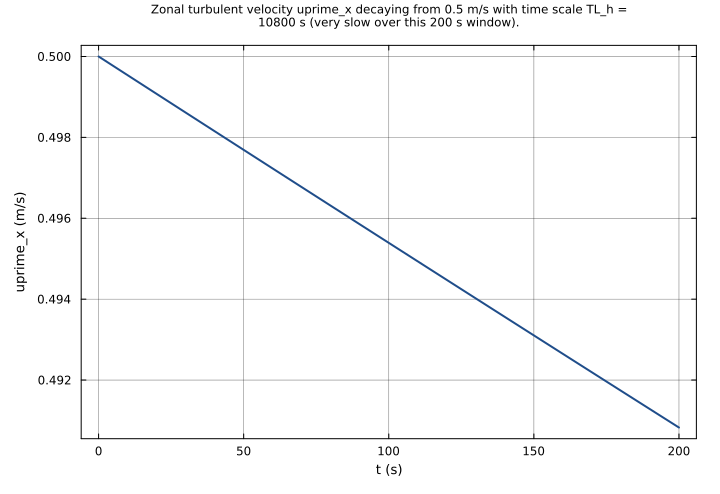
D(uprime_x)/dt = -uprime_x/TL_h
D(uprime_y)/dt = -uprime_y/TL_h
The upstream source also contains a TODO noting that Bw should be replaced by separate Bx, By for uprime_x and uprime_y. When gt-kuxo is resolved, add three brownian variables (Bw, Bx, By) and restore the full SDE diffusion terms.
Coupling: sigma_u and sigma_v are consumed by GaussianKC (as sigma_u_x, sigma_u_y) for Gaussian puff dispersion. When coupled, these are promoted to shared algebraic variables via connector equations.
Tolerance rationale (rel=1e-6, abs=1e-10): algebraic outputs are smooth functions of bounded parameters; ODE drift terms are linear in state variables with constant (parameter-derived) coefficients. Relative tolerance 1e-6 gives margin well above roundoff while remaining tight enough to catch sign errors._
Variables
| Name | Units | Default | Description |
|---|---|---|---|
wprime | m/s | 0.0 | Turbulent vertical velocity fluctuation w’ (m/s). ODE state governed by Langevin equation D(wprime)/dt = -wprime/TL_v (deterministic drift; Brownian noise term omitted — see TODO_GAP gt-kuxo). |
uprime_x | m/s | 0.0 | Turbulent horizontal velocity fluctuation in x (eastward, m/s). ODE state: D(uprime_x)/dt = -uprime_x/TL_h (deterministic drift; Brownian noise omitted). |
uprime_y | m/s | 0.0 | Turbulent horizontal velocity fluctuation in y (northward, m/s). ODE state: D(uprime_y)/dt = -uprime_y/TL_h (deterministic drift; Brownian noise omitted). |
lon | 1 | 0.0 | Lagrangian particle longitude coordinate (radians, dimensionless). ODE state: D(lon)/dt = uprime_x * x_trans. |
lat | 1 | 0.0 | Lagrangian particle latitude coordinate (radians, dimensionless). ODE state: D(lat)/dt = uprime_y * y_trans. |
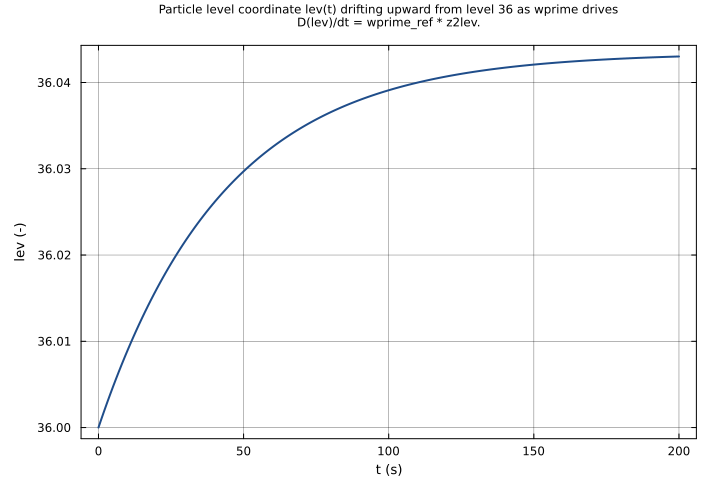
lev | 1 | 1.0 | Lagrangian particle level coordinate (dimensionless level index). ODE state: D(lev)/dt = wprime_ref * z2lev. Boundary conditions applied via wprime_ref reflection. |
Parameters
| Name | Units | Default | Description |
|---|---|---|---|
kappa | 1 | 0.4 | von Karman constant (dimensionless). Appears in the Monin-Obukhov length formula (ARL-224 Eq. 27). Upstream Julia @constants kappa = 0.4. |
PBLH | m | 1000.0 | Planetary boundary layer height (m). Input meteorological field; sets the upper bound of the boundary layer used in stability calculations. |
USTAR | m/s | 0.3 | Surface friction velocity u* (m/s). Input meteorological field; drives stable/neutral turbulence intensity (ARL-224 Eqs. 71-76). |
HFLUX | W/m^2 | 0.0 | Surface sensible heat flux H (W/m^2). Positive upward (daytime unstable); negative downward (nighttime stable). Drives convective turbulence intensity. |
EFLUX | W/m^2 | 0.0 | Surface latent heat flux LE (W/m^2). Positive upward. Contributes to the virtual temperature flux (moisture buoyancy correction). |
PS | Pa | 101325.0 | Surface air pressure (Pa). Used with T2M and Rd to compute surface air density rho. |
T2M | K | 293.15 | 2-metre air temperature (K). Used to compute virtual temperature Tv2m, air density rho, and wstar. |
QV2M | 1 | 0.009 | 2-metre specific humidity (dimensionless, kg/kg). Moisture correction in virtual temperature: Tv2m = T2M * (1 + 0.61 * QV2M). |
z2lev | 1/m | 0.0 | Vertical coordinate gradient d(lev)/dz (1/m). Converts vertical turbulent velocity wprime_ref to level-coordinate velocity D(lev)/dt. |
TL_h | s | 10800.0 | Lagrangian time scale for horizontal velocity fluctuations (s). Default 3 h. Governs decorrelation of uprime_x, uprime_y: D(u)/dt = -u/TL_h + noise. |
TL_v_min | s | 5.0 | Minimum Lagrangian time scale for vertical turbulence (s). Clamps TL_v from below to prevent singular Langevin dynamics near the surface. |
TL_v_max | s | 1000.0 | Maximum Lagrangian time scale for vertical turbulence (s). Clamps TL_v from above to prevent unrealistically slow decorrelation. |
Rd | J/(kg*K) | 287.05 | Specific gas constant for dry air (J/(kg K)). Used to compute surface air density rho = PS / (Rd * Tv2m). |
cp | J/(kg*K) | 1004.0 | Specific heat capacity of dry air at constant pressure near 300 K (J/(kg K)). Converts surface sensible heat flux to kinematic form: wth = HFLUX / (rho * cp). |
Lv | J/kg | 2500000.0 | Latent heat of vaporization of water (J/kg). Converts surface latent heat flux to kinematic form: wq = EFLUX / (rho * Lv). |
g | m/s^2 | 9.80665 | Gravitational acceleration (m/s^2). Appears in Monin-Obukhov length (ARL-224 Eq. 27) and convective velocity scale wstar (ARL-224 Eq. 28). |
R_inv | 1 | 0.2 | Heat-flux ratio at the inversion (dimensionless). Appears in the unstable mixed-layer sigma_w formula (ARL-224 Eq. 90): sigma_w2_UML = wstar^2 * zeta^(2/3) * (1-zeta)^(2/3) * (1 + 0.5*R_inv^(2/3)). |
KMIX0 | m | 150.0 | Minimum mixing depth (m). The effective PBL height zi = max(PBLH, KMIX0) ensures a minimum well-mixed layer. |
TKEMIN | m^2/s^2 | 0.001 | Minimum turbulent kinetic energy (m^2/s^2). Sets a floor on the vertical velocity variance: sigma_w2_min = (2/3) * TKEMIN (isotropic TKE partition). |
x_trans | 1/m | 0.01 | Longitude scaling: d(lon)/d(x) in radians per meter (1/m). Converts zonal turbulent velocity uprime_x to longitude rate: D(lon)/dt = uprime_x * x_trans. |
y_trans | 1/m | 0.01 | Latitude scaling: d(lat)/d(y) in radians per meter (1/m). Converts meridional turbulent velocity uprime_y to latitude rate: D(lat)/dt = uprime_y * y_trans. |
z_agl | m | 50.0 | Particle height above ground level (m). Used to compute the normalized height zeta_clip = z_agl / zi, which determines the stability sub-regime. |
lev_gnd | 1 | 1.0 | Level index of the ground surface (dimensionless). Boundary reflection condition triggers when lev <= lev_gnd + 0.05. |
lev_top | 1 | 72.0 | Top level index of the domain (dimensionless). Boundary reflection condition triggers when lev >= lev_top - 0.05. |
w_damp | 1 | 1.0 | Fraction of vertical velocity absorbed on boundary impact (dimensionless). 0.0 = perfect elastic bounce; 1.0 = complete absorption. wprime_ref = (1 - w_damp) * |wprime| at boundaries. |
Observed
| Name | Units | Default | Description |
|---|---|---|---|
zi | m | Effective planetary boundary layer depth (m). zi = max(PBLH, KMIX0). Provides a minimum mixing depth floor. | |
Tv2m | K | 2-metre virtual temperature (K). Tv2m = T2M * (1 + 0.61 * QV2M). Moisture-corrected temperature for density and buoyancy calculations. | |
rho | kg/m^3 | Surface air density (kg/m^3). rho = PS / (Rd * Tv2m). Used to convert heat and moisture fluxes from energy to kinematic units. | |
wth | K*m/s | Kinematic sensible heat flux w’theta’ (K m/s). wth = HFLUX / (rho * cp). ARL-224 Eq. 27. | |
wq | m/s | Kinematic moisture flux w’q’ (m/s). wq = EFLUX / (rho * Lv). Units m/s since q is dimensionless kg/kg. | |
wthv | K*m/s | Kinematic virtual potential temperature flux w’theta_v’ (K m/s). wthv = wth*(1+0.61QV2M) + 0.61T2M*wq. Combines sensible and moisture buoyancy contributions. | |
wthv_num | K*m/s | Sign proxy for wthv: wthv_num = HFLUX*(1+0.61QV2M)/cp + 0.61T2MEFLUX/Lv = rhowthv. Since rho>0, sign(wthv_num)==sign(wthv), so wthv_num>0 iff Lmo<0 (unstable). Uses only multiplication/addition of parameters — no division by rho — so evaluates to 0 (not NaN) when SymPy substitutes 0 for all free symbols during Piecewise-condition simplification. | |
wthv_eff | K*m/s | Effective virtual temperature flux (K m/s), bounded away from zero to prevent singular Lmo. wthv_eff = ifelse(wthv>=0, max(wthv,1e-8), min(wthv,-1e-8)). Stability branch uses wthv_num>=0 (sign proxy without rho division) to avoid NaN when SymPy substitutes 0 for all free symbols. | |
Lmo | m | Monin-Obukhov length L (m). Lmo = -USTAR^3 * Tv2m / (kappa * g * wthv_eff). Negative in unstable conditions (upward heat flux), positive in stable conditions. ARL-224 Eq. 27. | |
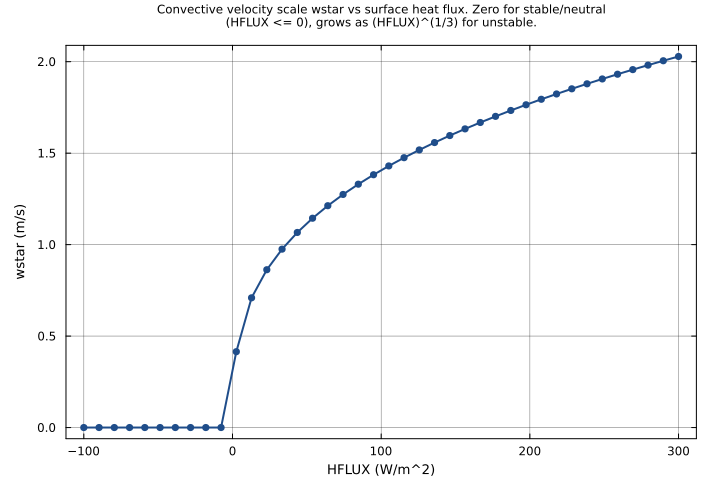
wstar | m/s | Deardorff convective velocity scale w* (m/s). wstar = (g/Tv2m * wthv * zi)^(1/3) when wthv > 0, else 0. ARL-224 Eq. 28. Stability condition uses wthv_num>0 (sign proxy, no rho division). | |
zeta_clip | 1 | Normalized height within the PBL: zeta_clip = clamp(z_agl / max(zi, 1.0), 0, 1). Dimensionless stability coordinate (0 at surface, 1 at PBL top). Corresponds to Julia local variable zeta_clip. | |
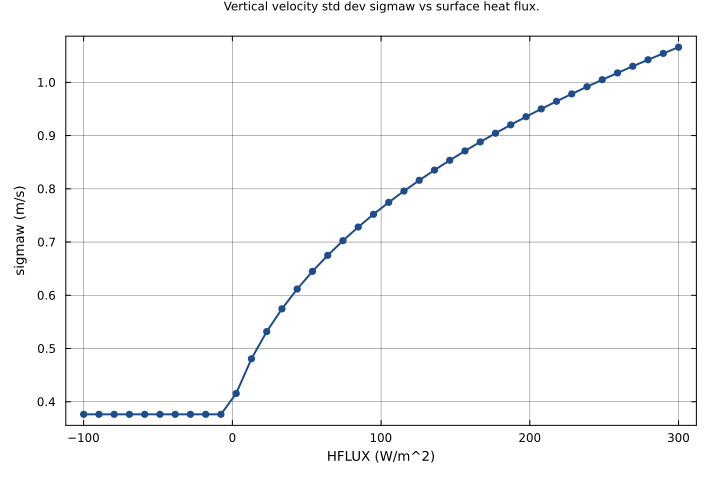
sigma_w2 | m^2/s^2 | Vertical turbulent velocity variance sigma_w^2 (m^2/s^2). Unstable surface layer (Lmo<0, zeta_clip<0.1): 1.74USTAR^2(1-3z_agl/L_eff)^(2/3) (Hanna 1982, ARL-224 Eq.92). Unstable mixed layer: wstar^2zeta^(2/3)(1-zeta)^(2/3)(1+0.5R_inv^(2/3)) (ARL-224 Eq.90). Stable/neutral: 1.7USTAR^2*(1-zeta)^1.5 (ARL-224 Eq.71). Corresponds to Julia sigma_w2_expr. | |
sigmaw | m/s | Standard deviation of turbulent vertical velocity sigma_w (m/s). sigmaw = sqrt(max(sigma_w2, (2/3)*TKEMIN)). Enters the Lagrangian time scale TL_v computation. | |
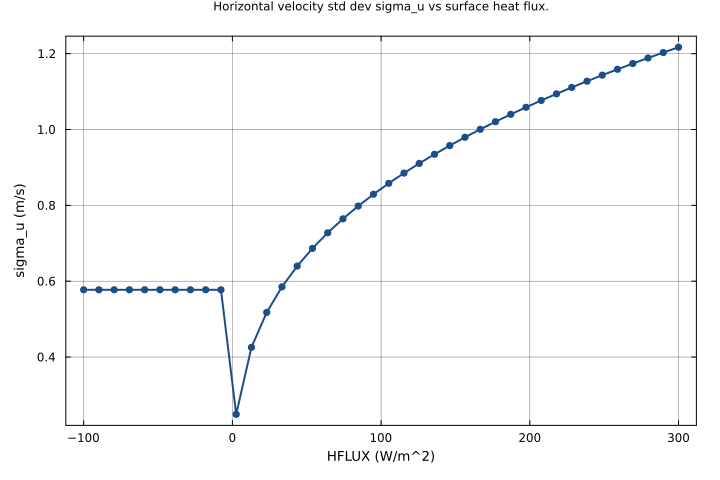
sigma_u2 | m^2/s^2 | Horizontal x-direction turbulent velocity variance (m^2/s^2). Unstable: 0.36wstar^2 (Kantha-Clayson, ARL-224 Eq. 91). Stable/neutral: 4.0USTAR^2*(1-zeta)^1.5 (ARL-224 Eq. 72-73). Corresponds to Julia sigma_u2_expr. | |
sigma_u | m/s | Standard deviation of turbulent horizontal x-velocity sigma_u (m/s). sigma_u = sqrt(sigma_u2). Consumed by GaussianKC as sigma_u_x when coupled. | |
sigma_v2 | m^2/s^2 | Horizontal y-direction turbulent velocity variance (m^2/s^2). Unstable: 0.36wstar^2 (ARL-224 Eq. 93, same as sigma_u2). Stable/neutral: 5.0USTAR^2*(1-zeta)^1.5 (ARL-224 Eq. 75-76, coefficient 5.0 vs 4.0 for x). Corresponds to Julia sigma_v2_expr. | |
sigma_v | m/s | Standard deviation of turbulent horizontal y-velocity sigma_v (m/s). sigma_v = sqrt(sigma_v2). Consumed by GaussianKC as sigma_u_y when coupled. | |
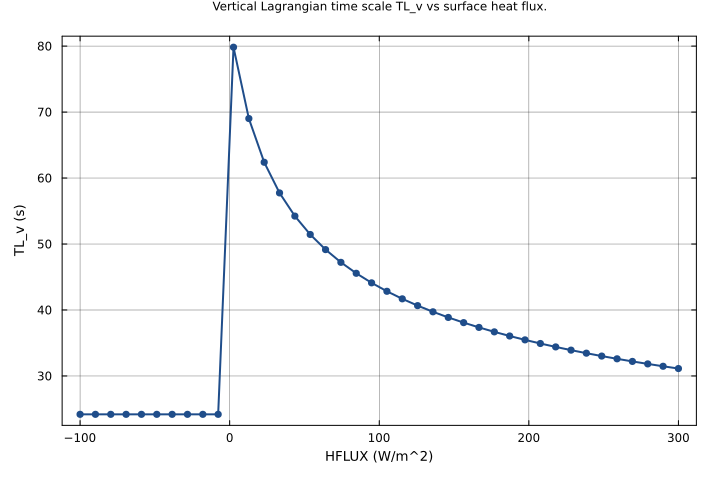
TL_v | s | Lagrangian time scale for vertical velocity (s), clamped to [TL_v_min, TL_v_max]. Unstable: 0.15zi/sigmaw(1-exp(-5zeta_clip)); Stable: 0.1zi/sigmaw*zeta_clip^0.8. Hanna (1982), ARL-224 Eqs. 63, 66. | |
wprime_ref | m/s | Reflected turbulent vertical velocity near boundaries (m/s). At ground (lev <= lev_gnd+0.05): wprime_ref = (1-w_damp)|wprime|. At lid (lev >= lev_top-0.05): wprime_ref = -(1-w_damp)|wprime|. Elsewhere: wprime_ref = wprime. |
Observed expressions
$$ zi = \mathrm{max}\left(PBLH, KMIX0\right) $$Effective planetary boundary layer depth (m). zi = max(PBLH, KMIX0). Provides a minimum mixing depth floor.
$$ Tv2m = T2M \cdot \left(1.0 + 0.61 \cdot QV2M\right) $$2-metre virtual temperature (K). Tv2m = T2M * (1 + 0.61 * QV2M). Moisture-corrected temperature for density and buoyancy calculations.
$$ rho = \frac{PS}{Rd \cdot Tv2m} $$Surface air density (kg/m^3). rho = PS / (Rd * Tv2m). Used to convert heat and moisture fluxes from energy to kinematic units.
$$ wth = \frac{HFLUX}{rho \cdot cp} $$Kinematic sensible heat flux w’theta’ (K m/s). wth = HFLUX / (rho * cp). ARL-224 Eq. 27.
$$ wq = \frac{EFLUX}{rho \cdot Lv} $$Kinematic moisture flux w’q’ (m/s). wq = EFLUX / (rho * Lv). Units m/s since q is dimensionless kg/kg.
$$ wthv = wth \cdot \left(1.0 + 0.61 \cdot QV2M\right) + 0.61 \cdot T2M \cdot wq $$Kinematic virtual potential temperature flux w’theta_v’ (K m/s). wthv = wth*(1+0.61QV2M) + 0.61T2M*wq. Combines sensible and moisture buoyancy contributions.
$$ wthv_{num} = HFLUX \cdot \left(1.0 + 0.61 \cdot QV2M\right) \cdot \frac{1.0}{cp} + 0.61 \cdot T2M \cdot EFLUX \cdot \frac{1.0}{Lv} $$Sign proxy for wthv: wthv_num = HFLUX*(1+0.61QV2M)/cp + 0.61T2MEFLUX/Lv = rhowthv. Since rho>0, sign(wthv_num)==sign(wthv), so wthv_num>0 iff Lmo<0 (unstable). Uses only multiplication/addition of parameters — no division by rho — so evaluates to 0 (not NaN) when SymPy substitutes 0 for all free symbols during Piecewise-condition simplification.
$$ wthv_{eff} = \mathrm{ifelse}\left(\mathrm{>=}\left(wthv_{num}, 0.0\right), \mathrm{max}\left(wthv, 1 \times 10^{-8}\right), \mathrm{min}\left(wthv, -1 \times 10^{-8}\right)\right) $$Effective virtual temperature flux (K m/s), bounded away from zero to prevent singular Lmo. wthv_eff = ifelse(wthv>=0, max(wthv,1e-8), min(wthv,-1e-8)). Stability branch uses wthv_num>=0 (sign proxy without rho division) to avoid NaN when SymPy substitutes 0 for all free symbols.
$$ Lmo = \left(-1.0\right) \cdot \frac{USTAR^{3} \cdot Tv2m}{kappa \cdot g \cdot wthv_{eff}} $$Monin-Obukhov length L (m). Lmo = -USTAR^3 * Tv2m / (kappa * g * wthv_eff). Negative in unstable conditions (upward heat flux), positive in stable conditions. ARL-224 Eq. 27.
$$ wstar = \mathrm{ifelse}\left(\mathrm{>}\left(wthv_{num}, 0.0\right), \left(\frac{g}{Tv2m} \cdot wthv \cdot zi\right)^{0.3333333333333333}, 0.0\right) $$Deardorff convective velocity scale w* (m/s). wstar = (g/Tv2m * wthv * zi)^(1/3) when wthv > 0, else 0. ARL-224 Eq. 28. Stability condition uses wthv_num>0 (sign proxy, no rho division).
$$ zeta_{clip} = \mathrm{max}\left(\mathrm{min}\left(\frac{z_{agl}}{\mathrm{max}\left(zi, 1.0\right)}, 1.0\right), 0.0\right) $$Normalized height within the PBL: zeta_clip = clamp(z_agl / max(zi, 1.0), 0, 1). Dimensionless stability coordinate (0 at surface, 1 at PBL top). Corresponds to Julia local variable zeta_clip.
$$ sigma_{w2} = \mathrm{ifelse}\left(\mathrm{>}\left(wthv_{num}, 0.0\right), \mathrm{ifelse}\left(\mathrm{<}\left(zeta_{clip}, 0.1\right), 1.74 \cdot USTAR^{2} \cdot \mathrm{max}\left(1.0 + \left(-3.0\right) \cdot \frac{z_{agl}}{\mathrm{ifelse}\left(\mathrm{>}\left(wthv_{num}, 0.0\right), -1.0, 1.0\right) \cdot \mathrm{max}\left(\left|Lmo\right|, 1.0\right)}, 1 \times 10^{-6}\right)^{0.6666666666666666}, wstar^{2} \cdot \mathrm{max}\left(zeta_{clip}, 1 \times 10^{-6}\right)^{0.6666666666666666} \cdot \mathrm{max}\left(1.0 + \left(-1.0\right) \cdot zeta_{clip}, 1 \times 10^{-6}\right)^{0.6666666666666666} \cdot \left(1.0 + 0.5 \cdot R_{inv}^{0.6666666666666666}\right)\right), 1.7 \cdot USTAR^{2} \cdot \mathrm{max}\left(1.0 + \left(-1.0\right) \cdot zeta_{clip}, 0.0\right)^{1.5}\right) $$Vertical turbulent velocity variance sigma_w^2 (m^2/s^2). Unstable surface layer (Lmo<0, zeta_clip<0.1): 1.74USTAR^2(1-3z_agl/L_eff)^(2/3) (Hanna 1982, ARL-224 Eq.92). Unstable mixed layer: wstar^2zeta^(2/3)(1-zeta)^(2/3)(1+0.5R_inv^(2/3)) (ARL-224 Eq.90). Stable/neutral: 1.7USTAR^2*(1-zeta)^1.5 (ARL-224 Eq.71). Corresponds to Julia sigma_w2_expr.
$$ sigmaw = \sqrt{\mathrm{max}\left(sigma_{w2}, 0.6666666666666666 \cdot TKEMIN\right)} $$Standard deviation of turbulent vertical velocity sigma_w (m/s). sigmaw = sqrt(max(sigma_w2, (2/3)*TKEMIN)). Enters the Lagrangian time scale TL_v computation.
$$ sigma_{u2} = \mathrm{ifelse}\left(\mathrm{>}\left(wthv_{num}, 0.0\right), 0.36 \cdot wstar^{2}, 4.0 \cdot USTAR^{2} \cdot \mathrm{max}\left(1.0 + \left(-1.0\right) \cdot zeta_{clip}, 0.0\right)^{1.5}\right) $$Horizontal x-direction turbulent velocity variance (m^2/s^2). Unstable: 0.36wstar^2 (Kantha-Clayson, ARL-224 Eq. 91). Stable/neutral: 4.0USTAR^2*(1-zeta)^1.5 (ARL-224 Eq. 72-73). Corresponds to Julia sigma_u2_expr.
$$ sigma_{u} = \sqrt{sigma_{u2}} $$Standard deviation of turbulent horizontal x-velocity sigma_u (m/s). sigma_u = sqrt(sigma_u2). Consumed by GaussianKC as sigma_u_x when coupled.
$$ sigma_{v2} = \mathrm{ifelse}\left(\mathrm{>}\left(wthv_{num}, 0.0\right), 0.36 \cdot wstar^{2}, 5.0 \cdot USTAR^{2} \cdot \mathrm{max}\left(1.0 + \left(-1.0\right) \cdot zeta_{clip}, 0.0\right)^{1.5}\right) $$Horizontal y-direction turbulent velocity variance (m^2/s^2). Unstable: 0.36wstar^2 (ARL-224 Eq. 93, same as sigma_u2). Stable/neutral: 5.0USTAR^2*(1-zeta)^1.5 (ARL-224 Eq. 75-76, coefficient 5.0 vs 4.0 for x). Corresponds to Julia sigma_v2_expr.
$$ sigma_{v} = \sqrt{sigma_{v2}} $$Standard deviation of turbulent horizontal y-velocity sigma_v (m/s). sigma_v = sqrt(sigma_v2). Consumed by GaussianKC as sigma_u_y when coupled.
$$ TL_{v} = \mathrm{max}\left(TL_{v\,min}, \mathrm{min}\left(TL_{v\,max}, \mathrm{ifelse}\left(\mathrm{>}\left(wthv_{num}, 0.0\right), 0.15 \cdot \frac{zi}{sigmaw} \cdot \left(1.0 + \left(-1.0\right) \cdot e^{\left(-5.0\right) \cdot zeta_{clip}}\right), 0.1 \cdot \frac{zi}{sigmaw} \cdot zeta_{clip}^{0.8}\right)\right)\right) $$Lagrangian time scale for vertical velocity (s), clamped to [TL_v_min, TL_v_max]. Unstable: 0.15zi/sigmaw(1-exp(-5zeta_clip)); Stable: 0.1zi/sigmaw*zeta_clip^0.8. Hanna (1982), ARL-224 Eqs. 63, 66.
$$ wprime_{ref} = \mathrm{ifelse}\left(\mathrm{<=}\left(lev, lev_{gnd} + 0.05\right), \left(1.0 + \left(-1.0\right) \cdot w_{damp}\right) \cdot \left|wprime\right|, \mathrm{ifelse}\left(\mathrm{>=}\left(lev, lev_{top} + -0.05\right), \left(-1.0\right) \cdot \left(1.0 + \left(-1.0\right) \cdot w_{damp}\right) \cdot \left|wprime\right|, wprime\right)\right) $$Reflected turbulent vertical velocity near boundaries (m/s). At ground (lev <= lev_gnd+0.05): wprime_ref = (1-w_damp)|wprime|. At lid (lev >= lev_top-0.05): wprime_ref = -(1-w_damp)|wprime|. Elsewhere: wprime_ref = wprime.
Equations
$$ \mathrm{D}\left(wprime\right) = \left(-1.0\right) \cdot \frac{wprime}{TL_{v}} $$ $$ \mathrm{D}\left(uprime_{x}\right) = \left(-1.0\right) \cdot \frac{uprime_{x}}{TL_{h}} $$ $$ \mathrm{D}\left(uprime_{y}\right) = \left(-1.0\right) \cdot \frac{uprime_{y}}{TL_{h}} $$ $$ \mathrm{D}\left(lon\right) = uprime_{x} \cdot x_{trans} $$ $$ \mathrm{D}\left(lat\right) = uprime_{y} \cdot y_{trans} $$ $$ \mathrm{D}\left(lev\right) = wprime_{ref} \cdot z2lev $$Analyses
stability_regime_sweep
Boundary-layer turbulence parameters (sigmaw, sigma_u, wstar, TL_v) as a function of surface sensible heat flux HFLUX over -100 to 300 W/m^2. Illustrates the transition from stable (HFLUX < 0, Lmo > 0) to neutral (HFLUX ~ 0) to convective (HFLUX > 0, Lmo < 0) regimes. USTAR=0.3 m/s, PBLH=1000 m, z_agl=50 m.
Time span: 0.0 → 0.0
Swept over: HFLUX
particle_velocity_decay
Time evolution of turbulent velocity components (wprime, uprime_x) and resulting particle level displacement under the deterministic Langevin drift. Initial conditions: wprime=1 m/s, uprime_x=0.5 m/s, lev=36 (interior domain). HFLUX=100 W/m^2 (unstable), z2lev=0.001. Shows exponential decay of velocity fluctuations: TL_v ~ 43 s for vertical, TL_h = 10800 s for horizontal.
Time span: 0.0 → 200.0
Raw .esm
Raw .esm JSON (this component)
{
"reference": {
"citation": "Draxler and Rolph (2003). NOAA ARL-224.",
"notes": "source_ref: EnvironmentalTransport.jl@a48559c4114eb9f06668ecf9f06235aad20f63f0:src/BoundaryLayerMixingKC.jl:15\n\nUpstream BoundaryLayerMixingKC is an MTK @component implementing the Kantha-Clayson & Garratt turbulence closure for HYSPLIT Lagrangian transport. It declares:\n - 9 @constants (kappa, one, m0, m1, ms0, kms0, kms1e_8, S, offset) used as MTK unit sentinels\n - 26 @parameters (PBLH, USTAR, HFLUX, EFLUX, PS, T2M, QV2M, z2lev, TL_h, TL_v_min, TL_v_max, Rd, cp, Lv, g, R_inv, KMIX0, TKEMIN, x_trans, y_trans, z_agl, lev_gnd, lev_top, w_damp)\n - 20 @variables (wprime, sigmaw, sigma_u, sigma_v, TL_v, zi, wprime_ref, Tv2m, rho, wth, wq, wthv, wthv_eff, Lmo, wstar, uprime_x, uprime_y, lon, lat, lev)\n - 1 @brownians Bw (single Wiener process for all three velocity components; upstream TODO notes intent to replace with separate Bx, By)\n\nMigration approach:\n The 9 MTK @constants are substituted as literal values in expressions (kappa = 0.4 retained as named parameter for legibility; one=1.0, m0=0.0, m1=1.0, ms0=0.0, kms0=0.0, kms1e_8=1e-8, S=1.0, offset=0.05 inlined directly). All 14 non-ODE @variables (zi, Tv2m, rho, wth, wq, wthv, wthv_eff, Lmo, wstar, sigmaw, sigma_u, sigma_v, TL_v, wprime_ref) are migrated as `observed` type, with their expressions computed from parameters and ODE states. Three additional `observed` intermediates (zeta_clip, sigma_w2, sigma_u2) are added for readability; they correspond to Julia local variables zeta_clip, sigma_w2_expr, sigma_u2_expr. sigma_v2 is the same expression as sigma_u2 in both stable and unstable regimes (both use 0.36*wstar^2 unstable, and differ only by coefficient in stable: 4.0 vs 5.0 for USTAR^2 term). Unicode variable names mapped to ASCII: sigma_u (from Julia sigma_u), sigma_v (from Julia sigma_v).\n\nKey physics:\n - Stability regime determined by Lmo: unstable (Lmo < 0), stable/neutral (Lmo >= 0)\n - Within unstable regime: surface layer (zeta_clip < 0.1, uses Hanna 1982 USL / ARL-224 Eq. 92) vs mixed layer (Kantha-Clayson / ARL-224 Eq. 90)\n - Lagrangian time scale TL_v clamped to [TL_v_min, TL_v_max] to prevent singular behavior\n - wprime_ref implements boundary reflection: partial absorption at ground (lev <= lev_gnd + 0.05) and lid (lev >= lev_top - 0.05)\n\nTODO_GAP: gt-kuxo — Upstream Julia component uses `@brownians Bw` (single Wiener process) to add diffusion noise to the three velocity Langevin equations:\n D(wprime) ~ -(wprime/TL_v) + sqrt(2*sigmaw^2/TL_v/1s) * Bw\n D(uprime_x) ~ -(uprime_x/TL_h) + sqrt(2*sigma_u2/TL_h/1s) * Bw\n D(uprime_y) ~ -(uprime_y/TL_h) + sqrt(2*sigma_v2/TL_h/1s) * Bw\nThe ESM schema v0.4.0 has no `brownian` variable type (gap gt-kuxo). This ESM migrates the deterministic drift only:\n D(wprime)/dt = -wprime/TL_v\n D(uprime_x)/dt = -uprime_x/TL_h\n D(uprime_y)/dt = -uprime_y/TL_h\nThe upstream source also contains a TODO noting that Bw should be replaced by separate Bx, By for uprime_x and uprime_y. When gt-kuxo is resolved, add three `brownian` variables (Bw, Bx, By) and restore the full SDE diffusion terms.\n\nCoupling: sigma_u and sigma_v are consumed by GaussianKC (as sigma_u_x, sigma_u_y) for Gaussian puff dispersion. When coupled, these are promoted to shared algebraic variables via connector equations.\n\nTolerance rationale (rel=1e-6, abs=1e-10): algebraic outputs are smooth functions of bounded parameters; ODE drift terms are linear in state variables with constant (parameter-derived) coefficients. Relative tolerance 1e-6 gives margin well above roundoff while remaining tight enough to catch sign errors."
},
"tolerance": {
"rel": 1e-06,
"abs": 1e-10
},
"variables": {
"kappa": {
"type": "parameter",
"units": "1",
"default": 0.4,
"description": "von Karman constant (dimensionless). Appears in the Monin-Obukhov length formula (ARL-224 Eq. 27). Upstream Julia @constants kappa = 0.4."
},
"PBLH": {
"type": "parameter",
"units": "m",
"default": 1000.0,
"description": "Planetary boundary layer height (m). Input meteorological field; sets the upper bound of the boundary layer used in stability calculations."
},
"USTAR": {
"type": "parameter",
"units": "m/s",
"default": 0.3,
"description": "Surface friction velocity u* (m/s). Input meteorological field; drives stable/neutral turbulence intensity (ARL-224 Eqs. 71-76)."
},
"HFLUX": {
"type": "parameter",
"units": "W/m^2",
"default": 0.0,
"description": "Surface sensible heat flux H (W/m^2). Positive upward (daytime unstable); negative downward (nighttime stable). Drives convective turbulence intensity."
},
"EFLUX": {
"type": "parameter",
"units": "W/m^2",
"default": 0.0,
"description": "Surface latent heat flux LE (W/m^2). Positive upward. Contributes to the virtual temperature flux (moisture buoyancy correction)."
},
"PS": {
"type": "parameter",
"units": "Pa",
"default": 101325.0,
"description": "Surface air pressure (Pa). Used with T2M and Rd to compute surface air density rho."
},
"T2M": {
"type": "parameter",
"units": "K",
"default": 293.15,
"description": "2-metre air temperature (K). Used to compute virtual temperature Tv2m, air density rho, and wstar."
},
"QV2M": {
"type": "parameter",
"units": "1",
"default": 0.009,
"description": "2-metre specific humidity (dimensionless, kg/kg). Moisture correction in virtual temperature: Tv2m = T2M * (1 + 0.61 * QV2M)."
},
"z2lev": {
"type": "parameter",
"units": "1/m",
"default": 0.0,
"description": "Vertical coordinate gradient d(lev)/dz (1/m). Converts vertical turbulent velocity wprime_ref to level-coordinate velocity D(lev)/dt."
},
"TL_h": {
"type": "parameter",
"units": "s",
"default": 10800.0,
"description": "Lagrangian time scale for horizontal velocity fluctuations (s). Default 3 h. Governs decorrelation of uprime_x, uprime_y: D(u)/dt = -u/TL_h + noise."
},
"TL_v_min": {
"type": "parameter",
"units": "s",
"default": 5.0,
"description": "Minimum Lagrangian time scale for vertical turbulence (s). Clamps TL_v from below to prevent singular Langevin dynamics near the surface."
},
"TL_v_max": {
"type": "parameter",
"units": "s",
"default": 1000.0,
"description": "Maximum Lagrangian time scale for vertical turbulence (s). Clamps TL_v from above to prevent unrealistically slow decorrelation."
},
"Rd": {
"type": "parameter",
"units": "J/(kg*K)",
"default": 287.05,
"description": "Specific gas constant for dry air (J/(kg K)). Used to compute surface air density rho = PS / (Rd * Tv2m)."
},
"cp": {
"type": "parameter",
"units": "J/(kg*K)",
"default": 1004.0,
"description": "Specific heat capacity of dry air at constant pressure near 300 K (J/(kg K)). Converts surface sensible heat flux to kinematic form: wth = HFLUX / (rho * cp)."
},
"Lv": {
"type": "parameter",
"units": "J/kg",
"default": 2500000.0,
"description": "Latent heat of vaporization of water (J/kg). Converts surface latent heat flux to kinematic form: wq = EFLUX / (rho * Lv)."
},
"g": {
"type": "parameter",
"units": "m/s^2",
"default": 9.80665,
"description": "Gravitational acceleration (m/s^2). Appears in Monin-Obukhov length (ARL-224 Eq. 27) and convective velocity scale wstar (ARL-224 Eq. 28)."
},
"R_inv": {
"type": "parameter",
"units": "1",
"default": 0.2,
"description": "Heat-flux ratio at the inversion (dimensionless). Appears in the unstable mixed-layer sigma_w formula (ARL-224 Eq. 90): sigma_w2_UML = wstar^2 * zeta^(2/3) * (1-zeta)^(2/3) * (1 + 0.5*R_inv^(2/3))."
},
"KMIX0": {
"type": "parameter",
"units": "m",
"default": 150.0,
"description": "Minimum mixing depth (m). The effective PBL height zi = max(PBLH, KMIX0) ensures a minimum well-mixed layer."
},
"TKEMIN": {
"type": "parameter",
"units": "m^2/s^2",
"default": 0.001,
"description": "Minimum turbulent kinetic energy (m^2/s^2). Sets a floor on the vertical velocity variance: sigma_w2_min = (2/3) * TKEMIN (isotropic TKE partition)."
},
"x_trans": {
"type": "parameter",
"units": "1/m",
"default": 0.01,
"description": "Longitude scaling: d(lon)/d(x) in radians per meter (1/m). Converts zonal turbulent velocity uprime_x to longitude rate: D(lon)/dt = uprime_x * x_trans."
},
"y_trans": {
"type": "parameter",
"units": "1/m",
"default": 0.01,
"description": "Latitude scaling: d(lat)/d(y) in radians per meter (1/m). Converts meridional turbulent velocity uprime_y to latitude rate: D(lat)/dt = uprime_y * y_trans."
},
"z_agl": {
"type": "parameter",
"units": "m",
"default": 50.0,
"description": "Particle height above ground level (m). Used to compute the normalized height zeta_clip = z_agl / zi, which determines the stability sub-regime."
},
"lev_gnd": {
"type": "parameter",
"units": "1",
"default": 1.0,
"description": "Level index of the ground surface (dimensionless). Boundary reflection condition triggers when lev <= lev_gnd + 0.05."
},
"lev_top": {
"type": "parameter",
"units": "1",
"default": 72.0,
"description": "Top level index of the domain (dimensionless). Boundary reflection condition triggers when lev >= lev_top - 0.05."
},
"w_damp": {
"type": "parameter",
"units": "1",
"default": 1.0,
"description": "Fraction of vertical velocity absorbed on boundary impact (dimensionless). 0.0 = perfect elastic bounce; 1.0 = complete absorption. wprime_ref = (1 - w_damp) * |wprime| at boundaries."
},
"wprime": {
"type": "unknown",
"units": "m/s",
"default": 0.0,
"description": "Turbulent vertical velocity fluctuation w' (m/s). ODE state governed by Langevin equation D(wprime)/dt = -wprime/TL_v (deterministic drift; Brownian noise term omitted — see TODO_GAP gt-kuxo)."
},
"uprime_x": {
"type": "unknown",
"units": "m/s",
"default": 0.0,
"description": "Turbulent horizontal velocity fluctuation in x (eastward, m/s). ODE state: D(uprime_x)/dt = -uprime_x/TL_h (deterministic drift; Brownian noise omitted)."
},
"uprime_y": {
"type": "unknown",
"units": "m/s",
"default": 0.0,
"description": "Turbulent horizontal velocity fluctuation in y (northward, m/s). ODE state: D(uprime_y)/dt = -uprime_y/TL_h (deterministic drift; Brownian noise omitted)."
},
"lon": {
"type": "unknown",
"units": "1",
"default": 0.0,
"description": "Lagrangian particle longitude coordinate (radians, dimensionless). ODE state: D(lon)/dt = uprime_x * x_trans."
},
"lat": {
"type": "unknown",
"units": "1",
"default": 0.0,
"description": "Lagrangian particle latitude coordinate (radians, dimensionless). ODE state: D(lat)/dt = uprime_y * y_trans."
},
"lev": {
"type": "unknown",
"units": "1",
"default": 1.0,
"description": "Lagrangian particle level coordinate (dimensionless level index). ODE state: D(lev)/dt = wprime_ref * z2lev. Boundary conditions applied via wprime_ref reflection."
},
"zi": {
"type": "unknown",
"units": "m",
"description": "Effective planetary boundary layer depth (m). zi = max(PBLH, KMIX0). Provides a minimum mixing depth floor."
},
"Tv2m": {
"type": "unknown",
"units": "K",
"description": "2-metre virtual temperature (K). Tv2m = T2M * (1 + 0.61 * QV2M). Moisture-corrected temperature for density and buoyancy calculations."
},
"rho": {
"type": "unknown",
"units": "kg/m^3",
"description": "Surface air density (kg/m^3). rho = PS / (Rd * Tv2m). Used to convert heat and moisture fluxes from energy to kinematic units."
},
"wth": {
"type": "unknown",
"units": "K*m/s",
"description": "Kinematic sensible heat flux w'theta' (K m/s). wth = HFLUX / (rho * cp). ARL-224 Eq. 27."
},
"wq": {
"type": "unknown",
"units": "m/s",
"description": "Kinematic moisture flux w'q' (m/s). wq = EFLUX / (rho * Lv). Units m/s since q is dimensionless kg/kg."
},
"wthv": {
"type": "unknown",
"units": "K*m/s",
"description": "Kinematic virtual potential temperature flux w'theta_v' (K m/s). wthv = wth*(1+0.61*QV2M) + 0.61*T2M*wq. Combines sensible and moisture buoyancy contributions."
},
"wthv_num": {
"type": "unknown",
"units": "K*m/s",
"description": "Sign proxy for wthv: wthv_num = HFLUX*(1+0.61*QV2M)/cp + 0.61*T2M*EFLUX/Lv = rho*wthv. Since rho>0, sign(wthv_num)==sign(wthv), so wthv_num>0 iff Lmo<0 (unstable). Uses only multiplication/addition of parameters — no division by rho — so evaluates to 0 (not NaN) when SymPy substitutes 0 for all free symbols during Piecewise-condition simplification."
},
"wthv_eff": {
"type": "unknown",
"units": "K*m/s",
"description": "Effective virtual temperature flux (K m/s), bounded away from zero to prevent singular Lmo. wthv_eff = ifelse(wthv>=0, max(wthv,1e-8), min(wthv,-1e-8)). Stability branch uses wthv_num>=0 (sign proxy without rho division) to avoid NaN when SymPy substitutes 0 for all free symbols."
},
"Lmo": {
"type": "unknown",
"units": "m",
"description": "Monin-Obukhov length L (m). Lmo = -USTAR^3 * Tv2m / (kappa * g * wthv_eff). Negative in unstable conditions (upward heat flux), positive in stable conditions. ARL-224 Eq. 27."
},
"wstar": {
"type": "unknown",
"units": "m/s",
"description": "Deardorff convective velocity scale w* (m/s). wstar = (g/Tv2m * wthv * zi)^(1/3) when wthv > 0, else 0. ARL-224 Eq. 28. Stability condition uses wthv_num>0 (sign proxy, no rho division)."
},
"zeta_clip": {
"type": "unknown",
"units": "1",
"description": "Normalized height within the PBL: zeta_clip = clamp(z_agl / max(zi, 1.0), 0, 1). Dimensionless stability coordinate (0 at surface, 1 at PBL top). Corresponds to Julia local variable zeta_clip."
},
"sigma_w2": {
"type": "unknown",
"units": "m^2/s^2",
"description": "Vertical turbulent velocity variance sigma_w^2 (m^2/s^2). Unstable surface layer (Lmo<0, zeta_clip<0.1): 1.74*USTAR^2*(1-3*z_agl/L_eff)^(2/3) (Hanna 1982, ARL-224 Eq.92). Unstable mixed layer: wstar^2*zeta^(2/3)*(1-zeta)^(2/3)*(1+0.5*R_inv^(2/3)) (ARL-224 Eq.90). Stable/neutral: 1.7*USTAR^2*(1-zeta)^1.5 (ARL-224 Eq.71). Corresponds to Julia sigma_w2_expr."
},
"sigmaw": {
"type": "unknown",
"units": "m/s",
"description": "Standard deviation of turbulent vertical velocity sigma_w (m/s). sigmaw = sqrt(max(sigma_w2, (2/3)*TKEMIN)). Enters the Lagrangian time scale TL_v computation."
},
"sigma_u2": {
"type": "unknown",
"units": "m^2/s^2",
"description": "Horizontal x-direction turbulent velocity variance (m^2/s^2). Unstable: 0.36*wstar^2 (Kantha-Clayson, ARL-224 Eq. 91). Stable/neutral: 4.0*USTAR^2*(1-zeta)^1.5 (ARL-224 Eq. 72-73). Corresponds to Julia sigma_u2_expr."
},
"sigma_u": {
"type": "unknown",
"units": "m/s",
"description": "Standard deviation of turbulent horizontal x-velocity sigma_u (m/s). sigma_u = sqrt(sigma_u2). Consumed by GaussianKC as sigma_u_x when coupled."
},
"sigma_v2": {
"type": "unknown",
"units": "m^2/s^2",
"description": "Horizontal y-direction turbulent velocity variance (m^2/s^2). Unstable: 0.36*wstar^2 (ARL-224 Eq. 93, same as sigma_u2). Stable/neutral: 5.0*USTAR^2*(1-zeta)^1.5 (ARL-224 Eq. 75-76, coefficient 5.0 vs 4.0 for x). Corresponds to Julia sigma_v2_expr."
},
"sigma_v": {
"type": "unknown",
"units": "m/s",
"description": "Standard deviation of turbulent horizontal y-velocity sigma_v (m/s). sigma_v = sqrt(sigma_v2). Consumed by GaussianKC as sigma_u_y when coupled."
},
"TL_v": {
"type": "unknown",
"units": "s",
"description": "Lagrangian time scale for vertical velocity (s), clamped to [TL_v_min, TL_v_max]. Unstable: 0.15*zi/sigmaw*(1-exp(-5*zeta_clip)); Stable: 0.1*zi/sigmaw*zeta_clip^0.8. Hanna (1982), ARL-224 Eqs. 63, 66."
},
"wprime_ref": {
"type": "unknown",
"units": "m/s",
"description": "Reflected turbulent vertical velocity near boundaries (m/s). At ground (lev <= lev_gnd+0.05): wprime_ref = (1-w_damp)*|wprime|. At lid (lev >= lev_top-0.05): wprime_ref = -(1-w_damp)*|wprime|. Elsewhere: wprime_ref = wprime."
}
},
"equations": [
{
"lhs": {
"op": "D",
"wrt": "t",
"args": [
"wprime"
]
},
"rhs": {
"op": "*",
"args": [
-1.0,
{
"op": "/",
"args": [
"wprime",
"TL_v"
]
}
]
}
},
{
"lhs": {
"op": "D",
"wrt": "t",
"args": [
"uprime_x"
]
},
"rhs": {
"op": "*",
"args": [
-1.0,
{
"op": "/",
"args": [
"uprime_x",
"TL_h"
]
}
]
}
},
{
"lhs": {
"op": "D",
"wrt": "t",
"args": [
"uprime_y"
]
},
"rhs": {
"op": "*",
"args": [
-1.0,
{
"op": "/",
"args": [
"uprime_y",
"TL_h"
]
}
]
}
},
{
"lhs": {
"op": "D",
"wrt": "t",
"args": [
"lon"
]
},
"rhs": {
"op": "*",
"args": [
"uprime_x",
"x_trans"
]
}
},
{
"lhs": {
"op": "D",
"wrt": "t",
"args": [
"lat"
]
},
"rhs": {
"op": "*",
"args": [
"uprime_y",
"y_trans"
]
}
},
{
"lhs": {
"op": "D",
"wrt": "t",
"args": [
"lev"
]
},
"rhs": {
"op": "*",
"args": [
"wprime_ref",
"z2lev"
]
}
},
{
"lhs": "zi",
"rhs": {
"op": "max",
"args": [
"PBLH",
"KMIX0"
]
}
},
{
"lhs": "Tv2m",
"rhs": {
"op": "*",
"args": [
"T2M",
{
"op": "+",
"args": [
1.0,
{
"op": "*",
"args": [
0.61,
"QV2M"
]
}
]
}
]
}
},
{
"lhs": "rho",
"rhs": {
"op": "/",
"args": [
"PS",
{
"op": "*",
"args": [
"Rd",
"Tv2m"
]
}
]
}
},
{
"lhs": "wth",
"rhs": {
"op": "/",
"args": [
"HFLUX",
{
"op": "*",
"args": [
"rho",
"cp"
]
}
]
}
},
{
"lhs": "wq",
"rhs": {
"op": "/",
"args": [
"EFLUX",
{
"op": "*",
"args": [
"rho",
"Lv"
]
}
]
}
},
{
"lhs": "wthv",
"rhs": {
"op": "+",
"args": [
{
"op": "*",
"args": [
"wth",
{
"op": "+",
"args": [
1.0,
{
"op": "*",
"args": [
0.61,
"QV2M"
]
}
]
}
]
},
{
"op": "*",
"args": [
0.61,
"T2M",
"wq"
]
}
]
}
},
{
"lhs": "wthv_num",
"rhs": {
"op": "+",
"args": [
{
"op": "*",
"args": [
"HFLUX",
{
"op": "+",
"args": [
1.0,
{
"op": "*",
"args": [
0.61,
"QV2M"
]
}
]
},
{
"op": "/",
"args": [
1.0,
"cp"
]
}
]
},
{
"op": "*",
"args": [
0.61,
"T2M",
"EFLUX",
{
"op": "/",
"args": [
1.0,
"Lv"
]
}
]
}
]
}
},
{
"lhs": "wthv_eff",
"rhs": {
"op": "ifelse",
"args": [
{
"op": ">=",
"args": [
"wthv_num",
0.0
]
},
{
"op": "max",
"args": [
"wthv",
1e-08
]
},
{
"op": "min",
"args": [
"wthv",
-1e-08
]
}
]
}
},
{
"lhs": "Lmo",
"rhs": {
"op": "*",
"args": [
-1.0,
{
"op": "/",
"args": [
{
"op": "*",
"args": [
{
"op": "^",
"args": [
"USTAR",
3
]
},
"Tv2m"
]
},
{
"op": "*",
"args": [
"kappa",
"g",
"wthv_eff"
]
}
]
}
]
}
},
{
"lhs": "wstar",
"rhs": {
"op": "ifelse",
"args": [
{
"op": ">",
"args": [
"wthv_num",
0.0
]
},
{
"op": "^",
"args": [
{
"op": "*",
"args": [
{
"op": "/",
"args": [
"g",
"Tv2m"
]
},
"wthv",
"zi"
]
},
0.3333333333333333
]
},
0.0
]
}
},
{
"lhs": "zeta_clip",
"rhs": {
"op": "max",
"args": [
{
"op": "min",
"args": [
{
"op": "/",
"args": [
"z_agl",
{
"op": "max",
"args": [
"zi",
1.0
]
}
]
},
1.0
]
},
0.0
]
}
},
{
"lhs": "sigma_w2",
"rhs": {
"op": "ifelse",
"args": [
{
"op": ">",
"args": [
"wthv_num",
0.0
]
},
{
"op": "ifelse",
"args": [
{
"op": "<",
"args": [
"zeta_clip",
0.1
]
},
{
"op": "*",
"args": [
1.74,
{
"op": "^",
"args": [
"USTAR",
2
]
},
{
"op": "^",
"args": [
{
"op": "max",
"args": [
{
"op": "+",
"args": [
1.0,
{
"op": "*",
"args": [
-3.0,
{
"op": "/",
"args": [
"z_agl",
{
"op": "*",
"args": [
{
"op": "ifelse",
"args": [
{
"op": ">",
"args": [
"wthv_num",
0.0
]
},
-1.0,
1.0
]
},
{
"op": "max",
"args": [
{
"op": "abs",
"args": [
"Lmo"
]
},
1.0
]
}
]
}
]
}
]
}
]
},
1e-06
]
},
0.6666666666666666
]
}
]
},
{
"op": "*",
"args": [
{
"op": "^",
"args": [
"wstar",
2
]
},
{
"op": "^",
"args": [
{
"op": "max",
"args": [
"zeta_clip",
1e-06
]
},
0.6666666666666666
]
},
{
"op": "^",
"args": [
{
"op": "max",
"args": [
{
"op": "+",
"args": [
1.0,
{
"op": "*",
"args": [
-1.0,
"zeta_clip"
]
}
]
},
1e-06
]
},
0.6666666666666666
]
},
{
"op": "+",
"args": [
1.0,
{
"op": "*",
"args": [
0.5,
{
"op": "^",
"args": [
"R_inv",
0.6666666666666666
]
}
]
}
]
}
]
}
]
},
{
"op": "*",
"args": [
1.7,
{
"op": "^",
"args": [
"USTAR",
2
]
},
{
"op": "^",
"args": [
{
"op": "max",
"args": [
{
"op": "+",
"args": [
1.0,
{
"op": "*",
"args": [
-1.0,
"zeta_clip"
]
}
]
},
0.0
]
},
1.5
]
}
]
}
]
}
},
{
"lhs": "sigmaw",
"rhs": {
"op": "sqrt",
"args": [
{
"op": "max",
"args": [
"sigma_w2",
{
"op": "*",
"args": [
0.6666666666666666,
"TKEMIN"
]
}
]
}
]
}
},
{
"lhs": "sigma_u2",
"rhs": {
"op": "ifelse",
"args": [
{
"op": ">",
"args": [
"wthv_num",
0.0
]
},
{
"op": "*",
"args": [
0.36,
{
"op": "^",
"args": [
"wstar",
2
]
}
]
},
{
"op": "*",
"args": [
4.0,
{
"op": "^",
"args": [
"USTAR",
2
]
},
{
"op": "^",
"args": [
{
"op": "max",
"args": [
{
"op": "+",
"args": [
1.0,
{
"op": "*",
"args": [
-1.0,
"zeta_clip"
]
}
]
},
0.0
]
},
1.5
]
}
]
}
]
}
},
{
"lhs": "sigma_u",
"rhs": {
"op": "sqrt",
"args": [
"sigma_u2"
]
}
},
{
"lhs": "sigma_v2",
"rhs": {
"op": "ifelse",
"args": [
{
"op": ">",
"args": [
"wthv_num",
0.0
]
},
{
"op": "*",
"args": [
0.36,
{
"op": "^",
"args": [
"wstar",
2
]
}
]
},
{
"op": "*",
"args": [
5.0,
{
"op": "^",
"args": [
"USTAR",
2
]
},
{
"op": "^",
"args": [
{
"op": "max",
"args": [
{
"op": "+",
"args": [
1.0,
{
"op": "*",
"args": [
-1.0,
"zeta_clip"
]
}
]
},
0.0
]
},
1.5
]
}
]
}
]
}
},
{
"lhs": "sigma_v",
"rhs": {
"op": "sqrt",
"args": [
"sigma_v2"
]
}
},
{
"lhs": "TL_v",
"rhs": {
"op": "max",
"args": [
"TL_v_min",
{
"op": "min",
"args": [
"TL_v_max",
{
"op": "ifelse",
"args": [
{
"op": ">",
"args": [
"wthv_num",
0.0
]
},
{
"op": "*",
"args": [
0.15,
{
"op": "/",
"args": [
"zi",
"sigmaw"
]
},
{
"op": "+",
"args": [
1.0,
{
"op": "*",
"args": [
-1.0,
{
"op": "exp",
"args": [
{
"op": "*",
"args": [
-5.0,
"zeta_clip"
]
}
]
}
]
}
]
}
]
},
{
"op": "*",
"args": [
0.1,
{
"op": "/",
"args": [
"zi",
"sigmaw"
]
},
{
"op": "^",
"args": [
"zeta_clip",
0.8
]
}
]
}
]
}
]
}
]
}
},
{
"lhs": "wprime_ref",
"rhs": {
"op": "ifelse",
"args": [
{
"op": "<=",
"args": [
"lev",
{
"op": "+",
"args": [
"lev_gnd",
0.05
]
}
]
},
{
"op": "*",
"args": [
{
"op": "+",
"args": [
1.0,
{
"op": "*",
"args": [
-1.0,
"w_damp"
]
}
]
},
{
"op": "abs",
"args": [
"wprime"
]
}
]
},
{
"op": "ifelse",
"args": [
{
"op": ">=",
"args": [
"lev",
{
"op": "+",
"args": [
"lev_top",
-0.05
]
}
]
},
{
"op": "*",
"args": [
-1.0,
{
"op": "+",
"args": [
1.0,
{
"op": "*",
"args": [
-1.0,
"w_damp"
]
}
]
},
{
"op": "abs",
"args": [
"wprime"
]
}
]
},
"wprime"
]
}
]
}
}
],
"tests": [
{
"id": "t0-unstable-thermodynamics",
"description": "At t=0 with HFLUX=100 W/m^2 (daytime unstable), verify thermodynamic chain: Tv2m from T2M/QV2M, rho from ideal gas, wthv from heat and moisture fluxes, Lmo negative (unstable), wstar from buoyancy flux, zi from max(PBLH,KMIX0), zeta_clip = z_agl/zi = 0.05 (surface layer), sigmaw from Hanna (1982) USL formula (ARL-224 Eq. 92), sigma_u = sigma_v from Kantha-Clayson (ARL-224 Eq. 91), TL_v from Hanna convective form (ARL-224 Eq. 66).",
"parameter_overrides": {
"HFLUX": 100.0,
"EFLUX": 0.0
},
"time_span": {
"start": 0,
"end": 0
},
"assertions": [
{
"variable": "Tv2m",
"time": 0,
"expected": 294.76,
"tolerance": {
"rel": 0.001
}
},
{
"variable": "rho",
"time": 0,
"expected": 1.1976,
"tolerance": {
"rel": 0.001
}
},
{
"variable": "wthv",
"time": 0,
"expected": 0.08363,
"tolerance": {
"rel": 0.01
}
},
{
"variable": "Lmo",
"time": 0,
"expected": -24.27,
"tolerance": {
"rel": 0.02
}
},
{
"variable": "wstar",
"time": 0,
"expected": 1.406,
"tolerance": {
"rel": 0.01
}
},
{
"variable": "zi",
"time": 0,
"expected": 1000.0,
"tolerance": {
"abs": 1e-10
}
},
{
"variable": "zeta_clip",
"time": 0,
"expected": 0.05,
"tolerance": {
"abs": 1e-10
}
},
{
"variable": "sigmaw",
"time": 0,
"expected": 0.7635,
"tolerance": {
"rel": 0.02
}
},
{
"variable": "sigma_u",
"time": 0,
"expected": 0.8437,
"tolerance": {
"rel": 0.02
}
},
{
"variable": "sigma_v",
"time": 0,
"expected": 0.8437,
"tolerance": {
"rel": 0.02
}
},
{
"variable": "TL_v",
"time": 0,
"expected": 43.46,
"tolerance": {
"rel": 0.03
}
}
]
},
{
"id": "t0-stable-thermodynamics",
"description": "At t=0 with HFLUX=-50 W/m^2 (nighttime stable), verify Lmo positive (stable/neutral regime), and sigma_w/sigma_u/sigma_v/TL_v using stable/neutral parameterizations (ARL-224 Eqs. 71-76 and Hanna 1982 Eq. 63).",
"parameter_overrides": {
"HFLUX": -50.0,
"EFLUX": 0.0
},
"time_span": {
"start": 0,
"end": 0
},
"assertions": [
{
"variable": "Lmo",
"time": 0,
"expected": 48.51,
"tolerance": {
"rel": 0.02
}
},
{
"variable": "sigmaw",
"time": 0,
"expected": 0.3764,
"tolerance": {
"rel": 0.02
}
},
{
"variable": "sigma_u",
"time": 0,
"expected": 0.5774,
"tolerance": {
"rel": 0.02
}
},
{
"variable": "sigma_v",
"time": 0,
"expected": 0.6455,
"tolerance": {
"rel": 0.02
}
},
{
"variable": "TL_v",
"time": 0,
"expected": 24.15,
"tolerance": {
"rel": 0.03
}
}
]
},
{
"id": "wprime-langevin-decay",
"description": "With HFLUX=100 W/m^2 and initial wprime=1.0 m/s, the deterministic Langevin equation D(wprime)/dt = -wprime/TL_v gives exponential decay wprime(t) = exp(-t/TL_v). At t~TL_v the solution is ~e^(-1) = 0.3679. TL_v ~ 43.46 s from the unstable USL parameterization; at t=43.5 s, wprime ~ exp(-43.5/43.46) ~ 0.3676.",
"initial_conditions": {
"wprime": 1.0,
"lev": 36.0
},
"parameter_overrides": {
"HFLUX": 100.0,
"EFLUX": 0.0
},
"time_span": {
"start": 0,
"end": 43.5
},
"assertions": [
{
"variable": "wprime",
"time": 43.5,
"expected": 0.3676,
"tolerance": {
"rel": 0.03
}
}
]
},
{
"id": "uprime-x-decay-and-lon-drift",
"description": "With HFLUX=100 W/m^2 and initial uprime_x=1.0 m/s, D(uprime_x)/dt = -uprime_x/TL_h gives uprime_x(t)=exp(-t/TL_h). D(lon)/dt = uprime_x*x_trans, so lon(t) = x_trans*TL_h*(1-exp(-t/TL_h)) = 108*(1-exp(-t/10800)). At t=100 s: uprime_x=exp(-100/10800)~0.9908, lon~108*(1-exp(-0.009259))~0.9958.",
"initial_conditions": {
"uprime_x": 1.0,
"lev": 36.0
},
"parameter_overrides": {
"HFLUX": 100.0,
"EFLUX": 0.0
},
"time_span": {
"start": 0,
"end": 100.0
},
"assertions": [
{
"variable": "uprime_x",
"time": 100.0,
"expected": 0.9908,
"tolerance": {
"rel": 0.005
}
},
{
"variable": "lon",
"time": 100.0,
"expected": 0.9958,
"tolerance": {
"rel": 0.01
}
}
]
}
],
"analyses": [
{
"id": "stability_regime_sweep",
"description": "Boundary-layer turbulence parameters (sigmaw, sigma_u, wstar, TL_v) as a function of surface sensible heat flux HFLUX over -100 to 300 W/m^2. Illustrates the transition from stable (HFLUX < 0, Lmo > 0) to neutral (HFLUX ~ 0) to convective (HFLUX > 0, Lmo < 0) regimes. USTAR=0.3 m/s, PBLH=1000 m, z_agl=50 m.",
"time_span": {
"start": 0.0,
"end": 0.0
},
"parameter_sweep": {
"type": "cartesian",
"dimensions": [
{
"parameter": "HFLUX",
"range": {
"start": -100.0,
"stop": 300.0,
"count": 40,
"scale": "linear"
}
}
]
},
"plots": [
{
"id": "sigmaw_vs_hflux",
"type": "line",
"description": "Vertical velocity std dev sigmaw vs surface heat flux.",
"x": {
"variable": "HFLUX",
"label": "HFLUX (W/m^2)"
},
"y": {
"variable": "sigmaw",
"label": "sigmaw (m/s)"
}
},
{
"id": "sigma_u_vs_hflux",
"type": "line",
"description": "Horizontal velocity std dev sigma_u vs surface heat flux.",
"x": {
"variable": "HFLUX",
"label": "HFLUX (W/m^2)"
},
"y": {
"variable": "sigma_u",
"label": "sigma_u (m/s)"
}
},
{
"id": "wstar_vs_hflux",
"type": "line",
"description": "Convective velocity scale wstar vs surface heat flux. Zero for stable/neutral (HFLUX <= 0), grows as (HFLUX)^(1/3) for unstable.",
"x": {
"variable": "HFLUX",
"label": "HFLUX (W/m^2)"
},
"y": {
"variable": "wstar",
"label": "wstar (m/s)"
}
},
{
"id": "TL_v_vs_hflux",
"type": "line",
"description": "Vertical Lagrangian time scale TL_v vs surface heat flux.",
"x": {
"variable": "HFLUX",
"label": "HFLUX (W/m^2)"
},
"y": {
"variable": "TL_v",
"label": "TL_v (s)"
}
}
]
},
{
"id": "particle_velocity_decay",
"description": "Time evolution of turbulent velocity components (wprime, uprime_x) and resulting particle level displacement under the deterministic Langevin drift. Initial conditions: wprime=1 m/s, uprime_x=0.5 m/s, lev=36 (interior domain). HFLUX=100 W/m^2 (unstable), z2lev=0.001. Shows exponential decay of velocity fluctuations: TL_v ~ 43 s for vertical, TL_h = 10800 s for horizontal.",
"initial_state": {
"wprime": 1.0,
"uprime_x": 0.5,
"lev": 36.0
},
"parameters": {
"HFLUX": 100.0,
"EFLUX": 0.0,
"z2lev": 0.001
},
"time_span": {
"start": 0.0,
"end": 200.0
},
"plots": [
{
"id": "wprime_decay",
"type": "line",
"description": "Turbulent vertical velocity wprime decaying from 1 m/s with time scale TL_v ~ 43 s.",
"x": {
"variable": "t",
"label": "t (s)"
},
"y": {
"variable": "wprime",
"label": "wprime (m/s)"
}
},
{
"id": "uprime_x_decay",
"type": "line",
"description": "Zonal turbulent velocity uprime_x decaying from 0.5 m/s with time scale TL_h = 10800 s (very slow over this 200 s window).",
"x": {
"variable": "t",
"label": "t (s)"
},
"y": {
"variable": "uprime_x",
"label": "uprime_x (m/s)"
}
},
{
"id": "lev_trajectory",
"type": "line",
"description": "Particle level coordinate lev(t) drifting upward from level 36 as wprime drives D(lev)/dt = wprime_ref * z2lev.",
"x": {
"variable": "t",
"label": "t (s)"
},
"y": {
"variable": "lev",
"label": "lev (-)"
}
}
]
}
]
}