DiagnosticPressure
Diagnostic pressure equation for the anelastic atmosphere in terrain-following coordinates, from Clark (1977) "A Small-Scale Dynamic Model Using a Terrain-Following Coordinate Transformation", Section 4. Observed-only algebraic component: from the pressure-gradient-force divergences, the pressure-perturbation Laplacian terms, and a momentum-divergence source it computes the pressure-gradient-force divergence div_PF (with the terrain-following Jacobian factor G^(1/2) scaling the vertical term), the pressure Laplacian laplacian_p, and the diagnostic pressure equation residual pressure_residual (Eq. 4.2), which vanishes when the anelastic mass-continuity constraint is satisfied. Migrated from AtmosphericDynamics.jl@816cc391 src/clark1977.jl:499 (`DiagnosticPressure` @component); the upstream @constant g is declared as a fixed-default parameter.
Description
Diagnostic pressure equation for the anelastic atmosphere in terrain-following coordinates, from Clark (1977) “A Small-Scale Dynamic Model Using a Terrain-Following Coordinate Transformation”, Section 4. Observed-only algebraic component: from the pressure-gradient-force divergences, the pressure-perturbation Laplacian terms, and a momentum-divergence source it computes the pressure-gradient-force divergence div_PF (with the terrain-following Jacobian factor G^(1/2) scaling the vertical term), the pressure Laplacian laplacian_p, and the diagnostic pressure equation residual pressure_residual (Eq. 4.2), which vanishes when the anelastic mass-continuity constraint is satisfied. Migrated from AtmosphericDynamics.jl@816cc391 src/clark1977.jl:499 (DiagnosticPressure @component); the upstream @constant g is declared as a fixed-default parameter.
Reference
_source_ref: AtmosphericDynamics.jl@816cc391:src/clark1977.jl:499
DiagnosticPressure is a ModelingToolkit @component implementing the diagnostic pressure equation of Clark (1977), Section 4 — the elliptic equation (Eq. 4.2) for the pressure perturbation derived from the anelastic mass-continuity constraint. All three equations are algebraic (no time derivative): div_PF, laplacian_p, and pressure_residual are @variables bound by three ~ equations; g is an upstream @constant; C_a, G_sqrt, p_prime, d2p_dx2, d2p_dy2, d2p_dz2, F_source, dPFX_dx, dPFY_dy, dPFZ_dz are @parameters.
Constant g: the upstream @constant g (gravitational acceleration) is serialized as a parameter-type variable with a fixed default — the .esm schema has no dedicated constant variable type, and physical constants are carried as parameters, matching the sibling general_circulation.esm and surface_layer_profile.esm migrations.
Omitted declarations: the upstream component also declares an @constant ρ_ref = 1.225 kg/m^3 and three @parameters PFX, PFY, PFZ (the un-differentiated pressure-gradient-force terms) that appear in no equation — the equations use the pre-differentiated divergences dPFX_dx, dPFY_dy, dPFZ_dz instead. MTK builds the system from the equations alone, so these four symbols are not in parameters(sys); mtk2esm follows suit and they are not carried here, mirroring the omitted air-pressure parameter in general_circulation.esm.
Dimensional note (upstream checks = false): the upstream System(...; checks = false) disables MTK unit validation because the pressure_residual equation is dimensionally inconsistent — the pseudo-compressible term g*p_prime/C_a^2 has dimension Pa/m ((m/s^2)*Pa / (m/s)^2), whereas laplacian_p and F_source are Pa/m^2. The upstream source documents this as a deliberately simplified form (its comment: “the full equation includes terrain-following metric terms”). The .esm units fields are descriptive metadata only — the ESS Python runner of record (earthsci_ast.simulation.simulate) performs no dimensional analysis, and the Model schema object has no checks field — so the units are recorded faithfully as declared upstream and the inconsistency is preserved, not papered over.
Tolerance rationale (model-level rel=1e-6, abs=1e-9): an observed-only algebraic system with no ODE integration — every output is constant in time. rel=1e-6 covers float64 roundoff in the closed-form +, -, *, /, ^ expressions; abs=1e-9 covers the intended exact zeros (every output when its driving inputs are zero) and the anelastic_balance test, where pressure_residual cancels to a ~3e-17 floating-point residual.
Tests: the upstream clark1977_test.jl carries only a structure test for DiagnosticPressure (3 unknowns, 3 equations) with no numeric assertions. The .esm tests below are derived directly from the three algebraic equations, each exercised across a physically meaningful parameter regime: the pressure Laplacian, the pressure-gradient-force divergence with and without a terrain Jacobian, the pseudo-compressible and source terms of the residual, the anelastic-balance case where the residual vanishes, and a full combined check sampled at two times to confirm time-invariance._
Parameters
| Name | Units | Default | Description |
|---|---|---|---|
g | m/s^2 | 9.81 | Gravitational acceleration |
C_a | m/s | 50.0 | Pseudo-compressible acoustic speed (numerical parameter) |
G_sqrt | 1 | 1.0 | G^(1/2) Jacobian factor of the terrain-following coordinates (dimensionless) |
p_prime | Pa | 0.0 | Pressure perturbation |
d2p_dx2 | Pa/m^2 | 0.0 | Second derivative of the pressure perturbation in x |
d2p_dy2 | Pa/m^2 | 0.0 | Second derivative of the pressure perturbation in y |
d2p_dz2 | Pa/m^2 | 0.0 | Second derivative of the pressure perturbation in z (terrain-following coordinate) |
F_source | Pa/m^2 | 0.0 | Pressure equation source F(x) from the momentum-equation divergences (Eq. 4.1) |
dPFX_dx | Pa/m^2 | 0.0 | Divergence of the x-pressure gradient force term, d(PFX)/dx |
dPFY_dy | Pa/m^2 | 0.0 | Divergence of the y-pressure gradient force term, d(PFY)/dy |
dPFZ_dz | Pa/m^2 | 0.0 | Divergence of the z-pressure gradient force term, d(PFZ)/dz (terrain-following coordinate) |
Observed
| Name | Units | Default | Description |
|---|---|---|---|
laplacian_p | Pa/m^2 | Pressure-perturbation Laplacian in terrain-following coordinates | |
pressure_residual | Pa/m^2 | Diagnostic pressure equation residual (Eq. 4.2); zero when the anelastic constraint is satisfied | |
div_PF | Pa/m^2 | Divergence of the pressure gradient forces |
Observed expressions
$$ laplacian_{p} = d2p_{dx2} + d2p_{dy2} + d2p_{dz2} $$Pressure-perturbation Laplacian in terrain-following coordinates
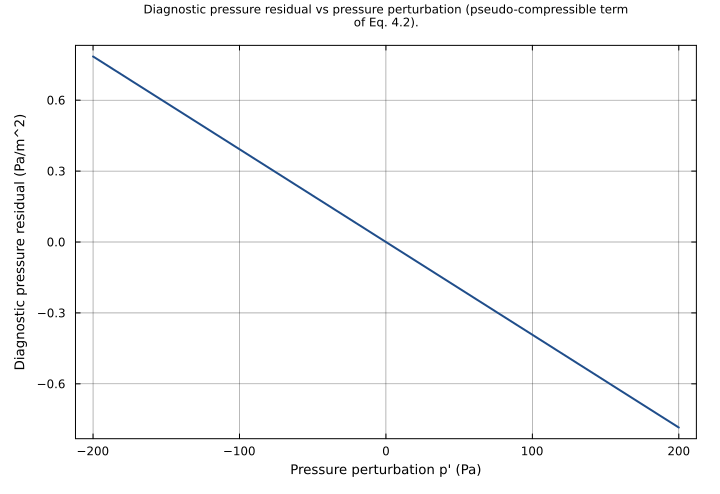
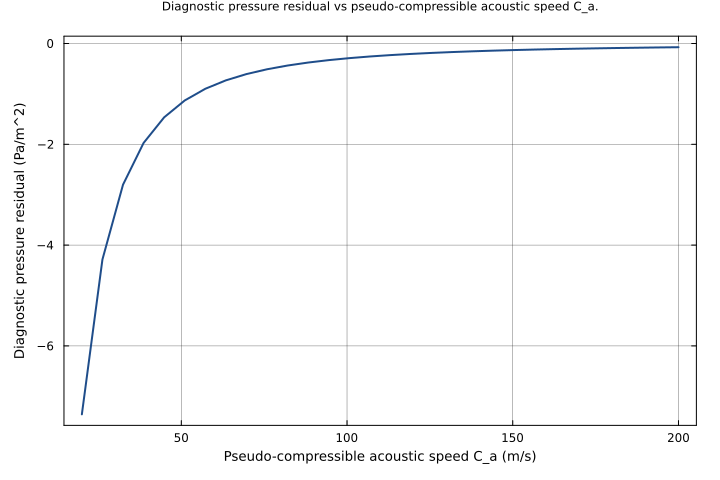
$$ pressure_{residual} = laplacian_{p} + \left(-1\right) \cdot \frac{g \cdot p_{prime}}{C_{a}^{2}} + \left(-1\right) \cdot F_{source} $$Diagnostic pressure equation residual (Eq. 4.2); zero when the anelastic constraint is satisfied
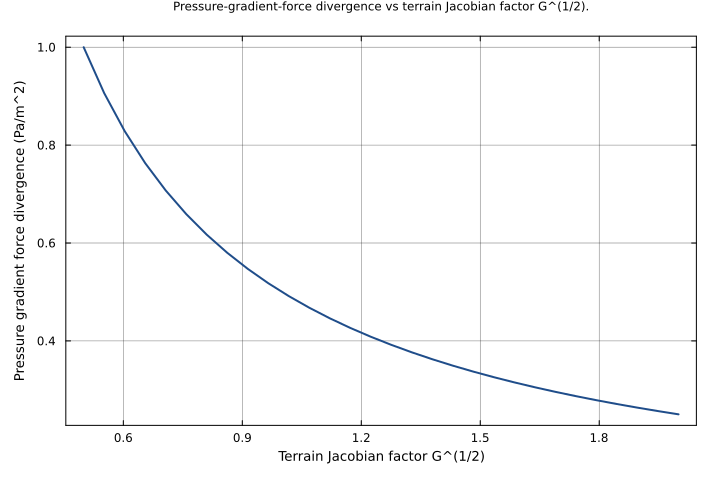
$$ div_{PF} = dPFX_{dx} + dPFY_{dy} + \frac{dPFZ_{dz}}{G_{sqrt}} $$Divergence of the pressure gradient forces
Analyses
pressure_residual_vs_pressure_perturbation
Diagnostic pressure residual as a function of the pressure perturbation p_prime, at the default acoustic speed C_a = 50 m/s with the Laplacian and source terms zero. The residual is the pure pseudo-compressible term pressure_residual = -g * p_prime / C_a^2 — a straight line through the origin, negative for p_prime > 0.
Time span: 0.0 → 1.0
Swept over: p_prime
div_pf_vs_terrain_jacobian
Pressure-gradient-force divergence as a function of the terrain-following Jacobian factor G^(1/2), with the vertical term fixed at dPFZ_dz = 0.5 Pa/m^2 and the horizontal terms zero. div_PF = dPFZ_dz / G_sqrt traces the 1 / G_sqrt scaling that the terrain-following transformation applies to the vertical pressure-gradient-force divergence.
Time span: 0.0 → 1.0
Swept over: G_sqrt
pressure_residual_vs_acoustic_speed
Diagnostic pressure residual as a function of the pseudo-compressible acoustic speed C_a, at a fixed pressure perturbation p_prime = 300 Pa with the Laplacian and source terms zero. The residual -g * p_prime / C_a^2 decays toward zero as C_a grows: increasing the artificial sound speed makes the pseudo-compressible scheme approach the true anelastic limit.
Time span: 0.0 → 1.0
Swept over: C_a
Raw .esm
Raw .esm JSON (this component)
{
  "reference": {
    "notes": "source_ref: AtmosphericDynamics.jl@816cc391:src/clark1977.jl:499\n\nDiagnosticPressure is a ModelingToolkit `@component` implementing the diagnostic pressure equation of Clark (1977), Section 4 — the elliptic equation (Eq. 4.2) for the pressure perturbation derived from the anelastic mass-continuity constraint. All three equations are algebraic (no time derivative): div_PF, laplacian_p, and pressure_residual are `@variables` bound by three `~` equations; g is an upstream `@constant`; C_a, G_sqrt, p_prime, d2p_dx2, d2p_dy2, d2p_dz2, F_source, dPFX_dx, dPFY_dy, dPFZ_dz are `@parameters`.\n\nConstant g: the upstream `@constant` g (gravitational acceleration) is serialized as a parameter-type variable with a fixed default — the .esm schema has no dedicated constant variable type, and physical constants are carried as parameters, matching the sibling general_circulation.esm and surface_layer_profile.esm migrations.\n\nOmitted declarations: the upstream component also declares an `@constant` ρ_ref = 1.225 kg/m^3 and three `@parameters` PFX, PFY, PFZ (the un-differentiated pressure-gradient-force terms) that appear in no equation — the equations use the pre-differentiated divergences dPFX_dx, dPFY_dy, dPFZ_dz instead. MTK builds the system from the equations alone, so these four symbols are not in `parameters(sys)`; mtk2esm follows suit and they are not carried here, mirroring the omitted air-pressure parameter in general_circulation.esm.\n\nDimensional note (upstream `checks = false`): the upstream `System(...; checks = false)` disables MTK unit validation because the pressure_residual equation is dimensionally inconsistent — the pseudo-compressible term g*p_prime/C_a^2 has dimension Pa/m ((m/s^2)*Pa / (m/s)^2), whereas laplacian_p and F_source are Pa/m^2. The upstream source documents this as a deliberately simplified form (its comment: \"the full equation includes terrain-following metric terms\"). The .esm `units` fields are descriptive metadata only — the ESS Python runner of record (earthsci_ast.simulation.simulate) performs no dimensional analysis, and the Model schema object has no `checks` field — so the units are recorded faithfully as declared upstream and the inconsistency is preserved, not papered over.\n\nTolerance rationale (model-level rel=1e-6, abs=1e-9): an observed-only algebraic system with no ODE integration — every output is constant in time. rel=1e-6 covers float64 roundoff in the closed-form +, -, *, /, ^ expressions; abs=1e-9 covers the intended exact zeros (every output when its driving inputs are zero) and the anelastic_balance test, where pressure_residual cancels to a ~3e-17 floating-point residual.\n\nTests: the upstream clark1977_test.jl carries only a structure test for DiagnosticPressure (3 unknowns, 3 equations) with no numeric assertions. The .esm tests below are derived directly from the three algebraic equations, each exercised across a physically meaningful parameter regime: the pressure Laplacian, the pressure-gradient-force divergence with and without a terrain Jacobian, the pseudo-compressible and source terms of the residual, the anelastic-balance case where the residual vanishes, and a full combined check sampled at two times to confirm time-invariance."
  },
  "tolerance": {
    "rel": 1e-06,
    "abs": 1e-09
  },
  "variables": {
    "g": {
      "type": "parameter",
      "units": "m/s^2",
      "default": 9.81,
      "description": "Gravitational acceleration"
    },
    "C_a": {
      "type": "parameter",
      "units": "m/s",
      "default": 50.0,
      "description": "Pseudo-compressible acoustic speed (numerical parameter)"
    },
    "G_sqrt": {
      "type": "parameter",
      "units": "1",
      "default": 1.0,
      "description": "G^(1/2) Jacobian factor of the terrain-following coordinates (dimensionless)"
    },
    "p_prime": {
      "type": "parameter",
      "units": "Pa",
      "default": 0.0,
      "description": "Pressure perturbation"
    },
    "d2p_dx2": {
      "type": "parameter",
      "units": "Pa/m^2",
      "default": 0.0,
      "description": "Second derivative of the pressure perturbation in x"
    },
    "d2p_dy2": {
      "type": "parameter",
      "units": "Pa/m^2",
      "default": 0.0,
      "description": "Second derivative of the pressure perturbation in y"
    },
    "d2p_dz2": {
      "type": "parameter",
      "units": "Pa/m^2",
      "default": 0.0,
      "description": "Second derivative of the pressure perturbation in z (terrain-following coordinate)"
    },
    "F_source": {
      "type": "parameter",
      "units": "Pa/m^2",
      "default": 0.0,
      "description": "Pressure equation source F(x) from the momentum-equation divergences (Eq. 4.1)"
    },
    "dPFX_dx": {
      "type": "parameter",
      "units": "Pa/m^2",
      "default": 0.0,
      "description": "Divergence of the x-pressure gradient force term, d(PFX)/dx"
    },
    "dPFY_dy": {
      "type": "parameter",
      "units": "Pa/m^2",
      "default": 0.0,
      "description": "Divergence of the y-pressure gradient force term, d(PFY)/dy"
    },
    "dPFZ_dz": {
      "type": "parameter",
      "units": "Pa/m^2",
      "default": 0.0,
      "description": "Divergence of the z-pressure gradient force term, d(PFZ)/dz (terrain-following coordinate)"
    },
    "laplacian_p": {
      "type": "unknown",
      "units": "Pa/m^2",
      "description": "Pressure-perturbation Laplacian in terrain-following coordinates"
    },
    "pressure_residual": {
      "type": "unknown",
      "units": "Pa/m^2",
      "description": "Diagnostic pressure equation residual (Eq. 4.2); zero when the anelastic constraint is satisfied"
    },
    "div_PF": {
      "type": "unknown",
      "units": "Pa/m^2",
      "description": "Divergence of the pressure gradient forces"
    }
  },
  "equations": [
    {
      "lhs": "div_PF",
      "rhs": {
        "op": "+",
        "args": [
          "dPFX_dx",
          "dPFY_dy",
          {
            "op": "/",
            "args": [
              "dPFZ_dz",
              "G_sqrt"
            ]
          }
        ]
      }
    },
    {
      "lhs": "laplacian_p",
      "rhs": {
        "op": "+",
        "args": [
          "d2p_dx2",
          "d2p_dy2",
          "d2p_dz2"
        ]
      }
    },
    {
      "lhs": "pressure_residual",
      "rhs": {
        "op": "+",
        "args": [
          "laplacian_p",
          {
            "op": "*",
            "args": [
              -1,
              {
                "op": "/",
                "args": [
                  {
                    "op": "*",
                    "args": [
                      "g",
                      "p_prime"
                    ]
                  },
                  {
                    "op": "^",
                    "args": [
                      "C_a",
                      2
                    ]
                  }
                ]
              }
            ]
          },
          {
            "op": "*",
            "args": [
              -1,
              "F_source"
            ]
          }
        ]
      }
    }
  ],
  "tests": [
    {
      "id": "default_parameters",
      "description": "All parameters at their declared defaults (every pressure-gradient-force divergence, second derivative, source, and the pressure perturbation are zero; G_sqrt = 1, C_a = 50, g = 9.81). All three outputs are zero. Guards the serialized parameter defaults.",
      "time_span": {
        "start": 0.0,
        "end": 1.0
      },
      "assertions": [
        {
          "variable": "div_PF",
          "time": 0.0,
          "expected": 0.0
        },
        {
          "variable": "laplacian_p",
          "time": 0.0,
          "expected": 0.0
        },
        {
          "variable": "pressure_residual",
          "time": 0.0,
          "expected": 0.0
        }
      ]
    },
    {
      "id": "pressure_laplacian",
      "description": "Pressure-perturbation Laplacian as the sum of the three second derivatives (laplacian_p = d2p_dx2 + d2p_dy2 + d2p_dz2 = 0.5 + 0.3 - 0.2 = 0.6 Pa/m^2). With p_prime = 0 and F_source = 0 the residual reduces to laplacian_p, so pressure_residual = 0.6 Pa/m^2; div_PF = 0 because no pressure-gradient-force divergence is set.",
      "parameter_overrides": {
        "d2p_dx2": 0.5,
        "d2p_dy2": 0.3,
        "d2p_dz2": -0.2
      },
      "time_span": {
        "start": 0.0,
        "end": 1.0
      },
      "assertions": [
        {
          "variable": "div_PF",
          "time": 0.0,
          "expected": 0.0
        },
        {
          "variable": "laplacian_p",
          "time": 0.0,
          "expected": 0.6
        },
        {
          "variable": "pressure_residual",
          "time": 0.0,
          "expected": 0.6
        }
      ]
    },
    {
      "id": "pressure_gradient_force_divergence",
      "description": "Divergence of the pressure gradient forces with a non-unit terrain Jacobian: div_PF = dPFX_dx + dPFY_dy + dPFZ_dz / G_sqrt = 0.1 + 0.2 + 0.4 / 2.0 = 0.5 Pa/m^2. The vertical term dPFZ_dz is scaled by 1 / G_sqrt; the horizontal terms are not. laplacian_p and pressure_residual stay zero.",
      "parameter_overrides": {
        "dPFX_dx": 0.1,
        "dPFY_dy": 0.2,
        "dPFZ_dz": 0.4,
        "G_sqrt": 2.0
      },
      "time_span": {
        "start": 0.0,
        "end": 1.0
      },
      "assertions": [
        {
          "variable": "div_PF",
          "time": 0.0,
          "expected": 0.5
        },
        {
          "variable": "laplacian_p",
          "time": 0.0,
          "expected": 0.0
        },
        {
          "variable": "pressure_residual",
          "time": 0.0,
          "expected": 0.0
        }
      ]
    },
    {
      "id": "flat_terrain_jacobian",
      "description": "Flat-terrain limit G_sqrt = 1: the vertical pressure-gradient-force divergence is passed through unscaled, so div_PF = dPFZ_dz = 0.7 Pa/m^2 when the horizontal terms are zero. Confirms the terrain Jacobian factor reduces to a no-op over flat ground.",
      "parameter_overrides": {
        "dPFX_dx": 0.0,
        "dPFY_dy": 0.0,
        "dPFZ_dz": 0.7,
        "G_sqrt": 1.0
      },
      "time_span": {
        "start": 0.0,
        "end": 1.0
      },
      "assertions": [
        {
          "variable": "div_PF",
          "time": 0.0,
          "expected": 0.7
        },
        {
          "variable": "laplacian_p",
          "time": 0.0,
          "expected": 0.0
        },
        {
          "variable": "pressure_residual",
          "time": 0.0,
          "expected": 0.0
        }
      ]
    },
    {
      "id": "compressibility_term",
      "description": "Pseudo-compressible term of the diagnostic pressure equation at the default acoustic speed (C_a = 50 m/s): with laplacian_p = 0 and F_source = 0, pressure_residual = -g * p_prime / C_a^2 = -9.81 * 100 / 2500 = -0.3924 Pa/m^2. Isolates the term that couples the pressure perturbation back into the residual.",
      "parameter_overrides": {
        "p_prime": 100.0
      },
      "time_span": {
        "start": 0.0,
        "end": 1.0
      },
      "assertions": [
        {
          "variable": "div_PF",
          "time": 0.0,
          "expected": 0.0
        },
        {
          "variable": "laplacian_p",
          "time": 0.0,
          "expected": 0.0
        },
        {
          "variable": "pressure_residual",
          "time": 0.0,
          "expected": -0.3924
        }
      ]
    },
    {
      "id": "acoustic_speed_sensitivity",
      "description": "Effect of the pseudo-compressible acoustic speed: at C_a = 100 m/s (double the default) and p_prime = 500 Pa, pressure_residual = -g * p_prime / C_a^2 = -9.81 * 500 / 10000 = -0.4905 Pa/m^2. The 1 / C_a^2 dependence makes the compressibility correction shrink as the artificial sound speed grows.",
      "parameter_overrides": {
        "p_prime": 500.0,
        "C_a": 100.0
      },
      "time_span": {
        "start": 0.0,
        "end": 1.0
      },
      "assertions": [
        {
          "variable": "div_PF",
          "time": 0.0,
          "expected": 0.0
        },
        {
          "variable": "laplacian_p",
          "time": 0.0,
          "expected": 0.0
        },
        {
          "variable": "pressure_residual",
          "time": 0.0,
          "expected": -0.4905
        }
      ]
    },
    {
      "id": "source_term",
      "description": "Source-term contribution: with the Laplacian and pressure perturbation zero, the residual is the negative of the momentum-divergence source, pressure_residual = -F_source = -0.35 Pa/m^2.",
      "parameter_overrides": {
        "F_source": 0.35
      },
      "time_span": {
        "start": 0.0,
        "end": 1.0
      },
      "assertions": [
        {
          "variable": "div_PF",
          "time": 0.0,
          "expected": 0.0
        },
        {
          "variable": "laplacian_p",
          "time": 0.0,
          "expected": 0.0
        },
        {
          "variable": "pressure_residual",
          "time": 0.0,
          "expected": -0.35
        }
      ]
    },
    {
      "id": "anelastic_balance",
      "description": "Anelastic constraint satisfied: when the pressure Laplacian exactly balances the pseudo-compressible and source terms the residual vanishes (Eq. 4.2). Here laplacian_p = d2p_dx2 = 0.4924 Pa/m^2 equals g * p_prime / C_a^2 + F_source = 9.81 * 100 / 2500 + 0.1 = 0.3924 + 0.1, so pressure_residual cancels to zero (a ~3e-17 floating-point residual, covered by the model-level abs=1e-9 tolerance).",
      "parameter_overrides": {
        "p_prime": 100.0,
        "C_a": 50.0,
        "F_source": 0.1,
        "d2p_dx2": 0.4924
      },
      "time_span": {
        "start": 0.0,
        "end": 1.0
      },
      "assertions": [
        {
          "variable": "div_PF",
          "time": 0.0,
          "expected": 0.0
        },
        {
          "variable": "laplacian_p",
          "time": 0.0,
          "expected": 0.4924
        },
        {
          "variable": "pressure_residual",
          "time": 0.0,
          "expected": 0.0
        }
      ]
    },
    {
      "id": "negative_pf_divergence",
      "description": "Pressure-gradient-force divergence with mixed-sign terms and a sub-unit terrain Jacobian (G_sqrt = 0.75, terrain steeper than flat): div_PF = dPFX_dx + dPFY_dy + dPFZ_dz / G_sqrt = -0.3 + 0.1 + (-0.6) / 0.75 = -0.3 + 0.1 - 0.8 = -1.0 Pa/m^2.",
      "parameter_overrides": {
        "dPFX_dx": -0.3,
        "dPFY_dy": 0.1,
        "dPFZ_dz": -0.6,
        "G_sqrt": 0.75
      },
      "time_span": {
        "start": 0.0,
        "end": 1.0
      },
      "assertions": [
        {
          "variable": "div_PF",
          "time": 0.0,
          "expected": -1.0
        },
        {
          "variable": "laplacian_p",
          "time": 0.0,
          "expected": 0.0
        },
        {
          "variable": "pressure_residual",
          "time": 0.0,
          "expected": 0.0
        }
      ]
    },
    {
      "id": "full_diagnostic",
      "description": "Comprehensive check exercising all three outputs with every driving input nonzero: C_a = 60 m/s, G_sqrt = 1.5, p_prime = 150 Pa, d2p_dx2 = 0.6, d2p_dy2 = 0.25, d2p_dz2 = -0.15, F_source = 0.05, dPFX_dx = 0.12, dPFY_dy = 0.08, dPFZ_dz = 0.3 Pa/m^2. div_PF = 0.12 + 0.08 + 0.3 / 1.5 = 0.4; laplacian_p = 0.6 + 0.25 - 0.15 = 0.7; pressure_residual = 0.7 - 9.81 * 150 / 3600 - 0.05 = 0.24125 Pa/m^2. Sampled at t = 0 and t = 1 to confirm the algebraic system is time-invariant.",
      "parameter_overrides": {
        "C_a": 60.0,
        "G_sqrt": 1.5,
        "p_prime": 150.0,
        "d2p_dx2": 0.6,
        "d2p_dy2": 0.25,
        "d2p_dz2": -0.15,
        "F_source": 0.05,
        "dPFX_dx": 0.12,
        "dPFY_dy": 0.08,
        "dPFZ_dz": 0.3
      },
      "time_span": {
        "start": 0.0,
        "end": 1.0
      },
      "assertions": [
        {
          "variable": "div_PF",
          "time": 0.0,
          "expected": 0.4
        },
        {
          "variable": "laplacian_p",
          "time": 0.0,
          "expected": 0.7
        },
        {
          "variable": "pressure_residual",
          "time": 0.0,
          "expected": 0.24125
        },
        {
          "variable": "div_PF",
          "time": 1.0,
          "expected": 0.4
        },
        {
          "variable": "laplacian_p",
          "time": 1.0,
          "expected": 0.7
        },
        {
          "variable": "pressure_residual",
          "time": 1.0,
          "expected": 0.24125
        }
      ]
    }
  ],
  "analyses": [
    {
      "id": "pressure_residual_vs_pressure_perturbation",
      "description": "Diagnostic pressure residual as a function of the pressure perturbation p_prime, at the default acoustic speed C_a = 50 m/s with the Laplacian and source terms zero. The residual is the pure pseudo-compressible term pressure_residual = -g * p_prime / C_a^2 — a straight line through the origin, negative for p_prime > 0.",
      "initial_state": {},
      "parameters": {},
      "time_span": {
        "start": 0.0,
        "end": 1.0
      },
      "parameter_sweep": {
        "type": "cartesian",
        "dimensions": [
          {
            "parameter": "p_prime",
            "range": {
              "start": -200.0,
              "stop": 200.0,
              "count": 30,
              "scale": "linear"
            }
          }
        ]
      },
      "plots": [
        {
          "id": "residual_vs_p_prime",
          "type": "line",
          "description": "Diagnostic pressure residual vs pressure perturbation (pseudo-compressible term of Eq. 4.2).",
          "x": {
            "variable": "p_prime",
            "label": "Pressure perturbation p' (Pa)"
          },
          "y": {
            "variable": "pressure_residual",
            "label": "Diagnostic pressure residual (Pa/m^2)"
          }
        }
      ]
    },
    {
      "id": "div_pf_vs_terrain_jacobian",
      "description": "Pressure-gradient-force divergence as a function of the terrain-following Jacobian factor G^(1/2), with the vertical term fixed at dPFZ_dz = 0.5 Pa/m^2 and the horizontal terms zero. div_PF = dPFZ_dz / G_sqrt traces the 1 / G_sqrt scaling that the terrain-following transformation applies to the vertical pressure-gradient-force divergence.",
      "initial_state": {},
      "parameters": {
        "dPFZ_dz": 0.5
      },
      "time_span": {
        "start": 0.0,
        "end": 1.0
      },
      "parameter_sweep": {
        "type": "cartesian",
        "dimensions": [
          {
            "parameter": "G_sqrt",
            "range": {
              "start": 0.5,
              "stop": 2.0,
              "count": 30,
              "scale": "linear"
            }
          }
        ]
      },
      "plots": [
        {
          "id": "div_PF_vs_G_sqrt",
          "type": "line",
          "description": "Pressure-gradient-force divergence vs terrain Jacobian factor G^(1/2).",
          "x": {
            "variable": "G_sqrt",
            "label": "Terrain Jacobian factor G^(1/2)"
          },
          "y": {
            "variable": "div_PF",
            "label": "Pressure gradient force divergence (Pa/m^2)"
          }
        }
      ]
    },
    {
      "id": "pressure_residual_vs_acoustic_speed",
      "description": "Diagnostic pressure residual as a function of the pseudo-compressible acoustic speed C_a, at a fixed pressure perturbation p_prime = 300 Pa with the Laplacian and source terms zero. The residual -g * p_prime / C_a^2 decays toward zero as C_a grows: increasing the artificial sound speed makes the pseudo-compressible scheme approach the true anelastic limit.",
      "initial_state": {},
      "parameters": {
        "p_prime": 300.0
      },
      "time_span": {
        "start": 0.0,
        "end": 1.0
      },
      "parameter_sweep": {
        "type": "cartesian",
        "dimensions": [
          {
            "parameter": "C_a",
            "range": {
              "start": 20.0,
              "stop": 200.0,
              "count": 30,
              "scale": "linear"
            }
          }
        ]
      },
      "plots": [
        {
          "id": "residual_vs_C_a",
          "type": "line",
          "description": "Diagnostic pressure residual vs pseudo-compressible acoustic speed C_a.",
          "x": {
            "variable": "C_a",
            "label": "Pseudo-compressible acoustic speed C_a (m/s)"
          },
          "y": {
            "variable": "pressure_residual",
            "label": "Diagnostic pressure residual (Pa/m^2)"
          }
        }
      ]
    }
  ]
}