WetDepositionFlux
Net wet deposition diagnostics — wet deposition flux, washout ratio, and wet deposition velocity — for a trace species removed from the atmosphere by falling rain, from Seinfeld & Pandis (2006), Atmospheric Chemistry and Physics, 2nd ed., Chapter 20 (Wet Deposition), Eqs. 20.6-20.9. Given the species concentration in ground-level rainwater (C_rain), its gas-phase concentration in air (C_air), and the precipitation rate (p₀), the component evaluates three quantities: the wet deposition flux F_w = C_rain·p₀ (Eq. 20.7) — the downward species mass flux carried to the surface by rain; the dimensionless washout ratio w_r = C_rain/C_air (Eq. 20.6) — a measure of how strongly the species partitions into rainwater; and the wet deposition velocity u_w = F_w/C_air (Eq. 20.8), equivalently w_r·p₀ (Eq. 20.9) — the flux normalized by the air-phase concentration. Migrated from AtmosphericDeposition.jl@e4468c79 src/seinfeld_pandis_2006_ch20.jl:451 (`WetDepositionFlux` @component). Flat observed-only algebraic model: C_rain, C_air and p₀ are the input parameters and F_w, w_r, u_w are the algebraic outputs, each fixed by one equation with no time derivative. The upstream @component is a single flat System with no subsystems; the migration-tracker `coupling.couple` feature tag and `depends_on: ParticleScavengingCoeff, GasScavengingCoeff` describe a conceptual relationship that the source code does not implement, so this is migrated as a standalone flat model.
Description
Net wet deposition diagnostics — wet deposition flux, washout ratio, and wet deposition velocity — for a trace species removed from the atmosphere by falling rain, from Seinfeld & Pandis (2006), Atmospheric Chemistry and Physics, 2nd ed., Chapter 20 (Wet Deposition), Eqs. 20.6-20.9. Given the species concentration in ground-level rainwater (C_rain), its gas-phase concentration in air (C_air), and the precipitation rate (p₀), the component evaluates three quantities: the wet deposition flux F_w = C_rain·p₀ (Eq. 20.7) — the downward species mass flux carried to the surface by rain; the dimensionless washout ratio w_r = C_rain/C_air (Eq. 20.6) — a measure of how strongly the species partitions into rainwater; and the wet deposition velocity u_w = F_w/C_air (Eq. 20.8), equivalently w_r·p₀ (Eq. 20.9) — the flux normalized by the air-phase concentration. Migrated from AtmosphericDeposition.jl@e4468c79 src/seinfeld_pandis_2006_ch20.jl:451 (WetDepositionFlux @component). Flat observed-only algebraic model: C_rain, C_air and p₀ are the input parameters and F_w, w_r, u_w are the algebraic outputs, each fixed by one equation with no time derivative. The upstream @component is a single flat System with no subsystems; the migration-tracker coupling.couple feature tag and depends_on: ParticleScavengingCoeff, GasScavengingCoeff describe a conceptual relationship that the source code does not implement, so this is migrated as a standalone flat model.
Reference
Seinfeld, J. H., & Pandis, S. N. (2006). Atmospheric Chemistry and Physics: From Air Pollution to Climate Change (2nd ed.), Ch. 20, Eqs. 20.6-20.9 (washout ratio, wet deposition flux, and wet deposition velocity). John Wiley & Sons, Inc.
_source_ref: AtmosphericDeposition.jl@e4468c79c8dd4aae88646cd16d6bcf290874742c:src/seinfeld_pandis_2006_ch20.jl:451
Upstream WetDepositionFlux is an MTK @component with 3 input @parameters (C_rain, C_air, p₀) and 3 output @variables (F_w, w_r, u_w), related by 3 algebraic equations. It returns System(eqs, t, vars, params; name) with no subsystems, so it is a flat algebraic model; the upstream Wet Deposition Flux (Eq. 20.7-20.9) test (test/seinfeld_pandis_2006_ch20_test.jl:293) checks equations(sys) == 3 and unknowns(sys) == 3.
Although the EarthSciModels migration tracker lists coupling.couple in this row’s features column and depends_on: ParticleScavengingCoeff, GasScavengingCoeff, the upstream @component (src lines 451-473) neither calls couple nor references those two components — its three equations use only its own parameters. Per the rig convention that the tracker feature / depends_on columns are not authoritative, the component is migrated as a standalone flat models block, mirroring the sibling observed-only sp06_ch20 migrations.
None of the equations carries a time derivative, so the system is purely algebraic (observed-only): system_kind is left unset because ode is the schema default and there is no differential state, matching the sibling observed-only sp06_ch20 migrations (gas_scavenging_coeff.esm, mass_transfer_coeff.esm, particle_collection_eff.esm, particle_scavenging_coeff.esm). F_w, w_r and u_w are each serialized as type: state with one explicit algebraic equation in the equations array.
Equation mapping (one .esm equation per source line):
- F_w = C_rain·p₀ (Eq. 20.7; src line 467) — the wet deposition flux, the downward species mass flux carried to the ground by rain.
- w_r = C_rain/C_air (Eq. 20.6; src line 468) — the dimensionless washout ratio.
- u_w = F_w/C_air (Eq. 20.8; src line 469) — the wet deposition velocity. The upstream equation is
u_w ~ F_w / C_airand is migrated verbatim: the right-hand side references the F_w algebraic state, which the ESS runner resolves through its topological algebraic-state substitution (u_w expands to C_rain·p₀/C_air). The source comment notes the equivalent closed form u_w = w_r·p₀ (Eq. 20.9); keeping F_w/C_air preserves the one-equation-per-source-line correspondence.
No module-level @constants of seinfeld_pandis_2006_ch20.jl (μ_air_sp, ρ_air_sp, μ_w_sp, ρ_w_sp, g_sp, kB_sp) are referenced by WetDepositionFlux — its three equations use only the component’s own parameters — so no constants are migrated. The three equations are dimensionally consistent (F_w: [mol/m^3]·[m/s] = mol/(m^2·s); w_r: [mol/m^3]/[mol/m^3] = 1; u_w: [mol/(m^2·s)]/[mol/m^3] = m/s), so there is no upstream checks=false to mirror.
The 3 parameters carry the upstream component defaults (C_rain = 1.0e-3 mol/m^3, C_air = 1.0e-6 mol/m^3, p₀ = 2.778e-7 m/s ≈ 1 mm/h). F_w, w_r and u_w have no upstream defaults; they are fixed entirely by the algebraic equations. At the component defaults F_w = 2.778e-10 mol/(m^2·s), w_r = 1000 and u_w = 2.778e-4 m/s — the case pinned by the upstream Wet Deposition Flux (Eq. 20.7-20.9) testitem, which checks C_rain·p₀ ≈ 2.778e-10 (F_w) and C_rain/C_air ≈ 1000 (w_r).
Tolerance rationale (model-level rel=1e-6): an observed-only algebraic system with no ODE integration; each equation is one multiply or one divide on float64 parameter values, evaluated once per test point. rel=1e-6 covers float64 round-off (~1e-16 per op) with ample headroom across the tested ranges (F_w ~ 1e-11 to 1e-8, w_r ~ 1e3 to 1e5, u_w ~ 1e-5 to 1e-2). No output is ever exactly zero — every test uses C_air > 0 and C_rain, p₀ > 0 — so a relative tolerance is well-defined throughout and no abs floor is needed (matching the sibling gas_scavenging_coeff.esm)._
Parameters
| Name | Units | Default | Description |
|---|---|---|---|
C_rain | mol/m^3 | 0.001 | Species concentration in rainwater at the ground |
C_air | mol/m^3 | 1e-06 | Species gas-phase concentration in air at the ground |
p₀ | m/s | 2.778e-07 | Precipitation rate (2.778e-7 m/s = 1 mm/h) |
Observed
| Name | Units | Default | Description |
|---|---|---|---|
F_w | mol/(m^2*s) | Wet deposition flux — downward species mass flux carried to the surface by rain (Eq. 20.7) | |
w_r | 1 | Washout ratio — ratio of the species concentration in rainwater to its gas-phase concentration in air (Eq. 20.6) (dimensionless) | |
u_w | m/s | Wet deposition velocity — wet deposition flux normalized by the air-phase concentration (Eq. 20.8) |
Observed expressions
$$ F_{w} = C_{rain} \cdot p₀ $$Wet deposition flux — downward species mass flux carried to the surface by rain (Eq. 20.7)
$$ w_{r} = \frac{C_{rain}}{C_{air}} $$Washout ratio — ratio of the species concentration in rainwater to its gas-phase concentration in air (Eq. 20.6) (dimensionless)
$$ u_{w} = \frac{F_{w}}{C_{air}} $$Wet deposition velocity — wet deposition flux normalized by the air-phase concentration (Eq. 20.8)
Analyses
wet_deposition_vs_precipitation_rate
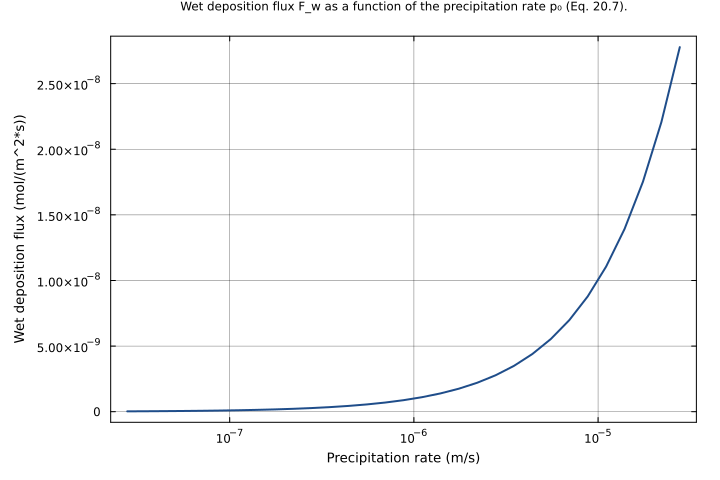
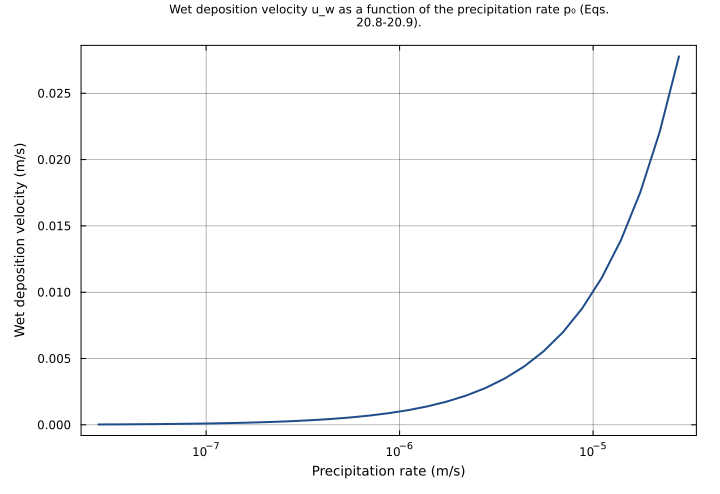
Wet deposition flux F_w and wet deposition velocity u_w as a function of the precipitation rate p₀, swept log-spaced from ≈ 0.1 mm/h (light drizzle) to ≈ 100 mm/h (intense rain) at the default rainwater and air concentrations. Both quantities are exactly linear in p₀ (F_w = C_rain·p₀, Eq. 20.7; u_w = F_w/C_air = w_r·p₀, Eqs. 20.8-20.9), so wet removal of a given species scales directly with rainfall intensity.
Time span: 0.0 → 1.0
Swept over: p₀
flux_over_rainwater_concentration_and_rate
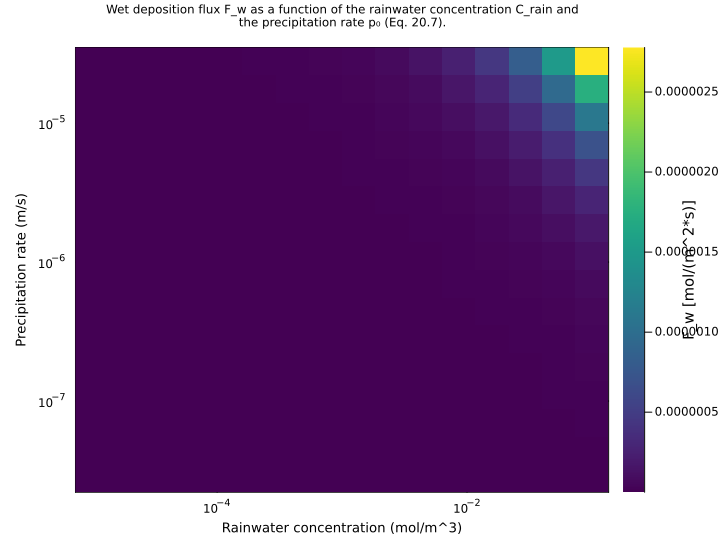
Two-dimensional sweep of the wet deposition flux F_w over the rainwater concentration C_rain (1.0e-5 to 1.0e-1 mol/m^3, log-spaced) and the precipitation rate p₀ (≈ 0.1 to 100 mm/h, log-spaced), at the default air-phase concentration. Surfaces the bilinear Eq. 20.7 dependence F_w = C_rain·p₀: the wet deposition flux is largest for a species at high rainwater concentration scavenged by intense rain.
Time span: 0.0 → 1.0
Swept over: C_rain, p₀
Raw .esm
Raw .esm JSON (this component)
{
  "reference": {
    "citation": "Seinfeld, J. H., & Pandis, S. N. (2006). Atmospheric Chemistry and Physics: From Air Pollution to Climate Change (2nd ed.), Ch. 20, Eqs. 20.6-20.9 (washout ratio, wet deposition flux, and wet deposition velocity). John Wiley & Sons, Inc.",
    "notes": "source_ref: AtmosphericDeposition.jl@e4468c79c8dd4aae88646cd16d6bcf290874742c:src/seinfeld_pandis_2006_ch20.jl:451\nUpstream `WetDepositionFlux` is an MTK `@component` with 3 input `@parameters` (C_rain, C_air, p₀) and 3 output `@variables` (F_w, w_r, u_w), related by 3 algebraic equations. It returns `System(eqs, t, vars, params; name)` with no subsystems, so it is a flat algebraic model; the upstream `Wet Deposition Flux (Eq. 20.7-20.9)` test (test/seinfeld_pandis_2006_ch20_test.jl:293) checks equations(sys) == 3 and unknowns(sys) == 3.\n\nAlthough the EarthSciModels migration tracker lists `coupling.couple` in this row's features column and `depends_on: ParticleScavengingCoeff, GasScavengingCoeff`, the upstream `@component` (src lines 451-473) neither calls `couple` nor references those two components — its three equations use only its own parameters. Per the rig convention that the tracker feature / depends_on columns are not authoritative, the component is migrated as a standalone flat `models` block, mirroring the sibling observed-only sp06_ch20 migrations.\n\nNone of the equations carries a time derivative, so the system is purely algebraic (observed-only): `system_kind` is left unset because `ode` is the schema default and there is no differential state, matching the sibling observed-only sp06_ch20 migrations (gas_scavenging_coeff.esm, mass_transfer_coeff.esm, particle_collection_eff.esm, particle_scavenging_coeff.esm). F_w, w_r and u_w are each serialized as `type: state` with one explicit algebraic equation in the `equations` array.\n\nEquation mapping (one .esm equation per source line):\n  - F_w = C_rain·p₀ (Eq. 20.7; src line 467) — the wet deposition flux, the downward species mass flux carried to the ground by rain.\n  - w_r = C_rain/C_air (Eq. 20.6; src line 468) — the dimensionless washout ratio.\n  - u_w = F_w/C_air (Eq. 20.8; src line 469) — the wet deposition velocity. The upstream equation is `u_w ~ F_w / C_air` and is migrated verbatim: the right-hand side references the F_w algebraic state, which the ESS runner resolves through its topological algebraic-state substitution (u_w expands to C_rain·p₀/C_air). The source comment notes the equivalent closed form u_w = w_r·p₀ (Eq. 20.9); keeping F_w/C_air preserves the one-equation-per-source-line correspondence.\n\nNo module-level `@constants` of seinfeld_pandis_2006_ch20.jl (μ_air_sp, ρ_air_sp, μ_w_sp, ρ_w_sp, g_sp, kB_sp) are referenced by `WetDepositionFlux` — its three equations use only the component's own parameters — so no constants are migrated. The three equations are dimensionally consistent (F_w: [mol/m^3]·[m/s] = mol/(m^2·s); w_r: [mol/m^3]/[mol/m^3] = 1; u_w: [mol/(m^2·s)]/[mol/m^3] = m/s), so there is no upstream `checks=false` to mirror.\n\nThe 3 parameters carry the upstream component defaults (C_rain = 1.0e-3 mol/m^3, C_air = 1.0e-6 mol/m^3, p₀ = 2.778e-7 m/s ≈ 1 mm/h). F_w, w_r and u_w have no upstream defaults; they are fixed entirely by the algebraic equations. At the component defaults F_w = 2.778e-10 mol/(m^2·s), w_r = 1000 and u_w = 2.778e-4 m/s — the case pinned by the upstream `Wet Deposition Flux (Eq. 20.7-20.9)` testitem, which checks C_rain·p₀ ≈ 2.778e-10 (F_w) and C_rain/C_air ≈ 1000 (w_r).\n\nTolerance rationale (model-level rel=1e-6): an observed-only algebraic system with no ODE integration; each equation is one multiply or one divide on float64 parameter values, evaluated once per test point. rel=1e-6 covers float64 round-off (~1e-16 per op) with ample headroom across the tested ranges (F_w ~ 1e-11 to 1e-8, w_r ~ 1e3 to 1e5, u_w ~ 1e-5 to 1e-2). No output is ever exactly zero — every test uses C_air > 0 and C_rain, p₀ > 0 — so a relative tolerance is well-defined throughout and no `abs` floor is needed (matching the sibling gas_scavenging_coeff.esm)."
  },
  "tolerance": {
    "rel": 1e-06
  },
  "variables": {
    "C_rain": {
      "type": "parameter",
      "units": "mol/m^3",
      "default": 0.001,
      "description": "Species concentration in rainwater at the ground"
    },
    "C_air": {
      "type": "parameter",
      "units": "mol/m^3",
      "default": 1e-06,
      "description": "Species gas-phase concentration in air at the ground"
    },
    "p₀": {
      "type": "parameter",
      "units": "m/s",
      "default": 2.778e-07,
      "description": "Precipitation rate (2.778e-7 m/s = 1 mm/h)"
    },
    "F_w": {
      "type": "unknown",
      "units": "mol/(m^2*s)",
      "description": "Wet deposition flux — downward species mass flux carried to the surface by rain (Eq. 20.7)"
    },
    "w_r": {
      "type": "unknown",
      "units": "1",
      "description": "Washout ratio — ratio of the species concentration in rainwater to its gas-phase concentration in air (Eq. 20.6) (dimensionless)"
    },
    "u_w": {
      "type": "unknown",
      "units": "m/s",
      "description": "Wet deposition velocity — wet deposition flux normalized by the air-phase concentration (Eq. 20.8)"
    }
  },
  "equations": [
    {
      "_comment": "Eq. 20.7 (src line 467) — wet deposition flux: F_w = C_rain·p₀, the downward mass flux of the species carried to the ground by rain.",
      "lhs": "F_w",
      "rhs": {
        "op": "*",
        "args": [
          "C_rain",
          "p₀"
        ]
      }
    },
    {
      "_comment": "Eq. 20.6 (src line 468) — washout ratio: w_r = C_rain/C_air, the dimensionless ratio of the species concentration in rainwater to its gas-phase concentration in air.",
      "lhs": "w_r",
      "rhs": {
        "op": "/",
        "args": [
          "C_rain",
          "C_air"
        ]
      }
    },
    {
      "_comment": "Eq. 20.8 (src line 469) — wet deposition velocity: u_w = F_w/C_air. Migrated verbatim from the upstream `u_w ~ F_w / C_air`; the RHS references the F_w algebraic state, which the runner resolves by substitution (u_w = C_rain·p₀/C_air). Equivalently u_w = w_r·p₀ (Eq. 20.9), per the source comment.",
      "lhs": "u_w",
      "rhs": {
        "op": "/",
        "args": [
          "F_w",
          "C_air"
        ]
      }
    }
  ],
  "tests": [
    {
      "id": "default_parameters",
      "description": "Component defaults — C_rain = 1.0e-3 mol/m^3, C_air = 1.0e-6 mol/m^3, p₀ = 2.778e-7 m/s (≈ 1 mm/h). This is the case pinned by the upstream `Wet Deposition Flux (Eq. 20.7-20.9)` testitem, which checks C_rain·p₀ ≈ 2.778e-10 (F_w) and C_rain/C_air ≈ 1000 (w_r); the wet deposition velocity follows as u_w = F_w/C_air = 2.778e-4 m/s. The system is algebraic, so all three outputs are re-asserted at t = 1 to confirm time-invariance.",
      "time_span": {
        "start": 0.0,
        "end": 1.0
      },
      "assertions": [
        {
          "variable": "F_w",
          "time": 0.0,
          "expected": 2.778e-10
        },
        {
          "variable": "w_r",
          "time": 0.0,
          "expected": 1000.0000000000001
        },
        {
          "variable": "u_w",
          "time": 0.0,
          "expected": 0.00027780000000000003
        },
        {
          "variable": "F_w",
          "time": 1.0,
          "expected": 2.778e-10
        },
        {
          "variable": "w_r",
          "time": 1.0,
          "expected": 1000.0000000000001
        },
        {
          "variable": "u_w",
          "time": 1.0,
          "expected": 0.00027780000000000003
        }
      ]
    },
    {
      "id": "heavy_precipitation",
      "description": "Heavy rainfall: p₀ raised tenfold to 2.778e-6 m/s (≈ 10 mm/h), C_rain and C_air at the component defaults. F_w = C_rain·p₀ (Eq. 20.7) and u_w = F_w/C_air (Eq. 20.8) both scale linearly with the precipitation rate, so each is exactly ten times its default_parameters value (F_w = 2.778e-9, u_w = 2.778e-3 m/s). The washout ratio w_r = C_rain/C_air is independent of p₀ and is unchanged at 1000.",
      "parameter_overrides": {
        "p₀": 2.778e-06
      },
      "time_span": {
        "start": 0.0,
        "end": 1.0
      },
      "assertions": [
        {
          "variable": "F_w",
          "time": 0.0,
          "expected": 2.778e-09
        },
        {
          "variable": "u_w",
          "time": 0.0,
          "expected": 0.002778
        },
        {
          "variable": "w_r",
          "time": 0.0,
          "expected": 1000.0000000000001
        }
      ]
    },
    {
      "id": "light_drizzle",
      "description": "Light drizzle: p₀ lowered tenfold to 2.778e-8 m/s (≈ 0.1 mm/h), C_rain and C_air at the component defaults. F_w and u_w scale linearly with p₀ (Eqs. 20.7-20.8), so each is exactly one tenth of its default_parameters value (F_w = 2.778e-11, u_w = 2.778e-5 m/s) — the weak-scavenging regime where wet removal is a minor sink. w_r is unchanged at 1000.",
      "parameter_overrides": {
        "p₀": 2.778e-08
      },
      "time_span": {
        "start": 0.0,
        "end": 1.0
      },
      "assertions": [
        {
          "variable": "F_w",
          "time": 0.0,
          "expected": 2.7780000000000003e-11
        },
        {
          "variable": "u_w",
          "time": 0.0,
          "expected": 2.7780000000000005e-05
        },
        {
          "variable": "w_r",
          "time": 0.0,
          "expected": 1000.0000000000001
        }
      ]
    },
    {
      "id": "soluble_gas_high_washout",
      "description": "A highly soluble gas (e.g. HNO₃): the rainwater concentration C_rain is raised to 1.0e-1 mol/m^3 while C_air stays at 1.0e-6 mol/m^3, giving a large washout ratio w_r = C_rain/C_air = 1.0e5 — strong partitioning of the species into rainwater. The wet deposition flux F_w = C_rain·p₀ rises in proportion to C_rain (F_w = 2.778e-8), and so does the deposition velocity u_w = F_w/C_air (u_w = 2.778e-2 m/s). Exercises the high-solubility end of the washout-ratio range.",
      "parameter_overrides": {
        "C_rain": 0.1
      },
      "time_span": {
        "start": 0.0,
        "end": 1.0
      },
      "assertions": [
        {
          "variable": "w_r",
          "time": 0.0,
          "expected": 100000.00000000001
        },
        {
          "variable": "F_w",
          "time": 0.0,
          "expected": 2.778e-08
        },
        {
          "variable": "u_w",
          "time": 0.0,
          "expected": 0.027780000000000003
        }
      ]
    },
    {
      "id": "dilute_background_air",
      "description": "Dilute background air: the gas-phase concentration C_air is lowered tenfold to 1.0e-7 mol/m^3, with C_rain and p₀ at the component defaults. The wet deposition flux F_w = C_rain·p₀ depends only on C_rain and p₀, so it is unchanged from default_parameters (F_w = 2.778e-10) — confirming F_w is independent of C_air. The washout ratio w_r = C_rain/C_air and the wet deposition velocity u_w = F_w/C_air both scale as 1/C_air, so each is ten times its default value (w_r = 1.0e4, u_w = 2.778e-3 m/s).",
      "parameter_overrides": {
        "C_air": 1e-07
      },
      "time_span": {
        "start": 0.0,
        "end": 1.0
      },
      "assertions": [
        {
          "variable": "F_w",
          "time": 0.0,
          "expected": 2.778e-10
        },
        {
          "variable": "w_r",
          "time": 0.0,
          "expected": 10000.0
        },
        {
          "variable": "u_w",
          "time": 0.0,
          "expected": 0.002778
        }
      ]
    }
  ],
  "analyses": [
    {
      "id": "wet_deposition_vs_precipitation_rate",
      "description": "Wet deposition flux F_w and wet deposition velocity u_w as a function of the precipitation rate p₀, swept log-spaced from ≈ 0.1 mm/h (light drizzle) to ≈ 100 mm/h (intense rain) at the default rainwater and air concentrations. Both quantities are exactly linear in p₀ (F_w = C_rain·p₀, Eq. 20.7; u_w = F_w/C_air = w_r·p₀, Eqs. 20.8-20.9), so wet removal of a given species scales directly with rainfall intensity.",
      "initial_state": {},
      "parameters": {
        "C_rain": 0.001,
        "C_air": 1e-06
      },
      "time_span": {
        "start": 0.0,
        "end": 1.0
      },
      "parameter_sweep": {
        "type": "cartesian",
        "dimensions": [
          {
            "parameter": "p₀",
            "range": {
              "start": 2.778e-08,
              "stop": 2.778e-05,
              "count": 31,
              "scale": "log"
            }
          }
        ]
      },
      "plots": [
        {
          "id": "F_w_vs_p0",
          "type": "line",
          "description": "Wet deposition flux F_w as a function of the precipitation rate p₀ (Eq. 20.7).",
          "x": {
            "variable": "p₀",
            "label": "Precipitation rate (m/s)"
          },
          "y": {
            "variable": "F_w",
            "label": "Wet deposition flux (mol/(m^2*s))"
          }
        },
        {
          "id": "u_w_vs_p0",
          "type": "line",
          "description": "Wet deposition velocity u_w as a function of the precipitation rate p₀ (Eqs. 20.8-20.9).",
          "x": {
            "variable": "p₀",
            "label": "Precipitation rate (m/s)"
          },
          "y": {
            "variable": "u_w",
            "label": "Wet deposition velocity (m/s)"
          }
        }
      ]
    },
    {
      "id": "flux_over_rainwater_concentration_and_rate",
      "description": "Two-dimensional sweep of the wet deposition flux F_w over the rainwater concentration C_rain (1.0e-5 to 1.0e-1 mol/m^3, log-spaced) and the precipitation rate p₀ (≈ 0.1 to 100 mm/h, log-spaced), at the default air-phase concentration. Surfaces the bilinear Eq. 20.7 dependence F_w = C_rain·p₀: the wet deposition flux is largest for a species at high rainwater concentration scavenged by intense rain.",
      "initial_state": {},
      "parameters": {
        "C_air": 1e-06
      },
      "time_span": {
        "start": 0.0,
        "end": 1.0
      },
      "parameter_sweep": {
        "type": "cartesian",
        "dimensions": [
          {
            "parameter": "C_rain",
            "range": {
              "start": 1e-05,
              "stop": 0.1,
              "count": 16,
              "scale": "log"
            }
          },
          {
            "parameter": "p₀",
            "range": {
              "start": 2.778e-08,
              "stop": 2.778e-05,
              "count": 16,
              "scale": "log"
            }
          }
        ]
      },
      "plots": [
        {
          "id": "F_w_heatmap",
          "type": "heatmap",
          "description": "Wet deposition flux F_w as a function of the rainwater concentration C_rain and the precipitation rate p₀ (Eq. 20.7).",
          "x": {
            "variable": "C_rain",
            "label": "Rainwater concentration (mol/m^3)"
          },
          "y": {
            "variable": "p₀",
            "label": "Precipitation rate (m/s)"
          },
          "value": {
            "variable": "F_w",
            "reduce": "final"
          }
        }
      ]
    }
  ]
}