BelowCloudGasScavenging
Irreversible below-cloud (washout) scavenging of a gas-phase species by falling raindrops, from Seinfeld & Pandis (2006), Atmospheric Chemistry and Physics, 2nd ed., Chapter 20 (Wet Deposition), Eqs. 20.22, 20.24, 20.25. The gas scavenging coefficient Λ_gas = 6·p₀·K_c/(D_p·U_t) (Eq. 20.25) for monodisperse drops is constant in time, so the below-cloud gas concentration decays exponentially via dC_g/dt = −Λ_gas·C_g (Eq. 20.24) and the below-cloud scavenging flux is F_bc = Λ_gas·h·C_g (Eq. 20.22). 'Irreversible' means the gas is assumed to be taken up and not re-released — the limiting case opposite to the reversible (Henry's-law-equilibrium) treatment of the sibling ReversibleGasScavenging component. Migrated from AtmosphericDeposition.jl@e4468c79 src/seinfeld_pandis_2006_ch20.jl:234 (`BelowCloudGasScavenging` @component). ODE system: C_g is the single differential state; Λ_gas and F_bc are algebraic outputs (upstream `@variables`, serialized as type `state` with explicit algebraic equations); K_c, U_t, D_p, h, p₀ are input parameters.
Description
Irreversible below-cloud (washout) scavenging of a gas-phase species by falling raindrops, from Seinfeld & Pandis (2006), Atmospheric Chemistry and Physics, 2nd ed., Chapter 20 (Wet Deposition), Eqs. 20.22, 20.24, 20.25. The gas scavenging coefficient Λ_gas = 6·p₀·K_c/(D_p·U_t) (Eq. 20.25) for monodisperse drops is constant in time, so the below-cloud gas concentration decays exponentially via dC_g/dt = −Λ_gas·C_g (Eq. 20.24) and the below-cloud scavenging flux is F_bc = Λ_gas·h·C_g (Eq. 20.22). ‘Irreversible’ means the gas is assumed to be taken up and not re-released — the limiting case opposite to the reversible (Henry’s-law-equilibrium) treatment of the sibling ReversibleGasScavenging component. Migrated from AtmosphericDeposition.jl@e4468c79 src/seinfeld_pandis_2006_ch20.jl:234 (BelowCloudGasScavenging @component). ODE system: C_g is the single differential state; Λ_gas and F_bc are algebraic outputs (upstream @variables, serialized as type state with explicit algebraic equations); K_c, U_t, D_p, h, p₀ are input parameters.
Reference
Seinfeld, J. H., & Pandis, S. N. (2006). Atmospheric Chemistry and Physics: From Air Pollution to Climate Change (2nd ed.), Ch. 20, Eqs. 20.22, 20.24, 20.25. John Wiley & Sons, Inc.
_source_ref: AtmosphericDeposition.jl@e4468c79c8dd4aae88646cd16d6bcf290874742c:src/seinfeld_pandis_2006_ch20.jl:234
Upstream BelowCloudGasScavenging is an MTK @component with 5 input @parameters (K_c, U_t, D_p, h, p₀) and 3 @variables (C_g, Λ_gas, F_bc) related by 3 equations. C_g is a true differential state — the upstream equation D(C_g) ~ -Λ_gas*C_g carries the time derivative — so this is an ODE system; system_kind is left unset because ode is the schema default. Λ_gas and F_bc are algebraic (their upstream equations have no time derivative); following the rig convention for ODE components (matches the sibling Aerosol.jl diameter_growth.esm migration) they are serialized as type: state with explicit algebraic equations in the equations array rather than as observed variables, preserving 1:1 symmetry with the upstream @variables block. The ESS Python runner topologically substitutes the algebraic states into the ODE right-hand side and recovers their trajectories, and overrides their t=0 sample from the algebraic body, so tests need only supply an initial_conditions value for the differential state C_g.
The single upstream helper function gas_scavenging_coeff(K_c, U_t, D_p, p₀_SI) is inlined into the Λ_gas equation AST: its body is Λ = 6 * p₀_SI * K_c / (D_p * U_t) (Eq. 20.25), encoded as the numerator 6*p₀*K_c over the denominator D_p*U_t, matching Julia’s left-associative 6*p₀*K_c/(D_p*U_t). The three equations are kept in upstream order — Λ_gas (Eq. 20.25), D(C_g) (Eq. 20.24), F_bc (Eq. 20.22) — which is already a valid topological order (Λ_gas before the two equations that consume it). The factor 6 is the dimensionless monodisperse-drop prefactor derived upstream from the drop number density N_D = 6·p₀/(π·D_p³·U_t) (Eq. 20.56); it carries no units.
The module-level @constants of seinfeld_pandis_2006_ch20.jl (μ_air_sp, ρ_air_sp, μ_w_sp, ρ_w_sp, g_sp, kB_sp) are NOT referenced by BelowCloudGasScavenging or by gas_scavenging_coeff — both use only the component’s own parameters — so no constants are migrated. All three equations are dimensionally consistent (Λ_gas: [m/s]·[m/s]/([m]·[m/s]) = s⁻¹; D(C_g): [s⁻¹]·[mol/m³] = mol/m³/s; F_bc: [s⁻¹]·[m]·[mol/m³] = mol/m²/s), so there is no upstream checks=false to mirror.
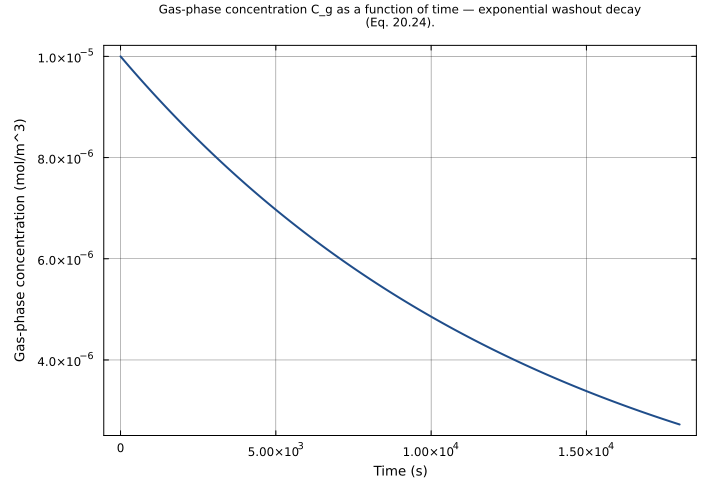
The 5 parameters carry the upstream component defaults (K_c=0.13 m/s, U_t=3.0 m/s, D_p=1.0e-3 m, h=1000.0 m, p₀=2.778e-7 m/s ≈ 1 mm/h). C_g, Λ_gas, F_bc have no upstream default; C_g is given its initial value per-test via initial_conditions (the upstream test uses C_g0 = 1.0e-5 mol/m³).
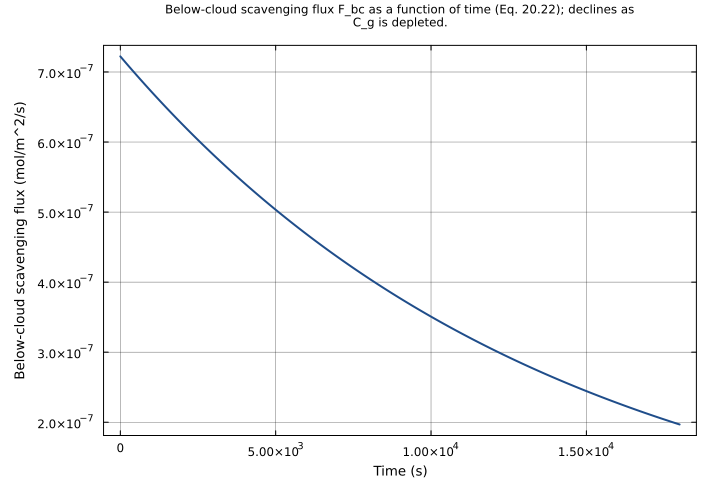
Tolerance rationale (model-level rel=1e-6): the system has a closed-form solution — Λ_gas is constant, so C_g(t) = C_g0·exp(−Λ_gas·t) (Eq. 20.24) exactly and F_bc(t) = Λ_gas·h·C_g(t). The expected values pinned in the tests are this analytic solution. The ESS Python runner integrates the ODE with scipy LSODA at rtol=1e-10/atol=1e-12; rel=1e-6 comfortably absorbs the integrator-vs-analytic gap (which is < 1e-8 relative for this non-stiff scalar exponential over the tested ≤ 2-hour windows) plus float64 round-off in the algebraic Λ_gas and F_bc expressions._
Variables
| Name | Units | Default | Description |
|---|---|---|---|
C_g | mol/m^3 | Gas-phase concentration below cloud |
Parameters
| Name | Units | Default | Description |
|---|---|---|---|
K_c | m/s | 0.13 | Gas-phase mass transfer coefficient to the raindrop |
U_t | m/s | 3.0 | Terminal velocity of the raindrop |
D_p | m | 0.001 | Raindrop diameter |
h | m | 1000.0 | Cloud base height (depth of the below-cloud layer) |
p₀ | m/s | 2.778e-07 | Precipitation rate (2.778e-7 m/s = 1 mm/h) |
Observed
| Name | Units | Default | Description |
|---|---|---|---|
Λ_gas | s^-1 | Gas scavenging coefficient (Eq. 20.25) | |
F_bc | mol/m^2/s | Below-cloud scavenging flux (Eq. 20.22) |
Observed expressions
$$ Λ_{gas} = \frac{6 \cdot p₀ \cdot K_{c}}{D_{p} \cdot U_{t}} $$Gas scavenging coefficient (Eq. 20.25)
$$ F_{bc} = Λ_{gas} \cdot h \cdot C_{g} $$Below-cloud scavenging flux (Eq. 20.22)
Equations
$$ \mathrm{D}\left(C_{g}\right) = \left(-Λ_{gas}\right) \cdot C_{g} $$Analyses
concentration_decay
Below-cloud gas concentration decay at the component defaults (p₀ ≈ 1 mm/h, Λ_gas ≈ 7.22e-5 s⁻¹) over a 5-hour rain event, starting from C_g0 = 1e-5 mol/m³. Reproduces the Below-Cloud Gas Concentration Decay (Eq. 20.24) figure of the AtmosphericDeposition.jl seinfeld_pandis_2006_ch20 documentation (the Λ ≈ 0.26 h⁻¹ curve). The companion plot shows the below-cloud scavenging flux F_bc declining as the gas reservoir is depleted.
Time span: 0.0 → 18000.0
decay_across_precipitation_rates
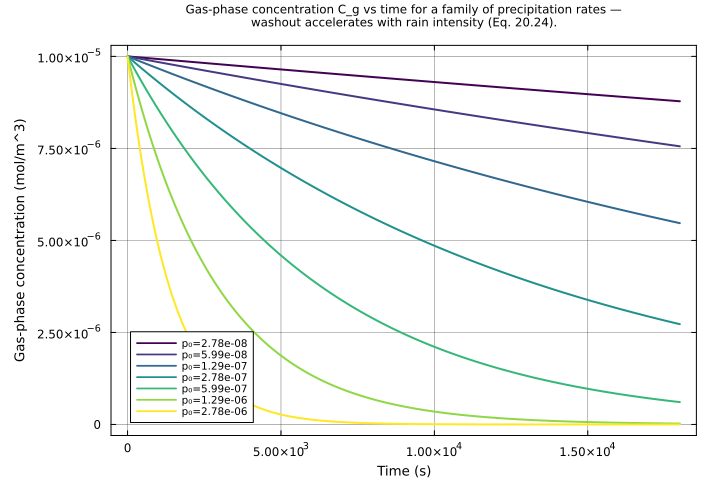
Below-cloud gas concentration decay over a 5-hour window for a family of precipitation rates, p₀ swept log-spaced from 2.778e-8 m/s (≈ 0.1 mm/h drizzle) to 2.778e-6 m/s (≈ 10 mm/h heavy rain). Each rate drives a separate integration of Eq. 20.24; the resulting family of C_g(t) curves spans the near-flat weak-scavenging regime to the rapid washout of heavy rain. Reproduces the spirit of the Below-Cloud Gas Concentration Decay (Eq. 20.24) figure of the AtmosphericDeposition.jl seinfeld_pandis_2006_ch20 documentation, which overlays decay curves for several scavenging coefficients.
Time span: 0.0 → 18000.0
Swept over: p₀
scavenging_coefficient_vs_precipitation
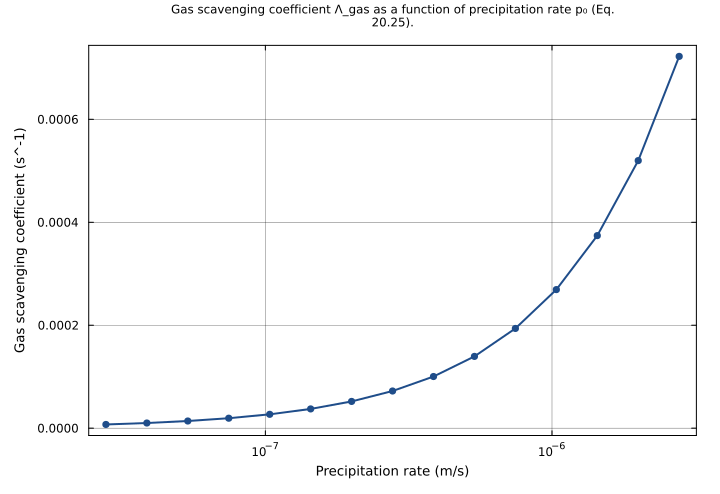
Gas scavenging coefficient Λ_gas as a function of precipitation rate p₀, swept log-spaced over the drizzle-to-heavy-rain range (≈ 0.1-10 mm/h) at the default drop size and mass transfer coefficient. Λ_gas rises linearly with p₀ — Λ_gas = 6·p₀·K_c/(D_p·U_t), Eq. 20.25 — so the curve visualizes the monodisperse-drop scavenging law directly. Λ_gas is time-invariant, so the final-time value plotted against the swept rate traces Eq. 20.25 exactly.
Time span: 0.0 → 3600.0
Swept over: p₀
Raw .esm
Raw .esm JSON (this component)
{
  "reference": {
    "citation": "Seinfeld, J. H., & Pandis, S. N. (2006). Atmospheric Chemistry and Physics: From Air Pollution to Climate Change (2nd ed.), Ch. 20, Eqs. 20.22, 20.24, 20.25. John Wiley & Sons, Inc.",
    "notes": "source_ref: AtmosphericDeposition.jl@e4468c79c8dd4aae88646cd16d6bcf290874742c:src/seinfeld_pandis_2006_ch20.jl:234\nUpstream `BelowCloudGasScavenging` is an MTK `@component` with 5 input `@parameters` (K_c, U_t, D_p, h, p₀) and 3 `@variables` (C_g, Λ_gas, F_bc) related by 3 equations. C_g is a true differential state — the upstream equation `D(C_g) ~ -Λ_gas*C_g` carries the time derivative — so this is an ODE system; `system_kind` is left unset because `ode` is the schema default. Λ_gas and F_bc are algebraic (their upstream equations have no time derivative); following the rig convention for ODE components (matches the sibling Aerosol.jl diameter_growth.esm migration) they are serialized as `type: state` with explicit algebraic equations in the `equations` array rather than as `observed` variables, preserving 1:1 symmetry with the upstream `@variables` block. The ESS Python runner topologically substitutes the algebraic states into the ODE right-hand side and recovers their trajectories, and overrides their t=0 sample from the algebraic body, so tests need only supply an `initial_conditions` value for the differential state C_g.\n\nThe single upstream helper function `gas_scavenging_coeff(K_c, U_t, D_p, p₀_SI)` is inlined into the Λ_gas equation AST: its body is `Λ = 6 * p₀_SI * K_c / (D_p * U_t)` (Eq. 20.25), encoded as the numerator `6*p₀*K_c` over the denominator `D_p*U_t`, matching Julia's left-associative `6*p₀*K_c/(D_p*U_t)`. The three equations are kept in upstream order — Λ_gas (Eq. 20.25), D(C_g) (Eq. 20.24), F_bc (Eq. 20.22) — which is already a valid topological order (Λ_gas before the two equations that consume it). The factor 6 is the dimensionless monodisperse-drop prefactor derived upstream from the drop number density N_D = 6·p₀/(π·D_p³·U_t) (Eq. 20.56); it carries no units.\n\nThe module-level `@constants` of seinfeld_pandis_2006_ch20.jl (μ_air_sp, ρ_air_sp, μ_w_sp, ρ_w_sp, g_sp, kB_sp) are NOT referenced by `BelowCloudGasScavenging` or by `gas_scavenging_coeff` — both use only the component's own parameters — so no constants are migrated. All three equations are dimensionally consistent (Λ_gas: [m/s]·[m/s]/([m]·[m/s]) = s⁻¹; D(C_g): [s⁻¹]·[mol/m³] = mol/m³/s; F_bc: [s⁻¹]·[m]·[mol/m³] = mol/m²/s), so there is no upstream `checks=false` to mirror.\n\nThe 5 parameters carry the upstream component defaults (K_c=0.13 m/s, U_t=3.0 m/s, D_p=1.0e-3 m, h=1000.0 m, p₀=2.778e-7 m/s ≈ 1 mm/h). C_g, Λ_gas, F_bc have no upstream default; C_g is given its initial value per-test via `initial_conditions` (the upstream test uses C_g0 = 1.0e-5 mol/m³).\n\nTolerance rationale (model-level rel=1e-6): the system has a closed-form solution — Λ_gas is constant, so C_g(t) = C_g0·exp(−Λ_gas·t) (Eq. 20.24) exactly and F_bc(t) = Λ_gas·h·C_g(t). The expected values pinned in the tests are this analytic solution. The ESS Python runner integrates the ODE with scipy LSODA at rtol=1e-10/atol=1e-12; rel=1e-6 comfortably absorbs the integrator-vs-analytic gap (which is < 1e-8 relative for this non-stiff scalar exponential over the tested ≤ 2-hour windows) plus float64 round-off in the algebraic Λ_gas and F_bc expressions."
  },
  "tolerance": {
    "rel": 1e-06
  },
  "variables": {
    "K_c": {
      "type": "parameter",
      "units": "m/s",
      "default": 0.13,
      "description": "Gas-phase mass transfer coefficient to the raindrop"
    },
    "U_t": {
      "type": "parameter",
      "units": "m/s",
      "default": 3.0,
      "description": "Terminal velocity of the raindrop"
    },
    "D_p": {
      "type": "parameter",
      "units": "m",
      "default": 0.001,
      "description": "Raindrop diameter"
    },
    "h": {
      "type": "parameter",
      "units": "m",
      "default": 1000.0,
      "description": "Cloud base height (depth of the below-cloud layer)"
    },
    "p₀": {
      "type": "parameter",
      "units": "m/s",
      "default": 2.778e-07,
      "description": "Precipitation rate (2.778e-7 m/s = 1 mm/h)"
    },
    "C_g": {
      "type": "unknown",
      "units": "mol/m^3",
      "description": "Gas-phase concentration below cloud"
    },
    "Λ_gas": {
      "type": "unknown",
      "units": "s^-1",
      "description": "Gas scavenging coefficient (Eq. 20.25)"
    },
    "F_bc": {
      "type": "unknown",
      "units": "mol/m^2/s",
      "description": "Below-cloud scavenging flux (Eq. 20.22)"
    }
  },
  "equations": [
    {
      "_comment": "Eq. 20.25 - gas scavenging coefficient for monodisperse raindrops: Λ_gas = 6·p₀·K_c/(D_p·U_t). Inlines the upstream helper gas_scavenging_coeff(K_c, U_t, D_p, p₀). Depends only on parameters, so Λ_gas is constant in time.",
      "lhs": "Λ_gas",
      "rhs": {
        "op": "/",
        "args": [
          {
            "op": "*",
            "args": [
              6,
              "p₀",
              "K_c"
            ]
          },
          {
            "op": "*",
            "args": [
              "D_p",
              "U_t"
            ]
          }
        ]
      }
    },
    {
      "_comment": "Eq. 20.24 - irreversible below-cloud decay of the gas concentration: dC_g/dt = -Λ_gas·C_g. The single differential equation of the system.",
      "lhs": {
        "op": "D",
        "args": [
          "C_g"
        ],
        "wrt": "t"
      },
      "rhs": {
        "op": "*",
        "args": [
          {
            "op": "-",
            "args": [
              "Λ_gas"
            ]
          },
          "C_g"
        ]
      }
    },
    {
      "_comment": "Eq. 20.22 - below-cloud scavenging flux: F_bc = Λ_gas·h·C_g, the column-integrated removal rate over the below-cloud layer of depth h.",
      "lhs": "F_bc",
      "rhs": {
        "op": "*",
        "args": [
          "Λ_gas",
          "h",
          "C_g"
        ]
      }
    }
  ],
  "tests": [
    {
      "id": "canonical_decay",
      "description": "Canonical irreversible below-cloud scavenging at the component defaults — the reference case of the upstream AtmosphericDeposition.jl seinfeld_pandis_2006_ch20_test.jl `BelowCloudGasScavenging Component` test (K_c=0.13 m/s, U_t=3 m/s, D_p=1 mm, h=1 km, p₀=2.778e-7 m/s ≈ 1 mm/h, C_g0=1e-5 mol/m³). The scavenging coefficient Λ_gas = 6·p₀·K_c/(D_p·U_t) ≈ 7.22e-5 s⁻¹ (Eq. 20.25) is constant, so the gas concentration decays exponentially C_g(t) = C_g0·exp(−Λ_gas·t) (Eq. 20.24) and the below-cloud flux F_bc = Λ_gas·h·C_g (Eq. 20.22) tracks it. Λ_gas is re-checked at t=3600 s to confirm it is time-invariant.",
      "initial_conditions": {
        "C_g": 1e-05
      },
      "time_span": {
        "start": 0.0,
        "end": 3600.0
      },
      "assertions": [
        {
          "variable": "Λ_gas",
          "time": 0.0,
          "expected": 7.2228e-05
        },
        {
          "variable": "Λ_gas",
          "time": 3600.0,
          "expected": 7.2228e-05
        },
        {
          "variable": "C_g",
          "time": 0.0,
          "expected": 1e-05
        },
        {
          "variable": "C_g",
          "time": 1800.0,
          "expected": 8.780862987755671e-06
        },
        {
          "variable": "C_g",
          "time": 3600.0,
          "expected": 7.710355480973744e-06
        },
        {
          "variable": "F_bc",
          "time": 0.0,
          "expected": 7.2228e-07
        },
        {
          "variable": "F_bc",
          "time": 3600.0,
          "expected": 5.569035556797716e-07
        }
      ]
    },
    {
      "id": "heavy_precipitation",
      "description": "Heavy rainfall: p₀ = 2.778e-6 m/s (≈ 10 mm/h) raises the scavenging coefficient Λ_gas tenfold to ≈ 7.22e-4 s⁻¹ (Λ_gas ∝ p₀, Eq. 20.25). The gas concentration is depleted rapidly — C_g falls to ~7% of C_g0 within one hour — and the below-cloud flux peaks high then collapses as C_g is consumed.",
      "parameter_overrides": {
        "p₀": 2.778e-06
      },
      "initial_conditions": {
        "C_g": 1e-05
      },
      "time_span": {
        "start": 0.0,
        "end": 3600.0
      },
      "assertions": [
        {
          "variable": "Λ_gas",
          "time": 0.0,
          "expected": 0.00072228
        },
        {
          "variable": "C_g",
          "time": 0.0,
          "expected": 1e-05
        },
        {
          "variable": "C_g",
          "time": 1800.0,
          "expected": 2.7250345120133797e-06
        },
        {
          "variable": "C_g",
          "time": 3600.0,
          "expected": 7.425813091663997e-07
        },
        {
          "variable": "F_bc",
          "time": 0.0,
          "expected": 7.2228e-06
        },
        {
          "variable": "F_bc",
          "time": 3600.0,
          "expected": 5.363516279847071e-07
        }
      ]
    },
    {
      "id": "light_drizzle",
      "description": "Light drizzle: p₀ = 2.778e-8 m/s (≈ 0.1 mm/h) lowers Λ_gas tenfold to ≈ 7.22e-6 s⁻¹. Over a 2-hour window the gas concentration barely moves — C_g stays above 94% of C_g0 — the weak-scavenging regime where washout is a minor sink.",
      "parameter_overrides": {
        "p₀": 2.778e-08
      },
      "initial_conditions": {
        "C_g": 1e-05
      },
      "time_span": {
        "start": 0.0,
        "end": 7200.0
      },
      "assertions": [
        {
          "variable": "Λ_gas",
          "time": 0.0,
          "expected": 7.2228e-06
        },
        {
          "variable": "C_g",
          "time": 0.0,
          "expected": 1e-05
        },
        {
          "variable": "C_g",
          "time": 3600.0,
          "expected": 9.743330629938707e-06
        },
        {
          "variable": "C_g",
          "time": 7200.0,
          "expected": 9.49324917643018e-06
        },
        {
          "variable": "F_bc",
          "time": 0.0,
          "expected": 7.222800000000002e-08
        }
      ]
    },
    {
      "id": "large_raindrops",
      "description": "Larger raindrops: doubling the drop diameter D_p to 2 mm halves the scavenging coefficient to ≈ 3.61e-5 s⁻¹ (Λ_gas ∝ 1/D_p, Eq. 20.25) — larger drops present less collecting surface per unit rainfall volume, so washout is slower. Checked over a 2-hour window.",
      "parameter_overrides": {
        "D_p": 0.002
      },
      "initial_conditions": {
        "C_g": 1e-05
      },
      "time_span": {
        "start": 0.0,
        "end": 7200.0
      },
      "assertions": [
        {
          "variable": "Λ_gas",
          "time": 0.0,
          "expected": 3.6114e-05
        },
        {
          "variable": "C_g",
          "time": 0.0,
          "expected": 1e-05
        },
        {
          "variable": "C_g",
          "time": 3600.0,
          "expected": 8.780862987755671e-06
        },
        {
          "variable": "C_g",
          "time": 7200.0,
          "expected": 7.710355480973744e-06
        },
        {
          "variable": "F_bc",
          "time": 7200.0,
          "expected": 2.784517778398858e-07
        }
      ]
    },
    {
      "id": "fast_falling_drops",
      "description": "Faster-falling drops: raising the terminal velocity U_t from 3 to 4.5 m/s lowers Λ_gas to ≈ 4.82e-5 s⁻¹ (Λ_gas ∝ 1/U_t, Eq. 20.25) — drops collect gas over less time per unit fall distance. The initial concentration C_g0 = 2e-5 mol/m³ is double the canonical value; because Eq. 20.24 is linear in C_g the normalized decay C_g(t)/C_g0 is independent of C_g0.",
      "parameter_overrides": {
        "U_t": 4.5
      },
      "initial_conditions": {
        "C_g": 2e-05
      },
      "time_span": {
        "start": 0.0,
        "end": 7200.0
      },
      "assertions": [
        {
          "variable": "Λ_gas",
          "time": 0.0,
          "expected": 4.8152e-05
        },
        {
          "variable": "C_g",
          "time": 0.0,
          "expected": 2e-05
        },
        {
          "variable": "C_g",
          "time": 3600.0,
          "expected": 1.681691245115087e-05
        },
        {
          "variable": "C_g",
          "time": 7200.0,
          "expected": 1.4140427219483657e-05
        },
        {
          "variable": "F_bc",
          "time": 0.0,
          "expected": 9.6304e-07
        }
      ]
    },
    {
      "id": "enhanced_mass_transfer",
      "description": "Enhanced gas-phase mass transfer: doubling the mass transfer coefficient K_c to 0.26 m/s doubles the scavenging coefficient to ≈ 1.44e-4 s⁻¹ (Λ_gas ∝ K_c, Eq. 20.25). A larger K_c represents more efficient gas uptake at the drop surface and accelerates the concentration decay.",
      "parameter_overrides": {
        "K_c": 0.26
      },
      "initial_conditions": {
        "C_g": 1e-05
      },
      "time_span": {
        "start": 0.0,
        "end": 3600.0
      },
      "assertions": [
        {
          "variable": "Λ_gas",
          "time": 0.0,
          "expected": 0.000144456
        },
        {
          "variable": "C_g",
          "time": 0.0,
          "expected": 1e-05
        },
        {
          "variable": "C_g",
          "time": 1800.0,
          "expected": 7.710355480973744e-06
        },
        {
          "variable": "C_g",
          "time": 3600.0,
          "expected": 5.9449581642981845e-06
        },
        {
          "variable": "F_bc",
          "time": 0.0,
          "expected": 1.44456e-06
        }
      ]
    },
    {
      "id": "tall_cloud_base",
      "description": "Doubled cloud base height h = 2000 m. The cloud base height enters only the flux Eq. 20.22 (F_bc = Λ_gas·h·C_g), not the scavenging coefficient Eq. 20.25 or the decay Eq. 20.24 — so Λ_gas and the C_g trajectory are identical to the canonical_decay case while F_bc is doubled at every time. Confirms h is wired into F_bc alone.",
      "parameter_overrides": {
        "h": 2000.0
      },
      "initial_conditions": {
        "C_g": 1e-05
      },
      "time_span": {
        "start": 0.0,
        "end": 3600.0
      },
      "assertions": [
        {
          "variable": "Λ_gas",
          "time": 0.0,
          "expected": 7.2228e-05
        },
        {
          "variable": "C_g",
          "time": 3600.0,
          "expected": 7.710355480973744e-06
        },
        {
          "variable": "F_bc",
          "time": 0.0,
          "expected": 1.44456e-06
        },
        {
          "variable": "F_bc",
          "time": 3600.0,
          "expected": 1.1138071113595431e-06
        }
      ]
    }
  ],
  "analyses": [
    {
      "id": "concentration_decay",
      "description": "Below-cloud gas concentration decay at the component defaults (p₀ ≈ 1 mm/h, Λ_gas ≈ 7.22e-5 s⁻¹) over a 5-hour rain event, starting from C_g0 = 1e-5 mol/m³. Reproduces the `Below-Cloud Gas Concentration Decay (Eq. 20.24)` figure of the AtmosphericDeposition.jl seinfeld_pandis_2006_ch20 documentation (the Λ ≈ 0.26 h⁻¹ curve). The companion plot shows the below-cloud scavenging flux F_bc declining as the gas reservoir is depleted.",
      "initial_state": {
        "C_g": 1e-05
      },
      "time_span": {
        "start": 0.0,
        "end": 18000.0
      },
      "plots": [
        {
          "id": "c_g_vs_time",
          "type": "line",
          "description": "Gas-phase concentration C_g as a function of time — exponential washout decay (Eq. 20.24).",
          "x": {
            "variable": "t",
            "label": "Time (s)"
          },
          "y": {
            "variable": "C_g",
            "label": "Gas-phase concentration (mol/m^3)"
          }
        },
        {
          "id": "f_bc_vs_time",
          "type": "line",
          "description": "Below-cloud scavenging flux F_bc as a function of time (Eq. 20.22); declines as C_g is depleted.",
          "x": {
            "variable": "t",
            "label": "Time (s)"
          },
          "y": {
            "variable": "F_bc",
            "label": "Below-cloud scavenging flux (mol/m^2/s)"
          }
        }
      ]
    },
    {
      "id": "decay_across_precipitation_rates",
      "description": "Below-cloud gas concentration decay over a 5-hour window for a family of precipitation rates, p₀ swept log-spaced from 2.778e-8 m/s (≈ 0.1 mm/h drizzle) to 2.778e-6 m/s (≈ 10 mm/h heavy rain). Each rate drives a separate integration of Eq. 20.24; the resulting family of C_g(t) curves spans the near-flat weak-scavenging regime to the rapid washout of heavy rain. Reproduces the spirit of the `Below-Cloud Gas Concentration Decay (Eq. 20.24)` figure of the AtmosphericDeposition.jl seinfeld_pandis_2006_ch20 documentation, which overlays decay curves for several scavenging coefficients.",
      "initial_state": {
        "C_g": 1e-05
      },
      "time_span": {
        "start": 0.0,
        "end": 18000.0
      },
      "parameter_sweep": {
        "type": "cartesian",
        "dimensions": [
          {
            "parameter": "p₀",
            "range": {
              "start": 2.778e-08,
              "stop": 2.778e-06,
              "count": 7,
              "scale": "log"
            }
          }
        ]
      },
      "plots": [
        {
          "id": "c_g_decay_family",
          "type": "line",
          "description": "Gas-phase concentration C_g vs time for a family of precipitation rates — washout accelerates with rain intensity (Eq. 20.24).",
          "x": {
            "variable": "t",
            "label": "Time (s)"
          },
          "y": {
            "variable": "C_g",
            "label": "Gas-phase concentration (mol/m^3)"
          }
        }
      ]
    },
    {
      "id": "scavenging_coefficient_vs_precipitation",
      "description": "Gas scavenging coefficient Λ_gas as a function of precipitation rate p₀, swept log-spaced over the drizzle-to-heavy-rain range (≈ 0.1-10 mm/h) at the default drop size and mass transfer coefficient. Λ_gas rises linearly with p₀ — Λ_gas = 6·p₀·K_c/(D_p·U_t), Eq. 20.25 — so the curve visualizes the monodisperse-drop scavenging law directly. Λ_gas is time-invariant, so the final-time value plotted against the swept rate traces Eq. 20.25 exactly.",
      "initial_state": {
        "C_g": 1e-05
      },
      "time_span": {
        "start": 0.0,
        "end": 3600.0
      },
      "parameter_sweep": {
        "type": "cartesian",
        "dimensions": [
          {
            "parameter": "p₀",
            "range": {
              "start": 2.778e-08,
              "stop": 2.778e-06,
              "count": 15,
              "scale": "log"
            }
          }
        ]
      },
      "plots": [
        {
          "id": "lambda_gas_vs_p0",
          "type": "line",
          "description": "Gas scavenging coefficient Λ_gas as a function of precipitation rate p₀ (Eq. 20.25).",
          "x": {
            "variable": "p₀",
            "label": "Precipitation rate (m/s)"
          },
          "y": {
            "variable": "Λ_gas",
            "label": "Gas scavenging coefficient (s^-1)"
          }
        }
      ]
    }
  ]
}