DryDepositionAerosol
ModelingToolkit implementation of particle (aerosol) dry deposition from Seinfeld & Pandis (2006), Atmospheric Chemistry and Physics, 2nd ed., Chapter 19 (Dry Deposition), Eq. 19.7. Computes the particle dry deposition velocity v [m/s] for a single aerosol size and the corresponding first-order deposition rate k = v/z [1/s], as a resistance network: v = 1/(R_a + R_b + R_a*R_b*V_s) + V_s, where R_a is the aerodynamic resistance (Eqs. 19.13-19.14), R_b is the quasi-laminar sublayer resistance (Eq. 19.27), and V_s is the gravitational settling velocity (Eq. 9.42). R_b combines Brownian diffusion (Schmidt number), inertial impaction (Stokes number) and interception, with land-use-dependent collector geometry from the Seinfeld & Pandis Table 19.2 characteristic-radius table. Migrated from AtmosphericDeposition.jl@e4468c79 src/dry_deposition.jl:1040 (the DryDepositionAerosol builder); its DryDepParticle kernel (src/dry_deposition.jl:272) and the whole helper chain (ra, mu, mfp, cc, vs, dParticle, sc, stSmooth/stVeg, RbParticle) are inlined. Purely algebraic: no differential states -- the 27 computed quantities are observed variables defined by inline expressions.
Description
ModelingToolkit implementation of particle (aerosol) dry deposition from Seinfeld & Pandis (2006), Atmospheric Chemistry and Physics, 2nd ed., Chapter 19 (Dry Deposition), Eq. 19.7. Computes the particle dry deposition velocity v [m/s] for a single aerosol size and the corresponding first-order deposition rate k = v/z [1/s], as a resistance network: v = 1/(R_a + R_b + R_aR_bV_s) + V_s, where R_a is the aerodynamic resistance (Eqs. 19.13-19.14), R_b is the quasi-laminar sublayer resistance (Eq. 19.27), and V_s is the gravitational settling velocity (Eq. 9.42). R_b combines Brownian diffusion (Schmidt number), inertial impaction (Stokes number) and interception, with land-use-dependent collector geometry from the Seinfeld & Pandis Table 19.2 characteristic-radius table. Migrated from AtmosphericDeposition.jl@e4468c79 src/dry_deposition.jl:1040 (the DryDepositionAerosol builder); its DryDepParticle kernel (src/dry_deposition.jl:272) and the whole helper chain (ra, mu, mfp, cc, vs, dParticle, sc, stSmooth/stVeg, RbParticle) are inlined. Purely algebraic: no differential states – the 27 computed quantities are observed variables defined by inline expressions.
Reference
Seinfeld, J. H., & Pandis, S. N. (2006). Atmospheric Chemistry and Physics: From Air Pollution to Climate Change (2nd ed.), Ch. 19, Eq. 19.7 (particle dry deposition velocity). John Wiley & Sons, Inc.
_source_ref: AtmosphericDeposition.jl@e4468c79c8dd4aae88646cd16d6bcf290874742c:src/dry_deposition.jl:1040
Upstream DryDepositionAerosol is an MTK builder – System(eqs, t, [v; k], params) with no subsystems – carrying two equations: v ~ DryDepParticle(…) and k ~ v/z. DryDepParticle (src/dry_deposition.jl:272) is a plain Julia function, not a registered symbolic, so it and its entire helper chain (ra, mu, mfp, cc, vs, dParticle, sc, stSmooth, stVeg, RbParticle) are inlined here. There is no time derivative anywhere (no D operator); the component is purely algebraic, so every computed quantity migrates as a type: observed variable carrying its inline expression, the equations array is empty, and system_kind is left unset. This is the pure-algebraic convention (matching sibling observed-only migrations such as aerosol/radiative_forcing/cloud_albedo.esm): the ESS Python runner evaluates an observed-only model by direct expression sampling, with no ODE integration. The 27 observed expressions are written in a valid topological order; the runner re-sorts and substitutes them regardless.
Resistance network. v is Eq. 19.7, v = 1/(R_a + R_b + R_aR_bV_s) + V_s, gated by ifelse(lev == 1, …, 0) so deposition acts only in the surface layer. R_a (Ra) is the aerodynamic resistance of ra, Eqs. 19.13-19.14, with three stability regimes: the unstable branch (zeta < 0) uses the integrated similarity form, the stable branch (zeta > 0) adds the 4.7*(zeta - zeta_0) term, and the neutral branch is the bare log profile. The intermediate i_unstable (upstream i) is the domain guard from the source comment: eta and eta_0 evaluate (1 - 15zeta)^(1/4), whose base is negative for zeta > 0; multiplying zeta by i_unstable (1 only when zeta < 0, else 0) forces the base to exactly 1 in the stable/neutral regimes, so the fractional power is always taken of a base >= 1. R_b (Rb) is RbParticle, Eq. 19.27, summing the Brownian term Sc^(-gamma), the impaction term (St/(alpha + St))^2 and the interception term 0.5(Dp/A)^2, scaled by the rebound factor R1 = exp(-sqrt(St)). V_s (Vs) is the Cunningham-corrected Stokes settling velocity of vs, Eq. 9.42, with the upstream Dp > 20 um cutoff returning the 99999999 m/s sentinel.
Neutral-stability guard. The default L = 0 is the neutral-stability sentinel and upstream ra writes zeta = ifelse(L/unit_m == 0, 0, z/L). The ESS Python runner lowers ifelse to a numpy select that evaluates every branch eagerly, rewrites any 1/L as L**(-1), and simplifies comparisons such as 0 < zeta – so any guarded division by L, and even an ifelse(L==0,1,0) in the denominator, is reduced back to a bare 1/L that raises at L = 0 (float division by zero / 0.0**negative). zeta and zeta_0 are therefore reformulated as zL/(LL + 1e-300) and z0L/(LL + 1e-300): the 1e-300 floor is a plain non-zero constant the simplifier cannot drop, keeps the denominator strictly positive, and sits ~284 orders of magnitude below L*L for every physical L, so the expression rounds to z/L (resp. z0/L) for L != 0 and is exactly 0 for L = 0 – the values the upstream guard produces, to within one ulp.
Lookup tables. The three Seinfeld & Pandis land-use tables are migrated as interp.linear over column-major-flattened const vectors, matching the sibling wesley1989/surface_resistance.esm precedent. A_table (the 5x5 season x land-use characteristic collector radius, S&P Table 19.2) flattens column-major (Julia vec) to a 25-entry vector on the integer axis [1..25], queried at A_table_index = (SeinfeldLandUse - 1)*5 + SeinfeldSeason; the upstream *1.0e-3 mm-to-m factor is baked into the stored entries. alpha and gamma (5-entry, land-use only) are queried directly at SeinfeldLandUse on the axis [1..5]. SeinfeldSeason in 1..5 and SeinfeldLandUse in 1..5 are categorical integers, so every lookup lands exactly on an integer axis knot – interp.linear returns the exact table entry with a zero blend weight, reproducing the upstream direct array indexing SA_F32[…][iSeason, iLandUse].
Desert sentinel. A_table’s land-use-4 (desert) column is Inf upstream – a sentinel that makes the vegetation-collector terms vanish (term_3 = 0.5*(Dp/A)^2 -> 0, and the unused st_veg -> 0; the St Stokes-number ifelse selects st_smooth for desert anyway). JSON cannot encode Inf, so the five desert entries are stored as the finite sentinel 1.0e25. At a desert query interp.linear returns 1.0e25 exactly (zero blend weight); term_3 = 0.5*(Dp/1e25)^2 is about 3e-65, reproducing the upstream Inf -> 0 behaviour to ~60 digits. A column-major 1-D flatten (rather than interp.bilinear) is used so the desert column never participates in a blend that could cancel the sentinel.
Float32 tables. The upstream tables are SA_F32 (Float32) static arrays. alpha and gamma have non-integer entries (0.8, 1.2, 1.3, 0.56, 0.54) that are not exact in Float32; each is stored as its exact Float64-promoted Float32 value (e.g. 0.8 -> 0.800000011920929) to reproduce upstream arithmetic. A_table’s entries (2, 5, 10) are exact in Float32, so A_table*1e-3 is stored as the clean 0.002 / 0.005 / 0.01.
Dropped declarations. DryDepositionAerosol declares WesleySeason and WesleyLandUse as @parameters and passes them to DryDepParticle, but DryDepParticle’s body never references its iWesleySeason / iWesleyLandUse arguments – they are dead – so they are omitted from the migration. The upstream unit-one @constants (unit_m, unit_T, unit_convert_mu, unit_v) are identically 1 and the ESS runners do no dimensional analysis, so they fold away (e.g. ifelse(L/unit_m == 0, …) becomes ifelse(L == 0, …); Dp > 20e-6*unit_m becomes Dp > 2.0e-5). dH2O and its constants (T_unitless, unit_dH2O) belong to the gas-deposition pathway and are not part of this component.
Constants. g, kappa (von Karman), k_B, M_air and R migrate as fixed-default parameters (ESM has no constant variable type). k_B and R use the schema-recognized physical-constant names with units J/K and J/(mol*K); their defaults are the upstream values (k_B = 1.3806488e-23, R = 8.3144621). pi is inlined as the literal 3.141592653589793 (Julia Float64 pi). The upstream component coupling tag metadata = Dict(CoupleType => DryDepositionAerosolCoupler) is informational only and, following the rig convention for migrated components, is not carried into a coupletype field.
Inputs. lev, z, z0, u_star, L, Dp, Ts, P, rho_particle and rho_a carry the upstream DryDepositionAerosol @parameter defaults. SeinfeldSeason (default 1 = midsummer) and SeinfeldLandUse (default 3 = grass) are the integer S&P season and land-use indices (land use: 1 evergreen, 2 deciduous, 3 grass, 4 desert, 5 shrubs; season: 1 midsummer, 2 autumn, 3 late autumn, 4 winter, 5 transitional).
Units. ESM units fields are descriptive only; the runners perform no dimensional analysis.
Tolerance rationale (model-level rel=1e-6): a closed-form algebraic system with no ODE integration – each observed value is the Float64 evaluation of the inlined Eq. 19.7 cascade. rel=1e-6 absorbs round-off across the reciprocal-sum resistance chain and the libm exp / log / atan / pow evaluations, well above the agreement expected between conforming runners. The supercoarse Dp > 20 um regime is migrated faithfully (the vs sentinel branch) but not given a dedicated inline test, because there exp(-sqrt(St)) underflows and drives Rb to a non-finite value that JSON assertions cannot express; v itself stays finite at the V_s sentinel._
Parameters
| Name | Units | Default | Description |
|---|---|---|---|
lev | 1 | 1 | Index of the atmospheric layer; deposition acts only when lev = 1 (the surface layer). |
z | m | 50.0 | Height of the top of the surface layer. |
z0 | m | 0.04 | Aerodynamic roughness length (upstream z_0). |
u_star | m/s | 0.44 | Friction velocity. |
L | m | 0.0 | Monin-Obukhov length. The value 0 is the neutral-stability sentinel. |
Dp | m | 8e-07 | Particle diameter. |
Ts | K | 298.0 | Surface air temperature. |
P | Pa | 101325.0 | Air pressure. |
rho_particle | kg/m^3 | 1000.0 | Particle (aerosol) mass density (upstream rho_Particle). |
rho_a | kg/m^3 | 1.2 | Air density (upstream rho_A). |
SeinfeldSeason | 1 | 1 | Seinfeld & Pandis season index 1-5: 1 midsummer, 2 autumn, 3 late autumn, 4 winter, 5 transitional. Default: midsummer. |
SeinfeldLandUse | 1 | 3 | Seinfeld & Pandis land-use index 1-5: 1 evergreen, 2 deciduous, 3 grass, 4 desert, 5 shrubs. Default: grass. |
g | m/s^2 | 9.81 | Gravitational acceleration (upstream @constant). |
kappa | 1 | 0.4 | Von Karman constant (upstream @constant kappa). |
k_B | J/K | 1.3806488e-23 | Boltzmann constant (upstream @constant). |
M_air | kg/mol | 0.02897 | Molecular weight of air (upstream @constant). |
R | J/(mol*K) | 8.3144621 | Ideal gas constant (upstream @constant). |
Observed
| Name | Units | Default | Description |
|---|---|---|---|
zeta | 1 | Stability parameter z/L of the surface layer, 0 in the neutral limit L = 0 (Eqs. 19.13-19.14). Written as zL/(LL + 1e-300): the 1e-300 floor keeps the denominator strictly positive (so neither the value nor any comparison on it ever divides by L = 0), and is far below the rounding scale of L*L for every physical L, so for L != 0 this equals z/L and for L = 0 it equals 0. | |
zeta_0 | 1 | Stability parameter z_0/L at the roughness height, 0 in the neutral limit L = 0. Written as z0L/(LL + 1e-300) for the same strictly-positive-denominator reason as zeta. | |
ra_neutral_stable | s/m | Aerodynamic resistance in the neutral/stable regimes (zeta >= 0): the log profile, plus the 4.7*(zeta - zeta_0) correction when stable (upstream r_a_1). | |
i_unstable | 1 | Domain-guard indicator: 1 when the layer is unstable (zeta < 0), else 0. Forces the base of eta / eta_0 to 1 in the stable/neutral regimes (upstream src comment at ra). | |
eta_0 | 1 | Similarity variable (1 - 15*zeta_0)^(1/4) at the roughness height, used in the unstable aerodynamic resistance. | |
eta | 1 | Similarity variable (1 - 15*zeta)^(1/4) at the surface-layer top, used in the unstable aerodynamic resistance. | |
Ra | s/m | Aerodynamic resistance to dry deposition (Eqs. 19.13-19.14): unstable integrated-similarity form when zeta < 0, else ra_neutral_stable. | |
mu | kg/(m*s) | Dynamic viscosity of air from the Sutherland relation (upstream mu); unit_T and unit_convert_mu folded away. | |
mfp | m | Mean free path of air (S&P Eq. 9.6, upstream mfp). | |
Cc | 1 | Cunningham slip correction factor (S&P Eq. 9.34, upstream cc). | |
Vs | m/s | Gravitational settling (terminal) velocity (S&P Eq. 9.42, upstream vs); the 99999999 m/s sentinel for Dp > 20 um, where Stokes settling no longer applies. | |
A_table_index | 1 | Flattened (column-major) lookup coordinate into the 25-entry season x land-use characteristic-radius table: (SeinfeldLandUse - 1)*5 + SeinfeldSeason. | |
A_collector | m | Characteristic radius of surface collectors (S&P Table 19.2, upstream A_table * 1e-3). 1e25 for desert land use, the finite stand-in for the upstream Inf sentinel. | |
st_smooth | 1 | Stokes number for smooth / bluff-roughness surfaces (S&P Eq. 19.23, upstream stSmooth). | |
st_veg | 1 | Stokes number for vegetated surfaces (S&P Eq. 19.24, upstream stVeg). | |
St | 1 | Selected Stokes number: st_smooth for desert land use (index 4), else st_veg. | |
D_brownian | m^2/s | Brownian diffusivity of the particle from the Stokes-Einstein-Sutherland relation (S&P Eq. 9.73, upstream dParticle). | |
Sc | 1 | Schmidt number of the particle (upstream sc). | |
alpha | 1 | Land-use impaction-efficiency parameter (S&P Table 19.2, upstream alpha_table). | |
gamma | 1 | Land-use Brownian-diffusion exponent (S&P Table 19.2, upstream gamma_table). | |
R1 | 1 | Particle-rebound correction factor exp(-sqrt(St)) of the sublayer resistance (Eq. 19.27). | |
term_1 | 1 | Brownian-diffusion collection term Sc^(-gamma) of the sublayer resistance (Eq. 19.27). | |
term_2 | 1 | Inertial-impaction collection term (St/(alpha + St))^2 of the sublayer resistance (Eq. 19.27). | |
term_3 | 1 | Interception collection term 0.5*(Dp/A_collector)^2 of the sublayer resistance (Eq. 19.27); ~0 for desert land use. | |
Rb | s/m | Quasi-laminar sublayer resistance to particle dry deposition (S&P Eq. 19.27, upstream RbParticle). | |
v | m/s | Particle dry deposition velocity (S&P Eq. 19.7); 0 above the surface layer (lev != 1). | |
k | 1/s | First-order particle dry deposition rate, v/z. |
Observed expressions
$$ zeta = \frac{z \cdot L}{L \cdot L + 1 \times 10^{-300}} $$Stability parameter z/L of the surface layer, 0 in the neutral limit L = 0 (Eqs. 19.13-19.14). Written as zL/(LL + 1e-300): the 1e-300 floor keeps the denominator strictly positive (so neither the value nor any comparison on it ever divides by L = 0), and is far below the rounding scale of L*L for every physical L, so for L != 0 this equals z/L and for L = 0 it equals 0.
$$ zeta_{0} = \frac{z0 \cdot L}{L \cdot L + 1 \times 10^{-300}} $$Stability parameter z_0/L at the roughness height, 0 in the neutral limit L = 0. Written as z0L/(LL + 1e-300) for the same strictly-positive-denominator reason as zeta.
$$ ra_{neutral\,stable} = \mathrm{ifelse}\left(\mathrm{<}\left(0, zeta\right), \frac{1}{kappa \cdot u_{star}} \cdot \left(\ln\left(\frac{z}{z0}\right) + 4.7 \cdot \left(zeta - zeta_{0}\right)\right), \frac{1}{kappa \cdot u_{star}} \cdot \ln\left(\frac{z}{z0}\right)\right) $$Aerodynamic resistance in the neutral/stable regimes (zeta >= 0): the log profile, plus the 4.7*(zeta - zeta_0) correction when stable (upstream r_a_1).
$$ i_{unstable} = \mathrm{ifelse}\left(\mathrm{<}\left(zeta, 0\right), 1, 0\right) $$Domain-guard indicator: 1 when the layer is unstable (zeta < 0), else 0. Forces the base of eta / eta_0 to 1 in the stable/neutral regimes (upstream src comment at ra).
$$ eta_{0} = \left(1 - 15 \cdot zeta_{0} \cdot i_{unstable}\right)^{0.25} $$Similarity variable (1 - 15*zeta_0)^(1/4) at the roughness height, used in the unstable aerodynamic resistance.
$$ eta = \left(1 - 15 \cdot zeta \cdot i_{unstable}\right)^{0.25} $$Similarity variable (1 - 15*zeta)^(1/4) at the surface-layer top, used in the unstable aerodynamic resistance.
$$ Ra = \mathrm{ifelse}\left(\mathrm{<}\left(zeta, 0\right), \frac{1}{kappa \cdot u_{star}} \cdot \left(\ln\left(\frac{z}{z0}\right) + \ln\left(\frac{\left(eta_{0}^{2} + 1\right) \cdot \left(eta_{0} + 1\right)^{2}}{\left(eta^{2} + 1\right) \cdot \left(eta + 1\right)^{2}}\right) + 2 \cdot \left(\mathrm{atan}\left(eta\right) - \mathrm{atan}\left(eta_{0}\right)\right)\right), ra_{neutral\,stable}\right) $$Aerodynamic resistance to dry deposition (Eqs. 19.13-19.14): unstable integrated-similarity form when zeta < 0, else ra_neutral_stable.
$$ mu = \frac{1.458 \times 10^{-6} \cdot Ts^{1.5}}{Ts + 110.4} $$Dynamic viscosity of air from the Sutherland relation (upstream mu); unit_T and unit_convert_mu folded away.
Mean free path of air (S&P Eq. 9.6, upstream mfp).
Cunningham slip correction factor (S&P Eq. 9.34, upstream cc).
Gravitational settling (terminal) velocity (S&P Eq. 9.42, upstream vs); the 99999999 m/s sentinel for Dp > 20 um, where Stokes settling no longer applies.
Flattened (column-major) lookup coordinate into the 25-entry season x land-use characteristic-radius table: (SeinfeldLandUse - 1)*5 + SeinfeldSeason.
$$ A_{collector} = \mathrm{fn}\left(\mathrm{const}\left(\right), \mathrm{const}\left(\right), A_{table\,index}\right) $$Characteristic radius of surface collectors (S&P Table 19.2, upstream A_table * 1e-3). 1e25 for desert land use, the finite stand-in for the upstream Inf sentinel.
$$ st_{smooth} = \frac{Vs \cdot u_{star}^{2} \cdot rho_{a}}{g \cdot mu} $$Stokes number for smooth / bluff-roughness surfaces (S&P Eq. 19.23, upstream stSmooth).
Stokes number for vegetated surfaces (S&P Eq. 19.24, upstream stVeg).
Selected Stokes number: st_smooth for desert land use (index 4), else st_veg.
$$ D_{brownian} = \frac{k_{B} \cdot Ts \cdot Cc}{3 \cdot 3.141592653589793 \cdot mu \cdot Dp} $$Brownian diffusivity of the particle from the Stokes-Einstein-Sutherland relation (S&P Eq. 9.73, upstream dParticle).
Schmidt number of the particle (upstream sc).
Land-use impaction-efficiency parameter (S&P Table 19.2, upstream alpha_table).
$$ gamma = \mathrm{fn}\left(\mathrm{const}\left(\right), \mathrm{const}\left(\right), SeinfeldLandUse\right) $$Land-use Brownian-diffusion exponent (S&P Table 19.2, upstream gamma_table).
$$ R1 = e^{-St^{0.5}} $$Particle-rebound correction factor exp(-sqrt(St)) of the sublayer resistance (Eq. 19.27).
$$ term_{1} = Sc^{-gamma} $$Brownian-diffusion collection term Sc^(-gamma) of the sublayer resistance (Eq. 19.27).
$$ term_{2} = \frac{St}{alpha + St}^{2} $$Inertial-impaction collection term (St/(alpha + St))^2 of the sublayer resistance (Eq. 19.27).
$$ term_{3} = 0.5 \cdot \frac{Dp}{A_{collector}}^{2} $$Interception collection term 0.5*(Dp/A_collector)^2 of the sublayer resistance (Eq. 19.27); ~0 for desert land use.
$$ Rb = \frac{1}{3 \cdot u_{star} \cdot \left(term_{1} + term_{2} + term_{3}\right) \cdot R1} $$Quasi-laminar sublayer resistance to particle dry deposition (S&P Eq. 19.27, upstream RbParticle).
Particle dry deposition velocity (S&P Eq. 19.7); 0 above the surface layer (lev != 1).
$$ k = \frac{v}{z} $$First-order particle dry deposition rate, v/z.
Analyses
deposition_velocity_vs_particle_diameter
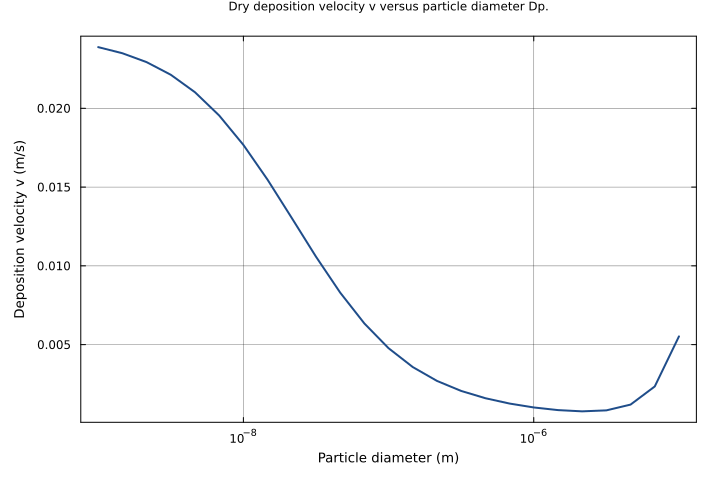
Particle dry deposition velocity v as a function of particle diameter Dp for midsummer grass at neutral stability. Sweeping Dp logarithmically from 1 nm to 10 um traces the classic U-shaped curve: Brownian diffusion drives v up at the fine end, inertial impaction and gravitational settling drive it up at the coarse end, and v reaches its minimum in the 0.1-1 um accumulation mode.
Time span: 0.0 → 1.0
Swept over: Dp
deposition_velocity_vs_friction_velocity
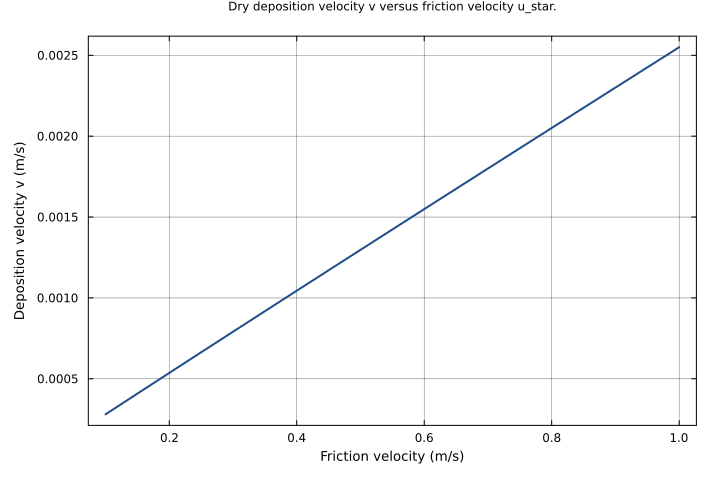
Particle dry deposition velocity v as a function of friction velocity u_star for a 0.8 um aerosol over midsummer grass at neutral stability. Stronger turbulence lowers both the aerodynamic resistance Ra and the quasi-laminar sublayer resistance Rb, so v rises with u_star.
Time span: 0.0 → 1.0
Swept over: u_star
deposition_velocity_over_diameter_and_turbulence
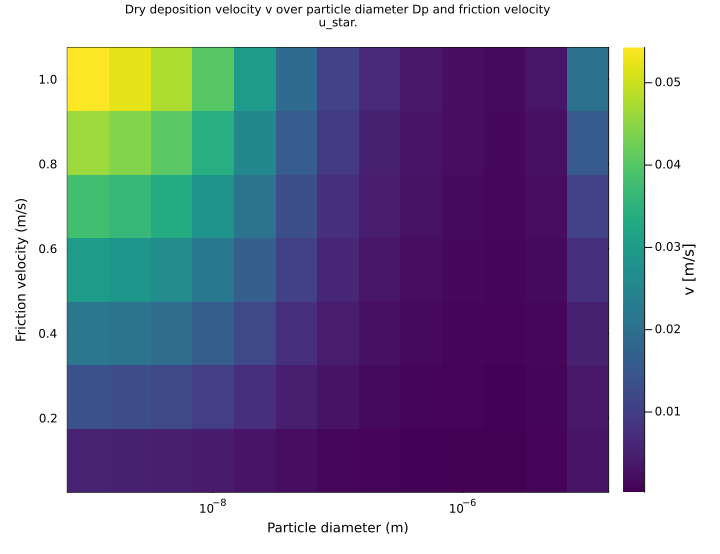
Particle dry deposition velocity v over midsummer grass as a joint function of particle diameter Dp and friction velocity u_star. Surfaces how the size-resolved deposition curve shifts with turbulence: the accumulation-mode minimum is shallowest, and the coarse and fine ends steepest, at high u_star.
Time span: 0.0 → 1.0
Swept over: Dp, u_star
Raw .esm
Raw .esm JSON (this component)
{
"reference": {
"citation": "Seinfeld, J. H., & Pandis, S. N. (2006). Atmospheric Chemistry and Physics: From Air Pollution to Climate Change (2nd ed.), Ch. 19, Eq. 19.7 (particle dry deposition velocity). John Wiley & Sons, Inc.",
"notes": "source_ref: AtmosphericDeposition.jl@e4468c79c8dd4aae88646cd16d6bcf290874742c:src/dry_deposition.jl:1040\n\nUpstream `DryDepositionAerosol` is an MTK builder -- `System(eqs, t, [v; k], params)` with no subsystems -- carrying two equations: v ~ DryDepParticle(...) and k ~ v/z. `DryDepParticle` (src/dry_deposition.jl:272) is a plain Julia function, not a registered symbolic, so it and its entire helper chain (ra, mu, mfp, cc, vs, dParticle, sc, stSmooth, stVeg, RbParticle) are inlined here. There is no time derivative anywhere (no D operator); the component is purely algebraic, so every computed quantity migrates as a `type: observed` variable carrying its inline `expression`, the `equations` array is empty, and `system_kind` is left unset. This is the pure-algebraic convention (matching sibling observed-only migrations such as aerosol/radiative_forcing/cloud_albedo.esm): the ESS Python runner evaluates an observed-only model by direct expression sampling, with no ODE integration. The 27 observed expressions are written in a valid topological order; the runner re-sorts and substitutes them regardless.\n\nResistance network. v is Eq. 19.7, v = 1/(R_a + R_b + R_a*R_b*V_s) + V_s, gated by ifelse(lev == 1, ..., 0) so deposition acts only in the surface layer. R_a (Ra) is the aerodynamic resistance of `ra`, Eqs. 19.13-19.14, with three stability regimes: the unstable branch (zeta < 0) uses the integrated similarity form, the stable branch (zeta > 0) adds the 4.7*(zeta - zeta_0) term, and the neutral branch is the bare log profile. The intermediate i_unstable (upstream `i`) is the domain guard from the source comment: eta and eta_0 evaluate (1 - 15*zeta)^(1/4), whose base is negative for zeta > 0; multiplying zeta by i_unstable (1 only when zeta < 0, else 0) forces the base to exactly 1 in the stable/neutral regimes, so the fractional power is always taken of a base >= 1. R_b (Rb) is RbParticle, Eq. 19.27, summing the Brownian term Sc^(-gamma), the impaction term (St/(alpha + St))^2 and the interception term 0.5*(Dp/A)^2, scaled by the rebound factor R1 = exp(-sqrt(St)). V_s (Vs) is the Cunningham-corrected Stokes settling velocity of `vs`, Eq. 9.42, with the upstream Dp > 20 um cutoff returning the 99999999 m/s sentinel.\n\nNeutral-stability guard. The default L = 0 is the neutral-stability sentinel and upstream `ra` writes zeta = ifelse(L/unit_m == 0, 0, z/L). The ESS Python runner lowers ifelse to a numpy select that evaluates every branch eagerly, rewrites any 1/L as L**(-1), and simplifies comparisons such as 0 < zeta -- so any guarded division by L, and even an ifelse(L==0,1,0) in the denominator, is reduced back to a bare 1/L that raises at L = 0 (float division by zero / 0.0**negative). zeta and zeta_0 are therefore reformulated as z*L/(L*L + 1e-300) and z0*L/(L*L + 1e-300): the 1e-300 floor is a plain non-zero constant the simplifier cannot drop, keeps the denominator strictly positive, and sits ~284 orders of magnitude below L*L for every physical L, so the expression rounds to z/L (resp. z0/L) for L != 0 and is exactly 0 for L = 0 -- the values the upstream guard produces, to within one ulp.\n\nLookup tables. The three Seinfeld & Pandis land-use tables are migrated as `interp.linear` over column-major-flattened `const` vectors, matching the sibling wesley1989/surface_resistance.esm precedent. A_table (the 5x5 season x land-use characteristic collector radius, S&P Table 19.2) flattens column-major (Julia `vec`) to a 25-entry vector on the integer axis [1..25], queried at A_table_index = (SeinfeldLandUse - 1)*5 + SeinfeldSeason; the upstream *1.0e-3 mm-to-m factor is baked into the stored entries. alpha and gamma (5-entry, land-use only) are queried directly at SeinfeldLandUse on the axis [1..5]. SeinfeldSeason in 1..5 and SeinfeldLandUse in 1..5 are categorical integers, so every lookup lands exactly on an integer axis knot -- interp.linear returns the exact table entry with a zero blend weight, reproducing the upstream direct array indexing SA_F32[...][iSeason, iLandUse].\n\nDesert sentinel. A_table's land-use-4 (desert) column is `Inf` upstream -- a sentinel that makes the vegetation-collector terms vanish (term_3 = 0.5*(Dp/A)^2 -> 0, and the unused st_veg -> 0; the St Stokes-number ifelse selects st_smooth for desert anyway). JSON cannot encode Inf, so the five desert entries are stored as the finite sentinel 1.0e25. At a desert query interp.linear returns 1.0e25 exactly (zero blend weight); term_3 = 0.5*(Dp/1e25)^2 is about 3e-65, reproducing the upstream Inf -> 0 behaviour to ~60 digits. A column-major 1-D flatten (rather than interp.bilinear) is used so the desert column never participates in a blend that could cancel the sentinel.\n\nFloat32 tables. The upstream tables are SA_F32 (Float32) static arrays. alpha and gamma have non-integer entries (0.8, 1.2, 1.3, 0.56, 0.54) that are not exact in Float32; each is stored as its exact Float64-promoted Float32 value (e.g. 0.8 -> 0.800000011920929) to reproduce upstream arithmetic. A_table's entries (2, 5, 10) are exact in Float32, so A_table*1e-3 is stored as the clean 0.002 / 0.005 / 0.01.\n\nDropped declarations. `DryDepositionAerosol` declares WesleySeason and WesleyLandUse as @parameters and passes them to DryDepParticle, but DryDepParticle's body never references its iWesleySeason / iWesleyLandUse arguments -- they are dead -- so they are omitted from the migration. The upstream unit-one @constants (unit_m, unit_T, unit_convert_mu, unit_v) are identically 1 and the ESS runners do no dimensional analysis, so they fold away (e.g. ifelse(L/unit_m == 0, ...) becomes ifelse(L == 0, ...); Dp > 20e-6*unit_m becomes Dp > 2.0e-5). dH2O and its constants (T_unitless, unit_dH2O) belong to the gas-deposition pathway and are not part of this component.\n\nConstants. g, kappa (von Karman), k_B, M_air and R migrate as fixed-default parameters (ESM has no constant variable type). k_B and R use the schema-recognized physical-constant names with units J/K and J/(mol*K); their defaults are the upstream values (k_B = 1.3806488e-23, R = 8.3144621). pi is inlined as the literal 3.141592653589793 (Julia Float64 pi). The upstream component coupling tag `metadata = Dict(CoupleType => DryDepositionAerosolCoupler)` is informational only and, following the rig convention for migrated components, is not carried into a `coupletype` field.\n\nInputs. lev, z, z0, u_star, L, Dp, Ts, P, rho_particle and rho_a carry the upstream `DryDepositionAerosol` @parameter defaults. SeinfeldSeason (default 1 = midsummer) and SeinfeldLandUse (default 3 = grass) are the integer S&P season and land-use indices (land use: 1 evergreen, 2 deciduous, 3 grass, 4 desert, 5 shrubs; season: 1 midsummer, 2 autumn, 3 late autumn, 4 winter, 5 transitional).\n\nUnits. ESM `units` fields are descriptive only; the runners perform no dimensional analysis.\n\nTolerance rationale (model-level rel=1e-6): a closed-form algebraic system with no ODE integration -- each observed value is the Float64 evaluation of the inlined Eq. 19.7 cascade. rel=1e-6 absorbs round-off across the reciprocal-sum resistance chain and the libm exp / log / atan / pow evaluations, well above the agreement expected between conforming runners. The supercoarse Dp > 20 um regime is migrated faithfully (the `vs` sentinel branch) but not given a dedicated inline test, because there exp(-sqrt(St)) underflows and drives Rb to a non-finite value that JSON assertions cannot express; v itself stays finite at the V_s sentinel."
},
"tolerance": {
"rel": 1e-06
},
"variables": {
"lev": {
"type": "parameter",
"units": "1",
"default": 1,
"description": "Index of the atmospheric layer; deposition acts only when lev = 1 (the surface layer)."
},
"z": {
"type": "parameter",
"units": "m",
"default": 50.0,
"description": "Height of the top of the surface layer."
},
"z0": {
"type": "parameter",
"units": "m",
"default": 0.04,
"description": "Aerodynamic roughness length (upstream z_0)."
},
"u_star": {
"type": "parameter",
"units": "m/s",
"default": 0.44,
"description": "Friction velocity."
},
"L": {
"type": "parameter",
"units": "m",
"default": 0.0,
"description": "Monin-Obukhov length. The value 0 is the neutral-stability sentinel."
},
"Dp": {
"type": "parameter",
"units": "m",
"default": 8e-07,
"description": "Particle diameter."
},
"Ts": {
"type": "parameter",
"units": "K",
"default": 298.0,
"description": "Surface air temperature."
},
"P": {
"type": "parameter",
"units": "Pa",
"default": 101325.0,
"description": "Air pressure."
},
"rho_particle": {
"type": "parameter",
"units": "kg/m^3",
"default": 1000.0,
"description": "Particle (aerosol) mass density (upstream rho_Particle)."
},
"rho_a": {
"type": "parameter",
"units": "kg/m^3",
"default": 1.2,
"description": "Air density (upstream rho_A)."
},
"SeinfeldSeason": {
"type": "parameter",
"units": "1",
"default": 1,
"description": "Seinfeld & Pandis season index 1-5: 1 midsummer, 2 autumn, 3 late autumn, 4 winter, 5 transitional. Default: midsummer."
},
"SeinfeldLandUse": {
"type": "parameter",
"units": "1",
"default": 3,
"description": "Seinfeld & Pandis land-use index 1-5: 1 evergreen, 2 deciduous, 3 grass, 4 desert, 5 shrubs. Default: grass."
},
"g": {
"type": "parameter",
"units": "m/s^2",
"default": 9.81,
"description": "Gravitational acceleration (upstream @constant)."
},
"kappa": {
"type": "parameter",
"units": "1",
"default": 0.4,
"description": "Von Karman constant (upstream @constant kappa)."
},
"k_B": {
"type": "parameter",
"units": "J/K",
"default": 1.3806488e-23,
"description": "Boltzmann constant (upstream @constant)."
},
"M_air": {
"type": "parameter",
"units": "kg/mol",
"default": 0.02897,
"description": "Molecular weight of air (upstream @constant)."
},
"R": {
"type": "parameter",
"units": "J/(mol*K)",
"default": 8.3144621,
"description": "Ideal gas constant (upstream @constant)."
},
"zeta": {
"type": "unknown",
"units": "1",
"description": "Stability parameter z/L of the surface layer, 0 in the neutral limit L = 0 (Eqs. 19.13-19.14). Written as z*L/(L*L + 1e-300): the 1e-300 floor keeps the denominator strictly positive (so neither the value nor any comparison on it ever divides by L = 0), and is far below the rounding scale of L*L for every physical L, so for L != 0 this equals z/L and for L = 0 it equals 0."
},
"zeta_0": {
"type": "unknown",
"units": "1",
"description": "Stability parameter z_0/L at the roughness height, 0 in the neutral limit L = 0. Written as z0*L/(L*L + 1e-300) for the same strictly-positive-denominator reason as zeta."
},
"ra_neutral_stable": {
"type": "unknown",
"units": "s/m",
"description": "Aerodynamic resistance in the neutral/stable regimes (zeta >= 0): the log profile, plus the 4.7*(zeta - zeta_0) correction when stable (upstream r_a_1)."
},
"i_unstable": {
"type": "unknown",
"units": "1",
"description": "Domain-guard indicator: 1 when the layer is unstable (zeta < 0), else 0. Forces the base of eta / eta_0 to 1 in the stable/neutral regimes (upstream src comment at ra)."
},
"eta_0": {
"type": "unknown",
"units": "1",
"description": "Similarity variable (1 - 15*zeta_0)^(1/4) at the roughness height, used in the unstable aerodynamic resistance."
},
"eta": {
"type": "unknown",
"units": "1",
"description": "Similarity variable (1 - 15*zeta)^(1/4) at the surface-layer top, used in the unstable aerodynamic resistance."
},
"Ra": {
"type": "unknown",
"units": "s/m",
"description": "Aerodynamic resistance to dry deposition (Eqs. 19.13-19.14): unstable integrated-similarity form when zeta < 0, else ra_neutral_stable."
},
"mu": {
"type": "unknown",
"units": "kg/(m*s)",
"description": "Dynamic viscosity of air from the Sutherland relation (upstream `mu`); unit_T and unit_convert_mu folded away."
},
"mfp": {
"type": "unknown",
"units": "m",
"description": "Mean free path of air (S&P Eq. 9.6, upstream `mfp`)."
},
"Cc": {
"type": "unknown",
"units": "1",
"description": "Cunningham slip correction factor (S&P Eq. 9.34, upstream `cc`)."
},
"Vs": {
"type": "unknown",
"units": "m/s",
"description": "Gravitational settling (terminal) velocity (S&P Eq. 9.42, upstream `vs`); the 99999999 m/s sentinel for Dp > 20 um, where Stokes settling no longer applies."
},
"A_table_index": {
"type": "unknown",
"units": "1",
"description": "Flattened (column-major) lookup coordinate into the 25-entry season x land-use characteristic-radius table: (SeinfeldLandUse - 1)*5 + SeinfeldSeason."
},
"A_collector": {
"type": "unknown",
"units": "m",
"description": "Characteristic radius of surface collectors (S&P Table 19.2, upstream A_table * 1e-3). 1e25 for desert land use, the finite stand-in for the upstream Inf sentinel."
},
"st_smooth": {
"type": "unknown",
"units": "1",
"description": "Stokes number for smooth / bluff-roughness surfaces (S&P Eq. 19.23, upstream `stSmooth`)."
},
"st_veg": {
"type": "unknown",
"units": "1",
"description": "Stokes number for vegetated surfaces (S&P Eq. 19.24, upstream `stVeg`)."
},
"St": {
"type": "unknown",
"units": "1",
"description": "Selected Stokes number: st_smooth for desert land use (index 4), else st_veg."
},
"D_brownian": {
"type": "unknown",
"units": "m^2/s",
"description": "Brownian diffusivity of the particle from the Stokes-Einstein-Sutherland relation (S&P Eq. 9.73, upstream `dParticle`)."
},
"Sc": {
"type": "unknown",
"units": "1",
"description": "Schmidt number of the particle (upstream `sc`)."
},
"alpha": {
"type": "unknown",
"units": "1",
"description": "Land-use impaction-efficiency parameter (S&P Table 19.2, upstream alpha_table)."
},
"gamma": {
"type": "unknown",
"units": "1",
"description": "Land-use Brownian-diffusion exponent (S&P Table 19.2, upstream gamma_table)."
},
"R1": {
"type": "unknown",
"units": "1",
"description": "Particle-rebound correction factor exp(-sqrt(St)) of the sublayer resistance (Eq. 19.27)."
},
"term_1": {
"type": "unknown",
"units": "1",
"description": "Brownian-diffusion collection term Sc^(-gamma) of the sublayer resistance (Eq. 19.27)."
},
"term_2": {
"type": "unknown",
"units": "1",
"description": "Inertial-impaction collection term (St/(alpha + St))^2 of the sublayer resistance (Eq. 19.27)."
},
"term_3": {
"type": "unknown",
"units": "1",
"description": "Interception collection term 0.5*(Dp/A_collector)^2 of the sublayer resistance (Eq. 19.27); ~0 for desert land use."
},
"Rb": {
"type": "unknown",
"units": "s/m",
"description": "Quasi-laminar sublayer resistance to particle dry deposition (S&P Eq. 19.27, upstream `RbParticle`)."
},
"v": {
"type": "unknown",
"units": "m/s",
"description": "Particle dry deposition velocity (S&P Eq. 19.7); 0 above the surface layer (lev != 1)."
},
"k": {
"type": "unknown",
"units": "1/s",
"description": "First-order particle dry deposition rate, v/z."
}
},
"equations": [
{
"lhs": "zeta",
"rhs": {
"op": "/",
"args": [
{
"op": "*",
"args": [
"z",
"L"
]
},
{
"op": "+",
"args": [
{
"op": "*",
"args": [
"L",
"L"
]
},
1e-300
]
}
]
}
},
{
"lhs": "zeta_0",
"rhs": {
"op": "/",
"args": [
{
"op": "*",
"args": [
"z0",
"L"
]
},
{
"op": "+",
"args": [
{
"op": "*",
"args": [
"L",
"L"
]
},
1e-300
]
}
]
}
},
{
"lhs": "ra_neutral_stable",
"rhs": {
"op": "ifelse",
"args": [
{
"op": "<",
"args": [
0,
"zeta"
]
},
{
"op": "*",
"args": [
{
"op": "/",
"args": [
1,
{
"op": "*",
"args": [
"kappa",
"u_star"
]
}
]
},
{
"op": "+",
"args": [
{
"op": "log",
"args": [
{
"op": "/",
"args": [
"z",
"z0"
]
}
]
},
{
"op": "*",
"args": [
4.7,
{
"op": "-",
"args": [
"zeta",
"zeta_0"
]
}
]
}
]
}
]
},
{
"op": "*",
"args": [
{
"op": "/",
"args": [
1,
{
"op": "*",
"args": [
"kappa",
"u_star"
]
}
]
},
{
"op": "log",
"args": [
{
"op": "/",
"args": [
"z",
"z0"
]
}
]
}
]
}
]
}
},
{
"lhs": "i_unstable",
"rhs": {
"op": "ifelse",
"args": [
{
"op": "<",
"args": [
"zeta",
0
]
},
1,
0
]
}
},
{
"lhs": "eta_0",
"rhs": {
"op": "^",
"args": [
{
"op": "-",
"args": [
1,
{
"op": "*",
"args": [
15,
"zeta_0",
"i_unstable"
]
}
]
},
0.25
]
}
},
{
"lhs": "eta",
"rhs": {
"op": "^",
"args": [
{
"op": "-",
"args": [
1,
{
"op": "*",
"args": [
15,
"zeta",
"i_unstable"
]
}
]
},
0.25
]
}
},
{
"lhs": "Ra",
"rhs": {
"op": "ifelse",
"args": [
{
"op": "<",
"args": [
"zeta",
0
]
},
{
"op": "*",
"args": [
{
"op": "/",
"args": [
1,
{
"op": "*",
"args": [
"kappa",
"u_star"
]
}
]
},
{
"op": "+",
"args": [
{
"op": "log",
"args": [
{
"op": "/",
"args": [
"z",
"z0"
]
}
]
},
{
"op": "log",
"args": [
{
"op": "/",
"args": [
{
"op": "*",
"args": [
{
"op": "+",
"args": [
{
"op": "^",
"args": [
"eta_0",
2
]
},
1
]
},
{
"op": "^",
"args": [
{
"op": "+",
"args": [
"eta_0",
1
]
},
2
]
}
]
},
{
"op": "*",
"args": [
{
"op": "+",
"args": [
{
"op": "^",
"args": [
"eta",
2
]
},
1
]
},
{
"op": "^",
"args": [
{
"op": "+",
"args": [
"eta",
1
]
},
2
]
}
]
}
]
}
]
},
{
"op": "*",
"args": [
2,
{
"op": "-",
"args": [
{
"op": "atan",
"args": [
"eta"
]
},
{
"op": "atan",
"args": [
"eta_0"
]
}
]
}
]
}
]
}
]
},
"ra_neutral_stable"
]
}
},
{
"lhs": "mu",
"rhs": {
"op": "/",
"args": [
{
"op": "*",
"args": [
1.458e-06,
{
"op": "^",
"args": [
"Ts",
1.5
]
}
]
},
{
"op": "+",
"args": [
"Ts",
110.4
]
}
]
}
},
{
"lhs": "mfp",
"rhs": {
"op": "/",
"args": [
{
"op": "*",
"args": [
2,
"mu"
]
},
{
"op": "*",
"args": [
"P",
{
"op": "^",
"args": [
{
"op": "/",
"args": [
{
"op": "*",
"args": [
8,
"M_air"
]
},
{
"op": "*",
"args": [
3.141592653589793,
"R",
"Ts"
]
}
]
},
0.5
]
}
]
}
]
}
},
{
"lhs": "Cc",
"rhs": {
"op": "+",
"args": [
1,
{
"op": "*",
"args": [
{
"op": "/",
"args": [
{
"op": "*",
"args": [
2,
"mfp"
]
},
"Dp"
]
},
{
"op": "+",
"args": [
1.257,
{
"op": "*",
"args": [
0.4,
{
"op": "exp",
"args": [
{
"op": "/",
"args": [
{
"op": "*",
"args": [
-1.1,
"Dp"
]
},
{
"op": "*",
"args": [
2,
"mfp"
]
}
]
}
]
}
]
}
]
}
]
}
]
}
},
{
"lhs": "Vs",
"rhs": {
"op": "ifelse",
"args": [
{
"op": ">",
"args": [
"Dp",
2e-05
]
},
99999999.0,
{
"op": "/",
"args": [
{
"op": "*",
"args": [
{
"op": "^",
"args": [
"Dp",
2
]
},
"rho_particle",
"g",
"Cc"
]
},
{
"op": "*",
"args": [
18,
"mu"
]
}
]
}
]
}
},
{
"lhs": "A_table_index",
"rhs": {
"op": "+",
"args": [
{
"op": "*",
"args": [
{
"op": "-",
"args": [
"SeinfeldLandUse",
1
]
},
5
]
},
"SeinfeldSeason"
]
}
},
{
"lhs": "A_collector",
"rhs": {
"op": "fn",
"name": "interp.linear",
"args": [
{
"op": "const",
"args": [],
"value": [
0.002,
0.002,
0.002,
0.002,
0.002,
0.005,
0.005,
0.01,
0.01,
0.005,
0.002,
0.002,
0.005,
0.002,
0.002,
1e+25,
1e+25,
1e+25,
1e+25,
1e+25,
0.01,
0.01,
0.01,
0.01,
0.01
]
},
{
"op": "const",
"args": [],
"value": [
1,
2,
3,
4,
5,
6,
7,
8,
9,
10,
11,
12,
13,
14,
15,
16,
17,
18,
19,
20,
21,
22,
23,
24,
25
]
},
"A_table_index"
]
}
},
{
"lhs": "st_smooth",
"rhs": {
"op": "/",
"args": [
{
"op": "*",
"args": [
"Vs",
{
"op": "^",
"args": [
"u_star",
2
]
},
"rho_a"
]
},
{
"op": "*",
"args": [
"g",
"mu"
]
}
]
}
},
{
"lhs": "st_veg",
"rhs": {
"op": "/",
"args": [
{
"op": "*",
"args": [
"Vs",
"u_star"
]
},
{
"op": "*",
"args": [
"g",
"A_collector"
]
}
]
}
},
{
"lhs": "St",
"rhs": {
"op": "ifelse",
"args": [
{
"op": "==",
"args": [
"SeinfeldLandUse",
4
]
},
"st_smooth",
"st_veg"
]
}
},
{
"lhs": "D_brownian",
"rhs": {
"op": "/",
"args": [
{
"op": "*",
"args": [
"k_B",
"Ts",
"Cc"
]
},
{
"op": "*",
"args": [
3,
3.141592653589793,
"mu",
"Dp"
]
}
]
}
},
{
"lhs": "Sc",
"rhs": {
"op": "/",
"args": [
"mu",
{
"op": "*",
"args": [
"rho_a",
"D_brownian"
]
}
]
}
},
{
"lhs": "alpha",
"rhs": {
"op": "fn",
"name": "interp.linear",
"args": [
{
"op": "const",
"args": [],
"value": [
1.0,
0.800000011920929,
1.2000000476837158,
50.0,
1.2999999523162842
]
},
{
"op": "const",
"args": [],
"value": [
1,
2,
3,
4,
5
]
},
"SeinfeldLandUse"
]
}
},
{
"lhs": "gamma",
"rhs": {
"op": "fn",
"name": "interp.linear",
"args": [
{
"op": "const",
"args": [],
"value": [
0.5600000023841858,
0.5600000023841858,
0.5400000214576721,
0.5400000214576721,
0.5400000214576721
]
},
{
"op": "const",
"args": [],
"value": [
1,
2,
3,
4,
5
]
},
"SeinfeldLandUse"
]
}
},
{
"lhs": "R1",
"rhs": {
"op": "exp",
"args": [
{
"op": "-",
"args": [
{
"op": "^",
"args": [
"St",
0.5
]
}
]
}
]
}
},
{
"lhs": "term_1",
"rhs": {
"op": "^",
"args": [
"Sc",
{
"op": "-",
"args": [
"gamma"
]
}
]
}
},
{
"lhs": "term_2",
"rhs": {
"op": "^",
"args": [
{
"op": "/",
"args": [
"St",
{
"op": "+",
"args": [
"alpha",
"St"
]
}
]
},
2
]
}
},
{
"lhs": "term_3",
"rhs": {
"op": "*",
"args": [
0.5,
{
"op": "^",
"args": [
{
"op": "/",
"args": [
"Dp",
"A_collector"
]
},
2
]
}
]
}
},
{
"lhs": "Rb",
"rhs": {
"op": "/",
"args": [
1,
{
"op": "*",
"args": [
3,
"u_star",
{
"op": "+",
"args": [
"term_1",
"term_2",
"term_3"
]
},
"R1"
]
}
]
}
},
{
"lhs": "v",
"rhs": {
"op": "ifelse",
"args": [
{
"op": "==",
"args": [
"lev",
1
]
},
{
"op": "+",
"args": [
{
"op": "/",
"args": [
1,
{
"op": "+",
"args": [
"Ra",
"Rb",
{
"op": "*",
"args": [
"Ra",
"Rb",
"Vs"
]
}
]
}
]
},
"Vs"
]
},
0
]
}
},
{
"lhs": "k",
"rhs": {
"op": "/",
"args": [
"v",
"z"
]
}
}
],
"tests": [
{
"id": "default_grass_midsummer",
"description": "Default case: a 0.8 um aerosol depositing onto midsummer grass (SeinfeldSeason=1, SeinfeldLandUse=3), neutral stability (L=0), all parameters at the upstream DryDepositionAerosol defaults. Pins the full Eq. 19.7 cascade from the aerodynamic resistance through the deposition velocity. v is re-checked at t=1 s to confirm the system is time-invariant (purely algebraic).",
"parameter_overrides": {
"lev": 1,
"z": 50.0,
"z0": 0.04,
"u_star": 0.44,
"L": 0.0,
"Dp": 8e-07,
"Ts": 298.0,
"P": 101325.0,
"rho_particle": 1000.0,
"rho_a": 1.2,
"SeinfeldSeason": 1,
"SeinfeldLandUse": 3
},
"time_span": {
"start": 0.0,
"end": 1.0
},
"assertions": [
{
"variable": "Ra",
"time": 0.0,
"expected": 40.516470626683784
},
{
"variable": "mu",
"time": 0.0,
"expected": 1.8365222177118288e-05
},
{
"variable": "mfp",
"time": 0.0,
"expected": 6.643401132906948e-08
},
{
"variable": "Cc",
"time": 0.0,
"expected": 1.2088571903835552
},
{
"variable": "Vs",
"time": 0.0,
"expected": 2.2959122625324298e-05
},
{
"variable": "A_collector",
"time": 0.0,
"expected": 0.002
},
{
"variable": "St",
"time": 0.0,
"expected": 0.0005148834839522268
},
{
"variable": "D_brownian",
"time": 0.0,
"expected": 3.5918416393193584e-11
},
{
"variable": "Sc",
"time": 0.0,
"expected": 426086.4857384236
},
{
"variable": "Rb",
"time": 0.0,
"expected": 849.3445918950064
},
{
"variable": "v",
"time": 0.0,
"expected": 0.0011457331839425675
},
{
"variable": "v",
"time": 1.0,
"expected": 0.0011457331839425675
},
{
"variable": "k",
"time": 0.0,
"expected": 2.291466367885135e-05
}
]
},
{
"id": "upstream_drydepparticle_anchor",
"description": "The configuration of AtmosphericDeposition.jl's drydep_test.jl DryDepParticle test (z=20 m, z0=0.02 m, evergreen land use index 1) at a 1 um particle. The upstream test asserts the velocity is within a loose 0.015 m/s band of the literature value 0.0002 m/s; this migration pins the exact algorithm value.",
"parameter_overrides": {
"lev": 1,
"z": 20.0,
"z0": 0.02,
"u_star": 0.44,
"L": 0.0,
"Dp": 1e-06,
"Ts": 298.0,
"P": 101325.0,
"rho_particle": 1000.0,
"rho_a": 1.2,
"SeinfeldSeason": 1,
"SeinfeldLandUse": 1
},
"time_span": {
"start": 0.0,
"end": 1.0
},
"assertions": [
{
"variable": "Ra",
"time": 0.0,
"expected": 39.24860953967123
},
{
"variable": "Cc",
"time": 0.0,
"expected": 1.167028594215202
},
{
"variable": "Vs",
"time": 0.0,
"expected": 3.463233810695372e-05
},
{
"variable": "St",
"time": 0.0,
"expected": 0.0007766681328776572
},
{
"variable": "Sc",
"time": 0.0,
"expected": 551697.8274604002
},
{
"variable": "Rb",
"time": 0.0,
"expected": 1277.5083605045559
},
{
"variable": "v",
"time": 0.0,
"expected": 0.000793073724223562
},
{
"variable": "k",
"time": 0.0,
"expected": 3.96536862111781e-05
}
]
},
{
"id": "fine_particle_evergreen",
"description": "A fine 10 nm (Dp=1e-8 m) aerosol over an evergreen forest. At this size Brownian diffusion dominates: the slip-correction factor Cc is large (~22.6), the Schmidt number is small, the sublayer resistance Rb collapses, and the deposition velocity v is an order of magnitude above the accumulation-mode minimum.",
"parameter_overrides": {
"lev": 1,
"z": 20.0,
"z0": 0.02,
"u_star": 0.44,
"L": 0.0,
"Dp": 1e-08,
"Ts": 298.0,
"P": 101325.0,
"rho_particle": 1000.0,
"rho_a": 1.2,
"SeinfeldSeason": 1,
"SeinfeldLandUse": 1
},
"time_span": {
"start": 0.0,
"end": 1.0
},
"assertions": [
{
"variable": "Cc",
"time": 0.0,
"expected": 22.59395252273215
},
{
"variable": "Vs",
"time": 0.0,
"expected": 6.704903434400587e-08
},
{
"variable": "D_brownian",
"time": 0.0,
"expected": 5.370619465295475e-08
},
{
"variable": "Sc",
"time": 0.0,
"expected": 284.9643679497453
},
{
"variable": "St",
"time": 0.0,
"expected": 1.503648068876788e-06
},
{
"variable": "Rb",
"time": 0.0,
"expected": 17.97385914365418
},
{
"variable": "v",
"time": 0.0,
"expected": 0.017475705489978052
},
{
"variable": "k",
"time": 0.0,
"expected": 0.0008737852744989026
}
]
},
{
"id": "coarse_particle_evergreen",
"description": "A coarse 10 um (Dp=1e-5 m) aerosol over an evergreen forest. Inertial impaction and gravitational settling dominate: the settling velocity Vs and the Stokes number St are large, and the deposition velocity rises again above the accumulation-mode minimum.",
"parameter_overrides": {
"lev": 1,
"z": 20.0,
"z0": 0.02,
"u_star": 0.44,
"L": 0.0,
"Dp": 1e-05,
"Ts": 298.0,
"P": 101325.0,
"rho_particle": 1000.0,
"rho_a": 1.2,
"SeinfeldSeason": 1,
"SeinfeldLandUse": 1
},
"time_span": {
"start": 0.0,
"end": 1.0
},
"assertions": [
{
"variable": "Cc",
"time": 0.0,
"expected": 1.016701510448128
},
{
"variable": "Vs",
"time": 0.0,
"expected": 0.00301712834100423
},
{
"variable": "St",
"time": 0.0,
"expected": 0.06766240927838231
},
{
"variable": "Sc",
"time": 0.0,
"expected": 6332705.650539515
},
{
"variable": "Rb",
"time": 0.0,
"expected": 234.85193351994351
},
{
"variable": "v",
"time": 0.0,
"expected": 0.006329359878097312
},
{
"variable": "k",
"time": 0.0,
"expected": 0.0003164679939048656
}
]
},
{
"id": "desert_landuse",
"description": "A 0.8 um aerosol over desert (SeinfeldLandUse=4). The desert branch exercises the A_collector 1e25 sentinel (upstream Inf): the Stokes-number ifelse selects st_smooth rather than st_veg, and the interception term collapses to ~0. alpha is the large desert impaction value 50.",
"parameter_overrides": {
"lev": 1,
"z": 50.0,
"z0": 0.04,
"u_star": 0.44,
"L": 0.0,
"Dp": 8e-07,
"Ts": 298.0,
"P": 101325.0,
"rho_particle": 1000.0,
"rho_a": 1.2,
"SeinfeldSeason": 1,
"SeinfeldLandUse": 4
},
"time_span": {
"start": 0.0,
"end": 1.0
},
"assertions": [
{
"variable": "A_table_index",
"time": 0.0,
"expected": 16
},
{
"variable": "A_collector",
"time": 0.0,
"expected": 1e+25
},
{
"variable": "alpha",
"time": 0.0,
"expected": 50.0
},
{
"variable": "St",
"time": 0.0,
"expected": 0.02960579261224418
},
{
"variable": "Rb",
"time": 0.0,
"expected": 986.085201011979
},
{
"variable": "v",
"time": 0.0,
"expected": 0.0009961771830953518
},
{
"variable": "k",
"time": 0.0,
"expected": 1.9923543661907037e-05
}
]
},
{
"id": "unstable_stratification",
"description": "A 0.8 um aerosol over midsummer grass with an unstable surface layer (L=-50 m, so zeta=-1). The unstable branch of the aerodynamic resistance (Eqs. 19.13-19.14) is taken: enhanced convective mixing lowers Ra below its neutral value, raising the deposition velocity.",
"parameter_overrides": {
"lev": 1,
"z": 50.0,
"z0": 0.04,
"u_star": 0.44,
"L": -50.0,
"Dp": 8e-07,
"Ts": 298.0,
"P": 101325.0,
"rho_particle": 1000.0,
"rho_a": 1.2,
"SeinfeldSeason": 1,
"SeinfeldLandUse": 3
},
"time_span": {
"start": 0.0,
"end": 1.0
},
"assertions": [
{
"variable": "Ra",
"time": 0.0,
"expected": 34.375953454599696
},
{
"variable": "Rb",
"time": 0.0,
"expected": 849.3445918950064
},
{
"variable": "v",
"time": 0.0,
"expected": 0.0011536808641150783
},
{
"variable": "k",
"time": 0.0,
"expected": 2.307361728230157e-05
}
]
},
{
"id": "stable_stratification",
"description": "A 0.8 um aerosol over midsummer grass with a stable surface layer (L=200 m, so zeta=0.25). The stable branch of the aerodynamic resistance adds the 4.7*(zeta-zeta_0) term, raising Ra above its neutral value and lowering the deposition velocity.",
"parameter_overrides": {
"lev": 1,
"z": 50.0,
"z0": 0.04,
"u_star": 0.44,
"L": 200.0,
"Dp": 8e-07,
"Ts": 298.0,
"P": 101325.0,
"rho_particle": 1000.0,
"rho_a": 1.2,
"SeinfeldSeason": 1,
"SeinfeldLandUse": 3
},
"time_span": {
"start": 0.0,
"end": 1.0
},
"assertions": [
{
"variable": "Ra",
"time": 0.0,
"expected": 47.18726608122924
},
{
"variable": "Rb",
"time": 0.0,
"expected": 849.3445918950064
},
{
"variable": "v",
"time": 0.0,
"expected": 0.0011372248196944183
},
{
"variable": "k",
"time": 0.0,
"expected": 2.2744496393888367e-05
}
]
},
{
"id": "deciduous_autumn",
"description": "A 0.8 um aerosol over an autumn deciduous forest (SeinfeldSeason=2, SeinfeldLandUse=2) at a cooler 295 K and a denser 1500 kg/m^3 particle. Exercises the season axis of the A_table lookup: A_collector = 0.005 m here, distinct from the grass value, and alpha is the deciduous value 0.8.",
"parameter_overrides": {
"lev": 1,
"z": 50.0,
"z0": 0.04,
"u_star": 0.44,
"L": 0.0,
"Dp": 8e-07,
"Ts": 295.0,
"P": 101325.0,
"rho_particle": 1500.0,
"rho_a": 1.2,
"SeinfeldSeason": 2,
"SeinfeldLandUse": 2
},
"time_span": {
"start": 0.0,
"end": 1.0
},
"assertions": [
{
"variable": "mu",
"time": 0.0,
"expected": 1.8222451524644062e-05
},
{
"variable": "Cc",
"time": 0.0,
"expected": 1.206180616865411
},
{
"variable": "Vs",
"time": 0.0,
"expected": 3.463165743042412e-05
},
{
"variable": "A_table_index",
"time": 0.0,
"expected": 7
},
{
"variable": "A_collector",
"time": 0.0,
"expected": 0.005
},
{
"variable": "alpha",
"time": 0.0,
"expected": 0.800000011920929
},
{
"variable": "St",
"time": 0.0,
"expected": 0.00031066114718423263
},
{
"variable": "Rb",
"time": 0.0,
"expected": 1093.207496642624
},
{
"variable": "v",
"time": 0.0,
"expected": 0.0009154887704771684
},
{
"variable": "k",
"time": 0.0,
"expected": 1.8309775409543368e-05
}
]
},
{
"id": "aloft_level_zero_dep",
"description": "Above the surface layer (lev=2): the Eq. 19.7 ifelse(lev==1, ...) gate returns 0, so the deposition velocity v and the rate k are both zero, while the resistance intermediates (Ra, Rb, ...) are still computed normally.",
"parameter_overrides": {
"lev": 2,
"z": 50.0,
"z0": 0.04,
"u_star": 0.44,
"L": 0.0,
"Dp": 8e-07,
"Ts": 298.0,
"P": 101325.0,
"rho_particle": 1000.0,
"rho_a": 1.2,
"SeinfeldSeason": 1,
"SeinfeldLandUse": 3
},
"time_span": {
"start": 0.0,
"end": 1.0
},
"assertions": [
{
"variable": "Rb",
"time": 0.0,
"expected": 849.3445918950064
},
{
"variable": "v",
"time": 0.0,
"expected": 0.0,
"tolerance": {
"abs": 1e-12
}
},
{
"variable": "k",
"time": 0.0,
"expected": 0.0,
"tolerance": {
"abs": 1e-12
}
}
]
}
],
"analyses": [
{
"id": "deposition_velocity_vs_particle_diameter",
"description": "Particle dry deposition velocity v as a function of particle diameter Dp for midsummer grass at neutral stability. Sweeping Dp logarithmically from 1 nm to 10 um traces the classic U-shaped curve: Brownian diffusion drives v up at the fine end, inertial impaction and gravitational settling drive it up at the coarse end, and v reaches its minimum in the 0.1-1 um accumulation mode.",
"initial_state": {},
"parameters": {
"lev": 1,
"z": 50.0,
"z0": 0.04,
"u_star": 0.44,
"L": 0.0,
"Ts": 298.0,
"P": 101325.0,
"rho_particle": 1000.0,
"rho_a": 1.2,
"SeinfeldSeason": 1,
"SeinfeldLandUse": 3
},
"time_span": {
"start": 0.0,
"end": 1.0
},
"parameter_sweep": {
"type": "cartesian",
"dimensions": [
{
"parameter": "Dp",
"range": {
"start": 1e-09,
"stop": 1e-05,
"count": 25,
"scale": "log"
}
}
]
},
"plots": [
{
"id": "v_vs_Dp",
"type": "line",
"description": "Dry deposition velocity v versus particle diameter Dp.",
"x": {
"variable": "Dp",
"label": "Particle diameter (m)"
},
"y": {
"variable": "v",
"label": "Deposition velocity v (m/s)"
}
}
]
},
{
"id": "deposition_velocity_vs_friction_velocity",
"description": "Particle dry deposition velocity v as a function of friction velocity u_star for a 0.8 um aerosol over midsummer grass at neutral stability. Stronger turbulence lowers both the aerodynamic resistance Ra and the quasi-laminar sublayer resistance Rb, so v rises with u_star.",
"initial_state": {},
"parameters": {
"lev": 1,
"z": 50.0,
"z0": 0.04,
"L": 0.0,
"Dp": 8e-07,
"Ts": 298.0,
"P": 101325.0,
"rho_particle": 1000.0,
"rho_a": 1.2,
"SeinfeldSeason": 1,
"SeinfeldLandUse": 3
},
"time_span": {
"start": 0.0,
"end": 1.0
},
"parameter_sweep": {
"type": "cartesian",
"dimensions": [
{
"parameter": "u_star",
"range": {
"start": 0.1,
"stop": 1.0,
"count": 19,
"scale": "linear"
}
}
]
},
"plots": [
{
"id": "v_vs_u_star",
"type": "line",
"description": "Dry deposition velocity v versus friction velocity u_star.",
"x": {
"variable": "u_star",
"label": "Friction velocity (m/s)"
},
"y": {
"variable": "v",
"label": "Deposition velocity v (m/s)"
}
}
]
},
{
"id": "deposition_velocity_over_diameter_and_turbulence",
"description": "Particle dry deposition velocity v over midsummer grass as a joint function of particle diameter Dp and friction velocity u_star. Surfaces how the size-resolved deposition curve shifts with turbulence: the accumulation-mode minimum is shallowest, and the coarse and fine ends steepest, at high u_star.",
"initial_state": {},
"parameters": {
"lev": 1,
"z": 50.0,
"z0": 0.04,
"L": 0.0,
"Ts": 298.0,
"P": 101325.0,
"rho_particle": 1000.0,
"rho_a": 1.2,
"SeinfeldSeason": 1,
"SeinfeldLandUse": 3
},
"time_span": {
"start": 0.0,
"end": 1.0
},
"parameter_sweep": {
"type": "cartesian",
"dimensions": [
{
"parameter": "Dp",
"range": {
"start": 1e-09,
"stop": 1e-05,
"count": 13,
"scale": "log"
}
},
{
"parameter": "u_star",
"range": {
"start": 0.1,
"stop": 1.0,
"count": 7,
"scale": "linear"
}
}
]
},
"plots": [
{
"id": "v_heatmap",
"type": "heatmap",
"description": "Dry deposition velocity v over particle diameter Dp and friction velocity u_star.",
"x": {
"variable": "Dp",
"label": "Particle diameter (m)"
},
"y": {
"variable": "u_star",
"label": "Friction velocity (m/s)"
},
"value": {
"variable": "v",
"reduce": "final"
}
}
]
}
]
}