SolidEquilibrationTimescale
Characteristic timescale for a gas to equilibrate with solid aerosol particles — Seinfeld & Pandis (2006), Atmospheric Chemistry and Physics, 2nd ed., Chapter 12. Computes the solid-particle gas-equilibration timescale in two equivalent forms: τ_s = ρ_p R_p²/(3 D_A m_p f) expressed via the aerosol mass concentration m_p (Eq. 12.135), and τ_s_alt = 1/(4π N R_p D_A f) expressed via the particle number concentration N and radius R_p (Eq. 12.139). The two forms coincide when the mass and number parameterizations are mutually consistent. Migrated from Aerosol.jl SolidEquilibrationTimescale.
Description
Characteristic timescale for a gas to equilibrate with solid aerosol particles — Seinfeld & Pandis (2006), Atmospheric Chemistry and Physics, 2nd ed., Chapter 12. Computes the solid-particle gas-equilibration timescale in two equivalent forms: τ_s = ρ_p R_p²/(3 D_A m_p f) expressed via the aerosol mass concentration m_p (Eq. 12.135), and τ_s_alt = 1/(4π N R_p D_A f) expressed via the particle number concentration N and radius R_p (Eq. 12.139). The two forms coincide when the mass and number parameterizations are mutually consistent. Migrated from Aerosol.jl SolidEquilibrationTimescale.
Reference
Seinfeld, J. H., and Pandis, S. N. (2006). Atmospheric Chemistry and Physics: From Air Pollution to Climate Change, 2nd Edition, John Wiley & Sons, Chapter 12. Solid-particle gas-equilibration timescale: Eqs. 12.135 and 12.139.
_source_ref: Aerosol.jl@c8c640bb636b22f2425460e9ed5cba50793bfee1:src/timescales.jl:145
Upstream SolidEquilibrationTimescale is an MTK @component (no parameterization) in Aerosol.jl’s timescales.jl. It declares six scalar @parameters — R_p (particle radius, m), ρ_p (particle density, kg/m^3), D_A (gas-phase diffusivity, m^2/s), m_p (aerosol mass concentration, kg/m^3), f_Kn (transition-regime correction factor f(Kn,α), dimensionless), N (particle number concentration, m^-3) — and two scalar @variables (τ_s, τ_s_alt, both in s). The two equations are τ_s ~ ρ_p R_p^2 / (3 D_A m_p f_Kn) (Seinfeld & Pandis 2006 Eq. 12.135 — the solid-particle gas-equilibration timescale expressed via the aerosol mass concentration) and τ_s_alt ~ 1 / (4 π N R_p D_A f_Kn) (Eq. 12.139 — the same timescale in the alternative form expressed via the number concentration N and radius R_p).
Observed classification: SolidEquilibrationTimescale has no D() time-derivative anywhere — it is a purely-algebraic component. Both τ_s and τ_s_alt are algebraic outputs (τ_s ~ ..., τ_s_alt ~ ...), each a function of the input parameters alone. After MTK mtkcompile/structural_simplify the compiled system has zero ODE states and both become observed quantities. They are therefore serialized as type: observed with an expression (not type: state with an equation), and the equations array is empty — matching the sibling pure-algebraic Aerosol.jl migrations kelvin.esm and zsr.esm. Unlike kelvin.esm’s S ~ exp(ln_S) chain, τ_s and τ_s_alt are mutually independent: neither references the other, so each observed expression resolves directly from the parameters.
π inlining: the π in Eq. 12.139 is Julia’s built-in Irrational math constant. The .esm Expression AST has no symbolic π, so it is inlined as the float64 literal 3.141592653589793 (the IEEE-754 double-precision representation of π), matching the rig convention (sibling particle_scavenging_coeff.esm: “Julia’s pi is inlined as the float64 literal 3.141592653589793”). The integer literals 3 and 4 in the denominators are kept as integers, and R_p^2 is encoded as a ^ node with integer exponent 2.
Physics — two equivalent forms: Eqs. 12.135 and 12.139 are alternative expressions of the same physical timescale. They are algebraically identical when the parameters are mutually consistent — i.e. when the aerosol mass concentration equals the number concentration times the per-particle mass: m_p = N · (4/3)π R_p^3 ρ_p (mass concentration = number concentration × per-particle volume × density). The upstream @parameters defaults (m_p = 1e-8 kg/m^3, N = 1e9 m^-3, R_p = 1e-7 m, ρ_p = 1000 kg/m^3) do not satisfy this relation — at the defaults the consistent m_p would be 4.18879e-9 kg/m^3 — so the two outputs differ at the default parameterization (τ_s = 16.6667 s, τ_s_alt = 39.7887 s). This is faithful to the upstream component, which declares the two parameter sets independently. The consistent_parameterization inline test sets m_p to the consistency value and confirms τ_s and τ_s_alt then coincide exactly (both 39.78873577297383 s).
Tests: the upstream component has no tests (has_tests: N on the migration tracker). The eight inline tests here are authored from the physics of Eqs. 12.135/12.139. default_parameters pins both outputs at the upstream defaults and re-asserts them at t=1 to document time-invariance (the component is algebraic — no time dependence). Six single-parameter tests each vary one parameter to exercise its scaling — τ_s ∝ R_p^2, ρ_p, 1/D_A, 1/m_p, 1/f_Kn and τ_s_alt ∝ 1/R_p, 1/D_A, 1/f_Kn, 1/N — and assert both outputs, so each test also documents which output a parameter does and does not affect (m_p and ρ_p move only τ_s; N moves only τ_s_alt; R_p, D_A and f_Kn move both). consistent_parameterization verifies the Eq. 12.135 ⇔ Eq. 12.139 equivalence.
Unicode identifiers τ_s, τ_s_alt and ρ_p are kept verbatim from the upstream @variables/@parameters declarations; the ESM identifier pattern permits unicode and the sibling Aerosol.jl migration kelvin.esm keeps the Greek symbols σ and ρ_l. The parameter N (particle number concentration) is a single-capital name and is not one of the schema’s reserved physical-constant names (R, k_B, N_A), so no rename is applied.
Tolerance rationale (model-level rel=1e-9): both outputs are small closed-form rational expressions — a handful of multiplications, one integer power, and one division, with no transcendental functions. float64 evaluation roundoff is at the few-ULP (~1e-15 relative) level; rel=1e-9 leaves roughly six orders of magnitude of headroom and matches the sibling pure-rational Aerosol.jl migration mean_free_path.esm. All asserted values are non-zero (smallest ~1.67 s), so no abs floor is needed._
Parameters
| Name | Units | Default | Description |
|---|---|---|---|
R_p | m | 1e-07 | Particle (aerosol) radius — the radius of the solid particles the gas equilibrates with (Eqs. 12.135/12.139 term R_p). The default 100 nm is a fine-mode aerosol radius. τ_s scales as R_p^2 (Eq. 12.135) while τ_s_alt scales as 1/R_p (Eq. 12.139). |
ρ_p | kg/m^3 | 1000.0 | Particle (aerosol) mass density (Eq. 12.135 term ρ_p). The default 1000 kg/m³ is the density of liquid water. τ_s scales linearly with ρ_p; ρ_p does not appear in Eq. 12.139. |
D_A | m^2/s | 2e-05 | Gas-phase molecular diffusivity of the equilibrating species A (Eqs. 12.135/12.139 term D_A). Both timescales scale as 1/D_A — faster gas-phase diffusion of the species toward the particles shortens the equilibration time. |
m_p | kg/m^3 | 1e-08 | Aerosol (solid-particle) mass concentration — the mass of aerosol per unit volume of air (Eq. 12.135 term m_p). The default 1e-8 kg/m³ is 10 µg/m³. τ_s scales as 1/m_p — a larger condensed-phase mass sink equilibrates the gas faster — and m_p does not appear in Eq. 12.139. |
f_Kn | 1 | 1.0 | Transition-regime (non-continuum) correction factor f(Kn, α), a function of the Knudsen number and the mass accommodation coefficient (Eqs. 12.135/12.139 term f). Dimensionless; equals 1 in the continuum limit, and a sub-unity value represents free-molecular/transition-regime slowing of mass transfer. Both timescales scale as 1/f_Kn. |
N | m^-3 | 1000000000.0 | Particle number concentration — the number of aerosol particles per unit volume of air (Eq. 12.139 term N). τ_s_alt scales as 1/N — more particles provide more surface area and equilibrate the gas faster — and N does not appear in Eq. 12.135. |
Observed
| Name | Units | Default | Description |
|---|---|---|---|
τ_s | s | Solid-particle gas-equilibration timescale (Eq. 12.135): the characteristic time for a gas-phase species to reach equilibrium with a population of solid aerosol particles, τ_s = ρ_p R_p²/(3 D_A m_p f). This form is expressed via the aerosol mass concentration m_p. | |
τ_s_alt | s | Solid-particle gas-equilibration timescale, alternative form (Eq. 12.139): τ_s ≈ 1/(4π N R_p D_A f) — the same physical timescale as τ_s, expressed via the particle number concentration N and radius R_p instead of the mass concentration m_p. Equals τ_s exactly when the parameterizations are mutually consistent (m_p = N (4/3)π R_p³ ρ_p). |
Observed expressions
$$ τ_{s} = \frac{ρ_{p} \cdot R_{p}^{2}}{3 \cdot D_{A} \cdot m_{p} \cdot f_{Kn}} $$Solid-particle gas-equilibration timescale (Eq. 12.135): the characteristic time for a gas-phase species to reach equilibrium with a population of solid aerosol particles, τ_s = ρ_p R_p²/(3 D_A m_p f). This form is expressed via the aerosol mass concentration m_p.
$$ τ_{s\,alt} = \frac{1}{4 \cdot 3.141592653589793 \cdot N \cdot R_{p} \cdot D_{A} \cdot f_{Kn}} $$Solid-particle gas-equilibration timescale, alternative form (Eq. 12.139): τ_s ≈ 1/(4π N R_p D_A f) — the same physical timescale as τ_s, expressed via the particle number concentration N and radius R_p instead of the mass concentration m_p. Equals τ_s exactly when the parameterizations are mutually consistent (m_p = N (4/3)π R_p³ ρ_p).
Analyses
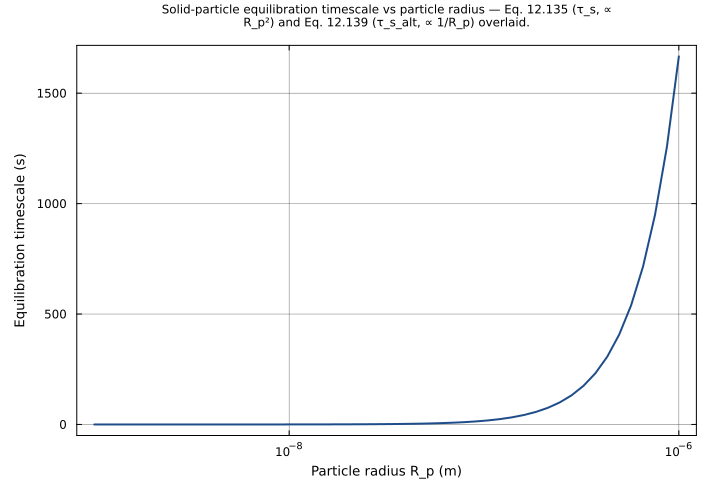
equilibration_timescale_vs_particle_radius
The two forms of the solid-particle equilibration timescale have opposite radius dependence: Eq. 12.135’s τ_s rises as R_p² while Eq. 12.139’s τ_s_alt falls as 1/R_p. Sweeping the particle radius over the 1 nm – 1 μm aerosol size range on a logarithmic axis traces the two curves, which cross where the default mass- and number-based parameterizations momentarily agree.
Time span: 0.0 → 1.0
Swept over: R_p
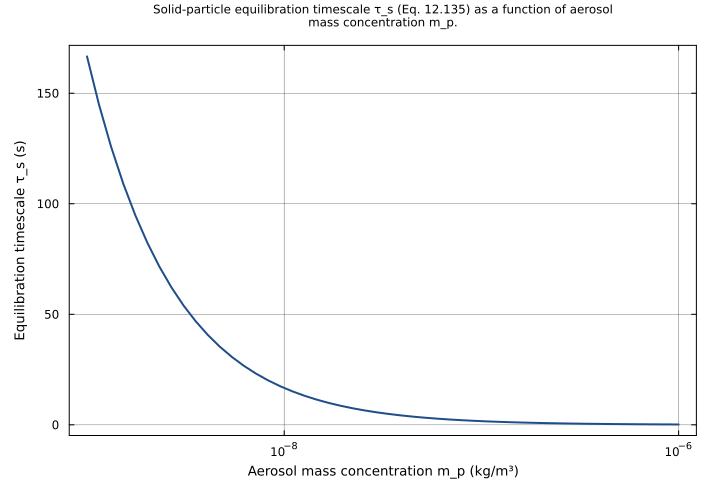
equilibration_timescale_vs_aerosol_mass
Eq. 12.135’s τ_s scales inversely with the aerosol mass concentration — a heavier condensed-phase mass sink equilibrates the gas faster. Sweeping m_p over the 1 – 1000 µg/m³ atmospheric loading range (1e-9 – 1e-6 kg/m³) on a logarithmic axis traces τ_s decreasing monotonically as the aerosol burden grows.
Time span: 0.0 → 1.0
Swept over: m_p
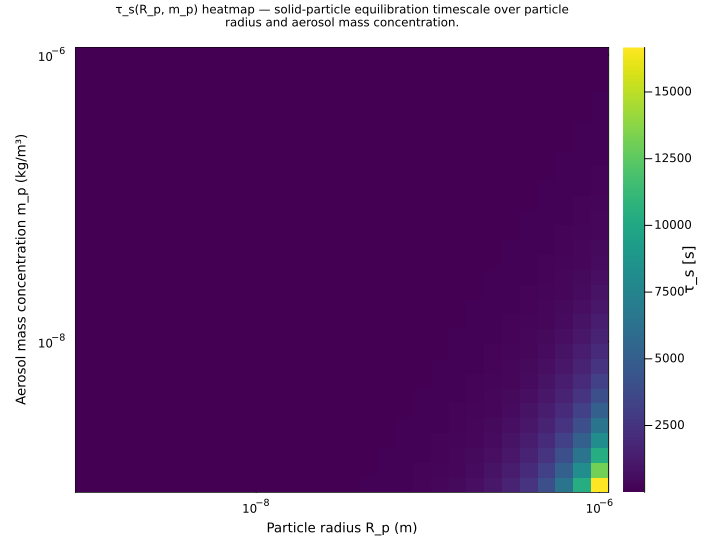
solid_timescale_radius_mass_heatmap
Joint dependence of the Eq. 12.135 equilibration timescale on particle radius and aerosol mass concentration. The heatmap of τ_s(R_p, m_p) shows the timescale longest for large particles in a lightly-loaded aerosol and shortest for small particles in a heavily-loaded aerosol.
Time span: 0.0 → 1.0
Swept over: R_p, m_p
Raw .esm
Raw .esm JSON (this component)
{
  "reference": {
    "citation": "Seinfeld, J. H., and Pandis, S. N. (2006). Atmospheric Chemistry and Physics: From Air Pollution to Climate Change, 2nd Edition, John Wiley & Sons, Chapter 12. Solid-particle gas-equilibration timescale: Eqs. 12.135 and 12.139.",
    "notes": "source_ref: Aerosol.jl@c8c640bb636b22f2425460e9ed5cba50793bfee1:src/timescales.jl:145\n\nUpstream `SolidEquilibrationTimescale` is an MTK `@component` (no parameterization) in Aerosol.jl's timescales.jl. It declares six scalar `@parameters` — `R_p` (particle radius, m), `ρ_p` (particle density, kg/m^3), `D_A` (gas-phase diffusivity, m^2/s), `m_p` (aerosol mass concentration, kg/m^3), `f_Kn` (transition-regime correction factor f(Kn,α), dimensionless), `N` (particle number concentration, m^-3) — and two scalar `@variables` (`τ_s`, `τ_s_alt`, both in s). The two equations are `τ_s ~ ρ_p R_p^2 / (3 D_A m_p f_Kn)` (Seinfeld & Pandis 2006 Eq. 12.135 — the solid-particle gas-equilibration timescale expressed via the aerosol mass concentration) and `τ_s_alt ~ 1 / (4 π N R_p D_A f_Kn)` (Eq. 12.139 — the same timescale in the alternative form expressed via the number concentration N and radius R_p).\n\nObserved classification: SolidEquilibrationTimescale has no `D()` time-derivative anywhere — it is a purely-algebraic component. Both `τ_s` and `τ_s_alt` are algebraic outputs (`τ_s ~ ...`, `τ_s_alt ~ ...`), each a function of the input parameters alone. After MTK `mtkcompile`/`structural_simplify` the compiled system has zero ODE states and both become observed quantities. They are therefore serialized as `type: observed` with an `expression` (not `type: state` with an equation), and the `equations` array is empty — matching the sibling pure-algebraic Aerosol.jl migrations kelvin.esm and zsr.esm. Unlike kelvin.esm's `S ~ exp(ln_S)` chain, `τ_s` and `τ_s_alt` are mutually independent: neither references the other, so each observed expression resolves directly from the parameters.\n\nπ inlining: the `π` in Eq. 12.139 is Julia's built-in `Irrational` math constant. The .esm Expression AST has no symbolic π, so it is inlined as the float64 literal 3.141592653589793 (the IEEE-754 double-precision representation of π), matching the rig convention (sibling particle_scavenging_coeff.esm: \"Julia's `pi` is inlined as the float64 literal 3.141592653589793\"). The integer literals 3 and 4 in the denominators are kept as integers, and `R_p^2` is encoded as a `^` node with integer exponent 2.\n\nPhysics — two equivalent forms: Eqs. 12.135 and 12.139 are alternative expressions of the same physical timescale. They are algebraically identical when the parameters are mutually consistent — i.e. when the aerosol mass concentration equals the number concentration times the per-particle mass: m_p = N · (4/3)π R_p^3 ρ_p (mass concentration = number concentration × per-particle volume × density). The upstream `@parameters` defaults (m_p = 1e-8 kg/m^3, N = 1e9 m^-3, R_p = 1e-7 m, ρ_p = 1000 kg/m^3) do not satisfy this relation — at the defaults the consistent m_p would be 4.18879e-9 kg/m^3 — so the two outputs differ at the default parameterization (τ_s = 16.6667 s, τ_s_alt = 39.7887 s). This is faithful to the upstream component, which declares the two parameter sets independently. The `consistent_parameterization` inline test sets m_p to the consistency value and confirms τ_s and τ_s_alt then coincide exactly (both 39.78873577297383 s).\n\nTests: the upstream component has no tests (`has_tests: N` on the migration tracker). The eight inline tests here are authored from the physics of Eqs. 12.135/12.139. `default_parameters` pins both outputs at the upstream defaults and re-asserts them at t=1 to document time-invariance (the component is algebraic — no time dependence). Six single-parameter tests each vary one parameter to exercise its scaling — τ_s ∝ R_p^2, ρ_p, 1/D_A, 1/m_p, 1/f_Kn and τ_s_alt ∝ 1/R_p, 1/D_A, 1/f_Kn, 1/N — and assert both outputs, so each test also documents which output a parameter does and does not affect (m_p and ρ_p move only τ_s; N moves only τ_s_alt; R_p, D_A and f_Kn move both). `consistent_parameterization` verifies the Eq. 12.135 ⇔ Eq. 12.139 equivalence.\n\nUnicode identifiers `τ_s`, `τ_s_alt` and `ρ_p` are kept verbatim from the upstream `@variables`/`@parameters` declarations; the ESM identifier pattern permits unicode and the sibling Aerosol.jl migration kelvin.esm keeps the Greek symbols `σ` and `ρ_l`. The parameter `N` (particle number concentration) is a single-capital name and is not one of the schema's reserved physical-constant names (`R`, `k_B`, `N_A`), so no rename is applied.\n\nTolerance rationale (model-level rel=1e-9): both outputs are small closed-form rational expressions — a handful of multiplications, one integer power, and one division, with no transcendental functions. float64 evaluation roundoff is at the few-ULP (~1e-15 relative) level; rel=1e-9 leaves roughly six orders of magnitude of headroom and matches the sibling pure-rational Aerosol.jl migration mean_free_path.esm. All asserted values are non-zero (smallest ~1.67 s), so no `abs` floor is needed."
  },
  "variables": {
    "R_p": {
      "type": "parameter",
      "units": "m",
      "default": 1e-07,
      "description": "Particle (aerosol) radius — the radius of the solid particles the gas equilibrates with (Eqs. 12.135/12.139 term R_p). The default 100 nm is a fine-mode aerosol radius. τ_s scales as R_p^2 (Eq. 12.135) while τ_s_alt scales as 1/R_p (Eq. 12.139)."
    },
    "ρ_p": {
      "type": "parameter",
      "units": "kg/m^3",
      "default": 1000.0,
      "description": "Particle (aerosol) mass density (Eq. 12.135 term ρ_p). The default 1000 kg/m³ is the density of liquid water. τ_s scales linearly with ρ_p; ρ_p does not appear in Eq. 12.139."
    },
    "D_A": {
      "type": "parameter",
      "units": "m^2/s",
      "default": 2e-05,
      "description": "Gas-phase molecular diffusivity of the equilibrating species A (Eqs. 12.135/12.139 term D_A). Both timescales scale as 1/D_A — faster gas-phase diffusion of the species toward the particles shortens the equilibration time."
    },
    "m_p": {
      "type": "parameter",
      "units": "kg/m^3",
      "default": 1e-08,
      "description": "Aerosol (solid-particle) mass concentration — the mass of aerosol per unit volume of air (Eq. 12.135 term m_p). The default 1e-8 kg/m³ is 10 µg/m³. τ_s scales as 1/m_p — a larger condensed-phase mass sink equilibrates the gas faster — and m_p does not appear in Eq. 12.139."
    },
    "f_Kn": {
      "type": "parameter",
      "units": "1",
      "default": 1.0,
      "description": "Transition-regime (non-continuum) correction factor f(Kn, α), a function of the Knudsen number and the mass accommodation coefficient (Eqs. 12.135/12.139 term f). Dimensionless; equals 1 in the continuum limit, and a sub-unity value represents free-molecular/transition-regime slowing of mass transfer. Both timescales scale as 1/f_Kn."
    },
    "N": {
      "type": "parameter",
      "units": "m^-3",
      "default": 1000000000.0,
      "description": "Particle number concentration — the number of aerosol particles per unit volume of air (Eq. 12.139 term N). τ_s_alt scales as 1/N — more particles provide more surface area and equilibrate the gas faster — and N does not appear in Eq. 12.135."
    },
    "τ_s": {
      "type": "unknown",
      "units": "s",
      "description": "Solid-particle gas-equilibration timescale (Eq. 12.135): the characteristic time for a gas-phase species to reach equilibrium with a population of solid aerosol particles, τ_s = ρ_p R_p²/(3 D_A m_p f). This form is expressed via the aerosol mass concentration m_p."
    },
    "τ_s_alt": {
      "type": "unknown",
      "units": "s",
      "description": "Solid-particle gas-equilibration timescale, alternative form (Eq. 12.139): τ_s ≈ 1/(4π N R_p D_A f) — the same physical timescale as τ_s, expressed via the particle number concentration N and radius R_p instead of the mass concentration m_p. Equals τ_s exactly when the parameterizations are mutually consistent (m_p = N (4/3)π R_p³ ρ_p)."
    }
  },
  "equations": [
    {
      "lhs": "τ_s",
      "rhs": {
        "op": "/",
        "args": [
          {
            "op": "*",
            "args": [
              "ρ_p",
              {
                "op": "^",
                "args": [
                  "R_p",
                  2
                ]
              }
            ]
          },
          {
            "op": "*",
            "args": [
              3,
              "D_A",
              "m_p",
              "f_Kn"
            ]
          }
        ]
      }
    },
    {
      "lhs": "τ_s_alt",
      "rhs": {
        "op": "/",
        "args": [
          1,
          {
            "op": "*",
            "args": [
              4,
              3.141592653589793,
              "N",
              "R_p",
              "D_A",
              "f_Kn"
            ]
          }
        ]
      }
    }
  ],
  "tolerance": {
    "rel": 1e-09
  },
  "tests": [
    {
      "id": "default_parameters",
      "description": "Eqs. 12.135 and 12.139 at the upstream default parameterization (R_p = 100 nm, ρ_p = 1000 kg/m³, D_A = 2e-5 m²/s, m_p = 1e-8 kg/m³, f_Kn = 1, N = 1e9 m⁻³). τ_s = ρ_p R_p²/(3 D_A m_p f) = 16.66667 s and τ_s_alt = 1/(4π N R_p D_A f) = 39.78874 s. The two forms differ because the default m_p and N are not mutually consistent (see the consistent_parameterization test). Both outputs are algebraic and time-invariant, so the same values are asserted at t = 0 and t = 1.",
      "parameter_overrides": {},
      "time_span": {
        "start": 0.0,
        "end": 1.0
      },
      "assertions": [
        {
          "variable": "τ_s",
          "time": 0.0,
          "expected": 16.66666666666666
        },
        {
          "variable": "τ_s",
          "time": 1.0,
          "expected": 16.66666666666666
        },
        {
          "variable": "τ_s_alt",
          "time": 0.0,
          "expected": 39.78873577297383
        },
        {
          "variable": "τ_s_alt",
          "time": 1.0,
          "expected": 39.78873577297383
        }
      ]
    },
    {
      "id": "larger_particle_radius",
      "description": "Eq. 12.135 carries the particle radius quadratically (τ_s ∝ R_p²) while Eq. 12.139 carries it inversely (τ_s_alt ∝ 1/R_p). Raising R_p tenfold from the default 100 nm to 1 μm multiplies τ_s by 100 (16.66667 → 1666.667 s) and divides τ_s_alt by 10 (39.78874 → 3.978874 s).",
      "parameter_overrides": {
        "R_p": 1e-06
      },
      "time_span": {
        "start": 0.0,
        "end": 1.0
      },
      "assertions": [
        {
          "variable": "τ_s",
          "time": 0.0,
          "expected": 1666.6666666666665
        },
        {
          "variable": "τ_s_alt",
          "time": 0.0,
          "expected": 3.9788735772973833
        }
      ]
    },
    {
      "id": "higher_gas_diffusivity",
      "description": "Both timescales scale inversely with the gas-phase diffusivity D_A — faster molecular diffusion of the species toward the particles shortens the equilibration time. Raising D_A fivefold from 2e-5 to 1e-4 m²/s divides both outputs by 5 (τ_s: 16.66667 → 3.333333 s; τ_s_alt: 39.78874 → 7.957747 s).",
      "parameter_overrides": {
        "D_A": 0.0001
      },
      "time_span": {
        "start": 0.0,
        "end": 1.0
      },
      "assertions": [
        {
          "variable": "τ_s",
          "time": 0.0,
          "expected": 3.3333333333333326
        },
        {
          "variable": "τ_s_alt",
          "time": 0.0,
          "expected": 7.957747154594767
        }
      ]
    },
    {
      "id": "higher_aerosol_mass_loading",
      "description": "The aerosol mass concentration m_p appears only in Eq. 12.135: τ_s ∝ 1/m_p — a larger condensed-phase mass sink equilibrates the gas faster — while Eq. 12.139's τ_s_alt is independent of m_p. Raising m_p tenfold from 1e-8 to 1e-7 kg/m³ (10 → 100 µg/m³) divides τ_s by 10 (16.66667 → 1.666667 s) and leaves τ_s_alt unchanged at 39.78874 s.",
      "parameter_overrides": {
        "m_p": 1e-07
      },
      "time_span": {
        "start": 0.0,
        "end": 1.0
      },
      "assertions": [
        {
          "variable": "τ_s",
          "time": 0.0,
          "expected": 1.6666666666666663
        },
        {
          "variable": "τ_s_alt",
          "time": 0.0,
          "expected": 39.78873577297383
        }
      ]
    },
    {
      "id": "denser_particles",
      "description": "The particle density ρ_p appears only in Eq. 12.135, linearly: τ_s ∝ ρ_p. Doubling ρ_p from 1000 to 2000 kg/m³ doubles τ_s (16.66667 → 33.33333 s) and leaves Eq. 12.139's τ_s_alt unchanged at 39.78874 s.",
      "parameter_overrides": {
        "ρ_p": 2000.0
      },
      "time_span": {
        "start": 0.0,
        "end": 1.0
      },
      "assertions": [
        {
          "variable": "τ_s",
          "time": 0.0,
          "expected": 33.33333333333332
        },
        {
          "variable": "τ_s_alt",
          "time": 0.0,
          "expected": 39.78873577297383
        }
      ]
    },
    {
      "id": "transition_regime_correction",
      "description": "The transition-regime correction factor f(Kn, α) appears in both equations as 1/f. It equals 1 in the continuum limit; a sub-unity value represents non-continuum (free-molecular / transition-regime) slowing of mass transfer. Setting f_Kn = 0.5 doubles both timescales (τ_s: 16.66667 → 33.33333 s; τ_s_alt: 39.78874 → 79.57747 s).",
      "parameter_overrides": {
        "f_Kn": 0.5
      },
      "time_span": {
        "start": 0.0,
        "end": 1.0
      },
      "assertions": [
        {
          "variable": "τ_s",
          "time": 0.0,
          "expected": 33.33333333333332
        },
        {
          "variable": "τ_s_alt",
          "time": 0.0,
          "expected": 79.57747154594766
        }
      ]
    },
    {
      "id": "higher_number_concentration",
      "description": "The particle number concentration N appears only in Eq. 12.139: τ_s_alt ∝ 1/N — more particles provide more surface area and equilibrate the gas faster — while Eq. 12.135's τ_s is independent of N. Raising N tenfold from 1e9 to 1e10 m⁻³ divides τ_s_alt by 10 (39.78874 → 3.978874 s) and leaves τ_s unchanged at 16.66667 s.",
      "parameter_overrides": {
        "N": 10000000000.0
      },
      "time_span": {
        "start": 0.0,
        "end": 1.0
      },
      "assertions": [
        {
          "variable": "τ_s",
          "time": 0.0,
          "expected": 16.66666666666666
        },
        {
          "variable": "τ_s_alt",
          "time": 0.0,
          "expected": 3.9788735772973833
        }
      ]
    },
    {
      "id": "consistent_parameterization",
      "description": "Eqs. 12.135 and 12.139 are two forms of the same physical timescale and coincide exactly when the aerosol mass and number concentrations are mutually consistent: m_p = N·(4/3)π R_p³ ρ_p (mass concentration = number concentration × per-particle volume × density). At the default N, R_p and ρ_p this consistency value is m_p = 4.18879e-9 kg/m³. With m_p set to it, τ_s and τ_s_alt both evaluate to 39.78873577297383 s — verifying the Eq. 12.135 ⇔ Eq. 12.139 equivalence.",
      "parameter_overrides": {
        "m_p": 4.18879020478639e-09
      },
      "time_span": {
        "start": 0.0,
        "end": 1.0
      },
      "assertions": [
        {
          "variable": "τ_s",
          "time": 0.0,
          "expected": 39.78873577297383
        },
        {
          "variable": "τ_s_alt",
          "time": 0.0,
          "expected": 39.78873577297383
        }
      ]
    }
  ],
  "analyses": [
    {
      "id": "equilibration_timescale_vs_particle_radius",
      "description": "The two forms of the solid-particle equilibration timescale have opposite radius dependence: Eq. 12.135's τ_s rises as R_p² while Eq. 12.139's τ_s_alt falls as 1/R_p. Sweeping the particle radius over the 1 nm – 1 μm aerosol size range on a logarithmic axis traces the two curves, which cross where the default mass- and number-based parameterizations momentarily agree.",
      "parameters": {},
      "time_span": {
        "start": 0.0,
        "end": 1.0
      },
      "parameter_sweep": {
        "type": "cartesian",
        "dimensions": [
          {
            "parameter": "R_p",
            "range": {
              "start": 1e-09,
              "stop": 1e-06,
              "count": 50,
              "scale": "log"
            }
          }
        ]
      },
      "plots": [
        {
          "id": "tau_s_vs_r_p",
          "type": "line",
          "description": "Solid-particle equilibration timescale vs particle radius — Eq. 12.135 (τ_s, ∝ R_p²) and Eq. 12.139 (τ_s_alt, ∝ 1/R_p) overlaid.",
          "x": {
            "variable": "R_p",
            "label": "Particle radius R_p (m)"
          },
          "y": {
            "variable": "τ_s",
            "label": "Equilibration timescale (s)"
          },
          "series": [
            {
              "name": "τ_s — Eq. 12.135 (mass-concentration form)",
              "variable": "τ_s"
            },
            {
              "name": "τ_s_alt — Eq. 12.139 (number-concentration form)",
              "variable": "τ_s_alt"
            }
          ]
        }
      ]
    },
    {
      "id": "equilibration_timescale_vs_aerosol_mass",
      "description": "Eq. 12.135's τ_s scales inversely with the aerosol mass concentration — a heavier condensed-phase mass sink equilibrates the gas faster. Sweeping m_p over the 1 – 1000 µg/m³ atmospheric loading range (1e-9 – 1e-6 kg/m³) on a logarithmic axis traces τ_s decreasing monotonically as the aerosol burden grows.",
      "parameters": {},
      "time_span": {
        "start": 0.0,
        "end": 1.0
      },
      "parameter_sweep": {
        "type": "cartesian",
        "dimensions": [
          {
            "parameter": "m_p",
            "range": {
              "start": 1e-09,
              "stop": 1e-06,
              "count": 50,
              "scale": "log"
            }
          }
        ]
      },
      "plots": [
        {
          "id": "tau_s_vs_m_p",
          "type": "line",
          "description": "Solid-particle equilibration timescale τ_s (Eq. 12.135) as a function of aerosol mass concentration m_p.",
          "x": {
            "variable": "m_p",
            "label": "Aerosol mass concentration m_p (kg/m³)"
          },
          "y": {
            "variable": "τ_s",
            "label": "Equilibration timescale τ_s (s)"
          }
        }
      ]
    },
    {
      "id": "solid_timescale_radius_mass_heatmap",
      "description": "Joint dependence of the Eq. 12.135 equilibration timescale on particle radius and aerosol mass concentration. The heatmap of τ_s(R_p, m_p) shows the timescale longest for large particles in a lightly-loaded aerosol and shortest for small particles in a heavily-loaded aerosol.",
      "parameters": {},
      "time_span": {
        "start": 0.0,
        "end": 1.0
      },
      "parameter_sweep": {
        "type": "cartesian",
        "dimensions": [
          {
            "parameter": "R_p",
            "range": {
              "start": 1e-09,
              "stop": 1e-06,
              "count": 30,
              "scale": "log"
            }
          },
          {
            "parameter": "m_p",
            "range": {
              "start": 1e-09,
              "stop": 1e-06,
              "count": 30,
              "scale": "log"
            }
          }
        ]
      },
      "plots": [
        {
          "id": "tau_s_r_p_m_p_heatmap",
          "type": "heatmap",
          "description": "τ_s(R_p, m_p) heatmap — solid-particle equilibration timescale over particle radius and aerosol mass concentration.",
          "x": {
            "variable": "R_p",
            "label": "Particle radius R_p (m)"
          },
          "y": {
            "variable": "m_p",
            "label": "Aerosol mass concentration m_p (kg/m³)"
          },
          "value": {
            "variable": "τ_s",
            "reduce": "final"
          }
        }
      ]
    }
  ]
}